THIS FAR AND NO FURTHER
A Timeline of Events Surrounding the Radical Right's Attempt to Subvert American Democracy
Written and Compiled by Black Max
1995

Searching This Site by Topic
Highlights of This Page
Operation Bojinka. Clinton administration continues to stonewall investigations into US connections to Iraq. Senate committee clears Clinton of Whitewater improprieties. Anti-abortion violence escalates. CIA-sponsored attempt to overthrow Saddam Hussein fails, mostly due to lies and incompetence of Ahmad Chalabi. White supremacist Timothy McVeigh bombs a federal building in Oklahoma, killing 168. GOP-directed Senate investigation of Whitewater opens. Susan McDougal indicted on Whitewater-related charges. Arkansas governor Jim Guy Tucker indicted on Whitewater-related charges. BCCI investigation concludes. Packwood resignation. False offer of al-Qaeda information from Sudan. Dick Cheney's Halliburton Oil fined for doing business with terror sponsor Libya. GOP gains control of Congress. Israel's Yitzhak Rabin assassinated. Newt Gingrich engineers shutdown of federal government. Clinton-Lewinsky affair begins. GOP Senator Orrin Hatch stonewalls investigation into FBI mistakes leading to 1993 WTC bombing. RTC clears Clintons of wrongdoing in Whitewater; Republicans refuse to accept findings. Conservatives oppose Clinton anti-terror measures.
Clickable Links for Each Month
- A favorite anecdote of House Majority Leader Dick Armey is that of his friend Charlie the janitor. According to Armey, Charlie used to be a janitor at North Texas State University, until Armey noticed that Charlie was no longer showing up for work. Armey later spied a depressed Charlie buying groceries with food stamps. Charlie explained that when the federal government raised the minimum wage, NTSU could no longer afford to pay his salary, and fired him. Armey says this experience crystallized his opposition to the minimum wage. Unfortunately, Armey is lying. No one can find any records at NTSU of a janitor named Charlie who worked there while Armey taught at the university; the chancellor of the university says that the school pays its janitors well above the minimum wage. When confronted, Armey changes his story, now saying that he personally never knew Charlie, but got the story from "Dale something" at the university's physical plant. (Al Franken)
- During the year, Republican congressman David McIntosh tells the House as well as the Senate Judiciary Committee that the Consumer Product Safety Commission has issued guidelines requiring all five-gallon and larger buckets be manufactured with a hole in the bottom to "avoid the danger of somebody falling face down in the bucket and drowning." The idea of a bucket deliberately made with a hole in it is not only amazingly stupid but, predictably, a falsehood promulgated by McIntosh: there is no such regulation. What McIntosh is riffing on is a CPSC study of deaths of small children who drown by falling into such buckets (228 between 1984 and 1994), and a subsequent investigation which was closed when the manufacturers agreed to put warning labels on the buckets and spend money on an information campaign warning the public about the dangers posed to children. House Republican Whip Tom DeLay likes to tell the story of a dentist who refused to give a child's baby teeth to the parents because the government classified the teeth as toxic waste; that story is so ludicrous that, as satirist Al Franken writes, "I didn't bother to check that one." (Al Franken)
- In researching his book Rush Limbaugh Is a Big Fat Idiot, satirist Al Franken's researcher, Geoff Radkey, asks Limbaugh's fact-checker, only identified as Waylon, for clarification of several lies Limbaugh has promulgated. "First of all," says Radkey, "back in 1991, Rush claimed that Styrofoam was biodegradable and paper wasn't" Waylon replies, "[T]hat's totally wrong." Radkey continues, "In his book, See, I Told You So, Rush writes, 'There are more acres of forestland in America today than when Columbus discoverd the continent in 1492." Waylon is unfamiliar with the claim, but Radkey clarifies it, saying, "Turns out Rush was off by about a quarter of a billion acres." And on the subject of global warming, which Limbaugh denies, Radkey asks Waylon about Limbaugh's 1992 statement, "Even if the polar ice caps melted, there would be no rise in ocean levels.... After all, if you have a glass of water with ice cubes in it, as the ice melts, it simply turns to liquid and the water level in the glass remains the same." Radkey points out that most of the polar ice is on the continent of Antarctica, and were it to melt, the world's ocean levels would rise a disastrous 200 feet. (Al Franken)
Early 1995
- Early 1995: Clinton's Assistant Attorney General John Hogan compiles a "Final Report" on Iraqgate that finds "no violation of laws" by Bush or any of his political and financial associates, but admits that the role of the CIA in the scandal "was not entirely clear." Ironically, while the report seems to mollify most Democrats, some Republicans are angered that the Clinton administration seems to be continuing the cover-up begun under Bush. Conservative columnist William Safire is one of the harshest critics of Iraqgate and the Clinton "whitewash," calling Iraqgate "the first global scandal" and writing, "[T]he leaders of these three nations [the United States, Britain, and Italy] are implicated in a criminal conspiracy; first, to misuse taxpayer funds and public agendas in the clandestine buildup of a terrorist dictator; then to abuse the intelligence and banking services of these nations to conceal the dirty deeds; finally, to thwart the inexorable course of justice." A subsequent Justice Department decision to award $400 million to Atlanta's BNL branch over losses suffered in connection with Iraq prompts Safire to charge that Clinton had become "a $400 million participant in Iraqgate." Naturally, right-wing hatred of Clinton affects the perspective of some critics: Middle East expert Kenneth Timmerman writes in the American Spectator that one possible reason for Clinton's decision to whitewash the Iraqgate investigation is connected to ties that Hillary Clinton had with LaFarge, a French chemical company. LaFarge owned a CIA-connected Ohio subsidiary which, in turned, owned waterfront property that had been used for transshipment of weapons bound for Iraq. Timmerman theorizes that Clinton did not want the Iraqgate scandal to connect back to his wife. A more reasonable theory proposed by Kevin Phillips is that Clinton simply wanted to keep Saddam Hussein as the US's "public enemy #1," and not muddy the waters with investigations into the Bush administration's murky dealings with Hussein. (Kevin Phillips)
January 1995
Operation Bojinka
- January: Operation Bojinka: As part of an investigation into a planned attempt on the life of Pope John Paul, an abortive plan to hijack a dozen airplanes and either explode them over the Pacific or ram them into various American targets is uncovered by Philippine intelligence. Yousef and Khalid Shaikh Mohammed are two of the plot's major planners. Another of the masterminds, Abdul Hakim Murad, had undergone flight training in the U.S. "Murad's idea is that he will board any American commercial aircraft pretending to be an ordinary passenger, then he will hijack said aircraft, control its cockpit and dive it at the CIA headquarters," one Filipino police report from 1995 said. Other police reports connect the terrorists to al-Qaeda and the 1993 bombing of the World Trade Center, and state that another bombing of the WTC was in the works as part of the plot, "which called for the hijacking of US bound commercial airliners from the Philippines, Korea, Thailand, Taiwan, Hong Kong and Singapore and then crash them into key structures in the United States. The World Trade Center, the White House, the Pentagon, the Transamerica Tower, and the Sears Tower were among prominent structures that had been identified in the plans that...had [been] decoded. ...What is strange is that the United States agencies that took possession of the evidence...obviously did not take Project Bojinka seriously." The operation is far enough along that specific flights have been selected, and Murad has chosen to be the suicide pilot who will strike the CIA HQ. Murad received his flight training in the US. After the 2001 WTC attacks, Condoleezza Rice will claim that no one had ever dreamed that such an operation could take place. A Philippine intelligence agent exclaimed after the 9/11 attacks, "It's Bojinka," and later said, "We told the Americans everything about Bojinka. Why didn't they pay attention?" In an interview after 9/11, Khalid Shaikh Mohammed will claim that the 9/11 attacks were a refinement and resurrection of Bojinka.
- FAA security expert Bogdan Dzakovic says in 2005, "What stopped those attacks...was a fire that broke out in the terrorists' apartment in Manila. They were building bombs and something went awry and the apartment caught on fire. The bad guys ran off, but the fire department showed up and found bomb-making equipment. They also found a laptop computer that had information about which planes they were going to bomb and when." (CCR, CNN/Killtown, From the Wilderness, Bogdan Dzakovic/Bill Katovsky)
- January: Seven CEOs from America's leading tobacco companies testify before Congress about their fraudulent business practices and their companies' lethally deceptive marketing tactics -- in the words of attorney Mike Papantonio, they "raised their right hands and began lying like convicts caught red-handed at a murder scene." Unfortunately for them, their own files, most of which they believed destroyed, proved that they were murderous liars. Among their firms' crimes: bribing members of Congress to paper over evidence that proved beyond doubt that tobacco caused cancer, emphysema, heart disease, and other potentially fatal diseases, evidence that had been in existence since the 1960s; and lying about their marketing strategies that targeted teenagers as young as 14 years old to addict children to tobacco (including statistics that showed if they could hook teenagers on tobacco, they could get around 25 years of consumption out of them before they died of tobacco-related disease). Papantonio says, "The memos are almost surreal in their callousness. They demonstrate a near-psychopathic indifference toward human life, an arrogance that is almost unimaginable." Tobacco-related diseases are later proven to have cost American taxpayers around $20 billion a year in health-care and other costs.
- During his administration, Bill Clinton will sue the tobacco companies for $130 billion to repay the federal government for the massive financial expenses incurred by their actions. But in the early years of the Bush administration, Attorney General John Ashcroft secretly reduces the claim to a mere $10 billion. Why? Tobacco companies had contributed over $40 million in the 1990s and 2000s to Republican causes. As just one example, Bush political guru Karl Rove received hundreds of thousands of dollars in fees from tobacco giant Philip Morris from 1991 through 1997, and, after joining Bush in the White House, will push tort reform to protect the tobacco industry from lawsuits. (Air America Playbook)
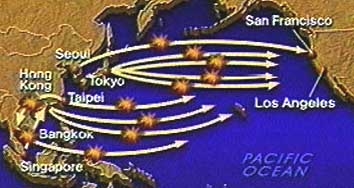
Map of planned Bojinka routes
Clinton administration continues to stonewall investigations into US connections to Iraq
- January: Court testimony proves that the CIA, under Director William Gates, knowingly provided Iraq with military weapons, ammo, and vehicles of non-US origin. Much of this information is revealed in the testimony of Reagan-Bush national security aide Howard Teicher; the Clinton administration chooses to classify the Teicher testimony and attack Teicher's credibility. (US/Iraq Relations Timeline, Consortium News)
Senate committee clears Clinton of Whitewater improprieties
- January 5: The Senate Banking Committee issues its report on its investigation of Whitewater. It finds no illegal actions or improprieties on the part of the Clintons. (Washington Post)
- January 10: Speaker of the House Newt Gingrich fires newly hired House historian Christina Jeffrey after the media discloses her history of racist and anti-Semitic writings. Jeffrey, an associate professor at Kennesaw State College where Gingrich once taught, objected to a 1986 course on the Holocaust because it failed to include the viewpoints of the Nazis and the Ku Klux Klan. "It's just appalling," says House member Barney Frank. "He ought to get rid of her. This is outrageous." Jeffrey says in response, "It wasn't the kind of thing I would have said if I had known it was going to be in the New York Times." Of the course, designed for teachers seeking extension of their certifications, Jeffrey wrote, "It is a paradoxical and strange aspect of this program and the methods used to change the thinking of students is the same that Hitler and Goebbels used to propagandize the German people. This re-education method was perfected by Chairman Mao and now is being foisted on American children under the guise of 'understanding history.'" It was heavily criticized by, among others, conservative critic Phyllis Schlafly, who asked the Education Department to reject the grant application and accused the program of "psychological manipulation, induced behavioral change and privacy-invading treatment." Jeffrey said she was chosen for the evaluation because "they assumed I would oppose that, because I was at Troy (State University in Alabama) which had a conservative reputation. I didn't know anything about the Holocaust." "Calling for equal time to present Hitler's point of view is outrageous and bizarre," says Rabbi Marvin Hier, dean and founder of the Simon Wiesenthal Center in Los Angeles. "To come out against the program on the ground that the Nazis were not given their due, if we used that standard on all educational grants, we'd probably have to cut out all grants." (New York Times/University of Pennsylvania, Al Franken)
Anti-abortion violence escalates
- January 21: While the headlines are dominated by stories of a gunman firing on abortion clinics in Massachusetts and Virginia, statistics from the Bureau of Alcohol, Tobacco, and Firearms (ATF) show that abortion providers and proponents have been the victims of a long and well-organized campaign of terror and violence since at least 1983. The tally of violence over the past 12 years includes 123 cases of arson and 37 bombings in 33 states, and more than 1,500 cases of stalking, assault, sabotage and burglary. "We have seen a consistent pattern, acknowledging the fact that people are willing to go to any means for their cause," says Ralph Ostrowski, chief of ATF's arson and explosives division. "In the past we would have acts of violence directed at property. Now we see acts of violence directed at people." Though almost all of the larger anti-abortion organizations deny condoning or tolerating violence, facts and evidence continue to show that the opposite is true. Operation Rescue's Flip Benson even accuses those in the pro-abortion community of faking attacks on clinics and says that he has evidence proving his allegations, evidence that no one will ever see. Anti-abortion organizers have rejected calls that they tone down their rhetoric of routinely branding abortion providers and supporters as "murderers" and "baby killers." Benham says he sees no connection between angry rhetoric and violent action: "This whole thing isn't about violence. It's all about silence -- silencing the Christian message. That's what they want," Benham says of abortion rights leaders. "They screech and scream about us crying fire in a crowded theater. And I agree it is wrong, unless there is a fire. If there's a fire in that theater, we better call it that. Our inflammatory rhetoric is only revealing a far more inflammatory truth."
- Much of the violence perpetuated by anti-abortion protesters targets clinics that do not devote the bulk of their time to providing abortions, but to routine women's reproductive health care and providing family counseling. Phone calls to a dozen clinics targeted by the violence found that six of them did not even provide abortion services.
- The experience of the Women's Pavilion Clinic in South Bend, Indiana, is typical. In recent years someone has hacked holes in the roof with an axe, shot out the windows, and sent repeated death threats to gynecologist Ulrich Klopfer, according to clinic director Marni Greening. Meanwhile, protesters from a group called Lambs of Christ have regularly barricaded the doors and blockaded the driveway, unfazed by repeated arrests. On Mother's Day, 1993, someone flooded the clinic with water and butyric acid, creating a foul stench that rendered the clinic uninhabitable for nearly eight weeks. A week ago, Klopfer was shot at on his way home from work.
- Owners of the Hillcrest Clinic in Norfolk, Virginia, where John Salvi allegedly fired about 23 shots, sustained $250,000 worth of damage in an arson case in 1984 and another $1,000 in damage in a bombing the next year. Staff members there have stopped commenting about attacks. At the Planned Parenthood clinic in Lancaster, Pennsylvania, clinic director Nancy Osgood remembers a 3 AM phone call in September 1993 when she rushed to the clinic in time to see the brick building smoldering, gutted by fire. The Lancaster facility does not perform abortions, although other Planned Parenthood clinics do. No suspects have been arrested in that arson, although national abortion rights groups offered a $100,000 reward for tips on this and other crimes. "Finally we have national leadership talking about this being domestic terrorism. We've said that for years," Osgood says. So far, the most expensive damage has been done to the offices of Family Planning Associates of Bakersfield, California, where arson did $1.4 million in damages. Arson and firebombings remain a favorite methodology of violence against abortion clinics and providers.
- Although the problem of domestic terrorism against abortion providers has been an issue for years, it was only after the Clinton administration took office that the Justice Department and FBI were instructed to take the crimes seriously. A federal task force of officials with the ATF, FBI, US marshals and lawyers from the Justice Department's criminal and civil divisions was created in 1993, and stepped up its efforts after Paul Hill shot to death two people at a Pensacola, Florida, clinic in July 1994. Authorities are focusing on whether there is a national conspiracy, although evidence to support this contention is limited. Some of the incidents match the description of tactics in "The Army of God" manual that law enforcement officers found buried in the yard of Rochelle Shannon, an Oregon activist convicted of shooting Wichita doctor George Tiller, and awaiting trial on eight counts of arson at clinics in several states. "Annihilating abortuaries is our purest form of worship," the manual says. It gives explicit instructions for home-brewing plastic explosives, fashioning detonators, deactivating alarm systems, and cutting phone, gas and water lines. The butyric acid attack on the Women's Pavilion in South Bend precisely matches tactics described in the manual. After the recent shootings in Massachusetts, in which two clinic receptionists were killed and five people wounded, the Justice Department ordered federal officials to record every threat against clinics and their staffs, and began to enforce the civil provisions of the Freedom of Access to Clinic Entrances (FACE) law. Enacted last year, the law makes it a federal crime to physically block access to clinics, damage their property or injure, interfere with or intimidate their staff or patients. Last week a federal judge in Kansas City used the civil provisions of the FACE law to issue a temporary restraining order against Regina Rene Dinwiddie for threatening and intimidating staff and clients at the Planned Parenthood of Greater Kansas City clinic. Antiabortion protesters say the law is being used to limit their freedom of speech. But federal officials are beginning to crack down on the death threats that have become increasingly common. There were about 400 death threats and bomb threats logged in 1994 alone.
- The extremists remain undeterred. In January of this year, four Long Island clinics were targeted with signs that read, "Danger: This is a War Zone. People are being killed here like in Boston. You risk injury or death if you are caught on or near these premises." Clinic staff members are targeted at their homes, as well Carolyn Izard, a nurse and clinic director at Little Rock Family Planning Services in Arkansas, says she arrived home one day to find her neighborhood was papered with fliers calling her a "death camp worker." Izard remembers that "[i]t backfired on them. I got calls from neighbors that told me that they supported me 100 percent and they were furious that this kind of brochure was left on their doors for their children to see." Little Rock clinic doctor Curtis Stover says he's seen a dramatic and disturbing change in the manner and actions of abortion protesters over the years. "Before, all they would do is quietly carry placards around and not do much," Stover said. Now, "every other sentence is full of the word 'murder.' Patients come in and they yell at them not to murder their babies. I've had picketers tell me I was going to die by a certain date." (Washington Post)
- January 24: Lynne Cheney, the former head of the National Endowment for the Humanities, writes an astounding op-ed for the Wall Street Journal entitled "Kill My Old Agency, Please." In it, she excoriates her former agency as a bastion of tax-wasting "cultural elites" who do not deserve funding in a time where "cutbacks in funding for many groups, including welfare mothers and farmers," are increasingly necessary due to Reagan-era deficits. The NEH receives a relatively paltry stipend of $177 million a year, hardly enough to touch the massive $180 billion-plus deficits; just a month before, the Senate had doled out billions in pork to the Pentagon that the Defense Deparment hadn't even requested. And one advocacy group showed that the NEH, the National Endowment for the Arts, and the Institute for Museum Services together generate over $36 billion in annual revenue and support 1.3 million jobs.
- But Cheney isn't interested in such facts. She is grinding the political "culture wars" axe for the benefit of the right wing. "It was shocking to those of us who were left behind," recalls one NEH staffer who had worked with Cheney. When she left the agency in December 1992, she wrote how her proudest achievement had been in "actively expanding the mandate of the Endowment" and how it was "an honor" for her to have worked with "the fine men and women of the National Endowment for the Humanities." Little at the NEH had changed, but Cheney's political agenda was now uppermost, and her former colleagues now worried about their jobs and the continued existence of their agency.
- The op-ed is merely a well-orchestrated first strike; Cheney testifies the same day before the House Interior Appropriations Subcommittee. The new House Republican leadership has arranged for Cheney to testify as part of a showy hearing on eliminating the NEH and the National Endowment for the Arts. "The American people deserive to understand why their money supports artists who submerge a crucifix in urine," she rails, referring to an infamous photograph by artist Andres Serrano entitled "Piss Christ." While Serrano's image is undoubtedly controversial, and offensive to many, Serrano had not obtained a grant from either the NEH or the NEA, but from a museum who had given part of its own NEA grant to Serrano. The agency had nothing to do with the Serrano piece. Similarly, Cheney's attacks on the political intolerance in academia are just as factually challenged. "Political correctness was real, but it was not limited to the left, which was her view," recalls John Hammer, director of the National Humanities Alliance.
- Cheney paints a horrific, and wildly inaccurate, picture of the NEH as an agency bent on brainwashing American children into despising their country. "Many academics and artists now see their purpose not as revealing truth or beauty, but as achieving social and political transformation," she thunders. "It's easy enough for grant recipients to toss objectivity to the winds since the post-modern view is that objectivity is an illusion -- one that the white male power structure uses to advance its interests." Former NEH chairman Bill Bennett echoes Cheney's arguments. But the argument fails, in large part because actor Charlton Heston, a favorite of the right wing and not yet plagued by the Alzheimer's disease that will distort his later public statements, testifies against them. Heston argues that the NEH grants are essential, and the Republicans split in their allegiances. Constituents from around the country whose communities had put NEH grants to good use also lobbied their congressmen to continue funding the agency.
- Thwarted in her efforts to remake America's literary, artistic, and cultural communities into a homogeneous right-wing bloc, Cheney retires temporarily from politics, continuing her work at the American Enterprise Institute, writing books, and arguing politics on CNN's Crossfire while she privately yearns for the position of Secretary of Education, a position she had coveted since the early 1990s. She knew she could not take a Cabinet position under Bush while her husband was Secretary of Defense, and she knew she would never be considered for any governmental position under Bill Clinton. And her husband's 2000 selection as George W. Bush's vice president will smother her political ambitions. Instead, she will begin alternating writing political polemics and children's books, and will take upon herself, when the Bush-Cheney ticket wins in 2000, the title of "first grandmother." (Lou Dubose and Jake Bernstein)
- January 29: The Starr investigation leaks to the Washington Post that it is investigating whether the Clinton gubernatorial campaign in Arkansas gave illegal funds to black ministers. Never mind that Starr's investigation had no legal brief to investigate Clinton's campaign finances from his governor's campaign, and never mind that Starr and his investigators found no proof whatsoever of the allegations, the insinuations were trumpeted all over the press...this time with the added spice of racial politics. (Washington Post/James Carville)
"Homosexuals want to come into churches and disrupt church services and throw blood all around and try to give people AIDS and spit in the face of ministers." -- Pat Robertson, The 700 Club, January 18, quoted by Brandi Mills
February 1995
- February: Speaker of the House Newt Gingrich shocks members of the National Restaurant Association by informing them that a federal shelter in Denver has 120 beds and costs $8.8 million a year to operate, while a similar-sized, private shelter in the same area costs only $320,000 a year to operate and saves more lives in the process. Audience members gasp. In reality, there is no such federal shelter in Denver. What Gingrich is apparently referring to is Arapahoe House, Colorado's largest alcohol and drug treatment facility, which operates multiple clinics and 16 school-based counseling programs at a total cost of $11 million, $4.3 million of that in federal grants. The private clinic Gingrich is referring to is a small homeless shelter which offers some drug counseling, but no formal treatment or detoxification programs. Gingrich uses the lie as anecdotal evidence of "how totally different our vision of the world is from the welfare state.... 25 times as much money to ruin lives. This is why we don't believe the big-spending theory of what liberal compassion is." Gingrich's slanders aside, programs such as the highly successful Arapahoe House have been proven to save $7 in medical expenses, crime, and lost productivity for every $1 spent. Far from "ruining" lives, these programs save lives. (Al Franken)
- February 9: Jim McDougal, owner of failed S&L Madison Guaranty, agrees to testify against the Clintons in the ongoing Whitewater investigation. McDougal is debilitated by a stroke and severe manic-depression, and changes his testimony time and again. Independent counsel Kenneth Starr "cherry-picks" McDougal's testimony, choosing the material most damning to the Clintons and dismissing the contradictory testimony. (CNN, H.R. Clinton)
March 1995
CIA-sponsored attempt to overthrow Saddam Hussein fails, mostly due to lies and incompetence of Ahmad Chalabi
- March: The Iraqi National Congress, a dissident group largely funded by CIA money and led by the charismatic, corrupt Ahmad Chalabi, conducts a disastrous attempt to overthrow Saddam Hussein. Chalabi's plan is to use his small, northern-based militia to foment uprisings in the largely Kurdish cities of Basra, Mosul, and Kirkuk, and, counting on massive defections from Hussein's military, supplant Hussein with himself. Hussein's government quickly learns of the planned insurrection; CIA official Robert Baer tells Chalabi that the CIA will not support the mission now that its secrecy had been blown. Chalabi insists that the assault be carried out anyway, but most of the Kurdish insurgents who are to form the bulk of the strike forces never show up, no one defects from Hussein's military, and the "revolt" founders. "There was nothing there," says the CIA's Bob Baer, who is station chief in the single CIA outpost in northern Iraq. "No one moved except one Kurdish leader acting on his own -- three days too late. Nothing happened." As far as Chalabi's promised recruits from Iraq's military, "Chalabi didn't deliver a single lieutenant, let alone a colonel or a general." Baer gives Chalabi credit for trying, but says "he was bluffing -- he thought it was better to bluff and try to win. But he was forced to play bridge with no trump cards. He always thought it was a psychological war, and that if Clinton would stand up and say, 'It's time for the guy to go,' people would do it." By late 1996 the Iraqi Army will drive Chalabi's operation almost completely out of Iraq; over 130 members of Chalabi's INC will be executed by Hussein's forces.
- Chalabi himself is found to be living the high life on CIA funds in northern Iraq and in London; when CIA agent John Maguire, Robert Baer's successor in Iraq, demands an accounting of Chalabi's expenditures in January 1996, Chalabi accuses Maguire of being impossible to deal with and of "thinking like an Arab." Maguire in turn tells Chalabi that if he ever sees him walking down the street in London, he will swerve his car onto the sidewalk and mow Chalabi down. "It was an ugly meeting," Maguire later recalls. Maguire is also wary of Chalabi's close connections to Iran. Chalabi has a house there as well as in Iraq and in London, and the INC even has a liason office in tehran. While the INC and tehran share a common goal of overthrowing Hussein, the CIA is aware of meetings between senior Chalabi aide Aras Habib and officers of Iranian intelligence, MOIS. Habib had received "tasking" instructions from MOIS, and, worse, informing MOIS of the identities of CIA agents and assets in Iraq, and of US plans in the region. Baer has already noted that Habib had used CIA safe houses in northern Iraq for his meetings with the Iranians. Both Baer and Maguire believe that Habib is a full-blown agent of MOIS, and they have their suspicions about Chalabi as well.
- Though INC leaders repeatedly charge Chalabi with mismanagement, self-aggrandizement, and corruption, he manages to stay in power even after his sponsors in the State Department and the CIA wash their hands of him. He will cut ties with Clinton officials and cultivate a relationship with US conservatives and neoconservatives, a relationship which will eventually bear fruit. Apparently his American conservative and neocon backers either refuse to believe the detailed connections between Chalabi's INC and Iran, or don't care that their favorite Iraqi is suspected of being an Iranian spy. Former Speaker of the House Newt Gingrich finds Chalabi's cause useful to use in bashing Clinton's foreign policy. And neocon intellectuals and policy wonks Paul Wolfowitz and Richard Perle (who had earned the nickname "Prince of Darkness" during his term as Reagan's assistant secretary of defense), along with their fellows at the neocon American Enterprise Institute, embrace Chalabi. Another AEI fellow, Dick Cheney, is also enamoured of Chalabi. Chalabi and the AEI neoconservatives manage to convince Clinton to sign the Chalabi-supported Iraq Liberation Act of 1998, which gives the overthrow of Saddam Hussein as a primary goal of the US.
- In 2001, the Bush administration packs the administration with AEI fellows and Chalabi supporters, including Wolfowitz, Perle, Douglas Feith, David Wurmser (who called Chalabi a "mentor"), and William Luti at Defense; Lewis Libby and John Hannah in Cheney's office, and others. All of these will look to Chalabi as the neocon savior of Iraq, the man they believe can succeed Hussein and bring Iraq into the fold. "Chalabi's past exploits and failures didn't matter," write Michael Isikoff and David Corn in 2006. "He had seduced the neoconservatives, and his previous trouble with the CIA was even a selling point among these national security intellectuals, who had long suspected the agency of being timid and too conventional." Chalabi and the Bush neocons will attempt to woo the CIA, including one memorable dinner at a lavish Washington restaurant with Chalabi and CIA senior official A.B. Krongard, which ends on a sour note when Chalabi attempts to pay the bill and has his credit card rejected. Wolfowitz later accuses the unconvinced Krongard of attempting to "undermine the president" by refusing to accept Chalabi.) (New Yorker, New Yorker/Global Policy, Seymour Hersh, Michael Isikoff and David Corn)
- March: Kenneth Starr's OIC invites Susan McDougal to come to Little Rock to meet with their attorneys. She writes that far from being unwilling to cooperate, she is actually looking forward to meeting with the OIC lawyers and clear up the "false statements and ridiculous rumors" circulating about Whitewater. Instead, she is greeted by a statement that the OIC has a foot-high stack of documents proving she has committed a number of crimes while at Madison Guaranty. "I had come in thinking that I was going to answer a few questions," she recalls, "and was now being told that I was a target of the investigation." The OIC refuses to let her attorney examine the documents, saying that they're not here to talk about potential criminal actions, they want to know if she is willing to make a proffer and what information she can give. Her attorney informs her that a proffer is a written statement outlining what she will testify to, usually in return for a grant of immunity from prosecution. "It immediately occurred to me," she writes, "that under this system, there was no obvious way to prevent a guilty person from simply telling grandiose lies against another person -- one who might well be innocent -- in order to save his own skin." Her attorney offers to have her testify to everything she knows after a grant of full immunity. The OIC counters with an offer of "global immunity," a veiled reference to the Mehta case. McDougal angrily turns them down, and the demands begin: "We want to know about the Clintons' role in Whitewater." The OIC is not pleased that McDougal says she knows of no illegal doings by the Clintons, and continues to threaten her with criminal prosecution. "[OIC attorney Steve] Lerman was a real pro: he managed to phrase things in a way that accomplished two things. First, he expressed a clear message: if I gave the OIC something on the Clintons, I would have no fear of criminal charges. Yet he did this in an oblique enough way that Starr and his staff could later indignantly assert that no one had ever made such an offer. But everyone on both sides of the table knew exactly what was going on." The meeting is adjourned without McDougal being asked a single question. Later that year, the OIC will ask McDougal to fly to Little Rock again to provide handwriting samples, supervised by two FBI agents. She will provide handwriting samples for three hours while in agony (she suffers from spinal scoliosis that causes pain and numbness in her arm). After she is allowed to stop, one of the agents will accuse her of deliberately trying to disguise her handwriting. Her attorney will suggest that she offer to tell the OIC about her problems with the handwriting samples, and offer to redo the samples provided that the FBI videotape the entire encounter. The OIC will reject the offer. A year later, the two FBI agents testifiy that she purposefully tried to deceive them. (Susan McDougal)
April 1995
- April: As noted in the March entry, Ahmad Chalabi's INC is all but routed from northern, Kurd-controlled Iraq, when one of the Kurdish factions within the INC invites Saddam Hussein's troops into Kurdistan, to crush a rival INC faction allied with Chalabi. 40,000 Iraqi soldiers and 300 tanks crosses into Kurdish territory, a flagrant violation of US restrictions. The US fails to react promptly to the incursion, and Hussein's forces capture, torture, and kill thousands of Chalabi's supporters. The US eventually evacuates 7,000 supporters. Chalabi aide Francis Brooke, a former public relations and marketing specialist for the Rendon Group, helps Chalabi carry out his revenge against the slow-footed US government through the American media, by helping ABC plan and produce a documentary sharply critical of the CIA's mistakes in northern Iraq. Already disenchanted with the corrupt Chalabi, and inflamed by the documentary, the CIA cuts off most of his funding, leading Chalabi to look for new financial and political supporters, this time in the rightist extremes of the Republican Party. This decision to reach out to America's neoconservatives will fundamentally reshape American and Middle Eastern history for a generation or more. (New Yorker, New Yorker/Global Policy)
- April 9: London's Sunday Telegraph prints an article by Ambrose Evans-Pritchard that alleges the Clintons deliberately falsified both the time and the place of Vince Foster's death. The story, given to Evans-Pritchard by state troopers Larry Patterson and Roger Perry under the auspices of Larry Nichols, a young woman named Helen Dickey phoned the governor's mansion in Little Rock at 6 pm on July 20, 1993 to tell governor Jim Guy Tucker of Foster's death. Perry had taken the call. Since the Park Police had not informed the Secret Service of the discovery of Foster's body until 8:20 pm, it's obvious, says Evans-Pritchard, that someone in the White House had known of the suicide well before the police informed the White House. Dickey, who was, according to the story, hysterical and crying, also tells Perry that Foster shot himself in his car in the White House parking lot. Perry says that lawyer Lynn Davis, whom Perry called later that evening, can corroborate his tale; Davis had helped negotiate the payments from Chicago financier Roger Smith to Patterson and Perry. Evans-Pritchard doesn't wonder why neither Nichols, Patterson, nor Perry had mentioned Dickey's phone call to either American Spectator reporter David Brock or Los Angeles Times reporter William Rempel when the two had written sensational articles about the circumstances surrounding Foster's death a year before. Evans-Pritchard writes, "Dickey, a former nanny to Chelsea Clinton, is a member of the tight-knit 'Arkansas Group.' She refused to answer queries about the alleged call to the Governor's Mansion.... If the White House received an early warning about Foster's death, why would it have been covered up? One explanation is that a tip-off would have provided a window of time for pre-emptive moves."
- A few days later, the Western Journalism Center, a Richard Mellon Scaife-supported outfit in California, pays to have Evans-Pritchard's entire article reprinted in a full-page advertisement in the Washington Times. The ad also urges readers to buy a videotape produced by Citizens for Honest Government titled Unanswered: The Death of Vincent Foster by "award-winning journalist Christopher Ruddy." (Ruddy is a cub reporter paid by Scaife to write scurrilous and factless smear articles about the Clintons; he will go on to head the Scaife-supported Internet "news" site NewsMax.com.) The video itself is a compilation of largely irrelevant questions not asked by investigators produced mainly to slam the Fiske investigation of a year before. On June 15, Scaife's Pittsburgh Tribune-Review publishes an article by Ruddy repeating and embellishing the troopers' story about Dickey's phone call. Already conspiracy Web sites are popping up almost daily on the Internet; inevitably, the mainstream media can't resist the siren call. The New York Post's John Crudele takes it upon himself to give Senator Alfonse D'Amato, whose Senate investigations of Whitewater are flagging, some advice on pepping up the proceedings: "Perry telling his story, followed by [Arkansas first lady] Betty Tucker confirming it, followed by Helen Dickey explaining the call, would make a great closing act to an otherwise tedious melodrama."
- D'Amato vows to investigate the Foster case himself in an interview on September 13. He announces plans to subpoena Dickey, and echoing the House's Newt Gingrich, uses Ruddy's own ballistic interpretation to tell listeners that it was impossible for the gun to have been found in Foster's hand after firing -- therefore Foster was murdered. D'Amato's investigation is derailed when the White House releases a sworn statement from Dickey saying that she indeed phoned Little Rock with news of the suicide -- at 10 pm, not 6. Nor had she said anything about the White House parking lot. In response, Kenneth Starr's OIC sends investigators to Fort Marcy Park, the site of the suicide, with metal detectors for a third time to hunt for the elusive bullet that killed Foster. Like so many other Clinton conspiracy theories, this one eventually fizzles, but not before doing more damage to Clinton's credibility and providing ammunition and motivation to his enemies -- and the press. (Joe Conason and Gene Lyons)
- April 11: After Iraq provides the second "Full, Final and Complete" disclosures of its prohibited biological and chemical weapons programs, IAEA reports to the UN that it is confident that Iraq's nuclear program components have been identified and destroyed. A third disclosure will be made on August 1 concerning Iraq's nuclear weapons capabilities. (UN/Electric Venom)
- April 15: The UN-sponsored "Food for Oil" program begins in Iraq, though it will not be fully implemented until late 1996. The program will eventually provide about $100 per year for the average Iraqi. (CCR, FactMonster, MidEast Web, UN/Iraqwatch/Electric Venom)
- April 17: The Nation prints an exhaustive analysis by journalist Allan Nairn tracing the links between US administrations and Guatemalan Army death squads that go far beyond the revelations that have hit the media. Recent reports that the CIA employed a Guatemalan colonel who ordered two murders have caused a wave of shock and outrage, but the story goes far deeper. ClA operatives work inside a Guatemalan Army unit that maintains a network of torture centers and has killed thousands of Guatemalan civilians.
- The G-2, headquartered on the fourth floor of the Guatemalan National Palace, has, since at least the 1960s, been advised, trained, armed and equipped by US undercover agents. Working out of the US Embassy and living in safehouses and hotels, these agents work through an elite group of Guatemalan officers who are secretly paid by the CIA and who have been implicated personally in numerous political crimes and assassinations. This secret G-2 / CIA collaboration has been described by Guatemalan and US operatives and confirmed, in various aspects, by three former Guatemalan heads of state, and are confirmed by the account given in a March 28 interview with Colonel Julio Roberto Alpirez, the CIA-paid Guatemalan G-2 officer who has been implicated in the murders of Guatemalan guerrilla leader Efrain Bamaca Velasquez and a US citizen, Michael DeVine.
- CIA agent Randy Capister, who works closely with G-2, has been involved in similar operations with the army of neighboring El Salvador. Another, weapons expert known Joe Jacarino, has operated throughout the Caribbean, and has accompanied G-2 units on missions into rural zones. Jacarino's presence in the embassy is confirmed by David Wright, a former embassy intelligence employee who calls Jacarino a "military liaison." Colonel George Hooker, the US Defense Intelligence Agency chief in Guatemala from 1985 to 1989, says he also knew Jacarino, though he says Jacarino was not with the DlA. When asked whether Jacarino was with the CIA he replied, "I'm not at liberty to say." Alpirez has denied any involvement in the deaths of Bamaca and DeVine, and says he has never been paid by the CIA. He does, however, go into detail about how the CIA advises and assists the G-2. He praises the CIA for "professionalism" and close rapport with Guatemalan officers. He said that agency operatives often come to Guatemala on temporary duty, during which they train G-2 men and provide "advice and technical assistance." He describes attending CIA sessions at G-2 bases on "contra-subversion" tactics and "how to manage the factors of power" to "fortify democracy." He said the CIA men were on call to respond to G-2 questions, and that the G-2 often consulted the agency on how to deal with "political problems." Alpirez said he was not authorized to give specifics on the technical assistance, nor would he name the Americans the G-2 worked with, though he said they were "very good friends."
- Other officials, though, say that at least during the mid 1980s G-2 officers were paid by Jack McCavitt, then CIA station chief, and that the "technical assistance" includes communications gear, computers and special firearms, as well as collaborative use of CIA-owned helicopters that are flown out of the Piper hangar at the La Aurora civilian air port and from a separate US air facility. Through what Amnesty International has called "a government program of political murder," the Guatemalan Army has, since 1978, killed more than 110,000 civilians. The G-2 and a smaller, affiliated unit called the Archivo have long been openly known in Guatemala as the brain of the terror state. With a contingent of more than 2,000 agents and with sub-units in the local army bases. the G-2-under orders of the army high command-coordinates the torture. assassination and disappearance of dissidents. "If the G-2 wants to kill you, they kill you," says former army chief of staff General Benedicto Lucas Garcia. "They send one of their trucks with a hit squad and that's it." Current and former G-2 agents describe a program of surveillance backed by a web of torture centers and clandestine body dumps. In 1986, then-army Chief of Staff General Hector Gramajo Morales, a US protege, said that the G-2 maintains files on and watches "anyone who is an opponent of the Guatemalan state in any realm." A former G-2 agent says that the base he worked at in Huehuetenango maintained its own crematorium and "processed" abductees by chopping off limbs, singeing flesh and administering electric shocks. At least three of the recent G-2 chiefs have been paid by the CIA. One of them, General Edgar Godoy Gaitan, a former army Chief of Staff, has been accused in court by the victim's family of being one of the prime "intellectual authors" of the 1990 murder of the noted Guatemalan anthropologist Myrna Mack Chang. Another, Colonel Otto Perez Molina, who now runs the Presidential General Staff and oversees the Archivo, was in charge in 1994, when, according to the Archbishop's human rights office, there was evidence of General Staff involvement in the assassination of Judge Edgar Ramiro Elias Ogaldez. The third, General Francisco Ortega Menaldo, who now works in Washington as general staff director at the Pentagon-backed Inter-American Defense Board, was G-2 chief in the late 1980s during a series of assassinations of students, peasants and human rights activists. These crimes are examples of a vast, systemic pattern; likewise, these men are only cogs in a large US government apparatus.
- Colonel Hooker, the former DIA chief for Guatemala, says, "It would be an embarrassing situation if you ever had a roll call of everybody in the Guatemalan Army who ever collected a CIA paycheck." Hooker says the agency payroll is so large that it encompasses most of the army's top decision-makers. When told that his friend, General Mario Enriquez Morales, the current Defense Minister, had reacted to the Alpirez scandal by saying publicly that it was "disloyal" and "shameful" for officers to take CIA money, Hooker bursts out laughing and exclaims: "Good! Good answer, Mario! I'd hate to think how many guys were on that payroll. It's a perfectly normal thing." Other top commanders paid by the CIA include General Roberto Matta Galvez, former army Chief of Staff, head of the Presidential General Staff and commander of massacres in the El Quiche department; and General Gramajo, Defense Minister during the armed forces' abduction, rape and torture of Dianna Ortiz, an American nun. Gramajo also managed the early 1980s highland massacres. Colonel Hooker says he once brought Gramajo on a ten-day tour of the United States to speak at US military bases and confer with the US Army Chief of Staff. Nairn concludes, "The killing of defenseless people has been state policy in Guatemala for thirty years. The question is not whether the US government has known -- it is obviously aware of its own actions. It is why, with overt and covert aid, it has helped commit the army's murders." (Nation/Third World Traveler)
White supremacist Timothy McVeigh bombs a federal building in Oklahoma, killing 168
- April 19: A fertilizer bomb concealed in a rental truck explodes outside the Murrah Federal Building in Oklahoma City, Oklahoma, killing 168 people. Speculation is rampant that Islamic terrorists set the bomb, until Timothy McVeigh, a 27-year old Gulf War veteran and survivalist, is arrested for the crime. He and partner Terry Nichols are convicted of setting off the bomb. McVeigh is an extreme right-wing libertarian, strongly anti-government, with many connections to the right-wing survivalist movement throughout the country, including the radical Christian Identity movement Elohim City. He is an avid fan of the infamous book The Turner Diaries, which describes a number of terrorist acts similar to that he perpetrated. On June 11, 2001, after refusing continued court appeals, McVeigh is executed by lethal injection; Nichols will be sentenced to life in prison. Richard Clarke writes in his 2004 book Against All Odds that McVeigh co-conspirator Terry Nichols may have been taught by al-Qaeda operatives how to detonate buildings. Intelligence reports place Nichols in the Phillippines on the same days as al-Qaeda operative Ramzi Yousef, and, as Clarke notes, "we do know that Nichols's bombs did not work before his Philippines stay and were deadly when he returned." (The day that McVeigh bombed the Murrah building, he wears a T-shirt with the famous Thomas Jefferson quote, "The tree of liberty must be refreshed from time to time with the blood of patriots and tyrants." On the front of the shirt is a portrait of Abraham Lincoln with the slogan, "sic semper tyrannis" -- "thus ever to tyrants." McVeigh ordered his shirt from the catalog of the Southern confederate and white supremacist magazine Southern Partisan. After McVeigh's arrest, the magazine sells out of the shirts.)
- Several months later, members of the Northern Michigan Regional Militia assert that McVeigh was a patsy for the CIA, who actually blew up the Murrah Building in retaliation for the Tokyo subway gas attack, which was carried out by US Army agents retaliating against Japanese bugging of White House communications. Like other conspiracy theories of this ilk, the story does not bear investigating, but is worth mentioning as an illustration of how far right-wing interests will stretch the credulity of their listeners in the attempt to blame incidents like the bombing on the Clinton administration. (CNN, Slate, Wikipedia, Sarah Vowell, Al Franken)
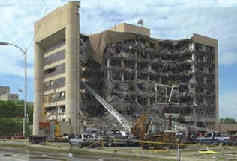
Murrah building after the explosion
- April 22: Kenneth Starr interviews Bill Clinton as part of his investigation of Whitewater. (Washington Post, H.R. Clinton)
- April 24: Shortly after the Murrah building bombing and the identification of McVeigh as the bomber, Clinton delivers a speech denouncing the incendiary excesses of some right-wing radio talk show hosts. He criticizes the innumerable calls to violence from these radio pundits, who name as targets of their hatred "liberal fascists," blacks, gays, environmentalists, immigrants, "feminazis," and others. Clinton tells his audience, "In this country we cherish and guard the right of free spech. We know we love it when we put up with people saying things we absolutely deplore. And we must always be willing to defend their right to say things we deplore to the ultimate degree. But we hear so many loud and angry voices in America today whose sole goal seems to be to try to keep some people as paranoid as possible, and the rest of us all torn up and upset with each other. They spread hate. They leave the impression that, by their words, that violence is acceptable. You ought to see -- I'm sure you are now seeing the reports of some things that are regularly said over the airwaves in America today." Clinton recommends that their hate speech be challenged and refuted: "The exercise of their freedom of speech makes our silence all the more unforgivable. So exercise yours, my fellow Americans. Our country, our future, our way of life is at stake. I never want to look into the faces of another set of family members like I saw yesterday -- and you can help stop it."
- The reaction from the right is apoplectic. Ignoring the fact that Clinton has merely called on the general public to speak out against such hate speech, the right-wing pundits accuse Clinton of wanting to round them up and jail them. Clinton has kicked off "a post-Oklahoma Kristallnacht," thunders an editorial in the Bircherite New Standard, featuring quotes from Mein Kampf and accusing Clinton of trying to become an American Hitler. GOP presidential candidate Lamar Alexander calls Clinton's remarks "inflammatory statements. Republican senator Don Nickles accuses Clinton of "trampl[ing] on domestic liberties." Right-wing shock jock Armstrong Williams, who in 2005 will be found to have accepted money from the Bush administration to write editorials in favor of its domestic policies, says Clinton is "trying to label everyone who disagrees with his policies as extremists." Neocon pundit Charles Krauthammer says Clinton is "closing in...on the legitimate speech of the political opposition." "There is a huge difference between dissent and hate," says hatemeister Rush Limbaugh.
- Some of what Clinton is objecting to includes the following. Limbaugh, no stranger to incitement to violence, told his audience on February 22, 1995, that large parts of the population of the American West were a breath away from rising up in violent revolution against "Washington bureaucrats...telling them what they can and dan't do with their land...." On August 26, 1994, G. Gordon Liddy, the Watergate criminal, tells his audience how to deal with ATF federal agents who come to their door: "They've got a big target on there, ATF. Don't shoot at that because they've got a vest on underneath that. Head shots, head shots.... Kill the sons of b*tches." Liddy will keep up his murderous exhortations even after the Oklahoma City bombings, telling his audience that during a family gathering on the previous Independence Day, he had used stick figures of the Clintons for target practice. "Thought it might improve my aim," he cracked. (After the bombing, Liddy will instruct his audience that the head is too small of a target, so instead shoot for the body, and if that doesn't work, for the groin: "You'll probably get a femoral artery and you'll knock them down at any rate.") Of course, it is these right-wing hatemongerers who want to silence political dissent, at the point of a gun if need be. "[I]t is they who have confused dissent with hate," writes Mark Crispin Miller, "and who were always trying, and are trying now, to have the left (i.e. all who disagree with them) 'permanently disqualified and silent.'" (Mark Crispin Miller)
- April 24: The most powerful bomb yet from the "Unabomber" kills Gilbert Murray, the president of the California Forestry Association, a timber lobbying group. The package is addressed to Murray's predecessor. The same day, the New York Times receives a second letter from the supposed anarchist group "FC," promising that the bombings will stop if the newspaper. or another publication such as Newsweek or Time, agrees to print a lengthy article written by the "group." The bomber also demands that three yearly articles be printed to rebut criticism and clarify material in the original treatise. In September, the Washington Post will print the treatise in an eight-page supplement. (Unabomber Timeline)
- April 29: Satirist Al Franken politely confronts Speaker of the House Newt Gingrich at the White House Correspondants Dinner, telling Gingrich, "I believe in the market system. I think that, at the end of the day, what you're doing will lead to a situation where the states are forced to compete with each other to drive out their poor by lowering benefits." Gingrich replies, "What's wrong with that?" (Al Franken)
June 1995
- June: Monica Lewinsky accepts a position as an unpaid intern in the White House. She will later receive a paid job there, answering correspondence. A 21-year old graduate of Lewis and Clark University in Portland, Oregon, Lewinsky quickly makes her presence known as an attractive, flirtatious young lady who will eventually catch the eye of Bill Clinton. Their affair will begin, by all accounts, in November 1995 and end in May 1997; the entire 1996 presidential campaign will play out without a single reporter finding out about Clinton and Lewinsky. (Executive Intelligence Review, Clinton Impeachment Timeline, Marvin Kalb)
- June 7: Kenneth Starr's Office of the Independent Counsel indicts Arkansas governor Jim Guy Tucker, Tucker's attorney, and Tucker's former business partner on three counts of conspiracy to commit bankruptcy and fraud. The charges, stemming from Tucker's 1987 acquisition of cable TV companies in Florida and Texas, are curious in several ways: the charges do not accuse Tucker and his associates of actually committing any crimes, but merely conspiring to do so; nor do the charges have any connection to Bill Clinton, Whitewater, or the collapse of Jim McDougal's Madison Guaranty S &L. Arkansas insiders know that, though Tucker and Clinton are fellow Democrats, they are more enemies than friends, with Tucker frequently having engaged Clinton in political battles and usually losing. Tucker had won the governorship in 1994 against longtime Republican enemy Sheffield Nelson, who had based his campaign on assertions that Tucker was about to be indicted, a campaign aided by a sensational, and mostly false, four-part "investigative series" published by the Arkansas Democrat-Gazette. Though lacking in evidence, the series makes a number of allegations about the Clintons (provided clandestinely by convicted embezzler David Hale, though the series does not inform its readers of its source).
- The characteristically combative Tucker accuses Starr of blatant partisanship, and blasts the "sickening mendacity" of Starr, whom he says publicly promised to respect the integrity of his office and the dignity of those he is investigating, but privately leaks damaging and often false information to Republican members of Congress and to sympathetic ears in the press. The OIC responds to Tucker's criticisms by indicting Tucker on additional charges on August 17 (see below), as part of a 21-count set of charges of bank fraud leveled against Tucker, Jim McDougal, and McDougal's wife Susan. Tucker publicly lambasts Starr and the OIC, accusing the organization of a "politically driven...taxpayer-funded invasion of Arkansas." He finds it incredible that in both sets of indictments, Starr did not have the courtesy to tell him or his lawyers; Tucker learned of both sets of charges through reporters. "If you throw enough mud at somebody," he says, "maybe you can make something stick. You file enough indictments against a whole bunch of people, some who are in fact culpable, and include someone who is not, maybe you'll get one of those to stick." He refuses to heed Sheffield Nelson's calls for him to resign the governorship of Arkansas. (Joe Conason and Gene Lyons)
- June 18: The Senate Banking Committee opens hearings on Whitewater. The committee is chaired by Republican senator Alfonse D'Amato, who is an unusual choice to lead the Senate charge in pursuit of Clinton due to D'Amato's own history of ethics violations; a still-secret 1991 ethics probe of D'Amato let him off with a reprimand only after literally dozens of his friends took the Fifth Amendment in testimony before Congress. D'Amato, who has always exercised his perogative to keep his own ethics violations records sealed (in his 1995 autobiography, he will falsely claim that his records are "classified"), will relentlessly demand "full disclosure" from the Clintons. His myriad of ethical violations and his self-acknowledged ties to Mafia figures, including using Mafia figures to extort campaign contributions, provoke laughter among many of his New York constituents when he takes the floor to denounce the Clintons for moral and ethical lapses.
- The hearings begin with a made-for-TV flourish, with Republican senator Frank Murkowski upending Vince Foster's empty briefcase -- provided by Starr -- to dramatize the Republicans' claim that the circumstances of the discovery of Foster's suicide note, found several days after his suicide, were suspicious. (Robert Fiske's declaration that Foster's death was nothing more than a suicide, with no sinister connections to the Clintons, has been long forgotten; Starr's own investigation into Foster's death has been dragging on for a year with no results.) D'Amato's hearings settle into a predictable pattern: one Republican after another levels sensational charges against the Clintons, with no evidence to bolster their denunciations; the national media repeats and embellishes the charges, adding predictions of yet more sensational charges to come. Committee members routinely fail to elicit any supporting testimony from the witnesses they call, then either harangue the witnesses and accuse them of lying, or merely pretend that their points have indeed been proven and move on to the next set of groundless accusations. The media charge is led by the New York Times's editorial doyen, William Safire: in January 1996, he will accuse Hillary Clinton of being a "congenital liar" who will soon be indicted for perjury. (No such indictment is ever handed down.) Protests by Senate Democrats such as Christopher Dodd are ignored or mocked.
- D'Amato focuses heavily on the role Vince Foster supposedly played in concealing Whitewater evidence. Though there was no Whitewater investigation before his death, according to the committee, Foster spent an inordinate amount of time and effort removing incriminating evidence from his office and the Clintons' legal files. The committee also accuses a raft of White House aides of removing evidence from Foster's office after his suicide, as part of a scheme supposedly coordinated by Hillary Clinton. Safire writes on July 24 that White House lawyer Steve Neuwirth "told congressional investigators that Susan Thomases, Hillary's confidante, told [White House counsel Bernard] Nussbaum that the Clintons wanted the search [of Foster's office] strictly limited." On August 3, Neuwirth appears in front of the committee and proves that Safire is a liar. Neuwirth never told investigators any such thing, and submits his deposition to those investigators as proof. He shows that nothing he did was at the behest of either Hillary Clinton or Susan Thomases. Neither Safire nor Susan Schmidt, who echoed Safire's accusations in a Washington Post article, ever retract their statements, but continue leveling new and equally groundless accusations.
- The August 9 testimony of Bernard Nussbaum is quite telling. He attacks the very premise of the committee's investigations, and testifies that, in the days following Foster's suicide, when many in the White House are grief-stricken and unsure what to do, he took it upon himself to sort through Foster's office in the presence of Park Police officers and Justice Department officials. He missed finding Foster's suicide note, which was shoved down and torn into shreds at the bottom of Foster's briefcase. Nussbaum then slams the committee for unfairly, and without a piece of evidence, attempting to link the tragedy of Foster's suicide and the above-board and properly supervised transfer of files from Foster's office to Nussbaum and other attorneys to the Whitewater investigation, which had not even begun when Foster killed himself. "Linking these two events is illogical, unwarranted and unfair," Nussbaum says. "They are totally unrelated." Nussbaum's challenge rocks the committee Republicans back on their heels; Senator Richard Shelby responds by calling Nussbaum's guardianship of the files "the fox guarding the henhouse" and accusing Nussbaum of trying to deceive and mislead the American people. Nussbaum is resolute in his defiance of the committee.
- GOP senator Lauch Faircloth finds an easier target in Maggie Williams, Hillary Clinton's chief of staff. He reduces her to tears by accusing her of lying about forgetting the details of a phone conversation she had two years earlier with Mrs. Clinton, brushing off the explanation that Williams has dozens of conversations with the First Lady every day. Faircloth accuses Williams of removing a stack of files from Foster's office hours after the lawyer's body was found in Fort Marcy Park; he dismisses the findings of two separate lie detector tests, one administered by Starr's office, that confirm Williams is telling the truth when she denies touching the files until weeks later, after investigators finished with Foster's office. Faircloth, who has David Bossie of Citizens United whispering in his ear during the interrogations, is equally peremptory to Susan Thomases, a campaign aide and close friend of Mrs. Clinton. He questions her about her phone calls with the First Lady and Nussbaum on the day after Foster's death, and openly mocks her protestations that the calls were nothing more than expressions of grief, consolations, and discussions of funeral arrangements. Thomases insists she never discussed the search of Foster's office with the First Lady, and knew nothing of Mrs. Clinton's opinion on the subject. (Joe Conason and Gene Lyons)
- June 26: The preliminary findings of the RTC investigation into Whitewater, informally called the "Pillsbury Report" after its chief architects, the law firm Pillsbury, Madison, & Sutro, are made public. The report completely exonerates the Clintons from any wrongdoings regarding Whitewater and finds that the couple actually lost money on the deal. It demolishes the two years' worth of claims made by the Arkansas Project, the galaxy of Clinton-haters working to besmirch his character, and the claims by press organs such as the New York Times. (Interestingly enough, the law firm was initially criticized by the White House because of its strong ties to Reagan-era officials, such ties now lending the report even more veracity.) So it comes as no surprise that the mainstream media virtually ignores the report. The Wall Street Journal, whose news department is, unlike the editorial department, quite non-partisan, publishes a clear and detailed account of the Pillsbury Report, but virtually no other media outlets, particular the Times and the Washington Post, choose to report the story until weeks later, and then in vague, back-page reports that serve to bury the report. In fact, Times reporters Jeff Gerth, who has a track record of writing false and misleading articles on Whitewater, and Stephen Engelberg mislead their readers by trumpeting the false allegation that the Clintons had failed to pay "their half of Whitewater's losses." The fact that the report finds that the Clintons were bamboozled out of at least $43,000 is a fact Gerth and Engelberg find unworthy of mention. A similar treatment of the Pillsbury Report's supplemental findings, released in December 1995, receives the same treatment from the press, though one might conclude that their findings, supporting their previous showings that the Clintons were passive investors in a land deal that went bad because of the criminal malfeasance of real estate mogul Jim McDougal, are worth reporting as well. In January 1996, the final conclusions of the Pillsbury Report will be issued, again to deafening silence from the media (aside from one well-written article by Neil Lewis of the Times). For the vast majority of the country, the Pillsbury Report may as well have not been conducted; the majority of news media outlets will still insist that there is evidence of the Clintons' culpability, and Kenneth Starr, the independent counsel investigating Whitewater, will ignore the report in its entirety. In another interesting media treatment, the Times's Stephen Labaton will write an article in June 1996 that, buried underneath paragraphs' worth of material about Kenneth Starr dismissing the Pillsbury Report, tells the readers that the "report found no evidence that President Clinton, Hillary Rodham Clinton or others had been involved in improperly diverting money from an ailing savings association into the Whitewater land venture." But readers were less likely to read that assertion than the one Labaton includes near the beginning of the story, which says that Starr's dismissal of the report constitutes "a tantalizing new clue about the direction of [Starr's] secretive inquiry." (Columbia Journalism Review, Joe Conason and Gene Lyons)
"Far from being the result of muckraking reporting by a vigorous and independent press, what 'the Clinton scandals' amount to is possibly the most politically charged case of journalistic malpractice in recent American history. [The news media] invented [Whitewater]." -- Gene Lyons, September 1996
- June 27: A bomb threat supposedly from the "Unabomber" against an airliner at LA International prompts an airport security crackdown across the nation. Days later, in a letter to the New York Times, the bomber claims that the threat was just a ruse. (Unabomber Timeline)
Summer 1995
- Summer: Caryn Mann and her son Josh inhabit a trailer on land owned by Hot Springs bait shop proprietor Parker Dozhier. Mann, who has dated Dozhier since early 1994, has become increasingly disenchanted by Dozhier's activities, particularly his cooperation with the Clinton-targeting Arkansas Project. She is disturbed by Dozhier's overt racism, his fascination with guns, and his connections to extremist right-wing political groups. She finds his obsession with Bill Clinton troubling, and though at first she believes Dozhier's diatribes against Clinton, as time goes on, she finds him less and less convincing. Watching Dozhier and his buddies strut around their property armed to the teeth and proclaiming that their lives are in constant danger provides Mann with sour amusement. Journal columnist Morrison's public condemnations of Clinton in Little Rock restaurants leads her to question his integrity. And Mann wonders why Hale is constantly bringing stacks of documents to Dozhier to be copied in his office. "Once Kenneth Starr started dealing with Hale, he was dealing with P.D. whether he know it or not," Mann says in 1998. "I don't think they were sure of Starr until after Hale and Dozhier went to Washington to talk with Ted Olson. After they came back, there was a whole new level of confidence in what was going to happen." Mann continues, "Did Starr's people know [of Dozhier's connection to Hale]? They called there for him. The independent counsel's office would call and ask for David Hale. How could they not know?" Mann says that one night in the summer of 1995, she watches Dozhier and Hale make copies of a stack of documents from Starr's OIC. Afterward, Dozhier brags that "they had what they needed to bring Hillary down." Soon afterwards, stories begin appearing in the national press predicting that Hillary Clinton would be indicted by Starr. During the 1999 trial of Susan McDougal, evidence is presented showing that Deputy Prosecutor Hickman Ewing drafted an indictment of Mrs. Clinton in the summer of 1995, an indictment that was never presented. By this point, the relationship between Dozhier and Mann is rapidly deteriorating. She cannot tolerate Dozhier's bullying of her son Josh, and by the time she decides that she and her son have to leave, she says she is badly frightened, not only for herself and her son, but because of Dozhier's political activities: what he is doing, Mann believes, is tantamount to "treason." (Joe Conason and Gene Lyons)
July 1995
- July - August: Low-level White House secretary Linda Tripp, a holdover from the Bush administration, testifies before Kenneth Starr's investigative committee about the events surrounding the death of Vince Foster, events of which she knows nothing, but provides plenty of rightist-based speculation damaging to Clinton. (Executive Intelligence Review, Joe Conason and Gene Lyons)
- July: During the televised Senate hearings, Susan McDougal, who watches them, becomes irate with the parade of politicians talking about how "complicated" the Whitewater situation is. More than once she shouts at the TV, "It was a stupid land deal that went bad! You know damn well that there is nothing complicated about it!" The biggest theory among the Senate inquisitors and the media is that through Whitewater, her former husband Jim McDougal was buying access to the Clintons so that he could influence them in the future. This theory is disproven by the fact that McDougal already had plenty of access; before the deal was signed, the McDougals and the Clintons saw each other regularly, and shortly after, he worked in the governor's office and had "24-hour access." Another theory, that the Whitewater account was being used to launder donations to Clinton for his campaigns, is easily disproven by the fact that no money went through the account for the simple reason that none of the parcels ever sold. One politician and pundit after another claimed that the reason no "smoking gun" of evidence could be found is because, in Susan's words, "the Clinton White House were masters of covering up evidence. They could accuse Clinton or anyone of an illegal act and then, when no evidence could be found, simply nod knowingly at the camera and complain about how the facts were being covered up. Joseph McCarthy would have been proud." (Susan McDougal)
- Early July: The American Spectator publishes a cover story that makes sensational allegations against Bill Clinton in relation to his supposed connections to a cocaine ring operating out of Mena, Arkansas. The source is L.D. Brown, a former Arkansas state trooper whom the Spectator reporters have previously found ridiculously unreliable (see previous entries), but the article is written by magazine editor Robert Tyrrell, who has clung to his desire to believe Brown's tale for nearly a year. Brown says that in the spring of 1984, then-Governor Clinton helped him apply for a job with the CIA, and, five months later, before he had even been hired, a clandestine CIA operative whom he later identifies as former Bush national security advisor Donald Gregg, brings him into the CIA as a "moonlighting" operative. Brown says his first assignment is to accompany CIA pilot Barry Seal on a C-123K transport plane to Central America, where he helped deliver M-16 rifles to the Nicaraguan Contras and load "duffel bags" loaded with cocaine aboard the transport. Upon his arrival at the Mena airfield, Seal gives Brown $2500 and a kilo of cocaine for his troubles. According to Brown, he was stunned by the gift and the realization that he had helped transport cocaine into the country, and immediately confronted Clinton, who languidly waved it off, saying "That's [Dan] Lasater's deal," naming a campaign contributor who had later been convicted of cocaine possession and for a time employed Clinton's brother Roger. Brown also says that he subsequently accompanied Clinton to several parties where the entertainment had consisted of "young girls" and "plenty of cocaine." Brown's story dovetails perfectly with Larry Nichols's stories as related in the 1994 videotape The Clinton Chronicles. (A year later, Brown will embellish his story, now saying that CIA operative Felix Rodriguez enlisted Brown to assassinate one of the Mena accomplices in Puerto Vallarta, Mexico; the accomplice was Terry Reed, the author of a smear book against Clinton who himself tells lurid tales of the Mena drug ring and Clinton's involvement. Brown says his conscience wouldn't allow him to shoot Reed, and he refused to see Rodriguez ever again.)
- To Tyrrell's consternation, the mainstream media largely ignores his article, with the significant exception of the Wall Street Journal editorial page, who uses the article as a basis for an editorial calling for a Congressional investigation. The response to the editorial is gratifying: the Republican chairman of the House Banking Committee, Jim Leach, requests immediate information from the National Security Agency about "money laundering in Arkansas in the late 1980s," including drug money, covert activities by the US government or private individuals, and any connection with Barry Seal. Leach admits he is following up unsubstantiated reports from the press and the Internet. A month later, Leach says during a C-SPAN interview that he himself intends to investigate the Mena allegations, even though they are outside the scope of his already-scheduled investigation into Whitewater. Leach will spend a year and a chunk of his committee's budget on his Mena investigation, but will never hold public hearings. Leach will, however, make a number of tantalizing, if groundless, leaks to the press that result in several similarly tantalizing but groundless stories, mostly in the New York Post.
- Tyrrell continues to pursue the Mena story even as his staff becomes increasingly disenchanted with the entire mess. He hires a private detective, Tom Golden, to find out more, and Golden will spend two years and a large amount of Tyrrell's money nosing around Arkansas and the Southeast. Golden manages to find out a good bit of information from sources close to the Kenneth Starr investigation of Whitewater, and passes at least $5000 of Tyrrell's money to Brown, but after two years admits that he can find nothing credible about the Mena allegations and no connections whatsoever to Clinton.
- In 1996, CNN reporter John Camp will find the truth about Brown's allegations. He investigates Brown's tale of flying from Mena to Central America on October 23, 1984, with Barry Seal in Seal's C-123 transport plane. Seal, as it turns out, did indeed fly the C-123 that day -- with Camp, not Brown, as a passenger. Camp, then working for Baton Rouge's WBRZ-TV, was making a film documentary about Seal's career as smuggler-turned-DEA informant, and spent the entire day with Seal shooting film and conducting interviews. Seal and his C-123 never flew into Central America that day, never took L.D. Brown aboard, never delivered guns to the Contras, and never picked up cocaine. (Joe Conason and Gene Lyons)
GOP-directed Senate investigation of Whitewater opens
- July 18: The Senate Special Whitewater Committee opens hearings on Whitewater and Vince Foster's death. The committee chairman, Republican Alphonse D'Amato, is also the chairman of former senator Bob Dole's Presidential campaign. The media fails to point out this serious conflict of interest. (Washington Post)
"We're going to keep building the party until we're hunting Democrats with dogs." -- Republican Senator Phil Gramm, August 1995, quoted in Mother Jones/Wikipedia
August 1995
Susan McDougal indicted on Whitewater-related charges
- August: Susan McDougal is indicted on eight criminal charges related to the David Hale -- Madison Guaranty loan. For some unexplained reason, she is given the court papers by Chris Vlasto, a news producer for ABC. (Vlasto will later be shown to have cooperated with the Starr investigators, both in gathering information against Clinton and in disseminating negative material on ABC.) She would stand trial in conjunction with Jim McDougal and Arkansas Governor Jim Guy Tucker, both indicted on charges by the OIC as well. She decides to allow herself to be tried alongside her ex-husband in an attempt to help him get off on some or all of the 19 charges filed against him. Her lawyers strongly disagree with her decision. (Susan McDougal)
- August 1: NATO launches a series of air strikes against Bosnian Serbs shelling Sarajevo. (NATO and UN History)
- August 5: With the House Banking Committee's hearings on Whitewater scheduled for August 8, Republican staffers make a preemptive leak to the press in preparation for their attack on Clinton. Anticipating a Democratic attack on the motives of RTC investigator L. Jean Lewis, who has obsessively, and fruitlessly, investigated Whitewater and Madison Guaranty for two years, they release documents that themselves shatter Lewis's almost-nonexistent credibility, attempting to take the wind out of the Democrats' sails. Interestingly, almost no major US news outlets pick up the story, though the Associated Press releases it worldwide. (Joe Conason and Gene Lyons)
- August 7-20: Under pressure, Iraq releases documents that prove it had begun an unsuccessful program to develop a nuclear bomb. (MidEast Web)
- August 8: Saddam Hussein's son-in-law, General Kamel, together with his brother and their families, seek asylum in Jordan. Iraq claims that Kamel unilaterally hid important information from UNSCOM and IAEA which was just discovered. Iraq withdraws its third Full, Final and Complete disclosure, issued a week earlier. (UN/Iraqwatch/Electric Venom)
- August 8: Republican Jim Leach, the chairman of the House Banking Committee, opens hearings over Whitewater. Leach's star witness is L. Jean Lewis, the RTC investigator who has obsessively investigated Whitewater and Madison Guaranty for two years. Leach trumpets Lewis as a "heroic" government employee who "refused to be cowed by the power structure." Led by press releases from Leach's office, reporter Jeff Gerth of the New York Times predicts, accurately, that Lewis will make, in the Times's words, sweeping charges of a conspiracy to "obstruct" her probe into Madison at the highest levels of the Clinton administration. When asked to name names, though, Lewis is unable to name a single person who interfered with her investigation. She also fails to provide any evidence that the Whitewater deal helped send Madison Guaranty into bankruptcy. Her entire evidence of "obstruction" consists of two delays, of one and two weeks respectively, by RTC and Justice Department officials reviewing her referrals.
- Lewis plays a tape she "inadvertently" made of a conversation between herself and April Breslaw, an RTC lawyer whom Lewis has accused of collusion with Clinton officials to cover up incriminating evidence concerning Whitewater. Unfortunately for her story, the tape proves that Lewis has badly misrepresented their conversation. Lewis says that Breslaw told her that "people at the top would like to be able to say Whitewater did not cause a loss to Madison;" Breslaw said nothing of the sort. What she did say was that if possible, the RTC would like to be left out of any high-stakes political investigation. Lewis also says that the tape provides definitive proof that Whitewater caused Madison's bankruptcy; the tape provides no such evidence. And it becomes clear during Lewis's testimony that she is unfamiliar with the RTC's "Pillsbury Report," available to her for four months. To observers, Lewis's testimony is unreliable, self-contradictory, and essentially worthless.
- However, readers of the Times or the Washington Post got a different story. The Post tells its readers that Lewis "gave a detailed description of how [her] investigation...was thwarted by [RTC] and Justice Department officials after Bill Clinton was elected president." Only the Wall Street Journal characterizes Lewis as not "wholly credible...[and] ready to draw the most incriminating conclusions from ambiguous circumstances."
- On August 10, Leach reverses himself and allows Breslaw to testify. She expresses her shock at her treatment by Lewis and Leach, and shows categorically that she did not have the authority to interfere with any RTC probe into Whitewater. Leach apologizes to Breslaw for slandering her character in the hearings without first hearing her side; however, he continues to refuse to allow Arkansas securities commissioner Beverly Bassett Schaffer, another official accused of collusion with the Clintons, to testify. On August 10, the committee officially reports that it can find no improprieties on the part of the Clintons. Again, Republicans ignore the report and continue to call for more investigations. (Washington Post, Joe Conason and Gene Lyons)
- August 17: Iraq admits a far more extensive biological program than previously admitted, including the filling of biological warfare agents into 166 bombs and 25 Al Hussein missile warheads. Iraq also admits to having produced missiles with greater range than previously reported. Iraq provides UNSCOM and IAEA with over 500,000 pages of documents which had been secreted on a chicken farm, purportedly owned by General Kamel. The documents include information concerning production of VX and nuclear weapons. (UN/Electric Venom)
Arkansas governor Jim Guy Tucker indicted on Whitewater-related charges
- August 17: Arkansas governor Jim Guy Tucker, a friend of the Clintons, and James and Susan McDougal are charged with bank fraud in loans related to McDougal's failed Madison Guaranty S&L. These are the second set of indictments handed down by Kenneth Starr's OIC, which some call into question because Starr had no brief to investigate or indict anyone outside of the Whitewater investigation; the Tucker indictments have no connection with anything Starr is authorized to pursue. It later becomes obvious that the Tucker indictments are an attempt to "flip" Tucker into testifying against Clinton, a strategy that has little impact because Tucker knows nothing incriminating. (See the entry for June 7, 1995.) (Washington Post, Joe Conason and Gene Lyons)
- August 20: Israeli Prime Minister Rabin transfers a number of areas of governmental responsibility in the West Bank and the Gaza Strip to Palestinian authorities. Right-wing elements in Israel are growing more and more alarmed at the idea of Palestinian autonomy and control of the occupied territories. (Dan Cohn-Sherbok)
September 1995
- September: The Petroconsultants' Petroleum Exploration and Production Database releases a report that predicts world oil production will peak in the year 2000 and begin a steady, irreversible decline afterwards. By 2025 it predicts that oil production will be half that of 2000, and oil prices will rise steeply and irrevocably after 2000. (American Assembler)
- September: Iraq's default on Bush-era loans proves to have cost the American taxpayer $2 billion. (US/Iraq Relations Timeline)
BCCI investigation concludes
- September: The Justice Department issues its "final report" on the BCCI scandal. Very little is revealed, and the mountain of evidence linking the Bush administration to illegal arms trafficking with Iraq is not included. (CCR)
- September 5: US District Court Judge Henry Woods dismisses Kenneth Starr's three-count indictment of Arkansas governor Jim Guy Tucker on the grounds that Starr exceeded his lawful authority as the special prosecutor in charge of the federal Whitewater investigation (see above). Woods notes, accurately, that the indictments have no relation to Starr's purview -- no connection to Whitewater nor to Bill or Hillary Clinton, nor to anyone's relationships with Jim or Susan McDougal. Woods answers the rhetorical question posed in Starr's brief thusly: "What is the harm if the Independent Counsel handles this investigation rather than the Attorney General? What difference does it make? It makes a great deal of difference if the stature and the Supreme Court plainly state that only matters related to the Independent Counsel's original prosecutorial jurisdiction are to be handled by him.... To gloss over and shortcut the requirements of criminal statutes is the first step towards tyranny." He quotes former Supreme Court Justice Robert Jackson, who in turn was quoted by Justice Antonin Scalia in Scalia's famous dissent opposing the independent counsel statute when it was used against Reagan and Bush during the Iran-Contra affair, noting that it is completely against the spirit of American jurisprudence for a prosecutor to "pick...the man and them search...the law books, or put...investigators to work, to pin some offense on him."
- The staff of the American Spectator, not to mention the operatives of the Arkansas Project, are outraged. Many of the Project members remember Woods as a feisty opponent of former governor Orval Faubus's attempts to preserve segregation, and more directly as an outspoken foe of white supremacist and Project mentor Jim Johnson. The Washington Times prints a lengthy op-ed written by Johnson himself, attacking Woods as a corrupt Clinton crony and smearing him with tales of escaping his own indictment in the 1950s over misusing highway funds. The allegations of cronyism stem from Woods's appointment of Hillary Clinton to a panel overseeing the integration of the Little Rock school system, an issue that drove Johnson into apoplectic rages of racist bile-spewing and accusations of Communist complicity (in 1991, Woods had voided the so-called "Johnson Amendment" to the state constitution, which directed the state to ignore the Supreme Court's 1956 Brown v. Board decision desegregating the nation's public schools). As for the allegations of fund misuse, those had been disproven 40 years earlier. Johnson also resurrects similarly baseless charges gleaned from the ever-fertile Clinton Chronicles videotape, including lies about Woods's criminal connections to Stephens Inc. Though Warren Stephens writes yet more letters to the Washington Times protesting the besmirching of his company and his family, he knows the letters will be ignored -- after all, Times editor Wesley Pruden is a native of Little Rock whose father was a member of Johnson's White Citizens Council.
- Though Johnson's smear editorial is nothing more than lies and savage character attacks, it is extensively quoted and extended by the Arkansas Democrat-Gazette as well as in the editorial pages of the Wall Street Journal, in columns by Journal writer Micah Morrison, himself an ad hoc member of the Arkansas Project. Parker Dozhier's notes show that Pruden has fed information about Woods to Morrison, information which he received during numerous meetings with Johnson. In addition, Dozhier, the Hot Springs bait shop owner whose lakeside resort serves as the informal headquarterss of the Project, faxes a blistering memo about Woods to Senator Lauch Faircloth, the extremist protege of Jesse Helms and one of the Senate's loudest voices for investigations against Clinton. Dozhier claims, with no evidence whatsoever, that Woods colluded with Clinton to "fix" the Tucker case in order to throw a monkey wrench into the Starr investigation. "Tucker is in the position of offering testimony [that] would send the President to prison," Dozhier claims. Dozhier's fax is rewarded by an immediate demand from Faircloth to examine fifteen years' worth of Woods's financial records. An outraged Woods summons all parties involved in the case to his chambers and informs him that such "a crude attempt to intimidate me" from Faircloth, who has "more than a passing interest in the Whitewater investigation," will not work. No one asks Woods to recuse himself.
- But the attack on Woods escalates. Johnson prints a second, even more vitriolic, editorial in the Washington Times accusing every single Democratically-appointed judge in Arkansas of being in cahoots with Clinton and Tucker. Starr responds by appealing Woods's dismissal of the original three charges against Tucker, asking the appellate court not only to reinstate the charges but to dismiss Woods from the case because of his "friendship" with Hillary Clinton and others in the "Arkansas political establishment." Starr admits that there is no connection between the Tucker indictments and the Clintons, but says that "information in the public domain" has created "an unmistakable appearance of bias by Judge Woods." Such tactics of using baseless accusations in the media to force the removal of a judge are almost unheard of, and serve to astonish and dismay many in America's legal community. (Joe Conason and Gene Lyons)
Packwood resignation
- September 7: Republican senator Bob Packwood resigns after weathering a blizzard of charges of sexual harassment and a Senate Ethics Committee recommendation that he be expelled. 29 women, including many congressional aides and interns, charge Packwood, the chairman of the Senate Finance Committee and one of the most powerful Republicans in the Senate, with various types of sexual harassment, including charges of groping, forced kissing, and propositioning them for sex. The Ethics Committee finds evidence supporting 17 of those claims. They also hold Packwood accountable for other charges, including using his influence to get a job for his wife, committing multiple campaign finance frauds, and altering his personal diary to help hide his misconduct. The Ethics Committee releases 10,000 documents and diary excerpts to illustrate the depth of Packwood's violations. However, despite the lengthy list of allegations against Packwood, the Justice Department refuses to pursue prosecution. When Packwood is asked on the CBS News program Face The Nation about his sexual misconduct later in the year, he will say, "In some cases, I was very frankly so drunk that I cannot remember the evening." A male intern who worked with Packwood in the 1970s, Tom Carson, says that according to Packwood's own tally, by the end of 1993 he had had "liasons" with 22 office staffers and 75 other women; Carson writes, "From my own memories of working in his office over two decades ago, I have no trouble believing that tally." Common Cause reporter Florence George Graves is primarily responsible for putting the decades-long story of Packwood's sexual predation together, and pursued the story even when major media outlets such as Vanity Fair refused to print her work. (The Oregonian, Packwood's state newspaper, failed to report the story even after one of its own reporters, Roberta Ulrich, had been groped by Packwood.) Finally, the Washington Post provided Graves with an outlet for her years of research and affidavits, though the Post bowed to pressure from Packwood not to run the story until after his successful 1994 bid for re-election (the story first ran on November 22, just days after Packwood's narrow victory over Democrat Les AuCoin). Graves says her inspiration to do the story came from the rafts of hypocrisy evident in the Anita Hill-Clarence Thomas hearings, when she witnessed lawmaker after lawmaker with their own sordid histories of sexual misconduct line up to impugn Hill and defend Thomas. As she began to track the story, she focused on Packwood as being one of the worst of the lot. Graves says she knows of many women who were also groped and harassed by Packwood, but who were afraid to come forward. One of Packwood's victims, Julie Williamson, says after Packwood's resignation, "The character flaw that I saw in Bob Packwood when he attacked me ran deeply through all his life. ...It is absolutely incredible to me that it took however many of us it took, who were considered nobodies from the hinterlands, to blow the whistle on Bob Packwood. So many people must have known and conspired and been part of all of it. It took those of us who were too naive to know that his power was too great to be challenged to challenge him." (CBS, Village Voice/Utne Reader, Common Cause/Find Articles, Castleton Communication)
- September 14: Dinesh D'Souza publishes his book The End of Racism, which argues that racial discrimination is valid and proper in modern America. D'Souza, an Indian immigrant who cut his teeth editing the racially explosive Dartmouth Review with Laura Ingraham and a fellow at the conservative American Enterprise Institute, argues that slavery was not racist, and that discrimination by landlords against African-Americans is rational because blacks are genetically violent, shiftless, and stupid. "What we need is a long-term strategy that holds the government to a rigid standard of race neutrality," he writes, "while allowing private actors to be free to discriminate as they wish. ...[I]ndividuals and companies would be allowed to discriminate in private transactions such as renting an apartment or hiring for a job." He urges the repeal of civil rights legislation as the first step towards a truly color-blind society, but discusses blacks in the most hateful of stereotypical terms, referring to such personality types as the "playful Sambo," the "sullen 'field n*gger,'" and the "dependable Mammy." He describes black ghetto streets as "irrigated with alcohol, urine, and blood." D'Souza's book, following on the heels of The Bell Curve, wins the general acclaim of the mainstream media, though most liberals and progressives find both books hateful and unacceptable. D'Souza sells far fewer copies than his predecessors Murray and Hernnstein sold of their Bell Curve, but both books are embraced by conservative politicians and pundits; Newt Gingrich will use the arguments of both books to bolster his agenda of dismantling the American welfare state and "racial entitlements." Embarassingly, two of the American Enterprise Institute's most prominent black members, Robert Woodson and Glenn Loury, resign their AEI fellowships in protest over D'Souza's book being so widely accepted by the AEI. Loury prints a damning critique of D'Souza's book, calling it "a defense of bigotry and prejudice...written in the language of blame and in the language of stereotypes." D'Souza will move on from the AEI to graze in the rich financial fields of the equally conservative Hoover Institute. (Joe Conason)
- September 19: The Washington Post prints the manifesto written by the "Unabomber" in an eight-page supplement. The publication of this treatise will be the ultimate downfall of the bomber, a former university professor and survivalist named Theodore Kaczynski; his family members will recognize his writing style and alert authorities. (Unabomber Timeline)
- September 22: Israel's Shimon Peres discusses the final aspects of Palestinian autonomy with the PLO's Yasser Arafat at a conference in Egypt. Shortly thereafter, Israeli Prime Minister Rabin signs the Oslo II peace accords, prompting outcries of treason by his right-wing opponents in Israel. The leader of the Likud party, Binyamin Netanyahu, condemns the entire proceedings, and accuses Rabin of betraying the concept of Eretz Israel. Nevertheless, the Israeli Knesset narrowly passes its acceptance of the accords. (Dan Cohn-Sherbok)
October 1995
- October: Republican Tom DeLay, the current House whip, finds himself immured in a scandal involving his brother Randy, who is a lobbyist for the giant Mexican cement company CEMEX. Randy DeLay has pressured Congress, with the help of his brother Tom, to kill a tariff that would cost CEMEX millions in contracts. In addition, Randy was a lobbyist for a group of highway interests while his brother was a member of the House Appropriations Committee's Subcommittee on Transportation. Though Randy DeLay insists that he drew a line between his work and his brother's position in the House, evidence shows that Tom DeLay broke the law time and again by cosigning letters on CEMEX's behalf, and even writing an editorial to the Houston Chronicle defending Mexican companies' dumping cheap cement on the American market. In 1996, Ralph Nader will announce that he has finally succeeded in getting a complaint before the House Ethics Committee, but no action will ever be taken. In June 1997, DeLay will say that he has banned his brother from lobbying in his office, and says that should put any ethical questions to rest. In 1998, DeLay will again be accused of improper behavior when a television pundit calls him "the bagman for the tobacco industry," referring to DeLay's practice of handing out checks on the floor of the House to Republican members from his ARMPAC, which is funded largely by the tobacco companies. DeLay will retaliate by condemning Democrats for their own fund-raising practices, and goes on to suggest that Democrats take money from people whose names are hard to pronounce and are therefore likely to be foreigners whose interests are inimical to those of the US's. Reminded that he has a large number of Asians in his district, DeLay will quickly apologize to Asian-Americans for his remarks, but no one else. (Hilton and Testa)
- October 11: UNSCOM reports that Iraq claims to have unilaterally destroyed banned items, knowing that UNSCOM can't verify their destruction, for the purpose of disguising caches of weapons they are forbidden to possess. Due to this deception, the Chairman does not believe UNSCOM can make any accurate claims on Iraq's disarmament status until re-evaluation of all prior UNSCOM reports and investigations. In November, after release of another Iraqi disclosure of its missile program, Jordan intercepts a large shipment of missile components headed for Iraq. Though Iraq denies any involvement with the shipment, it is subsequently discovered that the Hussein regime has been attempting to acquire guidance and control components for banned missiles. UNSCOM continues to report that Iraqi compliance is incomplete, and that information about some chemical and missile programs continues to be hidden. (UN/Iraqwatch/Electric Venom)
- October 21: Unocal signs a contract with Turkmenistan to pump $8 billion of natural gas through a $3 billion pipeline, to run from Turkmenistan, through Afghanistan, and into Pakistan. Unocal wins the contract over a more experienced Argentinian firm; Unocal consultant Henry Kissinger calls it "the triumph of hope over experience." Unocal will later withdraw from the deal in the face of bribery and influnce-peddling. (CCR, Salon)
False offer of al-Qaeda information from Sudan
- Late October: The government of Sudan offers the US intelligence agencies their extensive files on al-Qaeda and Osama bin Laden; the intelligence community refuses. One intelligence agent who claims to have seen the files said that the information was exhaustively detailed about bin Laden's colleagues, business transactions, and much more. Other, more thorough investigations have later shown that the Sudan offerings were of little substance. (CCR)
Dick Cheney's Halliburton Oil fined for doing business with terror sponsor Libya
- Late October: Halliburton Oil, based in Dallas, is fined almost $4 million for its dealings with Libya, a nation that sponsors terrorism and therefore is proscribed by US law. Halliburton, who has just named Dick Cheney their new CEO, pays the fine and continues to do business as usual in Libya. Halliburton is one of the US's oldest and most profitable oil companies. It has already been found guilty of selling proscribed technology to Iraq. In 2001 it will open new offices in Tehran, Iraq, doing business in that country in flagrant violation of the US Trading with the Enemy Act.
- How Cheney became the CEO of Halliburton is a story in itself. The official line involves a five-day fishing trip in Canada in early 1995, after Cheney had abandoned his hopes to run for the presidency in 1996. The story is that while Cheney slept in the fish lodge, the Halliburton executives on the trip began talking about their need for a new CEO. One of the executives, Tom Cruikshank, is a Cheney fan who had been agog at Cheney's heroic tales of running the Pentagon for George Bush, and had donated $1000 to Cheney's exploratory presidential committee. Someone in the party said that Cheney would make a fine CEO, and the deal was done before Cheney ever woke up.
- The reality is a bit more involved. As a former defense secretary, Cheney would be a real catch for Halliburton. Halliburton and its affiliate, Kellogg Brown & Root, have been a cornerstone of the military-industrial complex since the 1960s; Cheney could ensure that government contracts would continue to flow into the corporation. (During Cheney's five years as CEO, government-backed loans to Halliburton from the Export-Import Bank of the United States would grow from $100 million to $1.5 billion.) Brown & Root, as it was known, was one of the major corporate backers of the political career of Texan Lyndon Johnson, and helped Johnson steal a Senate race in 1948 (after a race marred by illegal contributions, Johnson won by 87 votes when an extra ballot box mysteriously appeared stuffed with Johnson ballots). Johnson would become known as the senator from Brown & Root. Halliburton and Brown & Root merged in 1963. By 1981, Halliburton's revenues, largely fueled by government contracts, soared. But the oil bust of the 1980s hit Halliburton hard, and the company was forced to eat huge deficits and downsize its employee pool into the 1990s. Cheney had helped steer a lucrative Army contract to Halliburton, helping the company's stock rise by 82%.
- Whether by luck or craft, Cheney found himself in an enviable position. He was not expected to be a brilliant business manager. "When we brought Cheney in, it really wasn't to run operations, it was to make the proper strategic decisions, and to establish relationships," Cruikshank will tell the New York Times. Cheney's contacts, both in Washington and the Middle East, would prove invaluable to Halliburton. (New York Times/Bernie Sanders, Online Journal, Wikipedia, Lou Dubose and Jake Bernstein)
Winter 1995
- Winter: American Spectator reporter David Brock interviews private investigator Rex Armistead over his assertions that he can prove Bill Clinton's ties to a cocaine ring operating out of the Mena, Arkansas airport (see 1994 for more information about Mena). Not only does Brock find Armistead completely unreliable, he learns that Spectator editor Robert Tyrrell not only plans to run with stories based on Armistead's claims, but that he plans on twisting the story to leave out evidence pinning the cocaine dealings on the CIA and Reagan-Bush officials, and instead implicate not only Clinton but Democratic senator John Kerry. Kerry has earned Tyrrell's ire because it was Kerry who, in 1986, first exposed the CIA's cocaine smuggling activities; Kerry is also running for re-election. Tyrrell plans stories smearing Kerry as having supported Communists in Central America and covered up drug dealing by the region's leftists. Armistead says he knows someone who can place Kerry and the president of Costa Rica together at a fishing resort that doubles as "a big drug transfer point." Brock decides privately to avoid Armistead, the Kerry story, and anything to do with the Clinton-smearing Arkansas Project. He worries that Tyrrell is obsessed with hanging the Mena story around Clinton's neck: "Bob never made a coherent case for any of this stuff," he later recalls. "If it would damage Clinton, that was the bottom line. Bob had no regard for the credibility of these sources." Armistead profits handsomely from his association with the Spectator and the Arkansas Project: by 1997, Armistead had collected over $375,000 in monthly fees and expenses. (Parker Dozhier, who runs the bait shop that serves as the informal headquarters of the Project, is, according to his former girlfriend Caryn Mann, incensed that Armistead is getting money he feels he, and not Armistead, deserves.)
- While the Spectator staff isn't buying Armistead's tale, other journalists are. Ambrose Evans-Pritchard, the London reporter for the Sunday Telegraph, and the Wall Street Journal's Micah Morrison have spent inordinate amounts of time hanging around Dozhier's bait shop, soaking up tales of Clinton's galaxy of perfidious acts and collecting leads and documents, some provided by Kenneth Starr's Office of the Independent Counsel. Information from Armistead will appear in Evans-Pritchard's book The Secret Life of Bill Clinton and in a number of Journal stories by Morrison. (Joe Conason and Gene Lyons)
November 1995
- November: The second round of Alfonse D'Amato's Senate Banking Committee hearings on Whitewater begin. D'Amato, who struck out in the first round, is determined to find something to pin on Clinton, and thus, knowingly or not, turns to he farrago of conspiracy theories advanced by the now-infamous Larry Nichols, of the Clinton Chronicles fame. He has already been embarrassed by trying to use stories from Nichols and the "Troopergate" troopers to "prove" that White House lawyer Vince Foster was murdered instead of killing himself, and he feels he has to find something. He begins by bringing earlier witnesses Maggie Williams and Susan Thomases back before the committee to once again explain the numerous phone calls they made to the Clintons and others in the White House in the days after Foster's death; he and his fellow Republicans feel that their explanations of sharing grief over the terrible news, weeping together, and trying to finalize funeral arrangements are lies to cover up something darker. "It's diffitult to believe," D'Amato tells one of the women, "[that] all of these calls were the result of touching, feeling, holding." (It is telling that D'Amato attempts to make their outpourings of grief sound like debauched phone sex.) GOP colleague Lauch Faircloth flatly accuses them of lying, and calls their testimony "an insult to this committee." Yet, aside from more vituperation, the grilling of Williams and Thomases produces nothing. The hearings wind on even more until November 29, when the committee's star witness, RTC investigator L. Jean Lewis, makes an appearance. (Joe Conason and Gene Lyons)
Israel's Yitzhak Rabin assassinated
- November 4: At a peace rally in Tel Aviv, Israeli Prime Minister Yitzhak Rabin is assassinated by a right-wing Israeli student, Yigal Amir, who is unhappy with Rabin's efforts to promote peace in the Middle East: according to Amir, Rabin wanted "to give our country to the Arabs." Rabin had previously served as Israel's Prime Minister, as well as Secretary of Defense and was re-elected to the prime minister's post in June 1992. He was a strong advocate for peace with Palestine, and an advocate for the creation of an independent Palestinian state. Over a million Israelis and representatives from over 80 countries attend Rabin's funeral; PLO leader Yasser Arafat wishes to attend, but does not, fearing his presence would be disruptive. Rabin's death is considered a tremendous setback for the entire Middle East peace process. Acting Prime Minister Shimon Peres says at Rabin's funeral, "You told me there are warnings of an assassination attempt at the large rally. We did not know who would strike. We did not imagine the harm would be so great. But we knew we must not fear death and we must not hesitate for peace." (Nobel e-Museum, H.R. Clinton, Dan Cohn-Sherbok)
- November 5: As part of the Senate Banking Committee's investigation into Whitewater, Republican committee members confront Clinton aide William Kennedy about a few pages of handwritten notes concerning a meeting between White House lawyers and Clinton's private counsel over how to handle the charges of criminal activities brought by embezzler David Hale. D'Amato, thundering about "cover-ups" and "smoking guns," demands to see the notes. The White House agrees, with the stipulation that they are not waiving their right to attorney-client privilege. D'Amato balks, and the situation remains unresolved for weeks, while the press fulminates about a "Constitutional crisis." D'Amato finally caves, and the White House turns over the notes. Predictably, the notes contain little of interest, mostly discussions of how to respond to media attacks. But on television, D'Amato charges that the phrase "Vacuum -- Rose Law Firm files" is evidence of a cover-up. Kennedy responds that the phrase "vacuum" means there is little information available. If D'Amato is right, and the word "vacuum" is used as a verb, then at least six lawyers, meeting for the first time, had launched a conspiracy to obstruct justice, taken notes on the conspiracy, and kept the notes in case they might be needed for an investigation into their criminal actions, an implausible scenario. A second entry also piques D'Amato's interest: "VF suicide -- David Hale investigation -- same day." Was the White House worried about a link between the Hale investigation and the Foster suicide? No, because the Hale investigation didn't even start until after Foster killed himself. Kennedy's note concerned the media's attempt to link the two, and how much of that attempt was caused by the erroneous assumption that the investigation took place before, not after, the suicide. Once again, the swirl of accusations and controversy in the hearings, and in the media, are proved without foundation. (Joe Conason and Gene Lyons)
- November 6: Starr officials inform the right-wing Washington Times that some of Starr's investigators believe that papers and perhaps a briefcase were "spirited away" from Vince Foster's death scene, or possibly taken from Foster's car, by shadowy Clinton operatives. Richard Mellon Scaife's "pet reporter" Christopher Ruddy will echo the same report two months later. The tale was, of course, untrue; the briefcase resided in the possession of Kenneth Starr, until, as James Carville notes, it was "tactlessly waved around like a bloody flag" by Republican senator Frank Murkowski during the GOP Senate hearings on Foster's death (see above). But it makes a good story and once again lights up the media like a pinball machine. (Washington Times/Pittsburgh Tribune-Review/James Carville)
- November 6: Starr officials leak to Insight magazine, an offshoot of the Washington Times, that they are "intrigued" by Bill Clinton's ties to Dan Lasater. Lasater is an Arkansas man tied to federal and state drug probes. The connection consisted of then-Governor Clinton's attempts to persuade the Arkansas legislature in 1986 to spend $30 million on a new police radio system then being marketed by Lasater. Starr's people are busy questioning state troopers about the "friendship" between Lasater and Clinton. As a media smear, the Lasater story is effective, particularly in associating Clinton with drugs, but the investigation finds no connections between the two men; the last time Clinton and Lasater spoke was in 1986, Lasater had only met Clinton a few times, and those were all in conjunction with his police radio system, and every lawmaker lobbied by Clinton agrees that Clinton's efforts were solely for the system and had nothing to do with Lasater personally. (Insight/CNN/James Carville)
- November 6-7: After Rabin's funeral, the Clintons, along with former Presidents Carter and Bush, Senator Bob Dole, Speaker of the House Newt Gingrich, and others, fly back to the US aboard Air Force One. Sleeping arrangements are limited, so several passengers, including Gingrich, have to sleep in their seats or on couches. Gingrich is insulted and resentful of not being given one of the beds (occupied by the Clintons and the two former presidents), and later admits this is one reason he is so motivated to challenge Clinton on budget issues. (H.R. Clinton)
- November 10: Nigerian human rights activist Ken Saro-Wiwa and eight colleagues are hanged by the Nigerian government after their refusal to stop speaking publicly about the staggering human-rights abuses perpetuated by the Nigerian government on its people, with the active complicity of US oil companies such as Chevron and Shell. Nigeria is a human-rights and environmental disaster, but it is a bonanza for Chevron and other US oil companies. Nigerian children grow up desperately poor, breathing toxic fumes from badly maintained oil facilities and dying in oil fires and explosions (a single such explosion killed 700 in October 2000). (Amy Goodman and David Goodman)
- November 10: Physician Hugh Short, an abortion provider in Ancaster, Ontario, is shot and wounded while watching television in his home. The unknown sniper fires shots into his second-floor bedroom, shattering his elbow. (Washington Post)
Newt Gingrich engineers shutdown of federal government
- November 13: Speaker of the House Newt Gingrich engineers the shutdown of the federal government by refusing to allow the passage of a stopgap measure to provide operating funds. Along with his personal resentments, he does this to try to force Clinton to sign a GOP-authored federal budget that Clinton finds repugnant and unacceptable. The government remains shut down for six days until an agreement is reached to pass a short-term funding bill, while Republican talk radio shows blast Clinton on a continual basis. On December 16, Gingrich again partially shuts down the government, this one lasting through most of January 1996. Clinton again refuses to sign the GOP budget. Alfonse D'Amato's Senate Banking Committee investigation of Whitewater is considered "essential" and continues to function during the shutdown, though services such as VA hospitals were closed to patients and most government employees were forced to spend Christmas without a paycheck. (H.R. Clinton, Joe Conason and Gene Lyons)
- November 13: Insight magazine, an adjunct of the conservative Washington Times, is given information by the Starr commission that "Bruce Lindsey, a Clinton aide and intimate friend of the First Lady, still is being scrutinized. There is a 50-50 chance that he will be prosecuted for banking and tax violations." Although not technically illegal, the "50-50" statement is tremendously misleading, since the Starr investigation never turns up any evidence of Lindsey's criminal misbehavior. (Insight/James Carville)
Clinton-Lewinsky affair
- November 15: Monica Lewinsky and Bill Clinton begin a sexual relationship, according to audio tapes made by Linda Tripp. Although there can be no justification for the affair, Clinton's tremendous lapse of judgment can be somewhat explained (though not excused) by the pressures on him at the time. He pondered an ultimatum given to him by Speaker of the House Newt Gingrich, who told Clinton to either sign the Republican-written budget bill as is or he would shut the government down. Clinton stood up to Gingrich, and on November 13, Gingrich carries out his threat (see below).
- Lewinsky remembers catching Clinton's eye during a departure ceremony in August. Part of a "rope line" of well-wishers, she remembers the two making "intense eye contact" that she found thrilling. On November 15, she wangles an invitation to a West Wing party for a White House aide; catching the president's eye when no one is looking, she lifts her jacket to show him the top of her thong panties. That evening, she is beckoned inside an office by Clinton, who speaks briefly with her before asking if he could kiss her. She breathlessly agrees, and a few minutes later the two are engaged in what she terms "heavy petting. She assures Clinton that she has been involved with a married man before and understands the conditions. Over the next two months their relationship continues with furtive moments stolen for more kissing and groping; Clinton will later swear that the "oral sex" component of their relationship did not begin until January 1997. For Lewinsky, the relationship was, according to her, pure puppy love, spiced with the thrill of being in an affair with the most powerful man in the world. Clinton's motivations are less clear, but it seems that for him, Lewinsky is a pressure release, someone with whom he can steal a few moments of illicit sexual thrills and put aside the pressures of his office for a short period of time, fondling one another and swapping stories of their childhood and telling each other jokes. Clinton will later testify that almost from the start, he knew he was making an extraordinarily reckless and foolhardy mistake, but lacked the willpower or the inclination, or both, to stop. He knew he should have never started the affair, or, failing that, ended it long before he finally did. "she's a good young woman with a good heart and a good mind," he later says. "But I knew the minute there was no longer any contact, she would talk about this. She would have to. She couldn't help it. It was part of her psyche. So I had put myself at risk." (Clinton Impeachment Timeline, Joe Conason and Gene Lyons)
- November 20: Starr sources leak the information that Starr "may seek to exhume the body of Vince Foster," the former Clinton aide who committed suicide, to conclusively determine the cause of Foster's death. This will, if true, mark "an about-face by Starr, who was about to conclude Foster killed himself." Apparently this leak is intended to fan the flames of suspicion against Clinton and take away some impact from the upcoming news that Starr will determine that, indeed, Foster committed suicide. True to form, the media feeds on the rumor that Foster will be exhumed, but barely mentions the fact that Starr clears Clinton of any wrongdoing in Foster's death. (Washington Times/James Carville)
- November 29: L. Jean Lewis testifies in front of Alfonse D'Amato's Senate Banking Committee on her knowledge of Whitewater. Lewis's incoherent and contradictory testimony at similar hearings in the House earlier in the year cast doubt on her ability to provide anything more than the innuendo and baseless allegations she gave before; to the Republicans' confusion, she opens her testimony by reciting almost word-for-word the same testimony she gave to Republican congressman James Leach's committee, claiming Democratic obstruction of her untiring efforts to reveal the crimes behind Whitewater and their connection to the Clinton "political machine." She says a two-week delay by US attorney Paula Casey in reviewing her criminal referrals against the Clintons -- referrals that were dismissed because of a patent lack of evidence -- is direct evidence of stonewalling and obstructionism. She repeats the same story about White House lawyer April Breslaw telling her that the White House expected the RTC to make the investigation into Madison Guaranty and Whitewater disappear, a story that was refuted by Lewis's own taped evidence of a conversation between her and Breslaw in the House. She demands to know why the Clintons themselves haven't testified, apparently unaware that the Clintons have both submitted depositions to the committee -- depositions that had been reported in the press in August 1995. Both Clintons had also testified under oath to Kenneth Starr's OIC.
- Lewis is amazingly ignorant of a number of pertinent facts about her own investigation. She didn't know, she testifies, that US attorney Chuck Banks had rejected her 1993 criminal referrals. She swears she knows nothing of the blizzard of faxes and telexes between the FBI and the Justice Department reviewing and dismissing her evidence of criminal wrongdoing, along with questioning her motives and her knowledge of the law. Again, these had all been discussed at length in articles by, among others, the Wall Street Journal and the Associated Press months before.
- This time, the committee Democrats have some surprises of their own. The Kansas City RTC office has long been weary of Lewis's machinations and her abuse of her position, which has dragged its officials into her obsession to "get" the Clintons. In 1994 she had been placed on administrative leave by her office pending an investigation into her actions -- among the charges forwarded to Washington were improper handling and disclosure of confidential financial documents, secret tape-recording of her colleagues, and frequent use of her office for personal financial gain. Her supervisor, Richard Iorio, was charged with failing to curb her activities, allowing her to take Madison Guaranty documents home with her (copies of many of which ended up in the hands of the Arkansas Project), condoning her secret tapings, and helping her defy orders to spend less time on Madison and more on investigations of larger, more overtly criminal actions at larger S & Ls which had lost billions of dollars. The RTC investigation into Lewis's actions had been taken over by Starr's OIC and transformed into an investigation of Lewis's supervisors. (Starr was simultaneously taking part in his law firm, Kirkland & Ellis's, negotiations of a highly sensitive legal settlement with the same RTC he was investigating as head of the OIC, a flamboyant conflict of interest, as the RTC is suing Starr's law firm for aiding and abetting breaches of fiduciary responsibility. In a move that stretches the definition of "coincidence," Starr will eventually subpoena the same RTC employees involved in the lawsuit against Starr's firm for Starr's own investigation. Democratic political consultant James Carville writes, "so you tell me: Was Ken Starr dispassionately serving the public interest with his inquiry into the RTC, or was he, by twisting the arms of those who threatened to expose its wrongdoing, serving the interests of the law firm that has made him wealthy?" Starr claims to have known nothing of the RTC lawsuit, even though he was a senior partner at Kirkland & Ellis and served on the firm's management committee. Starr refused to make this conflict of interest public, and the two Republican-led congressional committees overseeing his work will never bring up the issue.)
- Minority counsel Richard Ben-Veniste has little trouble exposing Lewis as a politically motivated liar. While Lewis claims that she had made no efforts to try for public referrals against the Clintons before the November 1992 elections as her own "October surprise," Ben-Veniste shows her FBI and RTC documents proving that she had, indeed, made, not one, but eight such efforts. Lewis says she has no personal animus towards the Clintons; Ben-Veniste shows her documents taken from her own computer where she calls Bill Clinton a "lying b*stard" who had put his mistress Gennifer Flowers on the state payroll. Senator Barbara Boxer quizzes her about a November 1993 letter in which she proposes to market "Presidential B*TCH" T-shirts and coffee mugs with Hillary Clinton's likeness underneath the logo ("Bubba, I'm Taking Charge -- Hillary"), and why she listed her RTC office as her personal business phone. (Lewis responds that she does not consider the term "b*tch" to be an epithet.) Ben-Veniste then challenges her testimony that her taping of her conversation with April Breslaw was sheer accident; he proves that she, in fact, bought a brand-new tape recorder for the specific purpose of taping Breslaw, showing store receipts that prove she bought the tape recorder two weeks before her meeting with Breslaw. Ben-Veniste proves that Lewis flat-out lied to both the House and Senate committees.
- The Democrats aren't through with Lewis. Senator Paul Sarbanes asks her to comment on a letter from US attorney Banks that explains her 1993 referral would constitute "prosecutorial misconduct" if pursued. He shows her a 1993 Justice Department memo criticizing her woefully inadequate understanding of federal banking law, a memo that criticizes her description of what she calls Jim McDougal's "check-kiting" as perfectly legal banking practices.
- As Sarbanes questions her, Lewis begins to tremble. Tears well up in her eyes. Suddenly she faints dead away at the witness table. She is hauled away and hospitalized, though the doctors will find nothing wrong with her except high blood pressure. She will not return. Her testimony, witnessed by thousands on C-SPAN, has been a complete disaster. Yet, for millions of readers of the next day's newspaper, the story is entirely different. Neither the New York Times nor the Washington Post mention her collapse at all. Their characterization of her testimony is fundamentally different from what C-SPAN and gallery viewers saw -- no mention of the "Presidential B*TCH" T-shirts and coffee mugs, no mention of the Justice Department and RTC lambastings of her expertise and motivations, no mention of the lies about the tape recorder. The Times's Stephen Labaton focuses on her mention of Gennifer Flowers, with the sub-headline "A Line of Inquiry Backfires on the Democrats." A Times editorial praises Lewis's steadfast testimony, and asks, "Why not come forward with the complete story?"
- As the hearings drone on, public interest is so low that the hearing room is all but devoid of spectators aside from the press; the Federal News Service quits providing continuous overnight coverage. (Joe Conason and Gene Lyons, H.R. Clinton, James Carville)
December 1995
GOP Senator Orrin Hatch stonewalls investigation into FBI mistakes leading to 1993 WTC bombing
- December: Senator Orrin Hatch, head of the Senate Judiciary Committee, is informed that the FBI missed important warnings that could have helped prevent the 1993 WTC bombing, and that the country was ill-prepared to handle further terrorist threats. Hatch approves investigative hearings, but the hearings never take place. Hatch, a Republican, continues to attack Clinton as using his administration's efforts against terrorism as specious attempts to distract the US public from the "real issues:" the Whitewater investigations and the various allegations of sexual misconduct leveled at Clinton. (Guardian)
- December: Clinton political consultant Dick Morris, later proven to be a GOP mole, informs Hillary Clinton that she is going to be indicted on unspecified charges by Starr's committee, and recommends that she accept the indictment and ask her husband for a pardon. Clinton refuses, saying "...if Starr does [indict me], I would never ask for a pardon. I will go to trial and show Starr up for the fraud he is." Hillary Clinton is never indicted by the Starr commission. It is unclear where Morris got his information. (H.R. Clinton)
- December 12: Kenneth Starr goes to appellate court to try to rescue his three dismissed counts of conspiracy to commit fraud against Arkansas governor Jim Guy Tucker. US district judge Henry Woods, who dismissed the three charges two months earlier, has been removed from the case due to a tremendous smear campaign against him orchestrated by Starr's office and Arkansas Project operatives.
- For Starr and his investigation, the stakes are far higher than they appear from the outside. The idea is to bring a conventional prosecution against Tucker along with the Clinton's former business partners Jim and Susan McDougal, all based on the testimony of convicted embezzler David Hale. Then the Starr team would attempt to "flip" them to testify against Clinton. While Starr calls his methodologies "time-honored and professional," his targets view his investigations as less interested in crimes than people, and for political motives. Worse for Starr, Woods, in his dismissal of the original three charges against Tucker, had cited Justice Antonin Scalia's blistering chastisement of the independent prosecutor statutes in his ruling; if Woods's ruling is allowed to stand, his ruling can be expected to be cited by almost every court hearing further presentations from Starr's OIC.
- Starr's case is almost entirely based on the largely fictional testimony of Hale. Documentary evidence against Tucker is weak at best, and many of Starr's own staff are hesitant to charge a sitting governor with the crimes Starr has charged based on such flimsy evidence.
- Originally, the appeal was to be heard by a three-judge panel composed of two Democratic-appointed judges and one Republican; but the case is inexplicably shunted to a panel of three Republican judges led by Pasco Bowman, a protege of Senator Jesse Helms and the most ideologically conservative judge in the Eighth Circuit. Bowman and his fellow judges pore over a glossy assemblage of mostly planted media articles critical of Woods, including diatribes by Arkansas Project reporter Micah Morrison of the Wall Street Journal and Arkansas Democrat-Gazette articles containing libelous, racially accusatory charges by Jim Johnson. The judicial panel summarily grants both of Starr's requests to allow him to pursue charges unrelated to his original assignment (the Clintons' involvement in Whitewater), in essence allowing him to prosecute anyone he chooses whether they have any relation to Whitewater or not, and, citing Johnson's racially tinged smears against Woods, approving the removal of Woods from the case -- "not because we believe Judge Woods would not handle the case in a fair and impartial manner, but only because we believe this step is necessary in order to preserve the appearance as well as the reality of impartial justice." Two Eighth Circuit judges file a dissent decrying the decision to recuse Woods based on media reporting; Woods himself later says that "I have the distinction of being the only judge in Anglo-American history, as far as I can determine, who was removed from a case on the basis of newspaper accounts, magazine articles, and television transcripts." US district judge William Wilson writes to the Eighth Circuit chief judge blasting the removal of Woods based upon "hearsay, hearsay on hearsay, and triple hearsay based on media reports."
- In March 1998, Woods will be given a sheaf of handwritten notes from Parker Dozhier, one of the Arkansas Project's chief operatives, which prove that, in Woods's own words, "closed-door meetings were held during the summer of 1995 at the Dozhier Bait Shop in Hot Springs. These alleged meetings involved, among others, Mr. David Hale (the government's chief witness in the Whitewater investigation), Mr. Parker Dozhier...and other persons with ties to Mr. Richard Mellon Scaife (who is, among other things, a financial backer of the American Spectator. [These] notes and memoranda reflect communications with Mr. Jim Johnson (a long-time foe of mine from the 1950s, when he led the segregationists in Arkansas while I worked on the other side).... There are also references to Mr. Wesley Pruden, a native Arkansas who is now the editor of the Washington Times. (Mr. Pruden's father was the chaplain to the White Citizens Council in the 1950s and an ally of Mr. Jim Johnson. Mr. Johnson wrote an op-ed piece which appeared in the Washington Times on June 23, 1995, in which he accused me, as well as a host of prominent Arkansas judges and officials, of having improper ties, communications, and connections.... [T]hat op-ed piece was subsequently quoted in other newspapers. Then a collection of...articles formed the basis of the 'documentation' used by the Independent Counsel to ask the Court of Appeals to remove me from presiding over the Tucker case.... Such matters strike at the heart of the judicial process. I want this matter thoroughly investigated." The investigation Woods calls for never materializes.
- Meanwhile, Starr is rolling, having the judicial leeway to prosecute not only Tucker, but just about anyone else he comes across as long as he makes his case to a "Whitewater" grand jury. The Tucker case is to be heard by Judge George Howard, a black Clinton appointee who is nevertheless seen as strongly pro-prosecution whose forceful religious beliefs often inform his decisions. Starr makes sure to arrive early in the courtroom every day and be seen by Howard sitting alone and reading his Bible. However, during the case itself, Starr is nowhere to be seen, instead choosing to help his law firm Kirkland & Ellis in its cases defending its clients against federal prosecutors. The Tucker case is handled largely by the husband-and-wife team of Ray and LeRoy Jahn, a formidable prosecution team from San Antonio. In pretrial motions, Howard systematically gives Jahn's team almost everything they ask for, most importantly denying Tucker's request that his trial be severed from that of Jim McDougal's. Tucker, who had formerly been involved in real estate deals with McDougal and chose to pay off fraudulent loans made in his name by McDougal instead of bringing charges against McDougal, earned McDougal's ire when he refused to testify as a character witness in McDougal's 1990 bank fraud trial. Tucker's ability to mount a strong defense is severely limited by being tried with McDougal. Howard also refuses to force the OIC to reveal all of its financial arrangements with Hale, probably because the jury might have been fascinated to know that the OIC had paid at least $56,000, and probably a great deal more, to Hale since Hale's 1994 guilty plea. Howard also refuses to look into defense charges that the OIC had tried to coerce or intimidate the Little Rock prosecutor who originally brought, then quickly dismissed, state banking fraud charges against Hale in 1993. Though Howard refuses to countenance the reveal, Tucker's defense team releases a letter to Starr from Little Rock police chief Louis Caudell which proves that the OIC forced a delay in the Hale case. Starr sends the OIC's "ethics counselor," eminent Washington lawyer Sam Dash, to explain to the media that muddles and confuses the story of the letter without revealing several pertinent facts that prove Dash, Starr, and the OIC are lying about the matter. Howard refuses to allow any insight into the connections between the OIC and its star witness.
- A well-orchestrated media charge, led by, among others, conservative pundit Robert Novak set up a howl that the entire mess is a sinister plot led by Clinton's allies in Arkansas. Con artist Larry Nichols, one of the loudest and least believable of the people involved in the Arkansas Project, tells talk show host Michael Reagan that Little Rock prosecutor Michael Stodola planned to have Hale murdered in jail.
- Howard also refuses a defense request to use FBI transcripts from Hale's FBI "keeper," David Reign, that show Hale testified in the Little Rock trial using prepared statements by OIC staffers, and might have showed more connections between the OIC and Hale that would prove the political motivation behind Hale's entire Whitewater testimonies. By refusing the request, Howard ensures that Tucker's defense team cannot even mention the idea that there might be a political reason behind the OIC charges.
- Howard does, however, allow Jahn to use the FBI transcripts for his own purposes. Jahn uses the FBI documents to allege that Hale, McDougal, and Tucker met in Tucker's kitchen in late 1985 and formed a conspiracy to perpetuate a series of "bogus real estate transactions" in order to pump money into Hale's business, money which would allow Hale to fraudulently borrow $600,000 in federal Small Business Association money to loan to Tucker and McDougal. Once the money was well and truly stolen, the money would be paid back, creating what Jahn calls "the perfect crime." Why Tucker would want to commit a series of federal crimes in order to borrow government money so he could pay interest on it is never addressed, particularly in light of Tucker's ability to secure money through his own business interests perfectly legally. But it becomes clear in Jahn's opening statement that Bill Clinton is his real target. Though Jahn insists Clinton is neither a defendant nor an "unindicted co-conspirator" -- a Watergate-era term latched on to immediately by media reports -- Clinton becomes a focus of Jahn's presentation. According to him, Clinton was at the 1985 meeting also, but wanted to ensure that his name never appeared on any of the loan papers. Jahn alleges that the evidence of Clinton's criminal behavior is just as strong as that against Tucker and McDougal, though he doesn't answer why Clinton, too, isn't sitting in the dock. Part of that answer comes from the original FBI investigation of Madison Guaranty in 1989, when David Hale told an entirely different story to the investigators, one which never mentioned Clinton at all. Two things have happened since then, says Susan McDougal's attorney, Bobby McDaniel. One, Hale was convicted of embezzling money from the federal government. Two, Hale has tried since then to get out of his own criminal culpability by dragging Clinton's name into his own crimes. McDaniel notes that, although Clinton is not a party in this case, Jahn felt it necessary to drop his name 18 times in his opening statement alone.
- The trial drags on through the upcoming months, until, on March 26, 1996, another key prosecution witness, Little Rock traffic judge Bill Watt, takes the stand. (Joe Conason and Gene Lyons)
RTC clears Clintons of wrongdoing in Whitewater; Republicans refuse to accept findings
- December 13: The second volume of the RTC's report on Whitewater, called the "Pillsbury Report," is released (the remainder of the report will be made available over the following weeks). Though White House advisor George Stephanopoulos has complained of a possible Republican bias from the investigating firm of Pillsbury, Madison, & Sutro, the report could not be more favorable towards the White House. Based on sworn testimony from the Clintons, 45 other witnesses, and approximately 200,000 documents, the report finds no evidence of wrongdoing on the Clintons' part and no basis for any of the accusations surrounding the "scandal," instead finding that the Clintons were "passive investors" who lost $43,000 on the deal due to criminal malfeasance on the part of Whitewater's managing partner, Jim McDougal. "There is no basis to assert that the Clintons knew anything of substance about the McDougals' advances to Whitewater," says the report, "or the sources of those funds used to make payments on the bank debt.... There is no basis to charge the Clintons with any kind of primary liability for fraud or intentional misconduct. This investigation has revealed no evidence to support any such claims. Nor would the record support any secondary or derivative liability for the possible misdeeds of others.... There is evidence that the McDougals and others may have engaged in intentional misconduct. There are legal theories that by which one can become liable for the conduct of others -- e.g. conspiracy and aiding and abetting. On this evidentiary record, however, these theories have no application to the Clintons." The subsequent report material exonerates the Rose Law Firm of wrongdoing. Furthermore, the entire report shows that RTC regulators did not, as L. Jean Lewis accused, show favoritism to Jim McDougal, but instead were quite aggressive in pursuing his case. It also proves that securities commissioner Beverly Bassett Schaffer did her job properly and showed no favoritism towards the Clintons, contrary to Lewis's accusations.
- Authors Joe Conason and Gene Lyons write, "In its hundreds of minutely detailed pages, thousands of footnotes, and documentary exhibits, the Pillsbury Report demonstrated that the premises of the Whitewater 'scandal' had no factual foundation." As a result, the mainstream media virtually ignores the entire report, with the exception of a well-balanced article by the Wall Street Journal. The Washington Post barely mentions the report in a mention hidden well inside another article, and the New York Times waits until Christmas Eve to publish a perfunctory, dismissive summary by Stephen Labaton buried on Page 12 which fails to mention the central thrust of the report (the exoneration of the Clintons) and focuses instead on the failure of the report's investigators to meet with some witnesses, in particular David Hale and the McDougals. "For the grat majority of the Washington press corps, and thus for their national audience," write Joe Conason and Gene Lyons, "the Pillsbury Report and the facts and conclusions its authors had painstakingly assembled didn't exist." The Republicans will dismiss the report as narrow and controlled by the Democrats (charges which are patently false) and continue to urge Kenneth Starr to find something with which to crucify the Clintons. (CNN, H.R. Clinton, Joe Conason and Gene Lyons)
- December 16: NATO deploys 60,000 peacekeeping troops in Bosnia. (NATO and UN History)
- December 19: The Office of the Independent Counsel unleashes an effort to either charge Hillary Clinton with perjury, or fill the press with reports that she is about to be charged. The onslaught begins with a Stephen Labaton-penned story in the New York Times that is based on information directly from either Kenneth Starr or his deputy, Hickman Ewing, that lays out the case for two counts: perjury and obstruction of justice. The key element in the story is a sworn statement by the First Lady from earlier in the year, where she says that Rick Massey, a first-year associate with the Rose Law Firm at the time, had been contacted by a friend at Jim McDougal's Madison Guaranty for help. Yet Massey has told federal investigators that he has no knowledge of why McDougal chose the Rose Law Firm to represent his institution. This seeming contradiction is bolstered in the public mind by an ABC Nightline report which all but calls the First Lady a perjurer. Host Ted Koppel, after intoning pronoucements about the White House's supposed unwillingness to release documents to investigators, then sets up a video clip with the assistance of correspondant Jeff Greenfield, who says, "Hillary Clinton did some legal work for Madison Guaranty at the Rose Law Firm, at a time when her husband was governor of Arkansas. How much work? Not much at all, she has said." The video then rolls, showing Mrs. Clinton at an April 1994 press conference where she tells the gathered reporters, "The young attorney, the young bank officer, did all the work. It was not an area that I practiced in. It was not an area that I know anything, to speak of, about." All well and good, until Koppel shows his audience notes taken by Hillary Clinton's aide Susan Thomases that tell a different story -- "she [Hillary] did all the billing," the notes read. A properly shocked Greenfield says that it was no wonder "the White House was so worried about what was in Vince Foster's office when he killed himself."
- Although the story of legal billing and lawyerly activities seems a bit abstruse, ABC goes to great lengths to help its audience understand that Hillary Clinton seems to have committed perjury. What it does not tell its audience is that it has carefully, and misleadingly, edited the video clip. Mrs. Clinton was not talking about how much work she had done on the Madison account, but about how her signature came to be on a letter dealing with Madison's 1985 proposal to issue preferred stock. Her answer in its entirety, without the editing, is thus, with the edited portions in italics: "The young attorney and the young bank officer did all the work and the letter was sent. But because I was what we called the billing attorney -- in other words, I had to send the bill to get the payment sent -- my name was put on the bottom of the letter. It was not an area that I practiced in. It was not an area that I know anything, to speak of, about." ABC News had maliciously edited the video clip to take Mrs. Clinton's words completely out of context, and then accused her of lying about the portion edited out. It is a stunning piece of partisan, unethical, almost criminal journalism. ABC will run the same clip again on the following evening's news broadcast, as will CNN. The New York Times flogs the First Lady with the "evidence" provided by the clip, as do columnists Maureen Dowd and William Safire, who predicts that Mrs. Clinton will be immediately indicted. (Joe Conason and Gene Lyons)
- December 22: Overriding a Clinton veto, Congress passes into law the Private Securities Litigation Reform Act, a GOP-led bill that, among its other stipulations, shields corporate officers and accountants from lawsuits. The bill will precipitate a wave of corporate crime, culminating in the Enron and WorldCom scandals of 2002. (Shearman and Stirling, Paul Waldman)
Late 1995
- Towards the end of the year, King Fahd of Saudi Arabia suffers a severe stroke. While ostensibly still in charge of the country, in reality he is able to do little more than sit up, and thus the government is plunged into a power struggle which continues to this day. Heir apparent Crown Prince Abdullah has repeatedly, and fruitlessly, called for an investigation into the rampant corruption in Saudi government. One former White House advisor says that the only reason Fahd is kept alive is to keep Abdullah from assuming the throne. (CCR, Seymour Hersh)
1995-2001
- 1995 - 2001: After the Taliban cement their control of the area around Kandahar, many prominent Middle Eastern businessmen, including Prince Turki al-Faisal of Saudi Arabia, other high-ranking Saudis, and several UAE government ministers, secretly fly in and out of Kandahar, ostensibly to go hunting. During these visits, ties are forged between these government representatives, the Taliban, and al-Qaeda. Osama bin Laden and Taliban leader Mullah Omar are known to have participated in a number of these visits. It is possible that the outgoing jets were used to smuggle goods and passengers. (CCR)
1995-2000
Conservatives oppose Clinton anti-terror measures
- 1995 - 2000: Partially prompted by the April Oklahoma City bombing, President Bill Clinton launches an aggressive campaign against terrorism that is either ignored or repudiated as "wag-the-dog" misdirection by his Republican opposition. He directs billions to be spent on counterterrorism activities across the spectrum of intelligence operations, and spends billions more on shoring up and protecting critical US infrastructure. He orders massive federal stockpiling of antidotes and vaccines to prepare for possible biological attacks. He oversees the reorganization of the intelligence community, ordering reforms and new procedures designed to counter the threat of terrorism. The National Security Council begins holding meetings three times a week to assess upcoming threats. National Security Advisor Sandy Berger prepares a huge dossier on al-Qaeda and Osama bin Laden, and puts together a program to track bin Laden's every movement. Almost every speech Clinton gives addresses the threat of terrorism in one form or another.
- In 1996, Clinton delivers a major address to the United Nations on the matter of international terrorism, calling it "the enemy of our generation." Clinton also pushes for cooperation from nations that sponsor or abet terrorist organizations, particularly pressuring Pakistani Prime Minister Nawaz Sharif to help in dealing with threats from Afghanistan and bin Laden. (After Sharif is removed from office, his replacement, ISI chief Pervez Musharraf, proves much less tractable in helping the Americans deal with Afghan-based terror.) Terrorist cells over the world are found and destroyed. A number of plots against American targets are revealed and thwarted, many of which are never revealed to the American people until recently.
- Yet, most Americans remain ignorant of both the threats and the Clinton administration's efforts to combat them. The media refuses to report on Clinton's public warnings about the threat of terrorism and the large-scale, unclassified actions taken to combat it, instead focusing on political scandals and Republican fulminations. Military actions against terrorist operations such as al-Qaeda are dismissed by conservative partisans in Congress and the media as "wag the dog" tactics; some TV networks actually broadcast clips of the movie "Wag The Dog" to promote the idea that everything the administration was doing was contrived fakery. (GOP representative David McIntosh insists that investigation of various White House "scandals" are more important than fighting terrorism: "We find it very troubling," he says, "that you're asking us for additional authority to wiretap innocent Americans when you have failed to explain to the American people why you abuse their civil liberties by having FBI files brought into the White House.") The bombing of the Sundanese factory at al-Shifa, in particular, draws wide condemnation, even though the CIA found VX nerve agent precursor in the ground outside the factory, even though the factory was owned by Osama bin Laden's Military Industrial Corporation, and even though the manager of the factory lived in bin Laden's villa in Khartoum. Instead of viewing the destruction of the factory as a positive action against terror, the public is led to view it as an egregrious political distraction from the "real issues," i.e. Whitewater and Monica Lewinsky.
- Clinton's 1996 omnibus terror legislation is gutted by GOP opposition in Congress, led by Senators Jesse Helms and Trent Lott, who are publicly contemptuous of all administration efforts to acknowledge the terrorist threat. Almost all of the measures in the 1996 bill will be adopted without hesitation after 9/11. Clinton's attempt to ban American companies and individuals from dealing with foreign banks and financial institutions used by al-Qaeda for money-laundering operations is scotched by GOP Senator Phil Gramm, who called it "totalitarian;" Gramm actually acts to protect the interests of his political and financial patron, the Enron Corporation and its executives, who uses those same terrorist financial networks to launder their own criminal profits and steal from Enron stockholders. In late 2000, Clinton finalizes a deal with the Organization for Economic Cooperation and Development to have some 20 nations close tax havens used by al-Qaeda. One of George W. Bush's first actions upon taking office is to kill the agreement and allow al-Qaeda to operate as before. Bush economic advisors Larry Lindsey and R. Glenn Hubbard are urged by conservative think tanks like the Center for Freedom and Prosperity to opt out of the coalition Clinton had formed. The conservative Heritage Foundation lobbies Bush's Treasury Secretary, Paul O'Neill, to do the same. The lobbyists succeed; Bush pulls American out of the plan. Without American involvement, "the biggest effort in years to rid the world's financial system of dirty money was short-circuited." Some observers believe that had Clinton been allowed to work against terrorism unimpeded by GOP and corporate opposition, that the 9/11 attacks would have been thwarted; while that statement is inherently unprovable, it is a fact that the Clinton administration's efforts to combat terror succeeded in stopping an equally deadly attack on targets in California and Washington, DC in December 1999.
- Compare this to the events leading up to the 9/11 attacks: as William Rivers Pitt writes, "the Bush administration is warned about a massive terror plot in the months before September by the security services of several countries, including Israel, Egypt, Germany and Russia. CIA Director George Tenet delivers a specific briefing on the matter to the administration on August 8, 2001. The massive compendium of data on Osama bin Laden and al-Qaeda compiled by Sandy Berger, and delivered to Condoleezza Rice upon his departure, went completely and admittedly unread until the attacks took place. The attacks themselves managed, for over an hour, to pierce the most formidable air defense system in the history of the Earth without a single fighter aircraft taking wing until the catastrophe was concluded. ...Had Clinton been heeded, the measures he espoused would have been put in place, and a number of powerful bulwarks would have been thrown into the paths of those commercial airplanes. Had the news media been something other than a purveyor of masturbation fantasies from the far-right, the American people would have know the threats we faced, and would have compelled their Congressmen to act. Had Congress itself been something other than an institution ruled by narrow men whose only desire was to break a sitting President by any means necessary, we would very probably still have a New York skyline dominated by two soaring towers. Had the Bush administration not continued this pattern of gross partisan ineptitude and heeded the blitz of domestic and international warnings, instead of trooping off to Texas for a month-long vacation, had Bush's National Security Advisor done one hour's worth of her homework, we probably would not be in the grotesque global mess that currently envelops us. Never forget that many of the activists who pushed throughout the 1990s for the annihilation of all things Clinton are now foursquare in charge of the country today. These are the sins of September 11." In 2000, George W. Bush will win the support of many American Muslims by denouncing Clinton's anti-terror initiatives. (Truthout, Joe Conason)
"I tell people don't kill all the liberals. Leave enough so we can have two on every campus -- living fossils -- so we will never forget what these people stood for." -- Rush Limbaugh, Denver Post, 12-29-95, quoted by Brandi Mills
