THIS FAR AND NO FURTHER
A Timeline of Events Surrounding the Radical Right's Attempt to Subvert American Democracy
Written and Compiled by Black Max
October 2006:
Week One



Secret Joint Chiefs report predicts more violence, chaos in Iraq
- October 1: A secret report by the Joint Chiefs of Staff, compiled in late May 2006 but just now being revealed to the public, stands in stark contrast to the Bush administration's relentlessly upbeat characterizations of Iraq. Bush said on May 22, for example, "Years from now, people will look back on the formation of a unity government in Iraq as a decisive moment in the story of liberty, a moment when freedom gained a firm foothold in the Middle East and the forces of terror began their long retreat." However, the JCS report paints a much bleaker and more realistic portrait of the realities in Iraq. Instead of a "long retreat," the report forecast a more violent 2007: "Insurgents and terrorists retain the resources and capabilities to sustain and even increase current level of violence through the next year." The report shows a relatively steady gain in attacks on US and coalition forces from May 2003 through May 2006, peaking at 3,500 a month in May (June 2006 saw over 4,500 attacks.) The report also predicts increasing problems with crude oil production, electricity production, and political progress. To counter the secret JCS report, the Pentagon released an unclassified report to Congress, as required by law, that contradicted the JCS assessment. The Pentagon's report confidently predicted that "appeal and motivation for continued violent action will begin to wane in early 2007." It is now clear that the Pentagon, and the Bush administration, has been consistently lying about Iraq. This is borne out not only by the two wildly contradictory reports, but from privately circulated memos, reports and internal debates that have consistently voiced grave concerns about the US's ability to bring peace and stability to Iraq since early in the occupation. The recently released NIE from April 2006 presents a similar contrast to Bush's rosy lies.
- On June 18, 2003, General Jay Garner told Defense Secretary Donald Rumsfeld, "We've made three tragic decisions" concerning Iraq. "three terrible mistakes." The first, says Garner, was his successor Paul Bremer's decision to ban up to 50,000 Ba'athists from government jobs. The second was the forced dismantling of the Iraqi military. Hundreds of thousands of disorganized, unemployed, armed Iraqis were now at ends. Third, Bremer had summarily dismissed an interim Iraqi leadership group that had been eager to help the US administer the country in the short term. "Jerry Bremer can't be the face of the government to the Iraqi people," Garner said. "You've got to have an Iraqi face for the Iraqi people. There's still time to rectify this. There's still time to turn it around." Rumsfeld glared at Garner and said, "Well, I don't think there is anything we can do, because we are where we are." Garner said again, "They're all reversible." But Rumsfeld was adamant. "We're not going to go back," he said. Later that day, Garner joined Rumsfeld in a meeting with Bush and other officials, including Dick Cheney and Condoleezza Rice. Instead of discussing any mistakes, Garner simply told colorful tales of his time in Baghdad. Bush seemed satisfied. In December, 2005, Washington Post reporter Bob Woodward asked Garner if he had any regrets in not telling the president about his misgivings. "You know, I don't know if I had that moment to live over again, I don't know if I'd do that or not," he replied. "But if I had done that -- and quite frankly, I mean, I wouldn't have had a problem doing that -- but in my thinking, the door's closed. I mean, there's nothing I can do to open this door again. And I think if I had said that to the president in front of Cheney and Condoleezza Rice and Rumsfeld in there, the president would have looked at them and they would have rolled their eyes back and he would have thought, 'Boy, I wonder why we didn't get rid of this guy sooner?'" Garner added, "They didn't see it coming. As the troops said, they drank the Kool-Aid."
- By early 2004, National Security Council officials were privately expressing their concerns about the ability of the US military to counter the growing insurgency in Iraq. Returning from a visit to Iraq, Robert Blackwill, the NSC's top official for Iraq, was deeply disturbed by what he considered the inadequate number of troops on the ground there. He told Rice and Stephen Hadley, her deputy, that the NSC needed to do a military review. "If we have a military strategy, I can't identify it," Hadley said. "I don't know what's worse -- that they have one and won't tell us or that they don't have one." Rice had made it clear that she had no authority over either Rumsfeld or the military, so Blackwill did not press the point. Still, he wondered why Bush had never asked for an explanation from the military. He wondered why he hadn't said to, say, General John Abizaid, "John, let's have another of these on Thursday and what I really want from you is please explain to me, let's take an hour and a half, your military strategy for victory." At the beginning of Bush's second term, Hadley, now Bush's national security advisor, said of the problems with the first term, "I give us a B-minus for policy development, and a D-minus for policy execution." Rice, now Secretary of State, sent her old friend Philip Zelikow to Iraq for a full report. On February 15, 2005, Zelikow gave Rice a 15-page memo. He said in part, "At this point Iraq remains a failed state shadowed by constant violence and undergoing revolutionary political change." The insurgency was "being contained militarily," but it was "quite active," leaving Iraqi civilians feeling "very insecure." US officials seemed locked down in the fortified Green Zone. "Mobility of coalition officials is extremely limited, and productive government activity is constrained." Zelikow was critical of the Baghdad-centered effort, noting that "the war can certainly be lost in Baghdad, but the war can only be won in the cities and provinces outside Baghdad." He summed up by saying that the US effort suffered because it lacked an articulated, comprehensive, unified policy.
- Unbeknownst to many outside the highest echelons of power in the White House was the fact that Henry Kissinger, the former secretary of state and globetrotting powerbroker, wielded great influence on Bush's Iraq policy. "Of the outside people that I talk to in this job," Cheney told Woodward in the summer of 2005, "I probably talk to Henry Kissinger more than I talk to anybody else. He just comes by and, I guess at least once a month, Scooter [his then-chief of staff, I. Lewis Libby] and I sit down with him." Bush also met with Kissinger every couple of months, making Kissinger the most regular and frequent outside adviser to Bush on foreign affairs. Kissinger brought the same impulse to the Iraq situation as he brought to the Vietnam War -- stay the course no matter what. Kissinger has always claimed that the US had essentially won the war in 1972, only to lose it because of the weakened resolve of the public and Congress. "Victory over the insurgency is the only meaningful exit strategy," he wrote in a Post op-ed in August 2005. He regularly gave the same advice directly to Bush, Cheney, and Hadley. In Woodward's words, Kissinger told them, "Victory had to be the goal, he told all. Don't let it happen again. Don't give an inch, or else the media, the Congress and the American culture of avoiding hardship will walk you back. He also said that the eventual outcome in Iraq was more important than Vietnam had been. A radical Islamic or Taliban-style government in Iraq would be a model that could challenge the internal stability of the key countries in the Middle East and elsewhere." Kissinger also told Rice that a political solution in America was essential. Get the politics right and Iraq would follow. No withdrawal of troops could be countenanced, or the public demand for a quick exit would overwhelm any chance of victory in Iraq. "The president can't be talking about troop reductions as a centerpiece," he told Bush speechwriter Michael Gerson in 2005. "You may want to reduce troops," but troop reduction should not be the objective. "This is not where you put the emphasis." He gave Gerson a copy of a memo he had given Nixon on September 10, 1969, that read in part, "Withdrawal of US troops will become like salted peanuts to the American public; the more U.S. troops come home, the more will be demanded." Two months later, the administration issued a 35-page "National Strategy for Victory in Iraq." "It was right out of the Kissinger playbook," Woodward writes. "The only meaningful exit strategy would be victory."
- Abizaid, the CENTCOM commander, was also mulling over Vietnam. He had a different take on the situation -- he worried that, like Vietnam, Iraq was turning into a quagmire, either winding down prematurely or becoming an entirely unwinnable war. In a 2005 meeting with several confidants, Abizaid, writes Woodward, "held to the position that the war was now about the Iraqis. They had to win it now. The US military had done all it could. It was critical, he argued, that they lower the American troop presence. It was still the face of an occupation, with American forces patrolling, kicking down doors and looking at the Iraqi women, which infuriated the Iraqi men. 'We've got to get the [expletive] out,' he said. Abizaid's old friends were worried sick that another Vietnam or anything that looked like Vietnam would be the end of the volunteer army. What's the strategy for winning? they pressed him. 'That's not my job,' Abizaid said. No, it is part of your job, they insisted. No, Abizaid said. Articulating strategy belonged to others. Who? 'The president and Condi Rice, because Rumsfeld doesn't have any credibility anymore,' he said. In March 2006, Abizaid presented a quite different picture of the Iraq situation in testimony before the Senate Armed Services Committee, giving a "careful but upbeat" assessment. Abizaid then discussed the situation privately with John Murtha, the crusty old House Democrat who has made a career out of supporting the military. Murtha had introduced a resolution calling for American troops to be withdrawn "at the earliest practicable date." Murtha said, "The war in Iraq is not going as advertised. It is a flawed policy wrapped in illusion." According to Murtha, Abizaid replied by holding his thumb and forefinger a quarter of an inch from each other and saying, "We're that far apart."
- In March 2006, Bush chief of staff Andrew Card was preparing to leave the White House after submitting his resignation. He considered Iraq unfinished business. "It's Iraq, Iraq, Iraq," Card had told his replacement, Joshua Bolten. "Then comes the economy." Card did not want Iraq to be thought of by history as another Vietnam. As Woodward writes, "One of Kissinger's private criticisms of Bush was that he had no mechanism in place, or even an inclination, to consider the downsides of impending decisions. Alternative courses of action were rarely considered. As best as Card could remember, there had been some informal, blue-sky discussions at times along the lines of 'What could we do differently?' But there had been no formal sessions to consider alternatives to staying in Iraq. To his knowledge there were no anguished memos bearing the names of Cheney, Rice, Hadley, Rumsfeld, the CIA, Card himself or anyone else saying 'Let's examine alternatives,' as had surfaced after the Vietnam era." Card blamed the generals at the Pentagon and Iraq. Had they come forward and said that the mission could not be accomplished for the price that had to be paid, Bush would have agreed to begin a withdrawal. Woodward writes, "Card was enough of a realist to see that there were two negative aspects to Bush's public persona that had come to define his presidency: incompetence and arrogance. Card did not believe that Bush was incompetent, and so he had to face the possibility that, as Bush's chief of staff, he might have been the incompetent one. In addition, he did not think the president was arrogant. But the marketing of Bush had come across as arrogant. Maybe it was unfair in Card's opinion, but there it was. He was leaving. And the man he considered most responsible for the postwar troubles, the one who should have gone, Rumsfeld, was staying." (Washington Post [from Woodward's book State of Denial])
- October 1: Bob Woodward, author of State of Denial, has his interview with Mike Wallace aired on CBS's 60 Minutes. While much of the interview is covered elsewhere in this site, the highlights of his interview include the failure of the Bush administration to admit to the huge level of violence in Iraq -- over 100 attacks a day on US forces and untold numbers of attacks on Iraqi civilians -- the inability of US forces to rely on Iraqi military and police forces, the attempts to force the resignation or firing of Donald Rumsfeld, the utter lack of any coherent strategy on dealing with Iraq, and the reliance of Bush and Cheney on Henry Kissinger for advice on foreign policy, especially regarding Iraq. (CBS, CBS/Crooks and Liars [full transcript, link to video])
- October 1: The White House releases a memo entitled "Five Key Myths in Bob Woodward's Book," designed to refute Woodward's new book State of Denial. The memo cites speeches over the years in which Bush acknowledged problems, and it quotes officials, including Defense Secretary Donald Rumsfeld and General Peter Pace, chairman of the Joint Chiefs of Staff, defending troop levels. Woodward reports that then-chief of staff Andrew Card twice tried to talk Bush into firing Rumsfeld, a report that Card has somewhat confirmed, and that Rumsfeld personally blocked repeated requests for increases in troop levels in Iraq.
- According to the memo, the five myths are: the refutation of Bush's claims by the May 24 NIE that Iraq was steadily, if slowly, improving; the administration's refusal to honor requests for more troops by Paul Bremer; Condoleezza Rice brushed off a specific, urgent warning from George Tenet and Cofer Black about an imminent al-Qaeda attack on July 10, 2001; General John Abizaid told Woodward that Donald Rumsfeld "doesn't have any credibility anymore;" and that Andrew Card tried to convince Bush to ask for Rumsfeld's resignation. The memo goes on to provide details refuting each "myth." Unfortunately, as dissected by various bloggers on the Daily Kos, the refutations from the White House are deliberately misleading, half-truths, and in some instances outright lies, with the best refutations merely denials of what Woodward reports that the sources told him for his book. (Washington Post, White House, Daily Kos)
- October 1: Secretary of State Condoleezza Rice acknowledges that Bush's war on terror will not be "won on George W. Bush's watch." This dovetails with recent declarations by Bush that "the next president" will have to decide what to do about Iraq, and predictions by military experts and retired generals that US forces will be in Iraq through at least 2010. Liberal commentator Rob Kall writes, "[M]aybe the detached Bush-Rice approach is part of a systematic strategy to 'stay the course,' to stay in a state of war, to stay in Iraq, to keep the orange and red alerts going because that's what keeps the base in line. Drop the fear, drop the threat and where's the reason to support the party that is supposedly better fighting terrorism? Maybe that's why the Wall Street Journal says, 'Thus, implicit in much of what Ms. Rice says is the idea that the U.S. has the luxury of time.' Ask the families of the half million plus GIs who have rotated through Iraq and Afghanistan how they feel about the 'luxury of time.'" (Wall Street Journal/OpEd News)
British make secret truce with Taliban
- October 1: In a secret truce leaked to the British press, British forces in Afghanistan have cut a secret truce with the Taliban, ceding authority in a portion of the Helmand province of southern Afghanistan to Taliban forces and agreeing to withdraw entirely from the region. The region centers around the town of Musa Qala, where British forces have sustained heavy losses attempting to defend a government outpost. Sir Richard Dannatt, the head of the British Army, has recently warned that British troops in Afghanistan were stretched to their capacity and can only "just" cope with the demands placed on them. The truce was opposed by Lieutenant General David Richards, the NATO commander in Afghanistan. Richards says the four remote British bases now under Taliban control will become "magnets" for Taliban forces. According to the truce, both Taliban and British forces will withdraw from the region, but few believe the Taliban will adhere to the agreement. "There is always a risk," says a British officer. "But if it works, it will provide a good template for the rest of Helmand. The people of Sangin are already saying they want a similar deal." One British officer sent a recent e-mail, published days earlier, saying in frustration, "We are not having an effect on the average Afghan. At the moment we are no better than the Taliban in their eyes, as all they can see is us moving into an area, blowing things up and leaving, which is very sad." (Sunday Times)
- October 1: US intelligence analysts have told Bush officials that the US may not be able to prevent Iran from obtaining a nuclear weapon, and instead of planning to destroy Iran's nuclear capabilities, it will have to find a way to live with it diplomatically. Bombing Iran’s nuclear facilities is rejected on the grounds that the intelligence needed for successful air strikes is lacking. "We only have an imperfect understanding of the extent and location of the Iranian program," says one source with knowledge of the meeting. "Even if we got the order to blow it up, we wouldn't know how to."
- The White House has backed away from earlier attempts to whip up war fever among the American citizenry against Iran, largely because of media reports of misleading, cherry-picked, and outright false intelligence being used to manipulate public opinion, and because of revelations such as the assessment that Iran is at least ten years away from being able to deploy a nuclear weapon. Adding to the problem for the White House is the Pentagon's warnings that it would be virtually impossible to accurately target and eliminate Iranian nuclear facilities, and the subsequent cost in innocent Iranian lives. "Unless you can be 100% effective and set the program back by two decades, you'll just get a short-term delay and you may not produce a result that is better than the current one," says an intelligence analyst. Such a military strike would undoubtedly subject the US to a wave of global outrage that would make the outcry over Iraq seem tame, say intelligence analysts. And worse, the effect among the world's Muslims would be potentially catastrophic. The commander of US forces in the Middle East, General John Abizaid, has warned that striking Iran could cripple oil supplies, unleash a "surrogate" terrorist army, and lead to missile attacks on America's regional allies. The army is particularly concerned about Iran’s ability to destabilize an already chaotic Iraq.
- The director of national intelligence, John Negroponte, has warned Bush personally that he should slow down in his rush to strike Iraq. "He has been saying, 'Slow down, it's not an immediate problem'" says Patrick Clawson, an Iran expert at the Washington Institute for Near East Policy. And Secretary of State Condoleezza Rice has taken the lead in trying, however ineffectually, to negotiate a settlement with Iraq with the help of Britain, France, and Germany, known informally as the EU3. "President Bush is not going to take military action against the advice of the secretary of state, US generals and the director of national intelligence," Clawson opines. "There are clear signs that the White House is keener on following a political approach," says a senior British source. "There's never been an appetite in the Pentagon for taking Iran on and the EU3 might get a deal that would bring the Iranians to the negotiating table in a reasonable fashion."
- "The conclusion is that America is going to have to live with the bomb unless there’s some miracle, such as a major accident, a major defector or an orange revolution," an unidentified source says, referring to the people's protests that brought reformers to power in Ukraine. None of these scenarios is considered likely. However, the Israelis continue to signal their willingness to strike Iran themselves if they feel sufficiently threatened. "The Israelis are going to have to make a decision earlier than we do," Clawson says. "That's a real problem for us." (Sunday Times)
- October 1: A secret memorandum is revealed, disclosing the deep conflicts among adminstration officials over the topic of the policy towards detainees. In June 2005, two senior national security officials, Gordon England and Philip Zelikow, wrote a nine-page memo proposing a sweeping new approach to the problem of detaining, interrogating, and prosecuting terror suspects, and urging the administration to seek Congressional approval for its detention policies. England is the acting deputy secretary of defense and Zelikow, of 9/11 Commission fame, is the counselor for the State Department and close colleague of Condoleezza Rice. The two recommended a return to the the minimum standards of treatment in the Geneva Conventions and for eventually closing the detention center at Guantánamo Bay, Cuba. The time had come, they wrote, for suspects in the 9/11 plot to be taken out of their secret prison cells and tried before military tribunals.
- Reportedly, the document so enraged Defense Secretary Donald Rumsfeld that his aides gathered up copies of the memo and shredded them. Says one Defense Department official who chooses to remain anonymous, "It was not in step with the secretary of defense or the president. It was clear that Rumsfeld was very unhappy."
- The long-simmering debate has come into sharp focus with the June 29 Supreme Court decision of Hamdan v. Rumsfeld, which threw out much of the Bush administration's unconstitutional treatment of detainees and demanded legislation delineating exactly what the US's policy towards detainees will be, and the responding legislation, passed in late September and currently awaiting Bush's signature, that guts detainees' rights to habeas corpus and denies them the right of being treated in accordance with the Geneva Conventions. The two sides were clearly divided. One side, usually led by Dick Cheney, demanded that the president (and, by default, Cheney also) should have the power to decide who would be held and how they were treated. On the other side were pragmatists, centered in the State Department, who insisted that the administration had claimed more authority than it needed, drawing widespread criticism and challenges in the courts. While it seemed at first, particularly after Bush's September 6 public revelation of the CIA's secret detention program and the new Pentagon directives of the same day that renounced military use of interrogation techniques that bordered on torture, that the pragmatists had won out over the extremists. But as the White House negotiated over the legislation with the Senate, Cheney's forces gained ground. Cheney's staff and its bureaucratic allies, after reluctantly agreeing to the disclosure of the CIA operation, were closely involved in guiding the talks with Republican senators. The moderates were kept almost completely out of the loop. In the end, the opposition led by Republican senators John McCain, John Warner, and Lindsey Graham collapsed, and the Senate passed legislation that allows the president to define whoever he wants as an "unlawful enemy combatant," hold them indefinitely without charge or trial, deny them access to lawyers, have them abused and tortured, and allow evidence against them to be presented during their tribunals without the defendants or any legal representatives to see, much less rebut, that evidence. The legislation also grants legal immunity to any administration officials over the abuse, torture, or mistreatment of any detainees before the end of 2005.
- Still, some officials say that the legislation in and of itself isn't enough to stop the outcry over the shredding of fundamental civil liberties, nor will it stop the rash of lawsuits that have tied up parts of the detention apparatus since 2002. "There have been so many times when we thought we had broken through and turned things around, and then the forces on the other side kept charging back," says one administration lawyer who has supported such changes. Now, the official adds, "even after what was supposed to be this major legislation to resolve these issues, we are going to be back at it."
- At the time the England-Zelikow memorandum was written, in mid-June 2005, several officials said they saw little enthusiasm for reconsidering the detention system that had been set up after 9/11, primarily by a small group of lawyers in the White House, the Justice Department and the Defense Department. That system had begun to come under increasing attack. An item in Newsweek magazine, about a Koran being flushed down a toilet at Guantanamo, led to violent demonstrations overseas. Criticism of the detention camp grew sharper in Europe. Some influential Republicans in Congress began to voice complaints as well. Zelikow and England came at the problem from a more pragmatic, less zealously tyrannical viewpoint. Zelikow joined State in 2005 and almost immediately began pushing for the high-level CIA captives being held in connection with the 9/11 attacks be given their day in court. England took over as Rumsfeld's acting deputy in April 2005 while continuing to serve as secretary of the Navy; he was confirmed as deputy secretary in April 2006. He, too, had experience with the detainee issue, having spent months working to overhaul what many military officers saw as a flawed screening process for prisoners at Guantanamo.
- The proposals were not particularly new. What was new was the attempt to persuade the administration to adopt a comprehensive approach to the detention problems that would satisfy the requirements of Bush's war on terror, mollify civil libertarians, and survive court challenges. The memo urged a return to the minimum standards as outlined by the Geneva Conventions, abandoned three years earlier by Bush, including the ban on "humiliating and degrading treatment" contained in the provision known as Common Article 3. The authors advocated that move not because they believed it was required by international law, officials said, but to win broader support from American allies and make court intervention less likely. The paper did not advocate abandoning the covert interrogation program, but restricting it to the shorter-term questioning of more important suspects. After repatriating many of the Guantanamo detainees, the authors argued, the detention center could be shut down and the remaining prisoners transferred to a long-term detention facility in the United States. The paper also argued that efforts to bring to justice the perpetrators of the 9/11 attacks must produce more than the chaotic trial of Zacarias Moussaoui, the French-born militant who remains the only person to have been charged in an American court with involvement in the attacks. The paper specifically called for taking Khalid Shaikh Mohammed and others held by the CIA before military commissions, arguing that much of the information that would be disclosed by their trials was already widely known.
- Secretary of State Condoleezza Rice reacted favorably to the memo, and forwarded it to the members of the National Security Council. But Rumsfeld quashed it. Besides his personal objections to having the powers of the presidency, and of himself, limited by the proposals advanced in the memo, he objected to the military taking responsibility for CIA detainees, and didn't want to close Guantanamo without a viable alternative already lined up. He was particularly angry at England's unauthorized participation. "England's wings got clipped after that," says one Defense Department aide.
- In early August 2005, after a long internal debate, new rules for the Guantanamo military tribunals were published which did not include changes that many military lawyers had advocated. David Addington, who was then Cheney's counsel and is now his chief of staff, was prominent among those who opposed modifications like an explicit ban on evidence obtained by torture, contending that it would wrongly hint that the government had sanctioned torture at all. At the Pentagon, England continued to pursue the idea of adopting Common Article 3 of the Geneva Conventions in a directive that would set guidelines for prisoner treatment and interrogations. In late August, he called a meeting with some of the vice chiefs of staff of the armed forces and senior uniformed and civilian lawyers to consider the matter. Everyone but two in the meeting endorsed the Geneva provision, but the two were among the most powerful in the roome -- the department's undersecretary for intelligence, Stephen Cambone, and its general counsel, William Haynes. Plans to once again abide by Common Article 3 were dropped.
- As for alternatives to Guantanamo, that was barely discussed. But the issue of the CIA's secret prisons was discussed, quite heavily, when senior agency officials indicated their unease and Supreme Court rulings made it known that such detainees would be allowed to challenge their detention in US courts. By late 2005, as stories about the CIA's secret prisons became headline news, the agency began moving some of its captives into custody of US and foreign governments. Military lawyers also began reviewing the files of the captives, looking for the means to conduct actual prosecution of some of the detainees. Ultimately, military officials concluded that they could make solid cases against the CIA prisoners without unduly exposing the agency's covert program or even having to depend heavily on statements that had been obtained during highly coercive interrogations. And several foreign governments were expressing public outrage over being used to detain CIA prisoners outside of their own, US, or international law. But several senior administration officials, including Cheney and Addington, continued to resist the idea of going public with the CIA's secret prisons, and fought the idea of prosecuting the detainees before military tribunals. They preferred to keep them detained secretly, with no recourse to any law, and keep the interrogations, and the torture, coming.
- With resistance from Cheney making the process more difficult, it was not until the late spring of 2006 that national security advisor Stephen Hadley began pushing senior officials to agree on options they could present to Bush. And, of course, the June 2006 Supreme Court ruling against the administration's policies lit the entire procedure up. Rumsfeld and his aides finally dropped their concerns about taking responsibility for the CIA detainees, and Hadley approved the arrangements for their transfer to Guantanamo. Cheney only dropped his opposition to the idea when, in late August, Bush decided to go ahead. As for the destruction of habeas corpus, the source of some of the most outrage and criticism of the new legislation -- that element was barely discussed. (New York Times/Global Issues)
Powell says he was fired, describes Bush as hell-bent on invading Iraq
- October 1: Former Secretary of State Colin Powell says in an upcoming biography of him that he was fired by Chief of Staff Andrew Card, on Bush's orders, before Bush's second term. Powell and other Bush officials have previously asserted that Powell chose to leave his post. According to an MSNBC report, Powell expected to return for Bush's second term even though his relationship with many White House officials was rocky, but his belief in Bush's loyalty did not pan out. The book is entitled Soldier: The Life of Colin Powell, and is written by Washington Post associate editor Karen deYoung. Powell also says in the book that in his last days as Secretary of State, he tried to give Bush a final warning over the meltdown in Iraq. The insurgency was growing and the country was spiraling into sectarian bloodshed, he warned. Elections in Iraq would not solve the problems, and the president's ability to act decisively was being crippled by divisions within his own administration. According to Powell, Bush appeared disengaged and brushed off Powell's complaints about dysfunction in his government. The book adds credence to Post reporter Bob Woodward's assertions in his just-published book, State of Denial, that the Bush administration is in deep disarray over the handling of Iraq and the war on terror, and Woodward's accounts of the tremendous infighting between Powell and his prime opponents in the White House, Dick Cheney and Donald Rumsfeld. Additionally, Powell gives details about the preparation for his infamous February 6, 2003 address to the United Nations, which convinced many holdouts that the war was indeed necessary. Powell says he spent the days before the speech "trimming the garbage" that Cheney's staff had provided by way of evidence of Iraq's weapons programs and ties to al-Qaeda. Powell admits that the UN speech was full of falsehoods and distorted intelligence and is a "blot" on his record. The book also details many of the "defeats and humiliations" he suffered as part of the Bush administration.
- The Post prints a lengthy excerpt from the biography, accessible through the link below. As detailed in the excerpt, Powell received a phone call from Card on November 10, 2004, eight days after Bush secured his re-election. Card informed Powell that Bush wanted to "make a change," avoiding the terms "firing" or "resignation." Bush wanted Powell's resignation in two days, though he expected him to remain at his post until a new Secretary of State was confirmed by the Senate. A staunch loyalist, Powell did not tell anyone of his firing except his deputy at State, Richard Armitage; he dropped off his letter of resignation with the White House, which was returned with a demand to correct a typographical error. Though he had stated his reluctance to return for a second term, Powell was surprised and insulted at his summary firing; but, out of loyalty and an unwillingness to stir public debate, he maintained publicly that he had chosen to step down and refused to discuss his leaving to any extent.
- Though Powell privately battled against the handling of war in Iraq, which he considered a horrendous mistake and a distraction from the war against Islamic terrorism, after his firing, he refused to criticize Bush officials for their conduct of the war except to say that he wished more troops had been deployed, and planning for the post-invasion occupation had been more thorough.
- Powell's selection as Secretary of State was considered Bush's most successful appointment, instantly giving the inexperienced and inarticulate former governor credibility in the arena of foreign policy. But behind the scenes, Powell found himself increasingly on the losing end of battle after battle, losing to the civilian ideologues in the White House and the Pentagon. Not only was Powell losing the battles, he found himself the target of increasing mockery and belittling from those who won the ideological and policy battles. But Powell saw himself as a soldier first and foremost, and to Powell, soldiers do not question their commanding officers. He remained publicly quiet and accepted the abuse.
- Powell was being used by the Bush campaign even before the 2000 election. Powell hardly knew the younger Bush, considered him a novice in foreign policy affairs, and said he would rather see Bush name John McCain as Secretary of State rather than himself. While the Bush campaign publicly announced that Powell was part of the Bush foreign policy "brain trust," giving the candidate invaluable advice and boosting Bush's credibility among skeptical voters, in reality Powell had almost no contact with Bush or the campaign. The campaign even claimed that Powell would accompany Bush on "fact-finding" trips overseas, but the campaign never asked Powell to meet with the candidate and never approached him to consider a Cabinet position. In Powell's recollection, the decision to name him as Secretary of State was never a formal or deliberate one: "It just sort of happened as it was assumed to happen." Powell became Bush's first designee for his Cabinet in December 2000.
- In early meetings with the new president, Powell found Bush less rough-hewn and more intelligent than his campaign demeanor suggested, though he was irritated by Bush's impatience and habit of constantly interrupting other speakers, often to insert trivialities or irrelevancies into complex discussions. Powell was disturbed that, in the first months of the adminstration, Cheney and other White House officials successfully pushed Bush away from diplomacy over various issues and towards confrontation and belligerence, usually against Powell's advice. After 9/11, any impulses towards diplomacy seemed forgotten. Powell was aghast that Bush was so focused, so early, on going to war with Iraq; Powell never believed the assertions from Cheney, Rumsfeld, and others that Iraq was at least partially responsible for the attacks, but had little success in steering Bush away from his path towards war. Powell did succeed in persuading a reluctant Bush to try to form a multinational coalition to invade Iraq instead of going it completely alone, as Cheney and others preferred. He also insisted, with some success, that Bush would be more credible in the eyes of the international community if he tried to work diplomatically against Saddam Hussein instead of just attacking outright.
- After five months of shadowboxing and pretend diplomatic efforts, in January 2003, Bush informed Powell that the case against Hussein still remained shaky, and support among Americans and other nations for an invasion needed shoring up. "We've really got to make the case" against Hussein, Bush told Powell in an Oval Office meeting in late January, "and I want you to make it." Only Powell had the "credibility to do this," Bush said. "Maybe they'll believe you." Powell did as he was told. He was told that the case against Hussein had already been put together, and he assumed that he could deliver the information to the United Nations with only a bit of tweaking and stylistic changes. He was appalled when, on January 28, he received a 48-page, single-spaced document compiling information about Iraq's alleged WMD stockpiles, "replete with drama, rhetorical devices and a kitchen sink full of allegations," according to the book, including "[t]he most extreme version of every charge the administration had made about Hussein[. T]he document had been written, Powell concluded, under the tutelage of Cheney's chief of staff, I. Lewis 'Scooter' Libby, who shared all of his boss's hard-line views and then some." The UN speech had originally been slated for February 5, and would be announced during Bush's State of the Union speech. Powell called national security advisor Condoleezza Rice and pleaded for more time. Powell was given 24 hours. Powell's chief of staff, Larry Wilkerson, agreed that the White House document "read more like a badly written novel than something designed to persuade the world." Wilkerson put together an ad hoc team to clean up the document, working out of CIA headquarters and consulting with agency analysts.
- Powell was not unwilling to criticize the UN himself, nor was he unwilling to make limited allegations against Iraq, but the presentation the White House wanted him to make would, he knew, destroy his own credibility as well as be a farrago of lies and badly sourced allegations. Powell knew his job was to present a "prosecution, designed to convince a skeptical jury that capital punishment, in the form of decapitating the Iraqi regime, was warranted." He and Wilkerson set about to make it happen. Powell and Wilkerson knew that Powell's credibility and integrity were no concern at all of either Cheney or Karl Rove, Bush's chief political advisor. According to Wilkerson, Cheney's idea of Powell's UN mission was to "go up there and sell it, and we'll have moved forward a peg or two. Fall on your damn sword and kill yourself, and I'll be happy, too." Wilkerson and his team put their CIA colleagues through their paces to find original source material for the document's allegations. Overall, Wilkerson was unimpressed. Much of the "evidence" was found in official intelligence reports, but as unconfirmed information that did not appear in the reports' conclusions. "They had left out all the caveats, all the qualifiers," Wilkerson recalls. In a few instances, he thought, they had even changed the meaning of the intelligence. Much of the worst of the allegations were eliminated entirely. However, both Powell and Wilkerson knew that the idea was for Powell to convince the world of Hussein's WMDs; to that end, Wilkerson tailored Powell's presentation around Adlai Stevenson's historic presentation to the Security Council at the height of the Cuban missile crisis in 1962. Stevenson convinced the Council through his use of poster-sized photos of Soviet missiles based in Cuba that the USSR had deployed such missiles. Wilkerson wanted a similar "Stevenson moment" for Powell.
- When Powell, Libby, and Rice's deputy Stephen Hadley joined the process of vetting and shaping the presentation, Cheney pressured Powell to "take a good look at Scooter's stuff." Libby also pled with Powell to include his material. Powell resisted. The process became a tug-of-war between Powell and Wilkerson, and Cheney, Rice, and Libby. Powell insisted on the removal of any intelligence from Iraqi exile Ahmad Chalabi, a favorite of Cheney and Rumsfeld, but widely distrusted at State. CIA director George Tenet opposed Powell on the issue of mobile biological laboratories, information provided by a Chalabi defector but which Tenet insisted had been confirmed as "totally reliable." The information later proved to be complete fiction. Wilkerson wanted photos for graphic aids, but Powell rejected many satellite images provided by CIA analysts as being unclear and open to interpretation. Instead, he approved a UN photograph of a generic Iraqi UAV, taken years earlier, to illustrate charges that Hussein was developing drones that could spray deadly weapons of mass destruction on population centers. The CIA refused to allow the use of some photographs, deeming them classified. As for the infamous aluminum tubes that supposedly proved Iraq's burgeoning nuclear program, they were the subject of hours of debate. Deputy CIA director John McLaughlin had brought one of the tubes to the table, and, while rolling it back and forth, insisted the tubes were concrete evidence of Iraq's nuclear program. Powell later recalls that the agency "pulled in their experts and swore on a stack of Bibles that they'd done every analysis imaginable, and [the tubes] simply were not for rockets, but for [uranium] centrifuges." Powell let the tubes stay in the speech; they were later proven to be obtained for conventional rocket manufacture.
- Though Bush, Cheney, and others would continue to insist that Hussein had attempted to obtain uranium from Niger for his nuclear program, no one asked Powell to include that allegation in his speech.
- Powell and Wilkerson found themselves even less convinced by the administration's allegations of ties between Hussein and Islamic terror groups such as al-Qaeda. Again, Tenet fought to keep those allegations in the speech, at one point hauling Powell into his office to discuss the matter between themselves.
- Tempers began to fray as the sessions continued into the weekend. Even Tenet and McLaughlin found themselves becoming angry at Hadley, who continued to fight for the reinsertion of even the most wildly unsupported White House allegations into the speech. Powell lambasted McLaughlin for his wordy, rambling answers to the simplest of questions. But Powell became more and more reliant upon Tenet, whose short, brusque answers to Powell's questions and concerns appealed to him. "George would give the kind of answers the secretary liked," says Wilkerson. "Whether you liked that 'slam-dunk' language or not, George, to his credit, would say, 'Absolutely, Mr. Secretary, I stand by that.'" Finally, the presentation was more or less complete.
- Powell was as nervous as Wilkerson had ever seen him as the day of the speech approached. He continued to revise and tweak the speech through the final "dress rehearsal" and even during the hours before he was to present the speech to the UN. Powell insisted that Tenet sit with him, in view of the television cameras, during the speech; Tenet replied that he, not Powell, would face a grilling by the Congressional intelligence committees if the speech contained any mistakes. He even picked up Tenet on his way to the UN building the morning of the speech.
- NO tension or nervousness was displayed by Powell during the presentation himself. He played it with cool, calm deliberation, using his photos and graphical aids to their maximum effect. "My colleagues," he said to the assemblage, "every statement I make today is backed up by sources, solid sources. These are not assertions. What we are giving you are facts and conclusions based on solid intelligence." Powell was magnificent. Opinion polls across America shifted dramatically in favor of an Iraqi invasion. Powell's wife, Alma, was less convinced; she believed her husband was being used by the White House. Wilkerson took a nap after the speech, and awoke depressed. The book says, "Later, when it became clear that much of the speech on which he had worked so hard was based on lies, he would come to think of that week as 'the lowest moment of my life.' Back in Washington, he ordered special plaques with Powell's signature made up for the State Department aides who had worked so hard to make the presentation happen. When they were handed out, Powell asked Wilkerson why he hadn't ordered one for himself. Wilkerson replied that he didn't want one."
- In 2004, Powell continued to publicly stand behind the particulars of his speech, even though many of the assertions he made that morning had been disproven. But he was floored when the head of the Iraq Survey Group responsible for finding Iraqi WMDs, David Kay, told reporters on January 23 that he doubted any such weapons resisted. Kay told Congress the same thing. Powell was almost immediately asked if he could reconcile his UN speech with Kay's conclusions. "You said a year ago that you thought there was between 100 and 500 tons of chemical weapons [in Iraq]," one reporter said. "Who's right?" Powell responded, "I think the answer to the question is I don't know yet." His was the first doubt any Bush official had expressed in public about the existence of WMDs, and the media reaction was fierce. He was reprimanded over the phone by Rice, who, according to Powell, was usually the one to upbraid him when the White House was upset with him over what he considered honest comment. On this issue, he said, there was little to be done. "The fact of the matter is, you can't ignore the possibility, since the guy we sent there for eight months as our guy says there's nothing there," he told Rice. "So, to say there's got to be something there when he, who has been there for eight months, says there's nothing there.... You can't do that. You've got to at least accept the possibility." He advised the White House to "just be quiet" for now. After spending the weekend comparing Kay's congressional testimony with his own UN speech, Powell gave an interview to the Washington Post that reaffirmed his public conviction that invading Iraq had been the proper course of action; he did say that, had he known no stockpiles of WMDs actually existed, he wasn't sure that he would have recommended the invasion. "[I]t was the stockpiles that presented the final little piece that made it more of a real and present danger and threat to the region and to the world," he replied, but since the CIA and British intelligence had "suggested the stockpiles were there," the question was now moot. However, "The absence of a stockpile changes the political calculus. It changes the answer you get with the little formula I laid out." To the White House, Powell's remarks were almost treasonous. "I think the whole White House operation was mad...the NSC, the president -- everybody was annoyed," Powell recalled. "White Houses do not respond well to immediate problems in the morning...all the white corpuscles race to the source of the infection, so all the white corpuscles raced to me." Another irate phone call from Rice ensued, and White House aides began contradicting Powell to reporters. Powell attempted to quell the dissension by backing down somewhat from his earlier equivocations, asserting that even if Hussein had no WMDs, he had the "capability and intent" to produce them, and that alone justified the invasion.
- Privately, Powell was furious at the White House's "machismo" that attacked anything that "suggests any weakness in the [administration's] position," regardless of common sense. He is also sick of the never-ending attempts to humble and belittle him. "There are people who would like to take me down," he said, jerking his thumb in the direction of the White House. "It's been the case since I was appointed. By take down, I mean 'keep him in his place'.... And there are those who, whether it was me or anyone else, just love somebody getting in trouble, because it's usually to the detriment of the person getting in trouble and to the advantage of someone else." Powell was also becoming increasingly angry with the CIA. Whether or not he agreed with the decision, at least Bush had taken the responsibility for ordering the invasion. Powell felt he had done his duty by privately expressing his doubts but publicly supporting the decision to invade. But the intelligence community had played fast and loose with the truth, thereby misleading the administration and the American people, and damanging Powell's own credibility. The first Powell knew that the CIA was finally backing off its assertions of Iraqi WMDs was when on February 5, Tenet admitted that errors and misjudgments may have been made. He had not been warned in advance, and listened stonily to a broadcast of Tenet's remarks. Afterwards, Wilkerson tried to lighten the atmosphere. "But the question is," he said, "are you still friends?" Powell replied, "I don't think so."
- Privately, Powell was outraged that he was the one being asked to back off of his prewar assertions of WMDs. "Is everyone else going to apologize?" he railed within the four walls of his office. "It's not [just] me getting had. I'm not the only one who was using that intelligence...they all stood up in the Senate. The president stood up on this material. Tony Blair stood up on this material.... The whole global intelligence community bears responsibility." But he knew that, because of his role as the war's most visible and effective salesman, he would forever be branded as the chief enabler of a massive deception. "I'm the guy who will always be known as the 'Powell Briefing'," he said. "I'm not being defensive, because I did it. But Powell wasn't the only one."
- At the end, Powell wanted to leave office with grace and dignity, and with some control over the circumstances. His plan was to submit his resignation on Friday, November 12, 2004, inform his staff that following Monday morning, e-mail his friends and family later that morning, and only then would the White House announce his resignation. It did not happen that way. Instead, the White House released five separate statements under Bush's name, announcing the resignations of the secretaries of agriculture, energy, education and state, and the head of the Republican National Committee. Each statement was three paragraphs long and titled "President Thanks [official's name]." When White House spokesman Scott McClellan briefed the media shortly after noon, all but one of the resignation questions were about Powell. Had Bush tried to persuade him to stay? Had Powell offered? If so, had the president turned him down? McClellan avoided a direct answer: "I think you saw from Secretary Powell's letter that this is a discussion that they've had for some months now, or over recent months at least.... And Secretary Powell made a decision for his own reasons that this was now the time to leave." Bush nominated Rice to replace Powell the next day. Powell saw Bush regularly over the next two months, passing through the Oval Office for routine meetings that took place as if nothing had transpired. Eventually, the White House contacted his office to schedule what it described as a "farewell call" with the president. Such calls were being arranged for each departing Cabinet secretary. When Powell saw the January 13 appointment on his calendar, his staff told him they assumed it was a goodbye photo opportunity with Bush. They suggested that perhaps he should bring his family. "We've got a houseful of pictures," Powell said. He had no idea how the visit would go, and was told it would be nothing more than a formal goodbye visit. As the meeting approached, the White House -- which had scheduled it in the first place -- inexplicably called the State Department to ask for "talking points" that aides could use to brief the president. Apparently Bush officials were worried that Powell would take the opportunity to sandbag Bush during this last meeting.
- The book reads, "The appointed time found Powell already in the Oval Office for a routine meeting; when it concluded, he lingered as the others left. As Powell later remembered it, Bush seemed puzzled and called after his departing chief of staff, 'Where you going, Andy?' 'Mr. President, I think this is supposed to be our farewell call,' Powell prompted. 'Is that why Condi ain't here?' he recalled the president asking. That was probably the reason, Powell replied. Card walked back inside, and the three men sat down. Powell had already decided to use the opportunity -- likely his last as secretary of state -- to unload. The war in Iraq was going south, he said after a few moments of small talk, and the president had little time left to turn it around. The administration's hope was that the upcoming election there would change the dynamics on the ground, and the Iraqi people would finally be ready and able to begin standing up to the insurgents on their own. But the administration, he pointed out, had entertained such hopes before over the past two years -- when it had set up a new legal framework for Iraq, when it had first turned a modicum of government power over to handpicked Iraqis and when ousted dictator Saddam Hussein had been captured -- and those hopes had been dashed every time. There would be a window of about two months after the election 'to start to see progress,' he told Bush. 'If by the first of April this insurgency is not starting to ameliorate in some way, then I think you really have a problem.' Elections, and talking about democracy, were unlikely to stop the insurgency, he said. Only the fledgling Iraqi army could do that, and it was unclear whether it would ever succeed. Its competence was not just a matter of training, Powell said; it was a question of whether the troops believed in what they were fighting for. Powell warned about serious internal problems in Bush's own administration, saying that the power he had given the Pentagon to meddle in diplomacy on issues as widespread as North Korea, Iraq and the Arab-Israeli conflict, along with poisoned personal relations between his State and Defense departments, were seriously undermining the president's diplomacy. Bush dismissed his concern. It wasn't any worse, he said, than the legendary battles between State and Defense during the Reagan administration. The session ended with a cordial handshake, and the secretary returned to the State Department. 'That was really strange,' he reported to Wilkerson. 'The president didn't know why I was there.'" (MSNBC/Daily Kos, New York Times, Washington Post)
Pages, House members and staffers knew about Foley's pedophilia for years before it was revealed
- October 1: Former House page Matthew Loraditch says he and his fellow pages have known about former Republican representative Mark Foley's pedophilia and Internet stalking "for several years." Loraditch, who runs the US House Page Alumni Association's Internet message board, says he knows of at least three other pages who have received sexually graphic messages from Foley besides the one who alerted Congressional staff members to Foley's proclivities in August 2005. "I've known about them [the messages] for several years now," says Loraditch. "It was more like, 'Hey, look at this. I don't think the people in question felt that uncomfortable. It was more, 'Ooh, look at that creepy guy.'" Loraditch served as a page in 2001-2002. He adds, "It was definitely crossing-the-line stuff. The instant message stuff, and stuff I've seen and heard about, definitely couldn't be misconstrued" as merely "friendly" or innocent. At the time he served, Loraditch says he and his fellow pages thought that Foley was a gregarious, if "flaky," Congressman who was taking a sincere interest in the pages. Foley liked to visit the areas where the pages congregated in the corner of the House of Representatives and chat or offer advice. Foley offered a number of pages his e-mail address. Loraditch says that after he returned home and began attending college, he learned from several former male pages that Foley was sending them Internet messages similar to those revealed last week by ABC. (See the September 29 item on Foley on this site for more details.) Loraditch says his friends all thought the messages were disturbing, but they did not report them, either because they did not think the messages posed a serious threat or because they might have worried about career consequences. He adds that all his friends received the questionable messages only after they had graduated and left the program, when, theoretically, that would not raise the same in-house sexual harassment issues as if they had been sent when the former pages still worked for Congress. "This all happened after we were outside the protective umbrella of all our supervisors, not when we were there," says Loraditch. "To me, that indicates some sort of thought process going on in Foley's mind." Loraditch does not believe any of the supervisors who run the page program were aware of any of Foley's exchanges with the former pages. "The supervisors I worked with, if any of them had been told, it would have been dealt with at the time promptly," he says. "All of our supervisors were great people. They love pages. Half of them were former pages, and they've got kids of their own. If they had known about it, it would have been dealt with."
- According to a largely ignored story in Foley's hometown paper, the Palm Beach Post, "Congressional staff members who asked not to be identified said it was widely known among Hill staffers and some House leaders that Foley had been engaging in inappropriate conduct and language with young aides. One highly placed staff member said Foley's abrupt resignation may have been demanded by Republican leaders who have been aware for some time about allegations of inappropriate behavior." The article does not identify the "Hill staffers and some House leaders." And Loraditch has confirmed for ABC News that he and other pages were warned in 2001 about Foley's tendencies by a staff member in the office of the House Clerk, Jeff Trandahl. Loraditch says they were told, "don't get too wrapped up in him being too nice to you and all that kind of stuff." Pages working for Democratic representatives during those years say they never received any warnings about Foley. Loraditch says that some of the pages who "interacted" with Foley were hesitant to report his behavior because "members of Congress, they've got the power." Many of the pages were hoping for careers in politics and feared Foley might seek retribution.
- Some observers are confused as to the involvement of Thomas Reynolds, the chairman of the National Republican Congressional Committee, whose job is to oversee House races nationwide. Why he would be involved in a controversy over a Congressman's e-mail exchanges with a teenager is difficult to fathom, particularly when the full House page board was never informed, but one possible explanation is that Reynolds's chief of staff, Kirk Fordham, worked for Mark Foley for ten years. During the last few days, Fordham has returned to work informally with Foley. The connection between Foley, Reynolds, and Fordham may be perfectly innocuous, but as the Talking Points Memo blog observes, "it is a little odd that the head of the NRCC would loan out his chief of staff to the disgraced former congressman in the midst of what is shaping up as a political crisis for the GOP." (Scripps Howard/Treasure Coast Palm, Palm Beach Post, The New Republic, Talking Points Memo, ABC News)
- October 1: Former representative Mark Foley checks himself into an alcohol rehabilitation facility. "I strongly believe that I am an alcoholic and have accepted the need for immediate treatment for alcoholism and other behavioral problems," Foley says in a statement released by his attorney, David Roth. (AP/Yahoo! News)
- October 1: In a belated move, Speaker of the House Dennis Hastert calls on Attorney General Alberto Gonzales to open an investigation into the Foley scandal. The FBI has already announced a preliminary investigation earlier the same day. In his letter to Gonzales, Hastert asks the Justice Department to investigate "who had specific knowledge of the content of any sexually explicit communications between Mr. Foley and any former or current House pages and what actions such individuals took, if any, to provide them to law enforcement." The scope of the investigation, writes Hastert, should include "any and all individuals who may have been aware of this matter -- be they members of Congress, employees of the House of Representatives or anyone outside the Congress." Hastert also sends a letter to Florida governor Jeb Bush asking that Bush "direct the Florida Department of Law Enforcement to conduct an investigation of Mr. Foley's conduct."
- Interestingly, Hastert's letter to Gonzales also asks that the Justice Department also investigate who possessed the e-mails and how they were released to the press: "Since the communications appear to have existed for three years, there should be an investigation into the extent there are persons who knew or had possession of these messages but did not report them to the appropriate authorities." Some observers interpret this as an attempt to try to pin some of the blame for leaking the story on either Democrats or on specific reporters. Talking Points Memo's Josh Marshall writes, "Let's try to make one thing clear about Speaker Hastert's call for an investigation. The way he specifically worded it. It's an attempt to get the spotlight and investigation off of him and his key subordinates and on to someone outside the institution or someone who works for it in some junior capacity who may have had knowledge or possession of the IMs and emails prior to last Friday. In all likelihood some of the ex-pages or staffers."
- Jennifer Crider, press secretary to House Democratic leader Nancy Pelosi, questions Hastert's efforts, saying he "seems more concerned by who revealed the Republican leadership's cover-up of Mr. Foley's internet stalking of an underage child than he was about ensuring the children entrusted to the House were protected." Pelosi is demanding that the House Ethics Committee question Republican House leaders under oath about the matter, and notes that the Republican leadership's call for an internal investigation is not enough: "Since that resolution unanimously passed, Republican leaders have admitted to knowing about Mr. Foley's outrageous behavior for six months to a year, and they chose to cover it up rather than to protect these children." In the Senate, minority leader Harry Reid has demanded all day that Gonzales open just such an investigation, writing in his own letter to Gonzales, "The American people have a right to feel confident that their Congressional leaders are committed not just to the best interest of the nation as a whole, but also to the safety of the young people who every year travel to Washington to work on Capitol Hill. The allegations against Congressman Foley are repugnant, but equally as bad is the possibility that Republican leaders in the House of Representatives knew there was a problem and ignored it to preserve a Congressional seat this election year. Under laws that Congressman Foley helped write, soliciting sex from a minor online is a federal crime. The American people expect and deserve a full accounting for this despicable episode. The alleged crimes here are far outside the scope of any Congressional Committee, and the Attorney General should open a full-scale investigation immediately. We have a responsibility to the long-term safety of every child who will work in Congress that must not be sacrificed to the short-term interest of any one political [p]arty."
- Marshall writes that, in a sense, the scandal of Foley's pedophilia has mostly run its course -- Foley has apologized, resigned, and will likely face criminal charges. The scandal that is just getting started is, in Marshall's words, "the mix of cover-up and enabling that reached its way through the highest reaches of the House Republican leadership." Marshall, a veteran political blogger and consultant, writes, "I'm not sure I've ever seen this big a train wreck where leaders at the highest eschelons of power repeatedly fib, contradict each other and change their stories so quickly. It's mendacity as performance art; you can see the story unravel in real time." The chain of events is startling and revealing, especially when one focuses on Hastert's tremendous mendacity. Hastert has continually insisted that he knew nothing about Foley's transgressions until September 28. Two of Hastert's Republican colleagues, John Boehner and Thomas Reynolds, have said they warned Hastert months ago about problems with Foley. Hastert has managed to get Boehner to recant; Reynolds is, so far, sticking to his story. Rodney Alexander brought the matter to Hastert's office, and Hastert's staff released what they call a "detailed internal review" that shows no member of the House leadership, including Hastert, John Shimkus, or the House Clerk, Jeff Trandahl, ever saw the e-mails in question. Except that Shimkus was at that moment telling the St. Louis Post-Dispatch that he and the Clerk had, indeed, read the e-mails. The AP even reports that Shimkus had worked out the details of his statement with Hastert's office beforehand. "Didn't seem to help," Marshall observes. "So the centerpiece point of the Hastert statement this evening appears to have been a fabrication. It stood up for maybe three or four hours."
- Marshall writes, "At present, the Speaker is committed to portraying himself as a sort of Speaker Magoo. We're supposed to believe that pretty much everyone in the House GOP leadership knew about this but him. These fibs and turnabouts amount to a whole far larger than the sum of its parts. Even the most cynical politicians carefully vet their stories to assure that they cannot easily be contradicted by other credible personages. When you see Majority Leaders and Speakers and Committee chairs calling each other liars in public you know that the underlying story is very bad, that the system of coordination and hierarchy has broken down and that each player believes he's in a fight for his life."
- One person who has yet to shed any light on the matter is Trandahl, who left his position around the time the Foley e-mails were under review by Hastert, Shimkus, Reynolds, Alexander, and whoever else was involved. Some of the suspect e-mails were sent by Foley on or around August 2005. The page reported the inappropriate contact to Alexander on August 31, 2005. Hastert publicly mentioned Trandahl's leaving in September 2005. Trandahl actually left the position on November 18, 2005, to become executive director of the National Fish and Wildlife Foundation. The connection between the Foley coverup and Trandahl's departure is unknown; there may be no connection at all. But Trandahl has yet to discuss his role in the matter. (Talking Points Memo, Talking Points Memo, Talking Points Memo, AP/New York Times, New York Times)
- October 1: House Minority Leader Nancy Pelosi writes to House Ethics Committee Chairman Doc Hastings and Ranking Member Howard Berman regarding the Foley matter: "On Friday, I offered and the House unanimously passed a resolution directing the Ethics Committee to begin an immediate investigation and provide the House with a preliminary report in 10 days concerning allegations about Congressman Mark Foley's highly inappropriate and explicit communications with a former underage Page. The resolution called for an investigation of 'when the Republican leadership was notified, and what corrective action was taken once officials learned of any improper activity.' Since that resolution unanimously passed, Republican Leaders have admitted to knowing about Mr. Foley's outrageous behavior for six months to a year, and they chose to cover it up rather than to protect these children. As the author of the resolution that the House unanimously passed, I am writing to insist that the Ethics Committee act as directed and immediately form the investigative Subcommittee and begin work on the preliminary report in 10 days. Central to the investigation is immediately questioning, under oath, the House Republican Leadership. It is a nightmare for every child, parent and grandparent to learn that a child is being stalked on the Internet by an adult in a position of authority. The fact that Mr. Foley was engaging in this behavior with underage children, that the Republican Leadership knew about it for six months to a year and has characterized the inappropriate behavior as 'overly friendly' and 'acting as a mentor,' and that apparently no action was taken to protect these underage children, is abhorrent. The children, their parents, the public, and our colleagues must be assured that such abhorrent behavior is not tolerated and will never happen again." (Nancy Pelosi)
- October 1: Democrats are calling for an independent investigation into what is becoming known as "Foleygate," the scandal surrounding Mark Foley's Internet stalking of a number of former House pages and its apparent coverup by House Republican leaders, but Republicans in Congress and the White House continue to insist that an "internal investigation" -- led by Republicans -- will suffice. "This should be investigated objectively. I think the Democratic leadership should have been told 10 months ago," says Jane Harman, the top Democrat on the House Intelligence Committee. "I gather that basically nothing was done except that Foley was warned." White House spokesman Dan Bartlett says there is no need for an outside investigation: "The leadership appear to be very aggressive in pursuing this investigation. I think that's the best place for this investigation to go forward." The biggest problem with Bartlett's soothing reassurances is that the House leadership seems to be the ones needing investigation. "I am not comfortable with where we're leaving this," says Harman. "It's not my call what we do next, but more needs to be done. There's been a Republican investigation for 24 hours of Republican activity, I just don't think that that is adequate." Democrat John Murtha says it is "outrageous" that the House GOP leadership failed to act sooner. "We have an obligation to protect these young pages. ...It really makes me nervous that they might have tried to cover this up." Unlike some Democrats, Murtha says that the House Ethics Committee can handle any investigation. Senate Minority Leader Harry Reid, a Democrat, says it is not enough for the House Republican leadership to essentially investigate itself, which is what has up till now been all that is underway (see next paragraph for an update). Calling the Foley case "repugnant," Reid says, "equally as bad is the possibility that Republican leaders in the House of Representatives knew there was a problem and ignored it to preserve a congressional seat this election year." Reid says the case should be handled outside Congress. "'Under laws that Congressman Foley helped write, soliciting sex from a minor online is a federal crime," he says. "The alleged crimes here are far outside the scope of any congressional committee, and the attorney general should open a full-scale investigation immediately."
- Shortly after the events reported in this item, the FBI, on the evening of October 1, announces that it will open what it calls a "preliminary investigation" into the Foley scandal. Agents in the FBI's Cyber Division have already begun to examine the texts of some of the messages. They intend to find out how many messages were sent, from what computers, and whether any of the pages will cooperate in the investigation. Only after the FBI announces its investigation does Hastert issue his own call for one. (AP/My Way News, ABC News, AP/New York Times)
- October 1: Congressman John Shimkus, the head of the House Page Board, allowed pedophile Mark Foley to spend "a lot of time" with underage pages, even going so far as to allow Foley to have a private dinner with one page, months after learning of Foley's inappropriate e-mail contacts with several pages. On June 6, 2002, well after the pages were warned to stay away from Foley, Shimkus praised Foley for spending a great deal of time with the pages during their goodbye ceremony. At the ceremony, Foley told of taking one male page to a private dinner, saying he put the page in his BMW and "cruised" to dinner at Morton's Steakhouse. In order to take the child to dinner, Foley notified the Clerk of the House, Jeff Trandahl, who worked for Republican House Speaker Dennis Hastert. AmericaBlog's John Aravosis writes, "Why did Shimkus let Foley spend so much time with the pages after GOP staff already knew Foley had a 'page problem?' Did the Clerk of the House approve of this dinner? Did Shimkus? Clearly Foley had no fear in the kid going to Clerk and asking for permission -- so Foley seemed to think the Clerk wouldn't mind. And clearly Foley had no fear in telling the story in front of Shimkus, so he obviously didn't think Shimkus would mind either. ...[W]hat in God's name were Shimkus and the Clerk doing approving of Foley taking a kid in his BMW to a private dinner in downtown Washington? The GOP staff already knew that Foley was trouble. They had already warned the kids. Yet Shimkus let Foley spend lots of time with the kids, by Shimkus' own admission. And then they let Foley cruise the kid to dinner in his beamer." (AmericaBlog)
"If the GOP can't even keep a bunch of 15 year olds safe, how can they keep America safe?" -- Talking Points Memo reader "JA"
- October 1: US intelligence pressured the British to arrest a key al-Qaeda suspect, warning British intelligence that if they did not immediately arrest Rashid Rauf, a British citizen suspected in plotting to detonate explosives on up to 10 transatlantic jetliners, that US intelligence agents would pick up Rauf and "render" him to a secret detention center for interrogation. The jetliner plot created sensational headlines in August, but is now considered dubious. The story is only now coming out in the British press. British intelligence is reported to have been dismayed, and worried that Rauf's arrest could prompt other terrorist cells in the UK to either go underground or trigger their own plots. British agents from MI5 and MI6 wanted more time to monitor Rauf and learn more about his connections, but American agents, apparently wanting a splashy headline arrest to bolster Bush's sagging polls in the US, insisted on Rauf's immediate arrest. Rauf was arrested in Pakistan by agents of Pakistani intelligence (ISI), forcing British police to arrest several suspected colleagues of Rauf's. Rauf remains in custody in Pakistan, awaiting extradition on an unrelated charge of murdering his uncle in Birmingham in 2002. British intelligence worries that more terror suspects escaped because of the premature arrest than they were able to catch. Immediately following the US's veiled ultimatum that MI6 should 'lift' Rauf, which was communicated to ISI, he was arrested by Pakistani intelligence officials, a move that forced the British police to carry out a series of arrests as they looked to pick up those allegedly linked to him. Rauf's father, Abdel, was arrested in Pakistan. Rauf's brother, Tayib, from Birmingham, was arrested and later released without charge. (Guardian)
Billion-dollar education program does little more than channel tax dollars to favored providers and GOP donors
- October 1: A centerpiece of Bush's No Child Left Behind Act, a billion-dollar program called Reading First, has been proven with five years of evidence to be a boondoggle, primarily working to funnel billions to programs sponsored by Republican and corporate associates.
- No Child Left Behind (NCLB) is premised on three goals: to focus on low-performing students and schools, to beef up the federal role in enforcing testing standards, and to bring facts and evidence to education policy, promoting teaching methods backed by "scientifically based research." While the least publicized of the three goals, it is arguably the most vital. The centerpiece of the new research-based approach is Reading First, a $1 billion-a-year effort to help low-income schools adopt strategies "that have been proven to prevent or remediate reading failure" through rigorous peer-reviewed studies. "Quite simply, Reading First focuses on what works, and will support proven methods of early reading instruction," the Education Department promised in 2001. Five years' worth of evidence shows, however, that Reading First has little scientific basis, has achieved virtually none of the lofty goals set for it in NCLB, and has become a funnel for channeling billions into pilot projects that themselves do little aside from enriching corporate fatcats and Republican cronies and campaign donors.
- Education Department officials and a small group of influential contractors have strong-armed states and local districts into adopting a small group of unproved textbooks and reading programs with almost no peer-reviewed research behind them. The commercial interests behind those textbooks and programs have paid royalties and consulting fees to the key Reading First contractors, who also served as consultants for states seeking grants and chaired the panels approving the grants. Both the architect of Reading First and former education secretary Rod Paige have gone to work for the owner of one of those programs, who is also a top Bush fundraiser.
- The department's inspector general released a report on September 22 that exposed Reading First as a fraud and a haven for favoritism. Then-program director Chris Doherty set the tone of the program's dealings with programs that weren't part of the favored (i.e. Republican donors and cronies) crowd: "They are trying to crash our party and we need to beat the sh*t out of them in front of all the other would-be party crashers who are standing on the front lawn waiting to see how we welcome these dirtbags." Though Doherty has since resigned, and education secretary Margaret Spellings has promised to review Reading First (emphasizing that the "individual mistakes" detailed in the report happened on Paige's watch, not hers), she continues to express her confidence in the program, saying, "Thanks to Reading First, struggling students are far more likely to get the help they need from teachers using scientifically based classroom reading instruction."
- Yet the report barely scratches the surface. It does not deeply explore the incestuous process that led to the program's creation. It doesn't hold to any scientifically based reading standards, nor does it promote scientifically based reading instruction. It does not attempt to meet national standards. Then what does it do, precisely?
- Bush administration officials insist that Reading First does not play favorites or intrude on local control, that states and districts are free to choose their own textbooks and programs -- as long as they're backed by sound science. But evidence collected by the newsletter Title I Monitor and reading advocates at the Success for All Foundation have proven this is anything from true, and the inspector general's report officially contradict them. Both accuse the department of breaking the law by promoting its pet programs and squelching others. In his internal e-mails, Doherty frequently admitted using "extralegal" tactics to force states and local districts to do the department's bidding. A report by Success for All documents how state applications for Reading First grants that promoted the preferred programs were the only ones approved. In fact, the vast majority of the 4,800 Reading First schools have now adopted one of the five or six top-selling commercial textbooks, even though none of them has been evaluated in a peer-reviewed study against a control group. Most of the schools also use the same assessment program, the same instructional model, and one of three training programs developed by Reading First insiders with little research backing. "They kept denying it, but everybody knew the department had a list," says Jady Johnson, director of the Reading Recovery Council of North America. "They're forcing schools to spend millions on ineffective programs."
- To some extent, the controversy over Reading First reflects an older controversy over reading, pitting "phonics" advocates such as Doherty against "whole language" practitioners such as Johnson. The administration believes in phonics, which emphasizes repetitive drills that teach children to sound out words. Johnson and other phonics skeptics try to teach the meaning and context of words as well. Reading First money has been steered toward states and local districts that go the phonics route, largely because the Reading First panels that oversaw state applications were stacked with department officials and other phonics fans. "Stack the panel?" Doherty cracked in one e-mail. "I have never *heard* of such a thing...." When Reid Lyon, who designed Reading First, complained that a whole-language proponent had received an invitation to participate on an evaluation panel, a top department official replied: "We can't un-invite her. Just make sure she is on a panel with one of our barracuda types." Doherty bragged to Lyon about pressuring Maine, Mississippi and New Jersey to reverse decisions to allow whole-language programs in their schools: "This is for your FYI, as I think this program-bashing is best done off or under the major radar screens." Massachusetts and North Dakota were also told to drop whole-language programs such as Rigby Literacy, and districts that didn't do so lost funding. "Ha, ha -- Rigby as a CORE program?" Doherty crowed in one internal e-mail. "When pigs fly!" Bruce Hunter, a lobbyist for the American Association of School Administrators, says, "It's been obvious all along that the administration knew exactly what it wanted."
- So, since phonics is a legitimate teaching methodology, one would think that Doherty and his colleagues would consider using a program called Success For All, the phonics program with the strongest record of scientifically proved results, backed by 31 studies rated "conclusive" by the American Institutes for Research. Instead, it has been shut out of Reading First. The nonprofit Success for All Foundation has shed 60% of its staff since Reading First began; the program had been growing rapidly, but now 300 schools have dropped it. Betsy Ammons, a principal in North Carolina, watched Success for All improve reading scores at her school, but state officials made her switch to traditional textbooks to qualify for the new grants. "You can't afford to turn down the federal money," Ammons says. "But why should we have to give up on something that works?" Because the program centers around forcing states to buy textbooks recommended by "experts" with a staggering array of conflicts of interest, documented in the article. (Washington Post)
- October 1: The Bush administration, with the Republicans in Congress, end the states' ability to manage the block grants awarded them as part of the Temporary Aid for Needy Families (TANF) program. TANF was created as part of the Clinton-era welfare reforms spearheaded by Congressional Republicans; one of the main selling points of the program, which replaced the more well-known federal welfare programs, was the giving of block grants to states with the understanding that the states would manage the money according to their own needs. Author Ron Haskins writes, "The most important characteristic of block grants is that they greatly increase state and local, as opposed to federal, control of social programs." The new regulations are outgrowths of the Deficit Reduction Act of 2005, which changed TANF by mandating that states place half of its adult cases and 90% of its cases involving two-parent families into "work activities," and ordered HHS to "issue regulations to ensure uniform and consistent measurement of work participation rates." The new rulings, atop the old, show that, in reporter Conor Clark's words, the "continuing hypocrisy about states' rights: Republicans are willing to let them go the moment they come into competition with other interests." Haskins writes that "Part of the birthright of Republicans is wariness about big government. ...All the more reason for Republicans to look for ways to subtract authority from the federal government and give it to state and local government." But this new ruling does just the opposite. They create a set of federal rules, and they link acceptance of those rules to federal funding: states risk losing a good deal of their block grants if they resist. Yet conservatives don't seem to mind. And results show that in some cases, flexibility has been good for the states. Two effects seem certain: states will throw up to 50% of their TANF recipients off the rolls, and new federal jobs -- a new bureaucracy -- will be created. (The American Prospect)
- October 1: Frameshop's Jeffrey Feldman writes one of the most cogent analyses I've seen about the Foley cover-up. Feldman focuses on Speaker of the House Dennis Hastert, and says that history will recall Hastert alongside Cardinal Bernard Law, whose distinguished career as a Catholic priest and luminary will forever be overshadowed by his decision to protect a number of sexual predators under his supervision. Feldman writes, "Fifty years from now, when historians write about the social problem of sexual predators in early 21st Century America, they will put a photo of Cardinal Bernard Law next to a photo of Republican Speaker of the House Dennis Hastert. These are men who had the chance to protect our children, but chose to protect a predator instead. They did more than just fail as leaders -- they endangered our families. Like Cardinal Law, Hastert was the most powerful man in his Archdiocese -- in this case, the United States Congress. Like Cardinal Law, Hastert learned that a sexual predator was working for him -- in this case a Congressman from Florida, not a parish priest. And like Cardinal Law, Hastert chose to help the predator to protect the image of his organization instead of exposing the predator to protect America's children. Protecting a sexual predator instead of protecting our children is a failure of leadership and a threat to the safety of America's families. For Cardinal Law, this failure led to his resignation. For Dennis Hastert the result must be the same. The Speaker of the House of Representatives -- the third most powerful person in our federal government -- cannot keep his job now that America sees he knowingly protected a sexual predator. Hastert protected his predator. And now that America knows -- America must protect itself from Hastert. The United States House of Representive simply cannot survive with a leader who chose to protect a sexual predator rather than protect our children. No more debate. No more distraction. Dennis Hastert must step down." (Daily Kos)
- October 1: In 2004, the best way to characterize the Democrats' response to GOP accusations of weakness and cowardice was "too little too late." As the November 2006 elections approach, that has changed. Democrats are responding with speed and ferocity to challenges to their patriotism and their commitment to protecting Americans from Republican opponents and their mouthpieces. A case in point is the brazen attack on Senator Hillary Clinton by her outgunned Republican opponent, John Spencer: Spencer is running an ad in the New York markets juxtaposing images of Clinton and Osama bin Laden, while Spencer intones, "I won't play politics with our security." Of course he's doing just that. However, Democrats are hitting back. Former president Jimmy Carter recently said Bush has brought "international disgrace" to the US because of the war in Iraq; Hillary Clinton has bemoaned the "incalculable damage" done by Bush's policies over the past six years. This electoral season, Democrats are not ceding the topic of national security to the Republicans.
- Republicans, of course, want to fold the Iraq war into a wider debate about the war on terror, a winning strategy in 2002 and 2004. Political guru Karl Rove is running the same kind of "fear and smear" campaign that worked for Republicans two times before. "It's all terrorism, all of the time," says pollster John Zogby.
- The kickoff was Bush's highly political, brashly partisan speech "commemorating" the fifth anniversary of the 9.11 attacks. Democrats reacted with outrage and counterattacks. Democrats intend to convince voters that they and not Republicans can protect the country better. To do so, they intend to split the issue of Iraq away from the war on terror. The recently released NIE predicting chaos in Iraq bolsters Democrats' chances to succeed in this arena.
- Democrats haven't yet solidified behind a unified message on Iraq, nor have they advanced a coherent alternative to Bush's Iraq policies, a problem for some voters. "There is a cacophony of voices among Democrats, and that is confusing and unattractive to the American public," says Larry Haas, a political commentator and former staffer in Bill Clinton's White House. The defeat of pro-war senator Joe Lieberman in the Connecticut primary has sown some confusion in the Democratic ranks, especially since Lieberman, running as an independent, is currently leading Democratic victor Ned Lamont in the polls. That may mean that while an anti-war message is resonating with the left-wing base of the Democrats, it is not yet a clear and powerful message that works among the general public. The GOP message painting Democrats as "the party of cut and run" seems to be working.
- Many Democrats believe that a winning strategy may involve attacking Bush himself -- the more they can make the 2006 elections about the president and less about Congress, the more they can succeed. The most effective Democratic TV ads feature attacks on Bush himself, and use footage of GOP candidates with Bush. In return, GOP candidates have shown a strong reluctance to link themselves with the president.
- While there is a lot of time and plenty of money to be spent before the November 7 elections, one Democratic advisor sums his party's position succinctly: "If we can't win now, when can we win?" (Observer)
- October 1: Author and political analyst Mark Crispin Miller writes that, strictly from a numbers point of view, Republicans have a zero percent chance of winning any election this year. Miller's tongue-in-cheek observation is, however sarcastic, is correct: "As a civic entity responsive to the voters' will, the party's over, there being no American majority that backs it, or that ever would." Liberals despise the GOP as it has degenerated under Bush, traditional conservatives revile it, and not enough moderates support it to make up the difference. "It seems the only citizens who still have any faith in him are those who think God wants us to burn witches and drive SUVs. For all their zeal, such theocratic types are not in the majority, not even close, and thus there's no chance that the GOP can get the necessary votes." (Miller is, of course, aware that he is making tremendous generalizations.) So why are so many races so closely contested, and why are so many Republicans returning to Washington in November?
- The situation is worse than many believe, says Miller; in reality, the possibility of another Republican victory on November 7 is quite strong, and Miller goes so far as to make the blunt prediction that "the Democrats are going to lose the contest in November, even though the people will (again) be voting for them. The Bush Republicans are likely to remain in power despite the fact that only a minority will vote to have them there." Why is this? Miller writes, "Even though this election could go either way, neither way will benefit the Democrats. Either the Republicans will steal their 're-election' on Election Day, just as they did two years ago, or they will slime their way to 'victory' through force and fraud and strident propaganda, as they did after Election Day 2000. Whichever strategy they use, the only way to stop it is to face it, and then shout so long and loud about it that the people finally perceive, at last, that their suspicions are entirely just -- and, this time, just say no.
- Miller is the author of the 2005 book Fooled Again, which presents solid facts proving that the 2004 election was stolen. (Editor's note: Greg Palast provides similar information about 2004's catastrophic election theft in his book Armed Madhouse. Palast's book has been incorporated into this site; Miller's book awaits inclusion.) The case for the theft of the 2004 presidential election was first made in the House's investigation of the election debacle in Ohio, an investigation boycotted and obstructed by House Republicans. The findings of the House Democrats were released on January 5, 2005, in the so-called Conyers Report, after representative John Conyers, the committee's ranking Democrat. The Republicans attacked it, and the press and leading Democrats ignored it; yet that report was sound, its major findings wholly accurate. In July 2005, the Democratic National Committee released its own study of Ohio, which compiled plenty of evidence to prove election fraud, but the report's authors lacked the backbone to actually follow through on their evidence, instead concluding that rampant "incompetence" marred the election -- all of which helped the GOP. Several months later, three investigative reporters that helped the Democrats conduct their research in Ohio, Bob Fitrakis, Harvey Wasserman and Steve Rosenfeld, published their book How the GOP Stole America's 2004 Election and Is Rigging 2008, reconfirming the Conyers report with reams of documentation. Like the Conyers and the DNC reports, the book went almost unnoticed by the press, as did Miller's own Fooled Again.
- Miller's book spanned the entire country, not just Ohio, but documented election fraud in, among other states, Florida, Pennsylvania, Oregon, New York, New Mexico, Nevada, Arizona, Minnesota, Michigan, Wisconsin, South Dakota, Iowa, New Jersey, Georgia, Arkansas, Louisiana, Texas, Alabama, Mississippi and the Carolinas. It also detailed the interference of Bush/Cheney with the votes of millions of Americans abroad. Though it was ignored in the mainstream media, books like Miller's, Palast's, the Ohio investigators, and others, including Steve Freeman and Joel Bleifuss's Was the 2004 Election Stolen?, which proved that the 2004 election day exit polls were actually correct, began making waves on the Internet, C-SPAN, liberal talk radio network Air America, and in some local outlets. Robert Kennedy Jr's review for Rolling Stone, Was the 2004 Election Stolen? drew much more media and political attention, largely because of Kennedy's fame. Much of the attention of Kennedy's article was negative, even from Democratic and liberal sources. Miller is obviously disgusted with the failure of Democrats and liberal media representatives to deal with the reality of the 2004 election fraud, writing, "Such denials have been persuasive not because they are well argued but because the truth is terrifying, and a lot of people (including those reporters) very badly need a reason to believe that all is well. Such wishful thinking has kept 'the liberal media' from dealing with the direst threat that our democracy has ever faced." Now further information has been revealed, in a follow-up article of Kennedy's entitled Will The Next Election Be Hacked?, that a Diebold official inserted a surreptitious and illicit patch into Georgia's election machines just before the 2002 midterm election. (See the 2002 page of this site for further information.) And Miller details other fraudulent election results as well.
- Miller concludes, "We must delve into the recent past, not to quibble over ancient numbers but to find out where we really are today. For what happened in some states four years ago, and in most states two years ago, is still happening now, and in more states than ever: a vast, complex and incremental process of mass disenfranchisement -- which is, in fact, the only way the Bush Republicans could ever get 'elected,' as their program is not conservative but radical, irrational, apocalyptic: i.e., unacceptable to most Americans, liberals and true conservatives alike. This is why they've gerrymandered Texas and (less visibly) Virginia -- and also why they've packed the Supreme Court with comrades disinclined to outlaw gerrymandering (unless it's Democrats who try it). This is why they are dead-set against repealing state laws disenfranchising ex-felons -- and also why they've used the 'war on drugs' to jail as many likely Democrats as possible. (This would also help explain the post-Katrina diaspora, and especially the out-of-state internment of over 70,000 Louisianans.) And this is why the Bush Republicans push e-voting machines in every state, and program them to flip votes cast by Democrats into votes 'cast' for Republicans, and systematically provide too few machines to Democratic precincts, and keep on arbitrarily removing Democrats from voter rolls, and 'challenge'would-be voters at the polls, and simply throw out countless ballots of all kinds, and spread disinformation on Election Day. These are just some of the devices that were used not only in Ohio to ensure Bush/Cheney's 're-election,' but in every state where they could pull it off -- on both coasts, in the Midwest, and throughout the South. ...If we get millions out to vote, without informing them they may well 'lose' anyway, the blow will devastate them, just as Kerry's abrupt concession did in 2004. It took two years to get Americans mobilized again. If Bush and his allies steal the next election, we won't have years to start resisting. The resistance must start on Day One, just as in Ukraine and Mexico; and so the people must be ready for the fight -- and so they need to know enough to wage it, and to win it." (Washington Spectator)
- October 1: Republican-backed attempts to "Swift Boat" Democratic congressman John Murtha are being strongly countered by a raft of military veterans and Democratic military brass who gather in Johnstown's Central Park to support Murtha and challenge the "Veterans for the Truth" organization. The VFT organization, a 527 group that is not officially backed by the Republican party but is working on behalf of Murtha's GOP challenger Diana Irey, is trying to smear Murtha with accusations of cowardice and a desire to "aid and abet" terrorism. Murtha, a former Marine with 37 years of service, is one of Congress's most solid backers of the US military. The rally is led by former Democratic senator Max Cleland, a Vietnam vet who lost three limbs in that conflict and was a victim of GOP smear tactics himself in 2002. Other big Democratic names at the rally include former senator Bob Kerrey, retired NATO commander General Wesley Clark, Pennsylvania gubernatorial candidate Ed Rendell, and others. The theme is plain -- Murtha is a longtime and valued ally of the US military, not a foe, as Irey and the VFT claim. "We're tired of swift-boating in America," says Cleland. "And it stops right here today, in Johnstown, Pennsylvania." Murtha drew fire from the GOP when he began publicly calling for a redeployment, or judicious withdrawal, from Iraq. He has also been one of the most powerful critics of White House policies in Iraq, and even critical of his own Marines in one instance, over the slaughter of 24 unarmed Iraqi civilians in Haditha. (Irey accused Murtha of "aiding and comforting the enemy" with his criticisms of the Haditha massacre. Like almost all of her fellow Republican chickenhawks, Irey has no military experience whatsoever, but is quick to accuse others who have honorably served her country of treason.)
- Bob Kerrey tells the crowd, "Long before it was cool to wave a flag and support the men and women wearing the military [uniforms] of our Army, Navy, Marine Corps, Air Force and Coast Guard, Jack Murtha was waving the flag and supporting the men and women of our Army, Navy, Air Force, Marine Corps and Coast Guard. Until Jack Murtha stood up and began to tell the American people what was going on, there were far too many people [unaware]." Clark adds, "Jack had the courage to stand up and tell the truth. This administration's leadership of the war has been incompetent, inept. We're not going to let any swift-boaters, shrimp-boaters or anybody else take out Jack Murtha." Rendell tells the crowd that Murtha has done more for the American soldier than "any American alive today. ...How dare these outsiders come here to Pennsylvania and impugn the patriotism of one of the greatest sons in this commonwealth's history?" Murtha is last to speak, and, after reiterating his criticism of the war effort, tells of his sympathy for the soldiers who must fight and die in it. (Murtha has visited war wounded every week since the war began in May 2003.) "You know what this war's doing?" he asks. "It's tearing the families apart. I don't appreciate these people sitting on their fat backsides in the White House, sending our young people to war, when they don't understand the circumstances." (Charleston Post-Gazette)
- October 1: British architect Seth Stein tells the British newspaper Independent about his being physically attacked on board an American Airlines flight because passengers mistook him for an Islamist terrorist. Stein is Jewish. On May 22, 2006, Stein was returning to London from a business trip to the Turks and Caicos Islands via New York. Less than an hour into the flight, Stein was settling in for the remainder of the flight with a book and a glass of ginger ale when a passenger suddenly attacked Stein from behind, grabbing Stein and placing him in a headlock. "This guy just told me his name was Michael Wilk, that he was with the New York Police Department, that I'd been acting suspiciously and should stay calm. I could barely find my voice and couldn't believe it was happening," says Stein. "He went into my pocket and took out my passport and my iPod. All the other passengers were looking concerned." Eventually, cabin crew explained that the captain had run a security check on Stein after being alerted by the policeman and that this had cleared him. The passenger had been asked to go back to his seat before he had restrained Mr Stein. When the plane arrived in New York, Mr Stein was met by apologetic police officers who offered to fast-track him out of the airport. Stein recalls, "The other passengers looked and me and said, 'What did you do?' It was so humiliating. The fact is he [the police officer] was told I was OK and should have left me alone. The airline had a duty of care." Airline officials apologized to Stein, a native New Yorker, but withdrew an initial offer of $2,000 compensation on the grounds that it would be an admission of liability. The airline claimed in a letter written on May 30 that it had done everything possible to try and protect Stein. The letter read, in part, "Unfortunately, as in any public gathering, there may be occasions when a conflict arises between people or when one individual's actions bother another.... As our crew members may not always be witness to the inappropriate acts of a particular passenger, there may be a limit to what our crews can do to improve behavior that is perceived as a nuisance." Besides having a tan, it is unclear what, if anything, Stein did to be considered a "nuisance."
- Stein, still furious and traumatized by his ordeal, has retained a team of US lawyers to act on his behalf. "This man could have garrotted me and what was awful was that one or two of the passengers went up afterwards to thank him," he says. He has since been told by airline staff he was targeted because he was using an iPod, had used the toilet when he got on the plane, and that his tan made him appear "Arab." Stein says, "I was terrified but am fortunate in that I was able to contact a lawyer. Yet someone else who is not assertive could be left completely traumatized." In a twist to the story, Stein has since discovered that there is only one Michael Wilk on the NYPD's official register of officers, but the man retired 25 years ago. Officials have told Stein that his assailant may work for another law enforcement agency but have refused to say which one. (Independent/LibertyPost)
- October 2: 9/11 commission members are alarmed and angry that they were never told about the July 10, 2001 White House meeting when then-CIA director George Tenet attempted to warn then-national security advisor Condoleezza Rice about an imminent al-Qaeda attack, a warning that Rice brushed off. The meeting was first made public in Bob Woodward's new book, State of Denial. The final report from the commission made no mention of the meeting nor did it suggest there had been such an encounter between Tenet and Rice, now secretary of state. Rice and other officials initially denied that any such meeting took place -- Rice said it was "incomprehensible" that she would have brushed off such a warning -- but after White House official documents and current and former officials confirm that the meeting indeed did occur, the White House is now saying that Woodward mischaracterized the nature and content of the meeting, and attempted to blame Tenet and Black for not providing a strong enough warning. "It really didn't match Secretary Rice's recollection of the meeting at all," says Dan Bartlett, counselor to President Bush. "It kind of left us scratching our heads because we don't believe that's an accurate account." Most experts believe that Tenet was the source of Woodward's account of the meeting. The book says that both Tenet and Cofer Black, Tenet's counterterrorism chief, left the meeting frustrated by Rice's refusal to take the warnings seriously. Black is quoted as saying, "The only thing we didn't do was pull the trigger to the gun we were holding to her head." Neither Black nor Tenet have commented on the report.
- According to Woodward, Tenet hurriedly organized the meeting -- calling ahead from his car as it traveled to the White House -- because he wanted to "shake Rice" into persuading the president to respond to dire intelligence warnings that summer about a terrorist strike. Woodward writes that Tenet left the meeting frustrated because "they were not getting through to Rice."
- Some 9/11 panel members are asking whether information about the meeting was intentionally withheld from the panel. Tenet, Rice, and Black all testified at length before the commission, and were asked specifically to detail how the White House had dealt with terrorist threats in the summer of 2001. "None of this was shared with us in hours of private interviews, including interviews under oath, nor do we have any paper on this," says Timothy Roemer, a Democratic member of the commission. "I'm deeply disturbed by this. I'm furious." Another Democratic commissioner, former Watergate prosecutor Richard Ben-Veniste, says that the staff of the commission was polled in recent days on the disclosures in Woodward's book and agreed that the meeting "was never mentioned to us. ...This is certainly something we would have wanted to know about." He says he attended the commission's private interviews with both Tenet and Rice and had pressed "very hard for them to provide us with everything they had regarding conversations with the executive branch" about terrorist threats before the 9/11 attacks. Philip Zelikow, the executive director of the 9/11 commission and now a top aide to Rice at the State Department, agrees that no witness before the commission had drawn attention to a July 10 meeting at the White House, nor described the sort of encounter portrayed in Woodward's book. "If we had heard something that drew our attention to this meeting, it would have been a huge thing," he says. "Repeatedly Tenet and Black said they could not remember what had transpired in some of those meetings."
- Liberal columnist and author William Rivers Pitt writes that, by refusing to divulge the meeting to the 9/11 commission during her testimony, Rice may well have committed perjury. According to Pitt, the counsel to the commission, Peter Rundlet, accuses the White House of deliberately hiding the meeting between Tenet, Black, and Rice from the commission. Rundlet is a former associate counsel to Bush, a White House Fellow, and a former member of the office of the chief of staff. Rundlet writes, "Many, many questions need to be asked and answered about this revelation, questions that the 9/11 Commission would have asked, had the commission been told about this significant meeting. Suspiciously, the commissioners and the staff investigating the administration's actions prior to 9/11 were never informed of the meeting. As Commissioner Jamie Gorelick pointed out, 'We didn't know about the meeting itself. I can assure you it would have been in our report if we had known to ask about it.'"
- During Rice's sworn testimony in 2004, the commission's vice-chair, Lee Hamilton, directly asked Rice about the intelligence failures leading up to 9/11: "At the end of the day, of course, we were unable to protect our people. And you suggest in your statement -- and I want you to elaborate on this, if you want to -- that in hindsight it would have been -- better information about the threats would have been the single -- the single most important thing for us to have done, from your point of view, prior to 9/11, would have been better intelligence, better information about the threats. Is that right? Are there other things that you think stand out?" Rice responded, "Well, Mr. Chairman, I took an oath of office on the day that I took this job to protect and defend. And like most government officials, I take it very seriously. And so, as you might imagine, I've asked myself a thousand times what more we could have done. I know that, had we thought that there was an attack coming in Washington or New York, we would have moved heaven and earth to try and stop it. And I know that there was no single thing that might have prevented that attack." Rice refuses to divulge the meeting between herself, Tenet, and Black, which, in Tenet and Black's minds, was the starkest warning they had given the White House on bin Laden and al-Qaeda. Pitt says that this meeting, combined with the equally ignored August 6, 2001 PDB that explicitly warned of an imminent attack on US territory by al-Qaeda, "the revelation of this meeting between Tenet, Black and Rice indicates that the Bush White House should have and could have made a far greater effort at thwarting the 9/11 attacks. Rice's testimony before the 9/11 Commission on the matter may rise to the level of perjury. At a minimum, it exposes yet another nest of lies delivered by a member of this administration." Rundlet himself writes, "A mixture of shock, anger, and sadness overcame me when I read about revelations in Bob Woodward's new book about a special surprise visit that George Tenet and his counterterrorism chief Cofer Black made to Condi Rice, also on July 10, 2001. If true, it is shocking that the administration failed to heed such an overwhelming alert from the two officials in the best position to know."
- Interestingly enough, Time magazine alluded to the report in August 2002, writing, "In mid-July, Tenet sat down for a special meeting with Rice and aides. 'George briefed Condi that there was going to be a major attack,' says an official; another, who was present at the meeting, says Tenet broke out a huge wall chart ('They always have wall charts') with dozens of threats." (New York Times, New York Times, Truthout, Time)
- October 2: In a related item to the one immediately above, the State Department reveals that Defense Secretary Donald Rumsfeld and former Attorney General John Ashchroft received the same CIA briefing about an imminent al-Qaeda attack that was given to Condoleezza Rice and Stephen Hadley on July 10. Rumsfeld and Ashcroft received their briefing about a week after Rice's. One official who helped to prepare the briefing, which included a PowerPoint presentation, described it as a "10 on a scale of 1 to 10" that "connected the dots" in earlier intelligence reports to present a stark warning that al-Qaeda, which had already killed Americans in Yemen, Saudi Arabia and East Africa, was poised to strike again. Apparently Tenet gave the 9/11 commission the same briefing on January 28, 2004, but did not mention that he had given the briefing to Rice, Hadley, Rumsfeld, and Ashcroft. The briefing's information was not contained in the commission's final report. Rice initially tells reporters that she has no memory of what she calls "the supposed meeting," adding, "What I'm quite certain of, is that it was not a meeting in which I was told that there was an impending attack and I refused to respond." Ashcroft, who resigned as attorney general on November 9, 2004, says he never received the briefing as well. But later today, Rice's spokesman, Sean McCormack, issues a statement confirming that she indeed received the briefing and recommended that it be given to Ashcroft and Rumsfeld. McCormack attempts to spin the briefing as "old news:" "The information presented in this meeting was not new, rather it was a good summary from the threat reporting from the previous several weeks. After this meeting, Dr. Rice asked that this same information be briefed to Secretary Rumsfeld and Attorney General Ashcroft. That briefing took place by July 17." The Pentagon refuses to confirm or deny that Rumsfeld ever received the briefing; Ashcroft's former chief of staff David Ayres says that Ashcroft still can't remember being briefed by Tenet and Black, though he does remember a July 5 briefing on threats to US interests abroad. The briefing "didn't say within the United States," said one former senior intelligence official. "It said on the United States, which could mean a ship, an embassy or inside the United States." 9/11 commission report author Philip Zelikow refuses to comment on why he left the information out of the commission's final report. Commissioner Richard Ben-Veniste says the commission was never told that Rice had brushed off the warning. According to Tenet, he says, Rice "understood the level of urgency he was communicating."
- Apparently Ashcroft did react more strongly to the briefing than Rice; upon receiving the briefing, he immediately stopped using commercial aircraft to travel, instead chartering private jets (at public expense). At the time, Ashcroft explained his decision by citing a nonspecific "threat assessment." Daily Kos blogger "Blue Meme" observes, "If Ashcroft decided that commercial flights were too dangerous based on the same warning as Rice (who presumably wasn't flying commercial flights either) ignored, we have ourselves some rather dramatic evidence of callous indifference and willingness on the part of the Bush Administration to put the preservation of their own hides before their duty. It will be tough for Rice to argue that the briefing was nothing new if it scared Ashcroft away from flying with commercial airlines." (McClatchy News, CBS/Daily Kos)
- October 2: The FBI was given a collection of sexually explict e-mail exchanges between Mark Foley and several former House pages months ago. The organization Citizens for Responsibility and Ethics in Washington (CREW) obtained the exchanges in July 2006, and provided them to the FBI on July 21. The organization denies providing the exchanges to ABC, which broke the news of the e-mails on September 28. CREW is calling for a separate inquiry, by the Department of Justice's Inspector General, to determine whether the FBI's actions -- or inaction -- was politically influenced. The FBI has acknowledged receiving the e-mail transcripts, including the sexually explicit exchanges that clearly state Foley was engaging in virtual sex with teenagers, but says nothing it received warranted any investigation. (CREW/TPM Muckraker, New York Times)
- October 2: The third member of the House Page Board, Shelley Moore Capito, says she, too, was never informed about the Mark Foley situation, despite claims from House Republican leaders that her board had investigated the matter. Capito, a Republican, joins Democrat Dale Kildee in saying that they were never informed of the situation. House Page Board member John Shimkus, another Republican, knew about the problem almost from the moment the 16-year old page first reported the e-mail exchanges between him and Foley. Capito says she was "astounded" to learn of the emails on September 29, and had she known, she would have taken more stringent action than Shimkus or other House leaders. The question remains: why did Shimkus take the problem with Foley to the House leadership, but refuse to inform his fellow page board members? "There's only three of us on the page board," says Capito. "I feel that we should have been informed. I'm absolutely disgusted by what I'm hearing. I was caught totally unaware." Of the e-mails that Hastert, Reynolds, Shimkis, and other Republican leaders can't seem to decide whether they saw or not, but all agree of their innocence, Capito says, "I don't think it would pass the sniff test. Even asking those questions -- that is not normal between a 52-year-old adult and a 16-year-old. It's not like they're family friends or anything. I think it would raise some serious questions. But I wasn't given that opportunity." (Charleston Gazette/TPM Muckraker)
- October 2: Mark Foley was well-known for squiring pages around Washington in his BMW. In 2002, he recalled taking a page to lunch: "We proceeded to cruise down in my BMW to Morton's," he said. "I've seen the way he acts around the pages, it's very chummy," says a Democratic Hill staffer. "He has a BMW convertible...one day I saw him riding around with a male page," in 2003, the staffer believes. He was struck by how unusual the image was, a page riding around with a member in the member's car. "It's one of those things where, if you were really discreet, you would not do those kinds of things." Worse, he attempted to set up a personal rendezvous with at least one page, according to recently released e-mails. "I would drive a few miles for a hot stud like you," he said in one exchange. Another exchange shows that he apparently met up with one page in San Diego: "I miss you lots since San Diego," he wrote. The exchange showed that the teen seemed uncomfortable with Foley's pressure: "hmmm I have the feeling that you are fishing here...im not sure what I would be comfortable with...well see," the teen wrote. (TPM Muckraker, ABC News)
- October 2: White House aides take to the radio and television airwaves to spin Bob Woodward's book State of Denial, whose content is documented in this and the September 2006 page of this site. The thrust of the aides' rebuttals is that Woodward has a partisan axe to grind, that Bush has been honest and forthright about his Iraq policies, and that it isn't the White House's fault if they went to war on faulty intelligence. Leading the charge is senior White House aide Dan Bartlett, and the White House is adding long "justify and deny" memos given out as press releases. In particular, Secretary of State Condoleezza Rice is taking fire for the revealed July 10, 2001 meeting where she is portrayed as distant and unconcerned about warnings of an imminent attack by al-Qaeda on a US target from CIA director George Tenet and counterterrorism chief Cofer Black. Bartlett, Rice, and others accuse Woodward of mischaracterizing the meeting. Tenet is apparently Woodward's prime source for the information. Another of Woodward's primary sources, former chief of staff Andrew Card, indirectly verifies much of the information in Woodward's book, including his attempts to have Rumsfeld replaced, though he says that the information about the extreme tension between Rumsfeld and Rice may have been a bit overstated. (Washington Post)
- October 2: The spin continues: White House press secretary Tony Snow dismisses the entire Mark Foley scandal as merely a matter of "naughty e-mails." Snow tells CNN anchor Soledad O'Brien, "...I hate to tell you, but it's not always pretty up there on Capitol Hill. And there have been other scandals, as you know, that have been more than simply naughty e-mails. You know, look, again, I reiterate my point. I think it's important to protect these kids and make sure that they have a good experience. And look, like you...want to find out what happened. But before we prosecute, let's figure out what all the facts are. That's probably the most important thing to do is to be fair to all parties." Democratic consultant Paul Begala retorts, "Naughty emails, Tony? Naughty emails? Is there anything more callous, more cavalier, more corrupt than laughing off a sexual predator as 'naughty?' The Capitol needs a change. Hell, it needs to be fumigated. And as the stench and filth of GOP sleaze slowly oozes away, let us never forget that these slimeballs, these dirtbags, these moral midgets think they're better than you and me." (CNN/Think Progress, Washington Monthly/Washington Post)
- October 2: While Dennis Hastert and his colleagues in the House GOP leadership are publicly saying that they desire full and open investigations of the Foley calamity, in reality they are doing their best to block such investigations. They have had no choice but to get behind the announced FBI probe into the Foley e-mails, but the Democrat's call for a House investigation was blocked by Majority Leader John Boehner. Instead, the investigation has been shunted to the House Ethics Committee, which is suspect at best. Hastert wants the FBI and Department of Justice to investigate Foley, but not any connections with the House leadership's failure to handle the situation in a proper and timely fashion. And no investigation was made possible by the House Page Board because the board's chief, Republican John Shimkus, refused to inform his colleagues of the situation. Page Board member Dale Kildee is furious about Shimkus's failure to perform his duties: "In my 21 years as a Member of the House Page Board, every decision has been made on not just a bi-partisan basis but on a non-partisan basis, with our main concern always being the safety and wellbeing of the young teenagers who serve the US House as pages. I was outraged to learn that the House Republican leadership kept to itself the knowledge of Mr. Foley's despicable behavior toward the House Pages. I am now equally outraged to learn that Republican House Speaker Dennis Hastert announced today that there will be changes in the policies of the House Page program. Once again, I was not informed of the meeting today, nor was I consulted in any way about any proposed changes. And once again, the House Republican leadership is following the same pattern of unilateral decision-making that caused this problem in the first place in the Mark Foley issue. Speaker Hastert's announcement this afternoon is yet another example of the House Republican leadership being more concerned with finding political cover for themselves than with the safety and wellbeing of the House pages." How anyone, Republican or Democrat, liberal or conservative, can justify covering up for a man that sexually preys on children is beyond me. (Daily Kos)
- October 2: Speaker of the House Dennis Hastert gives a prepared statement to the press and then leaves the podium without taking questions. According to Talking Points Memo's Josh Marshall, Hastert seems to be trying to be shifting the blame to unnamed people outside the House, including former clerk Jeff Trandahl, and perhaps onto fellow Republican representative Rodney Alexander. He also makes the point that neither he nor any other House member knew about the more salacious e-mails, only the relatively innocent (if "over-friendly") ones. Which begs the point: if ABC could dig up those e-mails in 24 hours, why couldn't Hastert, Reynolds, Shimkus, and their colleagues find them in over a year? Hastert says that he finds the Foley e-mails "repugnant," and says that had Foley not resigned, he would have demanded his expulsion. "Anyone who had knowledge of these vile instant messages should have turned them over to authorities immediately so that kids could be protected," he says, and rushes to add, "I repeat again, the Republican Leaders of the House did not have them. We have all said so. On the record. But someone did have them. And the ethics committee, the Justice Department, the news media -- or anyone who can -- should help us find out who." He reiterates that he has asked the FBI to investigate the matter, forgetting that the FBI had already announced an investigation before he made his request, and says he will be discussing with John Shimkus how to "make sure this never happens again." He concludes sternly, "Congressman Foley duped a lot of people. He lied to Mr. Shimkus and he deceived his instate newspaper when they each questioned him. He deceived the good men and women in organizations around this country, with whom he worked to strengthen our child predator laws. I have known him for all the years he served in this House. He deceived me, too."
- During the same day, Hastert, in an off-camera press briefing, displays a breathtaking callousness towards the fact that Foley continued pursuing the pages after they left the program. "I understand that these are pages that have all left the program," he says. "This was after the fact. And you know -- woulda, coulda, shoulda." John Shimkus, the chair of the House Page Board, uses almost exactly the same term in his testy exchange with a reporter. "...What else do you want me to do? Take off my shirt and give myself forty lashes? Would've, could've, should've." John Aravosis of the liberal Web blog AmericaBlog writes of Shimkus, "We're talking about the sexual molestation of children here, Mr. Shimkus. Playing cute little word games isn't going to gloss over the fact that you knew about this scandal, hid it from your Page Board colleagues, and then helped cover it up." (Talking Points Memo, Los Angeles Times, San Jose Mercury News/AmericaBlog)
- October 2: Mark Foley is not only a pedophile, but one of the "bankrollers" of the Republican Party's various campaigns, being an efficient and effective fundraiser in his wealthy Florida district. While some candidates have said that they will return contributions they have received from Foley, Republicans are still holding on to Foley's $2.8 warchest with the intention of using it for the November elections. Foley's contributions to the National Republican Congressional Committee, the committee responsible for overseeing House Republican election efforts and fundraising, has topped out over $550,000. NRCC chairman Thomas Reynolds was one of the first House members alerted to Foley's inappropriate contacts with House pages, indicating that the first concern of the House Republicans was not for the welfare of the pages or the moral or criminal aspects of Foley's actions, but was concern over its political impact. Coasting to re-election before his resignation, Foley has more cash in his campaign committee than all but three House members -- nearly $2.8 million, according to his most recent finance reports. A member leaving Congress with money left in the bank can transfer some or all of it to national, state or local political party committees, such as the NRCC. They can donate it to candidates, within federal limits, or return the donations to contributors. Leftover money can also go to charity. Or Foley could argue to the Federal Election Commission that his remaining cash should go toward his legal bills, which could be substantial as the FBI investigates whether his behavior violates any of the child exploitation laws that Foley championed in Congress. Officeholders can use campaign money to cover the expenses of holding office, but the connection between Foley's official duties and his behavior with former pages is tenuous.
- While the GOP leadership attempts to drain $2.8 million from Mark Foley's campaign warchest for their own political purposes, Connecticut Republican Nancy Johnson is giving Foley money back. Foley, whose rich GOP-leaning district has funneled millions into Republican candidacies for years, donated the $1,000 she received from Foley back to Foley, where he can redirect it as he pleases. Republican candidates George Allen ($2,000) and Heather Wilson ($8,000 since 1998) have already announced they are giving their Foley donations to charity. The National Republican Congressional Committee is keeping the $550,000 they have received from Foley since 1996. (Capital Eye, TPM Cafe)
- October 2: In the latest salvo in the cavalcade of perpetually changing stories of who told whom about the Foley e-mails and when, NRCC chairman Thomas Reynolds says he told Speaker of the House Dennis Hastert about the e-mails early this year. But, more interestingly, Hastert now says that Reynolds told him of the e-mails in the context of, as Hastert says, "other things that might have affected campaigns." Hastert's statement lends weight to the Democrats' contention that the Foley situation was handled with little thought for the immorality of Foley's actions or the possible threat towards the underaged House pages, but from nothing but a political, damage-control viewpoint. (CNN/Think Progress)
- October 2: GOP Senate Majority Leader Bill Frist stuns supporters and opponents alike by saying the insurgency in Afghanistan cannot be beaten, and therefore the Taliban and their supporters should be brought into the national government. Frist says he realizes from briefings that Taliban fighters are too numerous and have too much popular support to be defeated militarily. "You need to bring them into a more transparent type of government," he says during a brief visit to a US and Romanian military base in the southern Taliban stronghold of Qalat. "And if that's accomplished we'll be successful." Republican senator Mel Martinez, who accompanied Frist in the visit, says that negotiating with the Taliban is not "out of the question," but that fighters who refused to join the political process would have to be defeated. "A political solution is how it's all going to be solved." Frist, still nursing hopes of a 2008 presidential bid, says he hopes that the US would be able to withdraw its forces from Afghanistan soon. But the 20,000 US troops are still needed to help the 37-country coalition deal with an intensifying Taliban insurgency. "We're going to need to stay here a long time," Frist says. The only way to win in places like Qalat is to "assimilate people who call themselves Taliban into a larger, more representative government. ...Approaching counterinsurgency by winning hearts and minds will ultimately be the answer. Military versus insurgency one-to-one doesn't sound like it can be won. It sounds to me...that the Taliban is everywhere." Afghan children pelted Frist's helicopter with stones, and Frist's first duty was to award a Purple Heart to a badly burned medic. Frist's fellow Tennesseean and surgeon, Lieutenant Colonel Steve Jarrard, says, "I really hope we're doing the right thing over here. It's too expensive. I've seen too many guys on the operating table. I try to bring them through and I'm not always successful." (Responding to the barrage of criticism resulting from his declaration, Frist says in a prepared statement, "Having discussed the situation with commanders on the ground, I believe that we cannot stabilize Afghanistan purely through military means. Our counter-insurgency strategy must win hearts and minds and persuade moderate Islamists potentially sympathetic to the Taliban to accept the legitimacy of the Afghan national government and democratic political processes. National reconciliation is a necessary and an urgent priority...but America will never negotiate with terrorists or support their entry into Afghanistan's government.") (AP/International Herald Tribune, Volpac)
- October 2: Some conservatives are now calling for Dennis Hastert to resign as Speaker of the House. David Bossie, the head of the conservative pressure group Citizens United and best remembered for his illegal actions in trying to get Bill Clinton impeached, says Hastert must resign, and says other conservative leaders are likely to join him in his call. Bossie says the initial e-mails alone, which included Foley's request of a minor's picture, should have prompted an immediate inquiry. "That was a cry for an investigation," Bossie says. Why couldn't the Speaker of the House muster the will to stop this?" Leaders from about six dozen socially conservative groups held a conference call late yesterday afternoon, and participants are described as livid with House GOP leaders. "They are outraged by how Hastert handled this," says conservative activist Paul Weyrich. "They feel let down, left aside. How can they allow a guy like [Foley] to remain chairman of the committee on missing and exploited children when there is any question about e-mails?" Former GOP congressman Vin Weber, now an influential lobbyist, says many Republicans outside of Washington are echoing Bossie. "From what I hear, it is resonating badly and our candidates are on the defensive about this," Weber says. "The maddening thing about this is if they had done the right thing" by informing Democrats early on and investigating it fully, "there would be no political fallout." GOP representative Benjamin Cardin, running for a seat in the US Senate, has joined Bossie in calling for the resignation of Hastert and other Republican House leaders if they knew of the Foley e-mails and "failed to take action." Top GOP strategists say party leaders will concentrate on trying to keep the focus of the unfolding story on Foley, rather than on how House leaders responded when informed about his contacts with former pages. "I don't know of any race ever where the action of one member has impacted the race of another," says Carl Forti, spokesman for the National Republican Congressional Committee, but the Foley case is likely to have just such an impact.
- The kiss of death for Hastert and other top-ranking Republicans may have come on October 5, when conservative financier and grey eminence Richard Viguerie, one of the founders of the conservative movement, calls for the resignation of any House GOP leaders who knew about the Foley e-mails. He calls them "enablers," and says that House members should be considered in loco parentis for the pages just as a teacher or clergyman would be considered. Worse for Republicans, Viguerie writes, "This isn't an isolated situation. It is only the most recent example of Republican House leaders doing whatever it takes to hold onto power. If it means spending billions of taxpayers' dollars on questionable projects, they'll do it. If it means covering up the most despicable actions of a colleague, they'll do it." Anyone who tolerated Foley's behavior has "lost their moral rudder," he says. (Washington Post, Unclaimed Territory, AmericaBlog)
- October 2: Religious right groups such as Focus on the Family and the Religious Freedom Coalition are exhorting their churches and members to attack what they call "liberal churches" by reporting them to the IRS. The attack on liberal churches and their political activities reeks of hypocrisy, since religious groups like FOTF and others routinely boast about how they defy IRS regulations that regulate non-profit religious organizations, and many rightist churches openly engage in political activities of their own, many against IRS and Constitutional regulations. The RFC's William Murray says on his group's Web site that his mission is to end "radical left-wing politics in the pulpit," and provides information on how to file an IRS complaint against churches. According to Murray, this effort is in the spirit of ecumenicalism. Murray says he collected more than 30 complaints against liberal, mostly black, churches on his Web site during the last presidential contest. He referred several cases to the IRS, he said, and has received two more during this year's midterm contests. Amazingly, Murray acknowledges his own hypocrisy, but is moving forward regardless: "I actually believe that what I'm doing with this is wrong, but I'm doing it in a defensive nature. Somebody has to defend the conservative churches and the only way to protect them is to attack the liberal churches." (Right Wing Watch)
- October 2: Frameshop's Jeffrey Feldman asks of the Mark Foley pedophilia scandal, "Is this scandal just about Republican Leader Dennis Hastert protecting a predator? Or is this a much, much larger scandal about a Republican Party that 'puckered up' to a known sexual predator because that predator represented one of the wealthiest high-profile congressional districts in America? Now we are starting to ask the right questions." Foley represented, before his abrupt resignation, one of the wealthiest Republican districts in the nation, a Florida district that includes Palm Beach. He has made huge donations to a number of Republican officeholders and candidates, including hosting an April 2005 fundraiser for Senate candidate and presidential hopeful George Allen, and a 2001 fundraiser for Hastert. Feldman writes, "Could it be that Republican Leadership was not just protecting Foley, but was actually trying to make him happy -- trying to keep him happy, at least through the 2008 election? After all, given how close Florida was in 2000 and 2004, the Republican leadership would want to make sure that a Congressman representing the biggest fundraising reserve in that state, if not America, was happy or at least not on the defensive. For the investigative reporters amongst us, I pose a few questions that need to be answered and answered soon:
- How many fundraisers for Republican Presidential hopefuls has Mark Foley been involved in -- either directly or indirectly -- since 2000?
- How much money has Mark Foley helped raise for Republican Presidential candidates since 2000? Who has he helped the most?
- What kinds of favors could the Republcian Party have been pushing to Mark Foley in order make sure that they stayed in good standing with the Representative from Palm Beach?
- Who are the key players in the Florida GOP fundraising world and what has been their involvement with Mark Foley since 2000?
- What was Dennis Hastert's involvement with Florida fundraising efforts for the GOP since 2000? How many events did Hastert attend that were either hosted or involved Mark Foley?
- To what extent was the White House involved with Mark Foley in raising money?
- October 2: Two Florida newspapers, the St. Petersburg Times and the Miami Herald, were given copies of the salacious e-mail exchanges between Mark Foley and underaged boys months ago, but both papers' editors decided that they lacked enough information to publish anything. GOP leaders such as Dennis Hastert have seized on the two newspapers' reluctance to publish the stories about Foley as justification for their own inaction. "He deceived his in-state newspaper when they each questioned him," Hastert recently said, "He deceived me, too." The Times says it received information about the e-mail exchanges in November 2005 from one of the boys who was targeted by Foley, but since the boy and his family did not want his name used in the paper, and no admission was forthcoming from Foley, the paper chose not to run the story based on what it calls an anonymous source. The Herald received similar information around the same time. ABC's Brian Ross says he learned of the e-mail exchanges in August 2005, but was too busy covering the Hurricane Katrina disaster to spend the time needed to dig into the story. From what the Times editors and Ross indicate, they were not given the most explicit of the e-mails, with the Times editors characterizing the e-mails as "friendly chit-chat." The editor of the Herald, Tom Fiedler, says the initial messages did not seem to justify writing a story. "We determined after discussion among several senior editors, including myself, that the content of the messages was too ambiguous to lead to a news story," he says. The story blossomed again in June 2006, when a chance contact in a bar led to the breaking of the story on an obscure Web blog, StopExPredators. A few days later, Ross led ABC in breaking the story nationally. He counters accusations that he broke the story to smear Republicans by saying that he received help from Republican sources in confirming the story. (New York Times)
- October 2: Speculation has been rampant about if and when spokesmen from the religious right will weigh in on the Mark Foley scandal. James Dobson, the head of one of the largest and influential of such groups, Focus on the Family, issues a statement that fails to mention the House Republican leadership whatsoever, and focuses largely on sorrow and forgiveness. Dobson says, in a short statement, "This is not a time to be talking about politics, but about the well-being of those boys who appear to have been victimized by Rep. Foley. If he is indeed guilty of what he is accused of, it is right that he resigned and that authorities are looking into whether criminal charges are warranted. This is yet another sad example of our society's oversexualization, especially as it affects the Internet, and the damage it does to all who get caught in its grasp." One can only imagine the fire and brimstone that would have issued forth from Dobson had Foley been a Democrat, but one can extrapolate from his 2001 statement about Bill Clinton: "When assessing the legacy of Bill Clinton, we can't overlook his shameful sexual behavior in the Oval Office, and then, his lies under oath to the American people to cover it up. Indeed, it is my belief that no man has ever done more to debase the presidency or to undermine our Constitution -- and particularly the moral and biblical principles upon which it is based -- than has William Jefferson Clinton."
- But Dobson's comment, and Tony Perkins's claim that Foley's predations happened because America "tolerates diversity," are virtually the only statements released by conservative religious leaders. Writer and Democratic activist Bob Geiger writes, with a generous helping of sarcasm, "If there's one thing you have to concede to America's Religious Right, it's that these folks have an amazing media and public relations network and can issue press releases, get on television and radio and, when they really want to, mobilize their lemming-like flock faster than Jack Abramoff can bribe a Republican Congressman. And yet here we sit, four days after it was revealed that Republican Congressman Mark Foley was using the Internet to go after teenaged boys, and all you can hear from our own little version of the Taliban is dead quiet and crickets chirping. Odd, isn't it? The same people who can move their followers to boycott any company that believes gay people even have the right to exist, can't muster much outrage over one of their own preying on young boys and, more importantly, the Republican leadership in the House of Representatives ignoring it to save their political hides." (TPM Cafe, AlterNet)
- October 2: Democratic representative Louise Slaughter writes of her outrage both at Mark Foley's reprehensible conduct with the House pages, and of the politicization of the issue by the Republican leadership. She writes, "I am mad as a wet hen about the disgusting stories coming out of Washington on yet another blockbuster Republican scandal. As a mother and a grandmother, I am disgusted at reports that top Republicans in this House might have put political expedience ahead of the safety of the children in our care. Instead of dealing with this problem immediately and directly, they chose instead to hide it for month after month. And today, rather than accepting responsibility for the consequences of their inaction, Tony Snow is trying to pretend like nothing happened [a reference to Snow's characterization of Foley's cyberstalking of underage pages as nothing more than "naughty e-mails"]. There is simply no accountability among the Republican Leadership, no matter how severe the circumstances. The safety of children on Capitol Hill should be more important than spin and political posturing. This is about trust." Slaughter then goes on to generalize how the Foley debacle is indicative of an overall failure of Republicans to act honestly and protect the interests of Americans, rather than their own. She writes, "We already knew that we couldn't trust Republicans to effectively protect us from outside threats by implementing the 9/11 Commission's recommendations. We already knew that they couldn't be trusted to keep our troops safe on the battlefield by getting them the armor and equipment they need. But now, we can't even trust them to keep kids safe in the halls of Congress. This scandal says a great deal about the real values of the Republican leadership in Washington today." (Daily Kos)
- October 2: Chicago columnist Ray Hanania writes that Speaker of the House Dennis Hastert owes the nation an apology. Hanania writes that Hastert's "political maneuvering" is "shameful," and writes, "What it really comes down to is that Dennis Hastert, the Illinois Congressman from the West Chicago suburbs and the powerful speaker of the US Congress is more concerned about how the Foley sex scandal will impact his efforts to retain Republican control of the House of Representatives. He doesn't really care about whether or not young teenagers were being propositioned by Foley, one of the Republican floor leaders. ...[I]n a way, Hastert is complicit in [Foley's] misconduct. Hastert is probably more responsible than Foley because while Foley can claim he was sick or deranged, Hastert clearly made a conscious decision to remain silent. At least until after the November elections in less than five weeks so that the scandal he knew about for months did not undermine the already shaking re-election campaigns of Republican congressmen around the country. Hastert owes the people of this county an apology. In fact, Hastert owes the people of Illinois and the people of his district an apology too. But more importantly, Hastert owes an apology to the young people of this nation who instead of receiving protection have been cast out into the cold night of politics and worse. Hastert is going to pretend he is doing the right thing. His defenders will even throw in the Bill Clinton/Monica Lewinsky scandal as a retort to the accusations involving Foley. But there is a significant difference. First, Lewinsky was a willing participate with Clinton. His moral crime was not having a sexual relation with Lewinsky, but his infidelity to his wife. And, his crime was lying to the American people. Sounds to me like Hastert is a big liar, too. More importantly, while the lying was a public failing on Clinton's part, his relationship with Lewinsky was a personal failing. It injured no one but himself and his family. In Foley's case, he was sexually harassing young pages and Republican leaders like Hastert were aware of it. ...Frankly, covering up the sexual incidents involving Foley is an even bigger crime because it involves young teenagers whose only mistake was to trust that they could be safe in the Congress among the nation's 450 congressmen. Rather than protect the young people of this nation when you had the information, [Hastert] chose to protect your political colleague and in the end, your own job. That is truly pathetic conduct, more shameful than even Foley's scandalous deeds. (Southwest News Herald)
- October 3: A Naval strike group anchored by the aircraft carrier USS Eisenhower departs for the waters near Iran, scheduled to arrive around October 21. Along with the carrier group, two nuclear submarines, the USS Minneapolis-St. Paul and the USS Newport News, are scheduled to patrol in the Persian Gulf off the Iranian border, as is a flotilla of minesweepers. Reporter Dave Lindorff writes, "This build-up of naval power around the coast of Iran, according to some military sources, is in preparation for an air attack on Iran that would target not just Iran's nuclear enrichment facilities, but its entire military command and control system. While such an attack could be expected to unleash a wave of military violence all over Iraq, Saudi Arabia, Kuwait and elsewhere against American forces and interests and against oil wells, pipelines and loading vacilities, as well as a mining of the Persian Gulf and the Strait of Hormuz, with a resulting skyrocketing of global oil prices, the real goal of this new war by the US would be ensuring Republican control of the House and Senate." If there is to be an "October Surprise" from the Republicans, this could be it. (Global Security, This Can't Be Happening/Daily Kos)
- October 3: Bush infuriates Democrats by saying during a campaign fundraiser, "If you listen closely to some of the leaders of the Democratic Party, it sounds like -- it sounds like -- they think the best way to protect the American people is, wait until we're attacked again." The statement is part of the Republican attempts to paint Democrats as "appeasers" of terrorism who are too soft and too frightened to protect the nation. (AP/My Way News)
- October 3: A memo issued by the California Secretary of State gives authorization for all California voters to vote using paper ballots instead of on electronic voting machines. The memo is in response to calls by many voting rights activists to give California voters an alternative to the unreliable, easily hacked voting machines in use throughout the state. (BradBlog)
- October 3: New statements from former pages and Capital Hill workers indicate that Mark Foley's proclivity for stalking and "coming on to" teenaged boys was known as far back as 1995. Foley officially entered Congress as a representative from Florida in January 1995. "Almost the first day I got there I was warned," says Mark Beck-Heyman, who served as a House page during the summer of 1995. "It was no secret that Foley had a special interest in male pages." Beck-Heyman adds that Foley on several occasions asked him out for ice cream. Another former congressional staff member says he too had been the object of Foley's advances. "It was so well known around the House. Pages passed it along from class to class," he says, and adds that when he was 18 a few years ago and working as an intern, Foley approached him at a bar near the Capitol and asked for his e-mail address. Both current and former Congressional staffers say that it has long been known in Washington's gay community that Foley has an interest in younger men and underage boys. "Among the gay political community, there was a pretty wide understanding that he had an eye for the interns and the younger staff," says one former congressional staffer. Several staffers say Foley would often seek out young men in bars, restaurants, and even around the Capitol building. One former intern says he was approached by Foley at Bullfeathers, a popular restaurant and bar a few blocks from the Capitol. "He asked for e-mail, which I gave him," says the young man. "I was 18. To have a congressman take an interest in you seemed pretty cool." But he says he quickly regretted it. Foley began sending him e-mails, asking for more information about him. "It was a patented act," he says. He stopped responding to Foley soon afterward, but not before Foley had asked to meet up with him in San Diego during the Republican convention. Beck-Heyman, the former page, says several other male pages in his class also had been approached by Foley. "Mark Foley knew he could get away with this type of behavior with male pages because he was a congressman," he says.
- Former page Tyson Vivyan tells the AP that he received sexually suggestive e-mails from Foley in 1997, years before the communications revealed in late September, and says he tolerated the sexually suggestive electronic messages because he thought Foley's friendship could be valuable to his future. "I absolutely wanted to maintain him in my networking," Vivyan says. Vivyan had never met Foley during his stint as a page, except for brief greetings in the House cloakroom. "It was almost surreal," says Vivyan. "Not only was I conversing with a congressman in a personal manner, I was conversing in a sexual manner." Vivyan says he tried to steer the conversations onto political matters, but Foley insisted on talking about sex. Vivyan says he visited Foley's brownstone at the congressman's invitation, bringing another page with him because he did not want to go alone. They had pizza and soft drinks, and nothing sexual happened, he says. "I was confident I could keep him at bay," he says. "He never stalked me, he was no threat to my physical safety. So I really didn't see any need" to terminate communications with him. Republican John Duncan, Vivyan's sponsor, says through his deputy chief of staff, Don Walker, that Duncan's office knew nothing about Vivyan's contact with Foley until October 2, 2006. "As soon as we learned of it we turned it over to the authorities," Duncan says. Vivyan says the FBI interviewed him this week. Vivyan says he expects there are other former pages with similar experiences. "Someone with [Foley's] type of pathology is not going to stop, it's going to be continuous. That's why I'm coming forward. I know some people might want to remain anonymous, but other people who have information need to come forward."
- Another former staffer says it was an oft-repeated story around Capitol Hill that Foley's former chief of staff, Kirk Fordham, would sometimes accompany the congressman to keep him out of trouble. Fordham represents a link between Foley and House GOP leaders. Shortly after leaving Foley's office last year, Fordham became chief of staff to Thomas Reynolds, the chairman of the National Republican Congressional Committee. Reynolds has said he was told this spring about the e-mails that sparked the initial complaint about Foley.
- Another former staffer says it was an oft-repeated story around Capitol Hill that Foley's former chief of staff, Kirk Fordham, would sometimes accompany the congressman to keep him out of trouble. Fordham, who is openly gay, represents a link between Foley and House GOP leaders. Shortly after leaving Foley's office last year, Fordham became chief of staff to Thomas Reynolds, the chairman of the National Republican Congressional Committee. Reynolds has said he was told this spring about the e-mails that sparked the initial complaint about Foley. Fordham also acknowledges that "as a friend" of Foley's, he worked with the ex-congressman to help deal with the fallout from the firestorm of media attention and controversy. (Los Angeles Times, Washington Post, New York Times, ABC News, AP/Yahoo! News, Knoxville News-Sentinel/MSNBC)
- October 3: Newly released e-mail and IM exchanges from Mark Foley show that in April 2003, while waiting for a House vote, Foley engaged in explicit cybersex with a high school student who had formerly served as a House page. "We are still voting," says Foley under the screen name "Maf54," and becomes quite explicit. After both Foley and his teenaged partner apparently achieve orgasms, Foley writes, "ok..i better go vote..did you know you would have this effect on me[?]" and asks his partner for a virtual goodnight kiss. Foley cast his vote for HR 1559, an emergency supplemental appropriation for the Iraq war. Another exchange shows Foley inviting the teen and a friend to come to his house near Capitol Hill to drink alcohol. "[T]hen we can have a few drinks," Foley says, adding "your not old enough to drink...we may need to drink at my house so we don't get busted." (ABC News)
- October 3: The publisher of the Miami Herald and its Spanish-language sister newspaper, El Nuevo Herald, Jesus Diaz, resigns after saying that he has lost control of his newsroom. Diaz fired three journalists at the El Nuevo Herald for accepting payments from the US government to appear in propaganda broadcasts promoting democracy in Cuba and attacking Fidel Castro. The three journalists had been paid through Radio Marti and TV Marti, broadcast stations which focus on Cuba and are funded by the government. In his resignation letter, Diaz offers to rehire the three and refuses to punish six others who had also taken payments for such appearances. Diaz says in a written statement to readers, "I realize and regret that the events of the past three weeks have created an environment that no longer allows me to lead our newspapers in a manner most beneficial for our newspapers, our readers and our community." The papers were recently bought out by the McClatchy Corporation, a news ownership conglomerate who recently bought out Knight Ridder, Incorporated.
- Diaz says he believes that the journalists' acceptance of payments "was a breach of widely accepted principles of journalistic ethics." He then adds that "our policies prohibiting such behavior may have been ambiguously communicated, inconsistently applied and widely misunderstood over many years in the El Nuevo Herald newsroom." Diaz says that no one at the papers would in the future be allowed to accept money from the US-run broadcasters, and that the papers' conflict-of-interest policies would be strengthened. Interim publisher David Landsberg, the former general manager, says, "At the end of the day, I think everyone agrees that working for money for TV and Radio Marti when you're an independent journalist is not the right thing to do." The Miami Herald reported last month that ten South Florida journalists had received thousands of dollars from the federal government for their work on radio and TV programming aimed at undermining Fidel Castro's communist regime. Pablo Alfonso, who reports on Cuba and wrote an opinion column for El Nuevo Herald, was paid almost $175,000 since 2001 to host shows on Radio and TV Marti, US government programs that promote democracy in Cuba. Olga Connor, a freelance reporter who wrote about Cuban culture for El Nuevo Herald, received about $71,000 from the US Office of Cuba Broadcasting, and staff reporter Wilfredo Cancio Isla, who covered the Cuban exile community and politics, was paid almost $15,000 in the last five years. The dismissals caused a furor among members of Miami's Cuban-American community, which responded with canceled subscriptions and attacks on Diaz and some of the newspaper's editors and journalists in letters and e-mails. Critics said Diaz reacted too quickly and harshly. The Herald's internal probe revealed that the activities at Radio and TV Marti of four of the six newly identified El Nuevo Herald employees had been approved by El Nuevo Herald executive editor Carlos Castaneda, who died in 2002.
- Like most American papers, the Miami Herald maintains, or claims to maintain, a neutral, non-partisan stance, but El Nuevo Herald is more frankly partisan, and quite anti-Castro. (ABC News, New York Times/International Herald Tribune)
- October 3: Mark Foley's lawyer, David Roth, gives a "bombshell" press conference (using ABC's term). Roth's bombshell? After saying Foley " explicitly reaffirms his responsibility and remorse" for the sexual stalking of teenagers over the Internet and perhaps in person, Roth piles on one excuse after another for Foley's actions. "Mark Foley wants you to know that he is a gay man," Roth says. Roth adds that Foley claims to have been molested by a clergyman when he was between the ages of 13 and 15. Roth refuses to give any details, but it is known that Foley was raised as a Catholic. In an interview earlier in the day, Roth says that his client has entered an alcohol rehabilitation program; Roth says that Foley will be in rehab for at least 30 days. Many who know Foley say they question whether Foley has ever had a problem with alcohol abuse, which raises the question of why Foley is entering a rehab program, if not in an attempt to duck responsibility for his actions both in the court of public opinion and in any possible legal proceedings he may face. "He continues to offer no excuse for his conduct," says Roth.
- Meanwhile, additional e-mail exchanges between Foley and a teenaged boy suggest that Foley met personally with the boy, most likely for sex. "I miss you lots since San Diego," Foley messaged the boy under his AOL screen name, "Maf54." Roth denies that Foley has ever had any sexual contact with any teenagers. "Mark Foley has never, ever had inappropriate sexual contact with a minor in his life," says Roth. "He is absolutely, positively not a pedophile." (TPM Muckraker, New York Times)
- October 3: Kirk Fordham, the chief of staff to NRCC head Thomas Reynolds and a longtime aide and confidante of Mark Foley, offered an exclusive to ABC News's Brian Ross on Foley's decision to resign, if Ross would agree not to run the ABC story on Foley's sexually explicit e-mails. Ross refused. The head of TPM Cafe's Election Central has asked Reynolds's communication director L.D. Platt two questions: Did Reynolds know that Fordham had offered this deal to Ross, and did Reynolds authorize it? As yet no answer is forthcoming. Reynolds has said that he did not give Fordham permission to work with Foley over the last few days, apparently forgetting that three days ago, Fordham publicly admitted working with Foley to coordinate his resignation. "I didn't give him permission to have any conversations that he's had at any time with Mark Foley, either as his friend or as his former employer," Reynolds says; "I don't know what he counseled him on. You'll have to ask him." (TPM Cafe, Syracuse Post-Standard/TPM Cafe)
- October 3: President Bush supports Dennis Hastert's call for a Justice Department investigation of the Mark Foley scandal, then roundly endorses Hastert. "I fully support Speaker Hastert's call for an investigation by law enforcement into this matter. This investigation should be thorough and any violations of law should be prosecuted," he says during a stop at a California elementary school that had been named for him. "Now, I know Denny Hastert, I meet with him a lot. He is a father, teacher, coach, who cares about the children of this country. I know that he wants all the facts to come out and he wants to ensure that these children up there on Capitol Hill are protected. I'm confident he will provide whatever leadership he can to law enforcement in this investigation." Former legislative assistant and columnist Brent Budowsky responds, "How typical of the hyper-partisanship that Republicans have brought to Washington that in one sentence the President says how appalled he is, and how he wants to get the facts. Then, in the next sentence, he gives the high five to partisan Republican leaders who let this happen, kept it quiet, and now claim they can't remember who told what, to whom, or when." (Time, Buzzflash)
- October 3: It is impossible for the US to compete economically with China unless China stops using horrific labor practices -- or until the US adopts some of its own, writes Rolling Stone's Matt Taibbi. He notes that on October 2, the New York Times observed, "Protectionism conveniently shifts the blame for trade-related hardships to foreigners, which is easier than adapting homegrown business practices to make America more competitive." Taibbi asks what, exactly, do the editors of the Times have in mind for "homegrown business practices? ...Eliminating the freedom of speech? Outlawing free trade associations? Legalizing child labor? Eliminating all environmental regulations and letting workers roll around in hazardous chemicals for fifteen hours a day for ten cents an hour? Ending all forms of corporate transparency? Come to think of it, we could solve our juvenile delinquency program and our trade competitiveness problem at the same time -- let's just lock up our high school dropouts in toy factories, get those little b*stards making radioactive Lego sets six days a week for a buck a shift. Imagine the profits! Who'd be laughing then, Yunagjiang City?"
- Taibbi writes, "In fact, 'When it comes to China, we just need to try harder' has to be among the most pervasive and universally-held lies in the American press these days, right up there with, 'In elections, any candidate, no matter how poor, has a chance' and 'The networks are just giving the people the news they want.'" A few months ago, Townhall.com chairman Doug Wilson wrote his recommendations for increasing American competitiveness with China. His list: school voucher programs, tax cuts, immigration reform, and attitude reform, or, as he wrote, "The American entrepreneurial spirit is alive and well. As Newt Gingrich says, 'We can win the future.' A positive vision for a better America is critical to our future." Nothing like an economic homily and a boilerplate Republican agenda.
- A bipartisan Senate attempt to impose tariffs on China for its manipulation of the yuan, which gives an unfair trade advantage to China, was derailed after Treasury Secretary Henry Paulson met with the two Senate sponsors, Democrat Chuck Schumer and Republican Lindsey Graham, after bowing to pressure from international corporations such as Caterpillar, General Electric, and Citibank. But Taibbi uses the incident to point out just "how twisted American politics have become." A country's manipulation of its currency is worth an outcry, but a country's reliance on slave labor and ruthless repression of dissent, which also results in what some would call an "unfair trade advantage," is not worth complaint. He writes, "And since most American politicians are heavily subsidized by campaign contributions from companies who take massive advantage of cheap Chinese labor -- GE alone donated over $1.4 million to federal candidates in the 2006 cycle -- the likelihood of anyone in government taking such action in the future is extremely limited." Independent House member Bernie Sanders says, "I'll ask a company like GE why we should give them money, if they won't promise to stop moving American jobs to China. And they'll say, 'Look, we're going to China, one way or another. But if you don't give us the money, we'll move there faster.' They're very honest about it." As a result, US labor practices become ever more restrictive, moving towards a Chinese paradigm, and the increasingly hapless and ineffective labor unions find themselves forced to accept humiliating and un-American labor agreements for their members. States pay more and more to companies to entice them to come to, or stay in, their areas and employ their citizens, but allow those companies to take more and more advantage of those working citizens.
- Taibbi writes, "The dirty little secret of both the American media and the American government is that neither sector much minds this state of affairs. In both cases the corporate sponsors who pay their bills would like nothing more than a full rollback here in America of workers' rights and deep cuts, if not the outright elimination, of corporate taxes. And if the General Electrics and the Caterpillars of the world are very much concerned about preserving democracy and civil liberties here in America, well, they're doing a good job of hiding it. These companies would love to be able to dump raw thallium in the Mississippi River, pay even skilled Americans pennies and get local cops in Little Rock and Peoria to arrest troublesome union leaders. And one good way to get there is to move overseas and then insist that America needs to 'try harder' to compete. And we know what they mean by 'trying harder.' That is what is most disgusting about the recent Times editorial, which cynically echoed its own undeserved reputation for liberal extremism to make it seem like they were calling protectionist measures a kind of racism -- 'blaming foreigners,' which they say is 'easier' than adapting 'homegrown business practices.' That's a lie, just like Tom Friedman's 'Do your homework' schtick is a lie. As if GE would pick the union member with the fair wage over the no-vote, ten-cent Chinese if he'd just done better in school. America doesn't need to try harder. China needs to stop using slave labor. If you see things any other way, you've probably got a factory in the Suzhou industrial park. Or you're taking money from someone who does." (Rolling Stone/AlterNet)
- October 3: John Boehner, the House Majority Leader who has changed his story on what he told Speaker of the House Dennis Hastert about the Mark Foley e-mails at least three times, seems to have finally settled on his story: it was all Hastert's fault. It's worth noting that if Hastert resigns as Speaker, as seems increasingly likely, Boehner is first in line for the position. Boehner uses the "it's not my job" excuse to duck any responsibility for his own inaction, saying, "I believe I talked to the Speaker and he told me it had been taken care of. And, and, and my position is it's in his corner, it's his responsibility. The Clerk of the House who runs the page program, the Page Board -- all report to the Speaker. And I believe it had been dealt with." Boehner is also reverting back to his orignial story from September 29. Boehner also attempts to turn the scandal back onto the Democrats, speculating, "We also need to know why these messages surfaced only last week, on the final day of legislative business before the November elections. If this evidence was withheld for political purposes, one can only speculate as to how many additional children may have been endangered before this information was finally revealed." (Boehner does not ask how many children were endangered by his and Hastert's own failure to act on the Foley e-mails.) The Chicago Tribune observes, "So if Democrats held on to the "warped and sexually explicit" emails in order to deliver an October surprise, in Boehner's words, then they would be be guilty of jeopardizing children. It's an attempt to turn the finger of blame towards Democrats, though Boehner never utters the opposition party's name." Boehner's (and other conservatives') attempt to smear the Democrats backfires when ABC's Brian Ross later confirms that his original source for the e-mails was a Republican staff member. Thomas Reynolds, head of the House GOP's political arm, the National Republican Congressional Committee, also implicates Hastert: "I did what most people would do in a workplace," he says. "I heard something, I took it to my supervisor."
- Congressman Rodney Alexander, who sponsored the first page to blow the whistle on Foley, originally joins in saying that Hastert "knew about the e-mails that we knew about," including one in which Foley asked the page to send his picture. Alexander quickly backs off that statement after Hastert publicly denies any knowledge of Foley's problem; now Alexander says he discussed the matter with Hastert's aides, not Hastert himself. "I guess that's a poor choice of words that I made there," he tells a reporter. He does say that in the spring of 2006, he discussed the matter with John Boehner, who referred him to Reynolds. "I went to Boehner before Reynolds," Alexander says. "He sent Reynolds to me to talk about it. Within a minute Reynolds and I were talking." Boehner and Reynolds have both said they had spoken with Hastert about a complaint concerning a former page from Louisiana last spring, after Alexander told them about it. Alexander is quite defensive about his own role in the matter, blurting, "Hey, what else was I supposed to do? I was very uncomfortable even talking to somebody in the speaker's office." (ABC News, Chicago Tribune, TPM Muckraker, ABC News)
- October 3: Dennis Hastert joins his second-in command, John Boehner, in changing his stories. Hastert can't seem to keep straight whether or not he asked for Mark Foley's resignation or if Foley resigned before Hastert could make any such request. On October 2, he told a reporter, "I think Foley resigned almost immediately upon the outbreak of this information, and so we really didn't have a chance to ask him to resign, and I left at the very end of the session, almost, before the very last vote." But today, he changes his story with the ever-compliant Rush Limbaugh, saying, "We found out about it, asked him to resign. He did resign. He's gone." Hastert uses the same line later that afternoon with Sean Hannity.
- Unsurprisingly, Hastert's claim of demanding Foley's resignation -- a claim echoed by many Republicans and conservative commentators -- is easily proven to be a lie. First, the spin. Hastert's claim on the matter is already detailed above. The current and former heads of the Republican National Committee, Ken Mehlman and Ed Gillespie, echoed that claim, saying that Hastert gave Foley the choice -- "Resign or be expelled" -- and calling Hastert's "bold ultimatum" to Foley is something not seen "in thirty years in this town." Mehlman said, "Ethical responsibility is critical to the American people, and what the American people are going to see when they look at this is that the moment the leaders of Congress looked at this, they did something that hasn't been done for 30 years. They told a member of Congress, 'Either you are out of here or we are going to push you out of here.'" Like Hastert, Mehlman is lying. The reality is that Hastert could not have issued an ultimatum to Foley after the sexually explicit instant messages were made public, because by that time, Foley had already resigned. ABC News did not make Foley's sexually explicit communications public until Friday, September 29, at 6pm ET. Foley had already resigned three hours earlier, at around 3pm ET. As ABC producer Maddy Sauer has described, Foley decided to resign not after an ultimatum from Hastert, but after ABC called his office on Friday morning and read Foley staffers the instant messages they had obtained. According to Sauer, Foley's office called ABC an hour later and said the congressman would be resigning. Democratic pollster Douglas Schoen says, "The incident itself is very sad and may well be criminal, but the real issue is the cover-up. For the Republicans not to take responsibility in a meaningful way is, to me, tantamount to accepting behavior that is clearly inappropriate or worse." Perhaps the most cynical viewpoint is aired by GOP senatorial candidate Peter Roskam, who says, "I predict in 10 days we'll be talking about something completely different," suggesting that the Foley matter is "perceived as an inside-the-Beltway scandal that is concerning but isn't driving the conversation.... We're just running our race, talking about taxes, immigration, the things we want to be talking about." (ABC News, Think Progress, Chicago Tribune)
- October 3: Republicans, fearing an imminent political meltdown over the Mark Foley scandal, are pressuring Speaker of the House Dennis Hastert to take action to prevent further political losses. Missing from the Republicans' anxious questions and recommendations are any worries about the effects Foley's sexual predations have had on the children he preyed upon. "This is a political problem, and we need to step up and do something dramatic," says representative Ray LaHood, adding that he had proposed abolishing the Congressional page program. "We need to admit that this was done on our watch," LaHood says. "The first three questions I was asked when I arrived in Peoria were not about immigration, the war or taxes. It was, 'What are you going to do about the page program?'" And in his own press conference to answer questions about Republicans' handling of the scandal, Hastert dismissed inquiries about what he believes he and other Republican House leaders should have done about the Foley situation by saying, "Would have, could have, should have."
- According to GOP insiders, Dennis Hastert has within 24 to 48 hours to "turn the Foley story around" or be replaced as Speaker of the House. "The next 24 to 48 hours will be critical for Hastert and the House leadership," says a Republican political strategist. He says that if the leadership can contain the issue fast, Hastert would not be in trouble. But there are indications that the affair will continue to expand as Democrats take advantage of the situation, possibly leading conservative Republican members to go public with their dissatisfaction with Hastert and demand his resignation. Reports indicate that either House Majority Leader John Boehner, himself a player in the Foley affair, and who is distancing himself fast from Hastert, or grey eminence and admitted adulterer Henry Hyde, who is not seeking re-election, would take the post if Hastert were forced to step aside. The hard-right Washington Times, whose editorial page led with a blunt call for Hastert to resign, is backing Hyde.
- Florida Republicans have named state representative Joe Negron to replace Foley as the state's candidate for the House in November, but at least one influential Republican acknowledges that, partially because Foley's name remains on the ballot, the chances of Negron winning the election are marginal at best. "To vote for this candidate, you have to vote for Mark Foley," House Majority Leader John Boehner tells conservative radio host Sean Hannity. "How many people are going to hold their nose to do that?" (New York Times, US News and World Report)
- October 3: Dennis Hastert, fighting for his position as Speaker of the House and rapidly becoming the focus of criticism for accusations of Republican cover-ups of the Mark Foley scandal, goes on the offensive by accusing Democrats of using the incident to plot his political downfall. Appearing as a guest on the most friendly media venue he could find, Rush Limbaugh's radio show, Hastert says Foley's miscreancy is "a political issue" and promises, "we are going on offense." The "offense" seems to be an effort to portray the scandal as a conspiracy specifically timed by liberals to affect the elections. "We are the insulation to protect this country," Hastert says, "and if they get to me it looks like they could affect our election as well." He accuses Democrats, who so far have been shown to be completely out of the loop on the Foley revelations, of "drop[ping] it the last day of the session, you know, before we adjourn on an election year. Now, we took care of Mr. Foley. We found out about it, asked him to resign. He did resign. He's gone. [Foley resigned on his own.] We asked for an investigation. We've done that. [Hastert and Majority Leader John Boehner blocked a resolution for a full House investigation, and Hastert only called for an FBI probe after the FBI had already announced it was opening an investigation.] We're trying to build better protections for these page programs [a toll-free phone number to report abuse]. But, you know, this is a political issue in itself, too, and what we've tried to do as the Republican Party is make a better economy, protect this country against terrorism -- and we've worked at it ever since 9/11 [there's the obligatory 9/11 reference], worked with the president on it -- and there are some people that try to tear us down. We are the insulation to protect this country, and if they get to me it looks like they could affect our election as well." Hastert's words opened the floodgates for conservatives and Republicans to begin firing an array of countercharges and vituperation, chanting Bill Clinton's name almost nonstop and spinning endless conspiracy theories about Democrats somehow orchestrating the entire Foley scandal for their own political gain.
- Veteran Daily Kos blogger "Hunter" writes, "In two thin, mean paragraphs, Hastert manages to say that it's all a conspiracy by Democrats and/or by Foley's victims, and he says the kids who dared report the child sex predator the GOP had been shielding in their ranks are trying to 'tear down' efforts to protect this country against terrorism. He says he's the 'insulation' to protect this country -- when all the press reports out there say America would be stupid to trust Dennis Hastert to protect a Boy Scout troop. This guy is just sick. He doesn't get it, even today -- he thinks having a sex predator in Congress, knowing about it for at least a year and doing flatly nothing to even investigate how bad it was, not after Alexander knew about it, not after Shimkus knew about it, not after Reynolds knew about it, not after Boehner knew about it, not after Hastert himself was told about it, not even informing the Republican or Democratic members of the Page Board itself, is just another political thing to be 'handled' on the Rush Limbaugh Show. And so now he's attacking the victims who finally did come forward, after nothing else worked, and saying that exposing the predator is all a plot against him and Republicans. Hastert needs to go. It's done. He has no compass for leadership -- or even for remaining in Washington. (Think Progress, Daily Kos)
- October 3: Finding his party in deep disarray and his fellow Congressman abandoning him, Speaker of the House Dennis Hastert rallies the troops around him for their support -- the conservatives of talk radio and Fox News. The Washington Post's Dana Milbank writes, "It was time for Hastert to take action to put down the mutiny. So he called Rush Limbaugh. And Sean Hannity. And Hugh Hewitt. And Lars Larson. And Roger Hedgecock. Even Neal Boortz, who said Hastert should find a 'better excuse' for his inaction on Foley. 'We're going to do them all,' said Hastert aide Ron Bonjean." By the early afternoon, the strategy had been mapped out -- defend Hastert and attack the Democrats and the American press. Hastert appears on Limbaugh's show, where the host stands up for Hastert by claiming that the Democrats and the media are making Hastert look more "interested in holding the House rather than protecting children." Limbaugh closes the interview by warning that the Democrats and the media would press the issue "even though you've dealt with it, even though he's gone, even though the mistake has been corrected." Hastert agrees, "They're trying to put us on defense." After the afternoon's events -- more lurid e-mail and IM exchanges, an endorsement from Bush -- Hastert joins Sean Hannity on the radio, what Hannity bills as "the last beacon of truth in a troubled time." Hannity had whipped up a frenzy for two hours, accusing Democrats of "dirty tricks" and "hypocrisy," and taking issue with the Washington Times's call for Hastert's resignation. Hannity gives his call-in guest Hastert the chance to deny any knowledge of the Foley messages, then, after ranting about Democratic sex scandals of the past, punts to Hastert: "Do you think there's a double standard?" he asks. "Yes, it appears there's a double standard," Hastert replies. Hannity concludes, "In all seriousness, how would you be responsible for what another congressman does on an instant message? How could you possibly know this kind of thing was going on?" "We don't know," the speaker agrees. Damage control for one day is accomplished, at least with the conservatives who listen to Limbaugh, Hannity, and their ilk. (Washington Post)
- October 3: In one of the most surreal moments (so far) of the fallout from the Mark Foley debacle, representative Thomas Reynolds, one of the leaders of the House GOP involved in the Foley coverup, holds a press conference while surrounded by hordes of small children brought in for the occasion. Blogger Jane Hamsher of Firedoglake says of the event, "[W]ords simply fail me. ...[W]e now have the head of the NRCC, Tom Reynolds, using small prop children as set decoration in a press conference devoted to the topic of...yes, predatory online sexual solicitation of minors." (Reynolds apparently commandeered the student center of a local college for his rent-a-kid audience.) Even the reporters at the conference were nonplussed. One reporter asks, "Congressman, do you mind asking the children to leave the room so we can have a frank discussion of this, because it's an adult topic. It just doesn't seem appropriate to me." Reynolds retorts, "I'll take your questions, but I'm not going to ask any of my supporters to leave." (How many of these Reynolds "supporters" are old enough to even know who Reynolds is, much less old enough to vote?) Another reporter asks, "Who are these children?" Reynolds responds, "Well, a number of them are from the community. There are several of the 'thirtysomething' set that are here and, uh, I've known them and I've known their children as they were born." Asked, "Do you think it's appropriate for them to be listening to the subject matter though?" Reynolds refuses to answer. During the conference, Reynolds insists that the $2.7 million raised for Foley's re-election campaign is "clean money," and will be used for other Republican campaigns. Hamsher observes, "Like a good Republican, Reynolds never takes his eye off the ball -- he wants that $2.7 million Foley raised for his re-election campaign for the NRCC. Any thought about using the money to help get therapy for any of the kids who might have been traumatized in the situation, especially because of the GOP leadership's inaction? Doesn't seem like that was ever a consideration. Reynolds cares about the kids who may have suffered in this case about as much as those he is using as his small human backdrops. " (Firedoglake [includes video link], Daily Kos)
- October 3: Some friends and colleagues of disgraced former GOP representative Mark Foley say they are shocked at his decision to enter an alcohol rehabilitation program, saying they rarely saw him drink. Their statements add fuel to the speculation that Foley entered the program in an attempt to duck responsibility for his actions with underage House pages. However, another friend of Foley's says that Foley does indeed have a drinking problem, and a psychiatrist who specializes in addiction notes that it's not unusual for alcoholics to hide their drinking. "I don't buy this at all," says Republican congressman Peter King. "I think this is a phony defense. The fact is, I think he's responsible for what he did here and I think it's a gimmick." Foley's attorney David Roth says, "Mark acknowledges that he is an alcoholic and as many alcoholics does not publicly display his consumption." It seems almost mandatory for public figures caught breaking the law or public standards of decency to flee into alcohol or drug rehabilitation. Actor Mel Gibson, a staunch religious conservative, blamed alcohol for his anti-Semitic tirade during a drunk driving arrest. Democratic congressman Patrick Kennedy entered the Mayo Clinic for treatment for addiction to painkillers after crashing his car near the Capitol Building. Republican congressman Bob Ney entered an alcohol dependency clinic after admitting that he had spent years taking bribes from Jack Abramoff and Abramoff's colleagues. (AP/Yahoo! News)
- October 3: The influential, hard-right, Moonie-owned Washington Times demands that Dennis Hastert resign as Speaker of the House. The Times writes, "The facts of the disgrace of Mark Foley, who was a Republican member of the House from a Florida district until he resigned last week, constitute a disgrace for every Republican member of Congress. Red flags emerged in late 2005, perhaps even earlier, in suggestive and wholly inappropriate e-mail messages to underage congressional pages. His aberrant, predatory -- and possibly criminal -- behavior was an open secret among the pages who were his prey. The evidence was strong enough long enough ago that the speaker should have relieved Mr. Foley of his committee responsibilities contingent on a full investigation to learn what had taken place, whether any laws had been violated and what action, up to and including prosecution, were warranted by the facts. This never happened." The editorial accuses Hastert of "dissembl[ing]" once the facts became public knowledge, but Hastert's mendacity is irrelevant, says the editorial; Hastert should have taken firm and immediate action. The Times continues, "When predators are found they must be dealt with, forcefully and swiftly. This time the offender is a Republican, and Republicans can't simply 'get ahead' of the scandal by competing to make the most noise in calls for a full investigation. The time for that is long past.
- "House Speaker Dennis Hastert must do the only right thing, and resign his speakership at once. Either he was grossly negligent for not taking the red flags fully into account and ordering a swift investigation, for not even remembering the order of events leading up to last week's revelations -- or he deliberately looked the other way in hopes that a brewing scandal would simply blow away. He gave phony answers Friday to the old and ever-relevant questions of what did he know and when did he know it? Mr. Hastert has forfeited the confidence of the public and his party, and he cannot preside over the necessary coming investigation, an investigation that must examine his own inept performance." The editorial recommends outgoing Republican congressman Henry Hyde to take Hastert's place, lauding the admitted adulterer as "principled" and "respected on both sides of the aisle," The editorial concludes, "Mr. Hyde would preside over the remaining three months of the 109th Congress in a manner best suited for a full and exhaustive investigation until a new speaker for the 110th Congress is elected in January, who can assume responsibility for the investigation." (Washington Times)
- October 3: The Wall Street Journal weighs in with a scathing editorial about the Mark Foley scandal. Unfortunately, the editorial glosses over Foley's sexual misconduct with teenagers, and focuses in on the apparent persecution of Foley because he is gay. "But this being five weeks from an election, the GOP House leadership is also being assailed for not having come down more strongly on a gay Congressman for showing a more than friendly interest in underage boys. That's a different issue altogether. At least this seems to be the essence of the Democratic and media charge against Speaker Dennis Hastert, who admits his office was told months ago about a friendly, non-explicit 2005 email exchange between Mr. Foley and another page," the Journal opines. The editorial defends the decision of John Shimkus, Dennis Hastert, and other House GOP leaders to do nothing about Foley's pursuit of young boys, asking, "What next was Mr. Hastert supposed to do with an elected Congressman?" and blaming "today's politically correct culture" for the leadership to give Foley plenty of leeway because he is a "well-known homosexual" even though Foley has never admitted being such. "Some of those liberals now shouting the loudest for Mr. Hastert's head are the same voices who tell us that the larger society must be tolerant of private lifestyle choices, and certainly must never leap to conclusions about gay men and young boys. Are these Democratic critics of Mr. Hastert saying that they now have more sympathy for the Boy Scouts' decision to ban gay scoutmasters? Where's Minority Leader Nancy Pelosi on that one?" The editorial concludes, "Yes, Mr. Hastert and his staff should have done more to quarantine Mr. Foley from male pages after the first email came to light. But if that's the standard, we should all admit we are returning to a rule of conduct that our cultural elite long ago abandoned as intolerant."
- The hypocrisy of this editorial is overwhelming. Democrats and other supporters of homosexual rights have never advocated for the legalization or tolerance of pedophiles, even when, as Foley was doing, the pursuit involves 16-year olds who, in strict technical terms, have reached "the age of consent" in some states. (Foley's own anti-stalking law made it a crime for anyone to use the Internet to have virtual sex, or make real-life assignations, with anyone under 18.) The criticism of Foley from Democrats and progressives does not focus on his homosexuality, but on the absolute inappropriateness and likely criminality of his stalking and cybersexing with underage children, who were until recently under the care of the House in its page program. And of course, the anti-gay persecution of the GOP and its conservative colleagues is axiomatic. For the Journal to set Foley up as a victim of gay persecution is ludicrous.
- Even conservative commentator Andrew Sullivan is outraged at the Journal's take on Foley: "Huh? I had no idea that the 'cultural elite' was now in favor of older, powerful men exploiting younger, powerless men in their teens for sexual titillation. In fact, the cultural elite is far more sensitive to that kind of sexual abuse than it was in the past. No one would regard it as intolerant to bar a person with such a predilection from interacting with teens past the legal age of consent. They might, however, consider it intolerant to accuse all gay men of such behavior and seeking to smear and 'quarantine' them." (Wall Street Journal, Washington Post)
- October 3: With the Mark Foley scandal story spinning into a full week of relentlessly negative coverage for the Republicans, the GOP has moved into the next phase of damage control: attacking the Democrats. (See the item above, with Dennis Hastert accusing the Democrats of playing politics and promising to "go on offense".) Daily Kos blogger "Davefromqueens," who compiled much of the information in this item, writes, "[T]he cynical side of me said that before long conservatives would be blaming everybody and everything except Mark Foley and his predator protectors in the Republican Caucus. I thought conservatives would blame the 1960s, Nancy Pelosi, Bill Clinton, Monica Lewinsky, Barney Frank, homosexuals, a breakdown in American culture, liberal judges, divorce rates, lesbians, pornography, sexual promiscuity, abortion rights, the ACLU, feminists, Hollywood, the media, evolution, Foley's victims, civil libertarians, Democrats in general, youthful indiscretions, and Ted Kennedy. I thought that by Friday Republicans would claim that Mark Foley was a Democrat but Bill O'Reilly made this thought come true with 2 full days to spare. Then I thought Republicans would claim that the critics of Foley would be traitors, treasonous, undermining the war on terror, aiding the enemy, giving the terrorists talking points, and that Democrats were talking about Foley because they had no issues to run on. And of course, give the GOP another 48 hours and Monica Lewinsky will have been 12 years old when Bill Clinton had oral sex with her. Well, needless to say, I'm about 80% right so far and don't be surprised when the other 20% comes to fruition. I must confess though that I didn't predict tolerance and diversity as reasons although Tony Perkins found blame there. I also hope I didn't give the Republicans any more ideas on who to blame."
- Some of the reactions from Republicans and their conservative allies in the media:
- Radio talk show host Michael Savage says everyone is overreacting and carrying out a witch hunt against child molesters; Savage claims that the media is making a big deal out of the Foley issue in order to dodge any discussion of how to deal with radical Islam.
- On CNN, the president of the conservative Family Research Council, Tony Perkins, blames what he calls pro-homosexual political correctness, then goes on to blame Foley's miscreancy on America's belief in "tolerance and diversity." Perkins says that the House leadership refused to deal with the issue out of a fear of being "seen as homophobic or gay bashing." He tells CNN host John King, "When we told up tolerance and diversity as the guideposts for public life, this is what you end up getting. You get congressmen chasing 16-year-olds down the halls of Congress." The FRC also writes in an e-mail to its members and supporters that the real problem is the so-called link between homosexuality and child sexual abuse: "...[T]he real issue, which is the link between homosexuality and child sexual abuse. ...While pro-homosexual activists like to claim that pedophilia is a completely distinct orientation from homosexuality, evidence shows a disproportionate overlap between the two. Although almost all child molesters are male and less than 3% of men are homosexual, about a third of all child sex abuse cases involve men molesting boys -- and in one study, 86% of such men identified themselves as homosexual or bisexual. Ignoring this reality got the Catholic Church into trouble over abusive priests, and now it is doing the same to the House GOP leadership. They discounted or downplayed earlier reports concerning Foley's behavior -- probably because they did not want to appear 'homophobic.' The Foley scandal shows what happens when political correctness is put ahead of protecting children." Attytood's Will Bunch correctly notes that there isn't a single instance of GOP leaders attempting to appear "overly friendly," to coin a phrase, towards homosexuals. It is also worth noting that the FRC's statistics linking homosexuals and child abuse are flat wrong, with heterosexual males forming the vast majority of child abusers: according to the Journal of Pediatrics, 98% of male children who are victims of sexual abuse are victimized by heterosexuals. The percentage of female children sexually abused by heterosexuals is 99.6%. For the Kool-Aid drinkers among us, that means of the boys victimized by sexual abuse, only 2% of them were victimized by gays or lesbians; of the girls, only .4% were victimized by gays or lesbians.
- Another Christian Right leader, James Dobson, blames Foley's actions on the oversexualization of society and "those who get caught in its grasp"
- As may be expected, Rush Limbaugh goes farther than just about anyone else, telling his listeners that the entire Foley scandal was "set up" and "coordinated" by Democrats. Limbaugh let fly on October 2, first speculating, "What if somebody got to the page and said, you know, we want you to set Foley up. We need to do a little titillating thing here. ...How would you get a kid to do that? ...You threaten him or pay him. There's any number of ways given the kind of people that we're dealing with and talking about here." He then launched into an overarching attack on Democrats and the worst kind of conspiracy theory: "I'm not trying to mount any kind of a defense. That's a bad word. I'm not trying to get into a defense of what Mark Foley did. Please don't misunderstand. I'm just telling you that the -- the -- the orgy and the orgasm that has been taking place in the media since Friday and with the Democrats is -- it's all coordinated, and it's all -- it's all oriented toward the election. There's no concern about the kid -- no concern about the children. There is -- there is -- there's not even any real problem with what Foley did, as we've discussed. In their hearts and minds and their crotches, they don't have any problem with what Foley did. They've defended it over the -- over the years.
- Limbaugh may have topped himself during the same day. He says that since there is (so far) no proof that Foley had any physical contact with any of those underage pages, his e-mails and exchanges with those children "were just words, like the Pope." (Limbaugh is referring to the Pope's recent statement that the Prophet Mohammed was evil, angering Muslims around the world.) Then Rush leapt on the Democrats. "The release of all this was not to save the children. It was not to take a predator off the streets. This was a strategic move to help the Democrats. They could have known it before the Republicans. It would appear so." He even blames House Minority Leader Nancy Pelosi for concealing the e-mails until September 28. Of course, Limbaugh is able to offer absolutely no proof of his wild allegations. Author and talk show host Steve Young writes, "Perhaps what he said and what he always says is true. You can never be sure. Mark Foley's behavior could be exactly like the Pope's. It would seem that one way to find out is to ask Catholics. Republican Catholics. Dittohead Catholics."
- Matt Drudge takes a slightly different, but equally ugly, tack: blaming the pages, whom he collectively labels "beasts." "And if anything, these kids are less innocent -- these 16 and 17 year-old beasts...and I've seen what they're doing on YouTube and I've seen what they're doing all over the Internet...you just have to tune into any part of their pop culture. You're not going to tell me these are innocent babies. Have you read the transcripts that ABC posted going into the weekend of these instant messages, back and forth? The kids are egging the Congressman on! The kids are trying to get this out of him. We haven't got the whole story on this." It is clear that Drudge is using the pedophile's favorite defense, blaming the victim. He continues by accusing the pages of "playing" Foley: "You could say 'well Drudge, it's abuse of power, a congressman abusing these impressionable, young 17 year-old beasts, talking about their sex lives with a grown man, on the Internet.' Because you have to remember, those of us who have seen some of the transcripts of these nasty instant messages. This was two ways, ladies and gentlemen. These kids were playing Foley for everything he was worth. Oh yeah. Oh, I haven't...they were talking about how many times they'd masturbated, how many times they'd done it with their girlfriends this weekend...all these things and these 'innocent children.' And this 'poor congressman sitting there typing, 'Oh, am I going to get any,' you know?" Drudge adds that he knows the pages were "having fun with" Foley because of all of "[t]hese LOLs throughout the entire conversation, these 'laugh out louds.'" He wraps up his diatribe by slamming Democrats for being cruel to Foley, saying that now he has announced his entry into an alcohol rehabilitation program, they need to show more restraint.
- The Wall Street Journal claims that Republicans didn't act on the Foley allegations because they are too tolerant of homosexuals and are afraid of being considered politically incorrect. (See the October 3 item on the Journal op-ed elsewhere on this page.)
- Former Speaker of the House Newt Gingrich agrees with the Wall Street Journal, saying that the GOP was afraid to go after Foley for fear that they would be accused of gay bashing.
- Fox News senior anchor Brit Hume compares Foley's behavior to the excesses of underage boys, and compares Foley's pedophilia to Bill Clinton's affair with Monica Lewinsky. Author and literacy advocate Stephen Elliot reminds his readers, at the Huffington Post blog, that "The faulty logic is obvious, there is no comparison between consensual, legal sex between adults, and the stalking and victimizing of children by an adult in a position of authority over them. But what's worse is that Fox News would chose, out of loyalty to its party, to delegitimize and trivialize such a serious crime. This is the same channel that makes so much out of child abuse and abductions when it doesn't hurt Republicans and boosts their ratings. This is the channel of Bill O'Reilly, who frequently had Mark Foley as a guest, and whose major focus is supposedly preventing exploitation of minors, much as Foley's was in congress." Hume also compares Foley to Democratic representative Barney Frank's relationship with a gay prostitute, and uses the examples of Clinton and Frank to claim that Democrats get away with similar behavior on a regular basis. Hume, of course, ignores the fact that as reprehensible as Clinton's and Frank's behaviors may have been, they were with consenting adults, not high school juniors and subordinates under their charge.
- Talk show host Sean Hannity spent a large segment of his October 2 Fox News show discussing the matter, but spent little time on either Foley or the House leadership, and a large amount of time speculating about the timing of the release of Foley's e-mails and IMs, wondering if they were "held back to maximize the political impact before an election."
- Conservative pundit Pat Buchanan later says on October 9, "Look, [Republican House member Jim] Kolbe is gay. He is an out-of-the-closet gay. Foley was gay. The House clerk who was in charge of the pages [Jeff Trandahl] was gay. Foley's administrative assistant, Mr. [Kirk] Fordham...was gay. You hear about a lot of others. What's going on here...is basically these, this little mafia in there looked upon the pages, I guess, as their -- sort of their personal preserve. And it stinks to high heaven what was done. And it stinks to high heaven that it was not exposed and these types of people, thrown out by the Republican Party."
- WABC radio talk show host Mark Levin blames the media, Florida newspapers, and ABC's Brian Ross; he suggests that Democrats shouldn't speak up because Ted Kennedy, of Chappaquiddick fame, is a Democrat.
- Probably the most ludicrous example of pure propaganda is from Fox News's Bill O'Reilly, who three times during two different segments of his October 2 show The O'Reilly Factor put up graphics identifying Foley as a Democrat. (See graphic below.) Interestingly, on the late-night reruns of O'Reilly's show, Fox "corrects" the error by blanking out the tagline entirely, therefore not identifying Foley's party at all. On October 4, the Associated Press joins in, identifying Foley as "D-Fla."
- An Investor's Business Daily editorial demands, "What did Democrats know and when did they know it?", taking House leaders' words that they knew nothing about Foley's years of cyberstalking and asking, "Is this scandal the Democrats' own 'October Surprise,' meant to throw the GOP into a tailspin shortly before the vote?" The IBD twists sanity and logic inside out, writing, "Despite [Republican condemnations of Foley], the immediate take by Democrats and much of the mainstream media was that this was a classic example of Republican hypocrisy -- talking 'morals' and 'values' while all the time shielding a child predator. But it was nothing of the kind. If anything, the episode reveals the Democrats' hypocrisy about their own behavior. The fact that Foley resigned virtually within minutes of being told that ABC News had copies of his salacious e-mails and text messages indicates he at least felt shame for his actions. Can the same be said for Democrats?" The editorial cites the 1983 page scandal involving Democrat Gerry Studds, who did not resign his post as a US representative (neither did Republican Dan Crane, though the IBD ignores this), and the 1989 incident involving Barney Frank and a gay prostitute; Frank did not resign, either. It concludes, "Turns out both the Democrats and several newspapers seem to have known about Foley's problem as far back as November, according to research by several enterprising blogs. [Two Florida newspapers indeed knew something of the situation in November, and chose not to run stories about it; see the item above. As for Democrats knowing anything about Foley, no evidence has yet come to light establishing this assertion.] Why didn't they come forward then? Who dredged up these e-mails -- and why did they hold them until now? This reeks of political trickery. ...[I]f this scandal is the Democrats' answer to their problems at the polls, it's pretty pathetic. It shows a base contempt for the voters." As an aside, the proprietor of this site observes that this editorial shows a base contempt for the facts, and the innate immorality of the situation, both from Foley, from the Republicans who enabled him for so many years, and from the IBD, who continues to find excuses for inexcusable behavior.
- Former Nixon speechwriter and game show host Ben Stein equates the Foley scandal to Monica Lewinsky, claiming that Foley is a lone example of miscreancy in a sea of honest, idealistic Republicans, while on the other hand, "we have a Democratic party that worships (not likes, WORSHIPS) a man named Bill Clinton..." at which time Stein goes on a descriptive, nearly pornographic tirade about the sexual relationship between Clinton and Lewinsky, some details of which have long since been proven false. Stein accuses the Democrats of having homosexual men and lesbian women as their prime constituency, and trots out the long-disproven canard that gays have a predisposition to pedophilia. (Stein's proof? The movie Endless Summer. Stein even, almost comically, defends himself from the charge of gay-bashing by writing, "Don't get me wrong. My very best friend is gay.") He even gets his licks in on the George Allen racism controversy by telling us that Senator Robert Byrd used to be a member of the Ku Klux Klan (in the 1950s, though he leaves that part out), so how dare the Democrats criticize either Foley or Allen?
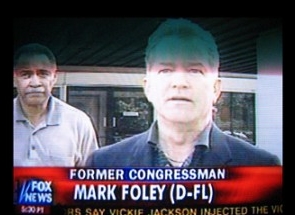
Screenshot from October 2 edition of Fox News's O'Reilly Factor
- October 3: Interestingly enough, in light of the above item, Tony Perkins of the Family Research Council admits, almost in passing, that the FRC knew about Mark Foley long before the Foley e-mails surfaced on ABC's Web site. Perkins tells MSNBC's Chris Matthews, "[I]t was widely known to watch out for him, that [Foley] liked boys." Matthews allows Perkins to spend the rest of the interview bashing gays, and never follows up on Perkins's admission. Nor does he ask the obvious question -- given the FRC's strong stance in favor of what it calls "family values" and its claim that the protection of children is of paramount importance, why didn't Perkins and the FRC ever speak out against Foley? The hypocrisy is amazing. (MSNBC/Daily Kos)
- October 3: The New York Times weighs in on the Foley debacle by writing in an op-ed, "History suggests that once a political party achieves sweeping power, it will only be a matter of time before the power becomes the entire point. Policy, ideology, ethics all gradually fall away, replaced by a political machine that exists to win elections and dispense the goodies that come as a result. The only surprise in Washington now is that the Congressional Republicans managed to reach that point of decayed purpose so thoroughly, so fast. ...When there is a choice between the right thing to do and the easiest route to perpetuation of power, top Republicans always pick wrong." (New York Times)
- October 3: Veteran liberal blogger Glenn Greenwald reminds us that it's of little use to call for Dennis Hastert's resignation over the Mark Foley debacle if John Boehner doesn't submit his as well. Not only is Boehner as guilty as Hastert is of covering up the Foley situation and then trying to block any meaningful investigations into his, Hastert's, and other House GOP leaders' role in the coverup (perhaps more guilty than Hastert), if Hastert resigns as Speaker of the House, Boehner is the most likely candidate to take his position. Like Hastert, Boehner has changed his story repeatedly. He first told the Washington Post on September 29 that he talked to Hastert about the Foley situation months ago and that Hastert assured him "we're taking care of it." But then, when Boehner learned that Hastert had denied knowing about Foley's page problem at all, Boehner quickly contacted the Post and changed his story, saying he now could not remember if he had spoken to Hastert after all. Then, Roll Call quoted Boehner as denying outright that he had informed Hastert about anything. Boehner then informed the Palm Beach Post that he was 99% sure he had spoken to Hastert about Foley, but couldn't remember any details of his conversation. Finally, he told a radio interviewer that he had told Hastert, had been assured that the situation had been taken care of (reverting back to his original tale), and asserts that it was not his responsibility to deal with the situation, it was Hastert's. What is true is that Boehner certainly lied to someone, and probably more than once. (Unclaimed Territory, ABC News)
- October 3: Former GOP congressman Joe Scarborough, now the host of an MSNBC talk show and a friend of Mark Foley's, writes, "Reading the first set of e-mails made me uneasy. My friends who knew Mark and I got on the phone and wondered aloud why he would ask a high school kid for a picture. Friday afternoon I saw the instant messages he sent to another student that made me scream. I realized Mark was in big trouble. But he is not alone. Where was the Republican leadership over the past year? They knew of Mark's inappropriate e-mails to a former page but never informed Democratic leaders so they could warn those pages they had brought to Washington. How could the Speaker of the House not remember being told by the Chairman of the Republican Congressional Committee that Foley had been confronted with his inappropriate emails to a male intern? Does this happen so often in Congress that it was no big deal to Denny Hastert? Why did Republicans allow Mark Foley to continue as chairman of the Committee on Missing and Exploited Children? Why did they let him lead the charge on their bill to stop the exploitation of minors on the Internet? And who was hiding these explosive instant messages over the past year?"
- After asking these fundamental questions -- none of which have been as yet even addressed by the House Republican leadership, much less answered satisfactorily -- Scarborough continues, "Someone buried these IM's despite the fact they allegedly showed a congressman trying to meet up to have sex with a teenage boy." Then comes the political accusations: "The fact this person held on to them until one month before the election makes it obvious that the intent was to inflict maximum damage on Mark Foley and the Republican Party. Why did this person (or people) withhold criminal evidence from the FBI? Should they also be arrested for obstructing a federal investigation and preventing congressional leaders from taking steps to protect other high school pages?" Worthy questions, but apparently ignorant of the fact that the FBI apparently had the information for a year, perhaps longer, without doing anything about it. Scarborough concludes, "And even though there is enough sleaze to fill buckets on both sides of the political aisle, it is the Republican Party of Foley, Abramoff, Cunningham, Ney and DeLay that will be on the ballot next month. That is bad news for Mark Foley's party and bad news for the President, who can ill afford to lose the House or Senate this fall." (MSNBC)
- October 3: Former federal prosecutor Elizabeth de la Vega reminds us that special prosecutor Patrick Fitzgerald's case against former Cheney chief of staff Lewis "Scooter" Libby is alive and well. The case, involving charges of perjury, false statements, and obstruction of justice in connection with Fitzgerald's investigation into the unauthorized disclosure of the identity of former Ambassador Joseph Wilson's wife, Valerie Plame Wilson, as a CIA operative, is set to begin on January 16, 2007. District Court Judge Reggie Walton has given clear signals that he intends to expedite this trial, and has made it abundantly clear that he will not let Libby's lawyers derail the case with their blizzard of dismissal motions based on technical abstrusities and claims that Fitzgerald does not have the authority to investigage White House officials. De la Vega says that Libby's best trial strategy -- indeed, what seems to be his only trial strategy -- is to not have a trial at all. The strategy dovetails with the needs of the Bush administration. Right now, the administration can (and has been) spinning Libby's prosecution for all it is worth as a triviality not worth covering, as has been the heavy hitters at the Libby Legal Defense Fund, but once a trial starts, the administration has little control over the trial nor over the information released during the trial. And, as de la Vega points out, the American public -- "aka 'voters'" -- loves trials.
- De la Vega believes that the Bush administration is laying down the PR needed to prepare the citizenry for a presidential pardon -- before the trial. Last year, not long after Libby was indicted, Senator Harry Reid and others in the Democratic leadership in Congress sent Bush a letter reminding him that the indictment of Cheney's Chief of Staff marked "the first time in 131 years that a senior White House official has been charged with a crime while still serving in the White House." Given the seriousness of the crimes, Reid urged, it was important for the President to "make clear in advance that, if convicted, Mr. Libby will not be able to rely on his close relationship with you or Vice President Cheney to obtain the kind of extraordinarily special treatment unavailable to ordinary Americans." In short, the Democratic Leadership was asking the President to reassure the public that he would not pardon Libby or anyone else ultimately convicted of a crime as a result of the CIA leak investigation. Bush refused to respond. Cheney, asked whether or not Bush should pardon Libby on a recent Meet the Press, also refused to respond. De la Vega says that the more hay the Democrats, and the people, make of Libby's possible pardon, the more remote the likelihood of such a pardon will be. (TomDispatch)
- October 3: Denver area resident Steve Howards files a lawsuit against a member of the Secret Service for his arrest after Howards approached Vice President Dick Cheney in Beaver Creek this summer and criticized him for his policies concerning Iraq. Howards's attorney, David Lane, says that on June 16, Howards was walking his 7-year-old son to a piano practice, when he saw Cheney surrounded by a group of people in an outdoor mall area, shaking hands and posing for pictures with several people. Cheney was apparently in Beaver Creek for a campaign fundraiser. Howards, according to the lawsuit, walked to within two or three feet of Cheney and said, in paraphrase, "I think your policies in Iraq are reprehensible," and departed. Ten minutes later, Howards and his son were walking through the same area when they were approached by Secret Service agent Virgil Reichle Jr., who asked Howards if he had "assaulted" the vice president. Howards denied doing so, but was nonetheless placed in handcuffs and taken to the Eagle County Jail. The lawsuit states that the Secret Service agent instructed that Howards should be issued a summons for harassment, but that on July 6 the Eagle County District Attorney's Office dismissed all charges against Howards. The lawsuit filed today alleges that Howards was arrested in retaliation for having exercised his First Amendment right of free speech, and that his arrest violated his Fourth Amendment protection against unlawful seizure. (Rocky Mountain News)
Al-Qaeda leaders need US to stay in Iraq to help the terrorists build alliances with other insurgent groups
- October 4: A newly disclosed al-Qaeda communique reveals a divided organization with only a fragile foothold in Iraq, hoping U.S. troops will stay long enough to give it time to build alliances with often-antagonistic Iraqi insurgents and other Sunni leaders, report Consortium News's Robert Parry. The letter was written on December 11, 2005, and is in essence a warning from a senior al-Qaeda operative called "Atiyah" to the then-leader of al-Qaeda in Iraq, Abu Musab al-Zarqawi. The letter criticized al-Zarqawi for attacks on fellow Muslims that had alienated key elements of the Sunni-led opposition to US forces. Atiyah told Zarqawi that "the most important thing is that the jihad continues with steadfastness and firm rooting, and that it grows in terms of supporters, strength, clarity of justification, and visible proof each day. Indeed, prolonging the war is in our interest." If the letter is accurate, and there is every reason to believe it is, then it flatly contradicts Bush's assertions that a quick withdrawal of US military forces would amount to a major victory for al-Qaeda. The "Atiyah letter" goes along with a previously intercepted message attributed to al-Qaeda's second-in-command Ayman Zawahiri to suggest that a US military pullout in 2005 or earlier could have been disastrous for al-Qaeda's terrorist bands. Without the US military presence to serve as a rallying cry and a unifying force, the al-Qaeda contingent in Iraq was threatened with disintegration from desertions and attacks from Iraqi insurgents who opposed what Parry calls "the wanton bloodshed committed by Zarqawi's non-Iraqi terrorists." The "Zawahiri letter," from July 9, 2005, said a rapid American military withdrawal could have caused the foreign jihadists, who had flocked to Iraq to battle the Americans, to simply give up the fight and go home. "The mujahaddin must not have their mission end with the expulsion of the Americans from Iraq, and then lay down their weapons, and silence the fighting zeal," the "Zawahiri letter" reads.
- The "Atiyah letter" stresses that al-Qaeda's position in Iraq is still vulnerable, and would profit from building alliances with other insurgent groups. Atiyah wrote al-Zarqawi, "Know that we, like all mujahaddin, are still weak. We have not yet reached a level of stability. We have no alternative but to not squander any element of the foundations of strength or any helper or supporter." The letter warned al-Zarqawi "against attempting to kill any religious scholar or tribal leader who is obeyed, and of good repute in Iraq from among the Sunnis, no matter what. ...The long and short of the matter is that the Islamic theologians are the keys to the Muslim community and they are its leaders. This is the way it is, whether you like it or not. ...If you appear before the community in the guise of a pariah to the class of religious scholars, contradicting them, disrespecting them, and insulting them, then you will lose the people and you will fail in any call [to religion] or political act. ...It is highly advisable to be polite and to show complete respect, regret, compassion, and mercy and so forth. You must incline yourself to this, and be humble to the believers, and smile in people's faces, even if you are cursing them in your heart, even if it has been said that they are 'a bad tribal brother,' and what have you." Both letters emphasize that one of al-Qaeda's biggest fears is that the United States will pull out of Iraq before the terrorist organization has built the necessary political infrastructure to turn the country into a future base of operations.
- Zawahiri was so concerned about the possibility of mass desertions after a US withdrawal that he suggested that al-Qaeda leaders in Iraq talk up the "idea" of a "caliphate" along the eastern Mediterranean to avert a disintegration of the force. It is clear in the letter that Zawahiri is doing nothing more than making empty promises to gullible followers to keep the ranks unified and focused, but Bush has used the references to a "caliphate" to justify an expanded war against Islamic militants. Bush continues to warn Americans about al-Qaeda's intent to follow up a US withdrawal from Iraq by turning the country into a launching pad for a vast Islamic "empire" that would spell the strategic defeat of the United States. Bush said on September 5, 2006, "This caliphate would be a totalitarian Islamic empire encompassing all current and former Muslim lands, stretching from Europe to North Africa, the Middle East, and Southeast Asia. We know this because al-Qaeda has told us." Some of Bush's neoconservative advisors have referred to this coming conflict with militants among the world's one billion Muslims as "World War III" and a "clash of civilizations."
- Bush also spurns the argument that the continuing occupation of Iraq is breeding the growth of Islamic terrorism: "My judgment is, if we weren't in Iraq, they'd find some other excuse, because they have ambitions," he said on September 26, 2006. "They kill in order to achieve their objectives." As with virtually every pronouncement Bush has made concerning Iraq, this is wrong. A large and growing body of evidence, including the two al-Qaeda letters, disprove Bush's conclusions about both the prospects for "a totalitarian Islamic empire" and a disconnect between the continuing Iraq War and terrorism. According to a National Intelligence Estimate, representing the consensus view of the US intelligence community in April 2006, "the global jihadist movement is decentralized, lacks a coherent global strategy, and is becoming more diffuse." The NIE also concluded that the Iraq occupation has not weakened Islamic terrorism, but has become a "cause celebre" that is "cultivating supporters for the global jihadist movement."
- The US still has time to counter al-Qaeda in Iraq. The organization is still floundering, unable as yet to get a strong foothold in that war-torn country; the organization's leaders count on a continued American presence in Iraq to generate a new surge of recruits to their cause. According to the "Zawahiri letter," al-Qaeda remained so disorganized that it even lacked a reliable means for getting out its messages. Zawahiri complained that six of his audio statements "were not published for one reason or another." The letter also asked if the embattled al-Qaeda operatives in Iraq might be able to spare $100,000 to relieve a cash squeeze facing the group's top leaders in hiding, presumably along the Afghan-Pakistani border. The "Atiyah letter" contained similar references to the weaknesses of the al-Qaeda leadership holed up in Waziristan on the Pakistani side of the border. "Atiyah" claimed that it was easier for Zarqawi to send an emissary to Pakistan than it was for al-Qaeda leaders to dispatch someone to Iraq. Al-Qaeda's leaders "wish that they had a way to talk to you and advise you, and to guide and instruct you; however, they too are occupied with vicious enemies here," the letter reads. But Bush is moving from a completely reversed set of conclusions, insisting that the US must stay in Iraq to counter al-Qaeda's operations. The facts prove Bush wrong: that the US invasion of Iraq in 2003 relieved pressure on al-Qaeda leaders in hiding and gave them hope by attracting a new generation of young Muslims to the extremist cause. By extending the US occupation of Iraq indefinitely, Bush appears to be continuing to play into al-Qaeda's hands.
- Unfortunately for American and global interests, Bush has his own interests in prolonging the war in Iraq. He and the "Bush Republicans" rode the wave of fear and anger generated by 9/11, and perpetuated by his invasions of Afghanistan and Iraq, into a position of power unprecedented in modern American history beginning in 2002. He has used his power, not to successfully battle global terrorism, but to engineer an unprecedented rollback of US constitutional liberties. Just recently, Bush and the Republicans in Congress succeeded in vaporizing the 800-year old principle of habeas corpus, a right to a trial by jury guaranteed in English and American civilization since the Magna Carta of 1215 and one of the few rights expressly written into the body of the Constitution. Bush and his colleagues have also used the threat of terrorism to smear and discredit his political opposition, cowing both Democrat opponents and the electorate to roll to victories in 2002 and 2004. While firing up the rhetorical engines and accusing Democrats of becoming "the party of cut and run," Bush is deliberately ignoring the reality -- that his policy of "stay the course" is what is actually serving al-Qaeda's interests. (Consortium News [includes links to actual letters])
- October 4: Bush issues another signing statement, this time asserting that he has the authority to flaunt a new law passed by Congress that sets minimum qualifications for future heads of the Federal Emergency Management Agency.
"Unitary executive"
Passed in response to former FEMA head Michael Brown's incompetence and political cronyism as demonstrated in the aftermath of Hurricane Katrina, the passage in the new homeland security bill establishes new job qualifications for the agency's director. The law says the president must nominate a candidate who has "a demonstrated ability in and knowledge of emergency management" and "not less than five years of executive leadership." Bush signs the bill into law this morning; hours later, after the press attention has died down, he issues a signing statement saying he could ignore the new restrictions. Bush says that under his interpretation of the Constitution, the FEMA provision interferes with his power to make personnel decisions. The law, Bush writes (or more accurately, his lawyers write), "purports to limit the qualifications of the pool of persons from whom the president may select the appointee in a manner that rules out a large portion of those persons best qualified by experience and knowledge to fill the office." - The FEMA director provision is only one of some three dozen provisions in the bill that Bush says he does not have to follow; among those is a provision empowering the FEMA director to tell Congress about the nation's emergency management needs without White House permission. This provision, Bush says, "purports...to limit supervision of an executive branch official in the provision of advice to the Congress." Despite the law, he says, the FEMA director would be required to get clearance from the White House before telling lawmakers anything.
- As usual, the public signing ceremony, in a bath of media attention, was all positive, with Bush proclaiming the bill to be "an important piece of legislation that will highlight our government's highest responsibility, and that's to protect the American people. [The bill] will also help our government better respond to emergencies and natural disasters by strengthening the capabilities of the Federal Emergency Management Agency." While reporters are e-mailed copies of Bush's remarks at the signing ceremony, and the White House Web site highlights the ceremony, Bush says nothing about his myriad objections to the law, and issues the signing statement with hardly any notification. The press office posts the signing-statement document on its Web site around 8 PM Wednesday, after most reporters had gone home. The signing statement is not included in news reports yesterday on the bill-signing.
- Such signing statements have no power in the law whatsoever, but Bush has long operated under the assumption that he can do as he pleases until someone makes him stop. No one in Congress nor in the judiciary has yet stepped up to fill that role, but Republican senator Susan Collins, the chairwoman of the Senate Homeland Security and Government Affairs Committee who has been one of the harshest critics of FEMA's performance during Katrina, rejects Bush's suggestion that he can bypass the new FEMA laws. She says there are numerous precedents for Congress establishing qualifications for executive branch positions, and that Congress has long authorized certain officials from a variety of departments "to go directly to Congress with recommendations," pointing out that the FEMA director statute was modeled after a law that gives similar independence to the chairman of the Joint Chiefs of Staff at the Pentagon. "I believe it is appropriate to extend this authority to the official tasked with leading the nation's response to disasters," she says.
- Georgetown Law School professor Martin Lederman says Congress clearly has the power to set standards for positions such as the FEMA director, so long as the requirements leave a large enough pool of qualified candidates that the White House has "ample room for choice." Lederman, a veteran of the Justice Department's Office of Legal Counsel from 1994 through 2002, says, "It's hard to imagine a more modest and reasonable congressional response to the Michael Brown fiasco." (Boston Globe, AP/Truthout)
- October 4: Former secretary of state Colin Powell says that there must be an end to the US presence in Iraq, and that the US and its allies alone cannot resolve the sectarian violence in that war-torn nation. "Only the Iraqi people can resolve this," Powell said. US forces have to stay in Iraq for "some time," he says, "but there is a limit to the patience of the American people." Powell is the featured speaker at the annual Carlson Lecture at the University of Minnesota. In Iraq, "staying the course isn't good enough because a course has to have an end," he says. He adds that the Iraq invasion and occupation, more than any other event of this era, will define both the Bush presidency and his own tenure as Secretary of State. Powell says that for the US, the challenge of the war is to answer the question of whether an essential "bond of trust that must exist within a nation...has been shaken." He says part of that answer will come on November 7. (Minneapolis-St. Paul Star-Tribune)
- October 4: Along with the entire infrastructure of the country, Iraq's public school and university system is on the brink of collapse, as thousands of students and teachers have fled in the face of violence. Pupils and staff say they no longer feel safe in attending their educational institutions. In some schools and colleges, up to half the staff have fled abroad, resigned or applied to go on prolonged vacation, and class sizes have also dropped by up to half in the areas that are the worst affected. Some college professors and instructors, particularly those teaching science and health-related courses, have been targeted for assassination. Universities from Basra in the south to Kirkuk and Mosul in the north have been infiltrated by militia organizations, while the same militias from Islamic organizations regularly intimidate female students at the school and university gates for failing to wear "proper" attire, usually the hijab. Women teachers too have been ordered by their ministry to adopt Islamic codes of clothing and behavior. "The militias from all sides are in the universities. Classes are not happening because of the chaos, and colleagues are fleeing if they can," says Professor Saad Jawad, a lecturer in political science at Baghdad University. "The whole situation is becoming completely unbearable. I decided to stay where many other professors have left. But I think it will reach the point where I will have to decide. A large number have simply left the country, while others have applied to go on prolonged sick leave. We are using recently graduated MA and PhD students to fill in the gaps." Another political science professor in Baghdad, Wadh Nadhmi, adds, "What has been happening with the murders of professors involved in the sciences is that a lot of those involved medicine, biology, maths have fled. The people who have got the money are sending their children abroad to study. A lot -- my daughter is one of them -- are deciding to finish their higher education in Egypt." A professor in Mosul, who does not want his name revealed for fear of reprisal, says, "Education here is a complete shambles. Professors are leaving, and the situation -- the closed roads and bridges -- means that both students and teachers find it difficult to get in for classes. In some departments in my institute attendance is down to a third. In others we have instances of no students turning up at all. Students are really struggling. To get them through at all, we have had to lower academic levels. We have to go easy on them. The whole system is becoming rapidly degraded."
- Public schools are in similar disarray. "Education in my area is collapsing," says a teacher from a high school in Amariyah, who quit four months ago. "Children can't get to school because of road blocks. The parents of others have simply withdrawn them from the school because of the fear of kidnapping. If children have to travel by car rather than making a short journey on foot, we are much less likely to see them. When I left, we had 50% attendance at the school. We see the parents when they come in to ask for the children to have a 'vacation' -- and they admit they are too scared to let them come. Between September 8 and 28 two members of the staff were murdered. The teaching staff was supposed to be 42. Now there are only 20. Some applied for early retirement or they asked to be transferred to other safer areas." High school student Ala Mohammed had hoped to be going to university this year having completed her high school diploma. But her college is in Adhamiya, a notorious neighbourhood for violence. "The journey is too long and too unsafe," she says. "I don't know whether I will be going to college or stay jailed at home." (Guardian)
- October 4: Repubiican representative Christopher Shays, battling for his seat in a tough election battle against an antiwar Democrat, calls for Defense Secretary Donald Rumsfeld. Shays's demand for such a resignation is very rare for any Republican, and particularly in these days of toe-the-line Republican party members. Shays also accuses officials at the Defense Department of withholding information about the Iraq war from Congress. "I am losing faith in how we are fighting this war," Shays, a longtime supporter of the conflict, says. "I believe we have to motivate the Iraqis to do more." Shays says defense officials stopped cooperating with his congressional subcommittee after he proposed setting a timeline for troop withdrawals. He offered the plan in August following his 14th trip to Iraq since the war began; previously Shays had resisted the idea of any kind of timeline towards withdrawal. "simply is refusing to cooperate with a committee that oversees the Department of Defense," Shays says. "To me he has crossed the line. I think Donald Rumsfeld needs to step down." Shays chairs the House Government Reform subcommittee on national security, emerging threats and international relations. One of the few Congressional Republicans who has joined Shays in demanding for Rumsfeld's resignation is representative Walter Jones, who has the Marines' Camp Lejeune. Jones has repeatedly called for Rumsfeld to step down. "I have felt this way for quite a while," Jones says. "He reminds me so much of [Defense Secretary Robert] McNamara in the Vietnam War. He is arrogant and will not admit a mistake." Shays's opponent, Democrat Diane Farrell, says Shays is flip-flopping with the political tides. She has called for Rumsfeld's resignation for months, and says this is just the latest change in Shays's position. "He has supported the war from Day One," says Farrell campaign spokeswoman Jan Spiegel. "He has voted to give the president a blank check." (ABC News)
- October 4: Bush signs a bill authorizing the construction of a $700 million "fence" along the border with Mexico. The barrier, to be equipped with high-tech surveillance equipment, will be built in areas where many illegal immigrants cross over into the United States. Under the new law, around $1.2 billion will be spent over the coming year on various anti-immigration measures along the border. Bush says the barrier alone is not enough to curb illegal immigration. "The funds that Congress has appropriated are critical for our efforts to secure this border and enforce our laws, yet we must also recognize that enforcement alone is not going to work," he says. "We need comprehensive reform that provides a legal way for people to work here on a temporary basis." There are an estimated 12 million illegal immigrants living in the US. An estimated 1.2 million illegal immigrants were arrested last year trying to cross into the US along the border states of Texas, New Mexico, Arizona and California. Mexico has said the fence will badly affect relations with the US; outgoing Mexican president, Vicente Fox, has called the fence shameful, and compared it to the Berlin Wall.
- Many Republicans backed the new bill in large part to shore up their credibility among disaffected conservative voters, who desire more to be done to curb illegal immigration into the country. "The perception that has been painted mistakenly is that the United States government, our Congress is not delivering to the American people on a huge problem that's out there," says Senate Majority Leader Bill Frist. "We're active." Democrats, however, say the fence bill is little more than political showboating, with senator Edward Kennedy calling it "a bumper sticker solution for a complex problem. ...It's a feel-good plan that will have little effect in the real world. We all know what this is about. It may be good politics, but it's bad immigration policy. That's not what Americans want."
- One of the biggest beneficiaries of the bill is embattled Republican representative James Sensenbrenner, in both political and financial senses. Sensenbrenner has long been a loud and sometimes vituperative foe of illegal immigration. But now he is facing an increasing amount of criticism from local critics who have evidence that Sensenbrenner has reaped, and continues to reap, financial profits from the immigration policies he has championed. Immigration rights advocates, the congressman's Democratic opponent, and some constituents are pointing to Sensenbrenner's investments in companies they say are generating profits from the labor of undocumented immigrants. They also say the congressman stands to benefit from investments in companies contracted by the federal government to provide services he has proposed as part of his immigration reform legislation -- such as building massive immigrant detention centers or providing surveillance systems to monitor immigrants near the border. Sensenbrenner owns $86,500 worth of stocks in Halliburton, which has come under fire for its hiring, underpayment, and mistreatment of thousands of undocumented workers in the aftermath of Hurricane Katrina; Halliburton has also secured a $385 million Department of Homeland Security contract to build gigantic immigrant detention centers near the US-Mexico border and stands to secure further contracts from proposals to reopen closed military bases to house deportees and detainees. Sensenbrenner owns more than $563,536 in General Electric stocks; GE's Security Unit has been a Pentagon subcontractor, providing video surveillance and other electronic security systems at the border. and contributed to Sensenbrenner through its employee PAC. Boeing, which recently secured a $2.5 billion contract order to install sensors, radar and cameras along the U.S. borders, is among the top contributors to Sensenbrenner's PAC. The multibillion dollar federal contracts and proposals to build the physical and virtual walls at the border were first proposed in Sensenbrenner's immigration bill, HR 4437.
- The usual political bob and weave isn't working so well for Sensenbrenner. A recent town hall meeting with his Wisconsin constituents turned contentious, fending off questions about the "moral and ethical" implications of investing in companies like Halliburton, which hire undocumented workers. Typically, Sensenbrenner tried to duck responsibility, first saying that the investments in question were "bequeathed to me before I began my public service," then insisting that his portfolio didn't affect his votes. "We don't believe it," some audience members responded. Asked about criticisms of the congressman's investments in companies hiring undocumented workers and benefiting from immigration policies, Sensenbrenner spokesperson Jeff Lungren said, "I'm unaware of these complaints." But his constituents are increasingly aware of Sensenbrenner's profiteering. His Democratic opponent in the congressional race, Bryan Kennedy, has publicly asked Sensenbrenner to divest himself of Halliburton and other companies he believes benefit by hiring undocumented workers. While Sensenbrenner has criticized companies that profit from exploitative working conditions that, as he recently said, make it "cheaper to hire an illegal alien than a citizen or a legal alien who is present in this country with a green card," his own practices in profiting from companies that hire undocumented workers. One such company is Darden Restaurants, in which Sensenbrenner owns over $44,000 in stocks. Darden operates chains such as the Olive Garden and Red Lobster, which employ illegal workers. One such worker at a Wauwatosa Red Lobster was surprised to find that he was working for a company that made the congressman that proposed "el Muro" (the wall) richer. "I don't have papers and had to cross the border from Mexico," he says. "Is he schizophrenic? Does he like our work and hate us?"
- Opinion is divided in Sensenbrenner's district. Cristina Neumann Ortiz, a Sensenbrenner constituent who organized the largest marches in Milwaukee history in response to HR 4437, finds typical the contradiction between the congressman's anti-undocumented immigrant policies and rhetoric and his pro-undocumented stock portfolio. "This is a classic case of exploiting workers," says Ortiz. "He is for their work while doing everything he can to make sure that they don't get any rights. I see this among exploitative employers. I see it in Congress." Another constituent, retired welder John Rehtman, who was just finishing a meal at the same Red Lobster in Wautatosa that employs illegal aliens, says, "I support what he's doing to try to stop those illegals." Asked how he felt about the fact that his food may have been prepared by one of the undocumented workers interviewed for the press, Rehtman responded, "I don't like it. Not one bit. They shouldn't be back there. That's why we need to change the laws." When told that Sensenbrenner, who recently referred to employers of the undocumented as "21st-century slave masters," was also an investor in the company that owned Red Lobster, Rehtman shook his head. "Car salesmen and politicians, they both..." He then stopped short. "I don't want to insult car salesmen that way." (BBC, CBS News, AlterNet)
Hastert knew of Foley's problem with male pages since 2003
- October 4: Kirk Fordham, Mark Foley's former chief of staff who resigned from Thomas Reynolds's staff today (see item below), says that Dennis Hastert knew of Foley's problems with male pages since Fordham informed him of the problem in late 2003. Fordham says Hastert's aide, Scott Palmer, then met with Foley. Fordham says Hastert knew about the meeting. Fordham says there had been a series of warnings from page supervisors that Foley was spending too much time with the pages in ways that were inappropriate and would not stop. Pages themselves say they had been warned by Republican staff to be careful around Foley. Hastert's office denies Fordham's claim.
- Fordham denies ever trying to block any inquiries into Foley's contacts with House pages, countering insinuations from what ABC News calls "unidentified GOP sources" saying Fordham tried to prevent just such an inquiry. "This is categorically false," Fordham says. "At no point ever did I ask anyone to block any inquiries into Foley's actions or behavior." He says he will fully disclose to the FBI and the House ethics committee "any and all meetings and phone calls" regarding Foley's behavior that he had with senior staffers in the House leadership. "The fact is even prior to the existence of the Foley e-mail exchanges I had more than one conversation with senior staff at the highest level of the House of Representatives asking them to intervene when I was informed of Mr. Foley's inappropriate behavior," he says. "Rather than trying to shift the blame on me, those who are employed by these House leaders should acknowledge what they know about their action or inaction in response to the information they knew about Mr. Foley prior to 2005. I have no reason to state anything other than the facts. I have no congressman and no office to protect." Of Foley, he says, "This was someone I had worked for for 10 years and had no inkling that this kind of blatantly reckless and just obscene behavior was going on behind our backs. Frankly, if I had ever known this stuff was out there, I wouldn't be talking to him at all."
- Interestingly, Hastert says, "What we did is exactly what we had planned to do if there was this type of situation." Nothing else has ever been said about any plan by House Republican leaders to deal with this kind of situation. (ABC News, ABC News, New York Sun, Beacon News/Daily Kos)
- October 4: Federal prosecutors from the office of acting US Attorney Jeffrey Taylor order the House of Representatives to preserve all documents and other materials related to Mark Foley's electronic communications with male teenage pages, signaling an intensifying investigation by the FBI and the Justice Department into possible criminal activity by the disgraced former GOP congressman. Legal experts believe this indicates preparation for grand jury subpoenas for records or searches of Foley's office. FBI agents are also seeking out current and former House pages who might have been contacted with Foley. And the Florida Department of Law Enforcement has announced it has begun its own preliminary inquiry. The letter is designed to avoid any legal conflicts with the House, as erupted in May 2006 after FBI agents raided the office of Democratic representative William Jefferson in search of evidence in a bribery investigation. The Justice Department and the FBI are preparing to use administrative subpoenas to obtain subscriber information for the e-mail accounts at the heart of the case. Authorities said their job will be made more difficult because providers such as America Online (AOL) do not keep records of instant messages, the real-time text chat used in the sexually explicit exchanges Foley is accused of engaging in. The FBI has not yet asked for information from AOL or other communications providers. So far, the focus of the probe is on whether Foley might be liable for charges of crossing state lines or using electronic communications to entice a minor into sexual acts. Investigators "have not ruled out any number of possible crimes that could be looked at," says one official. Speaker of the House Dennis Hastert told reporters on September 2 that House leaders "expect everybody to cooperate" and would not stand in the way of investigators. Foley's attorney, David Roth, also pledged full cooperation with the FBI. "Nothing will be altered," he said. (Washington Post)
- October 4: An increasingly desperate Dennis Hastert is now blaming the media, George Soros, and Bill Clinton for the outrage that has erupted over Mark Foley's e-mails and the failure of the House GOP leadership to do anything about it when they had the chance. Typically, Hastert is blaming everyone except those actually responsible for the calamity, which is predicted to be the death blow to the Republicans' chances of holding onto control of Congress. Hastert tells the Chicago Tribune, When the [Republican] base finds out who's feeding this monster, they're not going to be happy. The people who want to see this thing blow up are ABC News and a lot of Demoratic operatives, people funded by George Soros." Hastert provides no evidence whatsoever that either Soros, the billionaire who finances MoveOn.org and other liberal groups, or Bill Clinton have any involvement in the outpouring of disgust and calls for investigations and resignations (starting with Hastert's) that have inundated the Republicans and their conservative supporters. MoveOn has nothing about Foley on its Web site's home page, and no campaigns mounted that make mention of the Foley debacle. As for Clinton, the Tribune writes that Hastert suggested "operatives aligned with former president Bill Clinton knew about the allegations and were perhaps behind the disclosures in the closing weeks before the Nov. 7 midterm elections, but he offered no hard proof." Hastert says, "All I know is what I hear and what I see. I saw Bill Clinton's advisor Richard Morris, was saying these guys knew about this all along. If somebody had this info, when they had it, we could have dealt with it then." Hastert fails to note that Dick Morris is a Republican who has long since severed any ties with the Clintons, and for years has spread scurrilous, often slanderous lies about the Clinton family and about Democrats in general; Morris also confirms on Fox News that he knows nothing about any Democratic involvement except for hearing from an unidentified reporter that one House Democrat knew about the matter. The San Francisco Chronicle's Marc Sandalow has a much more straightforward explanation for Hastert, from October 2: "If there is even a hint [that] Republican leaders were more interested in protecting their majority than the children who serve as their pages, this will be a scandal with enormous repercussions." At least one House member is joining Hastert in smearing the Democrats: at a Republican fundraiser in Arizona, GOP representative Trent Franks says he knows nothing about Foley or his conduct with House pages, but he believes leaders of the Democratic party knew about it 10 months ago. How Franks comes by this "information" he never bothers to say.
- Hastert also reiterates his claim that he demanded that Mark Foley resign, a story Hastert has only begun spreading in recent days. Initially, Hastert and other House Republican leaders say that Foley had already resigned before they had the chance to broach the subject with him. (Chicago Tribune, San Francisco Chronicle, San Francisco Chronicle, Talking Points Memo, New York Times)
- October 4: Kirk Fordham, the chief of staff for Republican congressman Thomas Reynolds, resigns. In his letter of resignation, he writes, "It is clear the Democrats are intent on making me a political issue in my boss's race, and I will not let them do so." He says he worked with Foley immediately after Mark Foley's e-mail exchanges became public knowledge as "a friend of my former boss, not as Congressman Reynolds' Chief of Staff. ...At the same time, I want it to be perfectly clear that I never attempted to prevent any inquiries or investigation of Foley's conduct by House officials or any other authorities." The truth seems a bit murkier. Republican sources on Capital Hill say Fordham had urged Republican leaders last spring not to raise questionable Foley e-mails with the full Congressional Page Board, made up of two Republicans and a Democrat. "He begged them not to tell the page board," says one source. But people familiar with Fordham's side of the story say Fordham is being used as a scapegoat by Speaker of the House Dennis Hastert. They say Fordham had repeatedly warned Hastert's staff about Foley's "problem" with pages, but little was done. At Fordham's urging, according to the sources, the matter was not given to the full board last spring, and instead Foley was privately approached and told to stop all contact with the page he had been e-mailing. Page Board member Dale Kildee says it was "unprecedented" to have handled the matter without informing the board members. Fordham was also instrumental in orchestrating Foley's abrupt resignation last week hours after ABC News confronted the congressman with sexually explicit instant messages allegedly sent to pages. Fordham offered ABC News a deal if it would not publish the content of the instant messages. "He said we could have the exclusive on the resignation if we did not run direct quotes from the instant messages," says Maddy Sauer, the ABC News producer who dealt with Fordham. ABC News refused to make any such deal. Capitol Hill sources say Fordham's resignation was demanded by Hastert, whose job is on the line because of his handling of the page scandal. John Shimkus, the Republican chair of the House Page Board, says he was never contacted by Fordham regarding Foley's e-mails.
- Fordham now insists that he told Hastert's chief of staff about the Foley problem two years ago, a charge that Hastert denies. "You can also find that as late as [October 3], he said this member never did anything wrong," Hastert says. "He [Fordham] has a short memory." Fordham's lawyer, Timothy Heaphy, says Fordham warned Hastert chief of staff Scott Palmer at least two years ago about inappropriate behavior between Foley and pages. "Palmer subsequently had a meeting with Foley and Foley mentioned it to Fordham," says Heaphy. Fordham is unsure when the meeting with Palmer occurred, but Heaphy says it was between 2002 and 2004, when Fordham was Foley's chief of staff. Fordham says he had "more than one conversation with senior staff at the highest level of the House of Representatives asking them to intervene" several years ago. The FBI has contacted Fordham and "he intends to cooperate completely," Heaphy says.
- Even House Majority Whip Roy Blunt is breaking ranks with Hastert, telling reporters that if his colleages had brought the matter to him, he would have handled it much differently. "I think I could have given some good advice here, which is, you have to be curious, you have to ask all the questions you can think of," Blunt says. "You absolutely can't decide not to look into activities because one individual's parents don't want you to." Blunt may be criticizing Hastert because if Hastert steps down, Blunt stands a very good chance of becoming Speaker himself.
- AmericaBlog's John Aravosis writes scathingly, "Congressman Reynolds, you'll recall, is the head of the National Republican Congressional Committee (NRCC), the congressional body in charge of helping House republicans get re-elected. Reynolds had been notified about Foley's page-baiting months ago, yet wants us to believe he did everything he could and that he's not responsible for the sexual predator getting an easy ride, for his being permitted to remain in congress, permitted to remain the chair of the House caucus on missing and exploited children, and being permitted to remain in the House Republican leadership. Now we know otherwise. Congressman Reynolds let his own chief of staff secretly work for a child predator in an effort to cover-up the worst evidence of the predator's sexual wrongdoing. Without that evidence, this case might not have broken wide open. Add Reynolds to the list, alongside Hastert and Shimkus, of members of Congress who need to resign now." (ABC News, ABC News, ABC News, Chicago Tribune, AmericaBlog)
- October 4: Bowing to intense political pressure, the Bush administration has backed off on its policy of seizing shipments of prescription drugs from Canada at the US-Canadian border. While it is still illegal to import drugs from Canada or any other country, the change means that smaller shipments of Canadian prescription drugs will be able to reach US consumers, mostly elderly citizens who have been angered at their inability to procure the less expensive Canadian drugs. "It's great news," says 74-year old Jean Edes. "There's no reason we shouldn't be able to buy drugs from Canada." The Bush administration still maintains that the practice is dangerous because the medications could be counterfeit or otherwise inferior; a spokeswoman with US Customs says that the policy shift does not mean the drugs are safe. "We just decided to focus our resources differently," says Lynn Hollinger. "We are still very committed to protecting the American public from these medications." Democratic senator Bill Nelson disagrees, insisting that as long as consumers are dealing with legitimate Canadian pharmacies, the drugs are as safe as any available in the US. Previous studies have estimated as many as 2 million Americans buy drugs from Canada, where the prices average 30 percent to 50 percent less than the same medicines in America. Canadian drugs are less expensive because the government limits what makers can charge. Several consumer groups support the policy change, though one organization says its timing so close to the midterm congressional elections suggests it has more to do with "public relations" than drug policy. Jerry Flanagan of the Foundation for Taxpayer and Consumer Rights said the government still has not done anything about the underlying problem: the high price of US drugs. His group thinks the federal government should adopt a Canadian-style approach to drug-cost management and negotiate with the drug industry to buy US medicines in bulk. "If Congress and the Bush administration were serious about lowering prescription-drug costs, they would adopt policies that allow American people to buy cheaper drugs at the stores in their own neighborhoods," he says. "We certainly think people should have the option of buying from Canada, but the point is, they shouldn't have to." Edes thinks the decision is entirely politically motivated: "I have a horrible feeling that it's all political. The Republicans are in hot water with so many things right now; they want to make the American people aware of something good' before the November elections." (Orlando Sentinel/Topix)
- October 4: The story from the Republican leadership just keeps changing. Thomas Reynolds, head of the National Republican Congressional Committee, says that he and his former chief of staff Kirk Fordham (who resigns today -- see above item) asked Mark Foley to resign on September 29. The messages "were despicable, they were deplorable," he says in a press conference, "and we moved and worked to get Foley's resignation and that was certainly obtained within hours and Mr. Fordham was helpful in getting that resignation." Though Reynolds says he and Fordham were instrumental in convincing Foley to resign, Reynolds says he knows nothing of Fordham's work with Foley leading up to Foley's resignation -- a contradiction that is hard to fathom. Fordham, who was once Foley's chief of staff, says when he learned of the graphic sexual content of some of the instant messages, he confronted Foley. "I said: 'Are these authentic?' and he said 'probably,' and he confirmed that they were likely his instant messages." Fordham says said the immediate reaction of his current boss, Reynolds, was to get Foley to leave Congress. "He told me [Foley] needed to resign," he says, adding that the National Republican Congressional Committee wrote the first draft of Foley's resignation letter before it was rewritten on Foley's official letterhead. "I was still pretty shell shocked myself," Fordham says of the day he learned about the messages. "This was someone I had worked for 10 years. I had no inkling that this kind of blatantly reckless -- just obscene -- behavior was going on behind our backs." Of the deal he offered ABC's Brian Ross, an exclusive interview with Foley if Ross would suppress publication of the e-mails and IM exchanges, Fordham says he only asked Ross to suppress the most graphic of the messages. Ross says that Fordham asked him to suppress all of the exchanges. (AP/Auburn Citizen)
- October 4: Republican congresswoman Deborah Pryce, chair of the Republican Conference, the fourth-highest party leadership post, asks the House clerk to investigate allegations raised in a GOP conference telephone call on October 3. Pryce writes in her letter to the clerk's office, "A member stated that there are rumors that there was an incident within the last several years when then-Congressman Foley in an intoxicated state was stopped by the Capitol police from entering the Page Residence Hall." The lawmaker who raised the concern was Republican congressman Roger Wicker. Pryce adds that another lawmaker says that at some point, "the director of the Republican pages [John Shimkus] brought specific concerns about...Foley's behavior to the attention of the then-clerk of the House [Jeff Trandahl]. While the details of these rumors are vague, these are very serious allegations and they deserve your full attention and thorough investigation." Pryce recommends that if Haas is unable to conclude this investigation, the inquiry should be handed over to the Department of Justice as part of its ongoing investigation of Foley's activities. Pryce's election opponent, Mary Jo Kilroy, locked in a close race with Pryce, notes that Pryce is a close friend of Foley's.
- Pryce's letter also notes that, according to what she was told over the conference call, former House Clerk Jeff Trandahl had been warned about Foley's predations among the House pages before he and others were told about Foley's improper e-mails. Trandahl has yet to speak publicly about the matter, but has retained a lawyer. (Washington Post/San Jose Mercury News, The Hill, TPM Muckraker)
- October 4: Speaker of the House Dennis Hastert tells conservative activist Paul Weyrich that he would resign his position if he thought it would help Republicans stave off defeat in November, but he feels for him to resign would prompt what he calls "a feeding frenzy" that would lead to more resignations. "He said if he thought that resigning would be helpful to the Republicans maintaining the majority, he would do it. But he did not think it would be helpful for Republicans," say Weyrich. "He said he thought his resignation would just lead to a feeding frenzy where they would go after [Majority Leader John] Boehner, then [Thomas] Reynolds, then [House Page Board chairman John] Shimkus," Weyrich adds. "And he said we would have the story running right up to the election." Weyrich yesterday said he believed Hastert should resign, but now he says, "I changed my mind after talking to the Speaker. I feel now that he ought to be given the benefit of the doubt. He has never, ever lied to me or dissembled. I regard him as one of the good people up there." Weyrich says House leaders should not have permitted Mr. Foley, whose homosexuality was widely known in Washington circles, to head a caucus on missing and exploited children. "I don't understand that. ...Why didn't they do something about it, at least making sure he had no interaction with male pages anyway? It's clear that political correctness had gripped the leadership." Asked about the relevance of Foley's sexual orientation, Weyrich says, "We know that homosexuals have a preoccupation with sex, much more so than heterosexuals."
- Weyrich says Boehner angered Hastert by asserting that Boehner did, indeed, tell Hastert about the Foley e-mails in the spring. "The Speaker was ticked by that one involving Boehner," Weyrich says. "Boehner threw it in his lap, and said he warned him. The Speaker said no such warning ever came from Boehner." According to one House GOP aide, "If the Speaker were to step down, or not run again...the next guy is going to have to be squeaky clean, which is why you see Boehner putting some daylight between him and the Speaker." Weyrich is apparently working to put more blame on Boehner than Hastert, saying, "I believe him when he says that he never talked to these other guys. That means somebody else is lying." Weyrich says that Hastert "did take Reynolds's word, but not Boehner's." (Congressional Quarterly/New York Times, New York Sun)
- October 4: An ACLU lawsuit against the constitutionality of the USA Patriot act will continue, after a federal judge dismisses the US government's request to dismiss the lawsuit. The case has been in the courts for over three years. According to US District Judge Denise Hood, the actual defendents -- six Muslim groups that provide religious, medical, social and educational services to Muslims and people of Arab descent -- have established that they have been harmed or threatened by Section 215 of the law. The six groups are being represented by the ACLU. "She confirmed what we've said all along, that our clients are suffering concrete harm as a result of the Patriot Act," says Michigan ACLU Executive Director Kary Moss. "Even though we think the act fails to comply with the Constitution, we believe our legal challenge and advocacy in Congress has fixed some of the worst problems." The ACLU has charged that the Patriot Act enabled the government to obtain warrants from the secret Foreign Intelligence Surveillance (FISA) Court in Washington without having to offer evidence to justify the request. The ACLU says the law has caused people served by the Muslim groups to stop attending mosques, practicing their religion, and expressing opinions about religion and politics for fear of being targeted by the government. The ACLU says the law has had a chilling effect on their clients' right to free speech and association because it enables the government to seize membership lists from political groups, find out what books people checked out of libraries or what they told social service agencies about medical and family problems without their ever learning about it. In March 2006, Congress amended the Patriot Act to correct a few of its most blatant "Constitutional deficiencies;" the ACLU says the corrections are not enough. (Detroit Free Press/Contra Costa Times)
- October 4: The New York Times reveals the existence of a $20 million funding "marker" inserted in the latest military spending bill to throw a celebration in Washington "for commemoration of success" in Iraq and Afghanistan. The money, of course, has not yet been spent, but House and Senate Republicans have written legislation allowing the money to be rolled over into 2007. The original legislation empowered Bush to designate "a day of celebration" to commemorate the success of the armed forces in Afghanistan and Iraq, and to "issue a proclamation calling on the people of the United States to observe that day with appropriate ceremonies and activities." Democrats have been highly critical of the unreported taxpayer funding of what would essentially be a celebration of Bush's foriegn policies; in response, Republicans have accused Democrats of playing election-year politics, and refused to reveal the names of the sponsors of the legislation. "If the Bush administration had spent more time planning for the postwar occupation of Iraq, and less time planning 'mission accomplished' victory celebrations, America would be closer to finishing the job in Iraq," says a spokesman for Senate Minority Leader Harry Reid. (New York Times/After Downing Street)
- October 4: With the nation rocked by the recent epidemic of school shootings, including the ones in Colorado, Wisconsin, and at the Amish schoolhouse in Pennsylvania, Bush declares himself "saddened and deeply concerned" about the shootings and plans to convene a summit of education and law enforcement experts to discuss federal action that can help communities prevent violence. Unfortunately, Bush's actions are quite different from his words; during his six years in office, he has consistently recommended pulling funding for school violence prevention programs In 2006, Bush proposed 5% cuts in already-underfunded youth and crime prevention programs. In his 2005 budget, he proposed a 40 percent drop in juvenile-crime prevention programs, following a 44 percent cut in 2004. His administration has repeatedly repeatedly recommended eliminating federal funding for the Safe and Drug-Free Schools and Communities State Grants program, which works on juvenile-crime prevention. As yet, Congress has not voted to completely defund the Grants program, but has defunded it by over 25% since 2001. More than half the nation's school districts receive $10,000 or less per year to fight violence and substance abuse, "too little to make a difference," according to an Education Department official. (Think Progress)
- October 4: The next round of the GOP-led "blame game" might focus on a supposed "cabal" of gay Republican aides and staffers, reports David Corn and Josh Marshall, two veteran leftist Washington political observers. Marshall writes, "There have been a number of signals through the course of the day that the last gambit of the GOP House leadership will be to blame the Foley debacle on a cabal of gay staffers who hid and/or enabled Rep. Foley's behavior for years. The idea being that they are to blame rather than the leadership. That may sound like a plot turn out of a bad novel. But with the times we're living in I guess we shouldn't be surprised. Fordham, the staffer who just turned on Hastert, is openly gay, as is at least one other central player in the drama. Fordham's word now threatens to take down the whole House leadership. So they're going to throw everything at him." Corn has a copy of what is being called "the list," a roster of senior Congressional aides who are gay. CBS reported on October 3 that some House Republicans are angry over what an unidentified House Republican called a "network of gay staffers and gay members who protect each other and did the Speaker a disservice." Corn writes, "The implication is that these gay Republicans somehow helped page-pursuing Mark Foley before his ugly (and possibly illegal) conduct was exposed." Corn says he will not publish the list, partially because he has no idea if the men on the list are actually gay or not, and because he doesn't particularly like outing homosexuals who don't want their sexual orientation made public, "though I have not objected when others have outed gay Republicans, who, after all, work for a party that tries to limit the rights of gays and lesbians and that welcomes the support of those who demonize same-sexers." Corn says the list includes nine chiefs of staffs, two press secretaries, and two directors of communications, and is most interesting, if accurate, because "it shows that some of the religious right's favorite representatives and senators have gay staffers helping them advance their political careers and agendas. These include Representative Katherine Harris and Henry Hyde and Senators Bill Frist, George Allen, Mitch McConnell and Rick Santorum." These are the same legislators who have demonized homosexuality, perhaps bottoming out when in 2003 Santorum compared homosexuality to bestiality, incest and polygamy."
- Corn writes, "Let's be clear about one thing: the Mark Foley scandal is not about homosexuality. Some family value conservatives are suggesting it is. But anytime a gay Republican is outed by events, a dicey issue is raised: what about those GOPers who are gay and who serve a party that is anti-gay? Are they hypocrites, opportunists, or just confused individuals? Is it possible to support a party because you adhere to most of its tenets -- even if that party refuses to recognize you as a full citizen? The men on The List might want to think hard about these questions -- as they probably already have -- for if I have a copy of The List, there's a good chance it will be appearing soon on a website near everyone."
- The first salvo in the new gay-bashing strategy may have been fired on CBS News, which on its October 4 edition of its Evening News featured Family Research Council president Tony Perkins suggesting that the House leadership failed to investigate Foley months ago because they were "afraid to stand up to that network" of gay GOP staffers. No views questioning this theory were aired. CBS reporter Gloria Borger says, "CBS News has learned that several other top Republican staffers who handled the Foley matter are also gay. Their role in this controversy has caused a firestorm among Republican conservatives who charge that a group of high-level gay Republican staffers were protecting a gay Republican congressman." As of yet, absolutely no evidence of any such conspiracy has been offered. Progressive watchdog site Think Progress writes, "Anyone who shirked responsiblity or withheld evidence or participated in a cover up should be held accountable. But it's grossly irresponsibile for the right-wing to use the Foley scandal to launch an anti-gay witchhunt, and CBS shouldn't be aiding their efforts." (David Corn, Talking Points Memo, Think Progress)
- October 4: In what is apparently an indefensible act of political vengeance surrounding the Mark Foley case, a right-wing political blog reveals the name of one of the House pages victimized by Foley. The former page's name was originally posted on an obscure blog called Passionate America, which gets little traffic, but two of the largest and most well-connected conservative blogs on the Internet, Pajamas Media (actually a portal and advertising broker for nearly ever major right-wing blog), and Glenn Reynolds's Instapundit (which gets more traffic than any other right-wing blog), quickly link to the story. Not only is the young man's name revealed, but photos of him and other House pages are published, screenshots of his MySpace Web page are provided, information about where he lives is printed, and the city where he works as an intern on a Republican congressman's re-election campaign is revealed. On the morning of October 6, cyberpundit Matt Drudge piles on with a banner headline on the front page of his site. The original blogger, who goes by the handle "Wild Bill," provides no hard evidence that the young man he targets was one of the ones who provided information about Foley's behaviors, but that has not stopped thousands of enraged conservatives from sending the young man death threats. "This teenager and his family have gone through hell," says GOP congressman Rodney Alexander, who sponsored the page. Other conservative luminaries such as Michelle Malkin have also written about the outing.
- A front-page story in The Oklahoman identifies the young man as Jordan Edmund, a volunteer for the campaign of Republican congressman Ernest Istook. Edmund is now 21 years old. Washington lawyer Stephen Jones has volunteered to represent Edmund. In a prepared statement, Istook says, "The sad and sick behavior of Mark Foley was a total surprise to me when it was revealed. Law enforcement is doing its job, and I support that effort. Now we should all support and protect the victims, and they should not be hounded by the press. It was a complete surprise to learn this morning that one victim may be someone I know. Each one of the victims deserves their privacy. To every reporter I request, please have the decency to avoid making things worse for the victims, and just leave them alone. This happened years ago when the victims were minors." According to his MySpace page, Edmund was a page in 2001 and 2002, when he was 16 and 17 years old. Liberal blogger "Atrios" succinctly sums up his judgment of the bloggers who outed Edmund: "No ethics, no scruples, no morals, no compassion, no sense. Just really bad people."
- Drudge's report goes farther than merely outing Edmund, but claims that Edmund engaged in sexually explicit IMs with Foley merely as a "prank." According to Drudge, "Edmund, a conservative Republican, goaded Foley to type embarrassing comments that were then shared with a small group of young Hill politicos." Drudge refuses to name his sources, and Jones, Edmund's lawyer, slaps Drudge's claims down by calling the entire story "fiction." "[T]here is not any aspect of this matter that is a practical joke nor should anyone treat it that way," Jones tells the press. It is plain that Drudge is attempting to twist the story in order to blame the pages for victimizing Foley.
- Note on this item from Max Black: As the sole owner and editor to this site, it was my decision, and mine alone, to recount the information about the page in this item. My decision was based on the fact that the damage has already been done and the information is already widely available. Edmund's name is being broadcast by Drudge, Reynolds, and others far and wide, to the point where he has been forced to accept the services of an attorney. The information is easily accessible through the links at the bottom of this item. Had this information not been so widely available, particularly in the Oklahoman story, I would have been far more reticent about providing the information as well as the links to sites that reveal the young man's name. Regardless of one's personal beliefs about the Foley case, it is beyond despicable to reveal any information about the children who were victimized. Refusal to reveal such information is standard practice by any reputable journalist; this practice was violated, not only by amateur bloggers such as "Wild Bill," but by more reputable journalist-bloggers such as Matt Drudge, Glenn Reynolds and Roger Simon of Pajamas Media, who have long argued that bloggers deserve much of the same recognition and respect as professional journalists. In these persons' cases, they have forfeited any such claims for any such treatment. While the privacy laws of the United States may allow them to escape any legal penalties for their vindictive and pointless outing of Jordan Edmund, I fervently hope that Edmund and his lawyer are able to put together a truly monumental civil suit; I also encourage the Internet and communications providers for Drudge, Reynolds, Simons, and the others who have participated in this outing to terminate all business with these people. It is possible that Drudge and the others may be charged with interfering in a federal investigation, or with witness intimidation. The outing of Edmunds did nothing except further victimize a young man who has already been the victim of sexual abuse. It is reprehensible; I hope that just retribution is meted out, and soon. (Think Progress, Daily Kos, The Oklahoman, TPM Muckraker, TPM Muckraker, Pensito Review)
- October 4: Speaker of the House Dennis Hastert backs out of an interview with Chicago radio host John Williams. Previously Hastert has only agreed to be interviewed by sympathetic conservatives such as Rush Limbaugh and Sean Hannity; Williams is a moderate who had planned to ask tough questions of Hastert. But Hastert refuses to appear. A post on the National Review's blog, The Corner, from Kathryn Jean Lopez reads, "A top source in the speaker's office tells me: 'We never booked WGN. Am not aware of a call.'" However, a producer for Williams's show, Matt Bubala, says that the interview was very much scheduled, and someone on Hastert's staff is not being honest. Bubala calls the statement from the anonymous Hastert staffer "a flat out lie." Bubala says that he was e-mailed a request for an interview by Hastert's deputy press secretary Chris Taylor sometime around noon, before Thomas Reynold's chief of staff Kirk Fordham went public with his revelations. As the scheduled time for the evening interview approached, Bubala says that he heard several times from Taylor, who said that Hastert was on a very important phone call and might miss the enterview. However, during the time that Hastert was supposedly taking the call, a WGN cameraman filmed Hastert arriving at and entering his home. (Think Progress)
- October 4: Former Hewlett-Packard chairwoman Patricia Dunn is charged with a number of felonies that surround accusations that she supervised a spying program targeting company employees. In addition to Dunn, the felony complaint names Kevin Hunsaker, a former senior lawyer at H-P; Ronald DeLia, a Boston-area private detective; Joseph DePante, owner of Action Research Group, a Melbourne, Florida, information broker; and Bryan Wagner, a Littleton, Colorado man who is said to have obtained private phone records while working for DePante. All of those named face four charges: using of false or fraudulent pretenses to obtain confidential information from a public utility, unauthorized access to computer data, identity theft, and conspiracy to commit each of those crimes. All of the charges are felonies. The charges stem from an internal H-P investigation into leaks from its board room. The firm hired DeLia, the owner of Security Outsourcing Solutions, who in turn hired DePante's firm to gather information. The state charges that they used pretexting -- pretending to be someone else -- to obtain information from telephone company employees. Dunn initiated the investigation in 2005 by contacting DeLia and received frequent reports on its progress, according to the company. Hunsaker, a senior counsel and director of ethics, supervised the investigation in 2006. Dunn resigned from the board last month. Hunsaker was fired after he refused to resign. (New York Times)
- October 4: Former leglislative assistant Brent Budowsky says that Republican congressman Ray LaHood's call to eliminate the House page program, in the wake of the Mark Foley scandal, is completely backwards. He writes, "[T]he very idea that there are now Republicans claiming that their Congress is morally incapable of protecting young people only demonstrates how far these people have come from the moral bearing of our democratic nation. Punish the pages and protect the politicians? No. Let's keep the pages and get rid of the politicians who threaten them. Let's respect the pages and get rid of the politicians with such little confidence in their own moral bearing they no longer believe they can protect them. Let's get rid of those who treat this sordid episode as just another example of one party corruption in Washington. ...They believe that when scandal strikes our young, they should run to the Chairman of the Republican Congressional Campaign group, who calls a press conference using young kids as props, while they deliberately, and shamefully, keep this matter secret from the full Page Board which is entrusted to protect the pages. True Conservatives, true Christians, true believers in the Judeo-Christian ethic, true men and women of faith of all denominations should demand a higher standard and refuse to vote for those who let this happen, those who kept it secret, those who covered it up, those who refuse to take responsibility today, and those who put their partisan politics ahead of protecting our kids." (Buzzflash)
- October 4: Former legislative assistant Brent Budowsky writes that the similarities between the Bush and Nixon administrations are uncanny, and that the Bush administration, like Nixon's before him, is headed for an inevitable fall. He writes, "In the Nixon years, as in the Bush years, a small inner circle with an obsession for their own power moved far from the mainstream of Americanism to take our nation down some dangerous paths. In the Nixon years, as in the Bush years, an intolerance for independence and integrity intimidated Republicans who know better into supporting the unsupportable, at great cost to their party, and our country. In the Nixon years, as in the Bush years, a 'do anything to win' partisanship polluted our politics, leading to a victory in 1972 but a devastation for Republicans in 1974. In the Nixon years, as in the Bush years, those who questioned the war had their patriotism questioned by those who promoted the war and led our country and our troops down a wrong and deadly path. In the Nixon years, as in the Bush years, an obsession with controlling the Supreme Court went hand in hand with 'I am the law' presidents. In the Nixon years, as in the Bush years, the press and the First Amendment came under attack for trying to report the truth, by those trying to withhold the truth. In the Nixon years, as in the Bush years, an obsession with secrecy and wiretapping led to unwise war and dangerous policies beyond the rule of law, and beyond the checks and balances envisioned by Washington, Jefferson and Madison. In the Nixon years, as in the Bush years, the coverup became the rule, and Republican leaders in Congress today have Haldemanns and Ehrlichmans monopolizing power, operating in secret, covering up wrongdoing, and now pointing fingers at each other like snakes locked in a bottle. In the Nixon years, as in the Bush years, there are enemies lists, where partisans demonize political opponents until, when the jig is up, they demonize each other by telling Bob Woodward about Iraq and telling ABC about abuse of congressional pages. In the Nixon years, as in the Bush years, nothing is sacred, nothing is holy, except winning, and if winning must be done through dirty deeds, covering up those deeds even though the truth eventually will come out. In the Nixon years, as in the Bush years, a foreign policy Svengali massages an obsessive President into extending disasters of war, while that President maneuvers to push back the date of that disaster, until the next election is over. ...In the Nixon years, as in the Bush years, negativity and obsession ruled the day, and truth was the casualty of partisanship and propaganda. But the Nixon victories of 1972 were followed by the Republican disasters of 1974. Periods of abuse will be followed by periods of reform. They never learn. And we should never forget." (Buzzflash)
- October 4: OpEd News contributor Jackson Thoreau refutes Republican charges (led by serial adulterer Newt Gingrich) that the Foley scandal, and GOP sex scandals in general, are outweighed by similar transgressions from Democrats. Unfortunately, Gingrich himself could not name any Democratic sex scandals aside from the Clinton-Lewinsky affair. He was assisted by Fox News, who first labeled Foley as a Democrat, then went back to 1983 to trot out former congressman Gerry Studds, who had sexual relations with a 17-year old male page and censured by the House. Republicans who trumpet Studds's name forget to mention that in that same year, Republican Dan Crane admitted to having an affair with a 17-year old female page. Thoreau writes, "For every Studds that the conservative hypocrites bring up, I can bring up five or six Republicans arrested or convicted in recent years for sexually preying on underaged boys or girls. Some have occurred this year." He gives a list, which is less than complete but quite indicative and useful for refuting Republican accusations.
- Texas Republican advertising consultant Carey Lee Cramer was sentenced in June 2006 to six years in prison for molesting two 8-year-old girls, one of whom appeared in an anti-Al Gore television commercial.
- Republican County Chairman Armando Tebano of New York was arrested in June 2006 and charged with sexually molesting a 14-year-old girl.
- Tom Adams, the Republican mayor of an Illinois city, was arrested earlier this year for distributing child pornography over the Internet.
- The Republican human resources director of the conservative Washington Times, Randall Casseday, was arrested in Sept. 2006 on charges of soliciting a teenager for sex on the Internet. He had allegedly arranged to meet what he believed was a 13-year-old girl he had been corresponding with online, but that person turned out to be a DC police official.
- Former Waterbury, Connecticut, Republican Mayor Philip Giordano was sentenced to 37 years in federal prison in 2003 for sexually abusing two girls, ages 8 and 10.
- Republican Constable Larry Dale Floyd won several elections in Denton County, Texas, before he was arrested in July 2005 and charged with sexual solicitation of a an 8-year-old girl. A grand jury indicted him on three counts of possession of child pornography.
- Former Republican Monroe County, Pennsylvania, judge Mark Pazuhanich pleaded no contest in 2004 to fondling a 10-year old girl and was sentenced to 10 years probation.
- Robert Stumbo, a former Republican Party chairman in Kentucky, was arrested in 2005 and charged with sexual abuse involving a 5-year-old boy.
- The Republican chairman of the Oregon Christian Coalition, Lou Beres, admitted in a police report that was released during a lawsuit filed in March 2006 that he molested a 13-year-old female relative. Beres, who once ran for a seat on the Republican National Committee, also acknowledged sexually touching a teen-aged friend of his daughter's.
- A Republican benefactor of conservative Christian groups in Montana, Richard Dasen, was arrested in 2004 and later found guilty of raping a 15-year old girl. Dasen allegedly told police that over the past decade he paid more than $1 million to have sex with a large number of young women.
- California Republican petition drive company owner Tom Randall pleaded guilty in 2002 to molesting two girls under the age of 14, one of them the daughter of an associate in the petition business. He served six months in jail and another three months on a work crew.
- Republican former New Jersey city councilman John Collins pleaded guilty in 2005 to sexually molesting two teen-age girls. New Hampshire Republicans repeatedly hired convicted child molester Mark Seidensticker to work on the campaigns.
- The Republican mayor of a New York city, John Gosek, was arrested in 2005 on charges of soliciting sex from two 15-year old girls.
- A former Republican County Commissioner in Ohio, David Swartz, pleaded guilty in 2004 to molesting two girls under the age of 11 and was sentenced to 8 years in prison.
- The former speaker of Puerto Rico's House of Representatives, Republican legislator Edison Misla Aldarondo, was arrested in 2002 and sentenced to 10 years in prison for raping his daughter.
- Former Kansas Republican zoning supervisor and Lutheran church leader Dennis Rader pleaded guilty to performing a sexual act on an 11-year old girl he murdered.
- Iowa Republican pastor Mike Hintz, whom George W. Bush commended during the 2004 presidential campaign, was arrested in 2004 for having sex with a female juvenile.
- Randy Ankeney was a rising star in Colorado Republican circles who held a $63,000 position in the Governor's Office of Economic Development until he was arrested in 2001 and accused of trying to have sex with a 13-year-old girl he met through the Internet. Another 17-year-old girl said Ankeney sexually assaulted her while working on a political campaign. In 2002, he pleaded guilty to attempted sexual assault of a child and was sentenced to 22 years in prison in 2003.
- Parker Bena, a Virginia Republican activist who cast one of his state's electoral votes for Bush in 2000, was indicted for possessing child pornography in 2001. Bena was sentenced to 30 months in federal prison and fined $18,000. Long-time Virginia Republican fund-raiser Richard Delgaudio was more fortunate. He only received two years probation in 2003 after pleading guilty to taking sexually-related photos of a 16-year-old girl in a motel room.
- Republican Marty Glickman of Florida, a vituperatively conservative radio talk show host, was arrested in 2001 and charged with giving drugs like LSD and money to underaged girls in exchange for sex.
- Kevin Coan, a Republican who formerly directed the St. Louis Election Board, was charged in 2001 with trying to solicit sex from a 14-year-old girl in cyberspace.
- October 4: The tabloid-y entertainment news Web site Radar Online reports that, while Mark Foley is simply described as "single" in media reports, Foley has been involved for over 19 years with the same man, a well-known Palm Beach dermatologist and socialite named Layne Nisenbaum. According to Bob Norman, a columnist for the New Times of Broward-Palm Beach, "It's common knowledge in Palm Beach political circles that Foley and Layne Nisenbaum have been long-term partners." (Radar Online)
- October 5: NATO assumes responsibility for security across the whole of Afghanistan, taking command in the east from US-led coalition forces. NATO's International Security Assistance Force (ISAF) already commands forces in the north, west and south, as well as in the capital, Kabul. Now it takes command of 10,000 to 12,000 US troops in the east. The US troop transfer had been expected later in the year, but alliance officials say battles with resurgent guerrillas in the south showed the urgent need to pool British, Dutch and Canadian troops under NATO with the US forces. With the inclusion of the US troops in the east, the NATO force in Afghanistan will number up to 33,000. The Afghan mission is the alliance's biggest ground operation in its history. NATO's senior civilian representative, Daan Everts, says that the best way to bring the war to an end is through political means, directly involving the Taliban. "We have to pursue reconciliation and non-military ways of accommodating Taliban and putting an end to a very misguided insurgency," he says. "Taliban is not monolithic. There are leaders, there are cadres and there are a large number of followers who probably are not even quite aware of what they are being mobilized for." (AP/Yahoo! News)
Bush's signing statements contravene Constitution, says nonpartisan report
- October 5: The Congressional Research Service reports that Bush's use of "signing statements" to willfully disobey enacted laws is "an integral part" of his unconstitutional, "comprehensive strategy to strengthen and expand executive power" at the expense of the legislative branch. The CRS reports that the Bush administration is using signing statements as a means to slowly condition Congress into accepting the White House's broad conception of presidential power, which includes a presidential right to ignore laws. The "broad and persistent nature of the claims of executive authority forwarded by President Bush appear designed to inure Congress, as well as others, to the belief that the president in fact possesses expansive and exclusive powers upon which the other branches may not intrude," the report reads. Under standard interpretations of the Constitution, the report says, many of the legal assertions in Bush's signing statements are dubious. For example, it said, the administration has suggested repeatedly that the president has exclusive authority over foreign affairs and has an absolute right to withhold information from Congress. Such assertions are "generally unsupported by established legal principles," the report says. Despite such criticism, the administration has continued to issue signing statements for new laws. Last week, for example, Bush signed the 2007 military budget bill, but then issued a statement challenging 16 of its provisions. The bill bars the Pentagon from using any intelligence that was collected illegally, including information about Americans that was gathered in violation of the Fourth Amendment's protections against unreasonable government surveillance. In Bush's signing statement, he suggested that he alone could decide whether the Pentagon could use such information. His signing statement instructed the military to view the law in light of "the president's constitutional authority as commander in chief, including for the conduct of intelligence operations, and to supervise the unitary executive branch." Bush also challenged three sections that require the Pentagon to notify Congress before diverting funds to new purposes, including top-secret activities or programs. Congress had already decided against funding. Bush said he was not bound to obey such statutes if he decided, as commander in chief, that withholding such information from Congress was necessary to protect security secrets.
- The CRS report, like all of its reports, was written for members of Congress and not made available to the public. The report was posted on the Web site of the Federation of American Scientists. A signing statement is issued by the president as he signs a bill into law. It describes his interpretation of the bill, and it sometimes declares that one or more of the laws created by the bill are unconstitutional and thus need not be enforced or obeyed as written. Signing statements date to the 19th century but were rare until the 1980s. The Bush-Cheney administration has taken the practice to unprecedented levels. Bush has used signing statements to challenge more than 800 laws that place limits or requirements on the executive branch, saying they intrude on his constitutional powers. By contrast, all previous presidents challenged a combined total of about 600 laws. The signing statements Bush has used to disobey include challenging the ban on torture, and the oversight provisions of the USA Patriot Act. The American Bar Association calls signing statements "contrary to the rule of law and our constitutional separation of powers." It says presidents cannot sign bills and then declare parts of them unconstitutional because a president has only two choices -- to sign a bill and enforce it as written, or to veto it and give Congress a chance to override the veto. (Boston Globe)
Warner says "change of course" should be considered for Iraq
- October 5: GOP senator John Warner, the chair of the Armed Services Committee, warns that the situation in Iraq is "drifting sideways" and says that the United States should consider a "change of course" if violence does not diminish soon. He also expresses particular concern that Iraqi Prime Minister Nouri al-Maliki has not yet moved decisively against sectarian militias. Warner says bluntly, "In two or three months if this thing hasn't come to fruition and this level of violence is not under control, I think it's a responsibility of our government to determine: Is there a change of course we should take?" While he does not specify what shift might be necessary in Iraq, he says that the American military has done what it could to stabilize Iraq, and that no policy options should be taken "off the table." Warner wants his committee to hold hearings in November on policy options to be recommended by the Iraq Study Group, led by former secretary of state James Baker and former representative Lee Hamilton. He does not endorse the partitioning of Iraq, and he refuses to support the idea of a specific timetable for a phased withdrawal. Warner's remarks are stunning for the administration, which did not expect such a senior Republican and such a respected supporter of the military to issue even such carefully couched challenges towards its policies.
- The top Democrat on the committee, Carl Levin, who along with Warner made a brief visit to Iraq in recent days, says he told Iraqi officials that he favors setting a date for a drawdown of US troops. He describes Maliki's plans, announced on October 2, for new security provisions to stabilize Baghdad as "very tenuous." The plan has no provisions for disarming sectarian militias. Levin added that the American ambassador in Baghdad, Zalmay Khalilzad, told him during the trip that such warnings were a "useful message" to send to Maliki, though the administration had not endorsed the idea. "I think the time is coming when the administration is going to deliver that message," he told Levin, "because it's the only way, I believe, to change the dynamic in Iraq." (New York Times/Veterans for America)
- October 5: A flak-jacketed Secretary of State Condoleezza Rice flies to Baghdad for a quick visit to tout progress in Iraq and insist that the Bush administration had never sugarcoated its news about the American occupation. She says her visit is to shore up the floundering Iraqi government of Prime Minister Nuri Kamal al-Maliki and give the American people "the truth." "What the American people see on their television screens is the struggle," she says. "It is harder to show the political process that is going on at local levels, at provincial levels and indeed at the national level. [Iraqis are] making progress." She praises Maliki for his "excellent leadership of Iraq." Rice's transport plane was forced to circle Baghdad for about 40 minutes because of what a State Department spokesman later says was either mortar fire or rockets at the airport. During an evening meeting with President Jalal Talabani, the lights went out, forcing Rice to continue the discussion in the dark. It is a reminder of the city's erratic, and sometimes nonexistent, electrical service. The security precautions for Rice's visit are extraordinary, even though Rice limits her visit to areas within the US-held Green Zone, with Rice being hustled from venue to venue by a phalanx of armed bodyguards. She left her comfortable official jet at an American air base in Turkey and boarded a C-17A cargo plane equipped with antimissile technology for the final, 90-minute leg into Baghdad; that procedure has become routine for all high-ranking Bush administration officials visiting Iraq. From the airport in Baghdad, Rice flew by military helicopter to the heavily fortified Green Zone, bypassing the dangerous, explosives-strewn airport highway into the city. Reporters traveling with her were told of the Baghdad trip only hours before departure and were instructed not to share details with anyone, including their editors and families, until she had arrived safely. They were barred from reporting how long she would stay in Iraq until after she had left the country.
- During her brief stay in Baghdad, 62 people are either killed during the fighting in Iraq, or their bodies were found, often showing signs of torture. And ABC's Terry McCarthy reports, "After six weeks away from Iraq and returning to Baghdad, I find the city appears much worse than when I left. Last week, according to a US military spokesman, Baghdad experienced more attacks from car bombs and improvised explosive devices than at any other time this year. In the last five days, 14 US soldiers have died in Baghdad, numbers that haven't been seen in the city since the 2003 invasion. ABC's local Iraqi staff tell us there are an increasing number of neighborhoods they no longer dare to visit.... For ordinary Iraqis, life has become ever more difficult. Many women are now afraid to leave their homes to go shopping, children are kept indoors to play, men sleep with guns next to their beds -- if they can sleep at all. The physical violence is horrific, but even more widespread is the psychological damage.... The US military said the situation in Baghdad would probably get worse before it gets better, and Iraqi citizens wonder how long they can stay alive before their lives improve."
- CNN correspondant Michael Ware, reporting on Rice's visit to Baghdad, says that Rice "is so far from reality" in her perceptions of Iraq that her presence is all but useless. CNN anchor Wolf Blitzer asks, "At this point, she comes in for a few hours, a day or whatever. Into Iraq, she immediately goes to the very secure Green Zone. Does she really see what's happening inside Iraq? Does she leave there with a better appreciation of either the sectarian violence or the insurgency?" Ware responds, "Of course not, Wolf. I mean you could just imagine the umbrella of security that encases someone like the Secretary of State. But I mean going to from the airport which is its own self-contained little bubble, to the Green Zone which is the ultimate bubble here in Iraq. I mean, US officials and contractors and all manner of people will come into six to 12 months in Iraq, but never leave the Green Zone. They don't know even what it's like to walk an Iraqi street. Certainly not without the shroud of heavily-armed American soldiers about them. They don't know what it's like to go to someone's home and sit and talk with them. To shop in the markets. To have blackouts. To not have water. ...Secretary Rice is so far from that reality that she couldn't possibly hope to understand it. Certainly not from fleeting visits to an artificial bubble like the Green Zone." (New York Times/Uruknet, ABC/Juan Cole, CNN/Crooks and Liars [link to video])
- October 5: Newly released e-mail exchanges from Mark Foley and two former House pages prove that Foley attempted to lure the boys into sexual encounters, including one exchange that seems certain involves a real-life encounter between Foley and a page in San Diego. "I could give you a massage here...just a block and a half," he wrote to one page. Later in that conversation, he wrote, "so you do see us palyin [sic] around?" The page responded, "Sure, weve gone over this before...havent we? I excuse your memory when you are drinking...cause i dont remember much when i drink." Often implicit in the chats is an exchange of professional advancement in exchange for sex that plays on the allure of power that Foley used to entice one of the teenagers. Foley at one point promised to help him become the "stylish elite type" person the teenager said he wanted to be, in return for sexual favors. "We will make you successful," Foley promised, "as long as you don't mind me grabbing your [deleted] once in a while." Meanwhile, three more pages, from the classes of 1998, 2000, and 2002 have reported being solicited by Foley. "I was seventeen years old and just returned to [my home state] when Foley began to e-mail me, asking if I had ever seen my page roommates naked and how big their penises were," says the page in the 2002 class. The former page also says Foley told him that if he happened to be in Washington, D.C., he could stay at Foley's home if he "would engage in oral sex" with Foley. The second page, a graduate of the 2000 page class, says Foley actually visited the old page dorm and offered rides to events in his BMW. "His e-mails developed into sexually explicit conversations, and he asked me for photographs of my erect penis," the former page says. He says Foley maintained e-mail contact with him even after he started college and arranged a sexual liaison after the page had turned 18. The third page, a graduate of the 1998 page class, says Foley's instant messages began while he was a senior in high school. "Foley would say he was sitting in his boxers and ask what I was wearing," the page says. "It became more weird, and I stopped responding. ...He didn't want to talk about politics. He wanted to talk about sex or my penis." An online story on the Drudge Report last week claimed one set of the sexually explicit instant messages obtained by ABC News was part of a "prank" on the part of the former page, who reportedly says he goaded the congressman into writing the messages. "This was no prank," says one of the three former pages. (Washington Post/San Jose Mercury News, ABC News)
- October 5: The House Ethics Committee votes to set up a subcommittee to investigate improper conduct between Mark Foley and former House pages. Leaders say the inquiry will take "weeks, not months." At least four dozen subpoenas will be issued, though committee chairman Doc Hastings, a Republican, refuses to say whether or not one of those subpoenas will be issued to House Speaker Dennis Hastert.
- Two of the Republicans on the Ethics Committee have financial ties to Hastert, raising questions about their impartiality and willingness to conduct a real investigation. Hastings, the chairman, received $2,500 during the 2000 campaign from Hastert's political action committee, Keep Our Majority. Fellow Republican Judy Biggert received $6,000 from Hastert's PAC and $2,000 from Hastert's own re-election fund during the 2002 campaign. Biggert says ingenuously, "I think that all of us on this committee were chosen because we are thought to be fair." Fred Wertheimer, president of the watchdog group Democracy 21, says the Hastert contributions undermine the subcommittee's credibility. "They should have brought in an outside counsel," he says. Two Democrats, Howard Berman Stephanie Tubbs Jones, round out the Foley investigative panel. The panel will be aided by William O'Reilly, the committee's staff director and counsel.
- Hastings may have demonstrated on October 5 just how "impartial" he is likely to be in this investigation. During a press conference broadcast on CNN, when asked if he personally supports Hastert, he says, "I think the speaker has done an excellent job." He later stammers, "Before I, before we quit here, I just simply want to say the remarks that I made regarding Speaker Hastert is not related to the matter at hand here." (New York Times, USA Today, CNN/Think Progress [link to video])
- October 5: The source of the e-mails and IMs from Mark Foley, who gave some of the e-mails to the media in July, says he got the documents from a House GOP aide. While the source refuses to identify the aide, he says the aide has been a registered Republican all his adult life, and shows The Hill public records supporting the claim. The aide, says the source, no longer works in the House, but at the time the documents were given to the media, the aide was a paid GOP staffer. The source proves his claim by sharing unedited e-mails with The Hill which include the names of senders and recipients which have not been published. The facts surrounding who and how the e-mails were brought to the attention of the media cuts the legs out from under Republican claims that Democrats somehow orchestrated the messages to be revealed just before the November elections. On October 4, Republican congressman Patrick McHenry demanded that House Minority Leader Nancy Pelosi and Democratic Congressional Campaign Committee Chairman Rahm Emanuel be forced to testify about what and when they knew of Foley's contact with former pages. And House GOP leaders say they want an investigation of how the Foley story became public. Republicans say the timing of the scandal is evidence of a political dirty trick orchestrated by Democrats. That Foley's scandalous communications came to public light during Congress's final week in Washington was largely determined by the media outlets which obtained the suspicious e-mails in the middle of the summer, says the person who provided them to reporters several months ago. That source says he has no knowledge of who gave the e-mail transcipts to two Florida papers last year. While Washington-based media organizations refused to report on the e-mails, ABC News reported on the e-mails last week after a Web blog, StopExPredators, published a few of the exchanges between Foley and the former page. After ABC disclosed the e-mails exchanged last year between Foley and a former page, it reported about much more sexually explicit communications between Foley and a different former page over AOL's instant messaging client. After that, the floodgates began to open. The Hill writes, "So while the primary source of the e-mails which kicked off the scandal was a House GOP aide, the trigger of the news coverage was the weblog." (The Hill)
- October 5: Dennis Hastert announces that he will name former FBI director Louis Freeh to oversee an investigation of the House page program; later Freeh's name is dropped from consideration. Freeh is best known for carrying water for Republicans during his term at the FBI, and working as a Republican "mole" inside the Clinton administration to ferry dirt from the White House to Congressional Republicans and conservative operatives and pundits. Within hours, the co-chairmen of the House Ethics Committee, Republican Doc Hastings and Democrat Howard Berman, announce that they, not Freeh, will be heading any investigation. The investigation cannot specifically investigate Foley, because he is no longer a member of the House, so it will take the form of a more general investigation of abuse in the page program. While the lawmakers comprising the subcommittee have "partisan feelings," Berman says, "we are going to put those partisan considerations totally aside, as I have seen witnessed from the chairman during the past five and a half months." Hastert later refuses to discuss the supposed nomination of Freeh, and instead tells reporters that he had discussed the idea with Minority Leader Nancy Pelosi. He says, "Pelosi said that's not good enough. We don't want an overhaul of the page program; we need a more thorough investigation." In the press conference, Hastert continues to insist that he and other House leaders did everything that they could to properly handle the Foley situation, attacks former Foley chief of staff Kirk Fordham, and again insinuates that the Democrats had created the scandal because they didn't have a message to win the elections. (Roll Call/TPM Muckraker, TPM Muckraker, TPM Muckraker, New York Times)
- October 5: In a press conference, Dennis Hastert seems to say that he is more interested in who "leaked" the sexually explicit instant message exchanges between Mark Foley and several teenaged House pages, than he is finding out what happened inside the Republican leadership. Chicago Tribune reporter Frank James asks, "Is it just me or is Hastert really saying that the investigation is as much intended to discover who had the 2003 instant messages and gave them to ABC News as it is to learn what happened within the offices of the Republican leaders?" Hastert says at the press conference, "We know there are reports of people that knew it and kind of fed it out or leaked it to the press. That's why we've asked for an investigation. So, let me just say, that's why we've asked for an investigation, to find who that is." James observes, "He speaks of someone leaking the information to the press. Leaks occur when insiders give secret information to reporters, information that others wish to keep from the press. Is Hastert saying that he would've preferred to keep the Foley matter a secret? And, if so, does he believe it should've stayed a secret until after the election or until he decided to retire from the House?" (Chicago Tribune)
- October 5: The lies and prevarications over the Mark Foley scandal continue. Speaker Dennis Hastert contradicts the statement of his Republican ally John Shimkus, telling the press that when Shimkus, the head of the House Page Board, spoke with Foley in 2005 about the e-mails, Shimkus asked Foley if any other messages existed. Foley said there were none, according to Hastert: "[Shimkus] asked him if there was any other messages," Hastert says. "[Foley] said no. That's what we did, and the parents were happy," Hastert says, referring to the parents of the former page who'd received Foley's emails. Unfortunately, Shimkus's statement to the Chicago Tribune is quite different, with Shimkus telling reporters that he did not ask Foley if there were any other messages sent to pages. (Chicago Tribune/TPM Muckraker)
- October 5: The watchdog group Citizens for Responsibility and Ethics in Washington (CREW), which provided the FBI with the Mark Foley e-mails in July 2006, says that the FBI has lied about why it never chose to investigate the e-mails. The FBI, according to a CBS report, says that the e-mails CREW provided it were "heavily redacted," and when the FBI asked the organization for more information to follow up on the provided information, CREW refused. According to a CREW press release, "The FBI is lying." The organization has asked the Justice Department to investigate the FBI's reluctance to open an investigation; so far, the Justice Department has defended the FBI's refusal to look into the matter. CREW writes, "On Monday, October 2, CREW sent a letter to the DOJ I.G.'s office, attaching exact copies of the emails CREW had sent to the FBI on July 21, 2006. Both the former page's name and the person to whom the page forwarded Rep. Foley's emails were clearly visible. Moreover, after CREW sent the emails to the FBI, CREW's only subsequent contact with the Bureau was one telephone call from the special agent to whom CREW had sent the material confirming that the emails were from Rep. Foley. CREW had no further contact with the FBI. In contrast with this new explanation for failing to investigate the Foley matter, the Washington Post has reported that an unnamed FBI official stated that the Bureau decided not to investigate after concluding that the emails 'did not rise to the level of criminal activity.'" CREW executive director Melanie Sloan says, "The FBI cannot have it both ways; either it failed to investigate the Foley emails because they did not rise to a level of criminal activity or because it did not have adequate information to do so. Pick one. Attorney General Gonzales has told the public repeatedly that the investigation and prosecution of those who sexually exploit children is a top priority. We are outraged that the FBI failed to investigate Rep. Foley and is now blaming others for its inaction. It is time for all of those who had knowledge about Rep. Foley's conduct to step up and take responsibility for leaving a sexual predator on the loose." CREW has received funding from liberal billionaire George Soros, leading Republicans to claim that CREW is part of a Democratic conspiracy to break the Foley scandal in the weeks before the elections. (CREW/AmericaBlog, Washington Post)
- October 5: The parents of former House page Jordan Edmund, who provided the original e-mails that showed Mark Foley was sexually preying on him and other House pages, call their son a "hero" for speaking out, and demand that the media leave their son alone. Edmund was outed on October 4 by a number of right-wing blogs, and has received numerous death threats from angry conservatives (see item above). Since then, Edmund's name has become common knowledge, and reported in the mainstream media. (Interestingly, CNN does not print Edmund's name in the original story, linked below, but by at least October 7, CNN anchors are openly saying his name during their broadcasts.) The family calls the e-mails their son received "ambiguous," say they knew nothing about the more sexually explicit instant messages Foley exchanged with their son, and confirms that they requested of House staffers that the matter be kept private. They also say that as far as they know, the conduct of the representative who sponsored their son, Rodney Alexander, has been "beyond reproach." (CNN [full text of letter], TPM Muckraker)
- October 5: Republican congressman Patrick McHenry attempts to twist the Foley scandal completely about by demanding an investigation into what Democrats knew about the Foley e-mail exchanges, and the timing of the release of the messages by the media. Though McHenry has no evidence, and the recent disclosure that the source of the e-mail and IM documentation was a Republican staff member, McHenry attempts to do with rhetoric and insinuation what he cannot do with fact. McHenry sends a letter to the Democratic minority leader of the House, Nancy Pelosi, and the chair of the Democratic Congressional Campaign Committee, Rahm Emanuel, demanding that they testify as to their knowledge of the timing of the publicizing of the Foley e-mails. "Is the American public to believe that neither of you nor your staffs nor anyone associated with your staffs had prior knowledge or involvement with the release of Foley's e-mails and/or explicit instant messages?" he demands. "Is the American public to believe that ABC News stumbled haphazardly on this story without Democratic assistance?" The Capital newsletter The Hill notes that McHenry, a freshman congressman, "has emerged as an attack dog for the GOP." McHenry, forgetting common courtesy, demands a yes or no answer from Pelosi and Emanuel as to whether or not they will go under oath "to assure the American people that neither you nor your staffs had prior knowledge or involvement -- at the strategic or tactical levels -- with the release of Foley's e-mails and/or instant messages."
- Spokespeople for Pelosi and the DCCC dismiss McHenry's demands as political posturing. "Republicans just don't get it; every mother in America is asking how Republicans could choose partisan politics over protecting kids, and the Republicans are asking who could have blown their cover-up," says Pelosi spokeswoman Jennifer Crider. "If we had seen Mark Foley's horrific e-mails or instant messages, we would have immediately acted to protect these kids." DCCC spokeswoman Sarah Feinberg adds, "Of course we did not have the e-mails or instant messages. Give me a break. If you recall, they also blamed us for indicting [former Majority Leader Tom DeLay]. Speaker Hastert and his staff have known about Foley's inappropriate behavior for years and their attempt to deflect their responsibility is absurd."
- Democrats are still battling to force Republican House leaders, some of whom have admitted to some knowledge of Foley's problems with stalking House pages for years, to agree to a full investigation of when they found out about Foley and what, if any, actions they took to stop Foley's predation. Democrats believe that the Republican leadership knew about the problems with Foley for months and possibly years, and themselves worked to hush up the story until at least after the November elections. The Hill writes, "As the scandal ballooned this week, several House Republicans sought to gain control of the media frenzy by questioning whether Democrats themselves knew about the emails and had sought to use them to political advantage by waiting until just before the elections to give them to the news media." Unfortunately for their strategy of countering-by-smear, ABC's Brian Ross, who broke the story on September 28, has confirmed that his original source for the e-mails was a Republican House staff member. "They were passed to a colleague of mine from a source, not someone from a Democratic campaign, a source on the Hill," adds ABC producer Maddy Sauer. At least two other news organizations, the Miami Herald and the St. Petersburg Times, knew of the email exchange but opted not to publish it. Republican operatives point out that an ethics watchdog group, Citizens for Responsibility and Ethics in Washington (CREW) had a copy of the emails as early as July 21 and passed them on to the FBI. They note that several of CREW's staff members previously worked on Capitol Hill for Democrats. But a spokeswoman for CREW, Naomi Seligman Steiner, says that the group did not pass the emails to any other entity and was not the source of the ABC News story. (The Hill)
- October 5: Republican House member Chris Cannon tries to pin the blame for Mark Foley's predations on the victimized House pages themselves. ""These kids are actually precocious kids," Cannon says on a radio talk show. "It looks like uh, maybe this one email is a prank where you had a bunch of kids sitting [around] egging this guy [Foley] on." Cannon adds that besides parents educating their kids to be safe online, there isn't much anyone can do about the situation. "Frankly, this is the responsibility of the parents," he says. "If you get online you may find people who are creepy. There are creepy people out there who will do and say creepy things. Avoid them. That's what you have to do. And maybe we can say that a little more to the pages." Cannon's "egging on" remark comes from an unsourced, unsubstantiated item on the Drudge Report, which claimed without any basis that some of the e-mail exchanges were "a prank."
- No other news media has confirmed that report, and since then three other pages have come forward to say they received lurid messages from Foley. "It's outrageous and irresponsible," says Cannon's Democratic opponent, Christian Burridge. "You have a district here with the most children in the United States in a congressional district and we've got a congressman blaming an absolutely irresponsibly outrageous conduct that needs to be investigated on the victims. That sends a horrible message to the victims of sex crimes." The next day, Cannon backs off a bit from his initial allegations, saying that he isn't trying to blame the pages, and that "[p]arents need to take some responsibility and teach their kids what to do." He then reiterates his belief that "all kids" are precocious, once again managing to shift the blame on the children. State Democratic Party spokesman Jeff Bell responds on his blog that Republicans have been trying to blame Democrats for making the scandal political. "Fine. Do it. I don't care," Bell writes. "And, you want to know why? Because one of Utah's politicians said the most disgusting, irresponsible and overwhelmingly partisan thing about the Foley Scandal: Chris Cannon blamed the pages, the children." (Salt Lake Tribune)
- October 5: Police attack a crowd of hemmed-in anti-Bush protesters, riding their horses into the peacefully protesting crowd and laying into protesters with pepper spray, beanbag guns, and pepper balls. One woman is kicked in the back by a mounted police officer; another protester suffers an asthma attack from the pepper spray and requires hospitalization. Daily Kos blogger "Varro" writes, "It's the same mentality as Daley's stormtroopers of the 1968 Democratic convention, the 8/22/02 attack by police on anti-Bush protesters in Portland, the Seattle WTO and Miami FTAA protests, or the police terrorism against anti-Republican Convention protesters in New York in 2004. Police do not respect people's rights to free speech (at least if it criticizes Bush or the war), and attack and arrest with seeming impunity. Only this time, pepper spray (fire) is used instead of the police dogs and water cannons of the era of Bull Connor." (Daily Kos [includes link to news video])
- October 5: Responding to today's stump speech by Bush touting his No Child Left Behind (NCLB) educational initiative, the Democratic National Committee reminds us that NCLB has been, in many ways, disastrous to public education. Since the law's passage in 2001, Bush has underfunded the program by $40 billion, forcing some states to sue the government to get the funds needed to implement the legislation; in addition, Bush has repeatedly attempted to cancel Even Start, bilingual, and after-school programs considered critical for the success of those students involved in those programs. "The broken promises of President Bush's No Child Left Behind Act are disgraceful," says Democratic National Committee press secretary Stacie Paxton. "No matter how hard the Bush Administration tries to spin today's events, they cannot hide the fact that President Bush's repeated under-funding of his own No Child Left Behind legislation has denied millions of American schoolchildren the opportunity to succeed." The defunding of $40 billion denies 3.7 million children needed tutoring and extra assistance in reading and math. 2 million children have been denied access to critical supplementary programs such as Even Start, a literacy program designed to help both at-risk children and their parents. Over 63,000 children have been denied help in learning English. And $288 million in funding for teacher improvement has been withheld, denying over 60,000 teachers access to additional training required under the law. (US Newswire)
- October 5: MSNBC commentator Keith Olbermann delivers a searing condemnation of Bush's propensity for lying about the issues that matter most. He calls Bush "unbowed, undeterred and unconnected to reality," and says that Bush has targeted the real enemies of American freedom: Democrats. He has done this by making flat-out lies about Democrats. Olbermann says, "Yesterday at a fundraiser for an Arizona congressman, Mr. Bush claimed, quote, '177 of the opposition party said, "You know, we don't think we ought to be listening to the conversations of terrorists."' The hell they did. One hundred seventy-seven Democrats opposed the president's seizure of another part of the Constitution. Not even the White House press office could actually name a single Democrat who had ever said the government shouldn't be listening to the conversations of terrorists. President Bush hears what he wants. Tuesday, at another fundraiser in California, he had said, 'Democrats take a law enforcement approach to terrorism. That means America will wait until we're attacked again before we respond.' Mr. Bush fabricated that, too. And evidently he has begun to fancy himself as a mind reader. 'If you listen closely to some of the leaders of the Democratic Party,' the president said at another fundraiser Monday in Nevada, 'it sounds like they think the best way to protect the American people is -- wait until we're attacked again.' The president doesn't just hear what he wants. He hears things that only he can hear." He notes that Bush is stopping just short of accusing Democratic leaders, Democrats, and anyone who disagree with his policies of outright treason. "It defies belief that this president and his administration could continue to find new unexplored political gutters into which they could wallow," he says, "yet they do."
- Bush has gone past the bounds of ordinary hypocrisy: less than a month ago, on the fifth anniversary of the 9/11 attacks, he called on the nation's people to "put aside our differences and work together to meet the test that history has given us." Olbermann responds: "Mr. Bush, this is a test you have already failed. If your commitment to 'put aside differences and work together' is replaced in the span of just three weeks by claiming your political opponents prefer to wait to see this country attacked again, and by spewing fabrications about what they've said, then the questions your critics need to be asking are no longer about your policies. They are, instead, solemn and even terrible questions, about your fitness to fulfill the responsibilities of your office. No Democrat, sir, has ever said anything approaching the suggestion that the best means of self-defense is to 'wait until we're attacked again.' No critic, no commentator, no reluctant Republican in the Senate has ever said anything that any responsible person could even have exaggerated into the slander you spoke in Nevada on Monday night, nor the slander you spoke in California on Tuesday, nor the slander you spoke in Arizona on Wednesday...nor whatever is next. You have dishonored your party, sir; you have dishonored your supporters; you have dishonored yourself."
- After such tearing criticism, Olbermann asks the obvious question: why would Bush do such a thing? Why is he going after Democrats harder than he goes after actual terrorists? Why has he chosen to lie with systematic impunity? "If this is not simply the most shameless example of the rhetoric of political hackery, then it would have to be the cry of a leader crumbling under the weight of his own lies. We have, of course, survived all manner of political hackery, of every shape, size and party. We will have to suffer it, for as long as the Republic stands. But the premise of a president who comes across as a compulsive liar is nothing less than terrifying. A president who since 9/11 will not listen, is not listening -- and thanks to Bob Woodward's most recent account -- evidently has never listened. A president who since 9/11 so hates or fears other Americans that he accuses them of advocating deliberate inaction in the face of the enemy. A president who since 9/11 has savaged the very freedoms he claims to be protecting from attack -- attack by terrorists, or by Democrats, or by both -- it is now impossible to find a consistent thread of logic as to who Mr. Bush believes the enemy is. But if we know one thing for certain about Mr. Bush, it is this: This president -- in his bullying of the Senate last month and in his slandering of the Democrats this month -- has shown us that he believes whoever the enemies are, they are hiding themselves inside a dangerous cloak called the Constitution of the United States of America."
- Olbermann quotes General Tommy Franks, from September 11, 2003, in an interview just after his retirement, when Franks, the designer of the Iraq invasion and one of Bush's staunchest supporters, said that the worst thing that can happen to the US is for the government, in response to a massive attack, to lose "what [the US and the free world] cherishes most, and that is freedom and liberty we've seen for a couple of hundred years, in this grand experiment that we call democracy." Franks fears that another attack would cause "our population to question our own Constitution and to begin to militarize our country in order to avoid a repeat of another mass-casualty-producing event. Which, in fact, then begins to potentially unravel the fabric of our Constitution." Olbermann observes that the Constitution is being dismantled by the Bush administration, without even the excuse of another 9/11 scale attack. "Habeus corpus neutered; the rights of self-defense now as malleable and impermanent as clay; a president stifling all critics by every means available and, when he runs out of those, by simply lying about what they said or felt. And all this, even without the dreaded attack. General Franks, like all of us, loves this country, and believes not just in its values, but in its continuity. He has been trained to look for threats to that continuity from without. He has, perhaps been as naïve as the rest of us, in failing to keep close enough vigil on the threats to that continuity from within."
- Olbermann recounts the lies of Secretary of State Condoleezza Rice, where she tried to deny the July 10, 2001 warning she received about an imminent terrorist attack, then dismissed the meeting as unimportant, but then said she wanted the same warning to be given to the Attorney General and the Secretary of Defense. Defense Secretary Donald Rumsfeld, meanwhile, has been proven a liar in his insistence that he relies on the advice and recommendations of "'the generals in the field.' But dozens of those generals have now come forward to say how their words, their experiences, have been ignored." Vice President Dick Cheney has been an egregrious and unrepentant liar, still to this day insisting that evidence of Iraqi WMDs exists in the face of mountains of documentation and inspections that found nothing. "There were no weapons of mass destruction in Iraq," says Olbermann. "But he still says so. There was no link between Saddam Hussein and al-Qaeda. But he still says so. And thus, gripping firmly these figments of his own imagination, Mr. Cheney lives on, in defiance, and spreads -- around him and before him -- darkness, like some contagion of fear. They are never wrong, and they never regret -- admirable in a French torch singer, cataclysmic in an American leader.
- The latest in the liefest has been the "sickening attempt" to blame the Mark Foley scandal on Democrats, or the mores of the Clinton era, or anyone except those responsible for protecting Foley and covering up his sexual predations. That was preceded in September by a tremendously powerful attempt to lay the blame for Osama bin Laden's impact on the US, and for 9/11, directly at the feet of the Clinton adminstration -- " projection of their own negligence in the immediate months before 9/11."
- Olbermann concludes, "Thus, the terrifying attempt to hamstring the fundament of our freedom—the Constitution -- a triumph for al-Qaeda, for which the terrorists could not hope to achieve with a hundred 9/11's. And thus, worst of all perhaps, these newest lies by President Bush about Democrats choosing to await another attack and not listen to the conversations of terrorists. It is the terror and the guilt within your own heart, Mr. Bush, that you redirect at others who simply wish for you to temper your certainty with counsel. It is the failure and the incompetence within your own memory, Mr. Bush, that leads you to demonize those who might merely quote to you the pleadings of Oliver Cromwell: 'I beseech you, in the bowels of Christ, think it possible you may be mistaken.' It is not the Democrats whose inaction in the face of the enemy you fear, sir. It is your own -- before 9/11 -- and (and you alone know this), perhaps afterwards. Mr. President, these new lies go to the heart of what it is that you truly wish to preserve. It is not our freedom, nor our country -- your actions against the Constitution give irrefutable proof of that. You want to preserve a political party's power. And obviously you'll sell this country out, to do it. These are lies about the Democrats -- piled atop lies about Iraq -- which were piled atop lies about your preparations for al-Qaeda. To you, perhaps, they feel like the weight of a million centuries -- as crushing, as immovable. They are not. If you add more lies to them, you cannot free yourself, and us, from them. But if you stop -- if you stop fabricating quotes, and building straw-men, and inspiring those around you to do the same -- you may yet liberate yourself and this nation. Please, sir, do not throw this country's principles away because your lies have made it such that you can no longer differentiate between the terrorists and the critics." (MSNBC [link to video], Crooks and Liars [more video copies, different formats])
- October 5: Louisville Courier-Journal columnist Bette Baye neatly skewers the Republican hypocrisy surrounding the House leadership's handling of the Mark Foley debacle, which she calls "powerful Republicans and their usual media apologists...struggling to paint lipstick on the pig that the Mark Foley/Dennis Hastert scandal has quickly become." Of Dennis Hastert, she writes, "Apparently [he failed to act] because it was more important to him that Republicans hold onto the House majority than that teenagers were protected. You'd think Republicans would have rushed to kick the bum out, seeing as how the GOP has claimed the mantle of being the party of God and family values." How deep their commitment to true moral values is evident in their attempts, collectively and individually, to dodge responsibility for their actions and blame everyone else -- Democrats, the media, even the pages themselves -- for the problem. Baye continues, "Also repugnant about this scandal is the not-so-sly attempt by certain Republicans to have it both ways. They imply that Foley's interest in young boys is because Foley is gay, as if just as night follows day, gay men prey on children. Thus, Republicans couldn't have moved on Foley earlier because they would have been accused of gay-bashing, former House Speaker Newt Gingrich said with a straight face." Baye finds little meaning in Foley's own "taking responsibility," which is made up of a pile of excuses for his behavior, and a great deal of irony in the fact that Foley, even after House leaders were informed of his problem, was allowed to remain as the chair of the House's Exploited and Missing Children's Caucus. Baye writes, "Is Mark Foley a troubled soul? I think so. Yet the people in Congress that he most often voted with were those fond of chiding Democrats and liberals for being soft on crime.' Phooey, they'd say, if some legal aid lawyer pleaded for leniency in sentencing for some poor kid from the ghetto because his daddy's in jail, his mama's on crack, he's been bouncing around the foster care system for years, and oh, by the way, the kid has been sexually and physically abused. 'No mercy.'" She finishes by pithily quoting her mother, "People living in glass houses should be damned careful about throwing stones." (Louisville Courier-Journal)
- October 5: Boston Globe columnist David Link, a member of the International Gay Forum, writes eloquently of what many others are pointing out -- that the Foley scandal has extra teeth to it because of the homosexual element, and because of the GOP's longstanding record of hypocrisy on the issue. Republicans have for years attacked homosexuals as "perverts" and "sinners" whose lifestyle is unacceptable and whose demands for equal rights under the law, such as the right to marry in civil ceremonies, is a matter to be fervently opposed. Yet homosexual Republicans have long held positions of power within the party, and those people are tolerated and even accepted as long as they stay in the closet, more or less, and publicly work for the Republicans' measures to limit gay rights.
- Link writes, "If this has a familiar ring, look in the Catholic Church for the bell. Republican leadership was acting like the Catholic hierarchy, which played shell games with men accused of sexually abusing children. And there's a good reason for the similarity. The inability to deal straightforwardly with gay people leads to other kinds of truth-avoidance when things go south. But that's what comes from not wanting to know something, and going out of your way to remain ignorant. We've come a long way since homosexuals had two basic options: the closet or jail. But a good portion of the electorate, most of them Republican, still seems to long for the good old days when we didn't have to think about 'those people.' Both Libertarians and, generally, the Democratic Party have withdrawn their official support for the closet over time. States, too, are seeing what a losing battle this is, and allowing homosexuals to live their lives in conformity with, rather than opposition to, the law. But that leaves Republicans and the religious right trying to live a 1950s lie in the new millennium. As Foley prepared in 2003 to run for the Senate, newspapers in Florida and elsewhere published stories about his homosexuality. But you'd never hear any of his colleagues saying such a thing. And Foley himself refused to discuss the issue, until his lawyer acknowledged Wednesday that the former congressman is indeed gay. Being in the closet is hard to pull off without help, and for years Foley was eagerly abetted by his Republican brethren, whose willful blindness is at the heart of the current tragedy. Speaker J. Dennis Hastert, majority leader John Boehner, and others in the House leadership are still under the impression that the closet, like Tinkerbell, will continue to live as long as we all believe. And believe, they do -- against all the evidence."
- Link writes that the GOP's own "don't ask, don't tell" policy has not only victimized their own members, but the House pages whom Foley pursued. He asks, "But what can one expect from denying grown men -- and women -- a normal, adult sex life? Whether the denial of adult intimacy comes from religious conviction or the ordinary urge toward conformity, people who run away from their sexuality nearly always have to answer to nature somehow. For people who fear abiding and mutual love, the trust and confusion of the young is a godsend. Add to that the perquisites of power, and a degenerate is born. Fortunately for the arc of justice, the closet ultimately works against itself. Foley's case and the Catholic Church's sex abuse scandal are the last screams of the dinosaurs. It took the dinosaurs a long time to finally die off, or evolve into creatures that could continue to survive, and the same will be true of the closet's final supporters. But they will look more and more ridiculous each time that they take pride in holding up the ruins of this particular antiquity while tending to the wounded when the building again collapses. Like the Catholic Church, the Republican Party in Washington guarantees its own future calamities in its enduring and steadfast habit of pretending that, unlike heterosexuality, homosexuality can be either denied or suppressed." (Boston Globe)
- October 5: The Bush administration continues to defend the practice of "waterboarding" as not constituting torture, CIA agents say that waterboarding is what made 9/11 planner Khalid Sheikh Mohammed confess, though much of his testimony is not reliable. But in 1947, the US prosecuted waterboarding as a war crime, and a 1968 allegation of waterboarding by US troops in Vietnam prompted an investigation.
- Waterboarding is explained in a January 21, 1968 article in the Washington Post, with a photograph showing an American soldier supervising the questioning of a captured North Vietnamese soldier who is being held down as water was poured on his face while his nose and mouth were covered by a cloth. The picture had a caption that said the technique induced "a flooding sense of suffocation and drowning, meant to make him talk." The article said the practice was "fairly common" in part because "those who practice it say it combines the advantages of being unpleasant enough to make people talk while still not causing permanent injury." The Army apparently did not feel that the practice was either common or acceptable, and reportedly launched an investigation.
- In 1947, the US prosecuted Japanese military officer Yukio Asano for carrying out another form of waterboarding on a US civilian. The subject was strapped on a stretcher that was tilted so that his feet were in the air and head near the floor, and small amounts of water were poured over his face, leaving him gasping for air until he agreed to talk. "Asano was sentenced to 15 years of hard labor," says Democratic senator Edward Kennedy. "We punished people with 15 years of hard labor when waterboarding was used against Americans in World War II." A 1963 CIA counterintelligence training manual outlines yet a third methodology, this one utilizing breathing masks and hours of immersion. Navy SEAL training used to include a form of waterboarding to train recruits how to resist torture; the practice was so successful at breaking their will, says one former Navy captain familiar with the practice, "they stopped using it because it hurt morale."
- Now waterboarding has been cleared as an acceptable interrogation tactic by both the White House and the Justice Department. And the passage of the Military Commissions Act provides retroactive legal protection to those who carried out -- and those who ordered -- waterboarding and other coercive, tortuous interrogation techniques. (Washington Post)
Marine testifies about beatings, abuse at Guantanamo
- October 6: A Marine sergeant testifies about guards at the Guantanamo Bay detention facility bragging about beating detainees and describing it as a common practice. The sergeant's statement is sent to the Inspector General at the Department of Defense by a high-ranking Marine Corps defense lawyer. The lawyer sent the statement on behalf of a paralegal who said men she met on September 23 at a bar on the base identified themselves to her as guards. The woman, whose name was blacked out in the document obtained by the Associated Press, said she spent about an hour talking with them. No one was in uniform, she said. A 19-year-old sailor referred to only as Bo "told the other guards and me about him beating different detainees being held in the prison," the statement said. "One such story Bo told involved him taking a detainee by the head and hitting the detainee's head into the cell door. Bo said that his actions were known by others," but that he was never punished, the statement said. The paralegal was identified in the affidavit as a sergeant working on an unidentified Guantanamo-related case. The statement was provided to the AP by Lieutenant Colonel Colby Vokey, the Marine Corps' defense coordinator for the western United States and based at Camp Pendleton. Other guards "also told their own stories of abuse towards the detainees" that included hitting them, denying them water and "removing privileges for no reason. ...About 5 others in the group admitted hitting detainees" and that included "punching in the face," the affidavit said. "From the whole conversation, I understood that striking detainees was a common practice," the sergeant wrote. "Everyone in the group laughed at the others stories of beating detainees." Vokey is demanding an investigation, and says the abuse alleged in the affidavit "is offensive and violates United States and international law." Guantanamo was internationally condemned shortly after it opened more than four years ago when pictures captured prisoners kneeling, shackled and being herded into wire cages. That was followed by reports of prisoner abuse, heavy-handed interrogations, hunger strikes and suicides. Military investigators said in July 2005 they confirmed abusive and degrading treatment of a suspected terrorist at Guantanamo Bay that included forcing him to wear a bra, dance with another man and behave like a dog. Last month, UN human rights investigators criticized the United States for failing to take steps to close Guantanamo Bay, home to 450 detainees, including 14 terrorist suspects who had been kept in secret CIA prisons around the world. Described as the most dangerous of America's "war on terror" prisoners, fewer than a dozen inmates have been charged with crimes. (AP/Guardian)
- October 6: A human rights group says that 9/11 mastermind Khalid Sheikh Mohammed and other detainees were held and interrogated at a US air base in Germany after they were captured. Germany denies the claim. The human rights group Reprieve cites information from three detainees in US custody in its report, saying it believes Ramstein Air Base was the place used, though it adds that it could have been another US base in Germany. "We call upon the German government to order an independent investigation," says Clive Stafford Smith, legal director for Reprieve. According to Reprieve, Hassan bin Attash, who was transferred to Jordanian custody in 2002 for 16 months after being arrested in Pakistan, claims he was told by his Jordanian torturers that his brother was being interrogated at a US prison at an air force base in Germany. The brother, Waleed Tawfiq bin Attash, is an alleged senior al-Qaeda figure. On September 6, President Bush announced he had been transferred to Guantanamo along with 13 other detainees who had been held by the CIA in secret locations. Binyam Mohamed, another detainee cited by Reprieve, was held in Morocco for 18 months after being captured in April 2002 in Pakistan. He claims he was told by Moroccan interrogators that Khalid Sheikh Mohammed was being held for interrogation at a US prison at an air force base in Germany. Shaker Aamer, the third detainee cited in the report, who was also detained in Pakistan, believes that he and 30 other prisoners stopped in Germany and changed planes while being transported from Afghanistan to Guantanamo Bay in February 2002. "The prisoners were blindfolded and shackled, but Shaker Aamer could see underneath his blindfold and hear people talking," Reprieve says. John Pike, director of GlobalSecurity.org, a military policy think tank, says it is plausible that Ramstein, in southwestern Germany, was used as a refueling stop for CIA planes carrying detainees, but unlikely that Ramstein housed a secret detention facility. "There are too many people there," he says. "It seems to me it would be noticed, an item of conversation." He adds that it is hard to believe that interrogators in Morocco and Jordan would tell terrorism suspects that top suspected al-Qaeda detainees were being held in a US base in Germany. Italian prosecutors investigating the alleged CIA kidnapping of an Egyptian cleric in Milan in 2003 believe that he was transported to Egypt via Ramstein. (AP/National Examiner)
- October 6: BBC reporter and political analyst Jon Leyne questions the purpose behind Condoleezza Rice's recent visit to Israel and the West Bank. "By all accounts, the US secretary of state had no fresh ideas to offer to revive what used to be called the Middle East peace process," he writes. "Both the Palestinian and Israeli sides have governments too weak to handle any major initiative. Aides on all sides played down the prospects of any progress. It seems they were right. So why come at all?" According to Leyne, both Israeli and Arab analysts have come to the same conclusion: Iran. The Jerusalem Post observes, "Every time the White House decides to confront a rogue regime, the state department decides it's time to build a coalition." From the Muslim Al Hayat newspaper on October 2, "Condoleezza Rice arrives in the region today. Her announced aim is to revive the Middle East peace process and stiffen the Arab position against Iran. In other words, the US administration is linking the Middle Eastern conflict to the Iranian file." And on September 15, State Department counsel and Rice confidante Philip Zelikow told a Washington think tank, "For the Arab moderates and for the Europeans, some sense of progress and momentum on the Arab-Israeli dispute is just a sine qua non for their ability to co-operate actively with the United States on a lot of other things that we care about." Leyne writes, "No mention of Iran, but the implication is clear. Give US friends cover, at least by appearing engaged on the Israeli-Palestinian issue." But the approach has serious problems. Israelis fear they will be be forced to make concessions to the Palestinians, to support this wider anti-Iran coalition. For Arabs, the concern is that it is all for show. Zelikow talked about a need for "a sense of progress" in the Arab-Israeli dispute, in order to reassure US Arab allies, but not necessarily any real progress. As with almost everything concerning this administration, it seems the focus is politics, marketing, and shaping perceptions.
- Interestingly enough, Arab support for the US in its conflict with Iran is not vital. The only seat held by an Arab country on the Security Council is Qatar's. So Arab support for diplomatic efforts is not vital. However, Arab support for military intervention is another thing entirely. Henry Kissinger, recently revealed as Bush's shadow counselor on foreign policy, advocates a very hard line against Israel, writing two months ago, if there is no military action taken against Iran, "every country...will face growing threats, be they increased domestic pressure from radical Islamic groups, terrorist acts or the nearly inevitable conflagrations sparked by the proliferation of weapons of mass destruction." Kissinger's rhetoric is almost identical to that of Dick Cheney before the invasion of Iraq: only tough, military action will keep us safe. (BBC)
- October 6: An unusually frank and open letter from an anonymous US soldier in Iraq has been circulating through senior military officers' inboxes for nearly a month; Time has now verified the author's identity (though respecting his wish to remain anonymous) and reprinted the letter. It is an amazing read. The soldier, a Marine intel officer currently stationed in Fallujah, says that it is tough for him to write honestly because either everything is classified or just too depressing to write about. Like his fellow soldiers, he works 18-20 hours a day, and drops from exhaustion. "The quest to draw a clear picture of what the insurgents are up to never ends. Problems and frictions crop up faster than solutions. Every challenge demands a response. It's like this every day. Before I know it, I can't see straight, because it's 0400 and I've been at work for 20 hours straight, somehow missing dinner again in the process. And once again I haven't written to anyone. It starts all over again four hours later. It's not really like Ground Hog Day, it's more like a level from Dante's Inferno."
- His "most surreal moment" is "[w]atching Marines arrive at my detention facility and unload a truck load of flex-cuffed midgets. 26 to be exact. We had put the word out earlier in the day to the Marines in Fallujah that we were looking for Bad Guy X, who was described as a midget. Little did I know that Fallujah was home to a small community of midgets, who banded together for support since they were considered as social outcasts. The Marines were anxious to get back to the midget colony to bring in the rest of the midget suspects, but I called off the search, figuring Bad Guy X was long gone on his short legs after seeing his companions rounded up by the giant infidels."
- His favorite profundity was from an Iraqi farmer who, when asked if he had seen any foreign fighters in his area, replied, "Yes, you."
- He says the worst city in al-Anbar province is "Ramadi, hands down." "Every day is a nasty gun battle," he writes. "They blast us with giant bombs in the road, snipers, mortars and small arms. We blast them with tanks, attack helicopters, artillery, our snipers (much better than theirs), and every weapon that an infantryman can carry. Every day. Incredibly, I rarely see Ramadi in the news. We have as many attacks out here in the west as Baghdad. Yet, Baghdad has 7 million people, we have just 1.2 million. Per capita, al-Anbar province is the most violent place in Iraq by several orders of magnitude. I suppose it was no accident that the Marines were assigned this area in 2003." His nominee for the bravest soldier in Anbar is "[a]ny Explosive Ordnance Disposal Technician (EOD Tech). How'd you like a job that required you to defuse bombs in a hole in the middle of the road that very likely are booby-trapped or connected by wire to a bad guy who's just waiting for you to get close to the bomb before he clicks the detonator? Every day. Sanitation workers in New York City get paid more than these guys. Talk about courage and commitment." His runners-up: "It's a 20,000-way tie among all these Marines and soldiers who venture out on the highways and through the towns of al-Anbar every day, not knowing if it will be their last -- and for a couple of them, it will be."
- He lauds the Iraqi police that he knows, "all local guys," who refused to give in to insurgent pressure, including the murdering of police officers, but "kept on coming." He writes, "The insurgents continue to target the police, killing them in their homes and on the streets, but the cops won't give up. Absolutely incredible tenacity. The insurgents know that the police are far better at finding them than we are -- and they are finding them. Now, if we could just get them out of the habit of beating prisoners to a pulp...."
- His perception of the high-ranking political visitors, government officials, and media celebrities is, not surprisingly, low. "More disruptive to work than a rocket attack," he observes. "VIPs demand briefs and 'battlefield' tours (we take them to quiet sections of Fallujah, which is plenty scary for them). Our briefs and commentary seem to have no effect on their preconceived notions of what's going on in Iraq. Their trips allow them to say that they've been to Fallujah, which gives them an unfortunate degree of credibility in perpetuating their fantasies about the insurgency here. Biggest Outrage -- Practically anything said by talking heads on TV about the war in Iraq, not that I get to watch much TV. Their thoughts are consistently both grossly simplistic and politically slanted. Biggest Offender: Bill O'Reilly."
- His most common thoughts are of home and his family. He concludes, "I hope you all are doing well. If you want to do something for me, kiss a cop, flush a toilet, and drink a beer. I'll try to write again before too long -- I promise."
- (Editor's note: a friend of mine, who recently worked as Army intel west of Ramadi, read this letter and verified it as absolutely accurate. He even believes he knows who the midget is who escaped the Marine dragnet.) (Time)
Rove White House aide resigns because of connections to Abramoff
- October 6: Susan Ralston, an aide to White House political advisor Karl Rove, resigns because of her connections to ex-lobbyist Jack Abramoff. Ralston had passed reams of inside White House information to Abramoff, and in return accepted tickets to at least nine sports and entertainment events. Abramoff and several of his colleagues have pled guilty to conspiracy and fraud in an influence-peddling scandal and are cooperating with a federal corruption probe that has reached deep into the Congress and the White House. According to White House spokeswoman Dana Perino, Ralston resigned after recognizing that "a protracted discussion of these matters would be a distraction to the White House. ...[W]e support her decision and consider the matter closed." Ralston worked for Abramoff before joining Rove as a key aide in the White House in 2001. A congressional report on Abramoff and his insider lobbying, bribery, and fraud activities has identified 66 Abramoff contacts with the White House and more than half of them had been with Ralston. The report cites instances in which Ralston apparently did not pay for sports or entertainment tickets. Government ethics rules bar the acceptance of gifts worth more than $20 from anyone doing business with the government. Republican congressman Bob Ney, and several former Republican aides have so far pleaded guilty in the corruption probe; former House Majority Leader Tom DeLay, another Republican, resigned from his seat in June after his close ties with Abramoff were made public. (Reuters/ABC News)
- October 6: The National Journal reports that White House deputy chief of staff Karl Rove threw a lavish party for White House staffers at convicted lobbyist Jack Abramoff's restaurant in January, 2004, but was not charged for the event. Rove only paid his $996 tab from Abramoff's restaurant Signatures in May 2006, after Abramoff had pled guilty to multiple felonies, including conspiracy to defraud the federal government. Rove feted approximately 50 staffers at the tony restaurant in a private room as they listed to Rove give a pep talk. Rove made the reservation through his assistant, Susan Ralston, who resigned today because of her ties to Abramoff (see above item). A Rove spokesman says that Rove tried to pay for the room, but was never charged. Ethics rules bar White House officials from accepting gifts worth more than $20; the restaurant appears to have charged Rove $19.92 per event attendee. The revelation comes after a congressional report last week that uncovered dozens of meetings between Abramoff's lobbying team and Rove's office. One e-mail exchange released by the committee showed Ralph Reed saying that he'd successfully stifled a nomination at the Interior Department for Abramoff by talking with Rove. (National Journal/TPM Muckraker)
- October 6: Republicans are keeping secret a report on whether Randy Cunningham, the former Republican member of the House Intelligence Committee convicted of multiple counts of fraud and bribery, abused his position until after the elections. The report has remained secret largely because of resistance from Republican chairman Peter Hoekstra to issue subpoenas in the matter. Democrat Jane Harman, the ranking Democrat on the committee, has publicly protested Hoekstra's refusal. Cunningham resigned from Congress in November and is serving an eight-year sentence in federal prison for accepting more than $2 million from supporters and military contractors in return for helping them obtain government business. His guilty plea centered mainly on his actions as a member of the House Appropriations Committee. He was also a member of the intelligence panel, and its investigation examined whether he tried to improperly influence decisions on classified spending proposals. Cunningham first sat on the Intelligence Committee in 2001 and for part of last year was chairman of its subcommittee on terrorism and human intelligence. A committee report on Cunningham's actions as a member of the Intelligence Committee was completed in June, and though it remains secret, some officials say it shows that Cunningham used the committee's secrecy to conceal his efforts on behalf of friends to insert spending items into classified bills. Hoekstra says through his office that a subpoena to Cunningham would merely be countered by Cunningham's refusal to incriminate himself. Harman is also "deeply disappointed" that Hoekstra has been in "informal" contact with Cunningham without informing Harman or anyone else, and says that Hoekstra's plans to visit Cunningham in prison would be "highly inappropriate." She says that the report, which is unclassified, should now be made public. (New York Times)
- October 6: Colin Powell's wife, Alma, says her husband was used by the Bush administration as a front man for their policies regarding Iraq. She is quoted in a new biography of Powell, Soldier, by Washington Post editor Karen DeYoung. Alma Powell says Powell, the former secretary of state, was "callously used to promote a war she wished had never happened," according to DeYoung. Mrs. Powell told DeYoung, "They needed him to do it because they knew people would believe him." Powell remained loyal to Bush even though he had deep reservations about the war. "I supported him," he told DeYoung. "I can't go on long patrol and then say, 'Never mind.'" As her colleague Bob Woodward writes in his book State of Denial, DeYoung describes a White House riven by rivalries, with Powell and former Deputy Secretary of State Richard Armitage on one side and Vice President Cheney and Defense Secretary Donald Rumsfeld on the other. "Armitage thought simple jealousy had a lot to do with it," says DeYoung. She also writes that Powell believes Bush sees the Palestinian/Israeli struggle in "black and white" terms and called Rumsfeld's team "the JINSA crowd," a reference to the neoconservative Jewish Institute for National Security Affairs. (New York Daily News)
- October 6: The US's current no-fly list, supposedly a list of terror suspects, is riddled with odd inclusions and omissions. 14 of the 19 9/11 hijackers are on the list, even though they are dead; Saddam Hussein, currently in jail and facing prosecution for war crimes, is also on the list. Osama bin Laden is not on the list. The names of Bolivian president Evo Morales and Lebanon's parliamentary speaker, Nabih Berri, appear on the list, though they are not considered terror suspects; the list also contains common names such as Robert Johnson, Gary Smith, and John Williams. Men with these names tell of being routinely detained and interrogated whilst trying to board flights in the US, according to a 60 Minutes interview to be aired on October 8. Young children have been detained, as has Democratic senator Edward Kennedy. A former FBI agent, Jack Cloonan, says that the list had been compiled quickly. "When we heard the name list or no-fly list...the eyes rolled back in my head, because we knew what was going to happen," he says. "They basically did a massive data dump and said: 'Okay, anybody that's got a nexus to terrorism, let's make sure they get on the list.'" However, the names of the 11 British suspects recently accused of a plot to blow up airliners flying to the US were not included on the list. Cathy Berrick, director of Homeland Security investigations for the General Accounting Office, says that this was due to concerns that the list could end up in the wrong hands. "The government doesn't want that information outside the government," she says. Over 30,000 Americans have requested that the Transportation Security Administration remove their names from the list; according to a Government Accountability Office report, half of the names on the list are there due to error. One stark example: Canadian software engineer Maher Arar, who had been placed on the list at the request of Canadian officials. Arar was detained at New York's Kennedy Airport in 2002 and transferred to Syria, where he was imprisoned and tortured for a year before a Canadian inquiry found that Arar's name was placed on the list by mistake. (BBC, AP/Washington Post)
- October 6: The No Child Left Behind legislation, already proven to be a giant boondoggle for funneling millions of tax dollars to educational companies with Republican connections, is also proven to be a financial windfall for presidential brother Neil Bush. Neil Bush's educational software company, Ignite! Inc, has received $5 million in 2006 alone in contracts for his software to be used in school systems around the country. Ignite!'s educational programs are described by experts as shoddy "edutainment" tools that do little more than help children with rote memorization of material found on standardized tests. Ignite! bought programs from a small educational software company, Adaptive Learning, with plans to implement Adaptive's individualized instruction software for its own systems. Instead, Ignite abandoned the idea of individualized instruction in favor of units that could be played for an entire classroom. The developers of Adaptive Learning's software complain that Ignite! replaced individualized instruction with a gimmick. "It breaks my heart what they have done. The concept was totally perverted," says Adaptive Learning's founder, Mary Schenck-Ross. Ignite! does not provide reading programs, and won't roll out its math programs until next year; its product line is geared toward middle school social studies, history and science. Most of Ignite's business has been obtained through sole-source contracts without competitive bidding. Worse, the programs often help foster GOP-friendly points of view, as with one such program portraying France as a morally corrupt nation, and portraying the aftermath of the US Civil War as "a tax-happy bunch of elites trying to keep the South down." Of course, much of the Ignite! software has been sold in Texas.
- Ignite! is bankrolled by such disparate financiers as Saudi Prince Alwaleed Bin Talal and onetime junk-bond king Michael Milken, and, of course, investors from the Bush family, including George and Barbara Bush. (Barbara Bush created a controversy when she contributed to a Hurricane Katrina relief foundation for storm victims who had relocated to Texas. Her donation carried one stipulation: it had to be used by local schools for purchases of Ignite! products.) The company disseminates portable units that Neil Bush calls "curriculum on wheels," or COWs. Each computerized unit costs $3,800, and displays videos and cartoons on a variety of subjects. Ignite! has sold 1,700 COWs since 2005, mainly in Texas, where Bush lives and his brother was once governor. In August, Houston's school board authorized expenditures of up to $200,000 for COWs. The company expects 2006 revenue of $5 million. Neil Bush says ingenuously about the impact of his name: "I'm not saying it hasn't opened any doors. It may have helped with some sales." And Bush keeps having doors opened for him. A Moonie-linked foundation has donated $1 million for a COWs research project in Washington, DC schools. In 2004 a Shanghai chip company agreed to give Bush stock then valued at $2 million for showing up at board meetings. (Bush says he received one-fifth of the shares.) But Bush says his success is strictly due to the merits of his products. "Not one of our investors has ever asked for any kind of special access -- a visa, a trip to the Lincoln Bedroom, an autographed picture, or anything," he says. He also plans to market his wares in other countries: "As our business matures in the USA we have plans to expand overseas and to work with many distinguished individuals in Asia, Europe, the Middle East and Africa." Houston teacher Jon Dansby was teaching at Houston's Fleming Middle School when Ignite products arrived. "You can't even get basics like paper and scissors, and we went out and bought them," he says. "I just see red." (Business Week, Daily Kos, Baltimore Sun)
- October 6: Republicans are desperately hoping that Dennis Hastert's recent, halfhearted, excuse-strewn "acceptance of responsibility" for the Foley debacle, and the naming of a House Ethics subcommittee to investigate the matter, will quell the uproar over Foley's predations and the House leadership's failure to handle it responsibly. "The speaker has taken responsibility and is taking control of the situation," says his spokesman, Ron Bonjean. Hastert has said that while he will not resign his position as Speaker of the House, he will see to it that anyone involved in covering up his or her knowledge of Foley's predations will be "punished." Former secretary of state James Baker, a longtime Bush family loyalist, says Hastert is right not to resign. "If you think that's going to stop the story, you've been smoking dope, because the minute they get Denny, they'll go after the next person who might have known something about this," Baker tells a Fox News interviewer. "I think the speaker's done the right thing by calling for an investigation." In contrast, a frustrated GOP strategist, speaking on the condition of anonymity, says that his party's mishandling of the Foley situation "speaks to our inability to govern and do the right thing. It says everything about who we are as a party." (Washington Post, Washington Post)
- October 6: Former House Ethics Committee Joel Hefley, who was ousted by House Speaker Dennis Hastert in February 2005 for being too willing to conduct an investigation into then-House Majority Leader Tom DeLay's array of criminal activities, says that the current committee needs to appoint an outside special prosecutor to conduct its investigation into the Foley scandal instead of conducting an investigation through its own subcommitee. Hefley says he has "been opposed to special counsels most of the time in the past," but that "the high-level nature" of the Foley investigation warrants a special prosecutor or special task force of former members. (NPR/TPM Muckraker)
- October 6: Some Republicans have asked Dennis Hastert to back off of his wild accusations of a Democratic conspiracy behind the Foley scandal. Hastert has accused Bill Clinton, billionaire Democratic financier George Soros, and ABC News of being behind the revelations. Hastert has apparently taken the advice to heart, somewhat; when asked on October 5 to elaborate on his conspiracy theory, Hastert instead said, "I only know what I've seen in the press and what I've heard. There's no ultimate, real source of information, but that's what I've read. And that's what I've heard in the press." Later, he said he believed that Democrats "don't have a story to tell. And maybe they're resolving to another way to -- to -- another political tactic." A Republican official tells the Chicago Tribune that Hastert's conspiracy theories are considered a serious misstep among senior party officials and lawmakers. Officials contacted Hastert's office before his news conference on October 5 to urge that he not repeat the charges, and he backed away from them in his news conference. "The Chicago Tribune interview last night -- the George Soros defense -- was viewed as incredibly inept," says the GOP official. "It could have been written by [comedian] Jon Stewart." (Chicago Tribune/TPM Muckraker)
- October 6: Apparently Republican House member John Shimkus didn't get the memo from GOP officials asking that the attempts to smear Democrats over the Foley scandal ease off (see above item). Shimkus, the head of the House Page Board and one of the prime players in the House Republican leadership's attempts to keep the news of Foley's sexual pursuits quiet, is demanding an apology from Congressional Democrats Nancy Pelosi and Richard Durbin for accusations that House leaders tried to cover up the Foley scandal. "People, like Sen. Durbin and Nancy Pelosi, who are using this for partisan gain, they ought to be ashamed of themselves," Shimkus tells a radio talk show audience. "[Durbin and Pelosi] have helped inflame the rhetoric which caused this family that wanted to be left alone, to be put in the national spotlight," Shimkus said, referring to the family of former House page Jordan Edmund, whose name was recently outed by Republican bloggers (see above item). Shimkus adds that Edmund's parents also deserved apologies from the Democrats. Naturally, Pelosi and Durbin refuse to apologize. Durbin's spokesman, Joe Shoemaker, says in response, "It's been a week since this scandal broke and US Rep. Shimkus still doesn't get it. This isn't about too much partisan politics -- it's about too little effort to protect children under his care. It is not a House scandal or a Republican scandal -- it is a national disgrace." Pelosi spokeswoman Jennifer Crider uses similar language in her response: "Republicans just don't get it; every mother in America is asking how Republicans could choose partisan politics over protecting kids, and the Republicans are still asking who could have blown their cover-up." Durbin says that Shimkus should resign from the Page Board over his conduct. "The fact of the matter is at the highest levels of the leadership in the House of Representatives they have known for months that something awful was happening," Durbin says. "What they did was to try to contain it or cover it up. They tried to protect themselves instead of trying to protect these pages, and now is the day of reckoning." Shimkus says he has no intention of resigning because that is just what "partisan hacks" would want him to do so they could use his resignation as evidence of wrongdoing. Shoemaker asks why, if Shimkus did everything he could do as he insists, he never called the DC police, never contacted the House Ethics Committee, or even spoke with other pages to see if they, too were being stalked by Foley. "No. Instead he 'talked' with the suspected offender, and proceeded to sweep it under the rug," Shoemaker says. (AP/San Jose Mercury News)
- October 6: An NPR story confirms that not only did the St. Petersburg Times and the Miami Herald have the Foley e-mails in their possession as early as July, but so did Fox News. Apparently Fox had no interest in investigating the e-mails, unlike the Times and the Herald, which did make some efforts. NPR's David Folkenflik reports, "Months ago, several major media outlets learned about troubling e-mails Rep. Mark Foley had sent to former pages -- but they didn't feel they had enough information to go public with the story. Brian Ross of ABC News got the same information back in August -- but he found a way to crack the scandal open. Reporters and editors at Florida's St. Petersburg Times, the Miami Herald and the Fox News Channel all say they obtained e-mails that seemed to be between Rep. Mark Foley and a former congressional page -- but that they didn't have enough to go public with the story. The reporters sought more information. 'We verified the accuracy of the email we had,' says Neil Brown, executive editor of the St Petersburg Times. 'We also spoke with congressman Foley and spoke with the boy's parents. Congressman Foley told us we had misinterpreted it -- and in fact maybe a page had misinterpreted it.' And there it largely stood for nearly a year." Folkenflik reports that in August 2006, Ross got the e-mails, and, once he was done with his segments on the anniversaries of Hurricane Katrina and the 9/11 attacks, he and his investigative unit began working on the story. "These are emails that were unusual for a 52-year-old man to be sending to a high school junior," Ross says, referring to the personal nature of the exchanges and requests for a photo. When Ross was unable to confirm the e-mails with the former pages, Ross asked Foley's aides. Foley's press secretary verified them, but asserted that the e-mails were harmless, and examples of Foley being "overly friendly." Ross says that he was given to understand that "others have looked at these -- and there's no story here." Ross disagreed. Though his editors refused to broach the story on the ABC evening news, Ross was able to post the story on the ABC News Web site. Within hours, Foley was issuing angry denials and accusations of smear tactics by his Democratic opponent, and former pages were sending Ross transcripts of far more explicit exchanges between themselves and Foley. ABC producer Maddy Sauer called Foley's office on September 29, and, as Ross recounts, "His former chief of staff called back 20 minutes later and said, 'the congressman is going to resign,' and we want to make a deal with you." The message was from GOP congressman Thomas Reynolds's chief of staff, Kirk Fordham, who was working with his friend and former boss, Foley. Fordham confirmed that the messages were real, but offered an exclusive interview with Foley for Ross if he wouldn't print the e-mails. Ross refused, and the story broke. Foley resigned almost immediately thereafter. (NPR)
- October 6: Focus on the Family founder and chairman James Dobson, a powerful spokesman for the Christian right, says that the Foley scandal is little more than a joke perpetuated on the congressman by the pages. It has, according to Dobson, "turned out to be what some people are now saying was a -- sort of a joke by the boy and some of the other pages" who had come forward with sexually explicit instant messages that Foley sent. Dobson's claim that the entire episode is nothing more than a series of pranks is echoed by Wall Street Journal deputy editorial page editor Daniel Henninger. who writes that "a rumor emerged that in fact Mark Foley had been pranked by the House pages." He calls it "the first plausible thing I've heard in seven days." Dobson and Henninger are echoing claims by Internet gossip Matt Drudge and talk show host Michael Savage, who are both attempting to shift the blame onto the pages. Dobson also reiterates his longstanding criticism of Bill Clinton: "We condemn the Foley affair categorically, and we also believe that what Mr. Clinton did was one of the most embarrassing and wicked things ever done by a president in power. ...As it turns out, Mr. Foley has had illicit sex with no one that we know of, and the whole thing turned out to be what some people are now saying was a -- sort of a joke by the boy and some of the other pages." Henninger and Dobson, among other conservative apologists, also continue to avow, against all scientific evidence, that homosexuals are often "compulsive, predatory sex offender[s]." (MediaMatters)
- October 6: Former GOP congressman Randy Cunningham's estranged wife Nancy agrees to pay $1.6 million in back taxes and penalties for her role in the bribery scandal that garnered her husband eight years in jail. Cunningham admitted last November that he took over $2.4 million in bribes from defense contractors in exchange for government contracts and other favors. In return for the settlement, the federal government has agreed to drop its lawsuit and other claims against Mrs. Cunningham. Her attorney, Douglas Brown, calls the deal "a compromise settlement" and says his client intends to file for divorce soon. (Washington Post)
- October 6: At least 150 voter registration forms submitted by the Tennessee Republican Party to the Metro Nashville election commission are fakes, the commission rules. The registration forms were submitted by a worker with ties to the Republican National Committee. A similar incident of potential voter registration fraud by Republicans is under investigation in Williamson County. Many of the forms have false data such as Social Security numbers, birth dates, and signatures; many of the people whose names are on the form have confirmed that they did not fill them out. The forms seem to indicate that the false voters are purportedly registering as Democrats, leading to speculation that the forms are an attempt to mire the Tennessee Democratic Party in a hoked-up voter registration fraud scandal. The forms come from a Republican campaign committee, Tennessee Victory 2006, a joint effort between the state Republican Party and the Republican National Committee. The RNC not only disavows any knowledge of the registration fraud, but refuses to confirm if any RNC operatives are even working in Tennessee. (Gallatin News-Examiner/Tennessean)
- October 6: Time's tehran correspondant, Azadeh Moaveni, tells what life is currently like in the Iranian capital. Paranoia and secrecy guard conversations in public, and Moaveni recalls discussing with an Iranian academic how they could avoid being labeled enemies of the state. "Such is life in tehran in the shadow of the Bush Administration's policy of regime change -- or building opposition to the mullahs, or whatever you want to call the US campaign to alter Iran's government," Moaveni writes. "Ever since President Bush earlier this year appealed to Iranians to 'win your own freedom,' and launched a $75 million program to promote democracy in Iran, reporting from tehran has taken on the flavor of a Cold War novel. The government is obsessed with the US plot for a 'velvet revolution,' hardline papers declare the most innocuous people...subversive, and everyone plays the 'who's really a US agent?' guessing game." Moaveni has found that most of the activities he used to do as Time's correspondant are "either potentially illegal or seriously unwise." Many activists refuse to meet with him; he refuses to meet with others. "There's a mutual fear that a Western journalist plus an opposition figure equals plot. The thing is, now that student dissidents, bloggers, and women's movement leaders have been identified (branded) by the United States as potential agents of peaceful change, they have become perceived as security threats by the Iranian government." He writes that if he attends seminars and conferences in the US, he will, in essence, sign his own arrest warrant. He cannot appear on Western radio and television broadcasts, and he avoids contact with Western diplomats, who in the eyes of the Iranians government, are all spies. Even cultural exchange programs are viewed in Iran as "Trojan horse[s]."
- "To be fair, it needs to be said that the Iranian theocracy is plenty paranoid and repressive on its own," Moaveni writes. "It bullied its opposition long before the United States unveiled its regime change intentions. But really, what were the clerics expected to do when informed that the US had opened up a listening post in Dubai, and called it the '21st century equivalent' of a station in Latvia that monitored the Soviet Union in the 1930s? Start issuing permits for independent newspapers and releasing political prisoners? I don't know a single Iranian scholar, intellectual, organizer, or journalist whose life and pursuits have not been dampened by this current US policy. Who is it actually benefiting? From where I sit, freedom has never seemed so remote." (Time)
- October 6: The New Republic's Lilly Ornstein writes that as bad as Dennis Hastert's conduct during the Foley scandal is, his conduct is even worse in other matters. It was Hastert who gutted the House Ethics Committee after it dared to rebuke his colleague Tom DeLay for misconduct. And it was Hastert who enriched himself to the tune of $6.2 million after ramming through a legislative earmark that increased his net worth by over twentyfold. (Hastert's "Prairie Parkway" real estate deal is more explictly detailed in previous pages of this site.) Ornstein writes, "We cannot say at this juncture whether the actions taken by the speaker are illegal. We can say that they do not meet the standards we expect -- or should expect -- from a member of Congress. And they certainly do not meet the standards we expect from the Speaker of the House." (The New Republic)
- October 6: Representative Nancy Pelosi, the Democrat who will become the Speaker of the House if the Democrats win control of the Senate in November, says she will lead the Democrats in "draining the swamp" that the GOP has transformed the country into once she takes her new position. She discusses her plans for the first 100 hours -- not days -- in office, saying that in the first few days she will put new rules in place to "break the link between lobbyists and legislation," enact all of the recommendations made by the commission that investigated the terrorist attacks of 9/11, raise the minimum wage to $7.25 an hour, cut the interest rate on student loans in half, allow the government to negotiate directly with the pharmaceutical companies for lower drug prices for Medicare patients, and broaden the types of stem cell research allowed with federal funds, hopefully "with a veto-proof majority." In the days following, she will work to rein in federal spending, putting the government back on a "pay as you go" basis. Pelosi says that Bush's tax cuts for those making above $250,000 or $300,000 a year must be rolled back. "We believe in the marketplace," Pelosi says of Democrats, in contrast to Republicans: "They have only rewarded wealth, not work. We must share the benefits of our wealth" beyond the privileged few. She also intends to force current Speaker Dennis Hastert and other members of the House Republican leadership to testify under oath about their knowledge of the Mark Foley scandal. (Washington Post)
- October 6: Los Angeles Times columnist Rosa Brooks calls the Republicans the "Grand Old Party of child endangerment." She mocks Bush's assertions that Republicans are the better choice to protect the country, when GOP congressman Ray LaHood shows, by his call for the termination of the House page program, that Republicans can't even guarantee the safety of the teenagers under their supervision in Congress. "It's a little hard to trust the Republican-led Congress to keep the whole United States safe when you can't even trust them not to molest your children," she writes.
- Her thesis of the GOP as the party of "child endangerment" goes far beyond the Foley scandal. She reminds the reader that "from 2000 to 2005, Congress handed out tax breaks for the rich like hors d'oeuvres at a Republican fundraiser," ensuring that their rich constituents would receive fat tax breaks while working Americans got the shaft. Congressional Republicans "gave the president a blank check for the war in Iraq (and blithely sent other people's children off to risk their lives in that war). They made no effort to hold the administration accountable for flawed prewar intelligence or the ongoing failure to bring some modicum of stability to Iraq. Instead, as the price tag for these failed policies went up and up, Congress kept right on writing checks." Brooks observes, "This combination of irresponsible tax cuts and out-of-control spending guaranteed that there would be little left over for the crucial social programs American children need, such as meaningful spending on healthcare, job-creation and anti-poverty programs." As a result, she writes, the number of children living in poverty soared by 1.3 million under Bush's watch, and the likelihood that any given child is poor rose by 9%. "Incidentally, Washington, DC -- the one region of the United States under the direct control of Congress -- had higher child poverty rates than any state in the nation, with 32.2% of children living under the poverty line in 2005," she writes. The number of uninsured children in America rose to 11.2%. "...American families and the children who live in them are more vulnerable now than they have been in decades," she writes. "The richest few are getting richer, but the middle class is disappearing, and the poor are getting poorer. From 2000 to 2005, the median income dropped 2.7% in real terms, yet Congress hasn't raised the minimum wage in nine years. The federally mandated minimum wage is still a rock-bottom $5.15. At that wage, a full-time worker remains well below the poverty line. In 2005, seven in 10 poor children had at least one working parent -- and the number of Americans living in what the government defines as 'extreme poverty' went up by 3.3 million from 2000 to 2005. The statistics are dry, but what they mean, in real life, is babies who die because their mothers lacked adequate prenatal care, children who suffer from preventable diseases, children who have no homes and instead move from shelter to shelter and children whose lives are blighted by uncertainty, instability and fear." She concludes that "the damage to children caused by [Foley's] abuse of power is still far, far less than the damage to American children caused by this Congress' disastrous mismanagement of the American economy." (Los Angeles Times)
- October 6: Influential liberal blogger John Aravosis says he is sick of watching the mainstream media unquestioningly report the Republican conspiracy theory that the Democrats are behind the Foley revelations, and cites CNN as perhaps the worst offender. He notes that Dennis Hastert's office has admitted that they have no proof whatsoever of the claims, "[b]ut the media doesn't bothering doing its work, so they simply repeat the lie because saying so apparently makes it so." Aravosis demands sarcastically, "So if the media is going to keep printing Republican demands that Nancy Pelosi and Howard Dean testify as to whether they were involved in the scandal, I think I'd like Wolf Blitzer and Larry King to testify too. As to whether they were involved in leaking, or not leaking (it's so difficult to keep up with the Republican attack day to day -- first we're bad for not exposing the documents, then we're bad for supposedly exposing the documents), and for good measure I'd like Wolf and Larry to testify that they've never engaged in sex with minors. Remember, today's news isn't about facts, it's about groundless allegations. So let's hope Wolf and Larry do the right thing and prove that they're not criminals." Aravosis says he will speak on CNN on October 7 about the Foley scandals, and has already been warned that he will be asked why, since he had the e-mails in questions since July, he didn't turn them over to the FBI. Aravosis says he knew that CREW had already turned them over to the FBI, so he saw no reason to repeat the performance. Aravosis says, "If CNN dares go there with me, I've already told them that I'll be asking the host in return why it is that ABC, the LA Times, the Miami Herald, the Palm Beach Post, several other publications and little old me had the memos all this time but CNN didn't. Kind of odd for the most trusted name in news to be dead last in actually getting the news on such a big story, don't you think? I'll also be asking CNN why they're asking the question at all -- do they turn all their sources in to the FBI? Do they report every story tip they receive, even before they're able to verify it's true? CNN knows the GOP is full of crap on this one, it's already been reported by numerous publications that ABC got its tip from Republicans. That Republicans were behind many of the news organizations in town receiving the emails. But hey, why trust an already established fact when you can defame people based on innuendo?" (AmericaBlog)
- October 7: Saying he was unable to stop the bloodshed, a Navy corpsman testified that he watched Marines in his patrol seize an Iraqi civilian from his home, throw him into a hole and shoot him at least ten times after growing frustrated in their search for an insurgent. Petty Officer 3rd Class Melson Bacos testifies that he saw a Marine put fingerprints from the victim onto a rifle and a shovel to implicate him as an insurgent. "I was shocked and I felt sick to my stomach," Bacos says. Bacos, a medic who had been on patrol with the squad, was charged along with seven Marines in the slaying of Hashim Ibrahim Awad last spring in the town of Hamdania, but Bacos struck a deal with prosecutors under which he pleaded guilty to kidnapping and conspiracy and agreed to testify at his court-martial about what he saw. Military judge Colonel Steven Folsom sentenced Bacos to 10 years in prison but reduced the term to one year because of the plea agreement. That will be further reduced by time served. A reduction in rank and a dishonorable discharge also were suspended. In exchange for Bacos' testimony, other counts of murder, kidnapping and conspiracy were dropped. "Why didn't I just walk away?" Bacos asked before being sentenced. "The answer to that question was I wanted to be part of the team. I wanted to be a respected corpsman, but that is no excuse for immorality." Bacos said he asked the Marines to let Awad go, but Corporal Marshall Magincalda told him in crude terms that he was being weak and should stop protesting. "I knew what we were doing was wrong," Bacos testifies. "I tried to say something and then I decided to look away."
- Prosecutors say that the servicemen killed Awad out of frustration and then planted the assault rifle and shovel by the body to make it look as if he had been caught digging a hole for a roadside bomb. Bacos testifies that the squad entered Hamdania on April 26 while searching for a known insurgent who had been captured three times, then released. Squad leader Sergeant Lawrence Hutchins was "just mad that we kept letting him go and he was a known terrorist," Bacos testifies. The group approached a house where the insurgent was believed to be hiding, but when someone inside woke up, the Marines instead went to another home and grabbed Awad, a former policeman, according to the testimony. Bacos says the squad had intended to get someone else if they did not capture the insurgent, then stage a firefight to make it appear they had found an Iraqi planting a roadside bomb. Awad was taken from the home with his feet and hands bound, then placed in a hole, Bacos says. "I felt I couldn't stop it any more that day," Bacos testifies. "They were going to do it. They were going to carry out the plan, so I continued on." Bacos said Hutchins fired three rounds into the man's head after checking to see if he was dead, then Corporal Trent Thomas fired seven to ten more rounds into his chest. After the killing, Bacos says Hutchins called in to a command center and reported the squad had seen a man digging a hole and wanted permission to fire at him. Bacos says he saw Lance Corporal Robert Pennington put the victim's fingerprints onto an AK-47 and on a shovel to implicate him as an insurgent who had fired first. Bacos was told to fire an AK-47 into the air to simulate the sound of a firefight. Along with Magincalda, Hutchins, Thomas and Pennington, the other Marines charged are: Lance Corporal Tyler Jackson, Private John Jodka and Lance Corporal Jerry Shumate Jr. (San Francisco Chronicle)
- October 7: On trial for five felony counts of perjury, obstruction and making false statements to the FBI in conjunction with his role in the Valerie Plame Wilson leak case, former Cheney chief of staff Lewis Libby intends to introduce so much classified evidence into his trial that the judge may be forced to call a mistrial or severely restrict the prosecution's ability to conduct its case. Special prosecutor Patrick Fitzgerald is working to limit the amount of classified material Libby will be allowed to introduce. US District Judge Reggie Walton is asking whether classified evidence would overlap with what Libby is likely to say in his testimony. Libby's attorneys have said he will take the witness stand to deny lying to the FBI in its investigation of the disclosure of Plame's identity to the media. Libby wants to inundate the court with biographical information about foreign leaders and government officials, names and histories of various terrorist groups, and sensitive material about "nine national security matters," according to his lawyers. The sheer volume and sensitive nature of Libby's "evidence" will, he hopes, make it virtually impossible to move forward with the trial. Once Walton identifies classified information Libby is entitled to present, US intelligence agencies must rule on whether the secrets can be declassified. The trial would collapse if the intelligence agencies refuse to declassify the information. In addition, Libby plans to use what his attorneys call "a memory defense" and must be allowed to demonstrate how busy he was, the lawyers say. (Washington Post)
- October 7: Former Mark Foley chief of staff Kirk Fordham, who resigned his post as Thomas Reynolds's chief of staff days earlier (see above item), plans to testify for the House Ethics Committee about his knowledge of how the Foley matter was handled by the House leadership. Fordham is expected to testify that he alerted Dennis Hastert's office about Foley's improper contact with teenaged pages as early as 2003. Fordham will also say that Hastert's chief of staff, Scott Palmer, met with Foley to discuss the problem, though Fordham did not attend that meeting. "He continues to stand by his claim that he alerted Scott Palmer to this incident with Foley, and he knows there was a subsequent meeting with Foley and Palmer," says Fordham's lawyer, Timothy Heaphy, who contacted the ethics committee on October 6 to offer Fordham as a witness. Palmer has denied any such discussion with Fordham until January 2004. Hastert continues to insist that he himself knew nothing of any problem with Foley until the family of a former page in Louisiana complained about a communication to their son from Foley in the fall of 2005. "The House Standards Committee is investigating this matter, and we are confident in its ability to determine the real facts," says Hastert spokesman Ron Bonjean. The committee intends to interview, among others, Christy Surprenant, the former director of administration for Hastert's office, who was Palmer's assistant. Surprenant later worked for the Bush-Cheney re-election campaign in her home state of Minnesota. Like Hastert, Reynolds continues to insist that he knew nothing of the messages from Foley to the pages. Fordham has already discussed his knowledge of the matter with the FBI, which is investigating whether a federal crime was committed. The ethics panel's inquiry focuses on how the House handled the matter and whether there was adequate response to any suggestion that Mr. Foley was stepping over the line with pages. (New York Times)
- October 7: A GOP congressional staffer with inside knowledge of what happened surrounding the Mark Foley revelations confirms that Dennis Hastert's staff confronted Foley about his inappropriate pursuit of male House pages in 2003, buttressing former Foley chief of staff Kirk Fordham's claim that he had appealed to Hastert's chief of staff, Scott Palmer, to do something about Foley in 2003. Hastert and Palmer insist that they learned nothing of Foley's contacts with the pages until November 2005. Palmer has denied Fordham's claims, but Fordham says he will testify under oath to the event. Timothy Heaphy, Fordham's attorney, says that Fordham is prepared to testify under oath that he had arranged the meeting and that both Foley and Palmer told him the meeting had taken place. Fordham spent more than three hours with the FBI on October 5, and Heaphy says that on Friday he contacted the House Committee on Standards of Official Conduct to offer his client's cooperation. "We are not preparing to cooperate. We are affirmatively seeking to," Heaphy says. Hastert spokesman Ron Bonjean refuses to comment on the second House staff member's assertion, saying that it is a matter for a House ethics committee investigation. "The Standards Committee has asked that no one discuss this matter because of its ongoing investigation," Bonjean says. According to Fordham, Foley was repeatedly confronted by then-House Clerk Jeff Trandahl over his pursuit of male pages; Foley would promise to stop, then weeks later, Trandahl would again contact Fordham over more inappropriate contacts by Foley, including unsupervised socializing with the pages. Finally, says Fordham, he contacted Palmer, in hopes that intervention from a more powerful House staffer would curb Foley's behavior. Palmer, who shares a townhouse with Hastert when the Speaker is in Washington, is considered one of the most powerful behind-the-scenes GOP operatives in the Capitol.
- Interestingly, Trandahl, who had served as House clerk for years, stepped down from his post with little fanfare days after he confronted Foley over his e-mails with pages. Usually the departure of a House clerk is marked with a suspension of debate on the House floor and the deliverance of numerous testimonials lauding the clerk from various House members for at least an hour. In Trandahl's case, his departure was marked by a brief recognition from John Shimkus, the chair of the House Page Board, and a brief insert into the Congressional Record. "My one-hour Special Order changed to a five-minute Special Order, now to a one-minute" said Shimkus. "I just want to say thank you for the work you have done." Scott Lilly, a former Democratic staff director of the House Appropriations Committee, says, [Trandahl] seemed to suddenly disappear in a puff of smoke." Trandahl, now the executive director of the National Fish and Wildlife Foundation, has refused to speak to the matter. Congressional aides point to another factor that links Trandahl to the Foley matter. A member of the board of the national gay rights group Human Rights Campaign, Trandahl is openly homosexual and personally close to Foley. (Washington Post)
- October 7: Maryland Republican Senate candidate Michael Steele tells voters that his opponent, Ben Cardin, is "tainted" by contributions from pharmaceutical companies and special interests. "Congressman Cardin took money from drug companies," Steele says in a television commercial. "I want to ban gifts from special interests." But a week before Steele's commercial began airing, Steele was the recipient of campaign donations raised at a $1000-per-person fundraiser hosted by a drug company executive and an industry lobbyist hosted a $1,000-a-person fundraiser at a K Street steakhouse in Washington. The lunch reception was hosted by by Sally Walsh, a director of federal government relations at GlaxoSmithKline, and Michael Carozza, a lobbyist for Bristol-Myers Squibb. Donors gave their cash to lobbyist Frederick Dombo, who identifies himself on his Web site as a Steele campaign volunteer. Federal records show that Dombo represents AmerisourceBergen Specialty Group, one of the largest pharmaceutical services companies in the country. "I think, charitably, you'd have assume people will look at this and say this guy is being hypocritical," says Donald Norris, a political science professor at the University of Maryland Baltimore County. "How can he slam the other guy if he's doing the same thing?" Steele campaign spokesman Doug Heye stays on message: "One of these two candidates does not dance to the tune of Washington special interests, and it's Michael Steele," he says. Steele and Cardin have both accepted money from pharmaceutical companies and other large corporations. (Washington Post)
- October 7: The trial of Ohio GOP fundraiser Tom Noe, coming up in days, is expected to further cripple Republicans' chances of retaining key Congressional seats in that state, as well as the governorship. Noe will be tried on charges that he stole millions of dollars from a state investment in rare coins. State GOP officials and lawmakers have tried, with limited success, to distance themselves from Noe, a coin dealer who managed the Ohio Bureau of Workers' Compensation's $50 million rare coin investment. "You couldn't think of much worse to happen to a state party during a critical election," says William Binning, a political scientist at Youngstown State University who has worked on past GOP campaigns. The scandal has become a dominant issue in Ohio over the last 18 months along with the state's sluggish economy. Federal prosecutors call Noe's activities "one of the most blatant and excessive criminal campaign finance schemes we've encountered."
- Investigations into Noe's coin investments led to separate ethics charges against Governor Bob Taft, who pleaded no contest last year to failing to report golf outings and other gifts. Noe has pleaded not guilty to state charges of theft, money laundering, forgery and a corrupt activity charge that includes accusations he stole more than $2 million. He faces up to 10 years in prison if convicted on the corrupt activity charge. He has already pled guilty to federal charges involving his illegal contributions of over $45,000 to Bush's 2004 reelection campaign, and is slated to serve two years in prison. The state trial is set to begin October 10, and is expected to last at least six weeks through Election Day on November 7. Among those who could be called to testify are state Auditor Betty Montgomery, who is running for attorney general, and James Conrad, former director of the workers' compensation bureau. A big question is whether testimony will link Noe's fundraising for Republicans with his management of the coin fund. A prosecutor said last month during a pretrial hearing that Noe got the deal because of his political connections. Noe used his political connections to win appointments to state boards that oversee the Ohio Turnpike and Ohio's public universities. Ohio started its rare coin investments in 1998, giving Noe $25 million, followed by another $25 million in 2001. Democrats charge that the deal demonstrates a culture of corruption that has set in while Republicans have been in charge. State officials initially defended the investment, saying it earned more than $15 million. But then Noe's attorney told investigators the fund had a shortfall of at least $10 million. A state lawsuit later accused Noe of improperly taking more than $4 million from the funds to pay himself and his coin collection business.
- After Bush was re-elected to the White House in 2004, Noe received a political sinecure -- he was allowed to sit on an influential committee at the US Mint. (AP/National Examiner, Air America Playbook)
- October 7: Republican congressional candidate Alan Fine, running for a seat in the fifth district of Minnesota, was charged and jailed in 1995 for domestic violence. Fine had his record expunged, and news of those charges, which were dropped by his then-wife, Rebecca Wexler, is only now reaching the press. Wexler and Fine have substantially differing stories of the incidents. It is not clear how Fine had the charges removes from Hennepin County court and police records. Fine says he was innocent of the charges. Wexler says she was repeatedly slapped by Fine, but agreed to drop the charges after he agreed that they would seek marriage counseling. The couple divorced in 1996. Fine accused his ex-wife and her father, Hennepin County Judge Thomas Wexler, of conspiring in 1995 to stage a domestic incident and get him arrested for assault in order to make him "look bad" before he filed for divorce. "They wanted to have leverage in the divorce," Fine says. "I'm speculating here. I don't have proof." Thomas Wexler, who has been on the court bench for 16 years, said he and his daughter did not try to stage the incident. "As a matter of fact, Rebecca had been reporting to me that Alan had been hitting her prior" to the incident, Judge Wexler says. He says that his wife had advised their daughter to call the police if another incident took place and that his daughter heeded the advice.
- Fine was arrested by Minneapolis police and booked into the county jail for fifth-degree assault on June 2, 1995. The report states that officers arrested Fine in his home after his then-wife told them that Fine had assaulted her. Police noted in the report that Fine had scratches on his face and chest. He was released from jail after several hours. Wexler says that Fine and his brother Bob Fine, an attorney, spoke to her about the charges after the arrest. "Bob Fine got on the phone with me and basically told me what to do in order to get Alan out of the mess he was in," she recalls. "I was also receiving calls from the prosecutor trying to get me to testify against Alan. And at the same time, I was trying to save my marriage. Within days after I told the prosecutor that I was not going to cooperate in pressing charges against Alan, Alan filed for divorce." According to Wexler's divorce affidavit, the alleged assaults started in late 1993 when she was two months pregnant. "In the middle of an argument, [Fine] suddenly slapped me across the face with sufficient force to knock me to the ground," she stated in her affidavit. The matter came to a head on June 2, 1995. Wexler says that she was changing her son's diaper and that Fine slapped her across the face after she asked for help. According to the affidavit, Fine "took a few steps away, then turned around and said, 'Wait, let me get the other side,' and slapped me on the side of my face." When he returned to the house that evening, she said she ordered him to leave. When he slapped her again, she said, she called police and Fine was arrested. Asked about his version of events, Fine first says he can't recall the details of the incident, then revises his story, saying that Wexler actually hit and scratched him. Judge Wexler says that Fine admitted to him that he had beaten his daughter. Fine disputes that statement as well. Fine says he doesn't know why he waited until 2004 to have his record expunged.
- Between 1995 and April 2005, Minneapolis police have recorded five 911 calls to the Fine residence for domestic disputes. Fine has repeatedly challenged the integrity of his Democratic opponent in the 2006 race, Keith Ellison, over Ellison's past ties to the Nation of Islam. One of Fine's campaign credos is "character matters." (Minneapolis-St. Paul Star-Tribune)
- October 7: Democrats continue to hammer away at Republicans over the Mark Foley scandal, using Foley's pursuit of male pages and the Republican House leadership's attempts to hush up and whitewash Foley's actions to make their point that Republicans are hopelessly corrupt. Democrat Patty Wetterling, a candidate for an open House seat in Minnesota, responds to Bush's weekly radio address, saying in part, "Foley sent obvious predatory signals, received loud and clear by members of congressional leadership, who swept them under the rug to protect their political power. We must hold accountable all those complicit in allowing this victimization to happen. ...If a teacher did this and the principal was told but did nothing, once the community found out, that principal would be fired." Wetterling's son Jacob was abducted 17 years ago, and has never been found. "We need a new direction in Congress because our children need strong voices," Wetterling says. "We need to stop the sexual exploitation of children across the country, and in Washington we must hold accountable all those complicit in allowing this victimization to happen. ...Members of Congress are not and should not be above the law." Republican Senate candidate Tom Kean Jr. has joined Democrats in calling for the resignation of House Speaker Dennis Hastert, saying, "Hastert should resign as speaker. He is the head of the institution and this happened on his watch." Republican candidates around the country have canceled scheduled fund-raising appearances by Hastert on their behalf. (AP/Yahoo! News, CBS News)
- October 7: Former Republican congressman Randy "Duke" Cunningham, who resigned from Congress after being convicted of a raft of criminal charges including conspiracy, tax evasion, and taking over $2.4 million in bribes from lobbyists while in office, writes an angry, error-filled letter to the San Diego Union-Tribune reporters who helped break the story of his criminal activities, blaming them as well as his criminal cohorts for his downfall. Cunningham is currently serving time in a low-security prison in North Carolina. Cunningham, whose hand-written "bribe menu" helped land him in court, complains that the reporters were only interested in "how I died, not how I lived." In the letter, he refuses to admit any culpability except for taking "gifts" from defense contractor Mitchell Wade, and cites his many accomplishments as a public servant, including his citation as "Library Man of the Year." (Wade pled guilty to charges of bribing Cunningham and other lawmakers, and is cooperating with investigators while awaiting sentencing. In the letter, Cunningham seems to blame Wade for his problems, and insists that he only supported programs that were good for the country. The evidence submitted during his trial tells a far different story.) Cunningham calls the Union-Tribune a "tabloid" paper, cites his prayers for forgiveness, and warns that when "the truth [comes] out...you will find out how liablest [libelous] you have & will be [sic]." Meanwhile, the Union-Tribune reports that Cunningham's wife has had to forfeit her home to the federal government, as Cunningham purchased the palatial estate through illegal means. (San Diego Union-Tribune, San Diego Union-Tribune/TPM Muckraker)
- October 7: According to a section of Bob Woodward's State of Denial, Democratic strategist James Carville may have had a hand in tipping off the Bush campaign to the strategy of the John Kerry camp the day after the November 2004 presidential election. Carville is married to Bush strategist Mary Matalin. In the early morning hours of November 3, Kerry had not yet decided to concede the election, as Ohio was still counting 250,000 outstanding ballots. Kerry was considering going to Ohio to camp out with his supporters and press for a recount. According to Woodward, Carville, who was not part of the Kerry campaign, called Matalin, who was at the White House with Bush. "Carville told her he had some inside news," Woodward writes. "The Kerry campaign was going to challenge the provisional ballots in Ohio -- perhaps up to 250,000 of them. 'I don't agree with it,' Carville said. 'I'm just telling you that's what they're talking about.' Matalin went to Cheney to report.... 'You better tell the President,' Cheney told her." Matalin did, advising Bush that "somebody in authority needed to get in touch with J. Kenneth Blackwell, the Republican Secretary of State in Ohio who would be in charge of any challenge to the provisional votes." An SOS went out to Blackwell. It is not clear what happened in Blackwell's office, but Blackwell, who had already perpetuated serious election fraud in Ohio, would be expected to take action to block any challenge to any votes. No such challenge was ever mounted.
- According to the book, "Kerry realized that fighting would mean leaving the country in disarray for the second presidential election in a row. It was a decision he would have to make himself. He decided to accept the result. 'To do otherwise,' he said later in an interview, 'would have been personal. It would have been venal. It would have been just the wrong thing to do when you're running for president of the United States. It's just what my gut told me. It just said to me, 'Look, this is the presidency.' And as much as I fought for it and as much as we care about what we fought for, there are larger interests that you've got to think about.' Ironically, though he would not become president, he said, 'It was sort of the kind of presidential moment if you will, and I felt the right thing to do at that point was not prolong the agony and not put the country through it no matter how personally invested in it we all were.' He added, 'Based on the numbers we had, you would have had to challenge the underlying foundation of the election. And as strongly as I feel that it is flawed, deeply flawed, I made just the fundamental decision that that was the wrong thing to do.'" (TPM Cafe)
- October 7: Liberal columnist E.J. Dionne makes the strong point that it is not just conservatives or evangelicals who are shocked and offended by the Foley scandal. Dionne writes, "Right out of the box, the widespread reaction to the Foley episode was that it would hurt the Republicans with their 'base' of Christian and moral conservatives. Well, yes, it will. But the implication here is that those of us who are not conservatives might somehow be less affected by what Foley did. Excuse me, but I am a married father of three, and that's more important to me than the fact that I am a liberal. Our kids matter infinitely more to my wife and me than the results of an election, even an election we both care a lot about. Like just about every parent I know, I was horrified by this episode because I couldn't believe that the politicians involved didn't themselves react first as parents, grandparents, aunts or uncles -- rather than as politicians -- when they learned about Foley's special interest in a page." Dionne writes that many liberals are shortchanged, both by popular perception and their own outlook, from being credited with having their own "family values," because the term has become such a powerful slogan for conservatives. "'Family values' is more than a political slogan to be pulled off the shelf at election time," he writes. "Republicans and conservatives do not have a monopoly on the commitments behind the phrase. For too long liberals have reacted against the idea of family values because they wrongly accepted it as a conservatives-only slogan. And many liberals who lead thoroughly old-fashioned, child-centered, family-oriented lives have not been willing to integrate that fact into the way they talk about policy." Of course, the Foley case is a reflection on the hypocrisy of the "family values"-embracing, publicly homophobic Republicans whose own lack of values and morality was exposed: "[I]sn't it strange that politicians who expressed moral objections to the desire of adult gays and lesbians to marry seemed to take the Foley matter so lightly when it first came to their attention? Where is the morality here?"
- Dionne concludes, "I would ask my friends who are Christian conservatives to think about this. But I'd also ask my liberal friends to be more willing to come out as family-oriented people. Same-sex marriage is not the greatest threat to the heterosexual family. Misbehavior and irresponsibility by married heterosexuals do far more damage to families and children. Liberals should be unafraid to embrace the language of personal responsibility. In my experience, there's not a dime's worth of difference between my morally conservative friends and neighbors and me in our attitudes toward the obligations of parenthood. ...The issue in the Foley case, at root, is no different from the issues raised by the great array of policy questions Congress faces all the time: When confronted with an issue, do politicians focus on narrow political imperatives or do they care most about the well-being of children and families? The politicians should have asked that question in Foley's case, and they should ask it about a lot of other issues, too." (Washington Post)
- October 7: Author Robert Kuttner, in a column for the Boston Globe, observes that the Foley scandal is emblematic of a Republican Party with far bigger, more encompassing problems than a single sexual predator (bad as that is) in its ranks. Kuttner writes, "Mark Foley was chairman of a House caucus on missing and exploited children. This was a party that literally put a pedophile in charge of pedophilia. Does that have a vaguely familiar ring? It should. It's the same party that put the oil companies in charge of energy policy, and invited the drug and insurance industries to write the Medicare prescription bill for their own maximum profit. As investigations have revealed, it put lobbyists for polluting industries in charge of environmental protection. So there is a consistent theme here of the fox guarding the chicken coop." Kuttner also points out that the cover-up and whitewash being carried out by the House leadership is just as typical. "It is of a piece with Defense Secretary Donald Rumsfeld burying intelligence accounts that did not square with the Saddam Hussein-al Qaeda story he was peddling, and the White House blowing off intelligence warnings about an impending al-Qaeda operation in summer 2001. As Bob Woodward recently revealed, these warnings went as high as CIA Director George Tenet paying an urgent call on then White House National Security Adviser Condoleezza Rice warning of an imminent attack, only to be rebuffed." Of Hastert's flaccid and finger-pointing leadership, Kuttner writes, "It's not surprising that Hastert did not lead. He was handpicked by then majority leader Tom DeLay to be a reassuring and largely powerless figurehead speaker. When DeLay fell, the cardboard Hastert was not up to the job. This pattern should also ring a bell. It was Dick Cheney, selected in 2000 by party leaders to find a running mate for novice candidate George W. Bush, who conducted a national search and then selected himself. Cheney, like DeLay, has been the power behind the throne. And when the time comes for hard decisions, Bush, like Hastert, is AWOL." (Boston Globe)
