THIS FAR AND NO FURTHER
A Timeline of Events Surrounding the Radical Right's Attempt to Subvert American Democracy
Written and Compiled by Black Max
October 2006:
Week Four


- October 22: One former House page recounts his experience of being sexually harassed by Mark Foley, on the condition of anonymity. The page is now 22, and was part of the 2000 class. At the time, the page was 16, a self-described political junkie, and pleased that the tanned and charismatic congressman would take the time to joke with him between votes. They spoke maybe a dozen times while the young man was a page, then Foley appeared, uninvited, to his page graduation ceremony and gave him his personal e-mail address. "I started contacting him right away," the young man recalls. "I knew a congressman that I...talked to online. That was pretty cool." At first the messages were innocent enough, but soon after the boy returned home, Foley began asking about "my roommates, if I ever saw them naked." Within months, Foley was dangling a job offer, "because I was a hot boy." Two years later, when he contacted Foley for advice on DC hotels, Foley wrote back: "You could always stay at my place. I'm always here, I'm always lonely, and I'm always up for oral sex." As of yet, no page or former page has stepped up to admit that he and Foley actually engaged in physical sex.
- From interviews with almost three dozen former pages, it is clear that Foley befriended a wide circle of teenagers during their stints as House pages. Then, shortly before they left or soon afterward, he singled out certain boys to write to. Some of the correspondence was brief and casual. But over months or years, if a boy seemed willing to go along, some conversations grew more sexual. Foley was able to operate unimpeded for years -- forming the friendships with pages that would be the seeds of online relationships later on -- in spite of rigorous supervision of the teenagers in the congressional page program and a "zero-tolerance" policy for pages and adults who broke its rules. Apparently, Foley's behavior went unchecked because he operated within accepted norms of the program's culture. Although many pages regarded Foley as the House's friendliest member, his interactions with boys before they graduated often did not stray far beyond those of several other members of Congress each year who were known by the pages to take a caring interest in this corps of teenagers, most living away from home for the first time. Foley also operated in an atmosphere in which male pages were able more easily than females to develop mentoring relationships with the male members of Congress, who account for nearly 9 in 10 members of the House. Most of all, his interest in the boys coincided with the ambitions of many of the teenagers, who craved contact with members in hopes of fostering political careers of their own. "I didn't want to piss off a member of an institution that I really revered," says a former Republican page from 2002, who says that, shortly after he finished the program, he exchanged a handful of messages with Foley over two months and that they gradually became sexual. He played along, then slowed his responses until Foley took the hint and stopped. He never considered reporting Foley to authorities. "I figured maybe someday I will want to be involved in Congress," he said. "I didn't want to make an enemy. Besides, it was embarrassing."
- One night in the spring of 2000, Foley showed up unexpectedly at a Capital Hill pub, Hawk 'n' Dove, and joined a half-dozen pages for dinner. "It was the craziest thing. He ate wings off everybody's plate," recalls Rebecca Hoffman, a Democratic page who was there. He shot billiards with them, another page recalls. "We were just absolutely shocked," says Hoffman. "We went back and told all our friends, 'You won't believe what happened.'" Republican page Michael Buck says, "There's something that really feels good about getting to hang out with people who are powerful and well known." Former page Ray Lahoud adds, referring to select House members. "You have your select group of people you become certain friends with. They were sort of your mentors. They replaced your parents.... Mark Foley was one of those people who was always...talking to us. He knew us all by name." A former colleague of Foley's says that Foley basked in the attention from the pages as well as the media. "He could not only tell you every time he was in a picture in the New York Times, but where he was in the photo. He thrived on the adoration of the people in the room. And here was a group of people who gave it unhesitatingly."
- At times, Foley seemed to speak suggestively to boys before they left the program. A female former page remembers becoming uneasy one day in 2000 as she watched him talk "a little too much" on the House floor to a boy she knew. Right afterward, she asked what Foley had said. The boy, she recalls, told her Foley had admired the page's "very big hands" and boasted about his "glorious" home in Florida. The boy added: "Eighteen. Eighteen's that magic number." The girl was appalled at what seemed to her to be a come-on that the boy did not fully understand. After their graduation a few months later, she said, another male page told her that he and Foley were exchanging e-mails and that the congressman had asked him to mail a picture of himself to Foley's Washington house. The Republican page from 2002, who exchanged instant messages with Foley for two months, says the first one arrived just before the start of his senior year of high school. He found the message when he logged on to his family's computer after dinner one night. At first, he assumed it was a prank by another page pretending to be the congressman. "It was a friendly conversation that got strange," he recalls. In one, Foley asked whether his roommates had worn "no boxers or briefs to bed." The young man says he did not immediately realize that the messages might be a solicitation. Catholic, conservative and from a small town, the former page says he had never known anyone who was gay. By early fall, Foley offered to write a college recommendation. By then, the young man says, "I just wanted the association with him not to be there." Foley never asked to meet him, he adds. "I think in my case, it was him just fantasizing." The self-described political junkie who received Foley's message about oral sex remembers that his parents were standing next to him at graduation in 2002 when the congressman offered his address. Foley's online overtures "put the ball always in the page's court," he says. "I would have had to make the move." But, "if we actually would have met in person, I think he would have tried something. There's no doubt in my mind."
- Although rules for page behavior in the dormitory are supposedly quite strict and rigidly enforced, rules for members of Congress's involvement were looser. "You can't put a member on a plane and send him home," says a former page tutor, Matthew Frattali. Since the 1983 page scandal, the program has put an emphasis on discouraging interaction between female pages and male lawmakers and staff, without similar sensitivities about male lawmakers and male pages. One female page remembers that she was chastised several years ago -- and a Republican House leadership aide was threatened with firing -- after she met with the aide after work one day in his office, with the door open, to talk about the Bible. It struck her as unfair. She was one of many girls who watched enviously as Foley surrounded himself with male pages on the House floor.
- Four former pages recall that they were able to share their own apartment and drink as much as they liked at the Hawk & Dove, where they were never carded. "We were absolutely unsupervised -- the place opened up my eyes," says one, Bill Powers, a car dealer in Clarksville, Tennessee. He and his fellow former pages served in the House during the early 1970s. "You might want to think about, as parents...we were very unsupervised," says another page. Julie Rosner of Northbrook remembers a Republican congressman stopped his car, got out, flirted with her and invited her to come out on a boat with him and take her top off. She declined that and all his romantic overtures, she says. (The former congressman denies the charges.) She also recalls a 24-year-old New York congressman dating a 17-year-old Texas page. The former pages agree that supervision of the pages tightened drastically after the 1983 scandal involving Democrat Gerry Studds and Republican Dan Crane. (Washington Post, Chicago Sun-Times)
- October 22: More information about corrupt GOP congressman Curt Weldon, under investigation for influence-peddling by the FBI, is emerging. Much of this information has been reported before, but with little notice taken until now. On July 15, 2003, Weldon stood on the floor of the House and demanded that the US ban all aid to the former Soviet republic of Moldova until the government of that country repaid his friend John Gallagher $2.5 million lost in the Moldovan seizure of Gallagher's cognac factory. That attempt to influence American foreign policy for the benefit of his friends and business colleagues is also under investigation. Years earlier, Weldon was accused of using a federal antipoverty program he had founded to pay for promotional materials from his congressional campaign. The Delaware County Partnership for Economic Development was closed after the US government concluded it had misspent more than $5 million on travel and gifts for staff and on no-bid contracts to politically connected firms, including the accounting firm of Weldon's former campaign treasurer. William Tancredi, the program's former executive director who pleaded guilty in 1992 to corruption charges, said he was pressed by Weldon to spend program money on campaign materials. He said a primary task of one agency worker was to run errands for Weldon. Weldon, of course, claimed then as he does now to be completely innocent and the victim of a "liberal smear campaign."
- The deal between Weldon, the huge Russian oil firm Itera, and his daughter Karen's fledgling lobbying firm Solutions North America, may be Weldon's final attempt to peddle influence. The latest FBI probe was most likely triggered by disclosures in 2004 that Karen Weldon and her business partner Charles Sexton, a Weldon crony, won contracts totaling more than $1 million from foreign interests that Weldon had helped. One of the largest was Itera International Energy Corp., a huge Russian firm that was seeking a grant from the US Trade and Development Agency to develop a sprawling Siberian natural-gas field. The agency gave preliminary approval for the $868,000 grant in 2002, but soon rescinded its decision after competing investors charged that Itera was composed of stolen assets and had never disclosed all its owners. Shortly afterward, Weldon began urging the agency to approve the grant. He wrote at least two letters to agency officials and led a congressional delegation to Moscow, where it met with Itera officials, and he praised the company. He also contacted Bush's top political adviser, Karl Rove, and Energy Secretary Spencer Abraham, to complain about Itera's treatment.
- In September 2002, after Weldon began helping Solutions North America, his daughter and Sexton signed a $500,000 contract with Itera. The following year, Karen Weldon and Sexton won two more lucrative contracts from clients who also benefited from her father's assistance. One was a Russian aircraft manufacturer, Saratov Aviation, that sought to sell equipment to the Pentagon. Both Weldon and his daughter visited Saratov's Russian plant in 2003, around the time Karen Weldon began negotiating a $20,000-a-month contract with Saratov to provide promotion and help it find clients. During this same period, Weldon also set out to help two Serbian brothers whose family foundation had hired Solutions North America. The brothers, Bogoljub and Dragomir Karic, had wanted to travel to the United States, but had been denied visas because of links to Serbian war criminal Slobodan Milosevic. Weldon said then that the two had been unfairly maligned by US intelligence agencies, and he tried to help polish their image. Since Milosevic was ousted, the government has taken a series of actions against the Karic brothers. It suspended the license of the cell-phone corporation of Bogoljub Karic and issued a warrant for his arrest. He is believed to be living in Moscow. US authorities, in addition to denying visas for the Karic brothers, have encouraged European countries to do the same. Among other efforts, Weldon wrote the brothers on congressional stationery on October 8, 2002, praising their business acumen and inviting them to the United States. "We are interested in establishing a dialogue regarding future economic cooperation between our two nations," said the letter, signed by Weldon and 18 other members of Congress. There was soon a surge in economic activity between the United States and Serbia; in 2003, Solutions North America signed a $240,000 contract to promote the Karic Foundation in the United States. (Philadelphia Inquirer)
- October 22: The Independent's Rupert Cornwell examines the "family psychodrama" behind the modern American presidency. He notes the endless media speculation about the stability and character of the marriage between Bill Clinton and his equally talented, ambitious wife Hillary, but says that while their marriage, and the threat to it posed by Monica Lewinsky, made very little difference to anything of national or global import, not so "the other psychodrama that has been playing out here for four years, and whose climax may be yet to come -- the relationship between Bush the elder and Bush the younger - '41' and '43' as they like to call each other -- the first father and son to become president since John Adams and John Quincy Adams...almost 200 years ago. It is a tangled tale of love and rivalry, of admiration and intense competition. And it may have brought us the disaster of Iraq."
- With Iraq descending into bloody chaos, Bush is currently meeting with the top US commander in the Middle East, General John Abizaid, trying to figure out what to do with Iraq. More troops, fewer troops, phased withdrawal, splitting the country into three, even talking with Syria and Iran (whom Cornwell notes is, along with radical Islamists, "the one indisputable benificiary"), or something else entirely. "As everyone but the White House acknowledges," Cornwell writes, "there are no good options; there are only less bad options. But Cornwell says that the real crux of the Iraq dilemma is not in Baghdad or even in Washington, but centers in "the complex feelings of Bush junior towards Bush senior...." He writes, "Normally I am not one to seek an explanation of contemporary political riddles in the teachings of Sigmund Freud. But the Bush case is an exception. First, the hermetic secrecy of this administration makes normal fact-gathering especially difficult. What clues to the father/son relationship that have emerged have done so as passing references in books, either by licensed court historians such as Bob Woodward, or in the memoirs of disgruntled former officials. Second, there seems no other answer to the question that baffles me even now: why precisely was Bush junior bent on war with Iraq, almost from his first day in office? One reason, recounted in the just-published Hubris by reporters Michael Isikoff and David Corn, is the son's desire to avenge the assassination attempt by Saddam's intelligence services on his father during the latter's visit to Kuwait in 1993: 'He tried to kill my dad,' the President used to fume to visitors. But there is far more to it than that."
- In 1991, after driving Saddam Hussein from Kuwait, the elder Bush refused to push into Baghdad and overthrow the tyrant. He did not because, as he and his national security advisor Brent Scowcroft wrote in their 1998 essay "A World Transformed," he knew invasion could lead to chaos and sectarian violence, leaving Americans as the unpopular occupiers of an Arab country, with no available exit strategy: "Had we gone the invasion route, the United States could conceivably still be an occupying power in a bitterly hostile land." Obviously his son had a different view. While the elder Bush has only publicly issued words of support for his son, it is clear that he opposed the 2003 invasion. He has never come out in support of it, a surprising choice considering he is not only the last Republican president to hold office, and the last US president to intervene in Iraq, but the current president's father. And Woodward writes in State of Denial that, according to Barbara Bush, the elder Bush was "losing sleep over it" and "up at night worried." Scowcroft describes the elder Bush as "in agony, anguished and tormented" over the war. Cornwell writes, "But none of this seems to have had much impact on the son, locked in his Oedipal struggle with the father whose achievements for so long eclipsed his own. Mr Scowcroft again, in Woodward's account, has an answer. 'In his younger years, Scowcroft thought, W couldn't decide whether to rebel against his father or try to beat him at his own game. Now he had tried at the game and it was a disaster. Scowcroft was sure that "41" would never have behaved in this way -- "not in a million years".'"
- It is likely that some of the same "Oedipal" reasoning surrounds the younger Bush's obduracy over hanging on to Donald Rumsfeld, even though Rumsfeld's list of transgressions, errors, and willful incompetencies are legion. Firing Rumsfeld would have been tantamount to admitting that the occupation was in large measure a mistake. But it is well known that the elder Bush detests Rumsfeld and thinks little of his abilities. Cornwell speculates, "Is the son's faith in his Defense Secretary another way of getting back at the father?"
- The story is taking a new turn with the upcoming policy report and recommendations from the Iraq Study Group, a bipartisan commission of grey eminences led by Bush family friend and consigliere James Baker. Cornwell writes, "Ever the diplomat, Mr Baker has been far too circumspect to say the war was wrong. Undoubtedly, however, he disapproved of the way this Bush White House trampled on the United Nations in its determination to invade. And in his new memoirs, Mr Baker largely blames poor planning by the Pentagon, as well as infighting between the Pentagon and the State Department, for the inept handling of the aftermath. But the only person in a position to stop such squabbling among courtiers is the monarch himself. The ISG has consulted 130 experts, in the military, the administration, in Congress, as well as academics, journalists and outside specialists, both American and foreign, including many senior Iraqis -- in short, a far wider spectrum of opinion and knowledge than ever drawn upon by the White House in its calamitous rush to war. The group will publish its conclusions after November's mid-term elections. Just possibly, they will give Bush junior a way out of the debacle he created. But why, oh why, didn't he listen to his father in the first place?" (Independent)
- October 22: Republican representative Barbara Cubin of Wyoming threatens to physically assault one of her opponents, Libertarian candidate Thomas Rankin, after a debate between herself, Rankin, and Democratic challenger Gary Trauner. Rankin suffers from multiple sclerosis and is confined to a wheelchair. As soon as the lights and cameras shut down, Rankin strode over to Rankin, who had criticized her for receiving contributions from former House Speaker Tom Delay, and said, "If you weren't sitting in that chair, I'd slap you across the face." Cubin has indeed taken $22,500 from DeLay's ARMPAC for her re-election efforts, and has refused to return the money, saying she believes DeLay is innocent. She has also taken $478,685 from oil and gas interests, and $91,750 from large pharmaceutical corporations. In return, Cubin has voted to allow further price gouging by oil companies, for the GOP Medicare revamping that has put billions into the pockets of the pharmaceutical companies, and to block attempts to allow Americans to legally buy cheaper prescription drugs from Canada. Nevertheless, Cubin spokesman Eric Cullen defends Cubin's assault on the paraplegic Rankin. "He misrepresented her and insulted her integrity during the debate," Cullen says.
- Cubin later apologizes for her verbal assault, but in the process changes the remark she says she made -- originally released by her own campaign. Now Cubin says she told Rankin, "If you had said that to anyone else, they probably would have smacked you." Rankin confirms the original threat, and says, "I was totally taken aback by it. I was not expecting it." Rankin denies saying anything after the debate to provoke the six-term congresswoman. "The only time I said anything to provoke her was when I accused her of taking Tom DeLay's PAC money, and that was aired on TV during the debate," he says. "Any other statements are false statements." Rankin says he believes Cubin should resign over the incident. "The best response Barbara Cubin could give would be a resignation," he says. "Nothing less than that would satisfy me. She is not the type of person Wyoming residents want representing them." (Casper Star-Tribune, Democratic Congressional Campaign Committee, USA Today, Jackson Hole News and Guide)
- October 22: Former Ohio Republican official Tom Noe, serving 27 months in jail for illegally funneling money into the 2004 Bush-Cheney re-election campaign, took part in a "birthday roast" of himself last year, featuring good-natured ribbing and lavish praises from high-ranking state Republicans, less than a year before scandal erupted. Now Noe's wife Bernadette Noe has offered the videotape of the event to the state Democratic party for use. The Toledo Blade writes that nuggets from the tape, featuring, among others, Senator George Voinovich, Governor Bob Taft, State Auditor Betty Montgomery, and State Attorney General Jim Petro, "could launch 30-second TV attack ads against GOP candidates like so many shells from a cannon." Mrs. Noe, the former chair of the Lucas County GOP, began meeting with Democratic Party officials as far back as May 17, a week after her husband asked a federal judge to allow him to change his not-guilty plea to a raft of federal charges. Noe was still facing dozens of state charges centering on his theft of over $2 million from the $50 million state rare-coin fund he managed; Mrs. Noe was perhaps a source proving that Noe had the backing of Voinovich, a former Ohio governor, and Taft to convince Ohio Bureau of Workers' Compensation officials to hand over to him $50 million to invest in rare coins. Mrs. Noe was less than useful: "She either did not know, or she was being cryptic about what she knew," says the Democratic Party's press secretary, Brian Rothenberg. "She mostly talked about this tape. I got the feeling that she felt it was something like a holy grail." Rothenberg says that Mrs. Noe was apparently offering the tape in revenge for the state prosecutors' and state GOP officials' failure to intervene on behalf of her husband in court. At the May 17 meeting, Rothenberg says that Mrs. Noe complained about how statewide GOP elected officials had been close to the Noes but "now acted as if they hardly knew them." Chris Redfern, a Democratic state representative and chairman of the Democratic party, says, "There are only two reasons why Bernadette Noe would meet with the chairman of the Democratic Party in the spring of 2006. One, political retribution; two, to find out if she could cut a deal."
- Mrs. Noe met in early September with Ohio Democratic Party officials, and allowed Rothenberg to view portions of the videotape including testimonials by Petro, Montgomery, Voinovich, and Taft. While most of the portions viewed by Rothenberg were fairly innocuous, some of Voinovich's comments are quite damning. He complements Noe on taking care of things in northwest Ohio, and calls him his northwest Ohio "consiglieri," defined as an advisor or counselor to a capo, or leader, of an organized crime syndicate. Voinovich later says he was making a joke. Redfern says that if Mrs. Noe ever gave him a copy of the tape, the Ohio Democratic Party would have used it to document "the relationship that existed between Tom Noe and a collection of statewide elected Republicans and show it in their own words." (Toledo Blade)
- October 23: Senior Bush administration officials wanted North Korea to test a nuclear weapon because it would prove their point that the regime must be overthrown, a Washington Post story reveals. According to reporter Glenn Kessler, traveling with Secretary of State Condoleezza Rice as she traveled to Moscow, in the days before North Korea's detonation of a nuclear device, senior Bush administration officials quietly rooted for just such a test, hoping that it would, in Kessler's words, "finally clarify the debate within the administration." Kessler notes that "[u]ntil now, no US official in any administration has ever advocated the testing of nuclear weapons by another country, even by allies such as the United Kingdom and France." Kessler believes that Rice herself is one of those officials, reporting that Rice "has come close to saying the test was a net plus for the United States." Rice has been trying to counter the prevailing view that the test was a failure of the Bush administration's policy. Think Progress reporter Joe Cirincione observes, "The revelation that some officials secretly wanted North Korea to test their nuclear weapons is evidence of how the administration's national security policy has become completely divorced from reality." (Washington Post/Think Progress)
- October 23: The Bush administration decides to abandon the term "stay the course" to refer to their description of their Iraq policy, and in true Orwellian fashion, administration officials decide that they have never used the term. The switchover begins with White House aide Dan Bartlett telling television reporters that Bush doesn't believe in "stay the course" on Iraq and is actually quite flexible in his views; Bush himself told ABC the day before that "we've never been 'stay the course.'" In reality, of course, Bush has used the phrase countless times. When press secretary Tony Snow describes the new flexibility policy (which, of course, has always been the policy), reporters contradict Snow's contention that Bush hasn't "used that term in a while...he stopped using it...[b]ecause it left the wrong impression about what was going on. And it allowed critics to say, well, here's an administration that's just embarked upon a policy and not looking at what the situation is, when, in fact, it's just the opposite. The President is determined not to leave Iraq short of victory, but he also understands that it's important to capture the dynamism of the efforts that have been ongoing to try to make Iraq more secure, and therefore, enhance the clarification -- or the greater precision." When asked, "Is the President responsible for the fact people think it's stay the course since he's, in fact, described it that way himself?" Snow replies, "No."
- The Washington Post's Eugene Robinson has no patience for Bush's doublespeak, writing, "Okay, now they're just making stuff up. George W. Bush went on television Sunday and claimed that on Iraq war policy, 'We've never been "stay the course"' -- as if no record survived of all the times he has used those very words. Maybe he was trying to outdo Dick Cheney, who went on the radio last week and proclaimed that the beleaguered Iraqi government is doing 'remarkably well.' Since Robinson doesn't believe that Bush and Cheney have gone completely insane, then there are only two choices left: "If Bush and Cheney were being sincere, then they're lying to themselves; if not, they're lying to the rest of us. My money is on the latter." Robinson continues, "The White House is still trying to shore up and defend a rhetorical Maginot Line that was overrun long ago, erased by implacable insurgents, sectarian militias, revanchist claimants to Iraq's vast oil wealth and Iraqi government officials whose interests do not necessarily coincide with those of the United States. By now it has become obvious even to some of the administration's staunchest supporters that the Iraq war is a disaster. Republican incumbents who have to face the voters two weeks from now, especially, are seeing the war in a new light. ...The truth is that 'the job,' to the extent that Bush has been able to define it, almost certainly will never get done. The question is how many more American and Iraqi lives will be lost before the president admits it, drops all the bluster and acknowledges what Americans already know: 'I made a mistake.'"
- Days later, Snow tells the press that in his entire presidency, Bush has only used the term "stay the course" eight times. Think Progress finds 30 instances of Bush's using the term with a simple Google search, the latest on August 30, 2006, when he said, "We will stay the course, we will help this young Iraqi democracy succeed, and victory in Iraq will be a major ideological triumph in the struggle of the 21st century." The Washington Post's Dan Froomkin notes that as of October 27, there were 96 documented instances of Bush using the term "stay the course" posted on YouTube, and counting. An official presidential compilation of presidential speeches shows 52 such utterances since 2003. And on October 25, in a conservation with a group of friendly conservative journalists, Bush seems to forget that the phrase is no longer operative, saying, "This stuff about 'stay the course' -- stay the course means, we're going to win." Froomkin writes, "When it comes to strategy, the message from the White House has been utterly constant since the beginning of the occupation -- regardless of the mounting evidence that it is not working. And that message has been 'stay the course.'" Liberal linguistics professor George Lakoff writes in a New York Times op-ed: "The first rule of using negatives is that negating a frame activates the frame. If you tell someone not to think of an elephant, he'll think of an elephant. When Richard Nixon said, 'I am not a crook' during Watergate, the nation thought of him as a crook. 'Listen, we've never been stay the course, George,' President Bush told George Stephanopoulos of ABC News a day earlier. Saying that just reminds us of all the times he said 'stay the course.' ...'Stay the course' was for years a trap for those who disagreed with the president's policies in Iraq. To disagree was weak and immoral. It meant abandoning the fight against evil. But now the president himself is caught in that trap. To keep staying the course, given obvious reality, is to get deeper into disaster in Iraq, while not staying the course is to abandon one's moral authority as a conservative. Either way, the president loses." Writer and Catholic priest Andrew Greeley writes, "It would appear that two weeks before the election, President Bush may be revising the course as well as staying it. Perhaps this is the ultimate Karl Rove scam: We will stay the course until victory in Iraq, but we will set up 'milestones' that will in effect be a schedule for withdrawal. We will have our cake and eat it too.... If it works, it will be the greatest shell game in political history. The only problem with it is, while it might win another election, what will happen when the bloody killing in Iraq continues despite the milestones?" (Editor and Publisher, Washington Post, Think Progress, Washington Post)
- October 23: The FBI and Justice Department appear to be expanding their probe into the Jack Abramoff lobbying scandal in hopes of bringing charges against another member of Congress and aides. An inside source says that the DOJ is acting on more information gathered from Abramoff, whom insiders say now has his own desk at the FBI to help in the investigation, and other scandal figures. It isn't backing off the public corruption case even though no new lawmakers or top Hill aides have emerged as suspects in recent weeks. "We thought it was wrapping up, but they've indicated that it is really about to expand," says one source involved in the case. "It's not ending anytime soon or even when he goes to jail." Abramoff is to be sentenced soon for his involvement in the lobbying scandal. (US News and World Report)
- October 23: With George W. Bush still insisting that his administration has no plans to make any serious changes in policies towards Iraq, Republican senator Lindsey Graham says, "We're on the verge of chaos, and the current plan is not working," says Graham, who adds that both US and Iraqi officials should be held accountable for the lack of progress. Asked who in particular should be held accountable -- Defense Secretary Donald Rumsfeld, perhaps, or the generals leading the war -- Graham says, "All of them. It's their job to come up with a game plan" to end the violence. Bush recently said, "Well, I've been talking about a change in tactics ever since I -- ever since we went in, because the role of the commander in chief is to say to our generals, 'You adjust to the enemy on the battlefield.'" Joseph Biden, the top Democrat on the Senate Foreign Relations Committee, says two Republicans have told him they will demand a new policy in Iraq after the election. Biden declines to name the GOP lawmakers, but says Republicans have been told not to make waves before the election because it could cost the party seats. (AP/Clark County Columbian)
- October 23: Former Enron CEO Jeffrey Skilling is sentenced to over 24 years in prison, the harshest punishment by far in Enron's scandalous collapse and one that caps a string of tough sentences for top executives in corruption cases. "His crimes have imposed on hundreds if not thousands a life sentence of poverty," says US District Judge Sim Lake. Skilling can reduce his sentence somewhat by undergoing alcohol and mental-health counseling, and for good behavior in prison. He continues to insist on his innocence, but did express remorse for what happened during his sentencing hearing. He is the last of the senior Enron officials to be punished for the accounting tricks and shady business deals that led to the loss of thousands of jobs, more than $60 billion in Enron stock and more than $2 billion in employee pension plans after the company imploded in 2001. Skilling's remaining assets, about $60 million, will be liquidated, according to an agreement among lawyers for Enron employees, the company's savings and stock ownership plans, prosecutors and Skilling's legal team. About $45 million will be put in a restitution fund for victims. The remaining $15 million will go to Skilling's legal fees. The Justice Department allowed Skilling to set aside $23 million for his defense when he was indicted; he still owes his lawyers $30 million. Restitution for his victims will not be paid until he has stopped appealing his sentence, which he has vowed to do. Skilling's co-defendant, Enron founder Kenneth Lay, died from heart disease on July 5. Lay's convictions on 10 counts of fraud, conspiracy and lying to banks in two separate cases were wiped out with his death.
- Skilling's arrogance, belligerence and lack of contriteness under questioning made him a lightning rod for the rage generated after Enron sought bankruptcy protection in 2001. Lay was once a leading city father whose charitable good works and affable nature endeared him locally. Skilling was little known outside Enron until his anger at being caught brought his personality into public focus. He disputes reports that he has no remorse for his role in the fraud that drove the company to seek bankruptcy protection. Skilling was convicted in May on 19 counts of fraud, conspiracy, insider trading and lying to auditors. He was acquitted on nine counts of insider trading. On Monday, Lake set investor loss tied to his actions at $80 million, which he relied on to set the sentence. Skilling also faces more than $18 million in fines for his crimes. Victims unleashed nearly five years of anger on Skilling and begged Lake to send Skilling to prison for life. "Mr. Skilling has proven to be a liar, a thief and a drunk, flaunting an attitude above the law," said 22-year Enron employee Dawn Powers Martin. "He has betrayed everyone who has trusted him. Shame on me for believing the management of Enron." Former employee Diana Peters later calls the sentence "just" and adds, "I am extremely disappointed he wasn't taken into custody today." (AP/Yahoo! News)
- October 23: In a new low for him, Rush Limbaugh attacks actor Michael J. Fox over Fox's television ad supporting embryonic stem cell research and Democratic senatorial candidate Claire McCaskill. (McCaskill's opponent, incumbent Republican Jim Talent, opposes such research.) Fox, who suffers from advanced Parkinson's disease, tells of his support for McCaskill because of her outspoken support for stem cell research, which may lead to a cure for Parkinson's and other diseases. He has since recorded similar ads for other Democratic candidates. Fox suffers from uncontrollable tremors and spasms because of the disease, and the disease cut short his acting career.
- On his radio broadcast, Limbaugh accuses Fox of either failing to take his medication or faking his physical symptoms, which are quite evident on the ad. He says that Fox is "exaggerating the effects of the disease" and continues, "[T]this is really shameless of Michael J. Fox. Either he didn't take his medication or he's acting, one of the two." He notes that Fox is "moving all around and shaking" in the ad, and declaims, "And it's purely an act. This is the only time I have ever seen Michael J. Fox portray any of the symptoms of the disease he has." He then says he will "hugely admit that I was wrong, and I will apologize to Michael J. Fox if I am wrong in characterizing his behavior on this commercial as an act, especially since people are telling me they have seen him this way on other interviews and in other television appearances," but then returns to his attack, saying, "Michael J. Fox is using his illness as a way to mislead voters into thinking that their vote for a single United States senator has a direct impact on stem cell research in Missouri. It doesn't, and it won't. ...But this commercial, he -- he's just all over the place. He can barely control himself. He can control himself enough to stay in the frame of the picture, and he can control himself enough to keep his eyes right on the lens, the teleprompter. But his head and shoulders are moving all over the place, and he is acting like his disease is deteriorating because Jim Talent opposes research that would help him, Michael J. Fox, get cured." To make matters worse, NBC showed video of Limbaugh delivering his remarks; as he spoke, Limbaugh flailed around in his chair in mockery of Fox's physical tremors. Limbaugh's "evidence" is that he's seen Fox on the television show Boston Legal, taped months earlier in which Fox's physical symptoms are less pronounced; a source with direct knowledge of Fox's illness who viewed a similar ad says Fox is not acting to exaggerate the effects of the disease. The source says Fox's scenes in Boston Legal had to be taped around his illness, as he worked to control the tremors associated with Parkinson's for limited periods of time.
- In an interview taped for October 29's This Week, Fox tells ABC's George Stephanopoulos, "I'm experienced enough and mature enough to take my licks. But...the community was really hurt by it. And it really brings up the specter of 'Go ahead, shut the windows, shut the doors, close the curtains and suffer. And don't let us know.' Because it's a fearful response. And what the irony is, is those people who are being pitied or being asked to suffer in silence don't want to suffer, don't see themselves as pitiable, don't see themselves as victims -- see themselves as citizens, participants in the process, and people with aspirations and hopes and dreams for the future." Of his success in battling the disease and Limbaugh's accusations of "being off his meds," Fox says, "I'm kind of lucky right now. It's ironic, given some of the things that have been said in the last couple days, that my pills are working really well."
- Fox gives a straightforward interview to CBS's Katie Couric, where he tells her he was actually overmedicated for the McCaskill ad: "What happens is when you -- I'm 15 years out from diagnosis -- one of the problems with medication, one of the reasons they are looking for cures, particularly for Parkinson's, is that the medication only has an efficacy that lasts so long and then at a certain point it ceases to, or it works with horrible side effects, which is the dyskinesia [the tremors and spasms] that you see. ...The irony of it is, I was too medicated. ...The thing about being symptomatic is it's not comfortable. Nobody wants to be symptomatic. It's like you want to hit yourself with a hammer, you know, you want at all times to be as comfortable as you can be. And at this point now, if I didn't take medication I wouldn't be able to speak. I'd have a mask face and I wouldn't be able to speak and I'd lock up and freeze and not be able to move. So there's no time I'm not medicated. It's just a matter of titrating the medication to make sure it works as best it can."
- Couric contacted Limbaugh for his contribution to the interview, and Limbaugh told Couric, "I believe Democrats have a long history of using victims of various things as political spokespeople because they believe they are untouchable, infallible. They are immune from criticism. ...Michael J. Fox is stumping for Democrats in the political arena and is, therefore, open to analysis and criticism as we all are." Fox responds to Limbaugh: "Well, first thing, he used the word victim, and in another occasion, I heard him use the word 'pitiable.' And I don't understand, nobody in this position wants pity. We don't want pity. I could give a damn about Rush Limbaugh's pity or anyone else's pity. I'm not a victim. I'm someone who's in this situation. I'm in this situation with millions of other Americans, whether it's like I said, for Parkinson's, or Alzheimer's, or ALS, or diabetes or spinal cord injury or what have you. And we have a right, if there's answers out there, to pursue those answers with the full support of our politicians. ...As far as Democratic politics go, you know it's kind of funny, because the argument that I heard from [Limbaugh] was first, that I was manipulating it, that I was a con-man essentially, and I didn't have the symptoms and was putting them on, so I was perpetrating fraud. And when he backed off then, then it became that I was a dupe of the, a shill for the Democrats, that I was being exploited. And the truth is, I've been involved with this issue since 2000. And in the meantime, separate and apart from my political involvement, I've started a foundation that's raised $85 million for research and is the second leading fundraiser for Parkinson's research after the federal government. ...No one plucked me off the apple cart to come and do this. I mean, I believe in this cause. ...Disease is a non-partisan problem that requires a bi-partisan solution. [Republican senator] Arlen Specter is my guy. I've campaigned for Arlen Specter. He's been a fantastic champion of stem cell research. I've spoken alongside Mike Castle, who's a Republican congressman. Absolutely. This is not about red states and blue states. This is not about Democrats and Republicans. This is about claiming our place as the scientific leader in scientific research and moving forward and helping our citizens. That's all it. It's that simple."
- AmericaBlog links to a CNN video showing Fox at a campaign event for McCaskill where his physical symptoms are just as evident. Elaine Richman, a neuroscientist who has written a book about the disease, says, "Anyone who knows the disease well would regard his movement as classic severe Parkinson's disease." Dr. William Weiner, the director of the University of Maryland Medical Center's Parkinson's clinic, says, "What you are seeing on the video is side effects of the medication. He has to take that medication to sit there and talk to you like that. ...He's not over-dramatizing. ...[Limbaugh] is revealing his ignorance of Parkinson's disease, because people with Parkinson's don't look like that at all when they're not taking their medication. They look stiff, and frozen, and don't move at all. ...People with Parkinson's, when they've had the disease for awhile, are in this bind, where if they don't take any medication, they can be stiff and hardly able to talk. And if they do take their medication, so they can talk, they get all of this movement, like what you see in the ad. ...The chorea that Michael J Fox has in that ad comes from chronic use of dopamine agonists in the context of Parkinson's. They're movements from the medicine, not the disease itself. Although he might have odd movements off of his meds, they wouldn't look like the ones in the ad. They'd look like the Parkinson's-like presentation of Muhammed Ali's Dementia Pugilistica. There is little chance he was acting, and if he was, he could only accentuate slightly movements he already had. In other words, this is as tragic as it looks."
- Interestingly, on October 26, CNN's Wolf Blitzer twice tells his audience that Limbaugh has aplogized for his remarks about Fox. Limbaugh has not, saying, "I stand by what I said. I take back none of what I said. I wouldn't rephrase it any differently. It is what I believe. It is what I think. It is what I have found to be true." Limbaugh has also falsely stated that Fox has only recorded ads for Democratic candidates, when in reality Fox has recorded ads supporting Republican senator Arlen Specter, another supporter of stem cell research.
- Unsurprisingly, Limbaugh is the focus of angry responses for his hateful, ignorant remarks. The Washington Post's David Montgomery hammers Limbaugh for his incredible accusations, writing, "Possibly worse than making fun of someone's disability is saying that it's imaginary. That is not to mock someone's body, but to challenge a person's guts, integrity, sanity." Liberal blogger "Hoffman" writes, "If Rush had a conscience, he'd be ashamed. He doesn't. He won't be," and calls Limbaugh's diatribe "uneducated and mean-spirited nonsense." (Media Matters, Washington Post, CNN/AmericaBlog [link to CNN video], ABC News, CBS News, The New Republic, CBS News, Crooks and Liars [link to ad, audio of Limbaugh], CNN/MediaMatters, MediaMatters, Hoffmania)
- October 23: As top aides to Speaker Dennis Hastert prepare to testify to the House Ethics Committee, inside sources report that the staff is riven with conflict and turmoil, with staff members accusing each other of being the ones responsible for covering up the information they knew about Mark Foley. Hastert chief of staff Scott Palmer testifies today. Hastert is also slated to testify. Some of Hastert's principal aides have hired criminal defense lawyers to represent them during the investigation; Ted Van Der Meid, Hastert's chief in-house counsel, has retained Washington-based attorney Lee Blalack, who also represents convicted former Congressman Duke Cunningham. (ABC News)
- October 23: Republican political strategist Dick Morris says that the best chance for the GOP to retain any control of either the House or the Senate is for the party to "scare [the voters[ silly." Morris writes, "They need to sound a note of alarm and fill the airwaves with specifics of exactly what will happen if the Democrats triumph. But inside-baseball talk about a Nancy Pelosi speakership won't do the job. The GOP needs to focus on the concrete ways in which a Democratic victory would threaten our safety." He envisions a television ad where a US intelligence agent is listening to a wiretap of a terrorist plot to blow up something in America: "Then, when he's about to spill the beans on when and where the next attack is going to come, the line should go dead, with a dial tone, with a machine voice saying 'This wiretap terminated in the name of privacy rights by the Democratic US Congress.' The announcer can then say, 'If the Democrats win, the National Security Agency will never be able to listen in as the terrorists are plotting to attack us.'" Of course, this would be a blatant lie, as the Democrats have never opposed wiretapping potential terror suspects; they merely insist that US intelligence agents have a judge sign off on any wiretaps of American citizens. But that wouldn't make for such a powerful ad. Morris then indulges in a bit of fantasy: "Republicans are doomed unless they can get their base back. But the GOP base is the best informed group of voters in the nation, with educational levels consistently higher than their Democratic counterparts'. They follow politics closely and are the easiest voters to reach via the news media, cable TV and talk radio." This has been disproven time and again by non-partisan studies, with staunch conservatives consistently weighing in as the least educated and least informed base of voters. But Morris's advice works for a less informed, less educated base: lie to them, "scare them silly," and they might vote for Republicans one more time. (New York Post)
Top US general says more troops may be sent to Iraq
- October 24: Army general George Casey, the US's top commander in Iraq, says he is considering sending more troops to Iraq to help quell the violence raging in Baghdad. He also says he and US ambassador to Iraq Zalmay Khalilzad are working on a timetable for progress that has been agreed to by the government of Prime Minister Nuri al-Maliki. Khalilzad says the timetable would include settling political differences between the country's competing groups through a "national compact" within the next year, and taking quick action on some of the country's most obdurate issues, including cracking down on Shiite militias, persuading Sunni Arab insurgents to lay down their arms and reaching agreement on a fair division of oil revenues. He says that some of these steps should be taken in the next few weeks, while he expects others to be completed a year from now. "Iraqi officials have agreed to a timeline for making these difficult decisions," he says. Casey also makes the sunny statement that the Iraqi military is on track to take over responsibility for security in the country with American forces providing "some level" of support.
- Democratic senator Jack Reed, a member of the Armed Services Committee, is skeptical. "I'm encouraged they're talking about timelines, but these timelines have to be backed up by real concerted efforts that are not revoked 24 hours after they're invoked," he says. A senior fellow of the Center for American Progress, a left-leaning think tank, former Reagan assistant secretary of defense Lawrence Korb, says that "things are getting worse rather than better" in Iraq. Reed made his remarks at a CAP-held press conference. Reed says the burden of establishing a stable Iraq must be on that country's political leaders. "We've got examples in the government of Iraq where there are people who are absolutely opposing this notion of reconciliation and national unity," he says. "The political leaders in Iraq have to take decisive actions. They have to go ahead and decisively undercut the roles of the militias in this society. They have to get on with true reconciliation, not just commissions and study groups and press releases." Korb says the violence in Iraq can be correctly described as "a civil war." He adds, "But in our view, it's worse," because there are several conflicts going on at the same time, "and our young men and young women are caught in the middle of all these conflicts." Korb says that the American campaign in Iraq had weakened rather than enhanced United States security by providing a recruiting tool for "radical jihadists" around the world.
- Khalilzad uses the terms "benchmarks," "milestones," and "timetable" interchangeably to describe the agreed-upon political and economic steps, and makes no mention of what the US might do if the timetable was missed. Likewise, Casey links plans for pulling back American forces solely to projections for progress in building Iraqi military capacity. Casey uses the term "difficult" to describe the current security situation in Iraq, and adds that "it's likely to remain that way over the near term." However, he denies that the country is "awash in sectarian violence" and says US/Iraqi efforts to suppress violence in Baghdad has been "decisive." Last week a senior military spokesman caused consternation in the White House by saying that the strategy was being re-evaluated in light of "disheartening" increases in violence elsewhere in the city, and the need for troops to return to areas that had already been cleared. Casey won't say what new measures are being contemplated, but he raises the possibility that solidifying any gains in Baghdad may require an increase in forces. "Now, do we need more troops to do that? Maybe," he says. "And as I've said all along, I will ask for the troops I need, both coalition and Iraqis." Military officials have said that American troops have borne the brunt of the Baghdad fighting, in part because the Iraqi Army did not deliver as many soldiers as called for in the plan devised before the crackdown began in August. Casey says that the goal of reducing United States troop levels remained central to American strategy here, and that he still hoped to meet the target of having Iraqi forces "completely capable of taking over responsibility for their own security," with a reduced level of American troops in a backup and support role, within 12 to 18 months. "I still very strongly believe that we need to continue to reduce our forces as the Iraqis continue to improve, because we need to get out of their way," says Casey. "The Iraqis are getting better. Their leaders are feeling more responsible for the security in Iraq, and they want to take the reins, and I think we need to do that. But I can't tell you right now until we get trough Ramadan here, and the rest of this, when that might be." (New York Times)
"Voter chaos" predicted for November 7
- October 24: The non-partisan group ElectionLine predicts that, because of a combination of new voting technologies, changing rules for voters, and a tight midterm election, US voting will be thrown into chaos on November 7. "This was supposed to be the year -- and the election -- when the voting process nationwide was more secure, more technologically advanced and more trusted by the citizens and candidates participating," says a report just issued by the group. "Yet as the midterm elections approach, machine failures, database delays and foul-ups, inconsistent procedures, new rules and new equipment have some predicting chaos at the polls at worst -- and widespread polling place snafus at best." Doug Chapin, director of the group, says it is impossible to predict exactly where troubles might occur. But, given "a high rate of change, the presence of tight races, or both," he highlights several states that might be ripe for problems. Those states include Arizona, where new laws on voter identification and proof of citizenship will be in force, potentially confusing voters and poll workers; Colorado, where election officials have been closing neighborhood polling places and are instead creating larger, consolidated voting centres; Ohio, the site of complaints about voting irregularities and election fraud in the 2004 presidential election; and Florida, the home of ballot controversy and widespread fraud in the 2000 presidential contest. (Financial Times)
- October 24: 12 Republican signature gatherers are charged with felonies in regard to their registering Orange County, California voters as Republicans without their consent, as part of a wider probe into GOP "voter flipping." In April 2006, over 100 people who thought they were signing petitions to cure breast cancer and punish child molesters were duped into registering as Republicans. The signature gatherers were part of an Orange County Republican registration drive that paid up to $10 for each "convert." Each defendant is charged with two to four counts of falsifying a voter registration card. Each charge carries a maximum penalty of three years in state prison. A number of defendants have not yet been arrested. Orange County Republican Party chairman Scott Baugh says his group was hurt by signature gatherers who took money for phony registrations. "May they rot in jail for stealing from us and disenfranchising voters," he says. Orange County Democratic Party Chairman Frank Barbaro says he hoped the arrests and Baugh's cooperation in the investigation of US House candidate Tan Nguyen (see related items) "are indicative of a new effort by local Republican Party leaders to protect the rights of all Orange County voters," but adds that the voter-registration fraud and the threatening letter from Nguyen have their genesis in a local GOP that routinely allows such misdeeds to go unpunished. (Orange County Register)
- October 24: Both Speaker Dennis Hastert and NRCC chairman Thomas Reynolds testify in front of the House Ethics Committee today, and both refuse to divulge details of their testimony. Reynolds has insisted that he informed Hastert last spring about concerns over inappropriate e-mail exchanges between Mark Foley and teenaged pages, but Hastert denies ever being informed. Hastert chief of staff Scott Palmer supported Hastert's denials in his own testimony yesterday, and it is believed that Hastert continues to deny any knowledge or involvement in the Foley cover-up. (ABC News)
- October 24: California Republican candidate Tan Nguyen personally bought the list of voters he used to mail a letter threatening Hispanic immigrants with jail if they voted on November 7. The law allows naturalized immigrants to vote. Nguyen has repeatedly denied any knowledge of the letter, which violates a number of state and federal laws, and has refused demands by his own party to drop out of the race for the House. According to the president of Political Data Inc., the firm which sold Nguyen the data, and sources familiar with California's investigation into the letter, Nguyen requested information on registered Democrats in the central Orange County Congressional district with Spanish surnames who were born outside the United States. "The only thing I can really say is, the candidate purchased the data, which he had a legal right to do, and if he went and did something illegal with it, he's going to have to answer for it," says Jim Hayes, president of Political Data Inc., the largest voter information broker in the state. Hayes met with investigators and provided them with the same information last week. Nguyen maintains that he had nothing to do with the letter's production or distribution, saying a campaign office manager misappropriated the list. He fired the worker last week but now says he will rehire her because he now believes the letter was accurate and did not violate the law. Other sources have told the Los Angeles Times that a Los Angeles Police Department officer who is close to Nguyen used an alias to order the letter produced and then paid $4,000 for it on his credit card.
- Nguyen's lawyer, William Braniff, says the purpose of requesting a list of voters born outside the United States was merely to identify Spanish-speaking voters and not necessarily to target immigrants. The letter, which may have been sent to as many as 14,000 voters, warned in Spanish: "You are advised that if your residence in this country is illegal or if you are an immigrant, to vote in a federal election is a crime that can result in imprisonment or you will be deported for voting without the right to do so." Braniff says the controversy over the letter stemmed from an inaccurate translation by news media inferring that the word emigrado, or "immigrant," included naturalized US citizens. The word, Braniff says, referred to immigrants with legal status but not citizenship. Nguyen says the term is used by US immigration agents to ask someone crossing the border whether they are a citizen or "a person who is here legally but with only a green card." However, a number of experts, including Border Patrol officials and Spanish-language experts, debunk Nguyen's explanation. The word "means anyone who comes from elsewhere," says Octavio Pescador, a visiting social science professor at UCLA who is an expert on Latino culture. "It doesn't mean that a person only possesses legal residency. It has no legal connotation." Border Patrol spokesman James Jacques says he is unaware of the word being used frequently by agents. "I've never used that word, and I've worked here 10 years," he says. "It's not part of any syllabus I know of. It's not part of any terminology we have." The letter went on to falsely claim that the state had developed a tracking system that would allow the names of Latino voters to be given to anti-immigrant groups.
- Democrats have used the incident to attack not only Nguyen, but what gubernatorial candidate Phil Angelides calls a "culture of intimidation" in the Republican Party. They have also linked Nguyen's letter to Republican support of the Minuteman Project border enforcement activists. "There is a culture of intimidation in the Republican Party," Angelides says, citing voting scandals in Florida and Ohio. "That is why Bush is president today. They do this time after time after time." (Los Angeles Times)
- October 24: In Virginia, US senatorial candidate Jim Webb's last name has been cut off on part of the electronic ballot to be used by voters in Alexandria, Falls Church and Charlottesville. The ballots have cut off Webb's last name because of a computer glitch that also affects other candidates with long names, according to elections officials. Those officials insist that voters will not have a problem discerning that "James H. 'Jim'" is Webb; the error only shows up on the summary page, where voters are asked to review their selections before hitting the button to cast their votes. Webb's full name appears on the page where voters choose for whom to vote. Election officials attribute the mistake to an increase in the type size on the ballot. Although the larger type is easier to read, it also unintentionally shortens the longer names on the summary page of the ballot. The machines with the problems are manufactured by Hart InterCivic. "We're not happy about it," Webb spokeswoman Kristian Denny Todd says, adding that the campaign learned about the problem a week ago and has since been in touch with state election officials. "I don't think it can be remedied by Election Day. Obviously, that's a concern." Every candidate on Alexandria's summary page has been affected in some way by the glitch. Even if candidates' full names appear, as is the case with Webb's Republican opponent, incumbent Sen. George F. Allen, their party affiliations have been cut off. Jean Jensen, secretary of the Virginia State Board of Elections, who says she only recently became aware of the problem, pledged to have it fixed by the 2007 statewide elections. "You better believe it," she says. "If I have to personally get on a plane and bring Hart InterCivic people here myself, it'll be corrected." Election officials have been forced to post signs in voting booths and instruct poll workers to explain why some longer names appear cut off. Election officials in Alexandria said they have been vexed by the problem since they purchased the voting machines in 2003. Although the problem has raised eyebrows among confused voters, elections officials said they are confident that the trouble has not led voters to cast ballots incorrectly. Hart InterCivic officials say they hope to have the problem corrected by next fall. (Washington Post)
- October 25: Vice President Dick Cheney confirms that US interrogators subjected captured senior al-Qaeda suspects to a controversial interrogation technique called "water-boarding," which creates a sensation of drowning. "It's a no-brainer for me," Cheney says in an interview with conservative talk radio show host Scott Hennen. Cheney says that neither he nor anyone in the administration regards water-boarding as torture. However, the US Army, senior Republican lawmakers, human rights experts and many experts on the laws of war consider water-boarding cruel, inhumane and degrading treatment that's banned by US law and by international treaties that prohibit torture. Some intelligence professionals argue that it often provides false or misleading information because many subjects will tell their interrogators what they think they want to hear to make the water-boarding stop. Republican senators John Warner, John McCain, and Lindsey Graham have said that a law Bush signed last month prohibits water-boarding. The three are the sponsors of the Military Commissions Act, which authorized the administration to continue its interrogations of enemy combatants and suspend key Constitutional and Geneva Convention protections. This is the first time that a senior Bush administration official has confirmed that U.S. interrogators used water-boarding against important al-Qaeda suspects, including Khalid Sheikh Mohammed, the chief architect of the 9/11 attacks. Water-boarding means holding a person's head under water or pouring water on cloth or cellophane placed over the nose and mouth to simulate drowning until the subject agrees to talk or confess. In what is now becoming an all-too-common occurrance, Lee Ann McBride, a spokeswoman for Cheney, denies that Cheney confirmed that interrogators used water-boarding or endorsed the technique. "What the vice president was referring to was an interrogation program without torture," she says. "The vice president never goes into what may or may not be techniques or methods of questioning."
- But Hennen says to Cheney that his listeners had asked him to "let the vice president know that if it takes dunking a terrorist in water, we're all for it, if it saves American lives. Again, this debate seems a little silly given the threat we face, would you agree?" Cheney replies, "I do agree. And I think the terrorist threat, for example, with respect to our ability to interrogate high-value detainees like Khalid Sheikh Mohammed, that's been a very important tool that we've had to be able to secure the nation." Hennen asks, "Would you agree that a dunk in water is a no-brainer if it can save lives?" "It's a no-brainer for me, but for a while there, I was criticized as being the vice president 'for torture,'" Cheney replies. "We don't torture. That's not what we're involved in. We live up to our obligations in international treaties that we're party to and so forth. But the fact is, you can have a fairly robust interrogation program without torture, and we need to be able to do that." The White House is so proud of Cheney's comments that it has posted the transcript of the interview on its Web site. CIA spokeswoman Michelle Neff says, "While we do not discuss specific interrogation methods, the techniques we use have been reviewed by the Department of Justice and are in keeping with our laws and treaty obligations. We neither conduct nor condone torture." (McClatchy News)
- October 25: Computer scientists warn that the new system used for US military and overseas ballots are vulnerable to loss of privacy, identity theft, hacking, and tampering. The system has never been publicly tested or used in any election -- its first use will be in the critical November 7 elections. "We believe that overseas voters deserve at least as much protection when they vote as when they purchase a book from Amazon," says a report by independent computer scientists and security experts about the new Defense Department overseas and military voting system. "Our service people should not be voting on a system that creates risks of identity theft, hacking, and vote tampering and which requires voters to relinquish their right to a secret ballot." As reported earlier, the DOD's new scheme to allow military and overseas voting over the Internet requires that many votes be subject to conversion from unsecured e-mail voting into faxed documents by a private company who, in turn, would then forward the vote to the appropriate county jurisdiction. That private company has close connections to Republican Party organizations, and the system they are administering is, according to experts, "ripe for fraud." Now a group of independent computer scientists and e-voting experts including David Jefferson of Livermore National Laboratories, Avi Rubin of Johns Hopkins, David Wagner of UC Berkeley, and Barbara Simons, a former researcher for IBM, have released an alarming short paper warning of "significant risks" found in the newly announced plan from the DoD's "Federal Voting Assistance Program" (FVAP). A similar program has been known since 2004 to have "a large number of security risks and vulnerabilities, including denial of service attacks, insider attacks, viral attacks on voters' PCs." That experimental program was subsequently cancelled after the findings. But now, in September of this year, the DoD announced and implemented their new scheme for military and overseas citizen voting via the Internet, to be used this November 7th without any public testing or peer review whatsoever. The new DoD voting scheme, called the "Interim Voting Assistance System" (IVAS), has been put in place without any "publicly available external security examination" and has "never been used in a public election before (not even in a primary)." The scientists say that security concerns about the new, untested system include loss of privacy and identify theft for the military and overseas voters and, even more troubling, they found the system to be vulnerable to hackers and tampering by governments both foreign and domestic.
- IVAS was announced to the public only last month (September), and has been designed and built only over the last several months, an extremely short time for a system of this complexity and importance. The current system has never been used in a public election before (not even in a primary), and has not been subject to any publicly available external security examination. The technical specifications have not been made publicly available. Simons calls into attention the "serious concerns about the security issues posed by this new system," posting the report by her and her colleagues on the Internet, and says that the system is easily hacked to allow identity theft, opportunities for hackers, foreign governments, and other parties to tamper with those ballots while they are in transit. FVAP's system does not include any meaningful protection against the risk of ballot modification. And anyone using the system has to forego their right to a secret ballot, not just with local election officials, but with the Department of Defense. (BradBlog)
- October 25: The conflict within the House Intelligence Committee is coming to a boil. After ranking Democratic member Jane Harman released the summary of the committee's investigation into the corruption of former Republican committee member Randy Cunningham to the press, Republican chairman Peter Hoekstra suspended the security clearance of a Democratic staff member, Larry Hanauer, and falsely accused Hanauer of leaking the April Iraq NIE to the New York Times. Hoekstra's staff admits to having no proof at all of Hanaeur leaking anything, and Republican Ray LaHood, who first made the accusation, has admitted that the entire thing is nothing more than political payback for the Cunningham release. Today, Hoekstra tells Harman and the other the Democratic members that he wants to convene an investigation in which the Republicans alone choose an investigator and that investigator gets to look through the Democratic staff's phone logs, email, and review all other "relevant" records all with a broad breach to uncover any "improper" conduct. "In other words," writes columnist and reporter Josh Marshall, "it's a witch hunt." Harman uses the same phrasing in her response of October 26, and adds that Hoekstra's proposal is a "shocking abuse of power." Harman also notes that Hoekstra is ignoring Internet-generated death threats towards Hanaeur. She writes, "Playing politics with our staffers' lives and security clearances is reckless and compromises the national security mission that our staff must play." Marshall adds, "The back story here is important. The Republicans are looking like they're going to sustain heavy losses on November 7th. One of the reasons is that the public is starting to get a clear view of the disaster they've created in Iraq and the broad sweep over corruption that pervades the entire Capitol. Hoekstra didn't like any of the Duke findings going public. He wanted Harman to agree to keep it secret. But she wouldn't. And there wasn't any legitimate reason why it shouldn't be made public. This is payback. Most of what is happening to the Republicans right now is happening because too many facts -- about Iraq, about the corruption, and all the rest -- started to leak out. Some people wouldn't roll over anymore." (Talking Points Memo)
- October 25: Republican House member Rick Renzi of Arizona is caught up in two potential scandals which on the surface are unrelated, but are actually quite closely tied together. Both hinge on the environmentally fragile but important San Pedro River, and Renzi's ability to aid his supporters by manipulating the waterway's health. In 2003, Renzi cut one deal that helped take water out of the San Pedro River, financially benefiting a major political backer but potentially devastating to the waterway, which is vital for millions of migratory birds. The congressman made a second deal deal in 2005 ostensibly to put water back into the river, and made millions for another major political supporter and onetime business partner. Both are now reportedly under federal scrutiny. In 2003, Renzi pushed for legislation that would exempt an army base from a promise it made to the US Fish and Wildlife Service the year before. Renzi's father is a senior executive with ManTech, a government intelligence contractor with significant operations at the base, called Fort Huachuca. The firm is one of Renzi's top campaign donors. ManTech held contracts to help the army expand its intelligence operations at Fort Huachuca, which has grown quickly since the 9/11 attacks. That growth required hundreds of thousands of gallons of water to get pumped out of the ground, drawing away from the water that should make the San Pedro River flow. In 2002, the army agreed to pay for replacing much of the water it was drawing out of the ground. The costs of the new agreement caused some to worry that Fort Huachuca would have to shrink or close altogether. If that happened, contractors like ManTech might lose business. Congress approved Renzi's proposal, despite critics' claims that it would be "a death blow" to the San Pedro, and it became law in November 2003. Three months later, James Sandlin, a Renzi backer and business partner, snapped up 480 acres of farmland that abutted the river for $960,000. In early 2005, about a year after Sandlin bought his land, Renzi began pushing investment groups to buy the tract and include it in public-private land swaps they were proposing. His reasoning, he explained in late 2005, was simple: if a group was to buy the land from Sandlin and then swap it with the government, the feds could kick off the farmers there who were using nearly 600 million gallons of water a year for their crops, which could instead feed the nearby San Pedro River. But Sandlin wanted a premium for the land. Just two years after he'd bought it, Renzi's backer now wanted $4.5 million for the tract he'd paid less than $1 million for. Eventually, he got his asking price. Shortly after the sale, Renzi backed away from the land swap; combined with the discovery of endangered species on another parcel included in the swap, the arrangement seems indefinitely suspended. Renzi has denied wrongdoing in both deals.
- The US attorney handling the Renzi investigation has decided not to indict Renzi until after the elections, though wiretapping evidence shows that Renzi solicited a bribe in in exchange for introducing a bill for a landswap in Cochise County. Renzi may be indicted for income tax fraud and a related charge to the bribery. (TPM Muckraker, AP/Daily Kos)
- October 25: The Ohio Republican Party attacks Democratic senatorial candidate Sherrod Brown for enlisting the help of comedian and talk show host Al Franken. In itself, that is nothing unusual, but the ORP decided to include a doctored photograph and a "quote" from Franken that it knew to be false in its press release. The photo is doctored to show Franken wearing outsized diapers, clutching a large teddy bear, and reclining on a bed; the actual photograph is a 2004 AP photo of Franken, wearing a shirt and tie, sitting in front of his microphone. The head was removed from the AP photo and placed in an entirely different photograph, not one of Franken. The quote is from Bernard Goldberg's book 110 People Who Are Screwing Up America, and is included in the following excerpt from the GOP press release: "It is not surprising that Sherrod Brown is enlisting the help of a Hollywood liberal, who like him, is so far out of the mainstream of Ohio values. What is troubling is that Brown would solicit support from someone [Franken] who compared conservatives to Nazis 'who should drink poison and die.'" The problem with the quote is that in his book, Goldberg makes it clear that the exchange is completely fictional. However, the ORP represents it as fact. (Think Progress [link to press release, photos])
- October 25: ABC's Nightline reports on the sleazy and misleading ads aired during the political season. It reports that "both sides are playing a serious game of hardball" with "mudslinging" attack ads hitting "below the belt." "How low can they go?" asks anchor Terry Moran. Though Moran insists that the "low punches" are being thrown by both Democrats and Republicans, the entire report focuses on a handful of controversial Republican commercials, including ads being aired in Tennessee, Massachusetts, and New York, that have garnered wide media attention and been broadly condemned, both for their inaccuracies and their ugly personal attacks. Moran's report provides no examples of Democratic-sponsored attack ads being aired that match the level of distortion and personal attack found in the Republican commercials. The Nightline broadcast follows an earlier ABC News report posted online that also addresses negative campaign ads. Again, despite focusing exclusively on the string of "ugly" and "nasty" Republican smear commercials, the ABC piece, like the Nightline report, insists that "Democrats aren't necessarily running clean campaigns." Unable to cite any current examples however, ABC simply stated, "As the races tighten in the next couple of weeks, the left will likely unleash its garbage as well." (Media Matters)
- October 26: The House Ethics Committee seems to completing their interviews of witnesses in the Mark Foley scandal. The committee spent the evening of October 25 interviewing Ted Van Der Meid, a senior aide for Speaker Dennis Hastert, who oversaw Hastert's pages. Van Der Meid was part of a small group of staff aides and lawmakers who knew of Foley's e-mails sent to a Louisiana teen last fall. The panel will hear today from Tim Kennedy, a more junior Hastert aide who last fall fielded the complaint about Foley from the office of Representative Rodney Alexander, the former page's sponsor. Kennedy alerted his supervisor. No lawmaker has yet acknowledged knowing of sexually graphic e-mails. The panel may want to know what Van Der Meid knew about earlier incidents regarding Foley. For example, the panel has been asked to look into rumors that several years ago Foley tried to enter the page dorm while drunk, an incident that Fordham has testified about. The panel apparently does not intend to interview Representative Jim Kolbe, who learned in 2000 or 2001 about Foley's exchanges with pages. Majority Leader John Boehner and House GOP campaign chairman Tom Reynolds have said they heard from Alexander last spring of the more recent incident involving overly friendly e-mails from Foley to the Louisiana teen. Alexander was concerned about news media inquiries into the matter. Boehner and Reynolds say they talked to Hastert about the topic, but Hastert says he does not recall the conversations. (AP/New York Times)
- October 26: The Web blog Stop Sex Predators, which helped bring the Foley e-mails to light, is run by a junior member of a gay rights organization called Human Rights Campaign. According to HRC spokesman David Smith, the group learned of the employee's handiwork this week, and immediately fired him for "misusing the group's resources." HRC would not disclose the name of the staffer. (New York Times/TPM Muckraker)
- October 26: A woman who claims to have been assaulted and propositioned by Republican congressman Jim Gibbons says that she was physically threatened, pressured and offered money to drop her accusations and change her story. Gibbons, who is running for governor of Nevada, disputes the allegations. According to Chrissy Mazzeo, the woman targeted by Gibbons, a friend, Pennie Puhek, who has connections to Gibbons' gubernatorial campaign, told her she would be paid if she dropped her accusations and signed a statement changing her account. "There's money in this, you will get money for signing this," her lawyer, Richard Wright, says. Mazzeo says Puhek told her that her life was in danger and "if you don't drop this, Chrissy, they will kill you, your baby and your family." Puhek, like Gibbons, denies the allegations. Mazzeo has accused Gibbons of pushing her up against a wall the evening of October 13 and propositioning her in a parking garage near a restaurant-bar where they had met earlier in the night. Gibbons, in statements to police and at a news conference with his wife last week, say he merely walked Mazzeo to the garage, caught her when she tripped, and walked away. Mazzeo says she decided not to press charges the next day, shortly after Gibbons was interviewed by police for the first time. She did not recant her story, but told police she did not want to "go up against" a congressman. Both Puhek and Gibbons have attacked Mazzeo's mental stability; Gibbons has called her "stumbling drunk" during their encounter, a charge Mazzeo denies. Gibbons' lawyer, Don Campbell, also describes Mazzeo's comments as inconsistent with her earlier statements to police, but refuses to give an example. Mazzeo, a waitress and stripper in Las Vegas, says that Puhek told her she was in touch with Gibbons through a legal secretary who shares office space with a top adviser to Gibbons. She adds that she is frustrated by Gibbons's denials, and by the lackadaisical investigation conducted by the Las Vegas police. "I want the truth to come out," she says, and adds that she wants the matter to "go away." (Boston Globe, TPM Muckraker)
- October 26: GOP representative Jean Schmidt, locked in a tight race against Democratic challenger Victoria Wulsin, blasts Wulsin for using Schmidt's words against her in a campaign commercial. On November 18, 2005, Schmidt said of Democratic House member John Murtha, a proponent of withdrawing US troops from Iraq, "Cowards cut and run. Marines never do." Murtha is a 38-year veteran of the Marine Corps; Schmidt has never served in the military. (See the item on the November 2005 page of this site.) Schmidt's spokesman, Matt Perin, says of Wulsin, "Her continued violation will land her in serious trouble with the House Ethics Committee." It is a violation of House rules to use a fellow member's words spoken on the House floor in campaign ads. Unfortunately for Schmidt, Wulsin isn't a member of the House. Schmidt dodged her own House ethics violations when she slandered Murtha -- House rules prohibit members from disparaging another member on the House floor. "The only person in this race who has broken House rules is Jean Schmidt," says Wulsin spokesman Ady Barkan. "If she didn't want people to see this ad, then she shouldn't have given that speech." (Cincinnati Enquirer)
- October 26: A staffer for Republican House incumbent Mark Steven Kirk of Illinois sent a threatening e-mail to the president of Tel Aviv University to pressure a prominent supporter of Kirk's opponent, Democrat Dan Seals, to back down from his support of Seals. The target of a July e-mail by Kirk district representative Caryn Garber was insurance magnate Robert Schrayer, who is the national chairman of the Tel Aviv University American Council and on the board of the Jewish Federation of Metropolitan Chicago. Kirk says he has reprimanded Garber and warned her that she would be fired if it happened again. Her action "does not reflect my view," Kirk says. "When I heard about it I was upset." Both Kirk and Seals are strong supporters of Israel; the 10th district has a large Jewish population. Garber sent the e-mail from her personal account to Sam Witkin, who is the president of TAU's US operation. Witkin declined her suggestion that he get TAU President Itamar Rabinovich, a former Israeli ambassador to the United States, to intervene. In the e-mail, Garber wrote "that Itamar should call Bob and tell him his actions can have a very bad effect on the university." Kirk is a member of the House Appropriations Committee's Foreign Operations subcommittee, which handles grants to entities in Israel and other countries. Garber added, "Revenge is a dish best served cold." Schrayer says he took the note "as a threat in two ways," to pressure Rabinovich to get him to resign his position with the university -- which involves fund-raising for the school -- "and kind of a blind threat that because he is on the appropriations committee, that Tel Aviv University could be hurt." Schrayer had supported Kirk in previous contests. Kirk says, "I am in a difficult position" because Schrayer "is now a passionate supporter of my opponent."
- Former House Democrat Abner Mikva, a famous Chicago-area representative and judge from the same 10th District Kirk and Seals are battling for, requests on October 30 that federal and state prosecutors investigate whether or not Garber broke the law. Mikva makes the request of US attorney Patrick Fitzgerald and Cook County State's Attorney Richard Devine. Mikva says Garber's note is "an overt threat of revenge against Mr. Schrayer and the university" and may have violated state and federal law "that criminalizes intimidating, threatening or coercing members of the public in an attempt to thwart the free expression of their vote." (Chicago Sun-Times, Chicago Sun-Times)
- October 26: Communications professor and author Mark Crispin Miller, who wrote the seminal 2005 book Fooled Again about the theft of the 2004 presidential election, discusses the upcoming election with liberal blogger Andy Ostroy. Ostroy writes, "Mark's been sounding the alarm on election fraud for years, convinced that both Al Gore and John Kerry were robbed of the presidency in 2000 and 2004. And he's afraid, very afraid, that the problem these days is worse, not better." Miller says that there a few simple things that citizens can do to help thwart another Republican election theft. "First and foremost, Americans must vote. And vote in record numbers," he says. "...The more Democrats that vote, the less likely that fraud would impact the outcome of an election. 96-million, 105-million and 121-million people voted in the '96, '00 and '04 elections respectively. In '04, overall turnout was a record 61%, but the GOP's highly efficient '72-hour' program delivered more voters than the Democrats' get-out-the-vote efforts. But as we now know, we still need even greater turnout. ...We need the biggest turnout ever, as a protest on behalf of free and fair elections in America. Such a turnout will make it that much harder for the Bush Republicans to spin their victory." Miller then says that Americans should bombard their congressmen and senators demanding an end to paperless electronic voting. Even better, we should have paper ballots that can be hand counted. Allowing votes to be tallied and processed by companies like Diebold, with its deep ties to the Republican Party, is, in Ostroy's words, "criminal." Ostroy writes, "As Miller points out, one little programmed tweak can, and did, turn countless Kerry votes into Bush votes. How this situation is allowed to exist in our democracy is incomprehensible." Miller notes that it is the media's job to educate the public about the problems with electronic voting. "The key here is mass awareness," he says. "Right now, when nobody has really heard what went down, it's hard to think of what to tell them to do.... The real problem here is the media. Their failure to put a spotlight on this is a gross abdication of their Constitutional responsibility. ...The media should be inundated with letters from people demanding to know why it's not being covered."
- On Election Day, Miller would like to see the US government make it a federal, national holiday that would make it as easy as possible for people to get to the polls. Less obstacles to voting makes for higher turnouts. It is very important, says Miller, that every voter have with them the phone number 1-866-OUR-VOTE (1-866-687-8683) from Election Incident Reporting System, which records and analyzes information about voting problems before, during, and after elections. He also cites the Election Defense Alliance, "which is setting up a citizen's rapid response mechanism to go to places where there are close races -- and where Republicans are cheating -- to help people gather evidence." Should you witness fraudulent and/or suspicious activity on election day, get on your phone and contact these groups immediately. And lastly, Miller wants consistency. "I think we need a federal standard of elections, so that there's a certain uniformity of voting methods coast to coast," he says. "The patchwork system we have now is a disaster, with different rules and systems from state to state and county to county.... The vast crazy-quilt of different voting systems nationwide is very dangerous, as it allows for huge inequities, and has help to over-complicate, and thereby obfuscate, what ought to be a fairly simple process." Miller says that states should retain overall control of their voting. "It's basically a good thing that the states control their own election systems, as that arrangement helps to keep the federal government at bay. Indeed, Bush is trying to tighten his control of the election system by strengthening the hand, and selecting the members, of the Election Assistance Commission. For BushCo to run the national vote directly would be catastrophic. So the principle of state control is worth preserving. The problem lies not with state control per se, but with the inordinate influence of the parties -- and, lately, just one party -- over the election process."
- Miller has a dire, and quite believable, scenario for November 8 if the GOP loses control of either or both houses of Congress: "If the GOP should lose the House or Senate, its troops will mount a noisy propaganda drive accusing their opponents of election fraud. This is no mere speculation, according to a well-placed party operative who lately told talk radio host Thom Hartmann, off the record, that the game will be to shriek indignantly that those dark-hearted Democrats have fixed the race. We will hear endlessly of Democratic 'voter fraud' through phantom ballots, rigged machines, intimidation tactics, and all the other tricks whereby the Bush regime has come to power. The regime will, in short, deploy the ultimate Swift Boat maneuver to turn around as many races as they need so as to nullify the will of the electorate." (Ostroy Report)
- October 26: In what he himself calls a long, rambling, passionate digression, Robert Kennedy Jr. gives a speech to the American Magazine Conference in Phoenix that blasts the mainstream media in America. "We have a negligent press in this country," he says, one that has "let the American people down" by not covering what he calls the "worst environmental White House we've ever had in history, bar none." Kennedy says that media consolidation that began in the Reagan administration has devolved to a state where news divisions are "corporate profit centers." And he blames the press for not getting the story of corrupt polluters out there, instead pandering to the "reptillian part of our brains." He says, "We know more about Tom and Katie than we do about global warming. We're the most entertained, least informed people in the world." (Media Bistro)
- October 26: Jim Webb, the former Marine and former Secretary of the Navy running against incumbent Republican George Allen for one of Virginia's Senate seats, is drawing fire from the Allen campaign over several fiction books he has written about the Vietnam War. (One of those books, Fields of Fire, is considered required reading at the Naval Academy and other military institutions. Webb's novels are gritty, realistic portrayals of the tragedy and brutality of both sides during that war.) Unlike Allen, who never served in the military, Webb not only served in Vietnam, but won the Navy Cross for bravery in 1969, the second-highest honor, behind only the Medal of Honor, that the nation awards for bravery in combat. He also earned the Silver Star, two Bronze Stars, and two Purple Hearts. Webb has refused to use his medals in his political campaign, even after the Allen campaign chose to begin slandering and smearing his books and, by extension, Webb's military service. The Virginian-Pilot reprints the citation for his Navy Cross in a news article accompanying its endorsement of Webb over Allen.
- The citation reads, "The Navy Cross is presented to James H. Webb, Jr., First Lieutenant, U.S. Marine Corps, for extraordinary heroism while serving as a Platoon Commander with Company D, First Battalion, Fifth Marines, First Marine Division (Reinforced), Fleet Marine Force, in connection with combat operations against the enemy in the Republic of Vietnam. On 10 July 1969, while participating in a company-sized search and destroy operation deep in hostile territory, First Lieutenant Webb's platoon discovered a well-camouflaged bunker complex which appeared to be unoccupied. Deploying his men into defensive positions, First Lieutenant Webb was advancing to the first bunker when three enemy soldiers armed with hand grenades jumped out. Reacting instantly, he grabbed the closest man and, brandishing his .45 caliber pistol at the others, apprehended all three of the soldiers. Accompanied by one of his men, he then approached the second bunker and called for the enemy to surrender. When the hostile soldiers failed to answer him and threw a grenade which detonated dangerously close to him, First Lieutenant Webb detonated a claymore mine in the bunker aperture, accounting for two enemy casualties and disclosing the entrance to a tunnel. Despite the smoke and debris from the explosion and the possibility of enemy soldiers hiding in the tunnel, he then conducted a thorough search which yielded several items of equipment and numerous documents containing valuable intelligence data. Continuing the assault, he approached a third bunker and was preparing to fire into it when the enemy threw another grenade. Observing the grenade land dangerously close to his companion, First Lieutenant Webb simultaneously fired his weapon at the enemy, pushed the Marine away from the grenade, and shielded him from the explosion with his own body. Although sustaining painful fragmentation wounds from the explosion, he managed to throw a grenade into the aperture and completely destroy the remaining bunker. By his courage, aggressive leadership, and selfless devotion to duty, First Lieutenant Webb upheld the highest traditions of the Marine Corps and of the United States Naval Service." (Virginian-Pilot)
- October 27: Pulitzer-winning author Ron Suskind says that the CIA's torture methods are not only brutal, but unproductive, and that Bush has specific personal knowledge of these illegal methodoligies. His two examples are often claimed to be success stories of CIA interrogation methods by Bush officials: Ramzi bin al-Shibh and Khalid Sheikh Mohammed. Bin al-Shibh gave very little information even though he was subjected to numerous forms of torture, including hot and cold waterboarding. Mohammed, the operational planner of 9/11, is a similar story, earning the grudging respect for the amount and length of waterboarding he could tolerate, along with the beatings and abuse he received. "He told us some things, but frankly things that professional interrogators say could have been gotten otherwise," says Suskind. Even threats against his children -- a 7-year old boy and a 9-year old girl, both in CIA custody -- did not move him. When CIA interrogators threatened the children with what Suskind calls "grievous injury " if he did not cooperate, Mohammed simply said, "That's fine. You can do what you want to my children, and they will find a better place with Allah."
- The 14 high-ranking terrorist prisoners held by the CIA in various "black sites" were sent to Guantanamo, Suskind says, because of the argument raging in the US government since early 2004 that the process has to have an end game, a finish. "We didn't have one," he says. "We were moving with a kind of improvisional urgency in that first year after 9/11 -- the thinking was, just do anything. We need to find these people, we have almost no human intelligence, and these interrogations may be our most precious material. The years started to pass -- and some of these people were not giving us much information in. Essentially we felt as through their yield had been harvested." The CIA finally agreed with the caveat that the 14 could never be prosecuted. Suskind is asked, "With all your access to high-level sources, have you come across anyone who still thinks it is a good idea for the US to torture people?" and he replies, "No. Most of the folks involved say that we made mistakes at the start. The president wants to keep all options open because he never wants his hands tied in any fashion, as he says, because he doesn't know what's ahead. But those involved in the interrogation protocol, I think are more or less in concert in saying that, in our panic in the early days, we made some mistakes." Suskind says the decision to torture prisoners in secret CIA sites resulted in a terrific cost to America's moral standing in the world. "We poured plenteous gasoline on the fires of jihadist recruitment," he says.
- Any pretense of ignorance by Bush is a flat misrepresentation, says Suskind. "The president understands more about the mistakes than he lets on. He knows what the most-skilled interrogators know too. He gets briefed, and he was deeply involved in this process from the beginning. The president loves to talk to operators."
- There are still plenty of prisoners held in secret sites by CIA and other military and civilian intelligence agencies, says Suskind, who calls the 14 transferred to Guantanamo "the prizes, the most significant of them. Are there others? Of course, they are in various places, in the sort of loose confederation of prisons that are housed simply within countries. The prisoners are farmed out but not beyond the purview of the United States, which is still interested in what they say. The Egyptians, Jordanians and others keep us informed. I assume there are still about 100 prisoners and that the system of Black Sites is continuing. The president has preserved his right to do that."
- Suskind does not believe that the 9/11 masterminds such as Mohammed will be prosecuted for a long, long time, if ever. "Can you imagine what discovery would look like for their attorneys?" he asks. "Constitutional crises are knitted into every step of that traditional legal process. The process of discovery for who was overseeing the [Black Sites] program would be very complex for the United States, and would lead right into the White House. My guess is that there will be some push-and-shove and court rulings and challenges and that nothing really significant will happen until January 2009, when a new president is in office."
- Suskind is asked, "What will Americans say in 10 years about Bush's 'War on Terror?'" and his response is illuminating: "They will say what I said: That the United States and its allies were winning this struggle up until around the end of 2002. Think back to September 12th. That arguably is the most important day, when we mustered ourselves to a response...." The Der Spiegel interviewer interjects, "...and most of the world stood in unity with the Americans." Suskind continues, "There were candellight vigils in Tehran -- a nice marker of where much of the world was. Even virulent radicalized Islamists were saying: 'That is not my Islam.' And virtually all were saying, in unanimity, 'Well, the United States is certainly justified in doing whatever it sees fit in Afghanistan with the Taliban and al-Qaeda. If any goal of foreign policy is to unite your allies and divide your enemies, it is fair to say that we were successful. Even countries that were not naturally inclined to be helpful were being helpful, especially in the Arab World. Our allies said, 'How can I help?' ...You can almost mark by the day how our human intelligence assets have withered. The chances of someone coming to the US authorities in this period are slim to none and that will blind us at a time when the terrorist threat has metastasized into what I call the franchise model. It is particulary difficult to discover prior to the operational moment. [Intelligence officials are saying,] 'We need to have a real strategy here that is not only tactically forceful, but where the left hand of the US foreign policy doesn't undermine what the right hand is doing.' Right now we often run like a headless chicken. We need a strategy. And we need it immediately because, in some ways, we are less safe then we were on September 12." (Der Spiegel)
- October 27: A federal judge suspends Ohio's new voter identification law as it applies to absentee voting, saying the state's 88 counties are inconsistently applying the rule in the voting, which is already under way. US District Judge Algenon Marbley grants the temporary restraining order on behalf of labor and poverty groups who sued on October 24. Marbley will consider arguments on November 1 from the same groups seeking to block application of the identification law for voters who go to the polls November 7. Under the law, an absentee voter must submit a written application that includes a driver's license number, the last four digits of the voter's Social Security number, or a copy of a current photo ID, military identification, utility bill or bank statement. Lawyers who filed the lawsuit said the law, which also requires voters to produce identification when they check in at polling stations, is unconstitutional because of the inconsistencies in the way it is being enforced. Secretary of State Kenneth Blackwell's office has argued that county boards of elections should have a clear understanding of the law because the state sent instructions to them at least twice since May. Blackwell is the Republican candidate for Ohio governor. The lawsuit, filed on behalf of the Service Employees International Union Local 1199 and the Northeast Ohio Coalition for the Homeless, claimed voters were facing different requirements from county boards for accepting military IDs, driver's licenses and Social Security cards. County election boards are using different requirements for acceptable identification, such as military identification, driver's licenses and Social Security cards, says Subodh Chandra, a Cleveland attorney. Other forms of valid ID can include current utility bills, bank statements and government checks, but the law doesn't define what "current" is, Chandra says. A federal judge in Cleveland this month struck down another new Ohio voting rule that required naturalized citizens to provide proof of citizenship if challenged by a poll worker. (AP/CBS News)
- October 27: Speaker Dennis Hastert's senior aide, Ted Van Der Meid, last year blocked efforts of congressional investigators who were examining Capital Hill security upgrades before the investigators were abruptly ordered to stop their probe. The former Appropriations Committee investigators say Van Der Meid, Hastert's chief counsel, resisted from the start the inquiry, which began with concerns about mismanagement of a secret security office and later probed allegations of bid-rigging and kickbacks from contractors to a Defense Department employee. Ronald Garant and a second Appropriations Committee investigator who asks not to be identified say Van Der Meid engaged in "screaming matches" with investigators and told at least one aide not to talk to them. Van Der Meid also prohibited investigators from visiting certain sites to check up on the effectiveness of the work, the investigators say. The inquiry began in late 2003 or early 2004 and was authorized by former Appropriations Chairman Bill Young, a Republicans, and the panel's top Democrat, David Obey. The probe focused on the office entrusted with ensuring continuity of Congress in the event of a terrorist or other attack. That office had grown from a sleepy Cold War relic to one that was spending hundreds of millions of dollars a year on numerous security upgrades on and off Capitol Hill in the wake of the 9/11 terrorist strikes and anthrax attacks the following month. The investigators say they were looking into concerns expressed by contractors that some of the security upgrades would fail to work in the event of a terrorist attack. Robert Pearre, the team's director, ordered the investigators to stop their work on the security contracts in the fall of 2005. Before that, the investigators say they were looking into allegations that security contractors had showered a Defense Department employee with kickbacks in the form of Redskins tickets, golf outings, a set of golf clubs and meals. The allegations of kickbacks did not implicate congressional aides. The office in charge of the upgrades was funded through the Defense Department and overseen by the Capitol Police Board, but the Speaker's office took a lead role because of Hastert's status as third in line to the presidency, the investigators say. In addition to allegations of bid-rigging and kickbacks, the investigators were looking into allegations that some security upgrades would fail to work. One investigator says he was told that "people are going to die" because the upgrades would fail to do the job. (Congressional Quarterly/Daily Kos)
- October 27: After years of getting almost used to dirty Republican ads, the Washington Post observes that this year's Republican slimefest is so bad it's almost "surreal." The list is enough to make a decent person gag. In Wisconsin's 3rd District, Republicans accuse Democrat Ron Kind for paying for sex, in an ad for his opponent, Paul Nelson, that features Kind's face stamped with "XXX." In reality, Kind supported the National Institutes of Health in the NIH's attempt to pursue peer-reviewed studies about human sexuality. Nelson also accuses Kind of wanting to "let illegal aliens burn the American flag" and "allow convicted child molesters to enter this country," both, of course, flat lies. Nelson doesn't even consider any of this negative campaigning. "Negative campaigning is vicious personal attacks," he says. "This isn't personal at all." Post reporter Michael Grunwald observes, "By 2006 standards, maybe it isn't." He writes, "While negative campaigning is a tradition in American politics, this year's version in many races has an eccentric shade, filled with allegations of moral bankruptcy and sexual perversion." Stanford professor Shanto Iyengar, who studies political advertising, says, "When the news is bad, the ads tend to be negative. And the more negative the ad, the more likely it is to get free media coverage. So there's a big incentive to go to the extremes." As a result, Grunwald observes, this year's campaigning "has been a carnival of ugly, especially on the GOP side, where operatives are trying to counter what polls show is a hostile political environment by casting opponents as fatally flawed characters. The National Republican Campaign Committee is spending more than 90% of its advertising budget on negative ads, according to GOP operatives, and the rest of the party seems to be following suit." The slander machine is cranking out attacks on more Democrats than just Kind:
- In New York's 24th District, the NRCC accuses Democratic House candidate Michael Arcuri of indulging in phone sex on the taxpayer's dime, with an ad featuring a dancing woman purring, "Hi, sexy. You've reached the live, one-on-one fantasy line." It turns out that one of Arcuri's aides had tried to call the state Division of Criminal Justice, which had a number that was almost identical to that of a porn line. The misdial cost taxpayers $1.25. (See item above.)
- In Ohio, GOP gubernatorial candidate Kenneth Blackwell has accused his opponent, Ted Strickland, of protecting a former aide who was convicted in 1994 on a misdemeanor indecency charge. Blackwell's campaign is also warning voters through suggestive "push polls" that Strickland failed to support a resolution condemning sex between adults and children. In reality, Strickland, a psychiatrist, objected to a line suggesting that sexually abused children cannot have healthy relationships when they grow up. (See above items, including Blackwell's accusation that Strickland is gay.)
- The Republican Party of Wisconsin distributed a mailing linking Democratic House candidate Steve Kagen (WI-08) to a convicted serial killer and child rapist. The supposed connection: The "bloodthirsty" attorney for the killer had also done legal work for Kagen.
- In two dozen congressional districts, a political action committee supported by a white Indianapolis businessman, Patrick Rooney, is running ads saying Democrats want to abort black babies. A voice says, "If you make a little mistake with one of your 'hos, you'll want to dispose of that problem tout suite, no questions asked." (See above item.)
- Virginia's GOP senatorial candidate, incumbent George Allen, is accusing his opponent, decorated war hero Jim Webb, of writing child pornography and being a misogynist. The accusations are based on small, out-of-context excerpts from Webb's series of award-winning novels about the Vietnam War, which depict in tragic and sometimes graphic terms the effects of the war on Vietnam's people and the US soldiers who served there. (See above item.)
- And in Tennessee, Democrat Harold Ford Jr., an African-American, has been victimized by an RNC ad implying that he sleeps with white Playboy bunnies, inspired by Ford's visit to a 3000-strong Super Bowl party sponsored by the magazine. After much controversy, the RNC pulled the ad, but replaced it with an ad claiming speciously that Ford "wants to give the abortion pill to schoolchildren." (See above item.)
- The "pays for sex" ad against Kind in Wisconsin is almost identical to the one aired against Democrat Brad Miller in North Carolina's 13th. The Kind ad says he spent tax dollars to study "the sex lives of Vietnamese prostitutes" and "the masturbation habits of old men" and "to pay teenage girls to watch pornographic movies with probes connected to their genitalia." Cue the punch line: "Ron Kind pays for sex, but not for soldiers." The Wisconsin Republican Party denounced the ad, and several TV stations refused to air it, but that only got it more attention. It is the centerpiece of Nelson's Web site: "This ad is so powerful, a sitting US Congressman threatened TV stations with legal action if they dared to play it." In response, Kind says that Nelson's slime ad is typical of modern politics, in which desperate candidates can attract media coverage and rally their base with distortion. He opposed the amendment in question -- as did many Republicans -- because he does not think Congress should interfere in peer-reviewed NIH studies, not because of any interest in teenage genitalia. Of course, that study had nothing to do with teenagers, making Nelson's ad that much more slanderous. "Man, it's a crazy system, and it's getting worse every year," Kind says. "We rip each other to shreds, and then we're all supposed to come back to Washington and try to work together. It's a hell of a way to elect representatives."
- Nelson is, at least, taking responsibility for the ad. The Ford "Playboy" ad is a product of the Republican National Committee, but RNC chairman Ken Mehlman said he has no power to pull the ad: it is an "independent expenditure" of the RNC, out of the committee's control. He hasn't actually denounced the ad, though, or used his position to get the ad pulled. (Washington Post)
- October 27: Adding to the outrage over the Republican National Committee ad attacking Tennessee Democratic senatorial candidate Harold Ford, which many have found racist over its implication that Ford had sex with white women at the Playboy mansion (implications which have no basis in fact; the ad is based on Ford's attendance, along with 3,000 others, at a Super Bowl party co-sponsored by Playboy; Ford is a bachelor) is the denials of RNC chairman Ken Mehlman that he and his organization had anything to do with the ad, which clearly states that it was produced by the RNC. The ad, which the New York Times calls "monstrous," remains on the air even though Mehlman, who as the RNC chairman should know, insists it was removed. Mehlman and other GOP leaders insist they were hobbled by campaign law from cutting off what is clearly their own handiwork, with Mehlman protesting, "We didn't have anything to do with creating it." The RNC did not create the ad, but financed it through a supposedly "independent" political outfit that, in the words of the Times, "serves as a shadow party operation specializing in attack ads on behalf of the Republican candidate, Bob Corker." The RNC then saw to getting it on the air throughout Tennessee. After the ad had caused a predictably tremendous stir, and presumably had had its effect on white racist voters, Corker then decided that the ad was not good for his campaign and requested that it be pulled, though it still continues to run, and the RNC continues to shrug its collective shoulders and deny responsibility. The Times concludes its op-ed on the piece by writing, "[V]iewers transfixed by the blonde's vixenish sign-off may miss the commercial's only truly enlightening statement, tacked on in quick-talk: 'The Republican National Committee is responsible for the content of this advertising.' It sure is." (Election law experts say Mehlman's claims of no responsibility for the ad, and no power to control its broadcast, are specious.)
- Note: the RNC finally pulls the ad over the last weekend in October. It is now airing an ad that falsely claims Ford "took cash from Hollywood's top X-rated porn moguls" and "wants to give the abortion pill to our schoolchildren." Interestingly, while no proof exists of any "porn moguls" contributing to Ford's campaign, Nicholas Boyias, whose Marina Pacific Distributors is one of the largest outlets for gay pornography in the country, is a regular GOP contributor, sending his checks directly to Mehlman's RNC. Marina Pacific markets, among other gay porn videotapes and DVDs, videos by "Active Duty Productions," featuring active-duty soldiers. Some of these soldiers have been court-martialed for their appearances in the porn films.
- The ad is the product of Republican political consultant Scott Howell. Howell describes himself as an admirer and follower of GOP strategist Lee Atwater, whose gutter brand of political attack ads gave the country, among other things, the "Willie Horton" ads which devastated the Democrats' chances of taking the White House in 1988. Reporter Max Blumenthal writes, "If a political attack ad crosses boundaries of good taste, is emotionally manipulative, excessively ominous, twists facts, exploiting hot-button issues of race, sex and terror, and winds up being condemned by civil rights groups, the chances are that ad has been produced by...Howell." Howell's commercial has been condemned by the NAACP and described by former Secretary of Defense and Republican Senator William Cohen as a "very serious appeal to a racist sentiment." Howell, who calls himself "Little Lee Atwater" after the man who was Karl Rove's mentor, refuses to stand by the truthfulness of his advertisements, telling Blumenthal in 2005, "I'd love to belabor that with you, [but] I just don't have the -- I can't stand to talk to somebody in the media and be wrong." He went on to call his political savagery "tasteful." He told Blumenthal that his ads were designed to appeal to voters on a visceral level: "Emotion, whether it's humor, angst, whether it makes you laugh or cry, it helps people to respond. We're in a sound-bite world, and you have to work to get people's attention."
- In keeping with his preference to leap into racially charged areas, another Howell ad, attacking Democratic candidate and former defense lawyer Tim Kaine, as soft on crime, ran in 2005. The ad, which debuted on the Jewish day of atonement, Yom Kippur, features an elderly Jewish man, Stanley Rosenbluth, recounting the murder of his son by a drug dealer. The commercial does not reveal that the son was a crack addict killed by his own drug dealer, or that Rosenbluth is a Republican activist. Rosenbluth lies on camera, telling viewers that Kaine "voluntarily represented the man who killed my son," then shouts, "Tim Kaine says that Adolf Hitler doesn't qualify for the death penalty!" The ad was promptly condemned by a parade of local rabbis for "trivializ[ing] the Holocaust." Another anti-Kaine ad attacking Kaine's supposed coddling of criminals features a middle-aged white woman describing the murder of her husband, a police officer, by a black Jamaican immigrant, Edward Bell, whom she calls "a drug dealer illegally in this country." She then says, in a trembling voice, "Tim Kaine called for a moratorium on the death penalty. How could you not think the death penalty was appropriate? That's not justice." The prosecutor in the case, Paul Thomson, lambasted the ad after it appeared, saying that the ad was "inherently distasteful" and noting that Bell was, indeed, legally in the country at the time of the murder.
- Howell's defense for lying in his commercials -- he didn't know any differently. He says Bell was "about to be deported," I think" and says that any appeal to prejudice in the ad as triggered by the claim that Bell was an illegal alien was "almost like an extra nugget. ...It wasn't intentional. It sort of found its way there." Howell learned his trade at the feet of two master liars, Atwater and Rove, who have both taken Howell under their wings and taught him their craft. Howell came to national prominence in 2002 when he created the advertisement that may have (along with rampant voter fraud) cost Georgia Democratic senator Max Cleland his seat. Cleland, who lost three limbs in Vietnam, was the victim of one of the ugliest ads in recent political memory, in which Howell morphed Cleland's face with those of Osama bin Laden and Saddam Hussein and attacked Cleland's patriotism in favor of his draft-dodging client, Saxby Chambliss. In 2004, a Howell ad featuring welfare checks being placed in anonymous brown hands appealed to the racism and intolerance of South Dakota voters, helping to defeat Oklahoma senatorial candidate Brad Carson. Howell is also responsible, with Rove, for an ad called "Safer, Stronger," that appropriated the iconic image of firefighters emerging from the wreckage of 9/11's Ground Zero with a flag-draped body, a production that used actors and was condemned as phony by the president of the International Association of Firefighters.
- For the Ford ad, Blumenthal deconstructs the imagery, showing the powerful, underlying racist appeal of the commercial. "Howell responded with perhaps his most controversial spot yet, a sarcastically-toned series of montages depicting mock Ford supporters as alternately stupid and sleazy while they explain why they're voting for the candidate to become the first black senator from the South since Reconstruction," he writes. "The ad begins with a black woman declaring, 'Harold Ford looks nice. Isn't that enough?' (Blacks base their votes on the color of a candidate's skin, and not the content of his character, this scene seemed to suggest.) A procession of comical characters follows, from a seedy-looking man dismissing claims that Ford 'took money from porn producers' to a camouflaged hunter stating, 'Ford's right. I do have too many guns.' The ad concludes with its most caustic scene, as a bare-shouldered blonde slattern announces that she met Ford at a 'Playboy party.' After a script reading, 'Harold Ford, he's just not right,' flashes onscreen, whispers her notorious line: 'Harold, call me.'" Josh Marshall adds his insights about the ad: "If you watch the ad closely it is clear that the racist appeal -- about Harold Ford having sex with white women -- is the centerpiece, the entire point of the ad. ...The ad has a number of faux man on the street interviews. Each is a spoof based on GOP policy talking points. ...[P]retty standard fair for 'funny' political ads. And each addressed to a question of public policy. But then you see that one 'man on the street interview' isn't quite like the rest. It's almost like those old Sesame Street segments, one of these things is not like the other. It's the one spot with the platimum blonde with no visible clothes on, vamping 'I met Harold at the Playboy Party.' What policy issue is she talking about? It's not connected to anything. It's just, 'I'm a loose white woman. I hooked up with Harold at the Playboy mansion. And I can't wait for him to do me again.' Once you watch the ad again after realizing that, it sticks out like a sore thumb. What becomes clear is that the funny man on the street interview clips are padding, filler meant to make the 'Harold does white chicks' blurb appear to fit into a larger whole, just one of a number of 'man on the street' clips. Mehlman says he doesn't think race is an issue in the ad. But face it, the entire ad was built around this one hot button racist appeal. It's not even close."
- The ad has had its effect, not only on voters on both sides of the issue, but on Corker, whose latest radio ad features jungle drums playing every time Ford's name is mentioned. Other GOP ads for Corker make the same racist appeal: one radio ad tells the listener that Ford is black six times in 24 seconds, including the warning that Ford is a member of the "Congressional Black Caucus, an all-black group of congressmen who represent the interests of black people." A magazine ad from the Tennessee GOP featured a suspiciously darkened photo of the light-skinned Ford. "They're edging right up to the line of race-baiting," says Bruce Oppenheimer, a longtime Tennessee political observer and professor at Vanderbilt University. Carol Swain, a black conservative professor at Vanderbilt, says the attacks appear designed, in classic coded fashion, to "trigger some questions about black people's responsibility once in power." Blumenthal writes, "Though the effect of Howell's ad is still difficult to gauge in a region where politicians have long exploited fears of black sexual predation of white women, it undoubtedly produced deep resonance." Democratic consultant Jim Jordan believes that the ad will help energize the Republican base in Tennessee and perhaps deliver the tight election race to the Republican.
- Blumenthal writes, "Thanks to Howell, a campaign that could determine control of the Senate for the next two years will now pivot on white sexual fears of an African-American male. Howell is comfortable conceding that his ads are emotionally manipulative and short on facts. As for stoking racial bigotry to advance his clients' political ambitions, he could care less. As he explained to me during the 2005 Virginia governor's race, all's fair in war. 'I'm not nearly as callous as they try to make me,' Howell said. 'You know how it is: They hate me because we beat 'em. I guess you could say it's a badge of honor in my business.'" (New York Times, The Nation, The Nation, Talking Points Memo, Talking Points Memo [link to video of RNC ad], Talking Points Memo, ABC News)
- October 27: Research into campaign funding shows that Texas billionaire Robert Perry, one of the chief contributors to the 2004 "Swift Boat Veterans for Truth" organization that so effectively slandered John Kerry, is pumping millions into campaign advertising for Republican candidates during this election season. Many of the ads Perry is funding are some of the most negative and sleazy ads coming out of the Republican campaign efforts. Perry's contributions make him the #1 Republican campaign donor this year. Some of the ugliest ads come from the Perry-funded organization Americans for Honesty on Issues, which is accusing Democrats of everything from carpetbagging and coddling illegal aliens to being soft on crime and advocating cutting off money for soldiers serving in Iraq. The AHI's president is Houston political consultant Sue Walden, a close ally of Republican Tom DeLay, and who once served as an advisor to Enron's Ken Lay. Another group that Perry funds with his millions is the Economic Freedom Fund, which is targeting Democrats in Southern and Midwestern states. The Perry-funded Free Enterprise Fund is spending its dollars attacking liberal 527 organization MoveOn, as well as Democratic Senate candidates Ned Lamont and Jon Tester. The ads attempt to link MoveOn and the candidates to "radical billionaire George Soros," a favorite conservative bugbear. The FEF is now working with many of the same operatives who founded and operated the Swift Boat Veterans organization. Reporter Paul Kiel notes that "[t]his July, the group got in hot water for an ad it ran against Ohio Senate candidate Sherrod Brown...which hit Brown for being weak on national security, [and] featured a doctored image of the twin towers with photogenic smoke hovering around them. According to documents and local television managers in Georgia and Iowa, SRCP [PR firms Stevens, Reed, Curcio, and Potholm] has been responsible for buying the airtime for the Economic Freedom Fund's television ads -- attacks against Reps. Alan Mollohan (D-WV), Leonard Boswell (D-IA), Jim Marshall (D-GA), and John Barrow (D-GA). It's not clear if the firm actually produced the ads, or was merely working with Meridian Pacific, the well-connected California consulting firm that works with the group, to get the ads placed." Like MoveOn and many other groups, the groups Perry funds are called "527"s, after the provision in the federal tax code that allows unregulated donations to be made to third-party organizations that do not support specific candidates.
- Perry, who runs a vast home-building firm, seems to be reaping some personal and business benefits from his heavy funding of Republican causes. He helped land the creation of the strongly anti-consumer Texas Residential Construction Commission. According to the Texas Monthly, "In the good old days, if you scrimped and saved and bought your dream home in Texas, you could sleep easy at night knowing that the roof over your head was protected by a common-sense legal doctrine. Known as an implied warranty of habitability, in layman's terms it meant that -- whether or not anything was put in writing -- the courts would hold the builder to a guarantee that your home was fit to live in and constructed with care. If your foundation sagged or your windows leaked or your roof caved in, you could demand that the builder fix the defect and take him to court if he didn't. That option is no longer available. In 2003, after spreading around $9 million in campaign contributions, the powerful home builders' lobby got the Legislature to agree with its contention that implied warranties were too darn vague and that the lawsuits they produced were too damaging to the industry. Instead, it asked lawmakers to create a new state agency to protect builders from legal retribution. It was one of the most blatant power plays in recent years, made possible by an anti-lawsuit fervor that swept through the new Republican-controlled Legislature and by the influence of two politically active builders: the biggest individual contributor, Bob Perry (no relation to Governor Rick Perry but lots of political ties), and the co-founder of Texans for Lawsuit Reform, Dick Weekley. Thus was born the Texas Residential Construction Commission (TRCC), which in its short life has served as the classic case study of what can happen when a public agency is captured by the industry it is supposed to regulate."
- Perry's FEF has launched some virulent ads in the Tennessee Senate race against Democrat Harold Ford, accusing Ford without any factual basis of "living it up on campaign cash but pushing higher taxes for Tennessee families." Michael Powell, senior advisor to the Ford campaign, calls the group's allegations "slander." The ads dub the candidate "Fancy Ford" for what it calls his "lavish spending from campaign funds." The three examples cited in the ad are "luxurious five-star hotels," "fancy designer Armani suit" and "fine Davidoff cigars." The group has produced no evidence that Ford has improperly spent campaign funds. "Swift boat politics has no place in Tennessee," says Powell. "By embracing this kind of stuff, [Republican opponent] Bob Corker proves yet again that truth is not important to him." Corker's campaign, hewing to party tradition, denies that it has had anything to do with the ad or the Free Enterprise Fund, but Corker spokesman Todd Womack says the ad's "facts appear to be accurate." (Media Transparency)
- October 27: Nevada Republican Jim Gibbons, already fending off charges that he assaulted a waitress in a casino parking lot, now finds himself being called a hypocrite by Hispanic voters. Gibbons is running for the governorship of Nevada, and is a loud advocate of stricter immigration rules, but evidence now proves that Gibbons hired an illegal alien to work as his nanny. The woman, Martha Patricia Pastor-Sandoval, was hired by Gibbons as his family's nanny in 1987 and, she says, was told to hide in the basement when people came to the Gibbons home. She became a permanent resident in 2002. "While he claims to be a voice against illegal immigration, a voice for family values, and a voice for Nevada, he continues to practice a double standard," says activist Laura Vargas. "Simply put, shame on Jim Gibbons," adds Vito de la Cruz, a federal public defender. "All the laws that he has tried to enact or successfully supported simply contradict his own actions. Shame on him." Gibbons, a US representative, voted in favor of the Immigration Law Enforcement Act and the Border Tunnel Prevention Act of 2006. A section of the Border Protection, Antiterrorism, and Illegal Immigration Control Act of 2005 that Gibbons voted in favor of increased the penalty for people who hire illegal immigrants. Gibbons's campaign says that while Sandoval did "occasional odd jobs," she was not considered an employee. "If the facts are reviewed, they will show that when Jim and Dawn Gibbons learned of Ms. Sandoval's status, they did everything in their power to help her achieve legal status," says campaign spokesman Robert Uithoven, who goes on to accuse the campaign of Gibbons's Democratic opponent, Dina Titus, of bringing up this "old" story. But Kirsten Searer, spokeswoman for the Nevada State Democratic Party, says that allegation is "absolutely not" true. "Jim Gibbons is the one who made this an election issue," Searer says. "He's the one who ran misleading ads about Dina Titus's position on immigration. He has talked the big talk on immigration, and yet he asked an illegal immigrant to hide in his basement."
- Attorney Vicenta Montoya, representing Sandoval, says it is indeed an old issue that has never been resolved. "If it had been investigated in 1995, it would have clearly been established that Patty worked for Dawn and Jim Gibbons," she says. "There were lies that were told. And if you look at the documents, the person who told the lies is Dawn Gibbons. And the person who has not admitted his culpability is Jim Gibbons." Dawn Gibbons has said she thought Sandoval was in the country legally. (According to a local reporter, Dawn Gibbons swore to something entirely different under oath, which if true means that she committed perjury during the federal investigation.) In September 1995, Dawn Gibbons accused Sandoval of extortion for threatening to reveal that Gibbons had not reported wages to the Internal Revenue Service, and filed a complaint with the Washoe County Sheriff's Office. The complaint went nowhere. "If there was the tiniest possibility that there was extortion, they would have arrested Patty, contacted immigration and begun deportation," Montoya says. "Nobody arrested her but they scared her. She was intimidated. It stopped her from doing anything further." Community activist Tahis Castro says what matters most is the mixed message Jim Gibbons is sending. "He's a good example of another Republican playing double standard with the Latinos," she says. "They always like to play with our vote and then they forget about us. So we are going to tell him that on November 7 we are not going to vote for him." (Reno Gazette-Journal, AmericaBlog [link to video])
- October 28: Democrat Charlie Brown, running for the House seat in California's 4th District, finally lashes out at his opponent, incumbent Republican John Doolittle, for Doolittle's questioning of Brown's patriotism and bravery. Brown is a retired Air Force major and Vietnam veteran. Doolittle avoided military service. Brown blasts Doolittle, calling him a coward who is "hiding behind the flag" and criticizing his failure to serve in the military. "While I was being shot at in Vietnam, John Doolittle was practicing his tennis game at [the University of California] Santa Cruz," Brown says during a news conference as he was surrounded by fellow veterans. Brown's wife is also an Air Force veteran, and their son Jeff will begin his fourth tour of duty in Iraq in December. Doolittle has long attacked Brown for supposedly being soft on terrorism because Brown does not support the war in Iraq. "He is not who he says he is," says Doolittle campaign spokesman Richard Robinson. "He says he is supportive of our troops, but he stood shoulder-to-shoulder with left-wing activists at a rally sponsored by [the women's peace and social justice group] Code Pink. We think it's important for the public to know that."
- Brown is angry over a recent spate of newspaper ads, radio and TV commercials, and campaign mailers that accuse him of harming troop morale and linking him to anti-war activists like Code Pink, Cindy Sheehan and Sean Penn. The accusation stems from Brown's appearance in January at an "Out of Iraq" forum in Sacramento, during which Penn and Sheehan were surprise guests. Brown has said he greeted Penn and Sheehan at the event but is "not associated with them." He said he has had no further contact with them and has not accepted campaign money from them. "He is hiding behind the flag saying he is defending this country, but I'm the only candidate in this race with real national security experience," Brown says. (AP/New York Daily News)
- October 28: Republican incumbent House member Tim Murphy of Pennsylvania has mixed campaign activities and official government work in a manner that present and former staffers consider unethical or in violation of House rules, according to interviews with a half-dozen of them. Some of those interviewed describe the practices as routine, others as sporadic, but all say they are disturbed by the conduct. The allegations primarily concern the use of taxpayer-funded congressional staff and resources to do work they view as part of Murphy's political campaign. "I see someone in a very high office taking advantage of people and situations, and it's wrong," says Jayne O'Shaughnessy, the scheduler in his Mt. Lebanon district office since April 2005. "He's someone who should know better." Murphy says he will let the House Ethics Committee review the allegations. "I will cooperate and have instructed staff to fully cooperate in the review. It is my full expectation the House ethics committee will find there were no intentional acts of wrongdoing." Only O'Shaughnessy and one other staff member have agreed to be identified by name. The others, mostly in their 20s and Republicans like the congressman, have left within the past year and said it could harm their careers if they publicly criticized an influential congressman. Murphy's opponent, Democrat Chad Kluko, has instructed his own staff not to pursue the allegations of questionable ethics once they began hearing such reports in June, but Kluko's former campaign manager, Marty Marks, informed the Pittsburgh Post-Gazette of the allegations a week ago.
- Among other things, Murphy and his staff have been accused of using his business office and equipment for campaign functions, making his campaign staff work overtime without pay or during their workdays at their regular jobs, and other practices, many of which are in legal "gray areas" that are hard to label as actual legal infractions. Staff member Emily Campbell, who quit the campaign in February 2006, says the use of staff time for holiday cards to donors was the most questionable activity she knew of the congressman directing, with "everyone expected to lend a hand." House ethics rules for members say no campaign activities may take place in any congressional office, and use of office resources such as equipment, supplies or files is prohibited. Even in cases where no rules or laws apply, staff members felt other things they were asked to do were wrong. Among those were visiting households to solicit people's concerns and advise how they could obtain help from the district office, but doing so only with those deemed likely to vote in upcoming elections. "We'd skip the others, and they were all the congressman's constituents too," says one involved in the task. "It's 100 percent unethical. That's while we were on official time with taxpayer dollars."
- Most observers say they don't expect much to come from the allegations against Murphy. "None of these alleged incidents individually stand out as shocking," says Paul Ryan, a lawyer with the Campaign Legal Center in Washington, when informed of the nature of the allegations. "You don't hear of a lot of investigation into these types of activities. Even though they may undermine the spirit of the law, they may nevertheless be difficult to prove." But an official with another private group that monitors federal officials' campaign conduct says any such conduct is wrong, if true, and ought to be exposed. "It's not OK, just because they may not find themselves prosecuted or brought before the ethics committee," says Melanie Sloan, executive director of the Citizens for Responsibility and Ethics in Washington. "You're not allowed to use taxpayer-funded machinery for campaign work, and no congressional office resources can be spent on campaign activities. ...Most members of Congress don't do this." (Pittsburgh Post-Gazette)
- October 27: NBC refuses to run an ad for the new Dixie Chicks documentary, "Shut Up & Sing, because, as Variety reports, "NBC's commercial clearance department said in writing that it 'cannot accept these spots as they are disparaging to President Bush.'" Harvey Weinstein, who is distributing the movie, issues the following statement: "It's a sad commentary about the level of fear in our society that a movie about a group of courageous entertainers who were blacklisted for exercising their right of free speech is now itself being blacklisted by corporate America. The idea that anyone should be penalized for criticizing the president is profoundly un-American." (Think Progress [link to commercial])
- October 28: Speaking at a campaign rally in Indiana, Bush's rah-rah rhetoric on Iraq acquires a desperate edge: "Five years after September the 11th, too many Democrats still do not get it. The best way to protect this homeland is to find the enemy and defeat them overseas. Oh, I know you've heard all the discussion about Iraq. They say -- in Washington, the Democrats say it's not a part of the war against the terrorists, it's a distraction. Well, don't take my word for it -- listen to Osama bin Laden." In reality, bin Laden and other terrorists have said that the reason they are sending forces to Iraq is because the Americans are already there. (White House/Democratic Underground)
- October 29: In an ominous harbinger of things to come, e-voting machines used for casting early votes in Florida and Texas have been caught "flipping" votes away from Democratic candidates towards Republicans. In one example cited in Florida's Broward County, one voter trying to cast her vote for Democratic gubernatorial candidate Jim Davis found the machine kept attempting to record her vote for Republican Charlie Crist. It took poll workers three tries to get the machine to accurately record the vote, at least on-screen. Broward Board of Elections spokeswoman Mary Cooney says the vote flipping is merely a glitch in the electronics that happens after heavy usage, and is something poll workers can correct on the spot. Another voter in Miami-Dade reported an identical problem in trying to vote for Davis; in another Miami-Dade precinct, a voter reported attempting to vote for a Democratic city council candidate, but the machine kept recording his vote as for the Republican candidate. As in 2004, the reason why people find these "glitches" so suspicious is that they always favor Republican candidates and never Democrats. Actual malfunctions would be random and, over time, accumulate errors that would more or less equally favor candidates from both parties.
- In Texas, Jefferson County voters casting early votes are complaining that when they try to cast a straight Democratic vote (a vote for all Democratic candidates at once), the e-voting machines are recording straight Republican votes. Voters are also finding that when they vote for individual Democrats, the machines are highlighting Republican candidates' names. One voter, Jerry Stopher, says, "There's something in these machines, in this equipment, that's showing Republican votes when you vote for Democrats. And I know [Jefferson county clerk Carolyn] Guidry's a nice lady, and she's working hard, but her theory that my fingernail was somehow over the Republican button is just unrealistic, my fingernail was not. The equipment is not working properly as far as I can tell." Like many other election officials in Texas and Florida, Guidry says the machines are working properly as far as she can tell, and that the machines are just "sensitive." She reminds voters to be very careful in checking their voting screens before touching the button that records their votes. (Miami Herald, KFDM-TV)
- October 29: Reflecting on Rush Limbaugh's recent savaging of Michael J. Fox (see above item), the Washington Post's William Saletan writes, "I once had a friend who listened to Rush Limbaugh three hours a day. He was a Republican operative. He sat in my apartment, wearing headphones, while I worked. He swore that if I put on the headphones for 10 minutes, I'd be hooked. So I put them on. Inside the headphones was another world. Everyone in this world thought the same way, except for liberals, and they were only cartoon characters, to be defeated as though in a video game. In the real world, my friend was unemployed and had been staying with me, rent-free, for two months. But inside the headphones, he could laugh about welfare bums instead of pounding the pavement. I thought about that last week when Limbaugh went after his latest target: Michael J. Fox." Saletan writes of the two worlds involved in the issue: Fox and the real world, and Limbaugh's fantasy world. "Here we have two completely different notions of reality,"Saletan writes. "Fox's job is to portray characters in movies and on television. For him, Parkinson's was an invasion of the fake world by the real one. ...Limbaugh's life story has gone the other way. His job is to explain politics, a branch of nonfiction. But for him, the fake world has overtaken the real one. He thinks 'Boston Legal' is reality. Anything that doesn't match this must be 'acting.' If you go off your meds, you're not revealing your symptoms. You're 'portraying' them. Radio, television and the Internet greased Limbaugh's descent into fantasy. Years ago, a profile described him 'holed up in his New York apartment with Chinese takeout and a stack of rented movies.' In another profile, he 'complained that he has virtually no social life.' Click the video links on his Web site, and you can peer into his world. He sits in a soundproof studio. He never has to go outside. In Limbaugh's world, 'there never was a surplus' under President Bill Clinton. AIDS 'hasn't made that jump to the heterosexual community,' and cutting food stamps is fine because recipients 'aren't using them.' Two years ago, he said the minimum wage was $6 or $7 an hour. Last year, he said gas was $1.29 a gallon."
- Saletan continues, "Limbaugh has particular trouble distinguishing reality from entertainment. The abuse at Abu Ghraib 'looks just like anything you'd see Madonna or Britney Spears do on stage,' he told his listeners. Last month, he defended ABC's Sept. 11 movie against the document on which it purportedly relied: 'The 9/11 commission report, for example, says, well, some of these things didn't happen the way they were portrayed in the movie. How do they know that?'" He has accused Democratic candidates of serving in Vietnam and Iraq "to pad the resume." He has charged veterans, including former senator Max Cleland, who lost an arm and both legs in Vietnam, of trying "to hide their liberalism behind a military uniform...pretending to be something that they are not." Saletan writes, "When war is just a television show, a uniform is just a costume. Liberalism is real; losing your limbs is a pretense."
- According to Limbaugh, Fox's calls for more research into stem cell treatments, research that, if successful, will prolong the lives of thousands who, like Fox, are dying of incurable diseases, are merely part of a "script" being followed by Fox's public relations people and "the entertainment media." "Script? Entertainment?" Saletan writes. "This is life and death." Saletan concludes, "I have another friend. He has Parkinson's. I've seen him on good days and bad days. That's how I know Fox isn't faking. My friend doesn't see the destruction of embryos as a dangerous price to pay for stem cell research. I do. But if you worry about the embryos, you had bloody well better look into the eyes of the people dying of these diseases. You had better ask yourself whether slowing research that might save them is an acceptable price for your principles. If you can't -- if all you can see is 'acting' -- then you need more help than they do. Fox's disease can only take your body. Limbaugh's can take your soul." ()
- October 30: A classified briefing prepared two weeks ago by the United States Central Command portrays Iraq as edging toward chaos, in a chart that the military is using as a barometer of civil conflict. A one-page slide shown at the October 18 briefing demostrates how the military command that oversees the war is trying to track its trajectory, particularly in terms of sectarian fighting. The slide is reprinted below. It includes a color-coded bar chart that is used to illustrate an "Index of Civil Conflict." It shows a sharp escalation in sectarian violence since the bombing of a Shi'ite shrine in Samarra in February, and tracks a further worsening this month despite a concerted American push to tamp down the violence in Baghdad. In fashioning the index, the military weighs factors like the ineffectual Iraqi police and the dwindling influence of moderate religious and political figures, rather than more traditional military measures such as the enemy's fighting strength and the control of territory. The conclusions the Central Command has drawn from these trends are grim. The slide shows Iraq as moving sharply away from "peace," an ideal on the far left side of the chart, to a point much closer to the right side of the spectrum, a red zone marked "chaos." As depicted in the command's chart, the needle has been moving steadily toward the far right of the chart. An intelligence summary at the bottom of the slide reads "urban areas experiencing 'ethnic cleansing' campaigns to consolidate control" and "violence at all-time high, spreading geographically." According to a Central Command official, the index on civil strife has been a staple of internal command briefings for most of this year. (New York Times/Michael Moore)
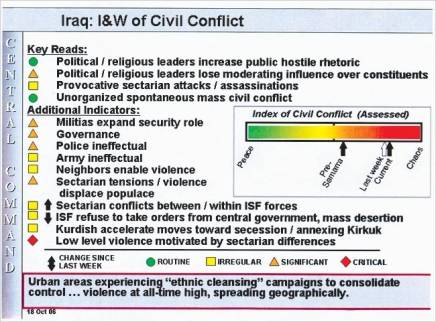
Iraq civil conflict graphic
- October 30: Bush escalates the Republican campaigns' tactics of attempting to terrorize Americans into voting Republican, saying that if Democrats win in November and begin to impose their policies on Iraq, then the terrorists will win and America will lose. "However they put it, the Democrat approach in Iraq comes down to this: The terrorists win and America loses," Bush tells a small but raucous crowd of Republican partisans at Georgia Southern University. "That's what's at stake in this election. The Democrat goal is to get out of Iraq. The Republican goal is to win in Iraq." Senate Minority Leader Harry Reid says that Bush "resorted to the same tired old partisan attacks in a desperate attempt to hold on to power." House Minority Leader Nancy Pelosi says Bush is looking to retain a "rubber-stamp Republican Congress that has done nothing to change our failed Iraq policy."
- Meanwhile, on Fox News, Dick Cheney goes even farther, saying that Iraqi insurgents are timing their attacks in an attempt to influence the elections -- presumably in favor of Democrats. "It's my belief that they're very sensitive of the fact that we've got an election scheduled," he says. "[The insurgents believe] they can break the will of the American people, [and] that's what they're trying to do."
- Both Bush and Cheney are using the most red-meat rhetoric to try to inflame their base, currently shown as flagging in their intentions to get out and vote over their anger with the Mark Foley scandal, federal spending, and the course of the Iraq war. Bush meets today aboard Air Force One with Fox talk show host Sean Hannity for an interview, and later brings Hannity to the Georgia Southern rally. But in many endangered races, Bush is choosing not to appear -- or the candidates are choosing not to appear with Bush -- and instead is sending surrogates, including perhaps his most popular fill-ins, First Lady Laura Bush and press secretary Tony Snow, himself a former Fox News host. (Washington Post)
- October 30: Former presidential candidate and Democratic senator John Kerry makes a perhaps unfortunate choice of words during a campaign speech on behalf of California gubernatorial candidate Phil Angelides. Kerry, speaking to a group of students, says that it is important for them to continue their education or they could "get stuck in Iraq." Republicans leap onto Kerry's statement and accuse Kerry, a decorated veteran of the Vietnam War, as trying to insinuate that those who join the military are not intelligent enough to find a different career. White House press secretary Tony Snow says that Kerry should apologize to US troops and their families: "What Senator Kerry ought to do first is apologize to the troops. This is an absolute insult. And I'm a little astonished that he didn't figure it out already." Republican senator John McCain, with 2008 aspirations of his own, piles on, saying that Kerry's remark is "an insult to every soldier serving in combat, and should deeply offend any American with an ounce of appreciation for what they suffer and risk so that the rest of us can sleep more comfortably at night." McCain is righteously indignant, saying, "I go out to Walter Reed quite often and see these brave young soldiers who have served and sacrificed so much. Many of them have lost limbs, as you know. And it's a very sad thing to see. But at the same time it's very uplifting." Ironically, McCain says this at a campaign rally for Congressional hopeful Peter Roskam, running against Iraq war veteran Tammy Duckworth, who lost both her legs in combat. Roskam has accused Duckworth of cowardice in regards to her opposition to the war.
- Snow, obviously trying to make a little election-season hay from Kerry's remark, is probably not ready for Kerry's counterblast in an unusually strong-worded press release that argues it is Bush and Cheney who owe the troops an apology. "If anyone thinks a veteran would criticize the more than 140,000 heroes serving in Iraq and not the president who got us stuck there, they're crazy," Kerry says. "This is the classic GOP playbook. I'm sick and tired of these despicable Republican attacks that always seem to come from those who never can be found to serve in war, but love to attack those who did. I'm not going to be lectured by a stuffed suit White House mouthpiece standing behind a podium [Snow], or doughy Rush Limbaugh, who no doubt today will take a break from belittling Michael J. Fox's Parkinson's disease to start lying about me just as they have lied about Iraq. It disgusts me that these Republican hacks, who have never worn the uniform of our country lie and distort so blatantly and carelessly about those who have. The people who owe our troops an apology are George W. Bush and Dick Cheney who misled America into war and have given us a Katrina foreign policy that has betrayed our ideals, killed and maimed our soldiers, and widened the terrorist threat instead of defeating it. These Republicans are afraid to debate veterans who live and breathe the concerns of our troops, not the empty slogans of an Administration that sent our brave troops to war without body armor. Bottom line, these Republicans want to debate straw men because they're afraid to debate real men. And this time it won't work because we're going to stay in their face with the truth and deny them even a sliver of light for their distortions. No Democrat will be bullied by an administration that has a cut and run policy in Afghanistan and a stand still and lose strategy in Iraq ."
- After the campaign appearance, Kerry holds a press conference to clarify his position, which reiterates and expands upon much of his previous statement, and backs off not one whit. "I apologize to no one for my criticism of the president and of his broken policy," he says. "If anyone owes our troops in the fields an apology, it is the President and his failed team and a Republican majority in the Congress that has been willing to stamp -- rubber-stamp policies that have done injury to our troops and to their families. My statement yesterday -- and the White House knows this full well -- was a botched joke about the president and the president's people, not about the troops. The White House's attempt to distort my true statement is a remarkable testament to their abject failure in making America safe. It's a stunning statement about their willingness to reduce anything in America to raw politics. It's their willingness to distort, their willingness to mislead Americans, their willingness to exploit the troops, as they have so many times at backdrops, at so many speeches at which they have not told the American people the truth. I'm not going to stand for it."
- Kerry continues, "Sadly, this is the best that this administration can do in a month when we have lost 100 young men and women who have given their lives for a failed policy. Over half the names on the Vietnam wall were put there after our leaders knew that our policy was wrong. And it was wrong that leaders were quiet then, and I'm not going to be quiet now. This is a textbook Republican campaign strategy: Try to change the topic; try to make someone else the issue; try to make something else said the issue, not the policy, not their responsibility. Well, everybody knows it's not working this time, and I'm not going to stand around and let it work. If anyone thinks that a veteran, someone like me, who's been fighting my entire career to provide for veterans, to fight for their benefits, to help honor what their service is, if anybody thinks that a veteran would somehow criticize more than 140,000 troops serving in Iraq and not the president and his people who put them there, they're crazy. ...I'm sick and tired of a bunch of despicable Republicans who will not debate real policy, who won't take responsibility for their own mistakes, standing up and trying to make other people the butt of those mistakes. I'm sick and tired of a whole bunch of Republican attacks, most of which come from people who never wore the uniform and never had the courage to stand up and go to war themselves. Enough is enough. We're not going to stand for this. This policy is broken. And this president and his administration didn't do their homework. They didn't study what would happen in Iraq. They didn't study and listen to the people who were the experts and would have told them. And they know that's what I was talking about yesterday. I'm not going to be lectured by a White House or by the likes of Rush Limbaugh who's taking a day off from mimicking and attacking Michael J. Fox, who's now going to try to attack me and lie about me and distort me. No way. It disgusts me that a bunch of these Republican hacks who've never worn the uniform of our country are willing to lie about those who did. It's over.
- "This administration has given us a Katrina foreign policy: mistake upon mistake upon mistake; unwilling to give our troops the armor that they need; unwilling to have enough troops in place; unwilling to give them the Humvees that they deserve to protect them; unwilling to have a coalition that is adequate to be able to defend our interests. Our own intelligence agency has told us they're creating more terrorists, not less. They're making us less safe, not more. I think Americans are sick and tired of this game. These Republicans are afraid to stand up and debate a real veteran on this topic. And they're afraid to debate -- you know, they want to debate straw men because they're afraid to debate real men. ...The bottom line is: These Republicans want to distort this policy. And, this time, it won't work because we are going to stay in their face with the truth. And no Democrat is going to be bullied by these people, by these kinds of attacks that have no place in American politics. It's time to set our policy correct. They have a stand-still-and-lose policy in Iraq and they have a cut-and-run policy in Afghanistan. And the fact is, our troops, who have served heroically, who deserve better, deserve leadership that is up to their sacrifice, period."
- During the questioning period, Kerry is asked about McCain's demand that Kerry apologize: "To those people who didn't get your joke, who may have misinterpreted you as saying the undereducated are cannon fodder, what do you say?" Kerry answers, "I never said that, and John McCain knows I've never said that and John McCain knows I wouldn't say that. And John McCain ought to ask for an apology from Donald Rumsfeld for making the mistakes he's made. John McCain ought to ask for an apology from this administration for not sending in enough troops. He ought to ask for an apology for putting our troops on the line with a policy that doesn't have an adequate coalition, that doesn't have adequate diplomacy, where we don't have a strategy to win. And what we need is to debate the real issues, not these phony, sideline issues that are part of the politics. Americans are tired -- sick and tired of this kind of politics. They know my true feelings. They know I fought to provide additional money for veterans. They know I fought to provide money for combat for veterans. They know I've fought to put money for VA. They know I've honored those veterans. They know that this is the finest military -- and I've said it 100,000 times -- that we've ever had. They know precisely what I was saying. And they're trying to turn this because they have a bankrupt policy and they can't defend it to the nation and they can't defend it to the world. And I'm not going to stand for this anymore; period. That's the apology that people ought to get."
- To the last question, he reaffirms his unwillingness to allow Republicans to smear him and his fellow Democrats: "Let me tell you something: I'm not going to give them one ounce of daylight to spread one of their lies and to play this game ever, ever again. That is a lesson I learned deep and hard. And I'll tell you: I will stand up anywhere across this country and take these guys on. This is dishonoring not just the troops themselves by pointing the finger at the troops, it's abusing the troops. They're using the troops. They're trying to make the troops into the target here. I didn't do that, and they know that. And for them to suggest that somebody who served their country, as I did, and has a record like I have in the United States Congress of standing up and fighting for the troops would ever, ever insult the troops is an insult in and of itself. And they owe us an apology for even daring to use the White House to stand up and make this an issue again. Shame on them. Shame on them. ...I honor their service, and I always have." Later on, Kerry says, "Had George Bush and Dick Cheney been in combat one minute of their comfortable lives, they would never have sent American troops to war without body armor or without a plan to win the peace, and they wouldn't be exploiting our troops today."
- A source close to Kerry says that he was trying to make a "tough and honest joke" about Bush that was mangled in Kerry's delivery. Apparently, Kerry meant to say, "I can't overstress the importance of a great education. Do you know where you end up if you don't study, if you aren't smart, if you're intellectually lazy? You end up getting us stuck in a war in Iraq." Kerry mistakenly dropped the "getting us" from his initial remarks, drastically changing the meaning. MSNBC's Chris Matthews says that from an examination of the transcript, it's clear that Kerry was insulting Bush and not the troops; in fact, Kerry preceded his botched joke with other quips about Bush, including a bit that said Bush once lived in the state of Texas, but he now "lives in a state of denial." Former Republican House member Dick Armey, a guest on Matthews's program, finds it amusing that the GOP is feigning mock outrage. Unfortunately, some Democrats are distancing themselves from Kerry, with one strategist privately grumbling, "He has already cost us one election. The guy just needs to keep his mouth shut until after the election." But former senator Max Cleland, a disabled Vietnam veteran, says, "John Kerry is a patriot who has fought tooth and nail for veterans ever since he came home from Vietnam. He has stood with his brothers in arms unlike this administration, which exploits our troops to make a political point and divide America." (MSNBC, Daily Kos, Hoffmania. John Kerry, New York Times)
- October 31: Iraqi prime minister Nouri al-Maliki orders the lifting of joint US-Iraqi military checkpoints around the Shi'ite militant stronghold of Sadr City and other parts of Baghdad in a move to assert his authority with the Americans and appeal to his Shi'ite support base. Within hours, US forces disappear from the checkpoints. Their departure is marked with celebrations among civilians and armed men on the edge of the sprawling slum controlled by the Mahdi Army militia run by radical anti-American cleric Moqtada al-Sadr. Al-Maliki's order for US troops to remove themselves is another move by the beleagured prime minister to assert his independence from US control. The tightened security had been credited by some for producing a temporary decline in violence, possibly because it curbed the activities of Shiite death squads blamed for waves of sectarian killings of Sunnis. The extra checkpoints were set up last week around Sadr City as US troops searched for a missing American soldier and raided homes looking for death squad leaders in the area. Other checkpoints manned by US troops were erected in the downtown Karradah neighborhood where the soldier was abducted. Calling the US checkpoints a "siege," al-Maliki says, "If this siege continues for long, we will resort to actions which I will have no choice but to take, God willing, and when the time is right." Al-Maliki was apparently angered by a statement from US Ambassador Zalmay Khalilzad that the prime minister had agreed to set a timeline for progress on reaching security and political goals, something al-Maliki denies. (ABC News)
- October 31: Veteran political reporter Robert Parry makes a compelling case for the idea that Islamic terrorists such as al-Qaeda are hoping for a Republican victory on November 7, because with Republicans continuing their "leadership" of the US, they have a far better chance of achieving their goals. "[Tt]here is a symbiotic relationship between Bush's blunderbuss 'war on terror' and bin Laden's ruthless strategy of terrorist violence -- one helping the other," he writes. He cites the recently leaked National Intelligence Estimate that cited the Iraq war as the "cause celebre" used around the world to recruit new jihadists, and al-Qaeda's own internal statements saying that they hoped the US would remain "bogged down" in Iraq for as long as possible: "Prolonging the war is in our interest," wrote one of bin Laden's top lieutenants. The likelihood that Bush, given a Republican victory on November 7, would invade either Iran or Syria, or perhaps both, is right in line with al-Qaeda's own hopes. As the violence in the Middle East worsens, millions of Muslim moderates would be forced to choose between supporting the American "infidels" invading and occupying even more of their sacred lands, or supporting Islamic jihadists. Many would not support the Americans. "Like any violent revolutionary, bin Laden knows that the greater the polarization the faster his extremist ideology can grow," Parry writes. "...Bush and bin Laden are the proverbial two sides of the same coin, both benefiting from the other's existence and actions. Indeed, in the six years of the Bush administration, bin Laden could not have found a more perfect foil -- or some might say a more useful fool -- than George W. Bush."
- Many observers on both the left and right believe that bin Laden released his October 29, 2004 videotape in hopes that the reaction among American voters would give Bush the victory in that year's presidential victory, a hope that was realized. The tape denouced the Bush administration, and right-wing pundits immediately spun the videotape into bin Laden's 'endorsement' of Democrat John Kerry. Polls registered an immediate bump of about five points for Bush. However, inside CIA headquarters, senior intelligence analysts reached the remarkable conclusion that bin Laden's real intent was to help Bush win a second term. "Bin Laden certainly did a nice favor today for the President," said deputy CIA director John McLaughlin in opening a meeting to review secret "strategic analysis" after the videotape had dominated the day's news. CIA analysts had spent years "parsing each expressed word of the al-Qaeda leader and his deputy, Zawahiri," according to author Ron Suskind in his book The One-Percent Doctrine. "What they'd learned over nearly a decade is that bin Laden speaks only for strategic reasons. ...Today's conclusion: bin Laden's message was clearly designed to assist the President's reelection." Jami Miscik, CIA deputy associate director for intelligence, expressed the consensus view that bin Laden recognized how Bush's heavy-handed policies -- such as the Guantanamo prison camp, the Abu Ghraib abuse scandal and the war in Iraq -- were serving al-Qaeda's strategic goals for recruiting a new generation of jihadists. "Certainly," Miscik said, "he would want Bush to keep doing what he's doing for a few more years." As their internal assessment sank in, the CIA analysts were troubled by the implications of their own conclusions. "An ocean of hard truths before them -- such as what did it say about US policies that bin Laden would want Bush reelected -- remained untouched," Suskind wrote. Parry notes, "Bin Laden had played Brer Rabbit to America's Brer Fox as in the old Uncle Remus fable about Brer Rabbit begging not to be thrown into the briar patch when that was exactly where he wanted to go."
- Another successful manipulation of American political rhetoric came in July 2005, when al-Qaeda leaders worried about the potential for thousands of sympathetic young "mujahedeen" in Iraq deserting their cause after the Americans left Iraq. To avoid that, the leaders, including Zawahiri, decided to have the al-Qaeda leader in Iraq, Ayman al-Zarqawi, talk up the idea of a "caliphate" stretching through much of the Middle East. The idea of such a large, all-encompassing political and religious entity was patently impossible to achieve, they knew, but such rhetoric would inflame American conservatives. They were right: within days, Bush, his officials, and right-wing pundits began railing against the concept of such a "caliphate" and used that idea to justify America's continual presence in Iraq. Parry concludes, "So, contrary to Bush's assertion that a Democratic congressional victory means 'the terrorists win and America loses,' the opposite might be much closer to the truth -- that a continuation of Bush's strategies, left unchecked by Congress, might be the answer to bin Laden's dreams." (Consortium News)
- October 31: A federal judge in Texas has blocked Republican state Attorney General Greg Abbott's use of an obscure election law to harass 13 Democrats, 12 of whom are either Hispanic or African-American, and almost all of whom are elderly females. The law prohibits voters from having an absentee ballot, even when, in the case of these 13 aged voters, the ballots are in their possession because they need assistance in casting their votes. The 13, all Democrats, had their absentee ballots in sealed envelopes. Judge John Ward grants a preliminary injunction stopping Abbott and his fellow Republican, Roger Williams, from continuing their prosecution of the 13 elderly Democrats. No Republicans have been charged with similar crimes. Says the Lone Star Project's Matt Angle, "Greg Abbott was not only improperly enforcing a flawed statute, but creating an atmosphere of intimidation and fear. Abbott has acted in a shameless manor, and Judge Ward's order is welcome protection for voters in Texas." Many political observers in Texas believe that Abbott is attempting to intimidate elderly Democratic voters from seeking assistance in casting their ballots. The Democratic candidate for AG, David Van Os, writes, "[T]he Texas Democratic Party has won a preliminary injunction stopping Attorney General Greg Abbott and Secretary of State Roger Williams from prosecuting voters who are trying to help seniors exercise their right to vote. Texas Republicans know that they would lose fair and free elections. That's why they've done everything they can to stack the deck...even if it means willfully ignoring the law and abusing the power of their office." Van Os goes on to slam the Republican gerrymandering of Texas's electoral districts, their use of corporate money to fund state House elections, and their attempt to override the results of a legally held primary in their attempt to remove Tom DeLay from the ballot after he decided to quit the US House instead of letting him face what Van Os calls " certain defeat at the ballot box." The Texas Democratic Party is filing an additional lawsuit challenging the legality of the provision.
- In eight of these cases, Abbott is prosecuting Texas voters for the simple act of assisting an elderly voter by making sure their completed and sealed ballot is placed in a mail box or delivered to an elections office. In none of these eight cases was the assistor accused of mis-marking a ballot or doing anything fraudulent. Abbott has so far spent an extraordinary $1.2 million investigating and attempting to prosecute these 13 victimized voters, all of which from the misuse of federal Byrne grants, which are awarded strictly for the battle against violent crime. (Lone Star Project/Daily Kos)
- October 31: In at least one instance, a Republican attack ad has seriously backfired on its purveyor. In the race for governor of Massachusetts, Republican Kerry Healey, previously keeping the race within a dozen percentage points of her Democratic opponent Deval Patrick through her attacks on Patrick's credentials on crime. But lately polls have shown Patrick opening up a near-30 point lead on Healey, largely because of a negative reaction to a Healey attack ad. One pollster, David Paleologos, says Healey crossed a line with the ad. The ad, detailed in an above item, charged Patrick, an African-American, with supporting convicted rapist Benjamin LaGuer. Patrick initially said his support was limited to writing a letter "maybe 15 years ago" to a parole board, but it later came out he had donated money for a DNA test, which eventually tied LaGuer to the crime. Paleologos says Healey's campaign carried the controversy too far. Campaign volunteers in prison-style orange jumpsuits picketed the homes of Patrick and his campaign manager, an action Healey later chastised after the public reacted negatively. Stories surfaced in the media of a 1993 rape conviction against one of Patrick's relatives, stories that the Healey camp most likely released (though the campaign denies any connections). Then Healey launched a controversial TV ad that showed a white woman walking alone in a dark parking garage and cut to Patrick describing LaGuer as "eloquent." The Reverend Jeffrey Brown, an African-American pastor, says, "What you get is that age-old, ancient stereotype in this nation of black men wanting to harm white women in a sexual way. I don't know of a black man that I've talked to who did not feel uncomfortable watching that commercial." Brown says he was once a Healey supporter. Political scientist William Mayer says that Healey also went overboard in attacking Patrick's family with the story of the 1993 rape conviction. "The LaGuer issue itself is perfectly reasonable," he says. "But I think you've got to tread lightly with it...[and] she rather significantly overplayed her hand." (Christian Science Monitor)
- October 31: Republicans in New York's Westchester County are already attempting to intimidate Democratic voters by challenging their right to cast their ballots. The same tactics worked in 2004, when Republican Nicholas Spano defeated Democrat Andrea Stewart-Cousins in a hotly challenged race that was not settled for three months and a bitterly contested recount that gave Spano an 18-vote victory. In 2004, GOP lawyers, led by John Ciampoli, successfully challenged the right of hundreds of paper ballots to be counted, mostly on small technicalities such as the failure of a voter to report an address change. Though Ciampoli now says that his top priority is simply to ensure that the election remains "as free of fraud as I can," almost all of those votes he and his colleagues challenged were of Democrats. This year Ciampoli and his colleagues have already challenged 5,929 voters based on change-of-address cards filed with the US Postal Service; again, almost all of those voters are Democrats, and most of them are blacks, Hispanics, and other minorities. Stewart-Cousins, who is black, has set up a telephone hot line for any challenged voter to call. "They cannot win in a fair fight, so they are trying to scare registered voters into staying away from the polls," she says. Two deputy commissioners at the Westchester County Board of Elections, Republican Melissa Nacerino and Democrat Jeannie Palazola, say that the process of verifying all the challenged addresses could not be completed before Election Day, but that files would be kept and the votes could be challenged after the election. To check an address, a first-class letter is sent to each person. If the letters come back undelivered, police are asked to visit the address and see whether the registered voter lives there. Democratic lawyer Jeffrey Pearlman said it is intimidating "to have police going to the houses of voters in mostly minority districts, knocking on the door, asking, 'What's your name? Is this really you?' It's voter suppression." (Boston Herald)
- October 31: Mike Stark, a former Marine, first-year law student, and self-described "citizen journalist," is viciously assaulted by three staff aides to Republican senatorial candidate George Allen. Stark approaches Allen after an Allen campaign rally at an Omni Hotel in Charlottesville, Virginia, and begins attempting to ask Allen about why he refuses to make his arrest records public, and whether or not rumors of him spitting on his wife are true. (Stories of Allen's apparent fondness for spitting on women have been circulating through the media for weeks. In recent days, Allen's campaign has tried to portray opponent Jim Webb as a misogynist, using several out-of-context passages from Webb's six novels about Vietnam as "evidence.") Allen refuses to acknowledge Stark, but three of Allen's campaign staff immediately leap upon Stark, put him in aheadlock, and wrestle him to the ground, in the process ramming Stark's head into a glass window (which luckily did not shatter and injure Stark). Shortly after the assault, Allen dismisses the incident with an airy, "Things like that happen," but later adopts a more magisterial approach, saying, "People have a right to express themselves and do it in a peaceful manner. And that's their right to do so." (Interestingly, much of the media coverage is quite deferential to Allen, calling Stark an "agitator," a "protester," or a "heckler." One anchor even says that since Stark was "carrying a backpack," he should have been treated with suspicion.)
- Unfortunately, Allen's campaign soon decides to pin the blame for the entire incident on Stark and, somehow, on Allen's Democratic opponent, Jim Webb. In a press release (which calls on Webb to "restrain his supporter," a ridiculous request since Webb's campaign has never heard of Stark), Allen's campaign says Start "aggressively went after" Allen, "his wife Susan, and Senator Elizabeth Dole, screaming that he answer inappropriate questions." The wording of the press release is to give the impression that Stark was not asking a legitimate question, he was "screaming" in an out-of-control fashion, and that he was somehow threatening the two women in Allen's company. As is evident from the video, none of these allegations are true. The release accuses Stark of pushing an Allen staffer -- more accurately, Stark shouldered past a staffer who was attempting to block his path -- and then, according to the release, "volunteers restrained him and asked to leave the building when he approached the Senator a second time, asking inappropriate questions." Again, a look at the video shows how deliberately incorrect this description is.
- The release then attacks Stark as "a frequent Daily Kos blogger [who] aggressively confronted Senator Allen in front of TV cameras and been removed from the premises by event security. In August, Stark was asked to leave a Holiday Inn by management 'after he became combative' while interrupting a press conference with Senator Allen. ...Stark has a history of violent outbursts on the Daily Kos, an extreme left-wing website, such as his post 'The F*****g Way...Take These RNC F*****s Down.' ...He also posted his intention last night on his blog, Calling All Wingnuts, which is subtitled 'Kickin' a*s on the lyin' side: A never-ending battle against stupid, ugly, deceitful and corrupt right-wing water carriers...' in which he wrote in reference to stalking Senator Allen, 'So yeah... I miss doing this stuff -- it seemed that at least once a month, something would happen that really got the adrenaline flowing... I miss those tasty morsels of victory.'" Stark has indeed verbally accosted Allen and other right-wingers both on the phone and in person, but has scrupulously avoided becoming physically confrontational, and his rhetoric on the Daily Kos has often been profane and derogatory towards Republicans, but never violent. "I'm also trying to 'Roger and Me' George Allen whenever I can," he recently wrote, in reference to Michael Moore's famous film of the same name, where Moore spent months trying without success to confront GM CEO Roger Smith.
- Stark is unapologetic, telling an AP reporter, "I am a constituent. I am allowed to ask my US senator questions." In a letter printed in the Richmond Times-Dispatch, Stark says that he intends to press charges against Allen and the three staffers who assaulted him, and writes, "I demand that Senator Allen fire the staffers who beat up a constituent attempting to use his constitutional right to petition his government. I also want to know why Senator Allen would want his staffers to assault someone asking questions about matters of public record in the heat of a political campaign. Why are his divorce records sealed? Why was he arrested in the 1970s? And why did his campaign batter me when I asked him about these questions[?] George Allen defends his support of the Iraq war by saying that our troops are defending the ideals America stands for. Indeed, he says our troops are defending our very freedom. What kind of country is it when a Senator's constituent is assaulted for asking difficult and uncomfortable questions? What freedoms do we have left? ...Demanding accountability should not be an offense worthy of assault. I will be pressing charges against George Allen and his surrogates later today. George Allen, at any time, could have stopped the fray. All he had to do was say, 'This is not how my campaign is run. Take your hands off that man.' He could have ignored my questions. Instead he and his thugs chose violence. I spent four years in the Marine Corps. I'll be damned if I'll let my country be taken from me by thugs that are afraid of taking responsibility for themselves. It just isn't the America I know and love. Somebody needs to take a stand against those that would bully and intimidate their fellow citizens. That stand begins right here, right now." Several observers have noted that Stark, with his Marine training, chose not to defend himself against the Allen staffers' aggression, when, presumably, he could have wreaked havoc on them if he had chosen. Instead he is choosing to handle the incident through legal channels.
- In several interesting turns of events, Allen campaign spokesman Chris LaCivita is now claiming that none of the three who assaulted Stark are employed by the Allen campaign -- presumably, if LaCivita is telling the truth, they are unpaid volunteers. And the Charlottesville police are, apparently, breaking their own procedures in refusing to handle the situation correctly: "We will find out who the people are, give him the information and he can go to the magistrate and try to obtain a warrant for them," says an officer; a lawyer responds, "The notion that a regular citizen would appear before a judge to obtain a warrant for an arrest is just plain bizarre. Police enforce the warrant and the district attorney (or his/her equivalent) prosecutes the crime." And Stark has just been hired as a reporter for Air America's "Young Turks." (WVIR-TV [link to video], Alternet [link to video], WVIR-TV, AP/Florida Times-Union, Virginian-Pilot, Daily Kos, Daily Kos)
- October 31: Once the darling of the Florida GOP, Katherine Harris, the former Secretary of State who in essence stole the 2000 campaign for George W. Bush, has seen her campaign for senate implode around her. She trails Democrat Bob Nelson by as much as 35 points in the polls, the state and national Republican organizations have abandoned her campaign, and some of her former staffers describe her as virtually insane. She says many of her former staff members -- of which there are many -- are colluding with both Nelson and the ungrateful national Republican organizations to "get" her. She is writing a tell-all book about the entire experience. "The only way Bill Nelson could lose this," says Darryl Paulson, a Republican political scientist at the University of South Florida, "is if he got himself in a drug-induced stupor and ran naked down the main street of his home town."
- Of course, none of this is her fault, in her view, not the bribery allegations, not the temper tantrums, not the bizarre statements that have alienated voters by the thousands. Former chief adviser Ed Rollins, who managed Ronald Reagan's reelection to the White House in 1984, said working for Harris was like "being in insanity camp." He likened her staff to dogs that have been kicked. Before he became the first of three campaign managers to quit, Jim Dornan programmed his cellphone to play the theme song from "The Exorcist" when Harris called. Several of her former staffers say they would have kept silent about goings-on in the Harris campaign if Harris herself had not publicly criticized them after they left, accusing them of being bad at their jobs, of putting "knives in my back" and of working with the Nelson campaign. They describe her as a micromanager, unable to trust her staff, prone to tears and rages over tiny things. They say she would rewrite speeches and press releases over and over. She would get upset if an aide hadn't brought her the correct coffee order from Starbucks. Dornan, the former campaign manager, says Harris was so concerned that only the best photographs of her went up on the campaign Web site that she insisted on going through every picture. "It would be weeks and weeks and weeks before we could put anything up on the Web site," he says. (Harris spends an inordinate amount of time on her appearance, and often appears in tight clothing and short skirts that some staffers believe to be, at best, un-senatorial.) "She just goes completely ballistic," he recalls. He says she yelled at him for 10 minutes and accused him of ruining her life. "I literally held the phone away from my ear, and everybody within a six-foot circle of me could hear her screaming." The presidential ambitions she seems to still cherish are, apparently, merely dreams.
- Her apparent religious mania has manifested itself in numerous and unsettling ways. Two former staffers, Rollins and former manager Jamie Miller, says that Harris told them that God wants her to be a senator. The Harris campaign has suffered a series of embarrassing gaffes. According to one Florida paper, her Web site listed endorsements from people who hadn't endorsed her. According to another paper, her campaign organized a rally in an airport hangar, but none of the nine officials named on her flier showed up. In the spring, Harris announced on television she was putting $10 million of her inheritance from her father into the race. Later, she said it turned out the inheritance would not be available, so she'd put in her own money. Thus far, she has put in approximately $3.2 million, which is, she says, "everything that I have liquid." Her campaign has less than $1 million left, while Nelson has over $7 million. Nelson is blasting the airwaves with television ads; Harris has a single ad running, and it just begun airing on October 30.
- Harris turns to the Bible for inspiration, especially to the story of Queen Esther, whom she seems to idolize. She tells a reporter, "I'll give you one verse. On the day that the enemies of the Jews had hoped to overpower them, the opposite occurred, in that the Jews themselves overpowered those who hated them." The bemused reporter asks what that has to do with the race. "November 7th," she replies. (Washington Post)
- October 31: Author Eric Boehlert takes the American media to task for lying for Rush Limbaugh and condoning his horrendous attacks on Michael J. Fox (see above item). The media has accurately portrayed Limbaugh's savaging of Fox over Fox's ads for Democratic candidates who support stem cell research, but many outlets have also reported, falsely, that Limbaugh has apologized for his verbal and physical belittling of Fox. Boehlert says, "Limbaugh said if he was proven wrong he'd apologized. But the press took that for an apology itself. Days later, as the controversy raged, Limbaugh was even clearer, insisting, 'I stand by what I said [about Fox]. I take back none of what I said. I wouldn't rephrase it any differently. It is what I believe. It is what I think. It is what I have found to be true.' That quote was key to understanding the radical, remorseless position Limbaugh had staked out for himself." At least eight major Canadian newspapers published Limbaugh's refusal to apologize. In America, none did. Boehlert writes, "The sounds of silence were fitting for a press corps that treated Limbaugh's allegation as rational, manufactured a central element of the story (his 'apology'), mischaracterized Fox's commercial, suggested his actions had 'spark[ed]' the controversy, and absolutely refused to put Limbaugh's attack in any sort of historical context regarding the talker's established record of hate speech."
- Boehlert continues, "[T]his is nothing new. Despite Limbaugh's torrent of rhetoric about how the press vilifies him (it's called a schtick; every radio talk show host needs one), the truth is Beltway media players routinely play nice with Limbaugh and his fringe brand of conservatism. Anxious for his right-wing seal of approval (and spooked by his liberal bias charges), the mainstream press corps has for years treated Limbaugh with undeserved respect, worked to soften his radical edges, and presented him as simply a partisan pundit. Why else would the Washington Post equate Limbaugh to Comedy Central's award-winning late-night satirist Jon Stewart? And why else would washingtonpost.com describe Limbaugh as a 'mainstream conservative' who simply 'pokes fun' at Democratic 'policy' and not at individuals? As if on cue last week, the press treated Limbaugh's odious, left-field attack as if it were a normal part of the public discourse -- naturally somebody would question whether Fox's body contortions were part of an act. 'Rush has done his job well,' blogger Jane Hamsher wrote at FireDogLake last week. 'The goalposts are suddenly moved, this is considered a legitimate line of inquiry.'"
- One of the most egregrious Limbaugh defenders during the Fox savaging was the Today Show's Matt Laeur of NBC, who, in Boehlert's words, "painted Limbaugh as some sort of Everyman, speaking the quiet truths of most Americans" by asking, "Rush Limbaugh started a lot of controversy when he said perhaps Michael J. Fox is exaggerating or faking these effects of Parkinson's Disease in that ad promoting stem cell research. Didn't Rush Limbaugh just say what a lot of people are privately thinking?" Boehlert responds, "Lauer assumed lots of people watched Fox, who suffers from an incurable brain disorder, and figured, yeah, he's fakin' it."
- Boehlert recounts an interesting exchange between ABC's Ryan Owens and deputy political director David Chalian that illustrates how reluctant most media figures are to offend Limbaugh. On ABC's digital/broadband show Inside the Newsroom, the two, who had just aired Limbaugh's quote about how Fox was "exaggerating the effects of the disease. He is moving all around and shaking. And it's purely an act," said the following:
- OWENS: Guess what, I'm gonna stay out of this and toss it right over to you, David. What do you think?
- CHALIAN: You know, as for Rush Limbaugh -- I'm not gonna pick a fight with Rush Limbaugh.
- OWENS: At least you try to respond, which makes you a better man than me.
- Owens and Chalian may be less cowards than prudently attempting to keep their jobs; their boss at ABC News, Mark Halperin, is a longtime, outspoken Limbaugh admirer who calls the talk show host an "American iconic" figure. Halperin also agrees with Fox News's Bill O'Reilly that the mainstream media has a liberal bias, and that Halperin's job is to convince conservative partisans that his news organization can be trusted. "In that context," Boehlert writes, "ABC's continuously skewed coverage of Limbaugh's 'apology' begins to make sense." ABC's rhetoric has consistently painted Fox as the attacker, not Limbaugh, even going so far to opine (as part of its "straight" news coverage) that it was Fox's ad that was "raising lots of eyebrows" and not Limbaugh's response. Boehlert writes, "Let's be clear, Fox's commercial in and of itself when it aired in Missouri on October 21 was a non-story nationally. The real-time reaction to the ad in the press as well as by big-time conservatives was virtually nil. (Go back and check the transcripts and the clips. I did.) Without Limbaugh and his baseless, tasteless allegation, the Fox ad would have quietly come and gone, generating only minor interest. But the press, led by ABC, seemed determined to tag Fox for creating the uproar."
- And, of course, Limbaugh has yet to apologize for his vicious attacks on Fox, but the media has reported differently. Limbaugh said on October 23, "So I will bigly, hugely admit that I was wrong and I will apologize to Michael J. Fox, if I am wrong in characterizing his behavior on this commercial as an act." AmericaBlog's John Aravosis responded shortly thereafter, "That's not an apology. It's not even one of those lame 'I apologize if you were offended' apologies." But that's not what ABC reported. Or CBS. Or NBC, CNN, Fox, MSNBC, NPR, USA Today, the Pittsburgh Post-Gazette, Time, the Associated Press, the Kansas City Star, the Washington Post, the New York Daily News, the Houston Chronicle, the Baltimore Sun, the Washington Times, the Los Angeles Times, and the Wall Street Journal, just to name a few. Even after Limbaugh made his "I stand by what I said" statement, media outlets continued to report his "apology." Boehlert concludes, "Yet the media still clung to the quaint, naive notion that Limbaugh, seeing the error of his ways, said he was sorry for smearing a sick man suffering from a degenerative disease. The press just can't bring itself to tell the truth about Rush Limbaugh." (Media Matters)
