THIS FAR AND NO FURTHER
A Timeline of Events Surrounding the Radical Right's Attempt to Subvert American Democracy
Written and Compiled by Black Max
May 2004:
Week One



- May 1: The shock and outrage over the photos of Iraqi prisoners being abused and tortured by US, and now British, soldiers continues to mount across the world. Baghdad newspapers have yet to print any of the pictures, because Iraqis will find them so offensive, according to one editor. More photos have been published since the original photos ran on April 28's 60 Minutes II broadcast, including one of a British guard urinating on a prisoner. London's Daily Mirror, which printed the photos, says it received them from soldiers who have returned from Iraq, who claim a rogue element in the British army is responsible for abusing prisoners and civilians. The soldiers told the paper no charges were brought against the unnamed captive. During the captive's eight-hour ordeal, he was threatened with execution, his jaw was broken, and his teeth smashed. After being beaten and urinated on, he was driven away and dumped from the back of a moving vehicle, the soldiers claimed, unaware if he was dead. The reason for making the photos public, the soldiers say, is to show why the US-UK coalition was encountering such fierce resistance in Iraq. One told the paper: "We are not helping ourselves out there. We are never going to get them on our side. We are fighting a losing war."
- The response from Blair and the British military is very similar to that of US officials: condemning the actions, but supporting the military and emphasizing that the actions are those of a very few soldiers. Blair says: "Let me make it quite clear that if these things have actually been done, they are completely and totally unacceptable. We went to Iraq to get rid of that sort of thing, not to do it. If these things have happened, they've got to be condemned utterly. I think in fairness, however, we should say that there are thousands of British troops in Iraq doing a very brave, extraordinary job on behalf of the Iraqi people and on behalf of our country to make the country better." British Army commander General Michael Jackson, speaking on behalf of Britain's minister of defense, says he is aware of the allegations and that the ministry has launched an investigation. He says, "The British Army should not be judged by the reprehensible ill discipline of a few soldiers -- who by this shameful behavior have let down the tens of thousands of British soldiers." Amnesty International spokesman Neil Dirkin says, "It's important that the public knows what the British army is doing in Iraq. It's important for Iraqis that they can trust the British army on the streets and feel that if their relatives are taken into custody, they will be at least looked after and, certainly, certainly not tortured."
- Ivan Frederick, the father of a military policeman involved in the case, Army Reserve Staff Sergeant Ivan "Chip" Frederick, says his son is "worried, and I'm sure he's scared." Frederick, with the 800th Military Police Brigade based at Cresaptown, Maryland, was relieved of his duties in mid-January, his father says. "When he left [the prison] he said there was some 900 prisoners," up from 400 when he arrived, the father says. He says his son had 70 Iraqis who he was trying to train to be security guards at the prison, and the language barrier made it hard to communicate with them. He says his son had been detained at Camp Victory in Iraq without an attorney for 82 days. "There's two sides to the story," says Frederick. "The military has one and we have another. We are a close-knit family, we always have been, and we are determined to do whatever it takes to get this situation straightened out. He's a perfect son."
- White House spokesman Scott McClellan describes the acts depicted in the photos as "despicable." "We cannot tolerate it, and the military is taking strong action against those responsible," McClellan says. He said the president has known about the images for some time, but refuses to elaborate. When asked about a potential worldwide backlash over the pictures, McClellan says, "It does not represent what we stand for, and I think the military has made it very clear that they are going to pursue -- to the fullest extent of the law -- these individuals." US intelligence officials say the CIA Inspector General is cooperating with Defense Department officials in the abuse investigations, including one case in which an Iraqi detainee died in the Abu Ghraib prison. A US intelligence official says CIA personnel had nothing to do with photos taken by US soldiers of Iraqi prisoners being abused at the same prison. "We do not support or condone abusing prisoners, and if we hear any such allegations, they are reported" to the CIA's inspector general, an official says. Brigadier General Mark Kimmitt, the coalition's deputy chief of operations, says he is "appalled that fellow soldiers who wear the same uniforms as us would do this. ...They crossed the line and violated every tenet we teach in the Army about dignity and respect," and adds he is expressing his personal opinion and not speaking on the coalition's behalf. CBS says it has dozens more pictures purportedly showing a range of abuses that it has yet to air.
- An investigation began in January after a soldier reported the alleged abuse to superiors, Kimmitt said this week. "We are committed to treating all persons under coalition custody with dignity, respect and humanity," he says. "Coalition personnel are expected to act appropriately, humanely and in a manner consistent with the Geneva Conventions." Abdel Bari Atwan, editor of Al-Quds Al-Arabi newspaper in London, says, "It is absolutely shocking. I think this is the end of the story, the straw that broke the camel's back, for America. People will be extremely angry. ...Sexual abuse is the worst thing in that part of the world. It is shocking to all Muslims. America has lost the battle completely. I believe there will be more attacks. ...I think the British job will be extremely difficult because we are associated with this torture. ...Iraqis expected the Americans and British to bring democracy and human rights and not the same thing as under Saddam. We have replaced a brutal dictator with a brutal super-power." Ann Clywd, a Labor MP who serves as Tony Blair's human rights envoy to Iraq, says she had raised the treatment of detainees at the prison with officials at the White House, but they had denied there was a problem. (CNN, CNN, Scotland Evening Times, BBC, Washington Post [gallery of prisoner abuse photos])
"Torture demonstrates weakness, not strength. It does not show understanding, power, or magnanimity. It is not leadership. It is a reaction of government officials overwhelmed by fear who succumb to conduct unworthy of them and of the citizens of the United States." -- Burton Lee, George H.W. Bush's personal physician and a former Army Medical Corps officer, quoted in the Washington Post
/BLOCKQUOTE>
British soldiers are shown abusing Iraqi prisoners
- May 1: The British newspaper The Mirror prints statements by two British soldiers detailing the graphic and horrifying abuse they witnessed being meted out to Iraqis in Basra. One soldier describes a prisoner being beaten to death: "Basically this guy was dying as he couldn't take any more. An officer came down. It was 'Get rid of him - I haven't seen him'. The paperwork gets ripped. So they threw him out, still with a bag on his head." Weeks after the pictures were taken, a captive was allegedly beaten to death in custody by men from the same Queen's Lancashire Regiment, members of which are alleged to have tortured a number of Iraqis. One of the soldiers tells of the beating death, beginning with a a young Iraqi hauled in under suspicion of stealing from the docks: "You pick on a man and go for him. Straightaway he gets a beating, a couple of punches and kicks to put him down. Then he was dragged to the back of the vehicle." Immediately a sandbag is placed over the man's head and his hands tied behind his back. "As we took him back he was getting a beating. He was hit with batons on the knees, fingers, toes, elbows, and head. You normally try to leave off the face until you're in camp. If you pull up with black eyes and bleeding faces you could be in sh*t. So it's body shots -- scaring him, saying 'We're going to kill you'. A lot of them cry and p*ss themselves. Because it was so hot we put him in the back of a four-tonner truck which has a canopy over it. That's where the photos were taken. Lads were taking turns giving him a right going over, smashing him in the face with weapons and stamping on him. We had him for about eight hours. You could see blood coming out early from the first 'digs'. He was p*ssed on and there was spew. We took his mask off to give him some water and let him have a rest for 10 minutes. He could only speak a few words, pleading 'No, mister,' No, mister.' I did less than the others. But I joined in. Me and my mate calmed down. Then two lads come on and it starts again. He was missing teeth. All his mouth was bleeding and his nose was all over the place. He couldn't talk, his jaw was out. He's had a good few hours of a kicking. He was on his way to being killed. There's only so much you can take."
- After the officer allegedly told the attackers to get rid of the suspect he was driven off: "The lads said they took him back to the dock and threw him off the back of a moving vehicle. They'd have freed his hands, but he'd still be hooded. He'd done nothing, really. I felt sorry for him. I'm not emotional about it, but I knew it was wrong." The second soldier says of the second beating, in September 2003, "It was only a matter of time. We had one who fought back. I thought 'Don't do that', it's the worst thing you can do. He got such a kicking. You could hear your mate's boots hitting this lad's spine. One of the lads broke his wrist on a prisoner's head. Another nearly broke his foot, kicking him. We're not helping ourselves out here. We're never going to get the Iraqis on our side. We're fighting a losing war." The soldier claims that after the September beating, troops were told to destroy incriminating evidence. He says, "We got a warning, saying the Military Police had found a video of people throwing prisoners off a bridge. It wasn't 'Don't do it' or 'Stop it'. It was 'Get rid of it.'" At least one soldier is expected to be charged with manslaughter. The two infantrymen claim abuse has started because Iraqi police are powerless to process suspects. The second soldier says, "There's no point taking them to the police station because they're released within 20 minutes. The coppers don't want any comeback and let them go. All we do is teach them a lesson our way. You're knackered and you don't want to be going to a police station and doing statements, just for them to be released. Give them a kicking, then it's done and dusted. A lot of the younger ones are worse. It's as though they've something to prove. You've got a gun and you're the law. You can make people do whatever you want." Both men fear the situation is worsening, with UK troops now seen as the enemy, rather than liberators. One says: "I can't believe it has taken the Iraqis so long to fight back. If it had been me or my family, I'd have retaliated straightaway. They've just got f*cked around so much. You can't go in now, and say 'Right, let's forget about what has happened and start again.' We're struggling now. There are too many people against us."
- Note: The veracity of this story is later thrown into doubt. (Mirror/Global Security)
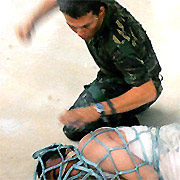
US soldier beating an Iraqi prisoner
- May 1: The head of the US Selective Service proposes drafting women into the military, and says all Americans of draft age need to periodically inform the government of their acquisition of "niche skills" being sought by the military. The proposals, presented on February 11, 2003 by Director Lewis Brodsky to senior Pentagon officials, also recommends raising the draft age from 25 to 34. The proposal was made privately, but was just now obtained by Freedom of Information Act requests. Pentagon officials characterize the proposals as no more than "food for thought." The US Congress would have to vote to reinstate the draft, which was abandoned in 1973 during the Vietnam war; a majority of legislators, along with Joint Chiefs of Staff head Richard Myers and Defense Secretary Donald Rumsfeld, pubicly oppose a draft. Nevertheless, the Pentagon has already taken steps to determine the process of reinstituting the draft. Registration for the draft resumed in 1980 under then-President Carter. At present, the Selective Service is authorized to register only young men and they are not required to inform the government about any professional skills. Separately, the agency has in place a special registration system to draft health care personnel in more than 60 specialties into the military if necessary in a crisis. Some of the skill areas where the armed forces are facing "critical shortages" include linguists and computer specialists, the agency says. Americans would then be required to regularly update the agency on their skills until they reach age 35. Individuals proficient in more than one critical skill would list the skill in which they have the greatest degree of competency. (Seattle Post-Intelligencer)
- May 1: In his weekly radio address, Bush says that he foresees peace and stability in Iraq: "Despite many challenges, life for the Iraqi people is a world away from the cruelty and corruption of Saddam's regime," he says. "[W]we will finish our work." The Democratic response is by Iraq war veteran Paul Rieckhoff, who says he is disappointed in Bush and his handling of the war. "Our troops are still waiting for more body armor," he says. "They are still waiting for better equipment. They are still waiting for a policy that brings in the rest of the world and relieves their burden," says Rieckhoff, an Army National Guard first lieutenant who was a platoon leader in Iraq. Rieckhoff calls his comrades in Iraq "and women of extraordinary courage and incredible capability. But it's time we had leadership in Washington to match that courage and match that capability." Bush continues to dispute the basic facts of the Iraqi insurgency, insisting that the resistance, which he still claims is made up of local militias, angry supporters of Saddam Hussein, and foreign terrorists, "have found little support among the Iraqi people." He says he is prepared to let local Iraqis negotiate the disarmament of "radicals" in the city of Fallujah while insisting that militias in the city of Najaf and elsewhere "must disarm or face grave consequences." Yesterday in Fallujah, Iraqi troops replaced US Marines and raised the Iraqi flag at the entrance to the city under a plan to end the monthlong siege there. US officials say military commanders won't wait forever for local political efforts to quell the insurgency in Fallujah. The United Nations' envoy to Iraq, Lakhdar Brahimi, has said that ordering American troops into Fallujah and Najaf "is not the right thing to do" and would anger the Iraqi people. Coalition soldiers surround both cities. Bush says the bigger picture in Iraq is much brighter. Electricity is now more widely available than before the war, he says wrongly, and Iraq has a stable currency with thriving banks, renovated schools and clinics and rebuilt power plants, hospitals, water and sanitation facilities and bridges. He fails to note that most hospitals and schools are still not open, and many that are cannot be operated properly due to shortages of basic materials and constant fighting. Water in Baghdad still approaches lethal toxicity, another point he fails to make, and electricity in the cities is sporadic at best, with lengthy blackouts occurring at any time and lasting for hours, and sometimes days.
- The radio address is given on the first anniversary of the infamous "Mission Accomplished" speech of May 1, 2003. A year later, the swaggering, fraudulent bravado of the president strutting about in a flight suit he does not deserve to wear, bragging about an end to a war that is just getting cranked up, has worn painfully thin. Political advisor Karl Rove tells an Ohio newspaper's editorial board, "I wish the banner was not up there" (referring to the giant "Mission Accomplished" banner hung by Bush's PR crew from the conning tower of the aircraft carrier as a backdrop for his entrance and speech). The New York Times's Frank Rich writes in 2006 of Rove's comment, "Not 'I wish that we had planned for the dangers of post-Saddam Iraq before recklessly throwing underprepared and underprotected Americans into harm's way.' No, Rove had his eye on the big picture: better political image management through better set design. In prewar America, presidential backdrops reading 'Strengthening America' and 'Strengthening Our Economy' had worked just fine. If only that one on the USS Lincoln had said 'Strengthening Iraq,' everything would be hunky-dory now." (AP/KFMB-TV, Frank Rich p.125)
- May 1: The unusual move of permitting an Iraq veteran to give the Democrat's weekly radio address, and not the usual political figure, attracts plenty of media attention. Paul Rieckhoff, who served with the Army for 10 months in Iraq, says, in part, "I'm giving this address because I have an agenda, and my agenda is this: I want my fellow soldiers to come home safely, and I want a better future for the people of Iraq. I also want people to know the truth. War is never easy. But I went to Iraq because I made a commitment to my country. When I volunteered for duty, I knew I would end up in Baghdad. I knew that's where the action would be, and I was ready for it. But when we got to Baghdad, we soon found out that the people who planned this war were not ready for us. There were not enough vehicles, not enough ammunition, not enough medical supplies, not enough water. Many days, we patrolled the streets of Baghdad in 120 degree heat with only one bottle of water per soldier. There was not enough body armor, leaving my men to dodge bullets with Vietnam-era flak vests. We had to write home and ask for batteries to be included in our care packages. Our soldiers deserved better.
- "When Baghdad fell, we soon found out that the people who planned this war were not ready for that day either. Adamiyah, the area in Baghdad we had been assigned to, was certainly not stable. The Iraqi people continued to suffer. And we dealt with shootings, killings, kidnappings, and robberies for most of the spring. We waited for troops to fill the city and military police to line the streets. We waited for foreign aid to start streaming in by the truckload. We waited for interpreters to show up and supply lines to get fixed. We waited for more water. We waited and we waited and the attacks on my men continued...and increased. With too little support and too little planning, Iraq had become our problem to fix. We had nineteen-year-old kids from the heartland interpreting foreign policy, in Arabic. This is not what we were designed to do. Infantrymen are designed to close with and kill the enemy. But as infantrymen, and also as Americans, we made do, and we did the job we were sent there for -- and much more. One year ago today, our President had declared that major combat operations in Iraq were over. We heard of a 'Mission Accomplished' banner, and we heard him say that 'Americans, following a battle, want nothing more than to return home.' Well, we were told that we would return home by July 4th. Parades were waiting for us. Summer was waiting for us. I wrote my brother in New York and told him to get tickets for the Yankees-Red Sox series in the Bronx. Baseball was waiting for us. Our families were waiting for us. But three days before we were supposed to leave, we were told that our stay in Iraq would be extended, indefinitely. The violence intensified, the danger persisted, and the instability grew. And despite what George Bush said, our mission was not accomplished. Our platoon had been away from their families for seven months. Two babies had been born. Three wives had filed for divorce and a fiancee sent a ring back to a kid in Baghdad. 39 men missed their homes. And they wouldn't see their homes for another eight months. But we pulled together -- we took care of each other and we continued our mission. The mission kept us going. The mission was to secure Iraq and help the Iraqi people.
- "We saw first-hand the terrible suffering that they had endured. We protected a hospital and kept a school safe from sniper fire. We saw hope in the faces of Iraqi children who may have the chance to grow up as free as our own. And still, we waited for help. And still, the people who planned this war watched Iraq fall into chaos and refused to change course. Some men with me were wounded. One of my squad leaders lost both legs in combat. But our platoon was lucky -- all 39 of us came home alive. Too many of our friends and fellow soldiers did not share that same fate. Since President Bush declared major combat operations over, more than 590 American soldiers have been killed. Over 590 men and women who were waiting for parades. Who were waiting for summer. Who were waiting for help. Since I've returned, there are two images that continue to replay themselves in my mind. One is the scrolling list of American casualties shown daily on the news -- a list reminding me that this April has become the bloodiest month of combat so far, with more than 130 soldiers killed. The other image is of President Bush at his press conference 2 weeks ago. After all the waiting, after all the mistakes we had experienced first hand over in Iraq, after another year of a policy that was not making the situation any better for our friends who are still there, he told us we were staying the course. He told us we were making progress. And he told us that, 'We're carrying out a decision that has already been made and will not change.' Our troops are still waiting for more body armor. They are still waiting for better equipment. They are still waiting for a policy that brings in the rest of the world and relieves their burden. Our troops are still waiting for help.
- "I am not angry with our President, but I am disappointed. I don't expect an easy solution to the situation in Iraq. I do expect an admission that there are serious problems that need serious solutions. I don't expect our leaders to be free of mistakes, I expect our leaders to own up to them. In Iraq, I was responsible for the lives of 38 other Americans. We laughed together, we cried together, we won together, and we fought together. And when we failed, it was my job as their leader to take responsibility for the decisions I made -- no matter what the outcome. My question for President Bush -- who led the planning of this war so long ago -- is this: When will you take responsibility for the decisions you've made in Iraq and realize that something is wrong with the way things are going? Mr. President, our mission is not accomplished. Our troops can accomplish it. We can build a stable Iraq, but we need some help. The soldiers I served with are men and women of extraordinary courage and incredible capability. But it's time we had leadership in Washington to match that courage and match that capability. I worry for the future of Iraq and for my Iraqi friends. I worry for my fellow soldiers still fighting this battle. I worry for their families, and I worry for those families who will not be able to share another summer or another baseball game with the loved ones they've lost. And I pledge that I will do everything I can to make sure they have not died in vain and that the truth is heard. Thank you for listening." (Fox News [transcript of entire address])
- May 1: Columnist Naomi Klein says that as the situation in Iraq continues to free-fall out of control, more and more nations, military units, and individuals are turning to mutiny as a means of survival and protest. Klein writes, "The last month of US aggression in Iraq has inspired what can only be described as a mutiny: waves of soldiers, workers and politicians under the command of the US occupation authority suddenly refusing to follow orders and abandoning their posts. First Spain announced that it would withdraw its troops, then Honduras, Dominican Republic, Nicaragua and Kazakhstan. South Korean and Bulgarian troops were pulled back to their bases, while New Zealand is withdrawing its engineers. El Salvador, Norway, the Netherlands and Thailand will likely be next. And then there's the US-controlled Iraqi army. Since the latest wave of fighting, its soldiers have been donating their weapons to resistance fighters in the south and refusing to fight in Fallujah. By late April, Major General Martin Dempsey, commander of the 1st Armoured Division, was reporting that 'about 40% walked off the job because of intimidation. And about 10% actually worked against us.' And it's not just Iraq's soldiers who have been deserting the occupation. Four ministers of the Iraqi governing council have resigned in protest; and half the Iraqis with jobs in the secured 'green zone' - as translators, drivers, cleaners - are not showing up for work. Minor mutinous signs are emerging even within the ranks of the US military: privates Jeremy Hinzman and Brandon Hughey have applied for refugee status in Canada as conscientious objectors, and Staff Sergeant Camilo Mejia is facing court martial after he refused to return to Iraq on the grounds that he no longer knew what the war was about. Rebelling against the US authority in Iraq is not treachery, nor is it giving 'false comfort to terrorists,' as George Bush recently cautioned Spain's new prime minister. It is an entirely rational and principled response to policies that have put everyone living and working under US command in grave and unacceptable danger. This view is shared by the 52 former British diplomats who, in their letter to Tony Blair, stated that although they endorsed his attempts to influence US policy on the Middle East, 'there is no case for supporting policies which are doomed to failure.'"
- Klein continues, "[T]he US occupation does appear doomed on all fronts: political, economic and military. On the political front, the idea that the US could bring genuine democracy to Iraq is now irredeemably discredited: too many relatives of Iraqi governing council members have landed plum jobs and rigged contracts, too many groups demanding direct elections have been suppressed, too many newspapers have been closed down and too many Arab journalists have been killed. The most recent casualties were two employees of al-Iraqiya television, shot dead by American soldiers while filming a checkpoint in Samarra. Al-Iraqiya is the US-controlled propaganda network that was supposed to weaken al-Jazeera and al-Arabiya, both of which have also lost reporters to US guns and rockets over the past year. White House plans to turn Iraq into a model free-market economy are in equally rough shape, plagued by corruption scandals and the rage of Iraqis who have seen few benefits -- either in services or jobs -- from the reconstruction. Corporate trade shows have been cancelled across Iraq, investors are relocating to Amman and Iraq's housing minister estimates that more than 1,500 foreign contractors have fled the country. Bechtel, meanwhile, admits that it can no longer operate 'in the hot spots' (there are precious few cold ones), truck drivers are afraid to travel the roads with valuable goods and General Electric has suspended work on key power stations. The timing couldn't be worse: summer heat is coming and demand for electricity is about to soar. As this predictable (and predicted) disaster unfolds, many are turning to the United Nations for help. Grand Ayatollah Ali al-Sistani called on the UN to support his demand for direct elections back in January. More recently, he called on the UN to refuse to ratify the despised interim constitution, which most Iraqis see as a US attempt to continue to control Iraq's future long after the June 30 'handover' by, among other measures, giving sweeping veto powers to the Kurds -- the only remaining US ally. Before pulling out his troops, José Luis Rodríguez Zapatero, the Spanish prime minister, asked the UN to take over the mission from the United States. Even Moqtada al-Sadr, the 'outlaw' Shia cleric, is calling on the UN to prevent a bloodbath in Najaf."
- Klein says that the UN has itself dashed Iraqi hopes that it would design a neutral transition government: "And what has been the UN's response? Worse than silence, it has sided with Washington on all these critical questions, dashing hopes that it could provide a genuine alternative to the lawlessness and brutality of the American occupation. First, it refused to back the call for direct elections, citing security concerns -- a response that weakened the more moderate Sistani and strengthened al-Sadr, whose supporters continued to demand direct elections. This is what prompted Paul Bremer's decision to take out al-Sadr, which in turn led to the provocation that sparked the Shia uprising. The UN has proven equally deaf to calls to replace the US military occupation with a peacekeeping operation. On the contrary, it has made it clear that it will only re-enter Iraq if it is the United States that guarantees the safety of its staff -- seemingly oblivious to the fact that being surrounded by American bodyguards is the best way to make sure that the UN will be targeted. The UN's greatest betrayal of all comes in the way it is re-entering Iraq: not as an independent broker but as a glorified US subcontractor, the political arm of the continued US occupation. The post-June 30 caretaker government being set up by UN envoy Lakhdar Brahimi will be subject to all the restraints on Iraqi sovereignty that sparked the current uprising. The US will maintain full control over 'security.' It will keep control of the reconstruction funds. And, worst of all, the caretaker government will be subject to the laws laid out in the interim constitution, including the clause that states that it must enforce the orders written by the US occupiers. The UN should be defending Iraq against this illegal attempt to undermine its independence. Instead, it is disgracefully helping Washington to convince the world that a country under continued military occupation by a foreign power is actually sovereign." Klein says that the UN should, in effect, "join the mutiny" against US rule. "This would help to force Washington to hand over real power -- ultimately to Iraqis, but first to a multilateral coalition that did not participate in the invasion and occupation and would have the credibility to oversee direct elections. This could work, but only through a process that fiercely protects Iraq's sovereignty. That means:
- Ditch the interim constitution It is so widely hated that any governing body bound by its rules will be seen as illegitimate. Some argue that Iraq needs the interim constitution to prevent open elections from delivering the country to religious extremists. Yet according to a recent poll by Oxford Research International, Iraqis have no desire to see their country turned into another Iran. There are also ways to protect women and minority rights without forcing Iraq to accept a sweeping constitution written under foreign occupation. The simplest solution would be to revive passages in Iraq's 1970 provisional constitution, which, according to Human Rights Watch, 'formally guaranteed equal rights to women and specifically ensured their right to vote, attend school, run for political office, and own property.' Elsewhere, the constitution enshrined religious freedom, civil liberties and the right to form unions. These clauses can easily be salvaged, and those parts of the document designed to entrench Ba'athist rule struck out.
- Put the money in trust A crucial plank of managing Iraq's transition to sovereignty is safeguarding its assets: its oil revenues, the remaining oil-for-food programme money and what's left of the $18.4bn in reconstruction funds. Right now the US is planning to keep control of this money long after June 30; the UN should insist that it be put in trust, to be spent by an elected Iraqi government.
- De-Chalabify Iraq The United States has so far been unable to install Ahmed Chalabi as the next leader of Iraq -- his history of corruption and lack of a political base have seen to that. Yet members of the Chalabi family have quietly been given control in every area of political, economic and judicial life. It was a two-stage process. First, as head of the de-Ba'athification commission, Chalabi purged his rivals. Then, as director of the governing council's economic and finance committee, he installed his friends and allies in the key posts of oil minister, finance minister, trade minister, governor of the central bank and so on. Now Chalabi's nephew, Salem Chalabi, has been appointed by the US to head the court trying Saddam Hussein. And a company with close ties to Chalabi landed the contract to guard Iraq's oil infrastructure -- essentially a licence to build a private army. It's not enough to keep Chalabi out of the interim government. The UN must dismantle Chalabi's shadow state by launching a de-Chalabification process on a par with the now abandoned de-Ba'athification process.
- Demand the withdrawal of US troops In asking the US to serve as its bodyguard as a condition of re-entering Iraq, the UN has it exactly backwards -- it should go in only if the US pulls out. Troops who participated in the invasion and occupation should be replaced with peacekeepers from neighbouring Arab states charged with making the country secure for general elections.
- May 1: In preparation for Vice President Cheney's upcoming graduation speech at Florida State University, which many believe will be transformed into a campaign speech, an op-ed in the Tallahassee Democrat does a nice job of summing up Cheney's political career to date. Here are the highlights:
- When in doubt, privatize: When Cheney was in charge of the Department of Defense, he decided much of the daily drudgery of military life could be privatized. So he funneled $3.9 million to a company called Halliburton to plan how it could prepare food, do laundry and clean latrines. After Cheney helped create a market for Halliburton, it got another $5 million to study it some more.
- When life hands you lemons, make lemonade: When Bill Clinton won office in 1992, Cheney lost his. His friends at Halliburton were more than happy to give him a job -- as CEO.
- It's all about the bling bling: By 2000, he was pulling in $36,086,635 from the oil-services company.
- Machiavellian politics pay off: In 2000, George W. put Cheney in charge of a team to select a running mate. Cheney chose himself.
- Think outside the box: After creating the Halliburton empire, Cheney turned his attention to creating a new energy policy for the United States. Using his world-famous Rolodex, the vice president merged two seemingly unrelated areas of administration: dealing with rogue states and capturing oil fields.
- Never let a conflict of interest get in the way of a good deal (part one): When Cheney met with his former colleagues to talk about the administration's energy policy, a war in Iraq was a major component.
- Never let a conflict of interest get in the way of a good deal (part two): After we invaded Iraq, who better to clean up the mess than Halliburton? No bidding required. And who knows -- after the Bush administration is out of power, Cheney just might be re-hired by Halliburton. Maybe his buddies could kick up the salary to eight figures. I'd say that Cheney has earned it.
- Timing is everything: The day after Halliburton was forced to admit that two of its employees had taken kickbacks resulting in overcharges of $6.3 million, the Pentagon gave it another contract. This one gives Halliburton $1.2 billion to rebuild Iraq's oil industry.
- Let them eat cake: Just because the vice president works for the people of the United States doesn't mean that they need to know who he actually works with or what he's doing. When he dreamed up the 2001 Energy Task Force, Cheney's guiding principle was that the administration has the right to act as it pleases, and that the public has no right to know what it's doing. Let's hear it for principles!
- Never let a conflict of interest get in the way of a good deal (part three): Nobody knew who was on the 2001 Energy Task Force. When the Sierra Club and Judicial Watch sued to get hold of the list of participants, Cheney went on a duck-hunting trip with Supreme Court Justice Antonin Scalia. While killing ducks, the two may have discussed the pending case. Nevertheless, Scalia refused to recuse himself when the case went before the Supreme Court this week.
- May 1: A letter-writer to the Boston Globe puts paid to the entire "ribbons vs. medals" controversy stirred up by the Bush campaign to attack John Kerry's war record. Richard Bartlett, a decorated World War II veteran, says, "What's all this horse manure about ribbons and medals? And it comes from absentee Dick Cheney and semi-AWOL George Bush. ...We now watch in amazement as the coalition of wimps tries to diminish John Kerry's service! I won some medals flying against the Nazis. Now I can't even find my medals or ribbons. The terminology is irrelevant. The ribbons are just the wearable stand-ins for the medals. They aren't important except for being symbols of service. All sevicemen's discharge papers record the awards. I recall the day my wife and I camped out on Lexington Green with John Kerry and the Vietnam Veterans Against the War. We and hundreds of the region's solid citizens believed that members of the US military who had been hoodwinked into fighting a dirty and mistaken war deserved our support. Kerry was right as a patriot to put his life on the line and then, with the wisdom that came from his experience in Vietnam, to do his best to end the slaughter of young Americans. If that's what this Republican flip-flop issue is about, I think the Bush camp should be ashamed. Cowards shouldn't quibble and accuse. They didn't earn the right." (Boston Globe)
- May 1: A "Darwin-free" amusement park is open in Pensacola, Florida. Called "Dinosaur Adventure Land," it combines attractions with a fundamentalist Christian message. Dinosaur exhibits explain that God created dinosaurs on the sixth day of creation, about 6,000 years ago, as told in the book of Genesis. Anti-Darwin and pro-creationism products are sold at the gift shops. Kent Hovind, the minister who opened the park in 2001, said his aim was to spread the message of creationism through a fixture of mainstream America -- the theme park -- instead of pleading its case at academic conferences and in courtrooms. Hovind, a former public school science teacher with his own ministry, Creation Science Evangelism, says he opened Dinosaur Adventure Land to counter all the science centers and natural history museums that explain the evolution of life with Darwinian theory. "There are a lot of creationists that are really smart and debate the intellectuals, but the kids are bored after five minutes," says Hovind. "You're missing 98 percent of the population if you only go the intellectual route."
- The theme park is just the latest approach to promoting creationism outside the usual school curriculum route, which Hovind and others see as important, but too limited and not sufficiently appealing to modern young families. Creationist groups are also promoting creationist vacations, including dinosaur digs in South Dakota, fossil-collecting trips in Australia and New Zealand, and tours of the Grand Canyon ("raft the canyon and learn how Noah's flood contributed to the formation"). Dan Johnson, an assistant manager of the park, said there were also creationism-themed cruises, with lectures on the subject amid swimming and shuffleboard. A Kentucky creationist group called Answers in Genesis says it is building a 100,000-square-foot complex outside Cincinnati with a museum, classrooms, a planetarium and a special-effects theater where moviegoers can experience the flood and other events described in Genesis. Ken Ham, the group's chief executive, says marketing surveys suggested that the complex would draw not just home-schooling families and other creationists, but mainstream church groups and curiosity seekers. Ham said a former Universal Studios art director was designing exhibits for the complex, including dioramas of Adam and Eve and a model of Noah's Ark. The complex will open in 2006 at the earliest, Ham said.
- At Dinosaur Adventure Land, visitors can make their own Grand Canyon replica with sand and read a sign deriding textbooks for teaching that the Colorado River formed the canyon over millions of years: "This is clearly not possible. The top of the Grand Canyon is 4,000 feet higher than where the river enters the canyon! Rivers do not flow up hill!" (Presumably, visitors are not encouraged to discuss the staggering logical flaw and lack of elementary geological understanding in this statement.) There is a movie depicting the creation, the flood and the fall of man, which fast-forwards from a lush Garden of Eden to a New York City traffic jam. There are no mechanized rides at Dinosaur Adventure Land -- no creationist-themed roller coasters, scramblers or even a ferris wheel -- but instead, a simple discovery center and museum and about a dozen outdoor games, each of which has a "science lesson" and "spiritual lesson" posted nearby. The theme park is part of the evangelical right's battle against science: in the words of Reconstructionist guru R.J. Rushdoony, "Not only is creationism a necessary faith, it is an inescapable fact." Rushdoony's followers routinely describe environmentalists, who have roundly criticized the park, as "neo-pagan pantheists" and "latent Stalinists." (New York Times, Mark Crispin Miller)
Private mercenaries and intelligence agents are involved in the prisoner abuse
- May 2: London's Sunday Herald calls them simply "The Pictures That Lost the War." Journalist Neil Mackay writes that the pictures forever cripple the "moral high ground" that Bush and Blair have attempted to occupy over the war. He writes, "It's an image that would do Saddam proud. A terrified prisoner, hooded and dressed in rags, his hands out-stretched on either side of him, electrodes attached to his fingers and genitals. He's been forced to stand on a box about one-foot square. His captors have told him that, if he falls off the box, he'll be electrocuted." The pictures, first of US soldiers abusing and torturing prisoners and then of British soldiers doing the same, have shocked and horrified the world. Pictures of British soldiers urinating on a bloodied prisoner, stomping on him, kicking him in the mouth, and beating him with a rifle butt, have inflamed anti-war protesters throughout Britain. A picture of US soldier Lynndie England, smiling while she fondles a hooded Iraqi's naked buttocks, along with other pictures, have sparked similar reactions in the US. Other pictures of England show her sprawled, laughing, over a pyramid of naked Iraqis while a male colleague grins behind them; England pointing at a naked Iraqi being forced to masturbate for the camera as three other naked, hooded Iraqis hide their groins with their hands; England embracing a male colleague while a naked Iraqi lies at their feet.
- Such dehumanization is unacceptable anywhere, but even more so in Arab cultures. Homosexual acts are against Islamic law and it is humiliating for men to be naked in front of other men. Bernard Haykel, a professor of Middle Eastern studies at New York University, says, "Being put on top of each other and forced to masturbate, being naked in front of each other -- it's all a form of torture." Other pictures show two naked Iraqis forced to simulate oral sex, and a group of naked Iraqi men made to clamber on to each other's backs. One picture features nothing but the bloated face of an Iraqi who has been beaten to death. His body is wrapped in plastic. Other pictures show an empty room whose walls are splattered with blood. Other pictures, not yet released, show a dog attacking a prisoner. An accused soldier says dogs are "used for intimidation factors." There are also pictures of an apparent male rape. An Iraqi POW claims that a civilian translator, hired to work in the prison, raped a male juvenile prisoner. He said: "They covered all the doors with sheets. I heard the screaming...and the female soldier was taking pictures."
- The British pictures show a hooded Iraqi aged between 18-20 on the floor of a military truck being brutalized. According to two soldiers who took part in the torture, but later reported it to superiors, the Iraqi's ordeal lasted eight hours and he was left with a broken jaw and missing teeth. He was bleeding and vomited when his captors threw him out of a speeding truck. No one knows if he lived or died. One of the British soldiers said: "Basically this guy was dying as he couldn't take any more. An officer came down. It was 'Get rid of him -- I haven't seen him.'" Another soldier says he witnessed a prisoner being beaten senseless by troops: "You could hear your mate's boots hitting this lad's spine.... One of the lads broke his wrist off a prisoner's head. Another nearly broke his foot kicking him." A video exists of prisoners being thrown to their deaths from bridges. Other photos document a prisoner being beaten to death.
- Armed Forces Minister Adam Ingram says that if the pictures were real, they were "appalling." The US torture pictures were taken by members of the American 800th Military Police Brigade sometime late last year. Following an investigation, 17 soldiers were removed from duty for mistreating captives. Six face court martial. Brigadier General Janice Karpinski, who ran Abu Ghraib and three other US military jails, is suspended and faces court-martial. Prior to the revelations, Karpinski assured the US media that Abu Ghraib was run according to "international standards." Brigadier General Mark Kimmitt, deputy director of coalition operations in Iraq, says, "These are our fellow soldiers. They wear the same uniform as us, and they let their fellow soldiers down. Our soldiers could be taken prisoner as well -- and we expect our soldiers to be treated well by the adversary, by the enemy -- and if we can't hold ourselves up as an example of how to treat people with dignity and respect...we can't ask that other nations do that to our soldiers as well. This is wrong. This is reprehensible. But this is not representative of the 150,000 soldiers over here." However, the claims that the soldiers are merely "rogues" acting against orders may well be wrong, Some accused claim they acted on the orders of military intelligence and the CIA, and that some of the torture sessions were under the control of mercenaries hired by the US to conduct interrogations.
- Two "civilian contract" organizations taking part in interrogations at Abu Ghraib are linked to the Bush administration. California-based Titan Corporation says it is "a leading provider of solutions and services for national security." Between 2003-04, it gave nearly $40,000 to George W Bush's Republican Party. Titan supplied translators to the military. CACI International Inc. describes its aim as helping "America's intelligence community in the war on terrorism." Richard Armitage, the current deputy US Secretary of State, was a member of CACI's board of directors. No civilians, however, are facing charges, as military law does not apply to them. CENTCOM'S Colonel Jill Morgenthaler says that one civilian contractor was accused along with six soldiers of mistreating prisoners. However, it was left to the contractor to "deal with him." One civilian interrogator told army investigators that he had "unintentionally" broken several tables during interrogations as he was trying to "fear-up" detainees. Lawyers for some accused say their clients are scapegoats for a rogue prison system, which allowed mercenaries to give orders to serving soldiers. A military report says private contractors were at times supervising the interrogations. Kimmitt says: "I hope the investigation is including not only the people who committed the crimes, but some of the people who might have encouraged the crimes as well because they certainly share some responsibility." CACI vice-president Jody Brown says: "The company supports the Army's investigation and acknowledges that CACI personnel in Iraq volunteered to be interviewed by army officials in connection with the investigation. The company has received no indication that any CACI employee was involved in any alleged improper conduct with Iraqi prisoners. Nonetheless, CACI has initiated an independent investigation." However, military investigators say: "A CACI investigator's contract was terminated because he allowed and/or instructed military police officers who were not trained in interrogation techniques to facilitate interrogations which were neither authorised nor in accordance with regulations."
- One of the US soldiers facing court martial, reservist Chip Frederick, blames US intelligence services for encouraging the brutality. Among the agencies coming to the prison were "military intelligence," he says, and adds, "We had all kinds of other government agencies, FBI, CIA." In letters and e-mails home, he wrote: "Military intelligence has encouraged and told us 'Great job.'" He added: "They usually don't allow others to watch them interrogate. But since they like the way I run the prison, they have made an exception.... We help getting [the POWs] to talk with the way we handle them.... We've had a very high rate with our style of getting them to break. They usually end up breaking within hours." Frederick says prisoners were made to live in cramped windowless cells with no clothes, running water or toilet for up to three days. Others were held for 60 days before interrogation. An interrogator told soldiers to "stress one prisoner out as much as possible [as] he wanted to talk to him the next day." Frederick also said one prisoner was "stressed so bad that the man passed away." Prisoners were covered in lice and some had tuberculosis. None were allowed to pray. Frederick says his commander sanctioned all this. Frederick, unlike mercenaries, faces jail and being thrown out of the army. His lawyer, Gary Myers, says: "The elixir of power, the elixir of believing that you're helping the CIA, for God's sake, when you're from a small town in Virginia, that's intoxicating. And so, good guys sometimes do things believing that they are being of assistance and helping a just cause...and helping people they view as important." Kimmitt admitts: "I'd like to sit here and say that these are the only prisoner abuse cases that we're aware of, but we know that there have been others." This also applies to Britain. At least seven civilians have died in British custody in Iraq. Describing the images of abuse as an "atrocity," Abdel Bari Atwan, editor of the newspaper Al-Quds Al-Arabi, says: "The liberators are worse than the dictators." From the Red Cross to the UN and from Amnesty to the coalition's loyal "deputy in the Pacific," the Australian premier John Howard, the world is united in horror against the actions of the US and UK forces. The cost of these acts of barbarism by Britain and America is summed up by ex-US Marine Lieutenant Colonel Bill Cowan: "We went to Iraq to stop things like this from happening, and indeed, here they are happening under our tutelage. ...If we don't tell this story, these kind of things will continue, and we'll end up getting paid back 100 or 1000 times over." (Sunday Herald, New Yorker)
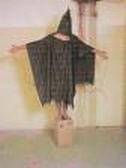
An Iraqi prisoner, hooded and wired with electrodes.
- May 2: The released Taguba report contains an interview with Brigadier General Janis Karpinski, the former commander of Abu Ghraib prison. Taguba finds Karpinski extremely emotional: "What I found particularly disturbing in her testimony was her complete unwillingness to either understand or accept that many of the problems inherent in the 800th MP Brigade were caused or exacerbated by poor leadership and the refusal of her command to both establish and enforce basic standards and principles among its soldiers." Taguba recommended that Karpinski and seven brigade military police officers and enlisted soldiers be relieved of command and formally reprimanded. No criminal proceedings were recommended for Karpinski; apparently the loss of promotion and a public reprimand were considered punishment enough. (Seymour Hersh)
Taguba report shows abuse to be systematic and approved at high levels
- May 2: A secret report commissioned by the US Army and written by Major General Anthony Taguba says that the torture and abuse of Iraqi prisoners at Abu Ghraib is far worse than has previously been revealed. His report, issued in February 2004, says there were "sadistic, blatant and wanton criminal abuses" at Abu Ghraib, and lists some of them: "Breaking chemical lights and pouring the phosphoric liquid on detainees...beating detainees with a broom handle and a chair; threatening male detainees with rape...sodomizing a detainee with a chemical light and perhaps a broomstick, and using military working dogs to frighten and intimidate detainees...and in one instance actually biting a detainee." Taguba's report clearly states that, far from being isolated actions by low-level personnel, intelligence interrogators encouraged the military police to "soften up" detainees. He recommended disciplinary action for at least two senior officers apart from Brigadier General Janis Karpinski, whose suspension as chief of military prisons in Iraq was revealed after the photographs were published last week. Other charges, including manslaughter, are being contemplated.
- Six suspects -- Staff Sergeant Ivan "Chip" Frederick, who was the senior enlisted man; Specialist Charles Graner; Sergeant Javal Davis; Specialist Megan Ambuhl; Specialist Sabrina Harman; and Private Jeremy Sivits -- are now facing prosecution in Iraq, on charges that include conspiracy, dereliction of duty, cruelty toward prisoners, maltreatment, assault, and indecent acts. A seventh suspect, Private Lynndie England, was reassigned to Fort Bragg, North Carolina, after becoming pregnant. The report concludes that between October and December of 2003 there were numerous instances of "sadistic, blatant, and wanton criminal abuses" at Abu Ghraib. This systematic and illegal abuse of detainees, Taguba reported, was perpetrated by soldiers of the 372nd Military Police Company, and also by members of the American intelligence community. (The 372nd was attached to the 320th M.P. Battalion, which reported to Karpinski's brigade headquarters.) Taguba chose not to include photos and videos in his report because of their "extremely sensitive nature." The UK has banned visits to Iraq by government officials and other VIPs, fearing kidnappings and retribution.
- According to the report, revealed by eminent investigative journalist Seymour Hersh, Abu Ghraib was packed with three types of prisoners: common criminals; security detainees suspected of "crimes against the coalition;" and a small number of suspected "high-value" leaders of the insurgency against the coalition forces. Many of the prisoners were detained without charge, and in some instances, US troops guarding the prisoners had no records of their names or any identification whatsoever. Part of the problem rests with the prison administration. Karpinski, an experienced operations and intelligence officer who had served with the Special Forces and in the 1991 Gulf War, had never run a prison system. Now she was in charge of three large jails, eight battalions, and thirty-four hundred Army reservists, most of whom, like her, had no training in handling prisoners. In private life, Karpinski is a business consultant. In December 2003, she told the St. Petersburg Times that, for many of the Iraqi inmates at Abu Ghraib, "living conditions now are better in prison than at home. At one point we were concerned that they wouldn't want to leave." In January 2004, Karpinski was formally admonished and quietly suspended, and a major investigation into the Army's prison system, authorized by Lieutenant General Ricardo Sanchez, the senior commander in Iraq, was under way.
- Last fall, General Sanchez ordered Provost Marshal Donald Ryder, a major general, to review the prison system in Iraq and recommend ways to improve it. Ryder's report, filed on November 5th, concluded that there were potential human-rights, training, and manpower issues, system-wide, that needed immediate attention. It also discussed serious concerns about the tension between the missions of the military police assigned to guard the prisoners and the intelligence teams who wanted to interrogate them. Army regulations limit intelligence activity by the MPs to passive collection. But something had gone wrong at Abu Ghraib. There was evidence dating back to the Afghanistan war, the Ryder report said, that MPs had worked with intelligence operatives to "set favorable conditions for subsequent interviews" -- a euphemism for breaking prisoners. "such actions generally run counter to the smooth operation of a detention facility, attempting to maintain its population in a compliant and docile state." General Karpinski's brigade, Ryder reported, "has not been directed to change its facility procedures to set the conditions for MI interrogations, nor participate in those interrogations." Ryder called for the establishment of procedures to "define the role of military police soldiers...clearly separating the actions of the guards from those of the military intelligence personnel." The officers running the war in Iraq were put on notice. Ryder undercut his warning, however, by concluding that the situation had not yet reached a crisis point. Though some procedures were flawed, he said, he found "no military police units purposely applying inappropriate confinement practices." His investigation was at best a failure and at worst a coverup, concludes Hersh.
- Taguba, in his report, was polite but direct in refuting his fellow-general. "Unfortunately, many of the systemic problems that surfaced during [Ryder's] assessment are the very same issues that are the subject of this investigation," he wrote. "In fact, many of the abuses suffered by detainees occurred during, or near to, the time of that assessment." The report continued, "Contrary to the findings of MG Ryder's report, I find that personnel assigned to the 372nd MP Company, 800th MP Brigade were directed to change facility procedures to 'set the conditions' for MI interrogations." Army intelligence officers, CIA agents, and private contractors "actively requested that MP guards set physical and mental conditions for favorable interrogation of witnesses." Taguba backed up his assertion by citing evidence from sworn statements to Army CID investigators. Specialist Sabrina Harman, one of the accused MPs, testified that it was her job to keep detainees awake, including one hooded prisoner who was placed on a box with wires attached to his fingers, toes, and penis. She stated, "MI wanted to get them to talk. It is Graner and Frederick's job to do things for MI and OGA to get these people to talk."
- Another witness, Sergeant Javal Davis, who is also one of the accused, told CID investigators, "I witnessed prisoners in the MI hold section...being made to do various things that I would question morally.... We were told that they had different rules." Taguba wrote, "Davis also stated that he had heard MI insinuate to the guards to abuse the inmates. When asked what MI said he stated: 'Loosen this guy up for us.' 'Make sure he has a bad night.' 'Make sure he gets the treatment.'" Military intelligence made these comments to Graner and Frederick, Davis said. "The MI staffs to my understanding have been giving Graner compliments...statements like, 'Good job, they're breaking down real fast. They answer every question. They're giving out good information.'" When asked why he did not inform his chain of command about the abuse, Sergeant Davis answered, "Because I assumed that if they were doing things out of the ordinary or outside the guidelines, someone would have said something. Also the wing" -- where the abuse took place -- "belongs to MI and it appeared MI personnel approved of the abuse." Another witness, Specialist Jason Kennel, who was not accused of wrongdoing, said, "I saw them nude, but MI would tell us to take away their mattresses, sheets, and clothes." (It was his view, he added, that if MI wanted him to do this "they needed to give me paperwork.") Taguba also cited an interview with Adel Nakhla, a translator who was an employee of Titan, a civilian contractor. He told of one night when a "bunch of people from MI" watched as a group of handcuffed and shackled inmates were subjected to abuse by Graner and Frederick.
- General Taguba saved his harshest words for the military-intelligence officers and private contractors. He recommended that Colonel Thomas Pappas, the commander of one of the MI brigades, be reprimanded and receive non-judicial punishment, and that Lieutenant Colonel Steven Jordan, the former director of the Joint Interrogation and Debriefing Center, be relieved of duty and reprimanded. He further urged that a civilian contractor, Steven Stephanowicz, of CACI International, be fired from his Army job, reprimanded, and denied his security clearances for lying to the investigating team and allowing or ordering military policemen "who were not trained in interrogation techniques to facilitate interrogations by 'setting conditions' which were neither authorized" nor in accordance with Army regulations. "He clearly knew his instructions equated to physical abuse," Taguba wrote. He also recommended disciplinary action against a second CACI employee, John Israel. (A spokeswoman for CACI said that the company had "received no formal communication" from the Army about the matter.) "I suspect," Taguba concluded, that Pappas, Jordan, Stephanowicz, and Israel "were either directly or indirectly responsible for the abuse at Abu Ghraib," and strongly recommended immediate disciplinary action.
- The problems inside the Army prison system in Iraq were not hidden from senior commanders. During Karpinski's seven-month tour of duty, Taguba noted, there were at least a dozen officially reported incidents involving escapes, attempted escapes, and other serious security issues that were investigated by officers of the 800th MP Brigade. Some of the incidents had led to the killing or wounding of inmates and MPs, and resulted in a series of "lessons learned" inquiries within the brigade. Karpinski invariably approved the reports and signed orders calling for changes in day-to-day procedures. But Taguba found that she did not follow up, doing nothing to insure that the orders were carried out. Had she done so, he added, "cases of abuse may have been prevented." General Taguba further found that Abu Ghraib was filled beyond capacity, and that the MP guard force was significantly undermanned and short of resources. "This imbalance has contributed to the poor living conditions, escapes, and accountability lapses," he wrote. There were gross differences, Taguba said, between the actual number of prisoners on hand and the number officially recorded. A lack of proper screening also meant that many innocent Iraqis were wrongly being detained -- indefinitely, it seemed, in some cases. The Taguba study noted that more than sixty per cent of the civilian inmates at Abu Ghraib were deemed not to be a threat to society, which should have enabled them to be released.
- Karpinski's defense, Taguba said, was that her superior officers "routinely" rejected her recommendations regarding the release of such prisoners. Karpinski was rarely seen at the prisons she was supposed to be running, Taguba wrote. He also found a wide range of administrative problems, including some that he considered "without precedent in my military career." The soldiers, he added, were "poorly prepared and untrained...prior to deployment, at the mobilization site, upon arrival in theater, and throughout the mission." General Taguba spent more than four hours interviewing Karpinski, whom he described as extremely emotional: "What I found particularly disturbing in her testimony was her complete unwillingness to either understand or accept that many of the problems inherent in the 800th MP Brigade were caused or exacerbated by poor leadership and the refusal of her command to both establish and enforce basic standards and principles among its soldiers." Taguba recommended that Karpinski and seven brigade military-police officers and enlisted men be relieved of command and formally reprimanded. No criminal proceedings were suggested for Karpinski; apparently, the loss of promotion and the indignity of a public rebuke were seen as enough punishment.
- After the story broke on CBS last week, the commander of the Guantanamo Bay detention center, Major General Geoffrey Miller, was assigned to head the Iraqi prison system. General Sanchez also authorized an investigation into possible wrongdoing by military and civilian interrogators. While Bush, Blair, and senior military and political leaders insist that the actions at Abu Ghraib were the actions of a rogue few, Taguba's report shows collective wrongdoing and the failure of Army leadership at the highest levels. At Abu Ghraib, Army regulations and the Geneva conventions were routinely violated, and in which much of the day-to-day management of the prisoners was abdicated to Army military-intelligence units and civilian contract employees. Interrogating prisoners and getting intelligence, including by intimidation and torture, was the priority. Former CID agent Willie Rowell says that using force such as Abu Ghraib does little good in producing usable information: "They'll tell you what you want to hear, truth or no truth," Rowell says. "'You can flog me until I tell you what I know you want me to say.' You don't get righteous information." Under the fourth Geneva Convention, an occupying power can jail civilians who pose an "imperative" security threat, but it must establish a regular procedure for insuring that only civilians who remain a genuine security threat be kept imprisoned. Prisoners have the right to appeal any internment decision and have their cases reviewed. Human Rights Watch complained to Secretary of Defense Donald Rumsfeld that civilians in Iraq remained in custody month after month with no charges brought against them. "Abu Ghraib had become, in effect, another Guantanamo," writes Hersh. (New Yorker, Independent/Truthout)
- May 2: Testimony from the Article 32 hearing (the military equivalent of a grand jury hearing) against Sergeant Chip Frederick, held on April 9 but just now released, sheds light on the atrocities committed at Abu Ghraib prison. One of the witnesses, Specialist Matthew Wisdom, an M.P., told the courtroom what happened when he and other soldiers delivered seven prisoners, hooded and bound, to the so-called "hard site" at Abu Ghraib -- seven tiers of cells where the inmates who were considered the most dangerous were housed. The men had been accused of starting a riot in another section of the prison. Wisdom said: "sFC Snider grabbed my prisoner and threw him into a pile.... I do not think it was right to put them in a pile. I saw SSG Frederic, SGT Davis and CPL Graner walking around the pile hitting the prisoners. I remember SSG Frederick hitting one prisoner in the side of its [sic] ribcage. The prisoner was no danger to SSG Frederick.... I left after that." When he returned later, Wisdom testified: "I saw two naked detainees, one masturbating to another kneeling with its mouth open. I thought I should just get out of there. I didn't think it was right.... I saw SSG Frederick walking towards me, and he said, 'Look what these animals do when you leave them alone for two seconds.' I heard PFC England shout out, 'He's getting hard.'"
- Wisdom testified that he told his superiors what had happened, and assumed that "the issue was taken care of." He said, "I just didn't want to be part of anything that looked criminal." The entire story was first revealed by a complaint filed by Specialist Joseph Darby, an MP whose role emerged during the Article 32 hearing against Frederick. A government witness, Special Agent Scott Bobeck, who is a member of the Army's Criminal Investigation Division (CID), told the court, "The investigation started after SPC Darby...got a CD from CPL Graner.... He came across pictures of naked detainees." Bobeck said that Darby had "initially put an anonymous letter under our door, then he later came forward and gave a sworn statement. He felt very bad about it and thought it was very wrong." Questioned further, Bobeck said that Frederick and his colleagues had not been given any "training guidelines" that he was aware of. The MPs in the 372nd had been assigned to routine traffic and police duties upon their arrival in Iraq, in the spring of 2003. In October of 2003, the 372nd was ordered to prison-guard duty at Abu Ghraib. Frederick, at thirty-seven, was far older than his colleagues, and was a natural leader; he had also worked for six years as a guard for the Virginia Department of Corrections. Bobeck explained: "What I got is that SSG Frederick and CPL Graner were road MPs and were put in charge because they were civilian prison guards and had knowledge of how things were supposed to be run." Bobeck also testified that witnesses had said that Frederick, on one occasion, "had punched a detainee in the chest so hard that the detainee almost went into cardiac arrest."
- At the Article 32 hearing, the Army informed Frederick and his attorneys, Captain Robert Shuck, an Army lawyer, and Gary Myers, a civilian, that two dozen witnesses they had sought, including General Karpinski and all of Frederick's co-defendants, would not appear. Some had been excused after exercising their Fifth Amendment right; others were deemed to be too far away from the courtroom. "The purpose of an Article 32 hearing is for us to engage witnesses and discover facts," Myers says. "We ended up with a CID agent and no alleged victims to examine." After the hearing, the presiding investigative officer ruled that there was sufficient evidence to convene a court-martial against Frederick. Myers says Frederick will plead not guilty, and will defend himself on the basis that he was following the explicit orders of his superiors. Myers says, "Do you really think a group of kids from rural Virginia decided to do this on their own? Decided that the best way to embarrass Arabs and make them talk was to have them walk around nude?" In letters and e-mails to family members, Frederick repeatedly noted that the military-intelligence teams, which included CIA officers and linguists and interrogation specialists from private defense contractors, were the dominant force inside Abu Ghraib. In a letter written in January, he said: "I questioned some of the things that I saw...such things as leaving inmates in their cell with no clothes or in female underpants, handcuffing them to the door of their cell -- and the answer I got was, 'This is how military intelligence (MI) wants it done.' ...MI has also instructed us to place a prisoner in an isolation cell with little or no clothes, no toilet or running water, no ventilation or window, for as much as three days." The military-intelligence officers have "encouraged and told us, 'Great job,' they were now getting positive results and information," Frederick wrote. "CID has been present when the military working dogs were used to intimidate prisoners at MI's request."
- At one point, Frederick told his family, he pulled aside his superior officer, Lieutenant Colonel Jerry Phillabaum, the commander of the 320th MP Battalion, and asked about the mistreatment of prisoners. "His reply was 'Don't worry about it.'" In November, Frederick wrote, an Iraqi prisoner under the control of what the Abu Ghraib guards called "OGA," or other government agencies -- that is, the CIA and its paramilitary employees -- was brought to his unit for questioning. "They stressed him out so bad that the man passed away. They put his body in a body bag and packed him in ice for approximately twenty-four hours in the shower.... The next day the medics came and put his body on a stretcher, placed a fake IV in his arm and took him away." The dead Iraqi was never entered into the prison's inmate-control system, Frederick recounted, "and therefore never had a number." Captain Shuck, Frederick's military attorney, closed his defense at the Article 32 hearing last month by saying that the Army was "attempting to have these six soldiers atone for its sins." Similarly, Myers says that he will argue at the court-martial that culpability in the case extended far beyond his client. "I'm going to drag every involved intelligence officer and civilian contractor I can find into court," he says. "Do you really believe the Army relieved a general officer because of six soldiers? Not a chance." (New Yorker, Seymour Hersh)
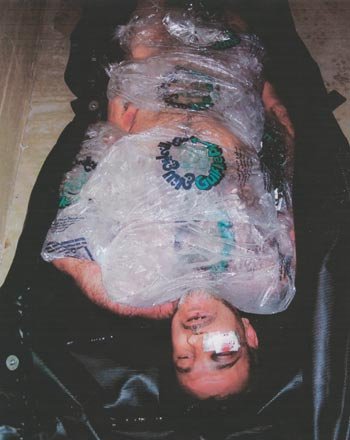
Iraqi prisoner apparently beaten to death by US soldiers
- May 2: Brigadier General Janis Karpinski, the former head of the MPs and soldiers running Abu Ghraib prison, says she knew nothing of the abuse and torture going on at her prison until weeks after it occurred and that she was "sickened" by the pictures. She said the prison cellblock where the abuse occurred was under the tight control of Army military intelligence officers who may have encouraged the abuse. Her belief that military intelligence, and the mercenaries employed by MI, has been supported by a report on prison conditions written by Major General Anthony Taguba. Now at home in South Carolina, Karpinski says that while the reservists involved in the abuses were "bad people" who deserved punishment, she suspects that they were acting with the encouragement, if not at the direction, of military intelligence units that ran the special cellblock used for interrogation. She said that CIA employees often joined in the interrogations at the prison, although she says she does not know if they had unrestricted access to the cellblock.
- Karpinski, a reservist, says she is speaking out because she believed that military commanders are trying to shift the blame exclusively to her and other reservists and away from intelligence officers still at work in Iraq. "We're disposable," she says of the military's attitude toward reservists. "Why would they want the active-duty people to take the blame? They want to put this on the MP's and hope that this thing goes away. Well, it's not going to go away." Karpinski says that the special cellblock, known as 1A, was one of about two dozen cellblocks in the large prison complex and was essentially off limits to soldiers who were not part of the interrogations, including virtually all of the military police under her command at Abu Ghraib. She says she is not defending the actions of the reservists who took part in the brutality, who were part of her command. She said that when she was first presented with the photographs of the abuse in January, they "sickened me." "I put my head down because I really thought I was going to throw up," she says. "was awful. My immediate reaction was: these are bad people, because their faces revealed how much pleasure they felt at this." But she said the context of the brutality had been lost, noting that the six Army reservists charged in the case represented were only a tiny fraction of the nearly 3,400 reservists under her command in Iraq, and that Abu Ghraib was one of 16 prisons and other incarceration centers around Iraq that she oversaw. "The suggestion that this was done with my knowledge and continued with my knowledge is so far from the truth,"she said of the abuse. "I wasn't aware of any of this. I'm horrified by this."
- She says she is alarmed that little attention has been paid to the Army military intelligence unit that controlled Cellblock 1A, where her soldiers guarded the Iraqi detainees between interrogations. She estimates that the floor space of the two-story cellblock was only about 60 feet by 20 feet, and that military intelligence officers were in and out of the cellblock "24 hours a day," often to escort prisoners to and from an interrogation center away from the prison cells. "They were in there at 2 in the morning, they were there at 4 in the afternoon," she says. "This was no 9-to-5 job." She says that CIA employees often participated in the interrogations. Karpinski notes that one of the photographs of abused prisoners also showed the legs of 16 American soldiers -- the photograph was cropped so that their upper bodies could not be seen -- "and that tells you that clearly other people were participating, because I didn't have 16 people assigned to that cellblock." Karpinski says she visited Abu Ghraib as often as twice a week last fall and had repeatedly instructed military police officers under her command to treat prisoners humanely and in accord with international human rights agreements. "I can speak some Arabic," she says. "I'm not fluent, but when I went to any of my prison facilities, I would make it a point to try to talk to the detainees." But she says she did not visit Cellblock 1A, in keeping with the wishes of military intelligence officers who, she said, worried that unnecessary visits might interfere with their interrogations of Iraqis. She acknowledges that she "probably should have been more aggressive" about visiting the interrogation cellblock, especially after military intelligence officers at the prison went "to great lengths to try to exclude the ICRC from access to that interrogation wing." She refers to the International Committee of the Red Cross, which has been given access over time to Iraqi detainees at the prison. Karpinski's lawyer, Neal Puckett, a former military trial judge, says he believes that she is being made a scapegoat for others in the military, especially for military intelligence officers who knew what was going on in Cellblock 1A. He says she had repeatedly insisted that troops under her command in Iraq receive instruction in proper treatment of detainees, but that despite her best efforts, some reservists joined in the abuse at Abu Ghraib. "All you can do is give training, give guidance and assume that your soldiers are going to follow orders and are not going to become sick b*stards," he says. (New York Times/CommonDreams)
- May 2: Army Chief of Staff Richard Myers says he can't rule out the possibility that the abuse at Abu Ghraib prison was "systematic," and not just the actions of a rogue few, as claimed by many Bush administration officials. Myers says he has not yet read the Taguba report, which documents "sadistic, blatant and wanton criminal abuses" of Iraqi prisoners, including beatings and sodomy. He says that if the abuse is truly systematic, then it has to be halted. He says there are ongoing investigations into the participation of intelligence personnel and private contractors in the abuse and torture of prisoners. Myers says that no such problems have been reported at the Guantanamo Bay detention camps. (Reuters/World Revolution)
- May 2: Facing allegations that the photos of British soldiers torturing Iraqi prisoners may be false, the two soldiers who provided the photos to the Daily Mirror are standing by their veracity. The soldiers also say they have further information about the tortures. Army sources have raised doubts about the veracity of the images, while Tory defense spokesman Nicholas Soames questions the decision to print them. The Mirror's editor, Piers Morgan, says he makes no apology for exposing "this outrageous behavior." He adds that the alleged abuse had been "common knowledge among disgusted British servicemen in Basra for months. These soldiers felt compelled to expose what went on because they believed it was fundamentally wrong, and that it would inevitably be reported at some stage. As General Sir Michael Jackson made clear, the people that carried out these sickening acts simply have no place in the British Army." (BBC)
- May 2: Iraqi civilian Dhia al-Shweiri says that being in prison under American guard is worse than being imprisoned by Saddam Hussein. Al-Shweiri was twice imprisoned by the Hussein regime and once by the Americans, and says he prefers Hussein's torture to the humiliation of being stripped naked by his American guards. He is a fighter in Moqtada al-Sadr's Mahdi Army. He says that, while jailed under Hussein, he was electrocuted, beaten and hung from the ceiling with his hands tied behind his back. "But that's better than the humiliation of being stripped naked," he says. "shoot me here," he adds, pointing between his eyes, "but don't do this to us." Al-Shweiri says he is not surprised to see TV images of smiling US soldiers posing by naked, hooded inmates who, in one photograph, were piled in a human pyramid. He says that, while detained by US soldiers, he was asked to take off his clothes only once and for about 15 minutes. "I thought they wanted me to change into the red prison uniform, so I took off my clothes, down to my underwear. Then he asked me to take off my underwear. I started arguing with him but in the end he made me take off my underwear," he says. He adds that he and six other prisoners -- all hooded -- had to face the wall and bend over a little as they put their hands on the wall. "They made us stand in a way that I am ashamed to describe. They came to look at us as we stood there. They knew this would humiliate us." He says that, unlike some of his fellow prisoners, he was not sodomized. "They were trying to humiliate us, break our pride. We are men. It's OK if they beat me. Beatings don't hurt us, it's just a blow. But no one would want their manhood to be shattered. They wanted us to feel as though we were women, the way women feel and this is the worst insult, to feel like a woman."
- He says the Americans arrested him along with his father and brother in the Shi'ite neighborhood of Sadr City in Baghdad, accusing him of belonging to the al-Mahdi Army because he had an automatic weapon in his house and some headbands with Islamic sayings on them. His father and brother were released shortly after the arrest. Al-Shweiri insists he wasn't involved in any religious or political group at the time. He worked in a fabric shop in Sadr City, attending Friday prayer sermons at his neighborhood mosque. He says he felt gratitude to the Americans for toppling Saddam, who had barred many Shi'ite public gatherings and whose regime arrested al-Shweiri twice. The first time came 12 years ago, when he was held for 19 months. He was arrested again in 1999 and sentenced to life in prison, charged with belonging to the then-banned Islamic al-Dawa Party, he said. He was freed when Saddam pardoned prisoners at the end of the same year. "I hated Saddam so much that when the Americans came, I viewed them as liberators. I was happy and supported them. But soon it became clear that they are no liberators but occupiers," he says. "I had seen how oppressed people were under Saddam and I refused to give in to oppression and injustice. We must fight oppression." When al-Shweiri left American detention, he said his hatred for Saddam was replaced with one for America and two months ago he joined the Mahdi Army. "If Seyed Muqtada orders us to disband, we will," al-Shweiri says. "If he orders us to die, we will die. And if he tells us to live, we will live. We have nothing to do with the Americans and what they demand from us." (AP/San Francisco Chronicle)
- May 2: Defense contractor CACI International Inc. opens an internal investigation of its employees in connection with allegations that Iraqi detainees were abused by U.S. soldiers at an Abu Ghraib. Employees for CACI were serving as interrogators at the facility, according to an attorney for one of the soldiers facing criminal charges. Two CACI employees were named in General Anthony Taguba's internal Army report about abuses at Abu Ghraib. The report alleges that one employee allowed or ordered untrained military police to set conditions for interrogations that amounted to abuse, and recommends he be fired. It recommends that the other be disciplined. CACI acknowledges that its employees had been interviewed by Army officials as part of the investigation, but says that it has "received no indication from the Army that any CACI employee was involved in any alleged improper conduct with Iraqi prisoners." It is unclear who is conducting CACI's investigation. "We are appalled by the reported actions of a few," the company statement says. "The Company does not condone or tolerate illegal behavior on the part of its employees when conducting CACI business in any circumstance at any time."
- According to several Internet job sites, CACI has been recruiting interrogators, senior counterintelligence agents and intelligence analysts for work in Iraq for more than a year, requiring some to have active and current top-secret security clearances. An ad posted on Yahoo's HotJobs Web site in February, under the headline "Exciting intelligence opportunities in Iraq!," sought to recruit interrogators with two or more years "conducting tactical and strategic interrogations." Another posting on IntelligenceCareers.com lists opening for senior counterintelligence agent with 10 years experience and intelligence analysts with a minimum of three years' experience. The increasingly prominent and important roles played by civilian contractors in Iraq have stirred criticism from some industry analysts, who said private contractors cannot be held to the same standards as soldiers. The Pentagon's oversight of private contractors around the world is "inconsistent and sometimes incomplete," according to a 2003 General Accounting Office report. "The use of private contractors in Iraq is becoming an increasingly volatile political issue," says the International Peace Operations Association, a Virginia-based nonprofit group representing private military service companies. "This incident could adversely impact an industry that has been instrumental in supporting stability and reconstruction efforts not just in Iraq, but also in Afghanistan, Liberia, Haiti and all over the world." There are 15,000 to 20,000 civilian military contractors in Iraq working at jobs once reserved for soldiers, says Peter Singer, a fellow at the Brookings Institution and author of Corporate Warriors: The Rise of the Privatized Military Industry. The duties have veered from the mundane, such as delivering mail and serving food, to critical activities that include conducting interrogations and coordinating logistics, Singer says. "We have truly pushed the boundaries to this," he observes. (Washington Post)
- May 2: The deaths of non-US soldiers in Iraq, while barely noticed by the US press, is setting off waves of protest in those soldiers' home countries and weakening an already-fragile coalition. A case in point is the March death of Estonian soldier Andres Nuiamae from a homemade bomb. Nuiamae's death barely made a dent in US coverage of the war, but in Estonia, which has not lost a soldier in war since 1920 outside of Estonians fighting for the former USSR, a wave of shock and grief has engulfed the tiny Baltic nation. His family received $160,000 in compensation and the nation observed a period of national mourning. While Estonia's government says its solidarity with the Iraqi occupation is unwavering, the citizens are saying something very different, a wave of protests and outcries that can't help but affect the government's resolve to stay the course with the US. "Nuiamae's killing was the equivalent of 2 percent of Estonia's 45-person contingent," observes columnist Elizabeth Sullvan. "That's many times the loss rate for American forces in Iraq, whose 700-plus deaths are balanced against hundreds of thousands of US troops who have rotated through the country since the war began." Another nation rethinking its allegiance with the coalition is Bulgaria, which is still reeling from the loss of five of its troops in a recent truck bombing. Bulgaria is resisting pressure to send more troops to offset the loss of the 1,400 Spaniards recently recalled home. Bulgaria's president, Georgi Parvanov, paid a surprise visit to Iraq to visit the troops and underscore his nation's engagement, and was shot at. He flew home in the company of 11 Bulgarian soldiers, one in a coffin. Seven of the others were said to be suffering "combat stress."
- Thailand is another country in the throes of self-doubt over its support of the Iraqi occupation; the loss of two Thais in Karbala shocked the citizenry, who were under the mistaken impression that their 480 soldiers were strictly doing humanitarian relief work. Thailand's prime minister says that although the Thai troops will stay for now, if the situation gets too hot for them to safely carry out their mission of road repair and delivering food and medical care, they will be recalled. Poland is refusing to send more troops to augment the 2,500 Poles already in Iraq after losing a soldier in a convoy ambush. After Spain announced its pullout, a number of Central American countries are also pulling their troops out. The deaths of six Ukranian soldiers have resulted in stiff pressure for Ukraine to recall its troops. Even Italy, whose government has loudly insisted that its troops will stay even after the deaths of 17 troops, is feeling the pressure of a massive civilian protest against an Italian presence. The Bush administration is already paying $1.4 billion to have other nations' troops in Iraq; it hasn't said how much it will request for the next fiscal year, but it seems increasingly clear that for some nations, no amount of money may be enough. (Cleveland Plain Dealer)
- May 2: Britain is planning to send 4,000 more troops to help the US pacify Najaf, the Shia holy city in Iraq that is currently engulfed in violence. While neither the US nor Britain will confirm this, it is widely believed that PM Tony Blair agreed to send the troops after meeting with US president Bush during a summit of the two leaders in mid-April. Defense chiefs support the deployment, but warn Blair that the British army is at full stretch and would struggle to deal with any other international emergency requiring personnel. Senior officers also warn that the deployment of troops to Najaf and Kut, where heavy fighting has recently taken place, is likely to lead to extensive casualties. Najaf, which contains the most important Shia shrine in Iraq, is where Moqtada al-Sadr, a Shia cleric, has established a 3,000-strong militia force whose members are vehemently opposed to the occupation of their country. A senior Ministry of Defense official says: "Not sending troops was never really an option because of the message it would have sent to the rest of the coalition. It is difficult to predict how long these troops will have to remain in Iraq, but it won't be less than two years." This means that many troops, mainly from the infantry and logistical support units, will have to complete a six-month tour of duty in Iraq every 10 months. For reasons of morale, the interval target between operational tours is supposed to be 24 months. "Plans have been drawn up for the deployment of at least three battle groups and a brigade headquarters to Iraq. Officially, no decisions have been made on troop numbers, but privately units are already being told to prepare for operations." (Daily Telegraph)
- May 2: Washington Post ombudsman Michael Getler writes that "almost everything we were told before the war, other than that Saddam Hussein is bad, has turned out, so far, not to be the case: the weapons of mass destruction, the imagery of nuclear mushroom clouds, the links between al-Qaeda and Hussein, the welcome, the resistance, the costs, the numbers of troops needed." He argues that, as good as much of the war reportage has been, "it is prewar coverage that counts the most." Getler seems to be acknowledging that the Post, like most other US media outlets, accepted the fictions spun by the Bush administration about Iraq as fact, and played its part in shaping public opinion to favor the invasion. (New York Times)
- May 2: The environmental group Clean Air Trust reveals that Exxon/Mobil, one of the world's largest oil and energy consortiums, is funding right-wing think tanks such as the American Enterprise Institute, in return for these organizations' promotion of Exxon/Mobil's agenda. AEI has responded by issuing reports that say the US government is spending too much money on cleaning up pollution, as Exxon/Mobil lobbies against the cleanup of train and marine diesel fuel as well as cleanup of its refineries. The company reports spending $6.8 million on such propaganda in 2003. Other recipients include The Annapolis Center (which just gave Republican senator James Inhofe an award for his pro-industry views on science); The American Legislative Exchange Council (which promotes industry viewpoints in state legislatures); The AEI-Brookings Joint Center for Regulatory Studies (which poses as an impartial think tank); The Cato Institute (a well-known right-wing/libertarianthink tank); The Competitive Enterprise Institute (another reliable corporate ally very big against attempts to deal with global warming); The Federalist Society (the right-wing legal fraternity that provided such corporate defenders as EPA Assistant Administrator Jeffrey Holmstead); The Mercatus Center (a front group housed at George Mason University in Virginia); and The Tech Central Science Foundation (which whips up propaganda against the McCain-Lieberman climate change initiative). Many others have received Exxon/Mobil funding. (Clean Air Trust)
- May 3: Families of Iraqi prisoners in Abu Ghraib have known for months that their relatives were being abused and tortured by US soldiers. Hiyam Abbas, whose 22-year old son, Hassan, has been in detention since November, has only been allowed to see her son once, in March. She says he told her then that he was forced to go naked in the prison all the time, they were menaced by dogs, and beaten with cables. "It's completely humiliating," she says tearfully. "My son is sick and suffering from hypertension. During the interview the American soldiers were standing so close to us. My son was crying." Hassan was detained after their house was broken into by gang members; his mother has no idea why he is being held. Of his captors, she says, "They are rubbish. Saddam Hussein may have oppressed us but he was better than the Americans. They are garbage." While US officials say "less than 20" soldiers participated in the abuse, Iraqi prisoners have a different take. Former prisoner Abu Salem, who spent six months inside Abu Ghraib between August and February, says abuse by US guards went on all the time. He says he has known about the practice of US soldiers posing for pictures with Iraqi prisoners for five months. "This didn't take place in the general camp but in individual cells," he says. Salem says he had been in the jail shortly before a visit from the International Red Cross in January. Until then, detainees in the prison wing had been kept naked. "The night before the Red Cross arrived, the American soldiers gave them some new clothes," he says. "They told us that if we complained to the Red Cross about our treatment we would be kept in prison forever. They said they would never let us out." Generally, detainees were tortured most frequently in the days immediately after their arrest, during interrogation, he adds. Many of the allegations made by Salem and other former detainees yesterday correspond with the damning internal US army report into Abu Ghraib.
- The mother of another detainee, Samira Hassan, said the latest allegations were horribly familiar. Her 22-year-old son Abbas had been arrested three months ago while walking past a US military base in the Baghdad suburb of Amariya. She finally managed to see him in prison two weeks ago. "He told me they are using electric shocks against the prisoners and taking off their clothes," she says. "He also told me something I can hardly talk about -- that the Americans are raping the Iraqi men. This is terrible," she says. "This is shame for us. We have a different culture and different religion. They should not do that. We are not talking about one case but of thousands of cases. The Americans said they would bring us freedom. Is this what they mean?" 70-year old Qahta al-Salim, a Sunni cleric from Samarra, has been in detention for four months since a neighbor told US soldiers he supported the resistance. His son, Mutashar Qahtan, is trying in vain to get news about his father. "My father is an old man," the son says. "He has a heart complaint. The first thing they did was to make him stand up for 12 hours. They then took him to Tikrit and finally to here." Qahtan says the allegations of abuse by US soldiers were "nothing new." He says he spent 47 days last year in US custody in Tikrit. "Personally they didn't do anything wrong to me," he says. "But I saw for myself what they did to others. They forced a group of prisoners to stand naked on the roof for seven days. They also told us that all Iraqis were sh*t." Relatives insist that the majority of "security detainees" are innocent, and claim they are often victims of random arrest following attacks on coalition forces. Either way, the images of torture and humiliation would merely serve to fuel the armed struggle against US occupation, Majid al-Salim, the brother of the imprisoned sheikh, says. "The Americans are driving people into the arms of the Maqawama [resistance]," he says. "We now look back at Saddam's era with nostalgia. He was a good leader. There was security. We hope he comes back." (Guardian)
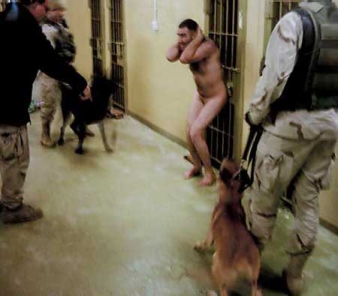
Naked Iraqi prisoner being menaced by attack dogs
- May 3: The two British soldiers who provided the photos of British troops abusing Iraqi prisoners say that hundreds of photos were swapped between soldiers. The latest allegations, by two soldiers serving in the Queen's Lancashire Regiment who sparked controversy after giving the tabloid newspaper photographs showing British soldiers apparently ill-treating an Iraqi prisoner, suggest the problem is much more widespread than has been admitted to by the Prime Minister, Tony Blair. After their initial claims last week, Blair said any misconduct in British ranks was "exceptional" and limited to a handful of servicemen. But the two soldiers say the photographs were "just the tip off the iceberg." They claim troops serving in southern Iraq had swapped hundreds of pictures among themselves. The soldiers, who say they stand by "every single word of our story," insist it is not a hoax and that the British Army knew a lot more had happened. One says, "Maybe the officers don't know what is going on -- but everyone else does. I have seen literally hundreds of pictures." Detailing allegations of other assaults, the soldiers describe a baton attack which left a prisoner with a compound fracture of his arm. Many of the pictures were destroyed last September when the soldiers' luggage was searched as they left Iraq. A Ministry of Defense spokesman says they are not aware of any other photographs of prisoners being mistreated or of a culture of trading pictures. He says: "If people have got evidence of such activity, then they should bring it to the attention of the Army authorities." (Independent/Independent Media)
- May 3: Although the US media has been relatively compliant in portraying Bush and his officials as shocked and anguished by the Iraqi prisoner abuse revelations, the media in the rest of the world has not been so forgiving. Comparisons between Bush and Saddam Hussein are rampant throughout the world's newspapers. The picture of the hooded Iraqi prisoner standing on a box, electrodes attached to fingers and genitals, is "an image that would do Saddam proud," said the Sunday Herald in Glasgow, Scotland. Many observers emphasized the fact that the abuses occurred in the notorious Abu Ghraib prison where Iraqis were tortured under Hussein's regime. The English language Web site of al-Jazeera quotes Saudi commentator Dawud Shiryan as saying, "Abu Ghraib prison was used for torture in Saddam's time. People will ask now: 'What's the difference between Saddam and Bush?' Nothing!" Shiryan said the photographs "will increase the hatred of America, not just in Iraq but abroad." In a front page story, the Yemen Times reports that many Yemenis "argue that even though Saddam Hussein was a brutal dictator, the crimes carried out by US soldiers are viewed very much the same." The Bahrain Tribune, a daily newspaper in the Persian Gulf emirate, says: "Bush seized all Saddam's properties and inherited everything Saddam had, including his torturing tools and methods." "The cells, which were criticized by Bush and his mouthpieces, are now used by Bush for jailing Iraqis who oppose the plundering and looting of the wealth of their country," the newspaper continues. "The torturing rooms, which were exposed to the whole world to highlight Saddam's barbaric behavior are now used by Bush and his soldiers to exercise their sick, sadistic and inhuman behavior." The paper said the scenes in the photographs cannot be treated as "rare incidents." "We are talking about the nature of an imperialist, immoral, racist and crusader President who should be driven out of Iraq and a corrupted, immoral, barbaric and impure army that should be forced to end its occupation of a sacred Islamic territory," the paper said.
- Musa Keilani, writing in the Jordan Times, sees an element of hypocrisy in the Arab reaction. When Hussein was in power, he writes, "the overriding feeling among the Arabs" was that the "the Arab world needed a leader like Saddam to challenge the West, particularly the US, and, of course, Israel. In the bargain, we all simply forgot that Saddam's continued survival in power in Iraq was at the expense of the basic human rights and well-being of the people of Iraq -- or most of the people of Iraq. Therefore, few wanted to focus attention on what was going on in Abu Ghraib and other prisons in Iraq." The photos of US prisoner abuses at Abu Ghraib "brought back memories of the Saddam era to many, and thus the basic question was immediately raised: Is this the way the US, the country which boasts of a great record of respect for human rights and dignity, treats its prisoners?" Keilani says yes. "The US, having invaded Iraq in the name of non-existent weapons of mass destruction and connections with international terrorism and then having shifted the argument to 'democracy' and human rights, is now kicking around the people of Iraq, whether in prison or otherwise. They have no respect for the people of Iraq and they consider every Iraqi as an enemy until proven otherwise." Ehsan Ahrari, columnist for the Hong Kong-based Asia Times, says the photos of Abu Ghraib undermine the Bush administration's only remaining justification for the war. "Once it could not find weapons of mass destruction to justify its invasion of Iraq, the administration of US President George W Bush claimed that the liberation of Iraqis from the most inhumane rule of a dictator was a good enough reason for taking military action against that country. Now reports of the US military's abuse of Iraqi prisoners in that notorious prison threaten to deprive the United States of even that wobbly claim." (Washington Post)
- May 3: Seemingly oblivious of the widening prison abuse scandal, Bush tells a campaign crowd in Michigan, "Because we acted, torture rooms are closed, rape rooms no longer exist, mass graves are no longer a possibility in Iraq." He uses almost the exact same phrasing he has used for the past six months, essentially refusing to deal with the reality of the prison scandal. (White House/Slate)
- May 3: The opium crop in Afghanistan has broken all known records, flooding Central Asia with cheap heroin, threatening the stability of border countries, and providing al-Qaeda financiers with more funds than ever before. A Western-led campaign against opium-growing and heroin laboratories has been a wholesale failure, and drug-control experts say the number of processing facilities in Afghanistan has exploded over the last year. The trade and huge sums of money involved threaten to undermine vulnerable bordering states such as Tajikistan. "There's absolutely no threat to the labs inside Afghanistan," says Major Avaz Yuldashov of the Tajikistan Drug Control Agency. "Our intelligence shows there are 400 labs making heroin there, and 80 of them are situated right along our border. Some of them even work outside, in the open air." Some 200,000 acres of opium poppies have been planted in Afghanistan and the country's late-summer harvest will produce three-fourths of the world's heroin. That will mean further billions for growers, smugglers, corrupt officials and Afghan warlords, not to mention to al-Qaeda and its sister groups, which are staking their claims to territories in Central Asia. "Drug trafficking from Afghanistan is the main source of support for international terrorism now," Yuldashov says. "That's quite clear." But in recent US congressional testimony about heroin flow out of Afghanistan, Drug Enforcement Administration head Karen Tandy spoke only of "potential links" and "possible relationships" between Afghan traffickers and terrorists. Drug agents in Central Asia say they're baffled by Tandy's hedging, though US observers note a clear desire from the Bush campaign to minimize the issue before the US elections. "The connection is absolutely obvious to us," says Colonel Alexander Kondratiyev, a senior Russian officer who has served with border guards in Tajikistan for nearly a decade. "Drugs, weapons, ammunition, terrorism, more drugs, more terrorism -- it's a closed circle."
- That circle has profound implications for the US-led fight against international terrorism. Regional diplomats, aid workers and law-enforcement officials fear that the expanding drug trade will destabilize one of the "stans," the five former Soviet republics that gained independence after the USSR collapsed. They worry about the emergence of a Central Asian narco-state, a country dominated by the drug economy and effectively controlled by a heroin mafia with roots in Afghanistan and ties to al-Qaeda and regional Islamists. "We have a deep responsibility to keep these Central Asian republics from becoming failed states," says a Western diplomat in Tajikistan. "Look what happened in Afghanistan. It was a failed state -- and it became a nest for terrorists. We have to stop that same thing from happening here. For our own security, we can't afford it." At particular risk is Tajikistan, a desperately poor, predominantly Muslim nation of 7 million. Tajikistan produces almost no opium or heroin of its own, but it has become a natural pathway for traffickers due to its 900-mile border with Afghanistan. Also, enough heroin has been "falling off the trucks" in Tajikistan that it now has galloping rates of heroin addiction, drug crime and HIV infection. The Tajik Drug Control Agency -- outmanned, outgunned and poorly equipped -- said it managed to seize nearly 6 tons of heroin from traffickers last year. Senior commanders estimate they catch about 20 percent of the traffic. Some analysts think it's probably about half that much. Tajikistan, isolated and landlocked, has almost no industrial economy other than a state-controlled aluminum smelter. Foreign investment is minuscule; not a single American firm is operating in the country. "Nobody even comes to look anymore," says a foreign diplomat. The national budget is barely $300 million a year, a pittance compared with the size of the drug economy. The heroin trade alone, Yuldashov says, is 10 times bigger. That kind of disparity leaves many Tajiks vulnerable to corruption and compromise by wealthy drug mafiosi, especially when the average salary is $10 a month and 80 percent of the population lives below the poverty line. A single trip as a drug courier can feed a Tajik family for a month.
- Another worrisome development is in the offing for Tajikistan: Next month, along the Afghan border, Russia will begin withdrawing 2,200 border-control officers who've been stationed here since the Soviet era. Their departure and the loss of Russian funding could further undermine Tajikistan's ability to defend itself from Afghan drug traffickers. Tajik officers and army conscripts will take over from the Russians, although they'll have no night-vision equipment, satellite phones or helicopters. Even now, many of the border posts lack two-way radios and binoculars. It remains to be seen whether European countries, the target destinations for much of Afghanistan's opium and heroin, will pick up the slack. The United States contributes to UN drug programs in the region, but the DEA has only a minimal presence here in terms of human intelligence: The DEA has deployed two agents to cover all of Afghanistan. There are no DEA agents in Tajikistan or neighboring Kyrgyzstan, another paradise for traffickers. "We know shockingly little about how the drug trade operates out here," says a Western official. Heroin moves out of Afghanistan via the so-called southern route -- through Iran or Pakistan -- or the northern route, which makes its way through the Central Asian "stans." It's unknown how much drug traffic passes through Turkmenistan. The secretive nation doesn't release information on drug seizures and no longer cooperates with regional drug-control initiatives. "They have open borders with Afghanistan, but not even the UN knows what they're doing" about drug trafficking, says Kamol Dusmetov, the head of the Uzbek National Center for Drug Control. Heroin is carried out of Afghanistan in vegetable trucks, fuel tankers and donkey carts. It's hidden in women's underwear, children's backpacks or sacks of pistachios. In Tajikistan, well-organized teams of couriers wade across the Amu Daria and Pyanj rivers, usually at night, backed up by accomplices armed with satellite phones, off-road vehicles, bales of bribe money and plenty of heavy weapons. In one recent seizure, troopers found $280,000 in cash stuffed among the 1-kilogram bags of heroin. In Uzbekistan, which has an 80-mile border with Afghanistan, smuggling can be more rudimentary. Dusmetov says rural couriers sometimes forced their dogs and donkeys to swallow balloons full of heroin. They tie a string to the balloons and wrap the other end of the string around the animal's tooth. Once across the border, the smuggler pulls the string and retrieves the balloons. "Borders [throughout the region] are not guarded well," Dusmetov says. "In many places, like Kazakhstan and Kyrgyzstan, borders are virtually open. You jump across a ditch and you're in another country." (Knight-Ridder)
- May 3: US military officials debunk Bush administration claims that foreign fighters and terrorists make up the bulk of the anti-American insurgency in Fallujah and the rest of Iraq. While the claims bolster the position of the administration that ordinary Iraqis are not rising up en masse against US occupation, and that the occupation is a key element in the war against terrorism, military experts confirm that foreigners are only playing a tiny role in Iraq's insurgency. In Fallujah, US military leaders say around 90 percent of the 1,000 or more fighters battling the Marines are Iraqis. To date, there have been no confirmed US captures of foreign fighters in Fallujah although a handful of suspects have been arrested. Those who have spent time inside Fallujah describe a city consumed with the fight fathers and sons fighting for the local mujahedeen and wives and daughters cooking and caring for the wounded. "The whole city supports this jihad," says Houssam Ali Ahmed, a Fallujah resident who fled to Baghdad when his neighborhood was caught in the fighting. "The people of Fallujah are fighting to defend their homes. We are Muslim mujahedeen fighting a holy war."
- Elsewhere in Iraq, US military commanders say foreigners have an even smaller role in the insurgency. In Baghdad, Major General Martin Dempsey has said foreigners account for just 1 percent or so of guerrillas. Dempsey said his 1st Armored Division detained just 50 to 75 foreign fighter suspects in Baghdad over the past year, among a population of captured guerrillas that reached 2,000. In the south, no one has suggested that foreigners pack the ranks of radical cleric Muqtada al-Sadr's al-Mahdi Army. The group, which has fought U.S. and allied troops across southern Iraq, is made up of Shi'ite Muslim radicals, many of whom are from the slums of Baghdad. In March, Dempsey called the idea that foreign fighters were flooding Iraq "a misconception." Foreigners are present, and have had a greater impact on the insurrection than their numbers would suggest, Dempsey and others have said. Foot soldiers of Jordanian terror suspect Abu Musab al-Zarqawi are thought to have operated in Fallujah and launched devastating bombings elsewhere. At least one al-Qaeda-linked suspect has been detained in Iraq, and a Yemeni man attempting to set off a car bomb was detained last summer. A Kuwaiti newspaper reported that four of the country's citizens have been killed fighting the occupation. Marines have captured at least one foreigner in Fallujah, a Sudanese man.
- But foreign participation appears far lower than US occupation officials like chief spokesman Dan Senor have suggested. Senor has portrayed the battle of Fallujah as one in which foreign fighters and terrorists were holding the city's "silent majority" hostage. "I would also say that there is a sense of frustration we are hearing among the silent majority of Fallujans about the foreign fighters and international terrorists that are hanging their hats in Fallujah right now," Senor said in a news conference last month. "That is not something the majority of Fallujans support." Army Brigadier General Mark Kimmitt, the command's chief spokesman, suggested this week that foreign fighters and terrorists were "driving a wedge" between Fallujah's residents and the Americans. "I find it hard to imagine that the people of Fallujah would tolerate outsiders turning their town into a battlefield," says Jeremy Binnie, a Middle East military analyst with London consultancy Jane's. "The foreign fighters are not the primary problem. Iraqi nationalists and Islamists are the problem." Guerrillas in Fallujah have the support of many, a US defense official in Washington says. Referring to the March 30 killing of four US contractors and the mutilation of their corpses, he says, "It wasn't Fedayeen cheering those burning bodies. It was young children and adults."
- A British aid worker, Jo Wilding, 29, spent five days working with an ambulance crew inside Fallujah during the fighting. Wilding said rebels detained her and took her to meet local imams and tribal leaders who appeared to be leading the uprising. "We probably saw hundreds [of fighters] and talked to a couple dozen," she says. "I had the impression it was very much grounded in the local area." One top US military official who had publicly blamed foreign fighters for a large measure of the revolt concedes privately that the US military may never find out whether many foreigners had fought in Fallujah. Many may have escaped, he says. Previous US claims that foreigners were behind attacks in Iraq have turned out to be flimsy. In March, after suicide bombers killed up to 271 people during the Shiite holiday of Ashoura, US and Iraqi leaders quickly blamed foreign terrorists fingering al-Zarqawi as the chief suspect. Officials said 10 foreigners had been arrested, five of whom were released, and five of whom later turned out to be Iraqis. Other suicide bombings, including two in February that killed almost 100 police and army recruits, were initially blamed on foreign groups. Subsequent evidence suggested Iraqis were behind the attacks. (Boston Globe/Warmwell)
- May 3: Skyrocketing US oil prices have hit levels not seen since 1990. Prices, already far above what US consumers are used to paying, are expected to continue increasing, particularly as oil installations in Saudi Arabia and Iraq are attacked by insurgent or terrorist forces. Currently US gas prices are at an average of $1.84 per gallon, and rising. (AP/My Way News)
- May 3: Charles Heyman, a senior defense analyst for Jane's, writes that the Bush and Blair administrations may be privately planning for a relatively hasty withdrawal from Iraq. He writes, "It begins to look as though there is going to be a rather messy political solution to the whole affair, possibly brokered by the United Nations. Expect to see an agreement where both sides can claim some sort of a victory, followed by a rather hasty withdrawal of coalition troops at some stage in the next six months." The coalition is not achieving any of the goals it has set for itself; rather, the insurgency has clearly spread from the few "former regime elements" and "foreign fighters" whom coalition spokesmen regularly blame, into a general uprising by Iraqi civilians. The interim government is not predicted to be able to command the loyalty of Iraqis to a sufficient degree to bring the insurgency under control. The coalition has had to back off sharply in Fallujah, and the "hunt" for Shi'ite religious leader Moqtada al-Sadr has achieved nothing. The propaganda war could not have gone worse with the publication of the photos of prisoner abuse. The pictures highlight the problem that the coalition, having failed to make the case for going to war over the elusive weapons issue, is now failing to make its second case: the moral argument that it can bring the rule of law to a land without law. Christopher Hitchens, the journalist who has been one of the war's great supporters, writes acerbically of his fellow journalists, "It's now fairly obvious that those who cover Iraq have placed their bets on a fiasco or 'quagmire.'" The whole idea was based on the belief that, as in Germany and Japan after the war, resistance would collapse and that the task of building institutions could therefore be given time. But even now, the drawing up of voting lists is only just being examined. (BBC)
- May 3: Over 200 students at Florida State University sign a letter to Vice President Cheney asking him not to deliver a political speech at their graduation ceremony, to be held May 8. The request follows a speech by Cheney at Westminster College in Missouri, where Cheney was slated to deliver an address concerning global foreign policy, but instead gave a campaign speech highlighted by attacks on John Kerry. The students, many of them members of the FSU College Democrats, say the graduation ceremony should be a chance for students to celebrate their accomplishments with friends and family, and not a venue for personal attacks against candidates. "We're really worried that something like this may happen at our graduation," says Tom Barcus, a student and former president of the FSU College Democrats. In the Westminster speech on Monday, Cheney attacked Kerry's national security credentials, calling his policies and U.S. Senate votes irresponsible and his foreign policy condescending. University President T.K. Wetherell, a Democrat and former speaker of the Florida House of Representatives, says " that Cheney's aides had assured him the speech would be "a positive message to the graduates." "We have been repeatedly assured that this will not be a political speech," Mary Coburn, the university's vice president for student affairs, says in reply to the students' letter. Westminster's president, Dr. Fletcher Lamkin, sent an e-mail afterward apologizing to students and faculty for Cheney's speech. He said he was "surprised and disappointed that Mr. Cheney chose to step off the high ground and resort to Kerry-bashing for a large portion of his speech." Westminster gave Kerry equal time on Friday, inviting him to speak at the same podium Cheney used. (Reuters/Neil Rogers)
- May 3: Seven students at Kalamazoo show up at a Bush campaign rally but, even though they have tickets, are denied entrance to the rally because College Republicans at the rally identify them as "liberals" who are not welcome. Two of the students, Ted Hufstader and Julia VanAusdall, say that they and their friends, most of whom are Bush detractors, merely wanted to see and hear Bush speak. They say they have no interest in engaging in any protests. "We wanted to get a better idea of what he's like," Hufstader says. "All we get are little soundbites on the news." He points to the fact that one of the seven was an international student as evidence of their sincerity: "We would not have done anything to jeopardize this student's standing in the country."
- Hufstader and another student went to a local Chamber of Commerce office for tickets, which were advertised as free and available on a first-come, first-serve basis. They were asked to show a photo ID and to provide their addresses, along with the addresses of several friends for whom they were obtaining tickets. "We later heard that some people who wouldn't declare they were Republicans were denied tickets," Hufstader says. "But we didn't see that happen." Hufstader and his friend, Lisa Dallacqua, were given seven tickets, and their names and the names of their friends were placed on a list that would be checked at the rally. When the seven arrived at Wings Stadium, the venue for the rally, they had to pass through a series of checkpoints. Hufstader maintains they were each dressed conservatively -- "you know, khakis and sweaters" -- and sported no political buttons or any other accouterments of dissent. At one of the checkpoints, they were spotted by a member of the College Republicans. He was familiar with the political predilections of several of these students and asked how they had received tickets. "We stood in line," Hufstader replied.
- At another checkpoint, Hufstader and his friends saw several College Republicans talking to the volunteers working security. The security people then told Hufstader, Dallacqua, VanAusdall and the others (Laura Lonneman, Leah Busch, Shanna Barkume, and the international student whose identity Hufstader and the others are currently protecting) that they could not enter. "They told us," Hufstader says, "that we failed a background check, that we had been identified by volunteers as a potential threat, and that if we didn't leave we would be arrested." Hufstader and the others insisted they simply wanted to hear Bush and demanded to see what list -- if any -- indicated that they had failed a background check. They argued their point until local police showed up and said they would be arrested unless they departed. The police officers explained the rally was a private event and the organizers could pick and choose who would attend. The police took their tickets and escorted them seven blocks away from the stadium. "several things anger us," says Hufstader. "It may have been a private event, but the tickets didn't say that and we were never told that. We felt misled. But we felt worse about the College Republicans. We were very disappointed that our peers singled us out for what they thought we might do. And we later heard they had been trained to find potential threats at the event. But we were not a threat. We're even friends with some of these College Republicans. This was a sad commentary about the bitter divide of American politics. Look how hard it was for us to hear a contrary view. We wanted to see the president and then talk about what he said afterward. We felt like we were being blacklisted by our campus peers, and this is a campus that is supposed to be open to different political views."
- Journalist David Corn writes, "[I]t's no surprise that the Bush campaign -- like other campaigns -- stage-manages its public events to the fullest extent possible and tells non-supporters to keep out (or be locked up). Bush did not engage in drive-by campaigning in Kalamazoo to provide local citizens the opportunity to see him in action. He hit the town in search of a middle-of-America backdrop, a screaming throng, and upbeat footage on the local news shows. After all, campaigns are about candidates, not voters. So while Hufstader and his pals did not get to see Bush in person wax about the glories of freedom, they did at least receive a lesson in modern politics." (The Nation)
- May 3: Former Senator Bob Dole, the Republican candidate for president in 1996 and a decorated World War II veteran, comes to John Kerry's defense over the Bush campaign's attempts to smear Kerry's Vietnam War record. He says the putative controversy over whether Kerry threw his ribbons or his medals over a fence during a 1971 protest doesn't have any content: "I don't think it matters much," he says. Dole says the 2004 campaign has already gotten "very hot" and "very personal," and says both sides should tone down the personal attacks. (AP/Kansas City Star)
- May 4: Testimony to the US congress about the Iraqi prisoner abuse scandal reveals that many prisoners are being held in camps and detention areas with no oversight or accountability from their US guardians, and that prisoner abuses and tortures similar to those documented at Abu Ghraib are likely happening in other places as well. At least 25 prisoners in US custody have been murdered while in detention, many at the hands of private "contractors," or mercenaries, with no charges being filed against any of the perpetrators. The Republican leadership in both houses have quashed Democratic and maverick Republican calls for a special investigation. Many senators are demanding that Defense Secretary Donald Rumsfeld testify in public about the prisoner abuse, but again, Republican leaders have blocked any such requests. Rumsfeld tells the Senate today, "My impression is that what has been charged thus far is abuse, which I believe technically is different from torture. I don't know if it is correct to say what you just said, that torture has taken place, or that there's been a conviction for torture. And therefore I'm not going to address the torture word."
- Former Clinton adviser Sidney Blumenthal writes, "Bush has created what is in effect a gulag. It stretches from prisons in Afghanistan to Iraq, from Guantanamo to secret CIA prisons around the world. There are perhaps 10,000 people being held in Iraq, 1,000 in Afghanistan and almost 700 in Guantanamo, but no one knows the exact numbers. The law as it applies to them is whatever the executive [Bush and his White House officials] deems necessary. There has been nothing like this system since the fall of the Soviet Union. The US military embraced the Geneva conventions after the second world war, because applying them to prisoners of war protects American soldiers. But the Bush administration, in an internal fight, trumped its argument by designating those at Guantanamo 'enemy combatants.' Rumsfeld extended this system -- 'a legal black hole,' according to Human Rights Watch -- to Afghanistan and then Iraq, openly rejecting the conventions. Private contractors, according to the Taguba report, gave orders to US soldiers to torture prisoners. Their presence in Iraq is a result of the Bush military strategy of invading with a relatively light force. The gap has been filled by private contractors, who are not subject to Iraqi law or the US military code of justice. Now, there are an estimated 20,000 of them on the ground in Iraq, a larger force than the British army. It is not surprising that recent events in Iraq centre on these contractors: the four killed in Falluja, and Abu Ghraib's interrogators.
- "Under the Bush legal doctrine, we create a system beyond law to defend the rule of law against terrorism; we defend democracy by inhibiting democracy. Law is there to constrain 'evildoers.' Who doubts our love of freedom? But the arrogance of virtuous certainty masks the egotism of power. It is the opposite of American pragmatism, which always under stands that knowledge is contingent, tentative and imperfect. This is a conflict in the American mind between two claims on democracy, one with a sense of paradox, limits and debate, the other purporting to be omniscient, even messianic, requiring no checks because of its purity, and contemptuous of accountability. 'This is the only one where they took pictures,' Tom Malinowski, Washington advocate of Human Rights Watch, and a former staff member of the National Security Council, told me. 'This was not considered a debatable topic until people had to stare at the pictures.' (Guardian)
- May 4: More information from the Taguba report paints a picture of an "out-of-control" prison system in Iraq featuring overcrowded cell blocks, untrained guards venting their boredom and stress by torturing inmates, and prisoners being moved around to avoid Red Cross oversight. The investigation showed there were too many inmates and not enough guards. Training was inadequate and superiors rarely made rounds. The American guards' morale was shattered when their of hopes of returning home soon were disappointed. Officers lost track of inmates. Escapes went unrecorded. Top commanders could not agree on who should run the cellblocks -— military police or military intelligence. In this general breakdown, some soldiers sank to "blatant, wanton and criminal abuse" of detainees, according to the report.
- Some of these abuses have been reported over the past week, with the revelation of graphic and sexually explicit photographs of some of the incidents. Those abuses occurred, according to the report, in one area of the prison, where prisoners suspected of terrorist activities were interrogated. Taguba's report also found that underlying the most horrific abuses was a prison in which mismanagement and unprofessional behavior had become routine. The classified report reveals a prison system so insecure that more than 27 prisoners escaped or attempted to escape in less than a year. It was so casually managed that civilian contractors wandered around without supervision and US soldiers consistently failed to fulfil even the basic duty of counting the prisoners in their charge. Standards were so inconsistent that Taguba found that treatment of prisoners varied from shift to shift and compound to compound. The report concluded that soldiers guarding prisoners probably wrote off some escapes without reporting them. The report said that 60 per cent of Abu Ghraib inmates were "not a threat to society." Some Iraqis apparently considered much of the prison well run by the Americans. Some prisoners were allowed to visit with family members, who waited for days for the uncertain chance to see them and bring food and clothing. But the relatives said other parts of the prison were off-limits. It was in those areas where several intelligence officers, private contractors, and members of the 372nd Military Police Company, attached to the army's 800th Military Police Brigade, are alleged to have taken part in the documented abuses.
- The members of the 372nd, Taguba found in is report, lived under persistent attack by mortar shells, small-arms fire and rocket propelled grenades. The unit was consistently understaffed and inmates were so poorly screened that innocent civilians were often detained indefinitely. There were also demands by military intelligence officials to "loosen up" inmates before questioning. The investigation found that the commanders had allowed military police to be used by military intelligence officials for just that purpose, contrary to army regulations. As for the soldiers stuck with their Iraqi charges in Abu Ghraib, they just wanted to go home. (Los Angeles Times/Washington Post/Calcutta Daily Telegraph)
- May 4: Six American soldiers have been "severely reprimanded" by the Army over their participation in the abuse of Iraqi prisoners. The reprimands, the harshest of the various reprimands available, may end the six soldiers' Army careers. A seventh soldier has received a "letter of admonishment," a lesser punishment. All seven are appealing the punishments. The six reprimanded soldiers are also facing unspecified criminal charges. The CIA's inspector general is investigating the death of an Iraqi prisoner at Abu Ghraib. Former Iraqi human rights minister Abdel Basset Turki says US civilian administrator Paul Bremer knew in November that Iraqi prisoners were being abused in US detention centers. "In November I talked to Mr. Bremer about human rights violations in general and in jails in particular. He listened but there was no answer," says Turki, who resigned on April 8 in anger over the US military offensives on Najaf and Fallujah. Iranian Foreign Minister Kamal Kharazi says the United States had fueled anti-Western hatred with its action in Iraq. Kharazi says he told EU Commission President Romano Prodi that "the very brutal actions of American soldiers are a systematic plan to humiliate the Iraqis, kill them, rape them. It's outrageous. The US policy has created hatred in all Islamic countries. We are at a stage of developing a clash of cultures and this is very dangerous." (Agence France-Presse/The Age)
- May 4: At a Pentagon news conference, Defense Secretary Rumsfeld and Marine General Peter Pace, the vice chairman of the Joint Chiefs of Staff, insist that the investigation into the Abu Ghraib abuses had moved routinely through the chain of command. The investigation was slow due to routine safeguards, says Pace, not because of any breakdowns or intentional slowdowns. Pace's and Rumsfeld's assertions are countered by a number of retired and active-duty officers and Pentagon officials, who say the system had not worked. A senior Pentagon official says that many of the top generals in the Army were kept out of the loop on the Abu Ghraib allegations, and that Rumsfeld, General Ricardo Sanchez, and General John Abizaid, the head of US CENTCOM in Tampa, did their best to hush the entire issue up during the first months of the year. The chain of command flows from Sanchez through Abizaid to Rumsfeld and, ultimately, President Bush. All did their best to prevent information from being released, not only to the press, but to military investigators and senior officials. "You've got to match action, or nonaction, with interests," says the official. "What is the motive for not being forthcoming? They foresaw major diplomatic problems." A retired major general says, "This is beyond the pale in terms of lack of command attention. Where were the flag officers? And I'm not just talking about a one-star [Karpinski]. This was a huge leadership failure." One officer who is still active in Iraq says that he learned in November 2003 of the abuse allegations, and took that information to Abizaid and his deputy, Air Force General Lance Smith. "I said there were systematic abuses going on in the prisons," he recalls. "Abizaid just didn't say a thing. He looked at me -- beyond me, as if to say, 'Move on, I don't want to touch this.' They knew last year." A military consultant with close ties to the Special Operations community says that a number of written complaints about prisoner abuse, along with photos, were made; all such complaints were routed directly to Sanchez, where the complaints were deep-sixed. The consultant angrily recalls, "People were beaten to death. What do you call it when people are tortured and going to die and the soldiers know it, but do not treat their injuries? Executions." (Seymour Hersh)
- May 4: The reports of abuse by US and British soldiers towards Iraqi prisoners has shattered these countries' claims to any moral "high ground" in Iraq, according to a number of experts. The allegations "make the US and coalition forces a legitimate enemy in the eyes of more Arabs than was the case before," says Anthony Cordesman, an expert on Middle East security issues at the Center for Strategic and International Studies. "Anything short of a court-martial of general officers will be seen throughout the region as a cover-up." "This has been a very difficult period. I don't think it is too late for us to get this right, but I don't think we have a lot of time to turn this around," says Sandy Berger, President Clinton's national security adviser. "This just reconfirms an image that we are not treating prisoners the way that civilized people should," says Ivo Daalder, a foreign policy analyst at the Brookings Institution. "We need a full court press by the administration to demonstrate that this is unacceptable behavior, that if it happened people will be punished, that if it is taking place that it will stop." (AP/Holland Sentinel)
- May 4: Arab television stations are airing photos of the torture at Abu Ghraib and Basra relentlessly, sparking tremendous anger among Arabs throughout the Middle East. "The situation has not changed in Iraq; only the prison warder is different," says one report on al-Arabiya. In Cairo, a group of men watching in a cafe react strongly to the broadcasts. "This is shameful, shameful, shameful," says one, getting nods of agreement. "A soldier urinating on a prisoner, sexual abuse and humiliation, is this human?" In a culture which prizes dignity, modesty, sexual privacy, and respect, the photos are tremendously upsetting, with none of the titillating aspects often produced in the US. The same Egyptian says, "The United States used to stand for liberty, now it stands for imperialism." One of the waiters says that because of the photos, he is ready to go to Iraq to become a martyr, fighting the Americans. "There is no doubting the deep offense that these photographs have caused," reports BBC correspondant Paul Wood. The US Senator Joe Biden has called this the worst blow to American prestige in the Arab world for a decade. "The cafe I visited was well known in Cairo because -- exceptionally -- they cheered when the Americans took Baghdad and toppled Saddam just over a year ago. The coalition has no defenders there now," writes Wood.
- "And the damage goes beyond the usual tea-house chatter. The Arab League has condemned what it calls the savage mistreatment and humiliation of Iraqi prisoners by US and British soldiers. The Arab Commission for Human Rights wants an urgent and independent investigation. It says these are not isolated incidents." At Cairo University, a furious debate is going on between an academic who is trying, somewhat to defend the Americans, and outraged students. Kuwaiti political scientist Shamlan al-Eesa points out an uncomfortable truth: in many parts of the Middle East, this is how the police are expected to behave. "These things happen every day in the Arab world, but no one reports it," he says. "That is the difference between the Arab world and the West -- the West admits these things and tries to do something about it." The students are too angry to debate his point. "This reveals the real nature of the United States and its policy," says one student. "Democracy and human rights -- all illusion." Another student adds, "I was shocked. Why were these photographs taken at all? This implies the soldiers were enjoying themselves. This is what gives us most pain and sorrow." Egyptian newspaper editor and advocate of democracy Nabil Zaki says this is the end of any chance the Americans might have had to bring US-style democracy to the Middle East: "Now anything connected with the Americans is disliked," he says. "Ninety nine per cent of the people of this region hate the Americans. They consider them aggressors." And the reports continue. Al-Jazeera broadcasts a report on an Iraqi prisoner, crippled since childhood, who was shackled even while in the hospital.
- Both al-Jazeera and al-Arabiya have been accused of being hostile, inflammatory, and inaccurate towards the Americans; both networks say that the photos prove that they were right all along. Even wildly unproven stories are being accepted as truth now, including a story from the Iraqi newspaper al-Bayyinah which alleged that Abu Ghraib had been turned into a "cowboy night club" where male prisoners were routinely raped and molested by US soldiers. "US soldiers drink alcohol over the prisoners' bodies while the minarets make the call to prayer," it said. Another set of photographs is circulating on Arabic-language Web site purporting to show two Iraqi women, both wearing traditional black robes, being raped at gunpoint by men described as wearing US Army uniforms. These pictures do not seem genuine: the uniforms do not seem right. But no one wants to disbelieve. The photos from Basra and Abu Ghraib have opened the floodgates. "The time will come when Iraqis will react to this," said a recent al-Jazeera report. In Kuwait, one of America's allies in the Arab world, al-Watan newspaper warns of "a gift to Islamic fundamentalists trying hard to defile the image of America." Wood concludes, "so perhaps, in the backroom of a mosque in Saudi Arabia, in Yemen, or in Iraq itself, a young Muslim is being shown these photographs -- and is recruited for jihad." (BBC)
- May 4: National Security Adviser Condoleezza Rice issues a public apology to the Arab world for abuse of Iraqi detainees at Abu Ghraib prison. In an interview with the al-Arabiya television network, Rice expresses sorrow about the treatment of the Iraqi detainees and says the United States regrets the humiliation caused to Iraqi detainees and their families. "The American president is reacting because no American wants to be associated with any dehumanizations now of the Iraqi people," she says. "We are deeply sorry for what has happened to these people and what the families must be feeling. It's just not right. And we will get to the bottom of what happened. It's simply unacceptable that anyone would engage in the abuse of Iraqi prisoners." Secretary of State Colin Powell says that the photos have "stunned every American. It was shocking. It showed acts that are despicable."
- As the probe of the alleged abuse continued, the Army today disclosed that it is investigating 10 prisoner deaths in Iraq and Afghanistan and 10 alleged assaults on prisoners since December 2002. Major General Donald Ryder, the Army's provost marshal, says investigators also looked at 12 other deaths in the prisons and found that they were the result of natural or unidentifiable causes. In one other case, a US soldier was found guilty in the death of a prisoner and was discharged from the service. At a Pentagon news briefing, Defense Secretary Donald Rumsfeld calls the reports of prisoner abuse "deeply disturbing," but he defends the military's investigation of the incidents and promises to "hold accountable those who may have violated the code of military conduct and betrayed the trust placed in them by the American people." Rumsfeld says he had asked for an investigation of other military detention facilities, such as the one at Guantanamo Bay, Cuba, and the Charleston Naval Station Brig. In response to a question about whether officials have indications of problems elsewhere, he says, "there are always allegations and charges of abuse in detention facilities," and adds that it would be "premature for me to try to" answer that question now.
- Rumsfeld speaks shortly after key members of the Senate, who were briefed by military officials today, complain to reporters about the Defense Department's handling of the allegations, saying they would summon officials to explain what happened and why Congress was not informed of it sooner. Senator John Warner, the GOP chairman of the Senate Armed Services Committee, calls the situation "as serious a problem of breakdown in discipline as I've ever observed" in the armed forces. Fellow Republican senator John McCain says it was "really egregious" for the Pentagon to have let the story come out in the news media before describing the problem to congressional oversight committees. "It's a neglect of the responsibilities that Secretary Rumsfeld and the civilian leaders of the Pentagon have to keep the Congress informed of an issue of this magnitude," he says. For his part, Rumsfeld lists the various military investigations of the alleged prison abuse and argues that the public was apprised of the incidents, including a brief news release issued by US Central Command on January 16 announcing the investigation and comments to reporters that day by Army Brigadier General Mark Kimmitt, the military's deputy director of operations in Baghdad. Rumsfeld says that although it takes time, the investigations must be handled properly so that justice can be served. "I recognize the appetite of people for instant information and instant conclusions," Rumsfeld says. "These things are complicated. They take some time.... And they're proceeding -- everything I can see -- in a very systematic, appropriate way." When asked specifically about the criticisms leveled by senators today, the defense secretary says, "Well, we informed the world on January 16th that these investigations were underway. It seems to me that that is a perfectly proper thing to do. The investigations were announced. The world knew it."
- Rumsfeld says he dismisses comparisons between the abuse by the US military and the abuses of former Iraqi leader Saddam Hussein. The current controversy "is an exception," he says. "The pattern and practice of the Saddam Hussein regime was...to murder and torture, and the killing fields are filled with mass graves. And equating the two, I think, is a fundamental misunderstanding of what took place." Rumsfeld refuses to apologize for the alleged abuses when asked by a reporter if such a remark would help ease complaints by Iraqi citizens about US behavior. "We have to deal with this issue from a standpoint of the Uniform Code of Military Justice. We have to deal with it from the standpoint of how we're organized and trained and led. And that has been my focus," he says. "There may be things that we can do that would be helpful in helping the world understand that this is an exceptional situation. It is not a pattern or a practice, and any suggestion that it is, I think, would be incorrect." The senators' comments followed a briefing for the Armed Services Committee by Army General George Casey, Army vice-chief of staff, which members said left them still in the dark as to the extent and severity of the abuse and the adequacy of the military's response to it. Warner chastises the Pentagon for not being "forthcoming," saying it should have "informed the Congress of this earlier on, perhaps as early as the first knowledge came to the department.... We will hold that hearing, a public hearing, at the first opportunity we can...." Democratic senator Carl Levin, the ranking minority member of the committee, says, "The actions of these individuals have jeopardized members of the armed services in the conduct of their mission and have jeopardized the security of this country. It's a few individuals that have apparently conducted these despicable actions. We hope it's a few. We don't know how systemic it is."
- It particularly troubled committee members that they heard about the severity of the allegations on CBS's 60 Minutes, which first displayed photos of the abuse of Iraqi prisoners that have now been broadcast across the globe. "It is a severe problem," says McCain. "It is a pattern on the part of the Defense Department of not keeping the Congress informed on a variety of issues. But this is really egregious." He continues, "The dissatisfaction in the committee is that we were not informed as to the investigation nor the results of the investigation. And the way that we were informed, of course, was through media reports. The Congress should have been notified of this situation a long time ago."
- Other senators, in other forums, said they were shocked by a statement earlier this week from Air Force General Richard Meyers, chairman of the Joint Chiefs of Staff, saying that he had yet to read the official report on prisoner abuse in Iraq. "It was totally unacceptable for the head of the Joint Chiefs of Staff to be saying, on the second of May, that a report that came out on this subject in February was working its way up through the chain of command and he hadn't gotten it yet, but at some point in the future he expected to," says Democratic senator Jeff Bingaman. "I think Senator Bingaman has it just about right," agrees Republican senator Chuck Hagel. "Obviously we must allow the military to conclude its investigations. And my understanding is that those investigations are going forward on many tracks. They need to be done very quickly. But there's no question the American people need to understand this.... Was there an environment, a culture, that not only condoned this but encouraged this kind of behavior? Yes, we need to look well beyond just the soldier," he continues. "Who was in charge? Was there a breakdown in command here? There's no question we have a chain-of-command breakdown, and we need to understand all the dynamics of this. So the Congress is going to have to take a very hard look at this." Democratic senator Edward Kennedy says after Casey's briefing that "the important point that I took from this hearing is that this does not appear to be an isolated incident and that there are additional reports in Iraq, and also Afghanistan. And I think we also have to find out if there -- the conduct of personnel down in Guantanamo as well. I think it's important we get the full range of this kind of despicable activity, not only in terms of the American military personnel, but also civilian contractors." (Washington Post)
- May 4: John Warner, chairman of the Senate Armed Services Committee opens public hearings about the Iraq prison scandals despite pressure from the White House. Warner is a loyal Republican, but is also a veteran who is outraged by the stories emanating from Abu Ghraib and other Iraq prisons. Warner specifically targets Iraq's new commander of prisons, Major General Geoffrey Miller, and Undersecretary of Defense Stephen Cambone for criticism. His opening statement is eloquent and incisive: "The mistreatment of prisoners represents an appalling and totally unacceptable breach of military regulations and conduct. The damage done to the reputation and credibility of our nation and the armed forces has the potential to undermine substantial gains and the sacrifices of our forces and their families and those of our allies fighting with us in the cause of freedom.... There must be a full accounting for the cruel and disgraceful abuse of Iraqi detainees consistent with our law and protections of the Uniform Code of Military Justice.... I think it is important to confront these problems swiftly, assuring that justice is done and take the corrective action so that such abuses never happen again."
- Though many of the key figures in the prison scandal troop before Warner's panel, including Cambone and Major General Antonio Taguba, Warner does not succeed in getting the problem properly confronted. Before long, Warner joins many of his fellow Republicans in helping to cover up and minimize the scandals, prompting Democrats in the Senate to accuse Warner and other Republicans of placing party loyalty above the truth. A Democratic aide says, "He means well, but people have convinced him that this will damage national security." Warner also is assured by the Pentagon that, in Warner's words, "the bad stuff is over," and that the military leadership now has everything "under control." A former senior intelligence official says that Warner "wants to go down as the guy who doesn't read other people's mail. The stakes are too high. He'd rather have some bad guys and perpetrators go fre than put national security at risk."
- Warner will continue his hearings, but they are largely ineffectual; according to a Democratic aide whose boss will participate in the closed portions of the hearings (dealing with classified information), Cambone and others are hardly more forthcoming in closed session than they are in public, and in general the senators don't push for more information than the witnesses are willing to give. When Defense Secretary Rumsfeld testifies, he promises the commission all of the confidential Red Cross reports on the prisons in Iraq; the Pentagon delays more than ten weeks in getting the documents to a secure committee room, and then places harsh restrictions on their access. Only senators may read the documents; no aides, even those with top-security clearance, are allowed to see the documents, even though many of the salient details from the documents have already been published in the Wall Street Journal. "I wrote a cover-up memo two months ago," a committee aide later tells journalist Seymour Hersh. The aide goes on to say that the delay in releasing the documents to the committee is a test by the Pentagon to see how the senators will react -- if they don't make too much of an outcry over the Red Cross documents, then the Pentagon will feel free to restrict access to far more sensitive documents, or even refuse to release them at all. "They're setting markers for future stuff and they wanted to see how much we resisted," says the aide.
- In mid-July, Warner will announce that he will call no more witnesses until the Army completes the prosecutions of all military policemen charged with crimes at Abu Ghraib. This effectively postpones the hearings until after the November elections. Few senators or media representatives complain about the decision. One Pentagon investigation is headed by Lieutenant General Paul Mikolashek; Mikolashek testifies before the commission that he found no evidence that any of the abuses in Iraq or Afghanistan were in any way reflective of overall military policy, but were merely "unauthorized actions taken by a few individuals, coupled with the failure of a few leaders to provide adequate monitoring, supervision, and leadership." Although a few Democrats make accusations of a whitewash, by and large, the senators accept Mikolashek's astonishing conclusions without undue comment. Privately, Army officers regard the report as pure fiction -- "Nobody believes that," says one intelligence officer in Iraq -- but publicly the report stands. Most GOP lawmakers eagerly embrace Mikolashek's report in hopes that the nation will accept the conclusions and move on. Unsurprisingly, none of the Senate Democrats were given the chance to review Mikolashek's report before the hearings. The Senate aide says that the GOP majority on the commission made a concerted effort to block the Democrats from making too much of a fuss over the report, and that, far from bucking the Bush administration in demanding the truth, were complicit with the White House in covering up the truth of Abu Ghraib. The investigation will proceed, but at a snail's pace, and under Rumsfeld's strict governance. "Rumsfeld has completely rigged the investigations," says lawyer Scott Horton. "My friends [in the Judge Advocate General's office] say we should expect something much akin to the Army IG report -- 'just a few rotten apples.'" (Seymour Hersh)
Ahmad Chalabi shown to have passed critical intelligence to Iran
- May 4: Ahmad Chalabi, the favorite Iraqi leader of the neoconservatives in the Pentagon and the Bush White House, has passed critically sensitive intelligence to Iran. Chalabi has always had close ties to the Iranian theocratic government, with US support: his Iraqi National Congress has long maintained a $36,000/month office in Tehran, funded by US tax dollars. He and fellow INC members have frequently paid visits to Iran to meet with a variety of government and religious figures. But now, electronic intercepts by US intelligence agencies show Chalabi has passed classfied intelligence on the Iraqi occupation to Tehran, particulary details of American plans for Iraq's occupation and the transition to an Iraqi government. There are also indications that Chalabi has provided details of US security operations. According to one US government source, some of the information Chalabi turned over to Iran could "get people killed." A Chalabi aide calls the allegations "absolutely false."
- If true, the reasons why Chalabi may have, in essence, served as an Iranian double agent are many. Administration officials say Chalabi may be working both sides in an effort to solidify his own power and block the advancement of rival Iraqis. A US official familiar with information presented to policymakers said that White House advisers were concerned that Chalabi was "playing footsie" with the Iranians. Yet Chalabi still has loyal defenders among some neoconservatives in the Pentagon. They say Chalabi has provided information that saved American lives. "Rushing to judgment and cutting off this relationship could have unintended consequences," says one Pentagon official, who refuses to comment on Chalabi's dealings with Tehran. Each month the Pentagon still pays the INC a $340,000 stipend, drawn from secret intelligence funds, for "information collection," though Chalabi himself has admitted that much of the intelligence he has provided the US was falsified. The State Department and the CIA are pressuring Bush to cut ties with Chalabi once and for all. Officials say that even some of Chalabi's old allies in Washington now see him as a liability. If Chalabi's support in the administration was once an iceberg, says one Bush aide, "it's now an ice cube." Chalabi's role in the invasion of Iraq cannot be underestimated.
- Over a decade ago, Chalabi sold US neoconservatives such as Dick Cheney, Donald Rumsfeld, Paul Wolfowitz, Douglas Feith, and Richard Perle on the need for a military occupation as the first step towards bringing democracy to the Middle East, and, after 9/11, to strike back at Islamic terrorism. Chalabi's intelligence on Iraq leading up to the war was critical for the invasion, and almost 100% false. It was Chalabi who sold the war planners in the Bush administration on the expectation that the Iraqi people would welcome the US with open arms, and make a post-war transition to an American-style democracy simple. And, he said, if he was allowed to lead Iraq's new government, he could bring about peace throughout the Arab world with Israel.
- "Ahmed Chalabi is a treacherous, spineless turncoat," says Marc Zell, a former law partner of Feith, now the undersecretary of defense for policy, and a former friend and supporter of Chalabi and his aspirations to lead Iraq. "He had one set of friends before he was in power, and now he's got another." Zell helped Chalabi's nephew Salem set up a new law office in Baghdad in late 2003. Chalabi met with Zell and other neoconservatives many times from the mid-1990s on in London, Turkey, and the US. Zell outlines what Chalabi was promising the neocons before the Iraq war: "He said he would end Iraq's boycott of trade with Israel, and would allow Israeli companies to do business there. He said [the new Iraqi government] would agree to rebuild the pipeline from Mosul [in the northern Iraqi oil fields] to Haifa [the Israeli port, and the location of a major refinery]." But Chalabi, Zell says, has delivered on none of them. Zell believes his former friend's moves were a deliberate bait and switch designed to win support for his designs to return to Iraq and run the country.
- The fallout from Chalabi's con game may be intense. Feith is expected to resign his post in mid-May, a condition reportedly set by John Negroponte as part of his agreement to become the US ambassador (and behind-the-scenes ruler) of Iraq. Wolfowitz, the Deputy Secretary of Defense, may also be asked to resign, though if Bush wins a second term, he may be awarded a senior spot in the CIA. Journalist John Dizard writes, "The White House seems to be performing triage to save the political capital of Defense Secretary Donald Rumsfeld and Vice President Dick Cheney, Iraq hawks who have close ties to the neocons. 'Rumsfeld and Cheney stay,' says an Army officer. 'Powell has his guy Negroponte in there. But the neocons are losing power day by day.'" Apparently Chalabi's assurances that he could sway the Arab world into ceasing its violent opposition to Israel was a key point in the neoconservatives' support of him. Now, instead of delivering on his promises to help ally a democratic Iraq with Israel, Chalabi seems to be forming alliances with the militant Shi'ite regime of Iran. Dizard writes, "Had the neocons not been deluded by gross ignorance of the Arab world and blinded by wishful thinking, they would have realized that the chances that Chalabi or any other Iraqi leader could deliver on such promises were always remote.
- In fact, they need have looked no further than the Israeli media: A long piece in Israel's Jerusalem Report magazine published nine days before the war began last year featured Israelis who dismissed Chalabi's promises about Israel as a political ploy, 'a means by which to appeal to the Jewish lobby and, in turn, the administration.'" "Chalabi has no use for Israel," says Robert Baer, a former CIA field officer who led covert U.S. operations inside Iraq in the mid-1990s aimed at toppling Hussein. "He knew all along that this was a nonstarter. Chalabi knows exactly what Israel stands for in Iraq and in Iran, with or without Saddam. The idea of building the pipeline to Haifa, or rapprochement with Iran...I'm sure he told [the neocons] these things could happen, that he played to their prejudices and said, 'This is the new Middle East,' but he didn't believe any of it. That's the way Chalabi operates. ...He was willing to ally with anyone to get where he is now, whether it was the neocons, the Israelis or the Iranians. He wanted back into Iraq and nothing was going to stop him."
- US neocons seem to have ignored Chalabi's history with the scandal-ridden Petra Bank, which under Chalabi's direction funnelled monies to Amal, a Shia militia allied with Iran in Lebanon. And according to a former CIA case officer who worked in Iraq, Chalabi had close ties to the Iranian regime when he was in Kurdish Northern Iraq in the mid-1990s trying to foment resistance to Hussein. He even dealt with Hussein himself when the price was right, and initiated a method to finance the dictator's trade with Jordan in the 1980s through his Petra Bank. Chalabi's Arab admirers say they knew he'd never make good on his promises to ally with Israel: "I was worried that he was going to do business with the Zionists," says Moh'd Asad, the managing director of the Amman, Jordan-based International Investment Arabian Group, an industrial and agricultural exporter, who is one of Chalabi's Palestinian friends and business partners. "He told me not to worry, that he just needed the Jews in order to get what he wanted from Washington, and that he would turn on them after that." Before and immediately after the war, the neoconservative position was that US empowerment of the long-disenfranchised Shia community would make possible an Iraqi government that would make a "warm peace" with Israel. This in turn would pressure the rest of the Arab world to make a similar peace, without the need to concede land to the Palestinians.
- Dizard writes, "This was, of course, a pipe dream: The Shia community in Iraq, like the Sunni community, is overwhelmingly anti-Israel, and the entire range of its leadership has close ties with Iran. Belatedly realizing that Chalabi's promise to build a secular, pro-Israel Shiite government is not going to come true, in the past couple of months the neocons in the Defense Department have tried to come up with a new plan. Feith, Wolfowitz and others are backing away from the Shia, due to their ties to Iran as well as Chalabi's deceptions. They are trying to cobble together a coalition of rehabilitated Sunni Muslim Iraqi Army officers and Kurdish leaders backed by their militias that would have Shia participation, but in a reduced role. For proponents of this strategy, the front-runner to be prime minister of the next version of the transitional government is Kurdish leader Jalal Talabani, the founder and leader of the Patriotic Union of Kurdistan. This policy has very little support. It's opposed by those neocons who still back Ahmed Chalabi and his Shia allies -- including influential former Defense Policy Board chair Richard Perle, along with neocon intellectuals Michael Ledeen, Bernard Lewis and Barbara Lerner. Although they like Talabani, they oppose the tilt toward the Sunnis, and some are still adamant that Chalabi play a role. 'He's effective in bringing groups of Iraqis together, something he's done for many years,' Perle said on CNN on March 28. 'He believes in democracy. I have complete confidence in him, and I hope the people of Iraq are wise enough to see his benefits.'"
- Others in the Bush administration, including Condoleezza Rice, Colin Powell, Negroponte, and much of the Pentagon leadership, also oppose Talabani as a putative leader. They look at the Iraqi population statistics, which show a Shia majority; a map of the country, which shows a long, hard-to-defend border with Iran; and the U.S. military order of battle, which shows overstretched armed forces, and conclude there cannot be a stable Iraqi government that isn't led by the majority Shia. Even the Kurds themselves are doubtful of their new support among the Bush neocons: Richard Galustian, a British security contractor in Iraq who works closely with the Kurdish authorities, says, "The political elevation of the Kurds within Iraq will be very unpopular with other Iraqis, and will be treated with caution by the Kurdish leaders themselves.
- Many will be skeptical of the ability of the US administration to sustain and remain consistent in any new relationships." Dizard observes, "If the Americans can turn on the Shia, the reasoning goes, why couldn't they later turn on the Kurds?" He writes of Chalabi, "Chalabi appears to have recognized that the neocons, while ruthless, realistic and effective in bureaucratic politics, were remarkably ignorant about the situation in Iraq, and willing to buy a fantasy of how the country's politics worked. So he sold it to them." Chalabi and some fellow exiles founded the Iraqi National Congress in 1992. The INC was largely funded by the CIA, which provided part of its support through the Rendon Group, a Washington public relations company that also does international political work for the Department of Defense. The CIA's support for the INC paid for two radio stations, various propaganda operations, and training camps in northern Iraq for Iraqi army defectors. Northern Iraq, controlled by various Kurdish factions and protected by U.S. air cover, was a safe haven for Iraqi dissidents along with US and allied intelligence operators. While Chalabi was perfectly willing to take the CIA's money, he quickly learned that it had become an ineffectual, self-obsessed bureaucracy, writes Dizard.
- "He had absolute, total disdain for D.C.," says one of his former case officers in northern Iraq. "He looked at the Agency, and Rendon, and they flashed incompetence." The case officer doesn't know precisely when Chalabi developed a deep relationship with the Iranian clerical regime, but it was in place when Chalabi was in northern Iraq in the early '90s. As the case officer recounts it, "He was given safe houses and cars in northern Iraq, and was letting them be used by agents from the Iranian Ministry of Intelligence and Security [Vevak], and the Iranian Revolutionary Guard Corps. At one point he tried to broker a meeting between the CIA and the Iranians." The same officer says from time to time Chalabi would offer him "intelligence," which the officer would turn down. "I knew it wasn't any good, and he knew I knew. He took the refusal in good humor. We had a good relationship. I like him." The CIA's relationship with Chalabi came to an end after a failed offensive in March 1995 against Saddam's forces by the small group of INC exiles and the militia of the Patriotic Union of Kurdistan. The CIA had withdrawn the support it had initially offered for the offensive, in what looks like a classic conflict between field officers and desk officers. Chalabi left northern Iraq the next month, and the CIA cut off its funding for the INC. It was at this time that Chalabi turned his attention to the American neoconservatives. The neocons were deeply disturbed by the Israeli government's "for peace" negotiations with the Palestinians, writes Dizard. The usefulness of the West Bank for "defense in depth" was less important than it would have been from the '40s to the '70s, given the increase in Israel's relative technological and military advantage over the Arabs. However, the idea of giving up what Israel's right-wing Likud leaders and some of the neocons themselves believed to be Israel's God-given lands on the West Bank of the Jordan River was anathema to them. The solution to Israel's strategic dilemma, in their view, was to somehow change the Arab governments.
- The neoconservative strategy for Israel was laid out in a 1996 paper called "A Clean Break: A New Strategy for Securing the Realm," issued by the Institute for Advanced Strategic and Political Studies in Jerusalem (but written by Americans). The principal authors for the paper were Douglas Feith, then a lawyer with the Washington and Jerusalem firm of Feith and Zell, and Richard Perle, who until last year was the chairman of the Defense Policy Board, an advisory committee for Defense Secretary Rumsfeld. In the section on Iraq, and the necessity of removing Saddam Hussein, there was telltale "intelligence" from Chalabi and his old Jordanian Hashemite patron, Prince Hassan: "The predominantly Shi'a population of southern Lebanon has been tied for centuries to the Shi'a leadership in Najaf, Iraq, rather than Iran. Were the [Sunni] Hashemites to control Iraq, they could use their influence over Najaf to help Israel wean the south Lebanese Shi'a away from Hizbollah, Iran, and Syria. Shi'a retain strong ties to the Hashemites." The Shia with "strong ties to the Hashemites" was the family of Ahmed Chalabi, who has a history of aligning themselves with the Iraqi governments even if it conflicts with the edicts of their religious leaders.
- Rashid Khalidi, an author and expert on the region, notes, "Perle and his colleagues were here proposing the complete restructuring of a region whose history and religion their suggestions reveal they know hardly anything about." In short, the Iraqi component of the neocons "new strategy" was based on an ignorant fantasy of prospective Shia support for ties with Israel, writes Dizard. Chalabi was determined to get the neocons' support in order to build a Washington power base, and Chalabi's support was key to key to the neocons' support for the INC. Perle and Feith, along with future Bush administration officials Paul Wolfowitz and Donald Rumsfeld, signed the February 1998 "open letter" to President Clinton, in which they listed nine policy steps that were in the "vital national interest" of the United States. The first of these was "Recognize a provisional government of Iraq based on the principles and leaders of the Iraqi National Congress (INC) that is representative of all the peoples of Iraq." In October 1998, under intense lobbying pressure from the neocons, Congress passed, and President Clinton signed, the "Iraqi Liberation Act," which provided money and US legitimacy for Chalabi's INC, along with six other exile groups.
- Chalabi had less success buying influence in the American intelligence community, and grew more and more dependent on his neocon support within the US power structure. When the neocons took power in the early days of the Bush administration, and refused to countenance any more dissent against Chalabi, Chalabi and his allies stepped up their planning for an American overthrow of Saddam Hussein. Behind the scenes, Chalabi was also detailing for the neoconservatives and their Israeli allies in the Likud party how the INC would take care of Israel. One of the key promises he made concerned the revival of the Iraq-Israel oil pipeline, writes Dizard. The pipeline from the oilfields of Kirkuk and Mosul to Haifa had been built by the British in the late 1920s, and was one of the main targets of the Palestinian Arab revolt in 1936-38. The 8-inch line was finally cut after Israel's independence in 1948. The sections in Arab territory have mostly rusted away or been carted off for scrap. The Israeli section is used as an irrigation pipe. The fully surveyed right of way, though, remains. It could handle a modern, 42-inch pipe, sufficient to supply the Haifa refinery. With Chalabi's encouragement, the Israeli Ministry of National Infrastructure, which is responsible for oil pipelines, dusted off and updated plans for a new pipeline from Iraq. "The pipeline would be a dream," says Israel's Joseph Paritzky, the minister of national infrastructures. "We'd have an additional source of supply, and could even export some of the crude through Haifa. If we could build it, a pipeline would give us stable transport prices. Compare that to tankers; this year their price has almost tripled. We could also avoid problems such as strikes in our ports, which I've had to deal with. But we'd need a treaty with Iraq, and a treaty with Jordan to build the pipeline." With Chalabi in power in Iraq, either in front or behind the scenes, Zell confirms, the neocons were told there would be such a treaty with Iraq: "He promised that. He promised a lot of things." The neocons in the Defense Department, such as Feith, were more optimistic about the pipeline project than Paritzky, who knew too much about the Middle East to be easily enthused by Chalabi's promises.
- The DOD neocons sent a telegram directly to the Israeli Foreign Ministry, violating protocol in bypassing the State Department, expressing interest and support for the pipeline project. The State Department had been told by the Jordanians that there would be no pipeline unless the Israelis reached a settlement with the Palestinians. The neocons didn't want to hear that. "If the government agreed to a pipeline without a Palestinian settlement," says a Jordanian official, "the monarchy would fall." In the meantime, having used the neocons to get himself on the Governing Council, Chalabi appointed friends and relatives to key positions in the government. His nephew Salem (Sam) Chalabi, a lawyer, did much of the drafting of the interim constitution. Another nephew, Ali Allawi, was made minister of trade, with responsibility over foreign trade and investment in Iraq, and was later named defense minister. Other Chalabi nominees went into the Central Bank, the Finance Ministry and the Oil Ministry. By this point Chalabi was already putting out feelers to the Iranians. He had visited Tehran before the war, in August 2002 and January 2003. On those trips he met with senior Iranian officials, and with Mohammed Bakr Al-Hakim, the leader of the Supreme Council for the Islamic Revolution in Iraq, the main Shia opposition group. The neoconservatives chose to overlook these visits to a member of the "Axis of Evil." It could be argued that there was no other way to liaise with Iraqi Shia leaders. Then in December 2003, Chalabi went to Tehran to meet with Hasan Rohani, the head of Iran's Supreme National Security Council. At that meeting, Chalabi said, "The role of the Islamic Republic of Iran in supporting and guiding the opposition in their struggles against Saddam's regime in the past, and its assistance toward the establishment of security and stability in Iraq at present, are regarded highly by the people of Iraq."
- US intelligence agencies, along with leading neocons, began to look again at just who Chalabi's real friends might be, especially since Iranian intelligence agents from his old friends at Vevak were known to be active in Iraq. Also, the Israelis began to notice that Chalabi's old promises had been forgotten. "I just got the bid papers for a $145 million highway project that were put out by the Iraqis, and they had the Israeli boycott language in them," an Israeli in Baghdad told Dizard in March. "Chalabi promised the boycott would be over." Ali Allawi, the Chalabi nephew in charge of the Ministry of Trade, and now also the minister of defense, calls trade with Israel "a non-starter. We aren't plugged into that network, and as far as I'm concerned they sell things we don't need. As for the boycott, I don't care. What's the matter with it? The US boycotts Cuba, and nobody says anything about it. Our future is more to the east, with Iran, and to the south, with the Gulf states. Iran has natural geographic ties to Iraq. I'm not interested in what those neoconservatives at the (Coalition Provisional Authority) have to say about Iran. We don't have sufficient port capacity, for example. We should use the Iranian ports and roads. Iraq should have fundamental economic and trade relations with Iran, and Turkey, as long as they reciprocate, and I think they will." He dismisses the Mosul-Haifa pipeline with a wave of his hand.
- Nabil Al Moussa, the deputy minister of planning for the Oil Ministry, confirms Allawi's position. Asked whether the ministry had any plans for rebuilding the pipeline to Israel, he snaps, "Absolutely not, and never! Don't ever ask us if we will sell oil to Israel, because we never will!" When he is told of Allawi's and Al Moussa's reactions, Paritzky says, "How naive can these Americans be? What, they thought they had a deal? Didn't they notice they were in the Middle East?" A neocon's reaction to Paritzky is characteristic: "He's a populist *sshole who should have kept his mouth shut." But Paritzky obviously understands Middle Eastern politics far better than the neocons. Even though Chalabi's reputation with the US intelligence community and the State Department is in free-fall, most neocons are sticking to the Bush strategy of staying on message and never admitting to mistakes. For example, last week, Michael Ledeen, a leading neocon at the American Enterprise Institute, complained in the National Review Online about "the cascade of anti-Chalabi leaks from his many mortal enemies at the Department of State and the Central Intelligence Agency." As one neocon says: "The worst part of all this [Chalabi's betrayal] is that it will be embarrassing to my friends in the Pentagon."
- Allawi doubts that the neocons will be able to prevail in their plan to replace Shia dominance in the new Iraq with the Sunni-Kurdish coalition: "This is the last stand of the neocons, I think. The US does have a new policy, which is to find a way to leave. That plan isn't the way to do it. I hear Condi Rice's office opposes the idea, and so does Ambassador Negroponte." "We really don't have any choice," says a former intelligence officer and West Pointer in Iraq. "We have to make a deal, though we probably don't have to deal with Iran directly. We can make it through the Shia clergy in Iraq." Allawi dismisses Feith and the neocons and what he calls "their grandiose schemes," but adds, "The neocons still have some influence, partly because they have good ties with the Kurds. And Sharon is still the 840-pound gorilla for US policy." "Clearly the neocons are now in the process of retreating and regrouping," writes Dizard. "he consensus they'd forged among themselves on Iraq policy has dissolved. The massive plans for the democratization of the Middle East are heading for the recycling bin. Meanwhile, Chalabi's hopes for playing a leadership role in Iraq appear to be gone, although the crafty businessman's ability to resurrect himself from the dead should not be underestimated. It should also be noted that Chalabi family members continue to wield power in Iraq, and will likely continue to. For example, defense minister Allawi insists that he is not 'in my uncle's entourage. Instead I travel alongside him.' The remark can be interpreted to mean that he doesn't take orders from his uncle, and yet they are still close. Allawi has had a rather more conventional business career than that of his uncle, which has helped his political position in Iraq. While an early investor in Petra Bank, he soon parted company with his uncle and the other partners. He went on to become a successful and respectable portfolio manager in London before returning to Iraq last year.
- In the end, despite the neocons' best hopes, Iran has emerged as crucial to the administration's desire for a political settlement in Iraq. Governments in the neighboring countries have taken notice of the neocons' big blunder. 'The Iranians have proven to be absolutely brilliant in all of this,' says a well-connected Jordanian. 'They're showing that they're going to be the ones to win this one, and they'll do it with American money and lives.' For his part, Allawi praises what he sees as the US military's new realism about the need for what he calls 'a cold peace' with Iran. 'There is no way to have stability in Iraq without Iran,' he insists. 'The US military has been very correct in its contact with Iran at the border, and has never violated the unwritten agreement.' The neocons' Iraq triumph of last year has turned to ashes. Their Likud allies in Israel are bitterly split over Prime Minister Ariel Sharon's plans for the settlements in the territories. They have a coldly hostile Iraqi government coming in the near future. The clerical regime they loathe in Iran has dramatically improved its strategic position. Some of them must be rueing the day they met Ahmed Chalabi, who told them the fairy tales they wanted to hear." (MSNBC, Salon)
- May 4: A former officer in Saddam Hussein's Republican Guard should not have been named to lead a military brigade in the tense Iraqi city of Fallujah, Pentagon officials now say. Undersecretary of Defense Douglas Feith says the last link in the vetting process -- public reaction -- prompted the removal of Major General Jassim Mohammed Saleh from the command of the Fallujah Brigade. "After you finished vetting people and go public with somebody, if you've made a mistake, you hear about it and that allows you to take corrective action," says Feith. "And that's what was done in that case. And it was a mistake." Defense Secretary Donald Rumsfeld says that "public vetting" has been used for many Iraqi officials. "You try to vet against a list, a database. But the real vetting comes when someone's head pops up. People look at him and say, 'No, no,'" he says. Saleh moved into Fallujah on April 30 to lead an all-Iraqi force as part of an agreement to restore order in the city, where a siege has killed 10 Marines and hundreds of Iraqis. Rumsfeld says he was told that Saleh had been recommended by someone on the US-appointed Iraqi Governing Council. US Central Command asked Saleh to begin organizing Iraqis in Fallujah, Rumsfeld says. "He had some success." But concerns about Saleh's past led to his removal as commander. He will likely be replaced by Major General Mohammed Abdul-Latif, a former military intelligence officer who was imprisoned by Saddam. Rumsfeld said "the vetting was imperfect" on Saleh. Though he hasn't seen anything conclusive that Saleh "has blood on his hands," Rumsfeld says "there was enough question that the people, again, on the ground made a judgment that a different individual, General Latif, would be preferable, and less risky, if you will." Rumsfeld says US forces "intend to take back the city and conduct joint patrols in the immediate future." He says that could happen "by force by the US Marines" or through peaceful means, "but one way or another it will be done." (AP/Kansas City Star)
- May 4: 60 former US diplomat write a joint letter to Bush criticizing his policy in the Middle East, saying it has cost the US "credibility, prestige and friends." The American diplomats say they are "deeply concerned" about US foreign policy and credibility in the world. At a news conference in Washington, some of those who signed the letter, including former US ambassadors to Qatar, Nepal and Saudi Arabia, say it will be sent to the president May 28. The diplomats include Andrew Killgore, former ambassador to Qatar; Richard Curtiss, former chief inspector U.S. Information Agency; John Dean, former ambassador to India; James Akins, former ambassador to Saudi Arabia; and Talcott Seelye, former ambassador to Syria. Last month, Bush moved away from decades of US policy and endorsed key aspects of Israeli Prime Minister Ariel Sharon's disengagement plan from the occupied Palestinian territories, including the security barrier being built around the West Bank. Bush said the right of Palestinian refugees to return to homes they left behind in 1948, a key Palestinian demand, was not "realistic." He also said many Israeli settlements in the West Bank were "now a new reality on the ground." "It is realistic to expect that any final status agreement will only be achieved on the basis of mutually agreed changes that reflect these realities," Bush said in a letter to Sharon. The comments drew widespread criticism around the world and the diplomats' letter to Bush echo some of those sentiments. It said Sharon's plan defies UN Security Council resolutions, international laws and the US-backed "road map" to peace in the region, which calls for mutual confidence-building measures, culminating in an independent Palestinian state by 2005 and peace and security for Israel. Bush's support of Sharon "reverses longstanding American policy in the Middle East," the letter says.
- The diplomats accuse Bush and Sharon of leaving the Palestinians out of the peace process, adding the United States could no longer be regarded as an "even-handed peace partner." "Your unqualified support of Sharon...[is] costing our country its credibility, prestige and friends," the letter warns. It says a return to US principles of "justice and fairness" in the Middle East would reverse the anti-US sentiments in the region and in Europe because the Israeli-Palestinian conflict was at the "core of the problems in the Middle East." A spokesman for the American-Israeli Public Action Committee, the pro-Israel lobby, condemns many of the authors of the letter, saying they had another agenda: "some of the authors of this letter have a long history of anti-Israel policies and to listen to them is to listen to the most radical fringe possible. Their brand of anti-Israel rhetoric crosses the line, and the fact they've got so many people is sad."
- At the Washington news conference to announce the letter, Edward Peck, who was US chief of mission in Iraq during the 1980s, said Bush was receiving poor advice from those around him. "The president of the United States may have been misled by his advisers who may have some advisers of their own," he says. Carleton Coon, the US ambassador to Nepal from 1981-84, said the policy was part of the reason the US-led occupation of Iraq had run into rough weather. "The Iraq thing wouldn't have gone so badly" if the United States were seen as an honest broker, he says. In an interview with a group of U.S. journalists in November, however, Israeli officials said the United States could not be an honest broker in peace negotiations between Israel and the Palestinians. "America is not and cannot be an honest broker," said a senior Israeli official. "America is a player here and can be a useful and influential and prominent player because it is such a great friend of the state of Israel." Arabs, in general, and Palestinians, in particular, have maintained that the United States is heavily tilted toward Israel in the Mideast conflict. The Bush administration, however, has maintained that it is a neutral player in the dispute, despite all evidence to the contrary. The senior Israeli official dismissed a US role as a neutral mediator in the conflict. "The French can be honest brokers here. The Canadians maybe...the Norwegians, the Swedish, but not America," he said. "America is the strongest ally of the state of Israel. So you cannot compare the American relationship with Israel with the American relationship with the PA or with Syria or with Lebanon." He said the Arab world heeded Washington's advice only because it was close to Israel. "They will respect you and listen to you only because they know that the US is such a good friend of Israel. This is why they go to you for help. Without that they'll ignore you." The plea from US diplomats comes soon after last week's letter by 52 British diplomats who urged Blair to start influencing the "doomed" US policy in the Middle East or stop supporting it. (UPI/Washington Times)
- May 4: CBS confirms it withheld broadcasting the photos of Iraqis tortured by American soldiers for two weeks at the request of the Pentagon. Joint Chiefs of Staff head General Richard Myers ensured the delay after speaking with CBS's Dan Rather; the reasoning was that the situation in Fallujah was so volatile that showing the pictures would inflame the situation even further. (Toronto Star)
Disney refuses to distribute Fahrenheit 9/11
- May 4: The Walt Disney Company blocks its subsidiary, Miramax, from distributing Michael Moore's controversial film Fahrenheit 9/11 because of its strong anti-Bush content. The film links the Bush family to the Saudi royal family and to the bin Laden family, and is harsh in its criticism of the Bush administration's policies towards Iraq. Disney's contract with Miramax allows it to block films that go seriously over budget or earn an NC-17 rating; neither caveat applies to Moore's film. Disney agreed to fund the film's production after Mel Gibson's company, Icon Productions, backed away. Moore's agent, Ari Emanuel, says Michael Eisner, Disney's chief executive, asked him last spring to pull out of the deal with Miramax. Emanuel said Eisner expressed particular concern that it would endanger tax breaks Disney receives for its theme park, hotels and other ventures in Florida, where Bush's brother, Jeb, is governor. "Michael Eisner asked me not to sell this movie to Harvey Weinstein; that doesn't mean I listened to him," says Emanuel. "He definitely indicated there were tax incentives he was getting for the Disney corporation and that's why he didn't want me to sell it to Miramax. He didn't want a Disney company involved." Disney executives deny the accusation, though they said their displeasure over the deal was made clear to Miramax and Emanuel. A senior Disney executive elaborates that the company had the right to quash Miramax's distribution of films if it deemed their distribution to be against the interests of the company. The executive says Moore's film is deemed to be against Disney's interests not because of the company's business dealings with the government but because Disney caters to families of all political stripes and believes Moore's film, which does not have a release date, could alienate many. "It's not in the interest of any major corporation to be dragged into a highly charged partisan political battle," this executive says. Miramax is free to seek another distributor in North America, but such a deal would force it to share profits and be a blow to executive Harvey Weinstein, a big donor to Democrats.
- Moore, who will present the film at the Cannes film festival this month, criticizes Disney's decision, saying, "At some point the question has to be asked, 'Should this be happening in a free and open society where the monied interests essentially call the shots regarding the information that the public is allowed to see?'" Moore does not disagree that Fahrenheit 9/11 is highly charged, but he took issue with the description of it as partisan. "If this is partisan in any way it is partisan on the side of the poor and working people in this country who provide fodder for this war machine," he says. Moore said the film describes financial connections between the Bush family and its associates and prominent Saudi Arabian families that go back three decades. He says it closely explores the government's role in the evacuation of relatives of Osama bin Laden from the United States immediately after the 2001 attacks. The film includes comments from American soldiers on the ground in Iraq expressing disillusionment with the war, he adds. (New York Times)
- May 4: White supremacist William Krar, who has pled guilty to owning enough sodium cyanide to fatally gas everyone in a 30,000-square-foot building, such as a civic center or high school basketball arena, is awaiting sentencing. He could receive a sentence of life in prison. East Texas investigators still aren't sure what Krar planned on doing with the cache of cyanide. Law officers say Krar was a supplier of explosives, dangerous chemicals and high-powered guns. "If you had a McVeigh type and a Krar type come together, you might have had a very big explosion," says assistant US Attorney Brit Featherston, lead prosecutor in Krar's case. Timothy McVeigh was executed after being convicted of federal murder charges in the bombing of the Oklahoma City federal building. Although Featherston says there is no indication that Krar and McVeigh ever crossed paths, there were many similarities between them. Both McVeigh and Krar had in their possessions at the time of their arrests The Turner Diaries and Hunter, two novels promoting racism, hate and reasons to attack the government. The government has said The Turner Diaries was used as a blueprint by McVeigh in planning his April 19, 1995, attack that killed 168 people. Court documents show that Krar's reading materials also included pamphlets entitled "Firearms Silencers," "Expedient Hand Grenades" and "Boobytraps." And, like McVeigh, he owned The Anarchist Cookbook and Poor Man's James Bond. Krar's cache of weapons included nine machine guns, three silencers, 67 sticks of explosives, more than 100,000 rounds of ammunition, 800 grams of near-pure sodium cyanide and the acids to turn it into poisonous gas. "The majority of what Krar possessed, you only possess to kill and maim human beings," says Featherstone.
- Krar's legal problems began in 1985, according to court records and FBI affidavits, when he was arrested in New Hampshire and charged with impersonating a police officer. He did not fight the charge, instead opting to pay a fine and be set free. In 1995, Krar was under suspicion again when his business card was found in a Tennessee home, along with what federal reports say were "large amounts of bomb-making components" and a "large number of firearms and ammunition." According to an FBI affidavit, that discovery placed Krar and a man identified as Sean Bottoms under police scrutiny for "serious allegations...to carry out a specific act of domestic terrorism against the United States government." An informant also described Krar as being a "good source of covert weaponry for white supremacist and anti-government militia groups in New Hampshire." Though the Department of Justice says it is focusing strongly on terrorist threats within the US, the department has paid surprisingly little attention to the Krar case. (AP/Daily Texan)
- May 4: The US plans on using the latest news-gathering technology to gather and broadcast its own news reports from Iraq, Kuwait, and Afghanistan, bypassing traditional media journalists who cannot be trusted to report the news in a way favorable to the US government. The official story is that the new program will allow local stations to receive reports they couldn't otherwise get. The reports are due to begin being offered in late May. (Broadcast Engineering)
- May 4: Editor-in-chief Ismail Zayer quits his position at Iraq's US-funded Al-Sabah newspaper, saying that US interference in the publication was too much for him. Zayer says almost his entire staff is joining him in leaving the paper. In an editorial, Zayer writes that he and his staff are "celebrating the end of a nightmare we have suffered from for months.... We want independence. They [the Americans] refuse." Al-Sabah was set up by US officials with funding from the Pentagon soon after the fall of Saddam Hussein last year. Since its first issue in July, many Iraqis have considered it the mouthpiece of the US-led coalition, along with the US-funded television station Al-Iraqiya. Zayer says he and the other former staff members will launch a new paper called Al-Sabah Al-Jedid ("The New Morning"), which would begin publishing today. Zayer had sought to break Al-Sabah away from the Iraqi Media Network, which groups the paper, Al-Iraqiya and a number of radio station and is run by Harris Inc., a Florida-based communications company that won a $96 million Pentagon contract in January to develop the media. "We informed [Zayer] that the paper would remain part of the IMN," says Tom Hausman of Harris' corporate communications. "He made the decision to resign." Hausman says Al-Sabah will continue publishing with a new staff. "We had a project to create a free media in Iraq," Zayer said of the founding of Al-Sabah. "They are trying to control us. We are being suffocated." Zayer accused Harris of interfering in the paper's workings, including trying to stop some of its advertising and speaking to reporters about articles. Among the ads that he said Harris tried to prevent was advertisement from a new political organization called "the Iraqi Republican Group." The ad ran in the May 3 issue, the last put together by Zayer's staff. The ad complained of the "griefs of occupation" and called on Iraqi elite to rally "to preserve our nation from destruction." Zayer said he was told by Harris that the ad was "too political." (AP/CommonDreams)
- May 4: Though the Bush administration insists that Bush's military records are complete, and definitely prove Bush served honorably in the Texas Air National Guard during the Vietnam War, the reality is still quite different. CBS reports that "[t]he missing military records include a bevy of forms, logs, pay stubs and evaluations from Mr. Bush's time in the Texas Air National Guard." The documents provided by the White House confirm that a number of gaping holes remain in the military records. The documents fail to show any hint of the required investigation into Bush's missed 1972 physical, which resulted in the loss of his flying wings. No record of an investigation, or any request to open one, are available. Many theories have been put forward, from a mere failure of Bush's commanding officer to ask for the investigation, to the widely held belief that Bush had a drug and/or alcohol problem that his superiors did not want to make public. Bush's own explanation of the missed physical, that his family doctor wasn't available to perform it, is specious: military regulations mandate that the physical be conducted by a military doctor, and there was no shortage of doctors available in Alabama. In 2004, the White House modified Bush's claim, saying that as he wasn't flying, he didn't need the physical, which begs the question. Author James Moore rightly points out, "A pilot simply did not walk away from all of that training with two years remaining on his tour of duty without a formal explanation as to what happened and why." The documents do not explain what happened during the "missing" year of Bush's service: from May 1972 through May 1973, no record of Bush's service can be found. The records of his attendance during that time are spotty at best, including pay stubs that prove a mere eight days of service and a dental exam. It is known that Bush was spending most of that time working on a political campaign in Alabama. Records show that he failed to perform any duty between April 16 and October 28, 1972, and he failed to show up for training in December 1972, February 1973 and March 1973. His Texas evaluators wrote that he failed to show up for the period of report; though he is recorded as transferring to a base in Alabama, no records of his Alabama service have been made public. His official discharge papers include no evidence of any duty between May 1972 and October 1973, when he left the Guard. As of this writing, neither Bush nor Kerry have signed a "release authorization form," which would allow the National Personnel Records in St. Louis to provide any interested party with their complete documents, though Kerry's military records as made available to the public are virtually complete. (CBS)
- May 4: Economist Paul Krugman says the implementation of a "flat tax" and other supply-side and privatization economic policies in Iraq have undermined the attempt to steer Iraq towards a representative democracy; on the other hand, these same policies have served to enrich US and other corporations doing business in Iraq. Krugman writes, "A number of people, including Jay Garner, the first US administrator of Iraq, think that the Bush administration shunned early elections, which might have given legitimacy to a transitional government, so it could impose economic policies that no elected Iraqi government would have approved. Indeed, over the past year the Coalition Provisional Authority has slashed tariffs, flattened taxes and thrown Iraqi industry wide open to foreign investors -- reinforcing the sense of many Iraqis that we came as occupiers, not liberators. But it's the reliance on private contractors to carry out tasks usually performed by government workers that has really come back to haunt us. Conservatives make a fetish out of privatization of government functions; after the 2002 elections, George Bush announced plans to privatize up to 850,000 federal jobs. At home, wary of a public backlash, he has moved slowly on that goal. But in Iraq, where there is little public or Congressional oversight, the administration has privatized everything in sight.
- "For example, the Pentagon has a well-established procurement office for gasoline. In Iraq, however, that job was subcontracted to Halliburton. The US government has many experts in economic development and reform. But in Iraq, economic planning has been subcontracted -- after a highly questionable bidding procedure -- to BearingPoint, a consulting firm with close ties to Jeb Bush. What's truly shocking in Iraq, however, is the privatization of purely military functions. For more than a decade, many noncritical jobs formerly done by soldiers have been handed to private contractors. When four Blackwater employees were killed and mutilated in Falluja, however, marking the start of a wider insurgency, it became clear that in Iraq the US has extended privatization to core military functions. It's one thing to have civilians drive trucks and serve food; it's quite different to employ them as personal bodyguards to US officials, as guards for US government installations and -- the latest revelation -- as interrogators in Iraqi prisons. According to reports in a number of newspapers, employees from two private contractors, CACI International and Titan, act as interrogators at the Abu Ghraib prison. According to Sewell Chan of the Washington Post, these contractors are 'at the center of the probe' into the abuse of Iraqi prisoners. And that abuse, according to the senior defense analyst at Jane's, has 'almost certainly destroyed much of what support the coalition had among the more moderate section of the Iraqi population.' We don't yet know for sure that private contractors were at fault. But why put civilians, who cannot be court-martialed and hence aren't fully accountable, in that role? And why privatize key military functions?
- I don't think it's simply a practical matter. Although there are several thousand armed civilians working for the occupation, their numbers aren't large enough to make a significant dent in the troop shortage. I suspect that the purpose is to set a precedent. You may ask whether our leaders' drive to privatize reflects a sincere conservative ideology, or a desire to enrich their friends. Probably both. But before Iraq, privatization that rewarded campaign contributors was a politically smart move, even if it was a net loss for the taxpayers. In Iraq, however, reality does matter. And thanks to the ideologues who dictated our policy over the past year, reality looks pretty grim." (New York Times/CommonDreams)
"swift Boat Veterans" organizes to smear Kerry's military record
- May 4: John O'Neill, a Navy veteran who has recently condemned John Kerry's Vietnam service, is organizing a group, Swift Boat Veterans For Truth, dedicated to opposing Kerry's election. The group claims to have no connection with the Bush campaign. "Our mission is to provide solid factual information relating to Mr. Kerry's abbreviated tour of duty," O'Neill writes. Kerry campaign spokesman Chad Clanton says, "The group behind this is the same group that smeared Sen. John McCain of Arizona in the 2000 Republican presidential primary." O'Neill, a Houston lawyer, is emerging to spearhead the new attack, just as he did for the Nixon White House in the 1970s. Nixon's secret tapes captured him fretting with aides about the political threat Kerry posed and plotting to "destroy" him. O'Neill, an articulate young vet who had criticized Kerry's anti-war speeches, was invited to the White House in 1971 and encouraged to debate Kerry. "Give it to him, give it to him," Nixon told O'Neill, who clerked with then-federal judge William Rehnquist in 1974 and who was appointed to the Supreme Court by Nixon. O'Neill says he is not coordinating with the White House this time around.
- Investigative reporter Joe Conason finds that O'Neill's group is engendered and supported by a group of veteran Republican operatives, including corporate media consultant and Texas Republican activist Merrie Spaeth, who is listed as the group's media contact. Spaeth, a former Hollywood starlet, herself is the former spokeswoman for Republicans for Clean Air, an organization whose primary function was to smear John McCain during the 2000 campaign. O'Neill is Spaeth's late husband Tex Lezar's law partner; Lezar had run for Texas's lieutenant governor as part of the Bush bandwagon in 1994. Retired Rear Admiral Roy Hoffman, a cigar-chomping former Vietnam commander once described as "the classic body-count guy" who "wanted hooches destroyed and people killed" is also involved. Spaeth says that O'Neill first approached her last winter to discuss his "concerns about Senator Kerry." Spaeth says she heard O'Neill out, but told him that he "sounded like a crazed extremist" and should "button his lip" and avoid speaking with the press. But since Kerry clinched the Democratic nomination, Spaeth has changed her mind and decided to donate her public relations services on a "pro bono" basis to O'Neill's latest anti-Kerry effort. "About three weeks ago, four weeks ago," she says, the group's leaders "met in my office for about 12 hours" to prepare for their Washington debut.
- Although not as well known as Karen Hughes, Spaeth is among the most experienced and best connected Republican communications executives. During the Reagan administration she served as director of the White House Office of Media Liaison, where she specialized in promoting "news" items that boosted President Reagan to TV stations around the country. While living in Washington she met and married Lezar, a right-wing extremist and Reagan Justice Department lawyer who ran unsuccessfully for lieutenant governor of Texas in 1994 with George W. Bush, then the party's candidate for governor, who did win. Through Lezar, who died of a heart attack last January, she met O'Neill, his law partner in Clements, O'Neill, Pierce, Wilson & Fulkerson, a Dallas firm. The firm also includes Margaret Wilson, the former counsel to Governor Bush who followed him to Washington, where she served for a time as a deputy counsel in the Department of Commerce. In 2001, Wilson went to Washington with Bush, who appointed her deputy general counsel in the Department of Commerce. During her tenure as Bush's counsel in Austin, she was implicated in the Service Corporation International funeral home scandal. State government whistle-blower Eliza May accused Wilson of participating in an effort to "intimidate" her from pursuing an investigation of SCI, a major Bush campaign donor. In 1998, Spaeth coached Kenneth Starr, the "independent" Whitewater counsel, to prepare him for his testimony urging the impeachment of then-President Clinton before the House Judiciary Committee. Spaeth was recommended to Starr by Theodore Olson, who was then deeply involved in the Arkansas Project, the smear campaign dedicated to smearing Clinton out of office; Olson is now the Bush administration's Solicitor General. Olson is also the godfather of Spaeth's daughter.
- As noted above, Spaeth participated in the 2000 attack on John McCain by the Bush campaign, when she worked with the supposed "consumer advocacy group" called "Republicans for Clean Air" that attacked McCain's environmental record. The group turned out to be two wealthy Bush campaign contributors, Sam and Charles Wyly. One of the Wyly family's private capital funds, Maverick Capital of Dallas, had been awarded a state contract to invest $90 million for the University of Texas endowment. When the secret emerged, spokeswoman Spaeth caught the flak for the Wylys, an experience she recalls as "horrible" and "awful." Her job was to assure reporters that there had been no illegal coordination between the Bush campaign and the Wyly brothers in arranging the McCain-trashing message. Not everyone believed her explanation, including the Arizona senator. It was O'Neill, not the SBVT's founder, Hoffman, who first came to Spaeth for assistance.
- Until now, Hoffmann has been best known as the commanding officer whose obsession with body counts and "scorekeeping" may have provoked the February 1969 massacre of Vietnamese civilians at Thanh Phong by a unit led by Bob Kerrey -- the Medal of Honor winner who lost a leg in Nam, became a US senator from Nebraska and now sits on the 9/11 commission. After journalist Gregory Vistica exposed the Thanh Phong massacre and the surrounding circumstances in the New York Times magazine three years ago, conservative columnist Christopher Caldwell took particular note of the cameo role played by Kerrey's CO Hoffman, who had warned his men not to return from missions without enough kills. "One of the myths due to die as a result of Vistica's article is that which holds the war could have been won sensibly and cleanly if the 'suits' back in Washington had merely left the military men to their own devices," Caldwell wrote. "In this light, one of the great merits of Vistica's article is its portrait of the Kurtz-like psychopath who commanded Kerrey's Navy task force, Captain Roy Hoffmann." Conason writes, "The president's Texas allies -- whose animus against his Democratic challenger dates back to the Nixon era -- are now deploying the same techniques and personnel they used to attack McCain's integrity four years ago. Bush's 'independent' supporters would apparently rather talk about the Vietnam quagmire than about his deadly incompetence in Iraq." (New York Daily News, Salon, Salon, Frank Rich p.140)
- May 5: At least four Iraqi detainees have died in British custody in the past year, one as a result of torture, says the human rights group Amnesty International, while the CIA admits it is investigating the death of a prisoner under its interrogation. Another Iraqi prisoner death in Abu Ghraib is also being investigated; both deaths are being called murders. 25 prisoners have died while in US custody in Iraq and Afghanistan. One prisoner was murdered by a US soldier who shot him to death over throwing a rock; that soldier was thrown out of the military, but did not serve any jail time. President Bush makes a point to call Defense Secretary Rumsfeld to ensure that "those responsible for these shameful, appalling acts" are held "fully accountable." (Rumsfeld refuses to use the word "torture," saying, "I'm not a lawyer. My impression is that what has been charged thus far is abuse, which I believe technically is different from torture.... And therefore I'm not going to address the 'torture' word."
- In Australia, the Federal Opposition condemns the Government for an "immoral disinterest" in the treatment of Iraqi prisoners and warns it had a legal responsibility to them. A CIA officer admits that "one prisoner...who we were talking to did die." And the former US officer responsible for the jail, Brigadier-General Janis Karpinski, reiterates that the cell blocks where the abuses took place were under the control of military intelligence when the prisoners were subjected to beating, rape, sexually humiliation and torture. Karpinski has been accused of failing to prevent the MPs from abusing prisoners, but insists that the MPs were given separate instructions by US intelligence officers "on what they needed to do." She says the Military Intelligence Brigade commander told her, "The MPs are doing a great job in there. They're getting more information." Amnesty issued a disturbing report on Iraq last month detailing allegations of torture and abuse by US and British forces in Iraq that are remarkably similar to the evidence that has now surfaced. But its report indicates that the abuses began when US-led coalition forces gained control of Iraq in April last year and took place throughout the country. Amnesty's report into the deaths of prisoners under British and US custody refers in part to a hearing in February into the death of an Iraqi at a detention centre in Nasiriyah, where a former US marine testified it was common practice "to kick and punch prisoners who did not co-operate, and even some who did." That hearing involved the death of a former Baath party official who was beaten and choked by a US marine reservist.
- The Amnesty report also noted that thousands of Iraqis had been arrested without charge and many held indefinitely as "suspected terrorists" or "security" detainees. Amnesty repeats its call for an independent inquiry, saying the abuses are more widespread than acknowledged and included the still unexplained deaths of two prisoners under interrogation in Afghanistan. "The problem seems to extend beyond one prison and one theater," says spokesman Alistair Hodgett. However, the Pentagon and the Bush Administration are resisting any calls for an independent investigation into its detention or interrogation practices in Iraq and Afghanistan, saying a high-level military review is already underway. "I think at this point there's no reason to suspect that the army's not capable of inspecting itself," says Brigadier-General Mark Kimmitt. Military lawyers in Washington are skeptical. "All of this is going to have to be run to ground," says Eugene Fidell, of the National Institute of Military Justice. "The lesson is, make yourself comfortable, because this is going to be a long and interesting process." A United Nations human rights investigator has called for an independent inquiry into the impact on civilians of the US military's month-long siege of Fallujah. There were credible claims that US-led forces in Iraq "have been guilty of serious breaches of international humanitarian and human rights law in Fallujah in recent weeks," the UN special rapporteur Paul Hunt said on Monday. (Sydney Morning Herald, Reuters/My Way News)
- May 5: Bush and his senior officials continue to deny knowing about the prisoner abuse in Iraq, but those denials are lies. The Pentagon has been in possession of the Taguba report since late February; even now, top administration officials admit knowing about the report but deny having read it. White House official admit that Bush was told about the investigation into prisoner abuse during the Christmas holidays -- December 2003. Yet White House spokesman Scott McClellan tried to lie about Bush's knowledge of the abue by telling the media that Bush "only become aware of the photographs and the Pentagon's main internal report about the incidents from news reports last week," a carefully parsed denial that doesn't admit to Bush's knowledge of the affair. Bush says he has still not read the Taguba report. Three weeks before the press reported the story of the Abu Ghraib report, Chairman of the Joint Chiefs of Staff Richard Myers knew enough about it to call CBS's Dan Rather and ask him to delay airing the story. Yet Myers still claims not to have read the report. Secretary of Defense Donald Rumsfeld said that he had merely "seen a summary." The level of claimed ignorance among the most senior administration officials is both astounding and hard to believe. (MSNBC/New York Times/Los Angeles Times/AP/Daily Misleader)
- May 5: Hasham Mohsen Lazim, a Shi'ite tire dealer, tells of his experience as a prisoner in Abu Ghraib. He says he was one of the hooded men in the photographs taken inside an Abu Ghraib cellblock that have generated worldwide revulsion. Although his identity could not be confirmed from the photographs, his account is supported by a friend from the prison, Hayder Sabbar Abd, who says he experienced the same treatment and can identify both himself and American guards from the photos. Lazim's papers show that he was in Abu Ghraib when the abuses occurred late last year. Lazim is completing courses that will allow him to join the new Iraqi police force. Lazim was arrested in August 2003 when the taxi he was riding home in was stopped and searched. American soldiers found weapons in the trunk, and arrested the driver and Lazim, who says he had no idea weapons were in the trunk. Soldiers placed hoods and handcuffs on the men, then took them to a former cigarette factory being used as a military base. When asked by a soldier, through an interpreter with Syrian-accented Arabic, who owned the guns, the taxi driver acknowledged that they were his, Lazim says. He says he expected a speedy release. Still hooded, Lazim was then inspected by the soldier, who opened Lazim's shirt and examined his arms. Lazim said the soldier was looking for the telltale tattoo of an eagle worn by members of Saddam's Fedayeen, a militia loyal to Hussein. He found instead a tattoo that said: "I Love You Mom." But Lazim says the soldier kept asking him: "Why were you trying to shoot Americans?" "I said I wasn't, that the taxi driver had already said the guns were his," Lazim recalls. "And no one was shooting at Americans. At the time, we liked them."
- That night, he said, he slept outside in a long, narrow cage. At 6 am, he was awakened, hooded and driven to Baghdad International Airport for more questioning. There he was placed among 60 people in a hangar with a peaked metal roof. The prisoners, among them a former high official of Hussein's Baath Party government, were standing in line to be questioned by 10 interrogators. "They asked me if I knew where Saddam was, where chemical weapons were, or if I knew any Baathists," he says. "I told them I knew a Baathist, and I gave them his name and address." The man had reported Lazim as a deserter from Hussein's army six years earlier, sending him to prison for a year. He had fled after the end of the war. For the next 28 days, Lazim said, he slept among 120 other prisoners in a large tent designed to hold a third that number. He said the food -- Army-issue MREs -- was sufficient and the bedding was fine. He was questioned only once more, briefly and on the same subjects. "I was going crazy," he said. The "worst part of it all" was not being able to contact his wife. "My brother is a translator for the Americans and even he was not allowed to see me," he remembers.
- Lazim was transferred to a tent complex in Abu Ghraib. But after a fight involving the burly inmate whom the US guards had made the "mayor" of Lazim's area, Lazim was named as one of the assailants. He was forced face-down in the dirt, handcuffed and hauled by truck to a cellblock on the other side of the complex. Cell 16 was his new home. Lazim says the worst abuse by US guards occurred during his first three hours in the new cellblock, where he was gathered with other detainees. He says the intense torment was not repeated during the balance of his imprisonment. He says the abuse began when a guard grabbed his neck and cuffed his hands. Screaming, the guard ran Lazim, who was hooded, toward the end of the hallway, where he would slam into the wall, Lazim recalls. Then he was spun around and made to do it again. This lasted 20 minutes, he remembers. "At that moment, I changed my feelings toward the Americans," Lazim says.
- He says that moments later, a guard grabbed the collar of his blue prison coveralls. A knife blade split the jumpsuit from his neck down to his thighs. "I heard the others screaming in a horrible way," he says. "I thought, 'Are they being cut to pieces?'" Like the others, Lazim says, he was kicked and punched severely for several minutes. Already Lazim was worrying about his impending nudity. He said he thought to himself that even if the coveralls were ripped off, he'd still be in his underwear. Women were in the room. He'd heard their laughter. "Then they cut my underwear off," he says. Only his hood remained. He says he sensed the guards around him, then felt the tip of a felt marker running over his body. They were writing on him, words and doodles. Soon he was covered in ink. Next the prisoners were asked to stand. A few minutes later, he says, his hood was briefly lifted and what he saw stunned him. "I saw one prisoner standing up, and another in a hood kneeling down with his head near his penis," Lazim says. The guards had assembled the prisoners in a semicircle and appeared to be moving from one detainee to the next, allowing each a glimpse of the scene. In the background, Lazim says, he saw a female guard snapping pictures. For three hours, Lazim said, the men were made to masturbate against a wall, crawl on top of one another to form a pyramid and ride each other "as if we were riding a donkey." "I felt so happy when I returned to my cell because I thought, 'Now at least they will kill me,'" he says.
- For two days Lazim was left without clothes and he used the hood to cover his genitals. No talking was permitted. At one point he grew frightened that the others might be dead, so he called out to a friend. "Ahmed, are you all right?" he recalls shouting. The reply came: "I am, Hasham." Examining photographs of abused prisoners that have been made public, Lazim recognized Charles Graner, a member of the 372nd Military Police Company and one of six soldiers charged with abusing prisoners at Abu Ghraib. Lazim says he would come to know Graner as the soldier who delivered his food over the next three weeks. Lazim says that after he was abused by the guards, Graner handcuffed him to the corner of his bed. He was left that way for several days. "We couldn't sleep or stand," he remembers. "Even to urinate, we had to do so where we sat." After 24 days, he was returned to the tents. Five days after that, in early December, he was released. The taxi driver and his friend Ahmad are still inside, he says. "I told no one what had happened to me, not even my mother," Lazim says. When asked why he would now join the US-sponsored Iraqi police force, he replies, "I want to do it because I will never hold an innocent man. I wanted to make sure it wouldn't happen again to someone else." Last week, Lazim was riding in a car with friends when the radio news described a series of pictures appearing on international television channels that depicted startling scenes from Abu Ghraib. The words jolted him, although he said nothing. "At first I felt happy that now everyone knew about this," he says. "But I also feel my life is destroyed." (Washington Post)
- May 5: President Bush agrees to give two 10-minute interviews to Arab TV today in an attempt to calm inflamed Arab anger over the Iraqi prisoner abuse scandals, but refuses to apologize. "This is an opportunity for the president to speak directly to the people in Arab nations and let them know that the images that we all have seen are shameless and unacceptable," says White House spokesman Scott McClellan. Bush's interviews are remarkably similar to the statements he has already made to the US press; while he expresses his anger and disgust at the photos, he stresses that in Saddam Hussein's Iraq, "trained torturers were never brought to justice" whereas in a democracy, such as the United States, accusations are handled "transparently." "It is important for the Iraqi people to know that in a democracy, everything is not perfect, that mistakes are made," he says in the interview with al-Hurra television, a US-sponsored station. The other interview is with independent Arab broadcaster al-Arabiya. "But in a democracy, as well, those mistakes will be investigated, and people will be brought to justice. We're an open society. We're a society that is willing to investigate, fully investigate, in this case, what took place in that prison." He says in the al-Arabiya interview, "It's very important for people, your listeners, to understand in our country that when an issue is brought to our attention on this magnitude, we act -- and we act in a way where leaders are willing to discuss it with the media. And we act in a way where, you know, our Congress asks pointed questions to the leadership. ...Iraq was a unique situation because Saddam Hussein had constantly defied the world and had threatened his neighbors, had used weapons of mass destruction, had terrorist ties, had torture chambers."
- Bush refuses to apologize for the tortures, and says, contrary to the facts, that the first he knew of the tortures was when the photos were broadcast on US television on April 28. In fact, Bush was briefed on the tortures as early as February 2004. The rest of his interviews are largely made up of stern warnings that the US will continue to pursue al-Qaeda and other terrorists, and calls for Iraqi Shi'ites to stop opposing US forces in Najaf. In fact, White House press secretary Scott McClellan claims that the administration has already apologized: "We've already said that we're sorry for what occurred and we're deeply sorry to the families and what they must be feeling and going through as well. The president is sorry for what occurred and the pain it has caused." When asked why Bush himself had not apologized, McClellan says: "I'm saying it now for him."
- Other administration officials try to assure the American public and the world that the abuse of prisoners at Abu Ghraib prison near Baghdad was an aberration, and that guilty parties would be dealt with swiftly and firmly. They list a host of investigations that were under way, as members of Congress called for their own probe. Secretary of State Colin Powell said he is shocked by the revelations but that a "fairly small number of soldiers" was involved. "I was in a unit that was responsible for My Lai," Powell, a former Army general, says, referring to the notorious 1968 incident when U.S. soldiers gunned down hundreds of Vietnamese villagers in what was thought to be a Viet Cong stronghold. "I got there after My Lai happened. So in war these sorts of horrible things happen every now and again, but they're still to be deplored." Powell fails to note that he helped cover up the My Lai massacre in Vietnam for months. Defense Secretary Donald Rumsfeld calls the images of physical and sexual abuses at Abu Ghraib "totally unacceptable and un-American," adding that no one should believe the behavior captured in the photographs was tolerated. "The actions by US military personnel in those photos do not in any way represent the values of our country or of the armed forces," Rumsfeld said. Condoleezza Rice, Bush's national security adviser, tells the Arab television network al-Arabiya that Bush is "determined to find out if there is any wider problem than just what happened at Abu Ghraib. And so he has told Secretary Rumsfeld that he expects an investigation, a full accounting."
- Arab viewers are less than mollified by Bush's appearances, which many consider high-handed and lacking in sincerity. They were further put off by the failure of al-Hurra to bother to translate Bush's remarks into Arabic. Many saw Bush's remarks as more of an effort to bolster his re-election efforts than to sincerely address the problem. "It's not enough for the American president to punish the troops who committed the odious practices and it's not enough that the national security adviser (Condoleezza Rice) apologizes," writes commentator Ghassan Sharbal in the London-based pan-Arab newspaper al-Hayat. Egyptian columnist Ahmed el-Birri writes in Egypt's al-Ahram: "It's not enough for Bush to be indignant... What they need to do is take an immediate decision to withdraw their forces from Iraq, confess the terrible injustice they have done to Iraq and apologize in public for what their troops have done."
- Many of the allegations of abuse were contained in an internal Pentagon report completed in March; Senate Minority Leader Tom Daschle demands to know why Bush was not earlier informed of the report and why Rumsfeld and Joint Chiefs of Staff chairman General Richard Myers had not yet read the two-month-old document. McClellan says the president first became aware of the allegations of abuse some time after the Pentagon began looking into it, but did not see the pictures until they were made public last week. Bush did not learn of the classified Pentagon report until news organizations reported its existence, McClellan says, a statement that is demonstrably untrue: for example, Marine General Peter Pace, vice chairman of the Joint Chiefs of Staff, says that beginning in mid-January, everyone "up the chain of command...was kept apprised orally of the ongoing investigation." When asked if Bush was "well aware of the situation," Pace replies, "Yes." Rumsfeld rejects suggestions that part of the Bush administration's justification for invading Iraq -- to remove a ruthless regime that tortured its own people -- had been undermined by the brutal behavior of US soldiers responsible for detention facilities, though evidence in Iraq suggests otherwise. Iraq's US-appointed human rights minister, Abdul-Basat al-Turki, says he resigned to protest abuses by American guards, and Interior Minister Samir Shaker Mahmoud al-Sumeidi demands that Iraqi officials be allowed to help run the prisons. The new commander of US-run prisons in Iraq also said he would cut in half the number of Iraqis held at Abu Ghraib and change some interrogation techniques considered humiliating, such as hooding prisoners. (AP/Guardian, Washington Post, White House/Slate, Detroit News, Reuters/Taiwan News, Washington Post)
"Iraqis are sick of foreign people coming in their country and trying to destabilize their country." -- George W. Bush, in an interview on al-Arabiya television
- May 5: President Bush chastises Defense Secretary Donald Rumsfeld over the handling of the Iraqi prisoner abuse scandal. Bush expresses his displeasure to Rumsfeld in an Oval Office meeting because of Rumsfeld's failure to tell Bush about photographs of the abuse, which have enraged the Arab world. Bush insists, despite evidence to the contrary, that he only learned of the abuse after the 60 Minutes II broadcast, and says that broadcast was the first time he has seen any of the photos. "When you see the pictures," says a White House official, "it takes on a proportion of gravity that would require a much more extreme response than the way it was being handled." Another White House official says, "The president was not satisfied or happy about the way he was informed about the pictures, and he did talk to Secretary Rumsfeld about it." The disclosure of the dressing-down of Rumsfeld is the first time that Bush has allowed his displeasure with a senior member of his administration to be made public. It also exposes the fault lines in Bush's inner circle that have deepened with the violence and political chaos in American-occupied Iraq. Secretary of State Colin Powell, who has often been at odds with Rumsfeld, went so far as to talk about the prison abuse scandal in the context of the My Lai massacre of hundreds of unarmed Vietnamese men, women and children by American troops, a historical reference that was not in the White House talking points that sought to stem the damage from the scandal.
- Powell said on May 4 that he served in Vietnam "after My Lai happened" and that "in war, these sorts of horrible things happen every now and again, but they're still to be deplored." The State Department also confirms that Powell and other State Department officials have tried vainly for months to get Rumsfeld, the Pentagon, and the White House to seriously address the stories of torture and abuse coming from Iraqi prisons. "It's something Powell has raised repeatedly -- to release as many detainees as possible -- and, second, to ensure that those in custody are properly cared for and treated," says a senior State Department official familiar with the discussions. But the Pentagon repeatedly failed to act on both requests, say US officials, who are privately furious over a human rights disaster that they believe might have been averted if military officials had acted on their requests. Rumsfeld's office denies that there was any difference of opinion between the State and Defense Departments.
- US officials in Washington, along with former Coalition Provisional Authority officials, attribute some of the problems to disarray and poor communication among different branches of the occupation structure in Iraq. But they say the Pentagon's resistance has also been a factor. "The level of disarticulation between the military and civilian components of our occupation is extraordinary," says Larry Diamond, fellow at Stanford University's Hoover Institute who served for several months as an adviser to Paul Bremer, the chief US administrator in Iraq, and is now a critic of the US occupation. "We're either serious about human rights and the Geneva Convention or we're not." Karl Rove, the president's chief political adviser, has told one Bush adviser that he believes that it will take a generation for the United States to live this scandal down in the Arab world, and that one of the dangers of basing a campaign on national security and foreign policy is that events can be beyond the president's control.
- Despite the behind-the-scenes criticism of Rumsfeld, Bush insists that the defense secretary still had his full support. "Of course I've got confidence in the secretary of defense," Bush said in an interview with al-Hurra, a US-sponsored Arab television network. Republicans note a strong public relations aspect to the disclosures about the Oval Office scolding, which made Rumsfeld the scapegoat in the scandal. On May 10, Bush is scheduled to make a rare visit to the Pentagon, where he will meet with Rumsfeld, receive a briefing on Iraq and make a public statement. White House officials say that the visit had been planned before the abuse scandal erupted, but they acknowledge that its timing was opportune for Bush to make a public show of support for Rumsfeld after the breaking of the abuse scandal. Still, Rumsfeld faces increasingly restive Republicans on Capitol Hill, who are angry that the defense secretary told them nothing about the photographs. "No member of the Senate had any clue," says senator Richard Lugar, the Republican chairman of the Foreign Relations Committee. "This is entirely unacceptable. I think it's a total washout as far as communications, and it has to be rectified." (New York Times, Washington Post)
- May 5: Democratic senator Mark Dayton tells the Senate, "I...am deeply disturbed, as a senator and as a member of the Senate Armed Services Committee, at the lack of communication from the military and the civilian command to those Members of the Senate about these incidents -- in fact, right up to the moment they were disclosed to the American people through, fortunately, a free and vigilant press. According to the information I have been able to obtain, a copy of the most recently referenced classified internal military report, and other news reports about that and other information, many of these incidents that have been under investigation occurred last October, last November -- in other words, over half a year ago. They are horrible events. ...I agree with the remarks of the majority leader that these people carrying out these terrible deeds were few in number, but tragically their impact is enormous. They are going to make life a lot more difficult and a lot more dangerous for the 134,000 incredibly brave, patriotic Americans who are over there putting their lives on the line every day and night.
- "...The outrage over the abuse shown in pictures printed on front pages and flashed across television screens drew emotional comparisons, asking how the American occupation of the country could be distinguished from the way Saddam Hussein's government oppressed the ordinary Iraqis. This kind of outrage will lead to more attacks against our forces, greater intensity of attacks, more bombing and assassination attempts against our forces and other representatives, more casualties, more men and women from America dying, shedding blood as a result of this immoral and illegal misconduct. The US military, according to this report, first became aware of these incidents, or some of them, as early as January of this year; in fact, maybe even sooner than that. It was January 19 when LTG Ricardo Sanchez, the commander of the joint task force in Iraq, requested that these incidents of last October, November, and December be investigated. There was a preliminary report which indicated systemic problems within the prison brigade and suggested a lack of clear standards, proficiency, and leadership. That investigation began then on January 24. ...On February 29, the executive summary was presented to the military command; on March 19, the final written report. The outbrief to the appointing authority took place on March 3, 2004. That is 2 months ago, and actually the 2 months preceding that, various people in the chain of command were aware of these incidents. They must have recognized the enormous impact they would have, the devastating effect they would have upon our situation in that country, militarily, diplomatically, and in our relations with other countries throughout the world. Yet as far as I have been told, not one word -- not one word, literally, was communicated to anyone in the Senate, Democrat or Republican. We had, in fact, a briefing last Thursday afternoon, a top-secret classified briefing, which was attended, as I recall, by about 40 to 45 Members of the Senate with the Secretary of Defense and the Chairman of the Joint Chiefs of Staff. That briefing occurred 2, 3 hours before the 60 Minutes II report which disclosed these incidents and this report. Not one word -- not one word -- was mentioned to any of us. I have been in briefings as a Member of the Senate Armed Services Committee through the last weeks and months where we have asked, time after time: What is going on? What is the progress? What is the lack of progress? Where are the problems? What is occurring? Not a word about this. Not a word, until it occurred, of the eruption of violence, the intensification of violence, in key areas of Iraq over the last several weeks, which caused, in April, the highest level of casualties since the war began. We ask, again and again: What is going on? And we are told: Everything is fine. We are making great progress.
- "As early as last August, we were told 95 percent of the country is peacefully progressing. Everything is going well. And we find out, through news reports or through the reality of events, that is not the case. There is no credibility. The American people are not being told the facts and the truth. The US Congress is not being told the facts and the truth. We deserve the facts and the truth. I do not know who knew what, at what point in time, up through this chain of command. But I believe we have the responsibility and the right to find out. I think the people at various levels who participated in this investigation -- I am not going to call it a cover-up, because there was an ongoing investigation, but, my goodness, for the last 2 months, when it was completed, and we were not informed, it was not being reported. If not covered up, it was being hidden from Congress. I am going to ask those individuals to read or reread the United States Constitution and refresh their understanding of what it means to be in a constitutionally established democracy where the executive branch and the legislative branch have coequal responsibilities. ...We need to make sure they never happen again. And we need to make sure that we in Congress are given the opportunity that we deserve, the right that we have, to look out on behalf of the American people to make sure they never occur again." (Mark Dayton)
- May 5: So many National Guardsmen have been deployed in Iraq and elsewhere that the Guard's ability to handle domestic crises has been seriously impaired, according to a report prepared for Congress. More than half the entire Army National Guard has been activated since Sept. 11, 2001, when President Bush declared a state of emergency. That pace may be unsustainable and could leave states without the specialists they need, the Government Accounting Office report says. "That certainly puts a strain on personnel and a strain on equipment in that we don´t have as much," says Major Peter Rogers, a spokesman for the Maine Army National Guard. "It leaves us short-handed with equipment." National Guard units often respond to natural disasters as well as security incidents. (AP/Maine Today)
- May 5: The Kerry campaign is preparing for an "October surprise" before the election, particularly a terrorist attack ostensibly mounted by al-Qaeda or other Islamic terrorists on American soil. "There is discussion of what are the unexpected, unanticipated [events]," says Rand Beers, Kerry's top foreign-policy guru and a former Bush National Security Council adviser, who is a member of a loose group of advisers that the Democratic challenger is putting together. "It would be a surprise if we were not going to talk about it." By design, the group includes several outside advisers who are free of the day-to-day management of the campaign and can thus think outside the box. Membership of the group and the issues they are discussing are being kept secret by the campaign. Campaign officials dislike discussing the issue at all for fear that it makes the campaign look intent on taking political advantage of what might be a catastrophic event, such as a terror attack. Aides also want to avoid signaling to the opposing camp what they are thinking or doing on strategic issues. But, they say, the have to prepare for the unexpected. "It's fair to assume in a post-9-11 world that a campaign is trying to think ahead to deal effectively as possible should anything arise," says one Kerry campaign adviser. Campaign observers said they would be surprised if Kerry was not preparing behind the scenes for an attack like that on 9/11 or on commuter trains in Madrid on March 11 that could reshape, perhaps deliberately, the outcome of the election this November.
- Republican House Majority Leader Tom DeLay makes the opposite claim, saying, "We have not sat around and talked about the political ramifications of war on terror." After al-Qaeda's attacks in Madrid, which killed 192 people and wounded more than 1,400, and the subsequent defeat of Spain's governing conservative party, which had supported Bush's Iraq policy, White House officials have warned that terrorists will strike the United States before the November elections. Bush's national security adviser, Condoleezza Rice, said last month, "We do have to take very seriously the thought that the terrorists might have learned we hope the wrong lesson from Spain. I think...[al-Qaeda] might try during the cycle leading up to the election to do something. In some ways, it seems like it would be too good to pass up for them, and so we are actively looking at that possibility." The concept of an October surprise originated in 1980, when President Jimmy Carter's campaign asserted that the Reagan campaign sent emissaries to delay the release of Americans held hostage by Iranian radicals at the US Embassy in Tehran. The allegations, long denied by Republicans, have proven to be true, though a 1992 Congressional task force found otherwise. Charlie Black, a lobbyist and close adviser to the Bush family, says, "I could frankly understand the Kerry campaign thinking they need to address the question because our side has the president and government." (The Hill)
- May 5: A Washington Post op-ed says the responsibility for the prisoner abuse in Iraq can be traced to Washington DC. "A pattern of arrogant disregard for the protections of the Geneva Conventions or any other legal procedure has been set from the top, by Mr. Rumsfeld and senior U.S. commanders," it writes. "Well-documented accounts of human rights violations have been ignored or covered up, including some more serious than those reported at Abu Ghraib."
- The editorial continues, "senior officers and administration officials responsible for creating the lawless system of detention and interrogation employed in Afghanistan, Iraq and elsewhere since 2001 should be held accountable. And the system itself must, at last, be changed to conform with the Geneva Conventions and other international norms of human rights. Congress, above all, must finally begin to exercise its authority to oversee and regulate the administration's handling of foreign detainees. That several of its senior Republican members were proclaiming themselves shocked yesterday to learn of the abuses -- as if none had been previously reported -- was itself shameful. The foundation for the crimes at Abu Ghraib was laid more than two years ago, when Mr. Rumsfeld instituted a system of holding detainees from Afghanistan not only incommunicado, without charge, and without legal process, but without any meaningful oversight mechanism at all. Brushing off his violation of the Geneva Conventions, Mr. Rumsfeld maintained that the system was necessary to extract important intelligence. But it was also an invitation to abuses -- and reports of those abuses have been appearing since at least December 2002, when a Post story reported on harsh 'stress and duress' interrogation techniques bordering on physical torture. Other reports by journalists and such groups as Amnesty International and Human Rights Watch documented the lawless detention and criminal treatment of detainees, including the deaths of at least two prisoners at the Bagram air base in Afghanistan that were ruled homicides by military investigators.
- Yesterday the Army revealed that two Iraqi prisoners were killed by US prison guards last year and that 20 other detainee deaths and assaults are still being investigated in Iraq and Afghanistan. No one has been criminally charged in any of these deaths. The reported abuses at Abu Ghraib were in line with the earlier reports. Carried out by untrained reservists, they look like particularly harsh examples of the practices -- such as holding prisoners naked or forcing them to stand in uncomfortable positions for long periods -- commonly reported elsewhere. In response to these reports and complaints from human rights groups and foreign governments, the Bush administration pledged a year ago not to subject any foreign detainee to treatment unacceptable under the U.S. Constitution. But there is no evidence that the administration ever distributed guidelines implementing its decision to the military or intelligence agencies -- and the official investigations of Abu Ghraib show that there at least, the policy was never applied. We have been saying for some time that Congress has neglected its responsibility to oversee the administration's conduct and provide the missing legal framework for handling foreign detainees. The result of its inaction and of the administration's refusal to respond to previous reports of abuses is the scandal of Abu Ghraib, which has done incalculable damage to the U.S. position in Iraq and around the world. The only way to even partial recovery is a full and independent congressional investigation of the abuses, both in Iraq and elsewhere; prosecution of all those responsible for crimes; and, finally, a resolve to handle prisoners in conformance with American standards of decency." (Washington Post)
- May 5: The Bush administration refuses to acknowledge Palestinians' territorial claims to the West Bank, further inflaming Palestinian resistance to the Middle East peace process and further ensuring that no peace settlement can be made. The decision is seen as a snub to Jordan's King Abdullah, one of the US's few allies in the Arab world, and who was scheduled to visit the White House tomorrow. It also undermines US discussions with other Arab and European representatives who had sought similar promises. The veto is also a setback to efforts by the EU, the UN, and Russia to resuscitate the Middle East road map. Representatives met US officials at the UN on May 4 to discuss Ariel Sharon's plan to withdraw from Gaza, which has won George Bush's backing, though not his own party's. After the talks the quartet said the Israeli plan represented a "rare moment of opportunity," but insisted it negotiate thorny issues with Palestinians instead of imposing unilateral solutions. King Abdullah had postponed an earlier visit to the US after Bush gave written sanction to Jewish settlements in the West Bank in a letter to Sharon. The king had hoped to emerge from his rescheduled meeting with a letter of his own, reaffirming the Palestinian legal claim to territories occupied by Israel, and the plight of refugees. Abdullah had promised that Jordan would intervene with the US to ensure that a final dispensation on the fate of Palestinian refugees and territory would be the outcome of negotiations, and would not be imposed by Israel. Until Monday Arab diplomats believed the discussions were progressing and that state department officials were seeking a way to accommodate the request. But yesterday a Jordanian embassy official refused to confirm the visit would take place. The uncertainty is a setback to a full-scale effort by US officials to show that Washington remained committed to a negotiated peace between Israel and the Palestinians despite its endorsement of unilateral action in Gaza by Sharon.
- "There have been attempts to placate, to reduce the level of tension that was generated in the Arab world as a result of this new approach through general statements, and the Arab world was trying to get a much more concrete response from the US," says Hassan Abdel Rahman, the Palestinian representative in Washington. He says the verbal assurances were not enough: "The Arab parties, and others in the international community, including the United Nations, Europe and Russia, were trying to ask for much more conclusive conditions from the United States, and so far what we have received are generalities and slogans." In his letter to Sharon, Bush said it was unrealistic for Israel to return to its pre-1967 borders, or for Palestinian refugees of the 1948 war to expect to return to their homes in what is now Israel. In the three weeks since then Jordanian, Saudi, Egyptian and Palestinian representatives, as well as European diplomats, have asked the US to clarify that promise, and to acknowledge in writing the Palestinian claim on lands occupied by Israel since 1967. Arab diplomats had hoped for some corrective from the Bush administration after the eruption of anger in the Middle East and Iraq, and Bush's support for Sharon. But even after Likud voters rejected Sharon's plan, embarrassing the Israeli leader and the White House, the Bush administration appears disinclined to change course. "The setback suffered by Mr Sharon and consequently by the Bush administration as a consequence of the Likud vote has powerfully reinforced those voices within the administration who have always been very skeptical about President Bush playing a more active role in the peace process," says Henry Siegman, a Middle East expert at the Council on Foreign Relations. Further appeals were made to the White House yesterday with the release of a letter from more than 50 retired diplomats rebuking Washington for its "unabashed support" of Sharon's government. But analysts say it is unlikely the petition would carry much weight with an administration which has a record of casting its critics as enemies to be ignored. (Guardian)
- May 5: Major General Geoffrey Miller allows Western journalists to tour Abu Ghraib prison. One journalist, the London Times' Stephen Farrell, writes, "As damage limitation exercises go, this one went badly wrong. If [Miller] hoped that the party of journalists he invited to tour the jail would leave with a new respect for the humane way prisoners were treated, he was doomed to disappointment." Living conditions for the prisoners are sparse and barely humane, with prisoners forced to huddle in tents pitched on the ground under the hot sun. Searchlights ring the compound, and US soldiers stand guard in watchtowers, barricaded by sandbags. "When the prisoners saw the bus," Farrell writes, "it was as if they were electrified. They ran towards the wire screaming and imploring and holding out their arms. Somehow word had got around that the bus contained journalists, and they realized that this was their opportunity to have their say. The fact that the guards banned us from interviewing or photographing them was irrelevant. They couldn't stop the prisoners shouting out to us through the wire, as they did at great length. 'Take us home!' one screamed. 'End this tragedy!' implored another. 'Our children are waiting for us!' wept a third. There were extraordinary scenes. One man unstrapped his false leg and waved it about. Others waved crutches in the air. Some stripped to the waist. 'Come closer, they won't let us talk to you!' one shouted. 'Is this the freedom and democracy they promised?' One of the most surprising aspects of this situation was that even as these chaotic protests were noisily taking place before our eyes, the US prison guards were talking to us in normal tones of voice, assuring us that they had a good relationship with the detainees. This was the first impression of the journalists who toured Abu Ghraib, and it was the abiding image that stayed with us all for the rest of the trip. Far from being reassured, we were all shocked." The journalists are allowed to tour the prison hospital and the interrogation rooms. "Hospital officials were keen to tell us that the large number of injured inmates we saw had almost all been hurt, not by mistreatment by their guards, but when anti-coalition guerillas fired mortars into the jail," Farrell writes.
- "The last major incident of this kind was on April 20 when two dozen prisoners were killed and nearly 100 injured. Throughout, there was a running insistence that whatever had gone on in the past, things were very different in Abu Ghraib now." He continues, "We stopped for a briefing with General Miller in the brick cell-block which is used to hold Abu Ghraib's female prisoners -- currently numbering five -- and the high security male prisoners. Once more, the scenes we saw in the first-floor block made as flinch. As we were led in, the women started to shout and plead, stretching their arms between the bars. 'I'm innocent, my babies, I shouldn't be here,' they screamed. One woman shouted that she couldn't read her Koran because there was no door separating her cell from the toilet and her room was defiled. The Arab journalists were recording everything that they heard and saw. Meanwhile General Miller carried on with his briefing. He could have kept us out of there, but he didn't. He even tried to make a virtue of the racket. 'Hey, we said we would be open and we are open!' he told us. Then he explained how numbers in the prison were being gradually reduced [many are being scheduled to be moved to a new detention facility, called 'Camp Avalanche'], and how they were trying to cut the length of the average prison stay which at the moment was four to six months. The prisoners' tents would be given fans, and pitched on concrete instead of dirt. He told us how the 53 different methods of interrogation in use by the army -- and in particular the eight to 10 methods categorised as the most aggressive -- were all being reviewed.
- "These aggressive methods included the 'fear up', when prisoners are intimidated to make them talk, and the 'ego down,' when the prisoners are made to feel worthless to break their spirit and make them talk. The review wouldn't finish until Saturday, he said, but after that there was the prospect that although these techniques would still be used, their use would be restricted. Other practices were banned -- the use of hoods, putting detainees in 'pressure positions', physical manhandling. The restrictions could only be broken with permission from a superior officer. Finally, he apologized for the things that had gone wrong in the prison under the previous regime. He said he was appalled and chagrined by the photographs he had seen and the evidence of what had gone on. He apologised 'for my nation, and for the military, for the small number of leaders and soldier who have committed unauthorised and possibly criminal acts on the detainees in Abu Ghraib.' His tone of voice was curious. He was saying sorry, but his manner wasn't apologetic. It was brisk and businesslike and direct. It was as if he was saying: that was all in the past, but now everything is under control. I have changed things, it is all being addressed. He was clearly hoping to reassure Iraqis, Arabs, the US media and the rest of the world. But he certainly didn't manage to convince any of the Arab journalists present whom I spoke to. They were all shocked. They said they didn't expect to see prisoners living in the open air. The message they would be taking back to their audiences was not likely to be what the US Army hoped." (London Times, Washington Post)
- May 5: Arab and Islamic Web sites are flooded with reports on the abuse of Iraqi prisoners by US and British soldiers, with many people calling for revenge against the "new Crusaders." "The Crusaders are back. Where are you Saladin?" asks a Checnyan Arab, referring to the 12th century Iraqi Kurdish warrior who defeated Europe's Christian invaders. Internet sites continue to reproduce graphic pictures of prisoners shown naked and in humiliating positions at the Abu Ghraib prison near Baghdad. The pictures are shown with fiery remarks calling for "cleansing the honor" of Muslims. "The new conservatives, and particularly the gang of Bush, are enjoying the humiliation of the Muslims," writes a Kuwaiti Salafist sheikh, Hamed ben Abdallah al-Ali. "You real terrorists who are leading the jihad, continue on the same path, unite under this banner and terrorise the enemies of Islam," he writes. The two sites also published an editorial by the London-based daily Al-Quds Al-Arabi denouncing "the scandalous aggression against Iraqi detainees which shows the contempt of the US administration for all Arabs and Muslims." "sheikh Osama, his deputy Ayman Zawahiri and the followers of Al-Qaeda should be the happiest people in the world while watching these humiliating pictures which give them the best motives to mobilise frustrated youths who care for their religion and dignity," it says. One Iraqi poster writes, "our anger and revenge will not be appeased until we pierce the eyes which saw the sexual organs of the Iraqis and until the Americans, British and Israelis are castrated on the banks of the Tigris and Euphratus rivers." A Jordanian calls on the "heroic fighters" in Iraq to "cut the penises of enemy soldiers taken prisoner and to release them in order for them to suffer the pains of humiliation." Some users say prisoners were abused to deliver a message to Muslims seeking to take part in the resistance against the United States. "Publishing these pictures is part of the psychological warfare against Muslims, just like pictures of Saddam" Hussein, says one. (Agence France-Presse/News24)
- May 5: Wil Hylton interviews Colin Powell for the men's magazine Gentleman's Quarterly; the interview is notable not so much for Powell's statements, but for the tidbits strewn by Hylton throughout the piece and the first statements from Powell's aides that he is at odds with senior officials from the Bush administration. He paints Powell as an essentially truthful, but very ambitious and politically driven, administration official, tired and almost friendless in the administration as he attempts to salvage his legacy and steer the government's foreign policy away from the course of destruction mapped out by the Bush neoconservatives. Hylton notes that even for an executive branch that always attempts to put on a mien of solidarity to the public, "the Bush administration for the past three years must rank among the greatest pieces of performance art in the last half century. Even as senior members of this administration have brawled in private, feuding over nearly every major piece of American foreign policy, not just the war in Iraq and the reconstruction of Afghanistan but also U.S. policy in China, Russia, Taiwan, Korea, Iran, Syria, and Libya, even as neoconservative firebrands like Paul Wolfowitz and Richard Perle have struggled against traditional conservatives like Colin Powell to export American democracy around the globe, even as the schism between the State Department and the Pentagon has become increasingly venomous and personal, the White House has been scrambling to keep the whole mess under wraps, to maintain the illusion that the president's 'dream team' is still very dreamy -- or, at the very least, a team."
- Hylton notes that the administration's show of solidarity has been quite successful, mostly because of a fawning press corps and an uninterested public -- though it should be noted that the public may have had its interest piqued if any real reporting on Bush administration conflicts had been able to surface from the endless drumbeat of happy talk emanating from the Washington press corps. Hylton writes, "I got a small but precious glimpse of the show when, shortly after I interviewed Colin Powell, I met with Condoleezza Rice in her office at the White House, a bright and white and airy room that looked like a wedding cake turned inside out, where Rice sat prim and pretty beneath an Impressionist painting in a black business suit and bright red lipstick, smiling politely as she lied through her teeth about the war between the State Department and the Pentagon, as though no such conflict could possibly exist, not in her immaculate White House, and the century-long battle between the two agencies had, in fact, come to a screeching halt on January 20, 2001, when she and the Texan came to town. I asked, for example, about the internal debate over Taiwan, an area of rising tension in the cabinet. For decades the Taiwanese government has been agitating for independence from China, and in recent years the Pentagon has been feeding its fire, assuring Taiwan that the United States will support it against China —- a situation that the former director of policy and planning at the State Department, Richard Haas, described to me as 'the one issue that could actually, if things ever got out of hand, light a fuse leading to any sort of direct military confrontation between the United States and China.' Meanwhile, to avoid such a crisis, the State Department has been trying to put the fire out, to muzzle Taiwan and tone down its rhetoric. But when I broached the subject with Rice, she insisted that the whole struggle for power was a myth. No such drama existed. 'There isn't some kind of little DOD [Department of Defense] cabal out there,' she snapped, 'saying things to Taiwan that the rest of the government isn't saying.'
- "On the basis of her indignation, Rice may have sounded convincing, except that a few days earlier, Powell's chief of staff, Larry Wilkerson, had told me just the opposite. As he put it, Taiwan is 'another place where you get a lot of tension, because there are literally people from the Defense Department on that island every week. Every week. And have been for three years. And many of those people -- I know, because some of them are my former colleagues and friends -- are delivering messages to Taiwan that Taiwan needn't worry. Meanwhile, we're trying to maintain a more balanced attitude.' And yet even after I had read Wilkerson's quote aloud to Rice, she refused to budge from her script. 'As a government,' she said weakly, 'we use all of the elements together in order to effect policy. They're working always in concert.' Of course, this was even more absurd. The notion that the departments of State and Defense are 'always in concert' is not only false; it has never been true and isn't supposed to be. If anything, a certain level of tension between the two departments is a good sign, a reflection of a working government, of the push and pull between diverging interests, the balance of power between military might and diplomatic maneuvering. The idea that the departments of State and Defense are 'always in concert' is actually somewhat scary and Orwellian. Fortunately, it's a lie. Unfortunately, the truth is scarier than the lie. In reality, the chasm that has emerged between State and Defense over the past three years is wider than it has been at any point in recent history, a division that transcends anything remotely healthy or useful. It is no longer just a difference of strategy and logistics but of fundamental values, principles, and philosophy. As Powell's friend and mentor, Harlan Ullman -- the man who coined the phrase shock and awe -- told me, 'There's an ideological core to Bush, and I think it's hard for Powell to penetrate that.'
- "When asked about Powell's relationship with Vice President Cheney -- Woodward's book described the two as barely on speaking terms; Rice then claimed that they are 'more than on speaking terms: They're friendly...very friendly' -- Ullman said, 'I can tell you firsthand that there is a tremendous barrier between Cheney and Powell, and there has been for a long time. It's like McCain saying that his relations with the president are 'congenial,' meaning McCain doesn't tell the president to go f*ck himself every time.' Then he added, 'Condi's a jerk.' Or as Larry Wilkerson described his boss's role in the cabinet, 'He has spent as much time doing damage control and, shall we say, apologizing around the world for some less-than-graceful actions as he has anything else.' Hylter writes that at the beginning of Bush's term, Powell's experience and savvy were well on the way to negating the influence of Rumsfeld, Wolfowitz, Perle, and the other neoconservatives in the administration. It was Powell who negotiated a settlement with the Chinese over the crashed spyplane on Hainan Island while the neocons screamed that war was inevitable and the best thing to do was strike first. Rumsfeld was widely believed to be on the outs as Defense Secretary, and it was expected that he would take his neocons with him. Then came the terrorist strike of 9/11, and everything shifted. Suddenly the neocons were in the saddle, and Powell was relegated to the sidelines."
- Hylton writes, "Powell found himself on new ground -- on the far side of American policy, gazing across the Potomac at the Pentagon, at Rumsfeld strutting across the Parade Grounds with his granite jaw thrust skyward, Cheney and Wolfowitz tagging behind. Suddenly, the president, who had campaigned to reduce the US military presence overseas, planted his feet firmly in the war department and began hurling verbal hand grenades around the globe: 'axis' of this, 'evildoer' that, drawing lines in the sand and preparing for combat in Afghanistan and Iraq, branding Syria and Iran and North Korea as potential targets, severing the lines of communication with some of our oldest European allies. As Powell's dominance evaporated, his alienation intensified. Far from the commanding figure he had struck in the summer, towering above the rest of the cabinet, now his isolation was real. Now he struggled just to be heard, to be in the loop, to stay connected to the president's inner circle. As the gears of war rolled on without him, as it became clear that the issue was not if but when, Powell found himself pressing for the administration to pause and consider, to make some gesture, however small, toward the world community before attacking a sovereign nation unprovoked; but even in this, the tables turned on him. He was sent to do the job himself, to carry the administration's water before a skeptical United Nations, the man who had argued against the invasion now making the case for it.
- "In what would become the lowest point of his career, an event that will taint his legacy forever, that will be written into his obituary one day, Colin Powell leaned forward in his chair at the General Assembly on February 5, 2003, with the world listening -- and listening precisely because it was he, not some old hawk like Don Rumsfeld or some ideologue like Paul Wolfowitz but Colin Powell, a man whose word actually meant something -- sitting there in front of those preposterous PowerPoint presentations and blurry satellite images, he raised his voice in outrage and said things that simply were not true: that Iraq had stockpiles of chemical weapons, that Saddam Hussein was an imminent threat, that the Ba'ath Party was linked to al-Qaeda, that these were 'not assertions' but 'facts and conclusions based on solid intelligence,' and that the evidence of it all was clear when he knew that it probably wasn't. 'The trade-off,' says Harlan Ullman, 'was "Go to the UN, go to Congress, slow this thing down; it's not going to be regime change, it's going to be weapons of mass destruction." And for that, Powell stayed a loyal member of the administration.'"
- Since then Powell has scratched and clawed to regain some of the ground he lost after 9/11 and the UN debacle. (Rice tries to portray Powell's UN speech as a consensus decision, with Powell 'enthusiastic' about the presentation and completely behind the content, spending four days in harmonious consultation with the CIA and Pentagon advisors to "punch up" the speech; Hylton writes, "By contrast, members of Powell's staff, including his two closest advisers, Richard Armitage and Larry Wilkerson, described Powell's four-day immersion at the CIA in very different terms-- not punching up the evidence but breaking it down, frantically sifting through droves of poor intelligence and false claims that the Pentagon, the intelligence services, and the vice president's office had slipped into his presentation, throwing out hype in an effort to preserve his reputation and avoid the kind of humiliation that he wound up with anyway. 'Four days!' Armitage practically shouted when I mentioned Powell's visit to the CIA. 'Four days! And three nights! The secretary is a man of honor! He values being credible. To be credible, you have to be able to stand behind what you say. That's why he fieldstripped it. Just like, you ever heard of fieldstripping cigarettes back in Nam?' He was referring to the process of tearing up smoked cigarettes so they will decompose quickly and leave no trace for the enemy. 'That means tear it up and shake the tobacco that's left to the wind,' Armitage said. 'He fieldstripped it. On the last day and night [at the CIA], the secretary called me, and he said, "I need a little extra reinforcement." So I went out there and spent Sunday and Sunday night with him. He needed someone. He was the voice throwing everything out, and he wanted another loud voice at the table.' Powell's chief of staff, Larry Wilkerson, described those four days at the CIA as a battle, with Powell's team scrambling in the final hours to save the general from humiliation. 'I was down at the agency as his task-force leader,' Wilkerson said. 'And we fought tooth and nail with other members of the administration to scrub it and get the crap out.'")
- Powell has had success. He has been particularly effective in stemming the problems between China and Taiwan, and coaxing China into intervening with a recalcitrant North Korea. He has overseen the reopening of diplomatic relations with, and the disarmamemt of, Libya. His close relationship with Pakistan's president, General Pervez Musharraf, has been fruitful in gaining Pakistan's cooperation in the US attempt to quash terrorism in Afghanistan and Pakistan. "The focus on Iraq gave Powell some flexibility that he might not have had," says Ullman. "There was a lot of reluctance to do a lot of things that he wanted to do. Some in the administration wanted a much tougher position vis-à-vis North Korea and Iran. And he prevailed. Some wanted a tougher position vis-à-vis China. He prevailed. The fact of the matter is that Powell has been able to prevail over foreign policy in much of the world, and Iraq has been kind of an odd man out." Hylton writes of the impression he got of Powell during the interview: "However much influence he may have regained in the past year, it became clear that he can no longer afford to enjoy it. He can tout his own accomplishments, but he cannot claim them as his own or reveal the struggle behind them. His capitulation on Iraq may have secured his footing in the administration, but to keep that footing he must not overstep. He holds his dissent close to the vest, careful to appear loyal before the public while working his channels of dissent in private. His position in the cabinet, then, is more tenuous and less tenable than ever. In order to keep his power, he cannot seem to have it."
- Hylton writes, "When [the interview] was finally over, he stood up to say good-bye, flashed me a sly smile, and said, 'You didn't get as much substance as you might have wanted.'" Hylton gains more insight from his interview with Powell's chief of staff and close friend Wilkerson. "What I didn't expect from Wilkerson was the rest of the picture, a glimpse of the venom with which Powell and his staff have come to regard their adversaries in the Pentagon,"
- Hylton writes. "But almost as soon as I asked about the relationship between Powell and the neocons, Wilkerson crouched forward in his chair and said, 'I make no bones about it. I have some reservations about people who have never been in the face of battle, so to speak, who are making cavalier decisions about sending men and women out to die. A person who comes immediately to mind in that regard is Richard Perle, who, thank God, tendered his resignation and no longer will be even a semiofficial person in this administration. Richard Perle's cavalier remarks about doing this or doing that with regard to military force always, always troubled me. Because it just showed me that he didn't have the appreciation, for example, that Colin Powell has for what it means. I call them utopians,' he said. 'I don't care whether utopians are Vladimir Lenin on a sealed train to Moscow or Paul Wolfowitz. Utopians, I don't like. You're never going to bring utopia, and you're going to hurt a lot of people in the process of trying to do it. It's politically incorrect for me to say so,' he added, 'but when all you use is a stick, you're not going to get very far.' He used the example of Pakistan. 'The problem is, you sanction Pakistan, you lay all this stuff on Pakistan, the Pressler Amendment, and so forth, and then all of a sudden Pakistan does a nuclear test in '98. But if you stay involved with them and you keep working on them and you keep at it, over and over and over again, keep seeing what's successful and what's a failure and emphasizing what's successful, doing more of it, and quit doing what's a failure, then you can make more progress than if you just sanction somebody and walk off and say, "That's it, I'm not dealing with you anymore." 'It hasn't worked in Cuba for forty years,' I said. 'Dumbest policy on the face of the earth,' he said. 'It's crazy.'
- "The more I spoke with Wilkerson, the more I understood why Powell's staff had gone to such lengths to set up my interview with him, reminding me that anything Wilkerson said was the same as hearing it from Powell. But if Wilkerson was going to be Powell's voice, if he was going to say the things that Powell wouldn't or couldn't, there was one question I still needed him to answer. Before I left, I wanted a sense of Powell's plans for the future. I was wary of how to phrase the question, though. It seemed safe to assume that Wilkerson had not been dispatched to announce the end of Powell's career in this article, at this particular moment, and if I asked him outright whether or not Powell was planning to quit, I could put him on the spot. He might wind up saying, as Powell did, 'I never speculate on that' or 'He hasn't announced a decision.' So I phrased the question differently. 'Being inside the building,' I said, 'is there as much expectation that this will be the end of Powell's tenure as there is outside the building?' Eight long seconds of silence. 'Um,' Wilkerson said, 'I've known him for fifteen years....' I nodded. 'My considered opinion is that he is....' His voice trailed off. 'He's tired. Mentally and physically. And if the president were to ask him to stay on—if the president is reelected and the president were to ask him to stay on, he might for a transitional period, but I don't think he'd want to do another four years.' Wilkerson fell silent again. 'He seems tired,' he said." (Gentleman's Quarterly [cached Google copy])
- May 5: After serving six months as a squadron leader in Iraq, Staff Sergeant Camilo Mejia, a Florida National Guardsman, chose not to return from a two-week furlough last October. Instead Mejia went into hiding until March, when he surrendered to military authorities. He is currently defending himself against charges of desertion by claiming conscientious objector status. Mejia knows that the US military is resistant to granting CO status due to the need for more troops in Iraq. The US Army considers Mejia a deserter, and he faces a court-martial later this month. Mejia says in an interview, "There comes a point when you have to realize there is a difference between being a soldier and being a human being." He says he has no regrets over his decision, that he regards the war in Iraq as immoral and illegal. He also accuses military commanders of sacrificing the lives of US troops for vanity, provoking clashes with Iraqis in the hopes of running up their medal tally.
- Mejia has put a public face on what soldiers' advocates say is widespread disillusion among the front-line forces in Iraq and among their military leadership. Since the start of the war, 29,000 troops have called an advice line run by the Central Committee for Conscientious Objectors. A sizeable portion, like Mejia, have gone AWOL, while a smaller number have asked about conscientious-objector status. Almost all wanted out of the military. "There are probably hundreds of service members who contact us every month who share the same beliefs as Camilo, who are opposed to war in general and this war in particular," says the committee's Teresa Panepinto. According to the Pentagon, 600 troops have failed to return from furloughs in the US. While desertion during wartime can be punished with death, no soldier has been executed for the crime since World War II. Mejia has been told that he faces a maximum sentence of one year in a military prison. Mejia has been a soldier since 1995, though he is not a US citizen. Mejia was born in Nicaragua and raised in that country, Costa Rica, and his grandmother's home in Miami. He attended college in the US and joined the military. When his initial three-year stint was up, Mejia enlisted in the Florida National Guard and enrolled in college. In late April 2003, Mejia was called up with the National Guard. He was by all accounts a promising soldier, promoted to squad leader in charge of eight other infantrymen.
- His early days in Ramadi went well. "At first, I loved it. Kids would come out of their homes waving and saying, 'Hello, mister, we love you, mister, hello, hello, how are you?' It was beautiful -- until we started getting shot at. Then we started getting into firefights, and killing civilians, and people were not so friendly any more. After a while we were still there, there was no electricity, no water, no jobs. There were roadblocks, and curfew, and people were dying, and the attitude changed. The people didn't want us there any more, and we didn't want to be there." The routine of combat kept Mejia from questioning his mission too closely. But last October, he flew home to Florida on the army's furlough program. That gave him time to think, and when his leave was up, he did not get on the plane. Instead he disappeared, ditching his cellphone in case he could be traced, and made his way to New York City, where he connected with soldier advocacy groups.
- By the time he surfaced last month, he had constructed a complex case against the war. First, he argues, the war was predicated on a lie, and the Bush administration's claims about saving the world from Iraq's deadly arsenal, and saving Iraqis from a brutal dictator, were a distraction from its real aim: controlling the country's oil, and gaining a foothold in a strategic location. He also argues that US army officers toyed with the lives of US soldiers and Iraqi civilians, all so that they could bring home medals. In addition, the troops of his own National Guard regiment were short-changed on protective gear and other equipment. "A lot of things happened there that should not have happened," he says. He accuses his commanders in the National Guard of instigating firefights, and of putting soldiers' lives in jeopardy: "You had a bunch of officers who had been in the military for 20 or 25 years and who had no combat experience. They were looking for fights so they could have it on their resume. No commander ever said, 'I am doing this to get medals,' but it was pretty obvious."
- Mejia's commanding officer disagrees vehemently with the charges, and has labelled him a coward, telling the media that Mejia lost his nerve. He accused Mejia of abandoning his fellow guardsmen in the war zone. The Pentagon is loath to publicise desertion figures, but the Marine Corps alone registered 1,113 cases of desertion in 2003, and 384 instances so far this year. The Army recorded 2,731 desertions last year, which, it claims, is a substantial drop on 2002. By the Pentagon's own admission, meanwhile, morale among forces serving in Iraq is perilously low, with three-quarters of troops believing that their superior officers have little concern for their well-being. Meanwhile, US soldiers -- like their fellow Americans -- are increasingly admitting to grave doubts about the morality of the war. At the same time, the Pentagon appears increasingly disinclined to recognise questions of conscience among its troops. According to the US army, 71 soldiers sought conscientious-objector status last year. Only half of those cases won approval. In 2002 there were 46 applications for conscientious-objector status, and 34 (73%) were approved. At least 11 additional claims have been filed since the start of this year, according to the Army, and are pending.
- "Certainly, soldiers can have a transformation after joining the army, but doing so right before deployment overseas places a serious burden on the soldier's unit. The soldier's decision could even put other soldiers in danger," says army spokeswoman Patricia McAllister. "Consider this a case in point. The M1A1/M1A2 Abrams main battle tank has a four-man crew. A soldier who, right before his unit's deployment to southwest Asia, decides that he cannot bear arms would have a serious effect on that crew." Such considerations present a serious challenge to Mejia's attorney, Louis Font, a West Point cadet who became a conscientious objector during the Vietnam war. He argues that the process of deciding conscientious-objector claims is weighted towards the military. "From the military's point of view it is never the right time," he says. "They often deny claims based on the timing." Nor does it help the chances of Mejia or other conscientious objectors that their claims are settled by military personnel rather than civilians. Mejia's case is further complicated by his disappearance last October. Font fears that the desertion charges may crowd out the sergeant's arguments that his conscience compels him not to fight. Mejia says he knows what's coming -- that he will be called a coward and accused of betraying his men -- but he says he is ready. "They make it seem as if you don't support what the government is doing then you are unpatriotic and if you don't support the war, you don't support the troops," he says. "I felt that somebody had to come forward and say: I support the troops, but I don't support the war." (Guardian)
Private mercenaries heavily involved in torture; not accountable to military law
- May 5 -- on: Writer Cheryl Seal pens an essay demonstrating that the Bush administration, including the president, knew of the Iraqi torture allegations for months before they became public knowledge, and says that corporate mercenaries, not US soldiers, are primarily responsible for the torture of Iraqis. She notes that many private companies providing "security" in Iraq for the US government, US corporations, and even Iraqi officials are actually hiring mercenaries, many of whom have bloody and objectionable backgrounds. Companies such as the UK's Sandline and Northridge Services Group and the USA's Blackwater Security Consulting, which are involved in Iraq, "act more or less as mercenary 'brokers,' recruiting 'manpower' from anywhere they can find it...." she writes. Some of the mercenaries serving in Iraq include South Africans, who participated in such heinous acts during the last few years of apartheid that South Africa has banned their employment abroad. Other mercenaries recruited by the UK have been accused of atrocities in Zimbawe and the Ivory Coast, while Russian mercenaries stand accused of participating in ethnic cleansing in Kosovo.
- The CPA, along with the Bush and Blair administrations, call these mercenaries "civilian contractors," a much softer term, but the BBC reports that mercenaries in Iraq are extremely active, and can command $10-20,000 a month for their services. Erinys, a UK- and South Africa-based company operating without bothering to register with the CPA, recently won a huge contract to protect the oil industry interests of several Western corporations in Iraq. Mercenaries contracted by US corporations are receiving a minimun of $100,000/year. The accepted euphemism for mercenary brokers in the US is "risk management companies," which sounds more like a stockbroking firm that a mercenary contractor. The four "civilian contractors" ambushed and murdered near Fallujah in March were in fact mercenaries recruited by Blackwater Security Consulting. Blackwater operates a 2,400-square-acre training facility in Moyock, North Carolina, near the Research Triangle, where many of the corporations in Iraq maintain offices. Many Blackwater mercenaries are veterans of some of the most repressive regimes of recent history: Blackwater has sent into Iraq at least 60 commandos who worked for Chilean dictator Augusto Pinochet, and a large number of former aparthied South African soldiers and police. At least 1,500 South African mercenaries are now in Iraq in direct violation of South African law. Chile, alarmed by the situation, is now investigating the recruitment of mercenaries. At the moment, the number of mercenaries in Iraq number between 15,000 and 20,000.
- The Pentagon under the Bush administration has opened its arms to mercenary usage. Since 2001, Blackwater's profits have increased by 300%. Last October, Blackwater landed a $35.7-million contract to train at least 10,000 sailors from Virginia, Texas, and California each year in the art of guerilla warfare (Blackwater calls this "force protection" training.). Reports of mercenaries in Iraq breaking international and US military laws governing rules of engagement and conduct during wartime and during post-war occupation are rife. The Army Times reports that that mercenaries are using armor-piercing, limited-penetration rounds manufactured by RBCD of San Antonio. These bullets have been banned by the US military because of the horrific, unnecessary suffering and damage they inflict, such as shredding internal organs. "The bullet is so controversial that if [the mercenary], a former SEAL, had been on active duty, he would have been court-martialed for using it," the newspaper reports. "The ammunition is 'nonstandard' and hasn't passed the military's approval process."
- Numerous mercenaries hired by the Pentagon have been engaged in the interrogation and torture of prisoners, including those at Abu Ghraib. War crimes expert Gary Solis of Georgetown University says the only reason he can think of that US military would use mercenaries for such a "delicate operation" as prisoner interrogation is that there are too few real military people available. Solis says that so many critical positions have been eliminated from the military now that when they do need trained specialists, they simply don't exist. All that are available, says Solis, are "trigger pullers." These mercenaries, as private contract employees, are being paid huge salaries by US taxpayers, and are not subject to military law. Solis believes that the Bush administration has been forced into using mercenaries in Iraq because of the failure of post-war planning and the need for tens of thousands more troops than was anticipated, but Seal believes this is wrong. She believes that the administration planned on using mercenaries all along. She notes that Cheney has led the move in the last decade to "privatize" many areas of military function once left to the military.
- She writes, "was no doubt assured by Cheney, Rumsfeld, Kissinger, and other 'advisors' that 15,000 or so brutal mercenaries roaming the countryside as 'support personnel' would be more than enough 'muscle' to keep Iraqis in line. After all, that tactic had worked for Cheney in Burma, for Kissinger in Indonesia and Chile, and for Rummy in the Iran-Iraq conflict." Seal also believes that the Bush administration has long planned to ensure that whatever happens in Iraq and Afghanistan, no one, particularly civilian officials in the administration, can be held accountable. Bush has never formally declared war on Iraq, and has instead claimed that the bombing and invasion was merely part of the much more diffuse "war on terror." He has also claimed that this "war on terror" does not constitute a "real war" under the Geneva Conventions and therefore is not bound by those restrictions.
- International law experts and human rights advocates have long decried that characterization. Kenneth Roth, Executive Director of Human Rights Watch, says, "To say that the Geneva Conventions do not apply to a war on terrorism is particularly dangerous, as it is all too easy to imagine this 'exception' coming back to haunt US forces in future conflicts." Bush has used this legal gray area to justify the indiscriminate round-up of Muslims and their shipment to Guantanomo Bay's Camp Delta. where they have been held, protected by no laws, regulations or basic sense of moral "rights" ever since. Bush has also continually refused to sign on to the International Criminal Court, a decision that Seal asserts "was designed to place the US beyond prosecution by the international community for crimes just such as those committed in Abu Ghraib." Of course, the Geneva Conventions are not the only internationally binding set of laws governing international conflict and occupation. Article 7 of the International Covenant on Civil and Political Rights, which the United States ratified in 1992, provides that "No one shall be subjected to torture or to cruel, inhuman or degrading treatment or punishment." Also in force at all times is the Convention against Torture and other Cruel, Inhuman or Degrading Treatment or Punishment and the UN Standard Minimum Rules on the Treatment of Prisoners to which the United States became a party in 1994. In addition, Article 3 of the International Convention states that "a mercenary, as defined in article 1 of the present Convention, who participates directly in hostilities or in a concerted act of violence, as the case may be, commits an offense for the purposes of the Convention."
- Bush's refusal to acknowledge the authority of the International Criminal Court efficiently prevents his administration, or for that matter any US soldiers or private mercenaries, from being held accountable for anything that may happen in Iraq or Afghanistan. Bush's May 1 declaration that the "official" war in Iraq was over puts everything that has happened since then, and that will happen, beyond the reach of the Geneva Convention. Solis states that even the most horrific and systematic abuse of prisoners, even those committed at a military-run facility like Abu Ghraib, are not war crimes, because anyone captured after Bush declared an end of major conflicts would automatically lose their prisoner of war status under the Geneva Convention. They would instead be classed as "insurgents." The claims that Bush and his administration knew little or nothing of the Abu Ghraib and other abuses of Iraqi prisoners are specious and unbelievable. An extensive report of abuses at the Abu Ghraib prison was sent to the Pentagon in January. The Red Cross now says they have been in touch with the CPA over prisoner treatment at Abu Ghraib and elsewhere since March 2003 at the war onset, not just calling attention to abuses but recommending changes. Yet Joint Chiefs of Staff head Richard Myers claims he never saw the "official report," nor did Bush or Rumsfeld until much later. This is hard to believe, but requisite for avoiding accountability.
- Seal believes that, to maintain deniability, it was prearranged by Bush officials that any reports like that were not to be acknowledged or passed on beyond a certain point in the chain of command. Just as certain pieces of information on terrorist activity before 9/11 were not passed on beyond a certain "checkpoint." This way Bush, Cheney and the Bush cabinet could later honestly claim they never saw them. That they knew the contents, however, seems quite certain, Seal asserts. On May 7, Rumsfeld stated on record and under oath that as soon as the Pentagon learned that abuses were going on that they took "immediate steps" to correct the situation. Yet only a handful of the least senior of the US soldiers involved in the Abu Ghraib tortures have been charged. The 37 mercenaries who worked as interrogators at Abu Ghraib and most likely were the orchestrators of the abuses, have yet to be charged.
- Seal also points out that, of all the candidates to become ambassador to Iraq, Bush selected John Negroponte. Negroponte was deeply involved in the instigation and later coverup of prisoners in Honduras. "What better man to have on the job in Iraq if you are running a banana republic-style operation?" Seal asks. "With all of the gifted seasoned diplomats around to choose from, Bush chose a known accomplice to torture and murder." The torture/interrogation techniques being used on Iraqi prisoners are quite similar to those used by the CIA in Central America, including Honduras under Negroponte's watch. A CIA training manual declassified under the Freedom of Information Act in 1997 details torture methods used against "insurgents" in Central America in the 1980s. "Human Resource Exploitation Training Manual -- 1983" and a CIA Vietnam-era training manual called "KUBARK Counterintelligence Interrogation -- July 1963," both taught the same method of torture being used in Iraq by the US right now: stripping suspects naked and keeping them blindfolded; dark, windowless interrogation rooms with no toilet, and other techniques. The 1983 manual advises an interrogator to "manipulate the subject's environment, to create unpleasant or intolerable situations." The manual suggests that prisoners be deprived of food and sleep, and made to maintain rigid positions, that they be threatened with rape or death and that their familes be threatened.
- In its 1995 investigative report on Negroponte in Honduras, the Baltimore Sun reported that "Ines Consuelo Murillo was tortured by a secret Honduran military intelligence unit called Battalion 316. Her captors tied the 24-year-old woman's hands and feet, hung her naked from the ceiling and beat her with their fists. They fondled her. They nearly drowned her. They clipped wires to her breasts and sent electricity surging through her body." Iraqi prisoners have endured identical torture techniques from US captors. Many of the same crimes being committed in Iraq were committed by Halliburton mercenaries in Burma while Cheney was CEO. The Institute for Public Accuracy reports, "Cheney's Halliburton also profited enormously from projects around the world that have been widely condemned for horrendous human rights abuses and massive environmental destruction. The numerous examples include doing business with the notorious Yadana pipeline project in Burma -- an environmentally damaging project on behalf of which, according to a US federal court, egregious human rights abuses were committed, including murder, torture, rape, forced labor and forced relocation." Seal concludes, "In short, the evidence that Bush knew about and condoned, if not promoted outright, abuses of Iraqi civilians is screaming at the American public...which has, alas, so far chosen to turn a deaf ear." (Democrats.com)
- May 5: Republican political strategist Dick Morris, who briefly worked for Bill Clinton and has now emerged as one of Clinton's sharpest critics, manages to rewrite reality numerous times during his two appearances on Fox News's talk shows. Fox tells host Sean Hannity that Hillary Clinton claims in her book Living History that she was named for Mount Everest climber Sir Edmund Hillary: "she says in the book, which is harmless, that she was named after Edmund Hillary, who climbed Mount Everest. But he did it five years after she was born." In reality, nowhere in the book does Clinton claim she was named for Edmund Hillary. He also tells Hannity, "I wanted to have the picture from Hillary's book with Living History crossed out. And the lawyers at Regan Books said you can't do that. You'll get sued because they'll say you're trying to fool people and think this is Hillary's book. ...So we cut it in half and we put her chin on top and the forehead on the bottom." In reality, Morris's book cover does not use the photo used on the cover of Living History.
- More importantly, Morris tells Hannity, "Bill Clinton was the only -- I was one of the only person who Bill Clinton told the truth to about Monica Lewinsky, with the possible exception of Hillary. We'll never know. So I knew that it was true. I didn't reveal it until the grand jury made me, but I knew it was true." If this is true, then he lied to a grand jury in 1998, when he told the jury that Clinton told him "these charges aren't true."
- Morris also tells Hannity, who apparently just laps this stuff up, that "Katie Couric interviewed [Hillary Clinton] on the Today Show seven days after 9/11. And she completely fabricated her story, made it up. ...That Chelsea jogged around the World Trade Center and was only protected because she went into a coffee shop and that she heard and saw the planes hit. Chelsea wrote an article four months later, saying she was 40 blocks -- 60 blocks away and watched it on TV, 80 blocks away, was not in danger." Morris's account is pure fiction, and completely misrepresents both Hillary Clinton's interview with Couric and Chelsea Clinton's article for Talk magazine. Senator Clinton, as the transcript reveals, didn't say Chelsea "jogged around the World Trade Center;" she said Chelsea "was going to go around the towers." She didn't say Chelsea "was only protected because she went into a coffee shop;" she simply said that Chelsea was getting a cup of coffee when the planes hit. And Chelsea didn't write in Talk that she was 40 or 60, or 80 blocks away, she wrote that she was "12 blocks away."
- Morris also contradicts his own political opinions as expressed in his book Rewriting History: he tells the hosts of Fox and Friends, "If John Kerry is elected president, and Hillary is not his Vice President, she'll never get to be president. Because Kerry runs for election in '04, he wins re-election in '08, his Vice President runs in '12, re-election in '16, and by 2020, she's 73 years old." In his book, he wrote, "After all, John Kerry is the Democratic Party's candidate in 2004, but Hillary is still its most popular politician. Unless Kerry beats Bush, she can have the nomination for the asking in 2008. And even if Kerry wins and runs for a second term, it will probably be Hillary's turn in 2012. She could even run for Vice President in 2004." Most of these are minor points, but they combine to prove that Dick Morris is a complete and total liar. Small wonder that he is one of Fox News's most prized political analysts. (Media Matters)
- May 6: The United States fails to block a UN vote on a plan to strengthen a treaty on torture, and is widely criticized by allies for trying to do so. The US argues that the measure, known as a protocol, could pave the way for international and independent visits to US prisons and to terror suspects being held by the US military at Guantanamo Bay Naval Base in Cuba. The objective of the protocol is "to establish a system of regular visits undertaken by independent and national bodies to places where people are deprived of their liberty, in order to prevent torture and other cruel, inhuman or degrading treatment and punishment." The protocol to the treaty passes by a vote of 35-8 with 10 abstentions in the UN Economic and Social Council. The United States abstains. A US proposal to reopen 10 years of negotiations on the document was voted down 29-15 with the rest abstaining. The protocol now moves to the General Assembly where it would need to be approved by a majority of the 190 member states. Then, it will require 20 ratifications before it can go into force. However, if the United States chooses not to sign the document it will not be bound by it.
- Denmark, which reads a statement on behalf of the European Union, accuses the United States of intentionally stalling in order to kill the proposal. Costa Rica, which sponsored the plan, "urged all delegations to vote against," the American request to reopen negotiations. Human rights advocates and diplomats argue that the protocol was essential to enforce the international convention on torture passed 13 years ago and since ratified by about 130 countries, including the United States. Countries are supposed to enforce the convention on their own, but rights groups argue that that isn't working everywhere. People were tortured or ill-treated by authorities in 111 countries last year, according to an Amnesty International report. Technically, the protocol seeks visits to prisons as a way to help enforce the anti-torture convention, which the United States has ratified. But the United States said elements of the plan were incompatible with the U.S. constitution. Privately, US diplomats said allowing outside observers into state prisons would infringe on states' rights. "The United States greatly regrets being put in the position of abstaining," US Ambassador Sichan Siv said after the debate.
- The protocol was widely supported among Western European and Latin American countries. The United States was supported by some countries accused by Amnesty International of torture, including Nigeria and Iran. Other US support comes from Japan, China, Cuba, Cyprus, India, Pakistan and Egypt. The text was accepted in an April vote by the Human Rights Commission in Geneva. The United States didn't participate in that vote because it lost its seat on the commission last year. Activists had feared that if the United States succeeded in reopening the negotiations, it would mean a "death sentence" for the protocol. Joanna Weschler of Human Rights Watch, says, "This is actually a great vote because the US tried and failed." Decisions by the Bush administration to back out of a protocol on climate control and talks on biological weapons have greatly frustrated its relationships at the United Nations. On May 4, the Bush administration cut support for the UN Population Fund, accusing the agency of sending money to Chinese agencies that carry out coercive programs involving abortion. The agency denies the accusation and a US government fact-finding mission found no evidence that agency money was being used in such a way. (Japan Today)
- May 6: More photos of prisoner abuse from Abu Ghraib are released in the US media. One shot shows an Iraqi man on a dog leash, being restrained by a grinning guard. Another shows a prisoner chained to prison bars, a pair of women's underwear on his head. Another photo shows a pile of naked prisoners being "guarded" by smiling, laughing soldiers. The photos were used in the investigation leading to the report written by General Anthony Taguba asserting "numerous incidents of sadistic, blatant, and wanton criminal abuses" that were inflicted on detainees. Shibley Telhami, who holds the Anwar Sadat Chair for Peace and Development at the University of Maryland, says the impact of the photos among Arabs is heightened by religion and culture. Arabs "are even more offended when the issue has to do with nudity and sexuality," he says. "The bottom line here is these are pictures of utter humiliation." PFC Lynndie England has been identified as the woman holding the leashed prisoner. Her father claims she was asked to pose for the photos by other soldiers. Other photos include shots of soldiers simulating sexually explicit acts with one another and shots of a cow being skinned and gutted and soldiers posing with its severed head. There are also dozens of pictures of a cat's severed head. Other photographs show wounded men and corpses. In one, a dead man is lying in the back of a truck, his shirt, face and left arm covered in blood. His right arm is missing. Another photograph shows a body, gray and decomposing. A young soldier is leaning over the corpse, smiling broadly and giving the "thumbs-up" sign. And in another picture a young woman lifts her shirt, exposing her breasts. She is wearing a white band with numbers on her wrist, but it is unclear whether she is a prisoner. (Washington Post)
Torture shown to have occured as early as April 2003, and involves prisoners in Afghanistan and Fallujah as well
- May 6: Evidence is mounting that the US is maintaining "torture facilities" in Iraq and Afghanistan, and perhaps in other places as well. An official in a US-run "interrogation center" in Afghanistan, where two Afghanis were recently found tortured to death, says, "[I]f you don't violate someone's human rights, you probably aren't doing your job." One focus of attention is the "interrogation center" at Bagram Air Force Base in Afghanistan. In a closed-off part of the base, the CIA has constructed an "interrogation center" out of metal shipping containers. Last year, reports began to surface that the CIA was getting information the old-fashioned way -- by breaking suspects physically, except when they inconveniently die. These accounts are strikingly consistent. Following the arrest of terrorist suspect Abu Zubeida last year after he was shot in the chest, groin and thigh, US officials admitted withholding painkillers as an inducement to force information from him. For part of his interrogation, John Walker Lindh was held naked in an unheated metal container in the dead of winter and duct-taped to a stretcher with a bullet in his leg.
- The latest allegation concerns two men who died while guests of the CIA. According to the military coroner, both men show "blunt force trauma" that contributed to their deaths. They died within a week of each other at the base, one of a pulmonary embolism and one of a heart attack. Both cases are now officially listed as homicides. One US official predicts that "this investigation will not go well for us." US Special Forces troops have been accused of beating suspects before turning them over for exposure to other techniques, such as being kept awake for days or forced to stand or kneel for long periods in painful positions. Witnesses also reported the use of bright lights and loud noises to reduce suspects to blithering idiots through sleep deprivation. To the amazement of the international community, the US government has openly admitted that it is now using such "stress and duress techniques." These practices are considered criminal acts within the US. However, the government insists that it can use the techniques abroad and that they fall just short of a technical definition of torture. International organizations like Human Rights Watch and Amnesty International and other groups disagree, and have condemned the techniques as flagrant violations of international law. Though not declaring them to be torture, the European Court of Human Rights found in 1978 that identical practices used by the British in Ireland were "inhuman" and in violation of various international agreements.
- Among the violations is the denial of rights under the Geneva Convention, which states in Article 17 that "no physical or mental torture, nor any other form of coercion, may be inflicted on prisoners of war to secure from them information of any kind whatsoever." There is no retroactive clause: the US cannot legally round up suspects, torture them and, if they die, retroactively label them enemy combatants outside of the Geneva Convention. However, this is quite possibly what is happening. The risks of using such torture techniques puts every American in Iraq in deadly danger, and gives other human rights violators such as Saddam Hussein ammunition to accuse the US of being on the same level as himself. Hussein missed his opportunity to market his services. When US techniques have proved unavailing, officials have transferred suspects to countries that we have previously denounced for grotesque violations of human rights. Suspects are simply shipped to Pakistan, Saudi Arabia or Morocco with a list of questions for more crude torture techniques. One official involved in these interrogations explains that "we don't kick the [expletive] out of them. We send them to other countries so they can kick the [expletive] out of them." This week, Democratic senator John Rockefeller encouraged the US to hand over the recently arrested al-Qaeda suspect Khalid Shaikh Mohammed to another country for torture. Law professor Jonathan Turley writes, "Whatever legal distinction Rockefeller sees in using surrogates to do our torturing, it is hardly a moral distinction. As a result, we are now driving the new market for torture-derived information. We have gone from a nation that once condemned torture to one that contracts out for torture services. Instead of continuing our long fight against torture, we now seek to adopt more narrow definitions to satisfy our own acquired appetite for coercive interrogations. If the US is responsible for the deaths of the two men in Afghanistan, it is more than homicide. It would be suicide for a nation once viewed as the very embodiment of human rights." (Los Angeles Times/CommonDreams)
- May 6: Two guards at the Guantanamo Bay detention camp have been punished for abusing prisoners. A third guard was charged with abuse but has been cleared of charges. The two guards were given administrative punishments, which often range from letters of reprimand to base restrictions. The specific types of abuse perpetrated by the two is not being made public, but the US military promises a full investigation to see if other abuses have taken place at the facility. The revelations come as Guantanamo's former commander, Army Major General Geoffrey Miller, apologized yesterday for the "illegal or unauthorized acts" committed by US soldiers at Iraq's Abu Ghraib prison. Miller has taken charge of US prisons in Iraq. He was the commander of Guantanamo from October 2002 to March 2004 and has said he was able to increase the amount of valuable intelligence tips gleaned from detainees during interrogations. The hard-nosed general attributes the success to a system of rewards given to detainees and says officials are working to make the detainees' incarceration more comfortable. Miller has already come under fire for tactics of interrogation used at Guantanamo Bay, a record that some say makes him unfit to head up the prison system in Iraq. When the first batch of detainees arrived at the prison camp in eastern Cuba in 2001, there was widespread anger over pictures of the detainees hooded, shackled, and kneeling outside of the chain-link cells of Camp X-ray, a temporary open-air prison that has since been replaced by Camp Delta, which has more than 1,000 cells. Criticism from human rights groups lessened when the detainees were moved into their permanent cells but spiked again after a rash of suicide attempts. There have been at least 34 suicide attempts since the mission began in January 2001. In its strongest public rebuke, the International Committee of the Red Cross said in October it found "a worrying deterioration" in mental health among many prisoners. Some Afghan detainees recently released from Guantanamo complained that they had been subjected to sleep deprivation and not provided with Korans in their cells, but none of the allegations was as serious as those being raised in Iraq. (AP/Boston Globe)
- May 6: Bush gives the most backhanded and indirect apology imaginable for the prisoner abuse scandals, saying he has apologized to King Abdullah of Jordan for the crimes committed against Iraqi prisoners. "I told him I was sorry for the humiliation suffered by the Iraqi prisoners and the humiliation suffered by their families," he says. "I told him I was equally sorry that people who have been seeing those pictures didn't understand the true nature and heart of America. I assured him Americans like me didn't appreciate what we saw, that it made us sick to our stomachs." He promises that "we'll find out the truth. We'll take a good look at the whole system to determine -- to make sure that this doesn't happened again. But I am -- I am -- I am sickened by what I saw and sickened that somebody gets the wrong impression of people who are serving this country and this world with such dignity." He admits that America's reputation had been damaged. "It's a stain on our country's honor and our country's reputation. I fully understand that. And that's why it's important that justice be done." He also reiterates that Donald Rumsfeld will continue to be Secretary of Defense. "He'll stay in my Cabinet," he says, a day after White House officials spread word that the president was upset at the secretary for not alerting him about damaging pictures. Some Republicans on Capitol Hill privately questioned whether Rumsfeld could survive and were angry that he had not shared information with them. Democrats Tom Harkin of the Senate and the House's Nancy Pelosi have already called for Rumsfeld's resignation; other Democrats have joined in the call. "For the good of our country, the safety of our troops, and our image around the globe Secretary Rumsfeld should resign," Harkin says. "If he does not resign forthwith, the president should fire him."
- Democratic presidential candidate John Kerry also pushed for Rumsfeld's ouster. "It's the way it was handled," Kerry says. "The lack of information to the Congress, the lack of information to the country, not managing it, not dealing with it, recognizing it as an issue." Rumsfeld cancells a planned speaking engagement in Philadelphia so he can could huddle in the Pentagon with top aides to prepare to testify Friday before Senate and House committees. General Richard Myers, chairman of the Joint Chiefs of Staff, returned early from a European trip to get ready for the appearance with Rumsfeld. Republican John McCain says it is premature to talk about Rumsfeld's resigning. "We need everybody to just take a deep breath and get all the facts," he says. Senator John Warner, the Republican chairman of the Armed Services Committee, says that "at this point in time I do not have any loss of confidence in Secretary Rumsfeld." Bush says Rumsfeld "is a really good secretary of defense. Secretary Rumsfeld has served our nation well. Secretary Rumsfeld has been the secretary during two wars. He's an important part of my Cabinet and he'll stay in my Cabinet." White House aides privately say they had not intended to trigger resignation calls by spreading the word Wednesday that Bush was unhappy with Rumsfeld. They suggest it had been a political and diplomatic maneuver rather than a signal that Rumsfeld's job was in trouble. Rumsfeld remains behind closed doors, and aides decline to comment on matters such as how much Rumsfeld knew about the prisoner abuses before the graphic photographs were broadcast and published around the world last week.
- Also in question is exactly when Rumsfeld informed Bush of the extent of the abuse. Bush says he told Rumsfeld on Wednesday that, "I should have known about the pictures and the report" done by the Pentagon before they turned up in news reports, though indications are that Bush was at least briefed on the prison abuses as early as February. Deputy Secretary of State Richard Armitage predicts that Rumsfeld would weather the crisis. "The only call that really matters is the one the president makes, and he has expressed full confidence in Secretary Rumsfeld," Armitage says. (AP/My Way News)
- May 6: The Pentagon's Daniel Dunn sends a confidential e-mail to Pentagon officials warning about the release of the Taguba report. The e-mail reads in part, "Fox News and other media outlets are distributing the Tugabe report (spelling is approximate for reasons which will become obvious momentarily). Someone has given the news media classified information and they are distributing it. THE INFORMATION CONTAINED IN THIS REPORT IS CLASSIFIED. ALL ISD CUSTOMERS SHOULD:
- NOT GO TO FOX NEWS TO READ OR OBTAIN A COPY
- NOT comment on this to anyone, friends, family etc.
- NOT delete the file if you receive it via e-mail, but
- CALL THE ISD HELPDESK AT 602-2627 IMMEDIATELY
- May 6: David Kay, who led the US search for weapons of mass destruction in Iraq, says he repeatedly told people about problems with the interrogation of prisoners, but the military ignored him. "I was there and I kept saying the interrogation process is broken. The prison process is broken. And no one wanted to deal with it," Kay says. "It was too, too distasteful. This is a known problem, and the military refuses to deal with it." Kay says that the abuse of Iraqi inmates at an American-run prison west of Baghdad is a disaster for the United States. Anything less than severe action, which he describes as a "hanging," against a two- or three-star general in charge means "in the Middle East, they are always going to believe we did it as part of a sanctioned process," Kay says. "I am terribly worried that if we only charge the seven or 15 reservists who were involved and condemn the contractors who were involved and maybe the one-star reserve general who was in charge of this overall military prison unit, I think we will have done a horrible mistake," he says. "Who's responsible for their behavior? Or are they scot-free?" he asks. He said that contract employees could be charged by a federal prosecutor with "violating a normative international law" but cannot be touched by the military that hired them because "the only sanction the military has against them is removal." He continues, "I can't tell you how revolted I am," yet Iraqis are far more revolted at the photos broadcast worldwide the past week showing US soldiers smiling and giving thumbs-up signs while naked prisoners were forced to assume humiliating positions. In his speech at the Miller Center, Kay defends the decision to go to war in Iraq even though no one has been able to find weapons of mass destruction, which had been the main reason given for going to war. Kay also said he never saw any evidence of a connection between Saddam Hussein and Osama bin Laden's al-Qaeda terror network.
- Kay, who previously worked in Iraq as the United Nations' chief nuclear weapons inspector, says that when American troops forced Iraq out of Kuwait in 1991, Iraq was "within six to 12 months of their first nuclear weapon." Years after Iraq was defeated in the first Gulf War, Saddam Hussein secretly decided in the mid-'90s to get rid of his weapons of mass destruction, mostly chemical stockpiles, because they were too easy to find and could be rebuilt after world sanctions lapsed, Kay says. Hussein kept up a policy of deception against weapons inspectors because he feared that the Iraqi people and his own army might overthrow him if they were not convinced he still had the weapons, Kay says. Every Iraqi general who has been interrogated was convinced the weapons were still in Iraq but had not seen them for years, he says. American intelligence agencies remained fooled because Iraqis who wanted Hussein toppled kept feeding them false stories about his hidden stockpiles of chemical and other weapons, Kay says. "They told us about weapons in order to get us to invade Iraq," he says. "They moved US policy, and we didn't catch it." The United States needs to massively rebuild human intelligence sources after too long a period of over-reliance on technology, Kay stresses. "As a nation, we've got to get serious about understanding the threats" and the conditions that build and foster terrorism, he says. All the major western intelligence services were fooled about Iraq's weapons of mass destruction in the past three years, he says. "Around the world in the intelligence services, there was a shocking uniformity. ...Everyone was drinking from the same polluted pool and drawing the same wrong conclusions." (Media General/Florence Morning News)
- May 6: Democratic presidential nominee John Kerry says that the treatment of Iraqi prisoners by American soldiers is "absolutely unacceptable and inexcusable." He criticizes the Bush administration for handling the scandal in a "slow and inappropriate" manner, and calls on Bush to "guarantee that the world is going to have an explanation." He also says that the tortures and abuses have put America at higher risk for terror attacks. His remarks may have bee sparked by concern among some allies in Washington about his relative silence since reports of the abuse surfaced last week. These allies urged him to speak out more forcefully, a Democratic source says. Kerry's press secretary, David Wade, rejects the criticism of the candidate, saying Kerry has addressed the misconduct "from the very beginning" in a statement released by the campaign on April 31. Kerry's comments today, he says, are prompted by a need to "respond to new information. ...We're only now learning just how slow this administration was to respond, and how much information they kept from senators and the American people" about the actions of US soldiers, says Wade. The first statement said Kerry was "disturbed and troubled" about the treatment of prisoners. As international outrage swirls over the prisoner abuse, Kerry says the incidents have "done a disservice to all of our troops who serve with great valor.... And it also undermines America's own efforts in the region." His comments came after Bush, in interviews with Arab TV stations, denounced the abuse but stopped short of an apology. A White House spokesman later said, "The president is sorry for what occurred." Asked whether Bush should have apologized, Kerry says: "The world needs to hear from the president that the United States of America regrets any time there is abuse of this kind. We have to show the world that we're willing to correct our own mistakes." Pressed to describe in detail how he would have reacted under similar circumstances, Kerry says, "I'd want to get the facts and hold the people accountable and make the appropriate statements.... If that includes apologizing for the behavior of the soldiers when that happens, then we ought to do that." (Los Angeles Times)
- May 6: Democratic senator Patrick Leahy expresses his outrage over the Iraqi prisoner abuses on the Senate Floor, saying in part, "Every day, we pride ourselves in our Constitution, and our Bill of Rights which was the template for the Universal Declaration of Human Rights. We often criticize other nations for violating those rights, for engaging in torture and other crimes, and it is right that we do. We should speak out when human rights and liberties are violated, whenever and wherever it occurs. But today, because of the failure of leadership that produced this crisis, we see our own faces in the mirror. Until recent days, and throughout my lifetime, it was beyond our ability to contemplate that we would become the subject of such universal ridicule and scorn for the actions of a handful of people. The reputation of our Armed Forces, certainly since the First World War, has deservedly been the finest in the world. ...Our troops are the finest in the world. They uphold and honor our finest traditions. They conduct themselves professionally, they treat others with respect, they perform bravely. 138,000 men and women are courageously wearing American uniforms in Iraq today. Now they and our other service men and women are needlessly endangered around the world, and their missions have been greatly complicated. At the heart of this problem is a failure of leadership, not of followership. We have heard from the Secretary of Defense. He was 'appalled' by what happened. So appalled that he did not bother to read the report that described the horrific conditions at Abu Ghraib prison, even though he has been aware of the concerns for months. So appalled that he forgot that it was he who decided, apparently on his own, that the United States military would no longer be bound by the Geneva Conventions. An astounding decision, when one considers its implications. So appalled that his Department has treated those of us who have asked questions, and sought information about the interrogation practices at US military detention facilities after reports of torture and even homicide, as a nuisance. So appalled that for days he treated this whole episode as though he could not quite grasp what all the fuss was about. After all, these are terrorists and we are fighting a war.
- "...I believe that [Defense Secretary Rumsfeld] and Deputy Secretary Wolfowitz bear ultimate responsibility for this catastrophe. The post-war chaos in Iraq that has resulted from such miserably poor planning and that so many people warned of; that has claimed the lives and limbs of hundreds of America's troops and civilians working in Iraq, and of thousands of Iraqis including many civilians; that has caused deep divisions between ourselves and the Iraqi people and Muslims around the world; and that has so damaged our image as a Nation that stands for respect for human rights, represents a colossal failure of leadership. This administration's arrogance and unilateralism have not helped but have hindered our abilities to pursue terrorists. For two years we have heard that if you aren't with us, you are against us. Who is with us now? Who was ever with us? The 'coalition' the President speaks of is a mirage. It is Americans who are dying. It is Americans who are paying the price -- another $25 billion according to the President today, and that is only to get us through the next few months. Another $50 billion, at least, will be necessary next year. Just for Iraq. $75 billion we do not have to pay teachers and police and firemen and other needs here in America. Mr. President, we have heard how the Secretary of Defense waited for months to tell the Congress about what was happening in that prison. When the photographs appeared in the press, he and the National Security Advisor and others said they were 'stunned.' 'Shocked.' And that these were 'isolated' incidents. The only thing they could have been shocked by was that the facts became public, because they have known about them for a long time. And not just about torture, cruel and degrading treatment in Iraq, but in US military facilities in Afghanistan, and the denial of basic rights at Guantanamo. The real question is not why the Secretary and General Myers waited so long to tell anyone, but why American soldiers and contractors would behave this way, and why they thought it was perfectly okay to behave this way. That is the real question, and it should trouble each one of us. Why they thought it was okay to behave this way. It represents a serious flaw of leadership, of morality, of decency, of professionalism, of training. It does not reflect the great military of our country. It certainly does not reflect the values of America. And we have to ask the leaders, why did you allow this shame to happen? Why did you allow America -- America -- to be shamed this way, throughout the world?" (Patrick Leahy)
- May 6: The Pentagon is withdrawing its support for pamphlets it had disseminated throughout Afghanistan threatening a cutoff of American humanitarian aid if the Afghani people did not provide more information about Taliban fighters in that country. Humanitarian organizations have angrily criticized the threats, calling them "despicable" and saying the threats endangered the safety of their own aid workers in Afghanistan. British and American military authorities now call the pamphlets a "mistake" and say it is not their policy to link aid with military operations in that way. They blame the decision to distribute the leaflets on local authorities. The Pentagon says it will instruct forces in the field and those on future training courses not to repeat the mistake. Joseph Collins, deputy assistant secretary at the Pentagon, says: "I have seen the leaflets in question. While they were no doubt well-intentioned, they do not reflect US policy. The United States does not condition humanitarian assistance on the provision of intelligence. We will instruct forces in the field to be careful not to portray assistance as a reward for the provision of intelligence." The leaflets were distributed by US forces in Zabul province, which borders Pakistan and where the Taliban have regained control of several districts. One of the leaflets, showing an Afghan carrying a bag of provisions, reads: "In order to continue the humanitarian aid, pass over any information related to Taliban, al-Qaeda or Gulbuddin organisations to the coalition forces." The latter reference is to the renegade warlord Gulbuddin Hekmatyar, who is believed to have allied himself with the Taliban. (Guardian)
Bush outpaces Kerry in lobbyist funds raised by more than 3 to 1
- May 6: Though the Bush campaign likes to say that John Kerry is beholden to Washington lobbyists, the Bush campaign has far outpaced Kerry in raising campaign funds from those lobbyists, roughly $1.1 million to Kerry's $305,000, according to a study by the nonpartisan Center for Public Integrity. In this election cycle, at least 704 federally registered lobbyists have given more than $1 million to Bush's 2004 campaign while Kerry has taken in slightly more than $305,000 from 263 lobbyists, says the report. The organization reviewed lobbying and campaign finance reports. Bush's re-election effort has yielded more than $6 million from the fund-raising efforts of about 50 lobbyists who each solicited $50,000 or more for the Republican's campaign, the center study finds. As Bush prepared to take office in 2001, he appointed roughly 90 lobbyists to serve on transition teams advising his incoming administration on a range of issues, the center also notes. Kerry, the four-term Massachusetts senator, listed at least four lobbyists who raised $100,000 or more for his presidential campaign. Some lobbyists have been hedging their bets. At least 21 gave to both candidates, the study shows. The lobbyist donations represent a fraction of the money Bush and Kerry have raised overall. Bush is already in the neighborhood of $200 million for the 2004 race and raised about $106 million in 2000; Kerry's campaign is approaching its goal of roughly $105 million. (AP/Guardian)
- May 6: Researchers, archivists, and historians strongly suspect that the unusual circumstances of the naming of Allen Weinstein as the head of the National Archives is because of the Bush administration's desire to keep public records, including the presidential libraries, as secret and inaccessible as possible. In November 2001, Bush signed an executive order giving himself broad powers to control the release of papers from the Reagan, Bush, and Clinton presidential libraries. Not only did he give himself the power to block the release of presidential records, but also he conferred it on former presidents, vice presidents and their designated representatives. Previously, the law required the automatic release of papers 12 years after a president left office. Papers could be withheld, but the library had to justify doing so. Bush's order put the burden of proving that a document should be declassified on the researcher, a real obstacle. Some suspect he is trying to protect his father. And indeed the following January the Bush White House initially blocked the release of 68,000 pages of Reagan's record even though the Reagan library had no objection to their disclosure. The meddling continued when the White House initially refused to turn over the bulk of 11,000 pages of records the 9-11 commission requested from the Clinton library before relenting under pressure from the commission and the media. Additionally, the former archivist, John Carlin, who has served since 1995, publicly expressed his intention of serving his full 10-year term and leaving on his 65th birthday in the summer of 2005. Instead, on December 19, 2003, Carlin told the White House he planned to resign in fall 2004. He has refused to say why, opening speculation that he was pushed out in favor of Weinstein. Suspicions have been raised that Carlin is leaving ahead of schedule because Bush wants his own person in place at the archives when the papers from his father's presidency come up on the 12-year release point next January. (Citizen Online)
- May 6: The New York Times calls Disney "craven," and accuses them of "cowardice" over the company's refusal to release Michael Moore's controversial documentary Fahrenheit 9/11. "A company that ought to be championing free expression has instead chosen to censor a documentary that clearly falls within the bounds of acceptable political commentary," it writes. "Mr. Moore's agent said that Michael Eisner, Disney's chief executive, had expressed concern that the film might jeopardize tax breaks granted to Disney for its theme park, hotels and other ventures in Florida, where Jeb Bush is governor," it continues. "If that is the reason for Disney's move, it would underscore the dangers of allowing huge conglomerates to gobble up diverse media companies. On the other hand, a senior Disney executive says the real reason is that Disney caters to families of all political stripes and that many of them might be alienated by the film. Those families, of course, would not have to watch the documentary. It is hard to say which rationale for blocking distribution is more depressing. But it is clear that Disney loves its bottom line more than the freedom of political discourse." (New York Times)
- May 6: FBI files on John Kerry's former organization, the Vietnam Veterans Against the War, show that he was considered a "glib, cool" spokesman for the organization, but says that the FBI had little interest in Kerry, preferring to focus on more radical elements of the group. Over 9,000 pages of documents obtained by an FOIA request by the AP show the FBI tracking the protests, manifestos and myriad activities of VVAW, and concluding that the group took a more extreme turn in the years after Kerry, now the Democratic presidential candidate, quit it. Kerry left the group in 1971 and has no connection with any of the group's activities thereafter. Kerry is accused in the file of little more than charisma. An FBI summary of the anti-war protests he helped organize in April 1971 says Kerry, a decorated war hero, "overshadowed" many of the organization's other leaders and was "a more popular and eloquent figure" than the rest. "Kerry was glib, cool, and displayed just what the moderate elements wanted to reflect," the summary says.
- Although the FBI was watching Kerry and the other protesters earlier in 1971, it placed the group under active investigation in August of that year following reports from many field offices that members were "engaging in illegal and subversive activities," an FBI memo says. Kerry left the group before the end of 1971 and was not implicated in violent activities or conspiracies attributed to other members in the file. That memo, which does not mention Kerry, says that in 1972, the group "moved toward increased militant and revolutionary-type activities in addition to continued cooperation with communist-dominated groups and foreign elements hostile to the US" By then, Kerry had moved on to run for Congress. The FBI memo -- the names of the sender and recipient are blacked out -- asserts that the investigation of the group was never directed or influenced by the Nixon White House. This, despite known efforts by Nixon's aides to discredit Kerry. Campaigning in Los Angeles, Kerry welcomes the release of the records. "I think it's great," he says. "I'm very proud of my efforts to end the war. I welcome anybody's perusal of them. I'm proud that I stood up to Richard Nixon. And you know, I personally have also requested those documents. So I'm happy to have them out there. It's terrific." Kerry is mentioned only sporadically in the file, most of which covers the group's activities from 1972 to 1975. In one document, the FBI field office in Pittsburgh notes that Kerry spoke at the University of Pittsburgh on Nov. 3, 1971. "The essence of Kerry's speech was to condemn those who did not get involved in social change," the FBI memo says. "He urged those present to make a conscientious commitment to end the war." An April 12, 1971, FBI memo from Baltimore quotes a confidential source as saying that Kerry had been telling members of the group that "Congress is prepared to listen" to their anti-war agenda but cautioned that it was critical that the coming demonstrations remain nonviolent. Kerry was on the group's national steering committee at the time. Another FBI memo describes in detail the medals Kerry won as a Navy lieutenant in Vietnam and noted he was a Yale graduate who was named class orator in 1966. In contrast, others members of the group were accused of conspiracy to riot during the 1972 Republican National Convention, of passing classified information to a Japanese communist leader, and various acts of violence. A Connecticut member was arrested with an explosive device en route to a speech given by Vice President Spiro Agnew. (AP/NewsMax)
- May 6: New York Times columnist Maureen Dowd is angered by the indifference shown by senior Bush administration officials such as Donald Rumsfeld and Paul Wolfowitz over the Iraq prisoner scandal, "the latest example of a dysfunctional and twisted occupation warped by arrogance over experience, ideology over common sense," she writes. "Can't the hawks who dragged us into this hideous unholy war at least pay attention to a crisis of American credibility that's exposing Iraq and the world to more dangers every day?" She notes that Bush "might think about getting just a tad more involved so he doesn't have to first see on TV, as he clicks around between innings, the pictures sparking a huge worldwide, American-reputation-shattering military scandal. And so he doesn't keep nattering about how we had to go to war to close Iraq's torture chambers, when they are 'really not shut down so much as under new management,' as Jon Stewart dryly put it. Most Republicans seemed in a 'party on, Garth' mood, less concerned with Humpty Dumpty Iraq or Unjolly Green Giant John Kerry than with the unfairness of a world where Jeb Bush would probably not be able to succeed his brother. 'By 2008,' a wistful Republican fund-raiser said, 'there'll probably be Bush fatigue.' It seems nothing can make hard-core hawks criticize the war (even the request for $25 billion more). Rush Limbaugh compared the prison torture to 'a college fraternity prank,' like a Skull and Bones initiation. ...Kerry jumped on the president on Wednesday for saying nothing about Crown Prince Abdullah's 'outrageous anti-Semitic comments' that terrorists in Saudi Arabia get funds from 'Zionists.' The remark -- and the arrests of reformers -- show that, far from transforming the Middle East into democracies that flower with love of America and Israel, the bumbling neo-cons have unleashed a rash of racism, revenge and hate. ...Just when you thought things couldn't get worse, The Associated Press reports from London that 'US soldiers who detained an elderly Iraqi woman last year placed a harness on her, made her crawl on all fours and rode her like a donkey.' And Douglas Feith, the defense under secretary who was in charge of Iraqi postwar planning and the secret unit that furnished pret-a-porter intelligence to back up Dick Cheney's doomsday scenarios, told conservatives that the administration might set up an office to plan postwar operations for future wars." (New York Times/Falls Church News-Press)
- May 6: Investigative journalist Greg Palast says that Disney's decision not to release Michael Moore's documentary Fahrenheit 9/11 is just the latest in a systematic attempt by US media companies to muzzle news stories unfavorable to the Bush administration's efforts in Iraq. Palast, who provided much of the footage and analysis used in Moore's film, writes, "On November 11, 2001, just two months after the [terrorist] attack [on the WTC and Pentagon], BBC Television's Newsnight displayed documents indicating that FBI agents were held back from investigating two members of the bin Laden family who were fronting for a 'suspected terrorist organization' out of Falls Church, Virginia -- that is, until September 13, 2001. By that time, these birds had flown. We further reported that upper level agents in the US government informed BBC that the Bush Administration had hobbled the investigation of Pakistan's Khan Laboratories, which ran a flea market in atomic bomb blueprints. Why were investigators stymied? Because the money trail led back to the Saudis. The next day, our Guardian team reported that agents were constrained in following the money trail from an extraordinary meeting held in Paris in 1996. There, in the Hotel Monceau Royale, Saudi billionaires allegedly agreed to fund Al-Qaeda's 'educational' endeavors. Those stories ran at the top of the nightly news in Britain and worldwide but not in the USA. Why? Our news teams picked up several awards including one I particularly hated getting: a Project Censored Award from California State University's school of journalism. It's the prize you get for a very important story that is simply locked out of the American press."
- Palast continues, asking, "What's going on here? Why the heck can't agents follow the money, even when it takes them to Arabia? Because, as we heard repeatedly from those muzzled inside the agencies, Saudi money trails lead back to George H.W. Bush and his very fortunate sons and retainers. We at BBC reported that too, at the top of the nightly news, everywhere but America. Why are Americas media barons afraid to tell this story in the USA? The BBC and Guardian stories were the ugly little dots connected by a single theme: oil contamination in American politics and money poisoning in the blood of our most powerful political family. And that is news that dare not speak its name." Palast says that he and his BBC and Guardian colleagues have long used Moore as an alternative conduit for news that the American mainstream media would not print. Palast writes, "This is not the first time that Michael Moore attempted to take our BBC investigative reports past the US media border patrol. In fact, our joke in the London newsroom is that if we can't get our story on to American airwaves, we can just slip it to the fat guy in the chicken suit. Moore could sneak it past the censors as 'entertainment.' Here's an example of Moore's underground railroad operation to bring hard news to America: In the Guardian and on BBC TV, I reported that Florida's then Secretary of State, Katherine Harris, removed tens of thousands of Black citizens from voter rolls just prior to the 2000 election. Her office used a list of supposed 'felons' - a roster her office knew was baloney, filled almost exclusively with innocents. I printed the first installment of that story in the Guardian papers while Al Gore was still in the race. The Washington Post ran my story seven months later. By then, it could be read with a chuckle from the Bush White House. The Black voter purge story would have never seen the light of day in the USA, despite its front-page play over the globe, were it not for Moore opening his book, Stupid White Men, with it." Palast concludes, "[C]hoking off distribution of Moore's film looks suspiciously like a hunt and destroy mission on unwanted news, even when that news is hidden in a comic documentary. Why should the media moguls stop there? How about an extra large orange suit for Michael for the new Hollywood wing in Guantanamo?" (Greg Palast)
- May 6: The US government is funding an organization called "Free Teens USA," an abstinence-promotion group that is part of the larger Sun Myung Moon organization. FTUSA operates in the New Jersey public schools and other places, and has so far received $475,000 in taxpayer funds. The FTUSA Web site says, in part, "We learned that sex makes you feel good, but it can kill you or make you sterile. We hear that to be happy you need to be sexy. Only losers and nerds are missing out on the fun, but then why do so many sexually active girls try to take their own lives?" Moon's organization makes a number of bizarre claims about human sexuality, and strongly advocates "eradicating" homosexuals. (Salon/John Gorenfeld)
- May 7: Grisly photographs taken at Abu Ghraib prison of two dead men may indicate that the violence at the prison went far beyond degrading treatment of detainees. The Bush administration has provided only limited information about one of the men; the other remains a mystery. The photographs come from the same collection of pictures that show military guards humiliating other detainees. All of the photographs, including those of the dead men, were taken at Abu Ghraib. One photograph shows the body of a man with a huge head wound. Next to him is a piece of paper with a detainee identification number: 153399. Pentagon officials have not answered any questions about the identity of that prisoner or the circumstances of his death. However, the Taguba report describes the death of prisoner No. 153399 during a riot on Nov. 24, 2003. The report said that the guards were authorized to use deadly force, but it harshly criticized the handling of the incident. Among the problems cited were overcrowding, lack of training for guards, poor communication between commanders and soldiers and "the mix of less than lethal rounds with lethal rounds in weapons." The other unidentified photo shows the body of a man with facial wounds and a bandage under his swollen right eye. He is in an unzipped body bag covered with bags of ice. There is no other information. Military officials say they are investigating 10 deaths of detainees, but have not said where any of the deaths occurred and have so far declined to provide any explanation of the photographs or describe the circumstances of the deaths. The photograph of the man packed in ice appears to match a reference in a diary entry made by Staff Sergeant Chip Frederick, who was a guard at the prison. He is one of six members of a military police unit charged in the abuse cases at Abu Ghraib. The diary mentioned an incident in November 2003 involving a detainee that Frederick described as an "OGA prisoner." That reference to OGA, or Other Government Agency, usually meant prisoners under the control of the CIA or other intelligence agencies. In his diary, Frederick wrote of the detainee: "They stressed him out so bad that the man passed away. They put his body in a body bag and packed him in ice for approximately 24 hours in the shower in 1B. The next day the medics came in and put his body on a stretcher, placed a fake IV in his arm and took him away. This OGA was never processed and therefore never had a number."
- Since the prisoner abuse scandal broke, the CIA's inspector general has said he is investigating the involvement of CIA officers and contractors in three deaths in Iraq and Afghanistan, including one at Abu Ghraib. In addition, the Justice Department is examining whether anyone violated federal law in cases involving the CIA. Neither of the two photographs appears to fit the description provided by government officials of the death at Abu Ghraib that the agency is investigating. In that case, which occurred in early November 2003, an American official said the detainee slumped over in his chair and suddenly died while being questioned by a CIA officer and a linguist who is a contractor working with the CIA. American officials identified the dead man only by his last name, Jamadi. The officials said his death occurred after he had been captured by Navy Seals, brought to the Baghdad airport and transferred the same day to Abu Ghraib, where he was then questioned by the CIA. (The prisoner is later identified as Manadel al-Jamadi; pictures of his battered body packed in ice have been seen around the world.) Although the CIA interrogated some detainees at Abu Ghraib, the prison was controlled by the United States military, the officials say. Most interrogations there were conducted by military intelligence, while the CIA focused on fewer, "high value" detainees, the officials say. The CIA's inspector general is also investigating the death later in November of a former Iraqi general, Abid Hamad Mahawish. He died in western Iraq in November several days after being interviewed by CIA personnel. His death occurred after other American interrogators from other agencies questioned him as well, officials say. The third death under investigation at the CIA occurred in Afghanistan in June 2003. The dead man was named Abdul Wali, a former local commander who had fought against the Soviet occupation of Afghanistan in the 1980's and turned himself in to American forces last June in Asadabad, the capital of Kunar Province in eastern Afghanistan. He died while being interrogated by an independent contract employee of the CIA. US officials say that the CIA notified the Congressional oversight committees of the three deaths when they occurred. The governor of the province, Fazel Akbar, says US military officials said the man died of a heart attack. (New York Times, Seymour Hersh)
- May 7: Three American MPs who served at Abu Ghraib prison say they witnessed numerous unreported cases of prisoner abuse and that the practice against Iraqis was commonplace. "It is a common thing to abuse prisoners," says Sergeant Mike Sindar, a National Guardsman with the 870th Military Police Company. "I saw beatings all the time. A lot of people had so much pent-up anger, so much aggression." Although public attention has focused on the dehumanizing photos, some members of the 870th MP unit say the faces in those images were far from the only ones engaged in cruel behavior. "It was not just these six people," Sindar says. "Yes, the beatings happen, yes, all the time." MP Ramone Leal says one female soldier in his unit fired off a slingshot into a crowd of prisoners, injuring one. Another group of soldiers knocked a 14-year-old boy to the ground as he arrived at the prison and then twisted his arm. "The soldiers were laughing at him," says Leal. "I saw the other soldiers that would take out their frustrations on the prisoners." Until earlier this year prisoners would arrive at Abu Ghraib with broken bones, suggesting they had been roughed up, he said, but the practice ended in January or February. A sergeant in their group was admonished last year after holding down a prisoner for other men to beat, both Leal and Sindar said. They said they saw hooded prisoners with racial taunts written on the hoods such as "camel jockey" or slogans such as "I tried to kill an American but now I'm in jail." "We were constantly being attacked, we had terrible support...also being extended all the time, a lot of us had problems with our loved ones suffering from depression," says MP Dave Bischell. "It all contributes to the psychological component of soldiers when they get stressed." When military investigators were looking into abuses several months ago, they gave US guards a week's notice before inspecting their possessions, several soldiers say. "That shows you how lax they are about discipline. 'We are going to look for contraband in here, so hint, hint, get rid of the stuff,' that's the way things work in the Guard," says Leal. (Reuters/CommonDreams)
Red Cross warned of abuses since the beginning of the occupation
- May 7: The Red Cross says it has been warning about prisoner abuse in Iraq since shortly after the US-led invasion in March 2003. "We were aware of what was going on, and based on our findings we have repeatedly requested the US authorities to take corrective action," says Nada Doumani, spokeswoman for the International Committee of the Red Cross. "We've been visiting Abu Ghraib prison since last year," she says. "We are of course aware of the situation since we talk with the detainees privately. We get testimony from them. We visit all the premises in this place. We crosscheck information we receive from different detainees. Definitely we were aware of what was going on in Abu Ghraib." CPA administrator Paul Bremer says he knew nothing of the allegations until January 2004. Brigadier General Mark Kimmitt, a senior military official in Baghdad, says the damage to Iraqi-American ties caused by the scandal "is not irreparable," but admits that improving relations with Iraqis is "going to take some effort on behalf of the Americans." President Bush, in an interview published in an Egyptian newspaper, acknowledges that "times are tough for the United States and the Middle East" and apologizes for the conduct of US soldiers in Iraq, using the word "sorry" six times. The International Committee of the Red Cross, or ICRC, says it warned American officials of prisoner abuse in Iraq more than a year ago and that the mistreatment was "not individual acts." "There was a pattern and a system," Pierre Kraehenbuehl, the ICRC's director of operations, says. Some of the actions were "tantamount to torture," he adds.
- The ICRC findings were "discussed at different moments between March and November 2003, either in direct face-to-face conversations or in written interventions," Kraehenbuehl says. Some of the earlier discussions were with Brigadier General Janis Karpinski, commander of the 800th Military Police Brigade overseeing the prison. In February, ICRC officials discussed a report on the subject with Bremer and Lieutenant General Ricardo Sanchez, the commander of US forces in Iraq. Kraehenbuehl refuses to give details of the report, but confirms that a leaked ICRC report published by the Wall Street Journal was genuine. The report summarized information given to US officials since shortly after Iraq was invaded in March 2003, Kraehenbuehl says. It described prisoners kept naked in total darkness and male prisoners forced to wear women's underwear. In another episode, nine men were arrested and beaten severely, and one of them died. "Ill-treatment during interrogation was not systematic, except with regard to persons arrested with suspected security offenses or deemed to have an intelligence value," the report says. Kraehenbuehl says American authorities took action on some issues but "there were situations that remained unacceptable and difficult." There also were problems with prisoners held by the British, Kraehenbuehl says, but he refuses to elaborate. One former prisoner, Fawzi Faisal, says he was arrested in December in the northern city of Mosul and brought to a lockup in northern Iraq, where "the Americans started to beat me severely and they put a sack on my head for seven days." Faisal, who says he was arrested on suspicion of attacking Americans, was later brought to Abu Ghraib, where he said soldiers entered his room "with dogs in order to frighten us." A young Iraqi girl held at Abu Ghraib was stripped naked and beaten while her brother heard her scream from another cell. The beating of the young girl is confirmed by a cameraman for al-Jazeera, Suhaib al-Baz, who saw the abuse while he was being held at the prison. Al-Baz says he himself was stripped, beaten, spat upon and deprived of sleep during his 74-day stint in US Army custody.
- The Swiss-based ICRC is designated by the Geneva Conventions on warfare to visit prisoners of war and other people detained by an occupying power to ensure that countries respect obligations under the 1949 accords. Dan Senor, spokesman for the Coalition Provisional Authority, says Bremer was made aware of the accusation concerning prisoner abuse in January. That month, the US command says it began investigating allegations of mistreatment of prisoners at a coalition detention center, later identified as Abu Ghraib. Senor says he is not sure when Bremer first saw photographs of the abuse. Those photographs unleashed worldwide condemnation of the way America was treating prisoners in a country the United States says it invaded to liberate from Saddam Hussein's tyranny. US officials in Baghdad have been desperately trying to calm the shock and anger felt throughout the Arab world, where there is already deep suspicion about US intentions in Iraq. The anger is intensified by the fact that Abu Ghraib was a notorious prison under Saddam where prisoners were tortured and executed. "Obviously, our reputation has been damaged severely by the terrible and horrible acts, inhumane acts that were conducted on Iraqi prisoners," Bush tells Egypt's al-Ahram newspaper. "I can't tell you how sorry I am to them and their families for the humiliation. I'm also sorry because people are then able to say, 'Look how terrible America is.'" Senor said the six soldiers who face criminal charges in the abuse scandal will be brought to trial and their hearings will be a "a fair and transparent process." Army PFC Lynndie England, shown in photographs smiling and pointing at naked Iraqi prisoners, became the seventh soldier charged by the military. Kimmitt said the United States has "to show to Iraqis that US justice works." In Kufa, Shi'ite cleric Moqtada al-Sadr, whose militia has fought US troops, rejected Bush's apology and demands that the accused soldiers be tried in Iraq. "What sort of freedom and democracy can we expect from you [Americans] when you take such joy in torturing Iraqi prisoners?" he says to worshippers at a mosque. "America claims that it is fighting terrorism, and not sponsoring it, and is spreading justice and equality among peoples and freedom and democracy," al-Sadr says. "Now it is doing the same acts done by the small devil Saddam and in the same place where Iraqis were oppressed." (AP/NewsMax, Scotsman)
- May 7: Amnesty International sends an open letter to President Bush calling the abuses at Abu Ghraib a "pattern of brutality and cruelty" that constitutes war crimes, and calls on the administration to fully investigate the charges so there's "no impunity for anyone found responsible regardless of position or rank." The organization says its investigators have documented "scores of individual cases" of mistreatment at the prison, including beatings, electric shocks, sleep deprivation, the use of hoods and prolonged forced standing or kneeling, which the military refers to as "stress positions." Combined with interviews of people who've been held at Bagram Air Base in Afghanistan and elsewhere, the group says the treatment constituted a pattern of abusing detainees that stretched back more than two years. Separately, Amnesty International, Human Rights Watch and seven other human rights organizations send another open letter to Bush urging him to take "immediate and decisive action." "The events at Abu Ghraib now in the headlines are the latest evidence of an interrogation and detention system that appears to be out of control...and not the isolated misdeeds of a few individuals allegedly acting without authorization," it reads. "The U.S. administration has shown a consistent disregard for the Geneva Conventions and basic principles of law, human rights, and decency," Irene Kahn, Amnesty International's secretary general, says; "This has created a climate in which U.S. soldiers feel they can dehumanize and degrade prisoners with impunity." Alistair Hodgett, a Washington spokesman for the group, says its researchers began documenting cases at Abu Ghraib last May. In July, the group raised its concerns to the US government and the ruling Coalition Provisional Authority in Baghdad. It requested permission to visit coalition-run prisons in Iraq, but was denied. The cases of abuse were compiled from detainees who'd been released from the prison, he says. Army investigators found abuse at the prison in January, and American officials vowed to stop it. But Hodgett said allegations of abuse continued. Officials with the International Committee of the Red Cross issued a confidential report to US authorities in Iraq over abuses in American-run prisons there. According to a statement from ICRC headquarters in Geneva, Red Cross delegates made 29 visits to 14 detention centers in Iraq between March 31 and Oct. 24, 2003. The delegates toured the facilities, interviewed prisoners, then developed a series of working papers they presented to coalition authorities highlighting "serious concerns" about the treatment of prisoners under the third and fourth Geneva Conventions. The delegates also repeatedly requested corrective action from coalition authorities, the group says. (Knight Ridder/San Jose Mercury News)
- May 7: Former Army secretary Thomas White says he warned his superiors at the Pentagon about the military's failure to control its privately hired contractors over a year ago. Some of these contractors figure heavily in the investigation of prisoner abuses in Iraq. White says that the recent events show the Pentagon has a long way to go to fix the problems he identified in March 2002. "Clearly, there was a lot of work that had to be done and still needs to be done," he says. Pentagon officials acknowledge they have yet to identify which Army entity manages the multimillion-dollar contract for interrogators like the one accused in the Iraq prisoner abuse probe. Defense Secretary Donald Rumsfeld also acknowledges his department hasn't completed rules to govern the 20,000 or so private security guards watching over US officials, installations and private workers in Iraq. No single Pentagon office tracks how many people -- Americans, Iraqis or others -- are on the department's payroll in Iraq. "You've got thousands of people running around on taxpayer dollars that the Pentagon can't account for in any way," says Dan Guttman, a lawyer and government contracting expert at Johns Hopkins University. "Contractors are invisible, even at the highest level of the Pentagon." The problem has been known at the Pentagon for years. In a March 2002 memo, White complained to three Pentagon undersecretaries that "credible information on contract labor does not exist internal to the (Army) Department." The Army could not get rid of "unnecessary, costly or unsuitable contracted work" without full details of all the contracts, White wrote. White's memo was first disclosed in April 2002 by the GovExec.com Web site, a trade publication for federal employees. The prison abuse controversy that erupted last week is not the first example from the Iraq war of contracting problems. Investigators from Congress' General Accounting Office and the Defense Contract Audit Agency say lax oversight contributed to problems with several contracts in Iraq with Halliburton Co. The government is investigating allegations of kickbacks and inflated charges on several contracts with Vice President Dick Cheney's former company. Guttman says the Pentagon in the past decades has significantly cut its contract management work force while increasing its number of contracts with private companies.
- The contract with CACI International Inc. is one example. An Army report on alleged abuse at the Abu Ghraib prison near Baghdad says a CACI interrogator lied to investigators and ordered soldiers to abuse prisoners. Pentagon officials say they have not determined which agency oversees the contract, which originally was with the Premier Technology Group, a smaller company providing contract interrogators that CACI bought last May. "We haven't been able to find anyone who knows what contract that was," says Deborah Parker, a spokeswoman for the Army's Intelligence and Security Command. Parker said her agency did not hire any contract interrogators. CACI in March landed an $11.9 million contract with the Army's European Command for "intelligence analyst support services," which includes providing intelligence operatives for the global war on terrorism. Pentagon officials say they don't know whether the CACI workers in Iraq were under a predecessor to that contract, which was not in effect at the time of the abuse last fall. CACI chairman J.P. "Jack" London says the Pentagon had not told CACI about any problems. The lack of oversight extended all the way down to the Abu Ghraib prison itself, said the report by Army Major General Antonio Taguba. The contractors "do not appear to be properly supervised within the detention facility," the report said. "During our on-site inspection, they wandered about with too much unsupervised free access in the detainee area," the report said. Pentagon officials refuse to release the report but say copies posted on the Internet by MSNBC and other news organizations are accurate. White says contractors should not be in charge of interrogating prisoners. "You can hire translators and people that would support the interrogation or the intelligence gathering efforts, certainly, but I would not think it would be wise to give up control of that process," says White, a Vietnam veteran and retired brigadier general. (Guardian)
- May 7: Scott Horton, a partner at Patterson, Belknap, Webb and Tyler who now chairs the Committee on International Law of the Association of the Bar of New York City, says he was approached last spring by "senior officers" in the Judge Advocate General Corps, the military's legal division, who "expressed apprehension over how their political appointee bosses were handling the torture issue." Horton, who once represented late Soviet dissident Andrei Sakharov, was serving as the chairman of the bar association's Committee on Human Rights law when the JAG officers first contacted him. Prompted by their allegations as well as press reports of torture and mistreatment of detainees in Afghanistan, Horton and other members of the New York bar began to compile a report examining US and international legal standards governing the treatment of military prisoners. Horton says he and his colleagues met with JAG officers expressing the same concerns again last fall. The bar association's 110-page report, released last week, leaves no doubt that the practices revealed at Abu Ghraib violated both US and international law. During the preparation of that report, Horton and his colleagues were more concerned with practices in Afghanistan and Guantanamo than in Iraq. What they have learned recently, however, suggests that questionable practices and attitudes toward prisoners stem from broad policy decisions made at the very highest levels of the Defense Department. Horton says that the JAG officers specifically warned him that Undersecretary of Defense for Policy Douglas Feith,one of the most powerful political appointees in the Pentagon, had significantly weakened the military's rules and regulations governing prisoners of war. The officers told Horton that Feith and the Defense Department's general counsel, William Haynes, were creating "an atmosphere of legal ambiguity" that would allow mistreatment of prisoners in Iraq and Afghanistan. Haynes, who was recently nominated to a federal appeals court seat by President Bush, is responsible for legal issues concerning prisoners and detainees. The general counsel reports to Feith, an attorney whose scorn for international human rights law can be summed up by his assessment of Protocol One, the 1977 Geneva accord protecting civilians, as "law in the service of terrorism."
- According to the JAG senior officers who spoke with Horton, Pentagon civilian officials removed safeguards that were designed to prevent such abuses. At a detention facility like Abu Ghraib, those safeguards would include the routine observation of interrogations from behind a two-way mirror by a JAG officer, who would be empowered to stop any misconduct. The JAG officers told Horton that those protective policies were discontinued in Iraq and Afghanistan. They said that interrogations were routinely conducted without JAG oversight -- and, worse, that private contractors were being allowed unprecedented participation in the interrogation process. Moreover, the contractors who participated in the interrogation of Iraqi prisoners were operating in a legal twilight zone, says Horton. "The Uniform Code of Military Justice, which governs the conduct of officers and soldiers, does not apply to civilian contractors," he adds. "They were free to do whatever they wanted to do, with impunity, including homicide." If that seems hard to believe, it is apparently true that the contractors are exempt from prosecution by Iraqi and US courts and not answerable to those within the military chain of command. Kenneth Roth, the director of Human Rights Watch, has suggested, however, that under the Geneva Conventions, the US government "nonetheless remains responsible for the actions of those running the detention facilities, be they regular soldiers, reservists or private contractors." In practice, the changes in oversight appear to have blurred authority and accountability at Abu Ghraib.
- Along with the lack of proper supervision and training of the Army reservists who ran the prison, these changes resulted in lawlessness and abuse. After hearing the complaints of the JAG officers, Horton and his bar colleagues wrote to Haynes and the CIA's general counsel in an effort to clarify US policy on the treatment and interrogation of detainees. Those inquiries, he recalls, "were met with a firm brushoff. We then turned to senators who had raised the issue previously, and [we] assisted their staff in pursuing the issue directly with the Pentagon. These inquiries met with a similar brushoff." The Bush administration apparently wanted no meddling by human rights lawyers as it brought democracy and human rights to Iraq. Horton says that career military officers at the Pentagon were "greatly upset" by what they regarded as the deliberate destruction of traditions and methods that have long protected soldiers as well as civilians. Those officers, and others who may have evidence to offer, are obviously reluctant to step forward and speak because they fear reprisal from the Pentagon and the White House. They have been instructed not to talk to anyone about these issues. (Salon)
- May 7: A former interrogator at both Guantanamo Bay and Abu Ghraib says that many of the prisoners abused at Abu Ghraib were innocent Iraqis picked up at random by US troops, and incarcerated by under-qualified intelligence officers. Torin Nelson, a former employee of CAIC International, says the abuses are the result of a a failure of command in US military intelligence and an over-reliance on private firms. He alleged that those companies were so anxious to meet the demand for their services that they sent "cooks and truck drivers" to work as interrogators. (Nelson says that the characterization of "cooks and truck drivers is rhetorical, and intended to reflect the poor quality of interrogators at the prison.) "Military intelligence operations need to drastically change in order for something like this not to happen again," he says. He claims that many of the detainees at the prison are actually innocent of any acts against the coalition and are being held until the bureaucracy there can go through their cases and verify their need to be released. ...One case in point is a detainee whom I recommended for release and months later was still sitting in the same tent with no change in his status." Nelson says that the same systemic problems were also responsible for large numbers of Afghans being mistakenly swept into Guantanamo Bay. He estimates that "30-40%" of the inmates at the controversial prison camp had no connection to terrorism. "There are people who should never have been sent over there," he says. "I was involved in the process of reviewing people for possible release and I can say definitely that they should have been released and released a lot sooner."
- The former commander of the Guantanamo Bay Camp, Major General Geoffrey Miller, was transferred to Iraq a month ago to overhaul the prison system there, although he has been criticized for his recommendations last year that US prison guards in Iraq help "set the conditions" for interrogations by softening up detainees. Such allegations have been made before by victims' families and human rights groups but Nelson's story represents the first insider's account by an American interrogator. It contradicts claims by the White House and the Pentagon that Abu Ghraib does not represent a systemic problem. Nelson denies any involvement in the physical and sexual abuse of Iraqis at Abu Ghraib, and is listed in the official military report into the scandal as a witness rather than a suspect. He says he resigned from his job in February in fear for his life, because Abu Ghraib was coming under increasing attack by Iraqi insurgents, and because of his disillusion in the military leadership there. He is now working for a private contractor, but not as an interrogator, in another country that is part of the US "global war on terrorism."
- Nelson said he has come forward to speak now because he believed that military intelligence was seeking to blame the Abu Ghraib scandal on a handful of soldiers to divert attention away from ingrained problems in the military detention and interrogation system. As a witness in an ongoing investigation, Nelson cannot discuss the abuses of specific prisoners at Abu Ghraib, but he says the nature of the detention system makes the imprisonment and abuse of innocent people all but inevitable. "A unit goes out on a raid and they have a target and the target is not available; they just grab anybody because that was their job," he says, referring to counter-insurgency operations in Iraq. "The troops are under a lot of stress and they don't know one guy from the next. They're not cultural experts. All they want is to count down the days and hopefully go home. They take it out on the nearest person they can't understand." He continues, "I've read reports from capturing units where the capturing unit wrote, 'the target was not at home. The neighbor came out to see what was going on and we grabbed him.'" According to Nelson's account, the victims' very innocence made them more likely to be abused, because interrogators refused to believe they could have been picked up on such arbitrary grounds. "Now, whether the detainees are put into the general intelligence holding area, where they rot for a few months until final release, or if they are placed in solitary confinement because their story seems unbelievable is completely in the hands of the interrogator's opinion," he says. "It is in solitary that the abuses can be committed. So, in theory it is in fact very possible that purely innocent Iraqis could be placed in an environment where they could be brutalized, abused, 'softened up' or even killed."
- "At Abu Ghraib," he recalls, "there were plenty of detainees talking or wanting to talk, but the leadership was focused on the 'hard' targets of high-value. This was mainly because the leadership was almost completely focused on getting the highest ranking Ba'ath party members still in hiding. And many of the interrogators were anxious to 'go after' the difficult eggs. They wanted to be the one interrogator who broke the linking detainee and found such and such high value target. They weren't interested in going through the less glamorous work of sifting through the chaff to get to the kernels of truth from the willing detainees, they were interested in 'breaking' the tough targets." Much of the problem lay in the quality of US interrogators, Nelson says, explaining that only the youngest and least experienced intelligence officers actually question detainees: "Once you get up to a level of NCO [non commissioned officer] or warrant officer you generally get moved into administration. You are taken out of working as an interrogator." As the number of suspects sucked into the system exploded, the Pentagon came to rely increasingly on interrogators from private contractors to question them. Nelson was one of a team of roughly 30 in Abu Ghraib employed by CACI International. He believes his decade of experience in military intelligence made him well-qualified to do the job, but he had growing doubts about his colleagues. "I'd say about of the contractors that it's kind of a hit or miss. They're under so much pressure to fill slots quickly.... They penalize contracting companies if they can't fill slots on time and it looks bad on companies' records," he says. As a result, he added, the quality of CACI's interrogators dropped sharply as demand rose. The firm has said hat it has not been contacted by military investigators about the work of its employees at Abu Ghraib. Its recruitment notices seeking interrogators state that the job "requires a top secret clearance" and note that the successful applicant would operate "under minimal supervision."
- Nelson worked at Guantanamo Bay as a senior interrogator attached to the Utah National Guard. He said that most of the interrogators there were military professionals, but that by the time he left in early 2003, private contractors had begun to arrive. There is no evidence of abuses on the scale of Abu Ghraib being committed at Guantanamo Bay, but Nelson says that like the Iraqi jail, it was packed with innocent people, who are only now being released. "Mistakes were made and people who should never have been sent there ended up there, and it's taken this amount of time to get people to take the decision to get these people out of there," he says. "All it takes is the signature of a low ranking NCO to send someone right around the world and have them locked up indefinitely but it takes the signature of the secretary of defense to let them go." (Guardian)
- May 7: Secretary of Defense Donald Rumsfeld, under fire for his handling of the Iraq prisoner abuse scandal, and flanked by a raft of generals, testifies to the Senate Armed Services Commission about the administration's response to the situation. He calls the abuses at Abu Ghraib "fundamentally un-American," warns that more stories of abuses are yet to come, and apologizes to the legislators for failing to keep Congress informed of the stories, and calls for the formation of an independent commission to look into the abuses and how the Defense Department handled them. He says that he has been trying for days to get hold of a CD with the photos on it, and has yet to be completely successful. He says that he and Joint Chiefs of Staff chairman Richard Myers finally viewed some of the photos last night. Rumsfeld complains that investigative procedures make it difficult to proceed efficiently with the investigation, especially in this case: "I wish I knew how you reach down into a criminal investigation when...it turns out to be something that is radioactive, something that has strategic impact in the world," he says. "We don't have those procedures. They've never been designed. We're functioning in a -- with peacetime constraints, with legal requirements, in a wartime situation, in the Information Age, where people are running around with digital cameras and taking these unbelievable photographs and then passing them off, against the law, to the media, to our surprise, when they had -- they had not even arrived in the Pentagon." When asked who was heading the investigations, Rumsfeld tries to pass the question off to one of the generals accompanying him, but is instead directed to answer the question himself by Republican senator John McCain: "No, Secretary Rumsfeld, in all due respect, you've got to answer this question," McCain says. "This is a pretty simple, straightforward question. Who was in charge of the interrogations?"
- One of the most powerful criticisms of Rumsfeld comes from Democratic representative Gene Taylor, who tells him, "It was moms and dads from homes who had to write me and tell me that their kids weren't getting the proper body armor. Then it was David Kay, a Bush appointee, who had to tell me in Baghdad that because of a lack of manpower, huge ammunition caches were left unguarded in Iraq.... It was a National Guard unit from home, shortly before Christmas, that showed me proudly their efforts to make their own up-armored Humvee, because apparently no one above was bothering to tell Congress, which writes the checks for these things, that they needed to be protected.... I mean, you're probably one of the smartest people I know. And what's troubling is how someone who is so smart and so detail-oriented, why does it take from January to May for this committee now to find out about" the Abu Ghraib photographs? In response, Rumsfeld cites the 18,000 criminal investigations the Pentagon launches each year. He says he heard "rumors of photographs...in that period of January, February, March." "But I would have believed," Taylor interjects, "that...somehow, someone would have seen that it got to you. Because I know you're a smart, detail-oriented guy." "It wasn't," Rumsfeld says. "It just wasn't." Rumsfeld does try to downplay the worldwide outrage caused by the photos on the media, saying that he found "inaccurate reporting" all over the airwaves and newspapers. (Fox News, the administration's mouthpiece, spent most of its coverage disparaging the idea that the photos should be shown at all, a response epitomized by Fox's Bill O'Reilly in his statement that showing the photos, along with photos of flag-draped coffins returning from Iraq might undermine morale if it tried to "exploit casualties in a time of war." O'Reilly says that he is "not going to use the pictures" from Abu Ghraib and suggests that 60 Minutes II should have followed his example.
- A former Army interrogation instructor, Tony Robinson, appears on another Fox show, Hannity & Colmes, to assert that the prison photos did not show torture. "Frat hazing is worse than this," Robinson tells Fox viewers.) Senator Pat Roberts, the Republican chairman of the Intelligence Committee, says it would be premature to call for Rumsfeld's resignation, "but the secretary does have a lot of questions to answer." Roberts continues, "He ought to outline the events as he knows them, what did he know and when did he know it," Roberts says, echoing the famous questions asked about President Richard Nixon during the Watergate scandal. Fellow senator Carl Levin, the top Democrat on the Armed Services committee, says, "People have got to be held accountable, that accountability has got to go right up the chain. It's not just the people who perpetrated the despicable conduct. There's strong feeling there's been a significant mismanagement of the war right from the beginning." Democrat Nancy Pelosi, the minority House leader, says Rumsfeld should go: "The Pentagon Secretary Rumsfeld oversees has become an island of unaccountability, ignoring the Geneva Conventions, our allies and common sense." House member Charles Rangel, also a Democrat, says Congress should impeach Rumsfeld if he declines to resign and Bush refuses to fire him. (AP/Guardian, CNN, Washington Post, New York Times, Seymour Hersh)
- May 7: Senior Senate Democrats, particularly Robert Byrd, ask caustic questions concerning the cover-up of the Iraqi prison scandal during Defense Secretary Donald Rumsfeld's testimony. Byrd asks, "Why was a report that described sadistic, blatant and wanton criminal abuses by American soldiers left to languish on a shelf in the Pentagon unread by the top leadership until the media revealed it to the world? Why wasn't Congress apprised of the findings of this report from the Defense Department instead of from CBS News? Mr. Secretary, it was President Truman who was said to have displayed the famous sign on his desk: The buck stops here. I served with President Truman. He was an honorable man. He did not shirk his responsibility. I see a very different pattern in this administration. I see arrogance and a disdain for Congress. I see misplaced bravado and an unwillingness to admit mistakes. I see finger-pointing and excuses. Given the catastrophic impact that this scandal has had on the world community, how can the United States ever repair its credibility? How are we supposed to convince not only the Iraqi people, but also the rest of the world that America is indeed a liberator, and not a conqueror, not an arrogant power? Is the presidential apology to the king of Jordan sufficient? I ask you that question." Rumsfeld replies, "senator, the facts are somewhat different than that. The story was broken by the Central Command, by the United States Department of Defense, in Baghdad. General Kimmitt stood up in January and announced that there were allegations of abuses and that they were being investigated. He then briefed reporters. And I think it was March 20 -- there's a timeline up here. By March 20, he went back out again and said that these had been filed. The idea that this is a story that was broken by the media is simply not the fact. This was presented by the Central Command to the world so that they would be aware of the fact that these have been filed. What was not known is that a classified report with photographs would be given to the press before it arrived in the Pentagon." Democratic senator Mark Pryor interjects, "Mr. Secretary, I must tell you that we do not like these type of surprises here in the Congress." (Tallahassee Democrat)
Conservatives defend Abu Ghraib torture as equivalent of fraternity pranks
- May 7: Conservatives have finally decided how to approach the issue of prisoner abuse in Iraq: they've decided that it's perfectly acceptable. Rush Limbaugh, the doyen of conservative talk radio, said on May 4 that the torture and abuse is "about people having a good time" and that the perpetrators just needed to "blow some steam off." "Maybe the people who executed this pulled off a brilliant maneuver," he claims. In subsequent shows, he said that the "reaction to the stupid torture is an example of the feminization of this country." In today's broadcast, he insists, "There was no horror, there was no terror, there was no death, there was no injuries." Weekly Standard editor Jonathan Last waves off the stories of torture, sodomny, and murder, saying "Worse happens in frat houses across America...bad pictures with some guys playing naked Twister. It's bad, but we don't want to get too crazy." Syndicated columnist and Fox News host Cal Thomas stated, "If there has been humiliation, it isn't the fault of the West. It is Muslims' fault." Fox News' show Hannity &Colmes guest Tony Robinson, a former US Army sergeant and former interrogation instructor, says that "frat hazing is worse" than "what [was] happening in these pictures. ...Now, I use the word torture, but that's not what's happening in these pictures. ...I've seen -- I've seen worse than this at -- frat hazing is worse than this. [I]t's not torture. If it was, they'd be accused of torture. They're accused of maltreatment. I'm not making excuses for them." Limbaugh's comments are even more appalling when taken as a whole: "I'm sorry, folks. I'm sorry. Somebody has to provide a little levity here. This is not as serious as everybody is making it out to be. My gosh, we're all wringing our hands here. We act like, 'Okay let's just die,' you know? 'Let's just give up. What can we do to make these people feel better? Let's just pull out of there, and let's just go. Let's just become a neutral country. Let's just do that.' I mean, it's ridiculous. It's outrageous what's happening here, and it's not -- and it's not because I'm out of touch; it's because I am in touch, folks, that I can understand. This is a pure, media-generated story. I'm not saying it didn't happen; I'm [not] saying the pictures aren't there, but this is being given more life than the Waco invasion got. This is being given more life than almost -- it's almost become an Oklahoma City-type thing."
- His explanation of the torture at Abu Ghraib almost makes it sound like fun: "This is no different than what happens at the Skull and Bones initiation, and we're going to ruin people's lives over it, and we're going to hamper our military effort, and then we are going to really hammer them because they had a good time. You know, these people are being fired at every day. I'm talking about people having a good time, these people, you ever heard of emotional release? You [ever] heard of need to blow some steam off? ...I don't understand what we're so worried about. These are the people that are trying to kill us. What do we care what is the most humiliating thing in the world for them? There's also this business of them all wearing hoods and how that's also very humiliating. You can see more guys wearing hoods at a [Sen.] Robert Byrd birthday party 40 years ago than we've seen in these prisoner photos." For Limbaugh, the message is clear: "There's only one thing to do here, folks, and that's achieve victory over people who have targeted us for a loooong, long time, well over 15, 20 years. It's the only way to deal with this, and that's why obsessing about a single incident or two of so-called abuse in a prison is nothing more than a giant distraction and could up being something that will really ties [sic] our hands and handcuffs us in what the real objective is here, which is the preservation of our way of life and our country. And that's why I'm not going to sit here and obsess and join the rest of the media with this and turn this into a campaign issue, try to convince as many people that George Bush is incompetent and needs to be thrown out of office -- because that's all this is. But in the process, what all that does is weaken the resolve of the people of this country...."
- "All right, so we're at war with these people," Limbaugh intones. "And they're in a prison where they're being softened up for interrogation. And we hear that the most humiliating thing you can do is make one Arab male disrobe in front of another. Sounds to me like it's pretty thoughtful. Sounds to me in the context of war this is pretty good intimidation -- and especially if you put a woman in front of them and then spread these pictures around the Arab world. And we're sitting here, 'Oh my God, they're gonna hate us! Oh no! What are they gonna think of us?' I think maybe the other perspective needs to be at least considered. Maybe they're gonna think we are serious. Maybe they're gonna think we mean it this time. Maybe they're gonna think we're not gonna kowtow to them. Maybe the people who ordered this are pretty smart. Maybe the people who executed this pulled off a brilliant maneuver. Nobody got hurt. Nobody got physically injured. But, boy, there was a lot of humiliation of people who are trying to kill us -- in ways they hold dear. Sounds pretty effective to me if you look at us in the right context. ...If they need an apologist, I'm going to be their apologist." And a fine apologist, and liar, he is. Two of the photos were of dead prisoners, one packed in ice and the other one beaten to a pulp. Limbaugh is also ignorant of, or ignoring, a directive given to US soldiers based in Iraq: "Do not shame or humiliate a man in public. Shaming a man will cause him and his family to be anti-Coalition." And as for "humiliation of people who are trying to kill us," reconcile that with the International Red Cross's estimate that 70 to 90 percent of the prisoners in Abu Ghraib had been arrested by mistake.
- Limbaugh caps off his statements with: "You know, if you look at -- if you, really, if you look at these pictures, I mean, I don't know if it's just me, but it looks just like anything you'd see Madonna, or Britney Spears do on stage. Maybe I'm -- yeah. And get an NEA grant for something like this. I mean, this is something that you can see on stage at Lincoln Center from an NEA grant, maybe on Sex in the City -- the movie. I mean, I don't -- it's just me." Other conservatives are busily downplaying the torture allegations. White House spokesman Scott McClellan told an off-camera gathering of reporters on May 6 that Limbaugh's comments were "wrong, unacceptable and inexcusable." McClellan changes his tune when the cameras are on, refusing to repeat his earlier repudiation of Limbaugh when asked directly by a reporter. The message is clear, says the Center for American Progress: "pander to the conservative base by not publicly rebuking Limbaugh while appearing contrite to the Arab world." CBS's Dick Meyer writes, "It is precisely the rebellion and repugnance at such failures that makes us vigilant against them in the future. And it is precisely the skilled sophistry, the chauvinism and the fear mongering of Limbaughism that corrodes the vigilance we should be proud of and that we need to ever cultivate." (CBS, Center for American Progress, Media Matters, Media Matters, Media Matters, The Stranger, Al Franken)
- May 7: Up to 40,000 voters identified as freed felons face being purged from Florida's election rolls. Lieutenant Governor Toni Jennings says that Governor Jeb Bush's administration is simply complying with federal election law, and that the secretary of state's office will ensure that those who retain the right to vote will not be purged. The issue of felon voting surfaced from Florida's 2000 presidential recount that resulted in George W. Bush capturing the White House. The governor's older brother won Florida's pivotal 25 electoral votes by 537 votes out of more than 6 million cast. Florida used out-of-state lists in 2000 to purge freed felons, taking their voting rights away although they had been restored in the state where their crimes were committed. Florida is among a handful of states that does not automatically restore the voting rights of convicted criminals once they leave prison. Thousands of voters were erroneously purged from the rolls because their name was identical or similar to that of a felon. Blacks, who as a group voted more heavily for Democrat Al Gore, were disproportionately affected. Since the 2000 election, the secretary of state's office has been moved from Cabinet status in Florida to an agency under the Republican governor. The secretary of state's office defends its decision. Jenny Nash, spokeswoman for Secretary of State Glenda Hood, says the purge is mandated by law, and that the current list of possible felons was approved by the US Department of Justice and the National Association for the Advancement of Colored People, which successfully sued the state over the list used in 2000. (Guardian)
- May 7: John Kerry says if he were president he would not be "the last to know what is going on in my command," a criticism of the Bush administration's handling of reports of abuse of prisoners held by US forces in Iraq and a slap at Bush's denial of knowledge about the prison scandal. "These despicable actions have endangered the lives of our soldiers and, frankly, have made their mission harder to accomplish," Kerry says. "We cannot succeed in Iraq by abandoning the values that define America." Kerry continues to call for the resignation of Defense Secretary Donald Rumsfeld, a position he has held for months due to Kerry's belief that Rumsfeld is one of the primary persons responsible for the mishandling of the Iraq occupation. "Rumsfeld and company made huge miscalculations about what it would take and the numbers of killings and what was involved, even though many of us were saying at the time that it's not winning the war that's difficult, it's winning the peace,"
- Kerry says. "Obviously with the images on television in the last few days, all of us are recoiling in horror at a looseness of command, at an arrogance of implementation, at a tin ear to the realities of what it takes to move a Middle Eastern nation towards democracy. And we're paying an enormous price in the blood of young Americans and in the dollars out of the tax pocket of Americans." "As president, I will not be the last to know what is going on in my command," Kerry continues. "I will demand accountability for those who serve and I will take responsibility for their actions. And I will do everything that I can in my power to repair the damage that this has caused to America to our standing in the world and to the ideals for which we stand." Instead of answering Kerry's charges directly, the Bush campaign responds with an attack on Kerry: "If Senator Kerry wants to take responsibility for his choices, he can start by simply taking one position and sticking to it. John Kerry has consistently played politics with Iraq - voting for the use of force, then voting against support for our troops in the field, then declaring himself an anti-war candidate," says Bush campaign spokesman Steve Schmidt. Kerry says he learned in the Navy that the captain was in charge and took responsibility. He cites President Kennedy's public statement after the Bay of Pigs invasion in 1961 that "I'm the responsible officer of the government." Kerry says, "Today I have a message for the men and women of our armed forces. As commander in chief, I will honor your commitment and I will take responsibility for the bad as well as the good." In a more general criticism, Kerry says Bush should be able to persuade other nations to help in Iraq. "All over this planet, people have an interest in the outcome of Iraq, but they're not there," he says. "And one of the reasons they're not there is that this administration is more interested in protecting Halliburton than it is in including other people in the reconstruction." (AP/Guardian)
- May 7: John Kerry's wife Teresa Heinz Kerry slams Dick Cheney for criticizing her husband's military record: "To have a couple of people, who escaped four, five, six times and deferred and deferred and deferred calling him anything regarding his service is in and of itself unpatriotic. Unpatriotic." Cheney received five separate deferments in the late 1960s to avoid serving in Vietnam. Kerry volunteered to serve and won numerous medals for bravery under fire, including a Silver Star. The Bush campaign responds angrily that Mrs. Kerry's "political line of attack is offensive and should be stopped," according to campaign chairman Marc Racicot. Racicot adds, "Every time the discussion focuses on John Kerry's Senate record of voting against weapons systems, voting against support for troops in the field or his positions on both sides of critical questions of national security, his campaign falsely claims that his patriotism is being attacked." The Bush campaign continues to deny any connection with the orchestrated blizzard of attacks against Kerry's military record that are coming from sources "outside" the campaign, though media investigation clearly shows many deep and integral ties. At the same time, the Bush campaign says it is unfair for Democrats to criticize Bush and Cheney's own inglorious service records. (AP/Guardian)
- May 7: The financially troubled Air America Radio liberal talk network loses its chairman and vice chairman, Evan Cohen and Rex Sorenson. Cohen is a co-founder of the network. The parent company also failed to make its scheduled payroll, delaying paying its staff of 100 writers and producers for a day. The radio network has been on the air for only five weeks. On April 30, it was pulled off Chicago's airwaves because of a payment dispute. "We're on a wild ride," says Jon Sinton, the network's president, acknowledging that Air America has suffered "typical bumps and bruises faced by any start-up. But the bottom line," he says, "is that we are on the air to stay." The departures of Cohen, a former Republican political operative from Guam who was among the network's initial investors, and Sorensen, an investor, mark the second executive shake-up at the fledgling network in as many weeks. Last week, co-founder and Chief Executive Mark Walsh resigned (he remains a senior adviser), and programming chief Dave Logan was forced out. Replacements for Walsh and Cohen have yet to be named. Asked when those positions would be filled, Sinton replies: "I wouldn't hold my breath." Sinton says Cohen was forced to resign by investors unhappy with the way he handled a clash with Multicultural Radio Broadcasting Inc., owner of Air America's Chicago and Los Angeles stations. After an acrimonious and public dispute, the two companies severed their relationship, leaving the network off the air in two of the nation's top three markets. (Air America remains on the air in 16 markets, including New York City.) "I think that other shareholders were upset with the way that escalated so quickly," Sinton said. "I don't think that needed to be handled in such an argumentative fashion." Cohen has previously said that Air America's investors include former broadcasters Thomas Embrescia and Norman Wain, TV pioneer Norman Lear, and Sheldon Drobny, the Highland Park entrepreneur who originally founded the company before selling most of it to Walsh and Cohen in November. (Chicago Tribune)
- May 7: The New York Times calls for the immediate resignation of Secretary of Defense Donald Rumsfeld. The Times writes, "It is time now for Mr. Rumsfeld to go, and not only because he bears personal responsibility for the scandal of Abu Ghraib. That would certainly have been enough. The United States has been humiliated to a point where government officials could not release this year's international human rights report this week for fear of being scoffed at by the rest of the world. The reputation of its brave soldiers has been tarred, and the job of its diplomats made immeasurably harder because members of the American military tortured and humiliated Arab prisoners in ways guaranteed to inflame Muslim hearts everywhere. And this abuse was not an isolated event, as we know now and as Mr. Rumsfeld should have known, given the flood of complaints and reports directed to his office over the last year. The world is waiting now for a sign that President Bush understands the seriousness of what has happened. It needs to be more than his repeated statements that he is sorry the rest of the world does not 'understand the true nature and heart of America.' Mr. Bush should start showing the state of his own heart by demanding the resignation of his secretary of defense.
- "This is far from a case of a fine cabinet official undone by the actions of a few obscure bad apples in the military police. Donald Rumsfeld has morphed, over the last two years, from a man of supreme confidence to arrogance, then to almost willful blindness. With the approval of the president, he sent American troops into a place whose nature and dangers he had apparently never bothered to examine. We now know that no one with any power in the Defense Department had a clue about what the administration was getting the coalition forces into. Mr. Rumsfeld's blithe confidence that he could run his war on the cheap has also seriously harmed the Army and the National Guard. This page has argued that the United States, having toppled Saddam Hussein, has an obligation to do everything it can to usher in a stable Iraqi government. But the country is not obliged to continue struggling through this quagmire with the secretary of defense who took us into the swamp. Mr. Rumsfeld's second in command, Paul Wolfowitz, is certainly not an acceptable replacement because he was one of the prime architects of the invasion strategy. It is long past time for a new team and new thinking at the Department of Defense."
- An op-ed from the Washington Post does not go as far as to call for Rumsfeld's resignation,but says that Rumsfeld bears the ultimate responsibility for the abuses: "Beginning more than two years ago, Mr. Rumsfeld decided to overturn decades of previous practice by the US military in its handling of detainees in foreign countries. His Pentagon ruled that the United States would no longer be bound by the Geneva Conventions; that Army regulations on the interrogation of prisoners would not be observed; and that many detainees would be held incommunicado and without any independent mechanism of review. Abuses will take place in any prison system. But Mr. Rumsfeld's decisions helped create a lawless regime in which prisoners in both Iraq and Afghanistan have been humiliated, beaten, tortured and murdered -- and in which, until recently, no one has been held accountable."
- The Post continues, "The lawlessness began in January 2002 when Mr. Rumsfeld publicly declared that hundreds of people detained by U.S. and allied forces in Afghanistan 'do not have any rights' under the Geneva Conventions. That was not the case: At a minimum, all those arrested in the war zone were entitled under the conventions to a formal hearing to determine whether they were prisoners of war or unlawful combatants. No such hearings were held, but then Mr. Rumsfeld made clear that US observance of the convention was now optional. Prisoners, he said, would be treated 'for the most part' in 'a manner that is reasonably consistent' with the conventions -- which, the secretary breezily suggested, was outdated. In one important respect, Mr. Rumsfeld was correct: Not only could captured al-Qaeda members be legitimately deprived of Geneva Convention guarantees (once the required hearing was held) but such treatment was in many cases necessary to obtain vital intelligence and prevent terrorists from communicating with confederates abroad. But if the United States was to resort to that exceptional practice, Mr. Rumsfeld should have established procedures to ensure that it did so without violating international conventions against torture and that only suspects who truly needed such extraordinary handling were treated that way. Outside controls or independent reviews could have provided such safeguards. Instead, Mr. Rumsfeld allowed detainees to be indiscriminately designated as beyond the law -- and made humane treatment dependent on the goodwill of US personnel.
- "...The Taguba report and others by human rights groups reveal that the detention system Mr. Rumsfeld oversees has become so grossly distorted that military police have abused or tortured prisoners under the direction of civilian contractors and intelligence officers outside the military chain of command -- not in 'exceptional' cases, as Mr. Rumsfeld said Tuesday, but systematically. Army guards have held 'ghost' prisoners detained by the CIA and even hidden these prisoners from the International Red Cross. Meanwhile, Mr. Rumsfeld's contempt for the Geneva Conventions has trickled down: The Taguba report says that guards at Abu Ghraib had not been instructed on them and that no copies were posted in the facility. The abuses that have done so much harm to the US mission in Iraq might have been prevented had Mr. Rumsfeld been responsive to earlier reports of violations. Instead, he publicly dismissed or minimized such accounts. He and his staff ignored detailed reports by respected human rights groups about criminal activity at US-run prisons in Afghanistan, and they refused to provide access to facilities or respond to most questions. In December 2002, two Afghan detainees died in events that were ruled homicides by medical officials; only when the New York Times obtained the story did the Pentagon confirm that an investigation was underway, and no results have yet been announced. Not until other media obtained the photos from Abu Ghraib did Mr. Rumsfeld fully acknowledge what had happened, and not until Tuesday did his department disclose that 25 prisoners have died in US custody in Iraq and Afghanistan. Accountability for those deaths has been virtually nonexistent: One soldier was punished with a dishonorable discharge. On Monday Mr. Rumsfeld's spokesman said that the secretary had not read Mr. Taguba's report, which was completed in early March. Yesterday Mr. Rumsfeld told a television interviewer that he still hadn't finished reading it, and he repeated his view that the Geneva Conventions 'did not precisely apply' but were only 'basic rules' for handling prisoners. His message remains the same: that the United States need not be bound by international law and that the crimes Mr. Taguba reported are not, for him, a priority. That attitude has undermined the American military's observance of basic human rights and damaged this country's ability to prevail in the war on terrorism." (New York Times/Yurica Report, Washington Post)
- May 7: The German daily Sueddeutsche Zeitung writes a scathing editorial slamming the Bush administration over its treatment of the Iraq prison scandal and the Iraqi war in general. It writes, in part, "If Americanism lies low in the world now, then these sentences are proof of arrogance, of hubris. When the Bush Administration adds deeds to such words, when the governing political thinkers in Washington prefer to see everything in black and white rather than in shades of gray and preach in moralizing tones, rather than painstakingly seek compromise, then our discomfort turns into pure anti-Americanism. Bush would also have to see this, if he were from his perch in the White House to observe the world around him. The reaction to the torture pictures from Iraq is overpowering. The world's outrage has yet to play itself out; it is probable that in the last few days the US has suffered more serious damage to its reputation than through the entire Iraq war. This is not the work of a few sadistic soldiers and mercenaries. It is also not to be laid at the feet of a misled military command structure whose interrogation techniques have veered out of control. America is hypocritical in its claim that it preaches moral values that America as a nation no longer observes. This suspicion dates back to Election Day in 2000, when Bush seized power through the most dubious methods. And he was reinforced in his political precepts and orientations; he governed by demonstrating his unbending resolve, but he has never demonstrated true moral strength of character.
- "...It hardly comes as a surprise that the repudiation of the Rule of Law and traditional order that Bush launched is now reflected in the treatment of these detainees. What has been rumored in Guantanamo for years and now comes before the Supreme Court in Washington -- all this has also transpired in the interrogation rooms of Abu Gharib. The Bush Administration argues before the Supreme Court, reduced to its essence, that a president in times of war can incarcerate an enemy of the state without any justification and without access to the most basic guarantees of the Rule of Law. This lack of proportionality, this total repudiation of the Rule of Law, and its consequences are now shockingly captured on a digital camera in a Baghdad prison -- and this utter lawlessness is precisely what the Bush Administration sought to create. Yet now this Administration seeks to avoid all responsibility for its political deeds, for its efforts to destroy or evade the controls of a free and democratic society. The Bush regime exploits fear of terror and the anxiety of the American people to stabilize and perpetuate its power and to trample the Rule of Law. ...The Bush Administration consciously and with the assistance of the majority in Congress politicized the courts and then it used its patriotism and terrorism-club to rob Congress of its oversight function. Even the conduct of war, the legitimate prerogative of the state, has been bartered away to private contractors and thus removed from Congress' scrutiny. The Bush regime evades law and responsibility, it avoids control and abhors balance, it creates an atmosphere of lawlessness in which the excesses of Abu Gharib can flourish. But the price for such misconduct is high: America loses not only its authority and credibility in the world, it loses its values." (Sueddeutsche Zeitung/Buzzflash)
- May 7: Washington Post political correspondant Dan Froomkin is contemptuous of Bush's high-handed "apology" to the Arab world for the Iraqi prison abuses. First, Bush's statement: "I told him [King Abdullah of Jordan] I was sorry for the humiliation suffered by the Iraqi prisoners, and the humiliation suffered by their families. I told him I was equally sorry that people who have been seeing those pictures didn't understand the true nature and heart of America." Froomkin writes, "Typically, when you apologize, you apologize to the people who have been harmed. But instead, Bush here is not apologizing directly to the Iraqis, he is reporting that he apologized to a third party. Does that meet the schoolyard test? If your little boy came home and said that after he kicked Tommy he apologized to Jimmy, would you be satisfied?" Susan Milligan of the Boston Globe writes: "Bush stopped short of taking responsibility for the episodes of abuse, but the president's comments were the closest he has come to a full apology since the photos were first aired April 28." And Talking Points Memo blogger Joshua Micah Marshall writes: "The president did what he was willing to do after the politicals told him the first try wasn't enough. Everyone's drawn their conclusions, and so forth. But what precisely was the idea in apologizing to Abdullah and then going out and announcing that he'd apologized to Abdullah?" Froomkin continues: "And then, it is worth noting that Bush said he is equally sorry that people have misinterpreted what happened. This reminds me a bit of my least-favorite apology construction: I'm sorry if I hurt your feelings." Apparently Bush couldn't bring himself to directly apologize to the Arab people, but decided that, according to the New York Times's Elisabeth Bumiller, "appeared to direct his words to the king as the leader of an Arab nation." The White House is claiming that no one in the Arab community asked for, or possibly even expected, an apology. (Washington Post)
- May 7: Disney CEO Michael Eisner claims that the reason his company has withdrawn its distribution of Michael Moore's film Fahrenheit 9/11 is that "we just didn't want to be in the middle of a politically-oriented film during an election year." Some see Eisner's position as laudable, while others believe it is a version of self-censorship, but either way, Eisner's position is based on lies. Disney is very much involved in presenting conservative political points of view. Almost all of Disney's major talk radio stations, including WABC in New York, WMAL in Washington, DC, WLS in Chicago, WBAP in Dallas/Ft. Worth and KSFO in San Francisco, broadcast Rush Limbaugh and Sean Hannity. WABC is considered the home station for both of these shows, which promote a steady Republican political agenda. (Disney's KABC in L.A. carries Hannity, but has Bill O'Reilly instead of Limbaugh.) Disney's news/talk stations are dominated by a variety of other partisan Republican hosts, both local and national, including Laura Ingraham, Larry Elder and Matt Drudge. Disney's Family Channel carries Pat Robertson's 700 Club, which routinely equates Christianity with Republican causes. Robertson is a former GOP presidential candidate. After the September 11 attacks, Robertson's guest Jerry Falwell said on September 13, 2001 that he blamed the attacks on those who "make God mad": "the pagans and the abortionists and the feminists and the gays and the lesbians who are actively trying to make that an alternative lifestyle, the ACLU, People for the American Way, all of them who try to secularize America." Robertson's response was, "I totally concur."
- As FAIR notes, "It's hard to imagine that anything in Moore's film will be more controversial than that." Lastly, Disney's ABC News prominently features John Stossel, who, though not explicitly partisan, advocates for a conservative philosophy in almost all his work: "It is my job to explain the beauties of the free market," he has explained. No journalist is allowed to advocate for a balancing point of view on ABC's news programs. The "insider" explanations, that Eisner does not want to jeopardize tax breaks Disney receives from Jeb Bush's state government for Disney World, and it does not want to antagonize Saudi royal family member and heavy Disney investor Prince Al-Walid bin Talal, who has sunk billions into Disney's ailing Eurodisney theme park, are more believable. In 1999, Eisner bowed to pressure from Talal to refrain from having an EPCOT Center display cite Jerusalem as the capital of Israel. (FAIR)
- May 7: An appearance by President Bush in Dubuque, Iowa billed as a "public event" is closed to anyone except supporters of Bush. Republican organizers exclude even a World War II vet and the former commander of the local American Legion chapter. Bill Ward, a member of the 45th Infantry Division during World War II, went to get tickets a few days ahead of time. He says, "When I got up there, they asked to see my license and so forth, and I showed it to them. And then this young guy asked, 'Are you a Bush backer?' And I said, 'No, I didn't vote for him the first time, and I'm not going to vote for him this time.' And he said, 'Get out.' I said, 'I don't have to take this crap. I'm a World War II vet.' He said, 'Escort him out.' I said, 'I don't need an escort. I can find my way out.'" Former American Legion post commander Nick Lucy, a Vietnam veteran, says, "I blow taps two or three times a week for veterans." But his service and his patriotism aren't enough to get him into the Bush event, either. "One of my Republican friends, a prominent businessman, gave me two tickets," he says. "I promised to go because I've seen almost every President since Johnson." But once he gets to the checkpoint, the security staff says, "You're name is not on the list." Lucy explains who had given him the tickets, and suggests that the security staff call up his Republican friend then and there. "I don't care who you want me to call," one of the security people responds. When Lucy tries to take the man's picture, "he put his notebook in front of his face," Lucy says. The official then tells the police to remove Lucy from the premises. "If we can't listen to one another, that's not going to make America better," Lucy says.
- Four members of Women in Black were also denied entrance, even though they had proper tickets. Jan Oswald was one of them. "I went the morning they were giving out tickets," she says. "It was a two-and-a-half-hour wait in the Dubuque Building, which is downtown." The screening process was obvious, she recalls. "Everyone was being asked whether they supported the President, or were they registered Republicans, or would they put up a sign in their yard or a sticker in their car," she says. But for some reason, when she got to the front of the line, the woman handing out tickets let her buy four of them without any questions asked, except for the names and phone numbers of all four women, Oswald says. On May 7, since she had a ticket, she expected to get into the event. "We walked up to the check people, and we had our drivers' licenses out and the tickets, so they looked up our names and they said we were on the list to get in. But then a gentleman said, 'You do not look like the kind of people who are here for the right reasons,'" she recalls. "I responded, 'You know, I'm an American. I've got a ticket that matches. I have identification, and I want to see the President.' The man said, 'This is a private affair. You are not welcome.' At that point, he ripped up our tickets. We told him it didn't seem like the kind of America we wanted to live in, and we walked away," she says.
- Matt Trewartha is a student of political science at Northeast Iowa Community College. He stood in line for an hour and a half on May 3 to get a ticket for himself and three friends. While there, he acknowledged to another person in line that he was not a Republican or a Bush supporter but nor was he a Kerry supporter. When he got to the front, he was told he would not be able to get a ticket because of the comment he made about not supporting Bush, he says. "I'm a nineteen-year-old political science major, and I thought it would be a once in a lifetime opportunity to see the President in my hometown," he says he told the ticket people. But to no avail. Trewartha then asked what he was supposed to do about the three tickets he was trying to buy for his friends. "Well, as long as they're Bush supporters they can come on down and get their own tickets," the man told him, according to Trewartha. Trewartha's professor of American history, Ralph Scharnau, upon hearing of his troubles, decided to give him one of his own tickets. "The day before the event, I went back to the same office and explained the situation and asked whether I could transfer the names on the tickets," Trewartha says. "And they said it was absolutely no problem. But then someone came out and said, 'Sir, you look familiar. You were here Monday. And you couldn't get a ticket then, and you can't get one now.' I said, 'Can I at least have my ticket back so I can give it back to my professor?' And she said no."
- Trewartha seethed afterwards. "I was extremely angry and quite frustrated by the whole thing," he says. Arthur Roche is the coordinator of Dubuque Peace and Justice. He also waited in line for two hours to get his ticket. Unlike Trewartha, he got a ticket. But he did not gain entry into the event. "As I was approaching the gate, a guy said, 'You need to have your ID and your ticket out,' so I did that, and the woman asked to see them, so I gave them both to her," Roche explains. "she raised her eyebrows when she saw my name, and she said, 'Just a moment please,' and walked about twenty feet away to confer with three men. She and one or two of those guys came back over to me and said, 'Sir, you're not invited. You'll have to leave.' She handed me my driver's license and my ticket back, and then one of the guys grabbed the ticket out of my hand, tore it in half, and threw it in the garbage." Roche says he tried to retrieve it, but the man said, "You can't have that. That's our property. You'll need to leave now." Roche recalls saying, "This stinks," and he walked away. Steve Bateman, chair of the Dubuque County Republican Party, says this screening policy was not his idea. "I wasn't in charge of President Bush coming to Dubuque," he says. "The Bush campaign ran the event." (Progressive/CommonDreams)
