THIS FAR AND NO FURTHER
A Timeline of Events Surrounding the Radical Right's Attempt to Subvert American Democracy
Written and Compiled by Black Max
May 2004:
Week Two



- May 8: In a puzzling and horrifying development, the decapitated body of American civilian Nicholas Berg is discovered on a roadside in Baghdad. Berg was in Baghdad as a private citizen, hoping to help the Iraqis rebuild their communications infrastructure and offering the services of his small business, Prometheus Methods Tower Service, which builds and maintains communications towers. Berg, a Jew, was captured by Islamic terrorists and apparently beheaded in retribution for the torture and abuse of Iraqi prisoners by US soldiers. Berg's last few months in Iraq were quite murky. In March, he was detained by Iraqi police in Mosul and interrogated by FBI agents who did not understand his presence in Iraq. He was not allowed to make phone calls or retain a lawyer. His parents, unable to contact him personally, filed a lawsuit on April 5 asserting that he was being held by US authorities in violation of his civil rights. He was freed on April 6, and disappeared shortly thereafter. "His parents contacted our office, the FBI, the State Department," says state representative Jim Gerlach, a Republican. "They got very insufficient information," he says. "They felt that they were not getting full answers." US authorities deny ever keeping Berg in custody, saying that he was detained by Iraqi police because he did not have proper identification and authorization papers. "To our knowledge, he was detained by the Iraqi police in Mosul," says coalition spokesman Dan Senor. "He was in Iraqi police custody. He was met by US officials, he was visited three times by the FBI, but at all times, he was in Iraqi custody." Iraqi authorities say they held Berg only briefly before handing him over to US troops, police sources in Mosul have said.
- Attorney General John Ashcroft says that Berg was in the custody of Iraqi police when he was questioned by the FBI. Ashcroft also says FBI agents and officials with the Coalition Provisional Authority "emphasized to him the dangerous environment that existed at the time in Iraq. And they encouraged him to accept the CPA's offer to arrange his safe passage out of Iraq." In a claim that Berg's family and friends both inside and outside of Iraq find hard to believe, Ashcroft also says that Berg turned down offers to advise his family of his status. Berg's family thinks that his ethnicity may have clinched his captors' decision to murder him. "There's a better chance than not that they knew he was Jewish. If there was any doubt that they were going to kill him, that probably clinched it, I'm guessing." His father Michael says that he himself is fervently anti-war, but that his son disagreed. "He was a Bush supporter," Berg says. "He looked at it as bringing democracy to a country that didn't have it." His mother Suzanne says that US officials were never helpful in assisting her in finding her son. "I went through this with them for weeks," she says. "I basically ended up doing most of the investigating myself." (New York Times/Truthout, AP/PhillyBurbs, CNN)
- May 8: Early accounts of prisoner abuse in Iraq, from as far back as October 2003, were met with silence from the Army. The situation is summed up by former prisoner Rahad Naif, who said then, "I wish somebody could go take a picture of Camp Bucca," a statement made ironic by hindsight. These early accounts by freed prisoners, reported by The Associated Press last fall, told of detainees punished by hours lying bound in the sun; being attacked by dogs; being deprived of sufficient water; spending days with hoods over their heads. One told the AP of seeing an elderly Iraqi woman tied up and lying in the dust; others told of ill men dying in crowded tents. They spoke repeatedly of being humiliated by American guards. None mentioned the sexual humiliation seen in recently released photos, but Arab culture might keep an Iraqi from describing such mistreatment. In contrast to suggestions that the photos indicate isolated abuse by a few, these Iraqis told of widespread practices in several camps that would violate the Geneva Conventions and other human rights standards. The Red Cross agrees, disclosing that its inspectors last year found a "broad pattern" of abuse. On Oct. 18, the AP posed specific questions about the reported abuses to the US military command in Baghdad and the 800th Military Police Brigade, which was in charge of detainees at Baghdad's Abu Ghraib prison and other facilities. The MP unit drafted responses, the AP later learned, but the Baghdad command did not release them. No explanation was given. The AP report, published Nov. 1, cited a statement to Arab television by the MP commander, Brigadier General Janis Karpinski, that prisoners were treated humanely.
- Meantime, "between October and December 2003, at the Abu Ghraib Confinement Facility (BCCF), numerous incidents of sadistic, blatant, and wanton criminal abuses were inflicted on several detainees," according to a Pentagon report. That report said the photos from Abu Ghraib dated from this period, both before and after the AP article appeared. The Army's report, which found that soldiers also committed "egregious acts and grave breaches" at Camp Bucca in southern Iraq, did not come to light until they were disclosed in the May 10 issue of the New Yorker magazine. It had been classified "secret." That investigation was prompted by a soldier's complaint to superiors in January about fellow guards' actions. The half-dozen ex-prisoners interviewed by AP in October were freed without charges after spending months in Abu Ghraib, Camp Bucca and the Baghdad airport's Camp Cropper. Some Americans were humane, they said, but many were not. "They don't have morals. They don't respect old or young. They humiliate everybody," said Naif, a Baghdad resident like the others and one of three brothers confined. Women guards especially were verbally abusive, with obscene invective, "insulting our sisters and parents. It was very hard to accept," he said. "some are like children, showing off their muscle," his brother Hassan says of the MPs.
- Last summer, when temperatures topped 120, guards struck one man at Camp Cropper with an "electric stick" because he was slow carrying water, and then "tied his hands and put him in the sun for three hours," said Ziad Tarik. This punishment in "The Garden" also was recounted by others: being made to lie bound in the sun for hours on a patch of sand enclosed by razor-wire, even for such lesser infractions as shouting to the next tent or stealing food. They also told of beatings by guards -- for example, of an Abu Ghraib prisoner who refused to eat. "He was stubborn, so they hit him, and he spent three days in the hospital," Tarik said. "They used to hit people and turn dogs loose on them," said Saad, the third Naif brother, who spent 2 1/2 months in Abu Ghraib. "They used to humble people by putting nylon bags over their heads, for three days, with their hands tied up. I know one who died because he couldn't breathe." The US military and CIA now say at least 14 detainee deaths have been or are being investigated. The camps held not only men captured in the anti-US insurgency, but many others picked up by US troops in broad neighborhood sweeps, on slight suspicions or unverified tips, or as curfew-breakers, checkpoint-dodgers or common criminals. Up to 8,000 are believed still held. The Naif brothers said they and neighbor Tarik were seized by American soldiers after a nasty quarrel with another neighbor, who had links with the US occupation and apparently denounced them as resistance supporters. The brothers were thrown into three separate camps. Prisoners regularly rose up in protest or riots to demand they be charged or freed, and sometimes to seek better treatment for ill comrades, the men said.
- "They'd turn dogs on us to put down the demonstrations," said Ra'id Mohammed Hassan. He said he was taken to Camp Bucca after Americans searching his car found a weapon, a common item for Iraqis. The ex-detainees complained they were never given enough water for drinking and washing and at times were denied food as punishment. "Once we were saying prayers for the death of a prisoner, and we were chanting, so they kept food from us for a day and a half," Saad Naif said. The Iraqis said the Americans' treatment of women detainees and the sick most appalled them. Hassan Ali Muslim, detained for alleged carjacking but never charged, remembered one man being brought into their stifling, overcrowded tent at Camp Cropper in a sickbed. He said another died beside him. "He was an old man. We had to line up for food, and it was very hot and it took a very long time, and wasn't good for sick people," Muslim said. "After the meal he began breathing heavily, and he just died." The men told of detainees in wheelchairs and poorly treated diabetics, of epileptic seizures and nervous breakdowns. "I saw four die in our camp," Tarik said of Abu Ghraib. Even when fellow prisoners warned of one man's worsening condition, he said, "they said they wouldn't take him [to a hospital] until it's serious and he's about to die."
- Saad Naif said the "worst thing" was the treatment of women. "Innocent women were kept for months in the same clothes. I saw a woman about 80 years old -- her hands were tied up and she was lying in the dust." Hassan Naif recalled a day at Camp Cropper when a man saw his sister being punished by being stretched out bound in the sun. He angrily tried to cross the razor wire ringing his tent, "and they shot him in the shoulder," he said. Saad Naif said he saw another prisoner shot dead when he approached the wire at Abu Ghraib. Muslim, whose father was jailed under the ousted Baathists, said the US system hardly compared with the old regime's bloody political prisons, and he said living conditions improved at times under the Americans. Camp Cropper, whose overcrowded conditions had grown notorious, was closed Oct. 1. The secret Army investigation, nevertheless, found that the worst abuses continued at least into December at Abu Ghraib. Much of what the ex-detainees told AP meshed with what delegates of the International Committee of the Red Cross, the only outsiders allowed into the camps, were said to have found on visits last year. Those findings were confidential, but the human rights group Amnesty International said last summer it learned that the ICRC inspectors were finding serious abuses, and it charged that "torture and gross abuse of human rights" were occurring. The Red Cross recently disclosed that it had repeatedly demanded last year that US authorities correct problems in the detention centers. The Americans took action on some issues but not others, it said. "We were dealing here with a broad pattern, not individual acts. There was a pattern and a system," Pierre Kraehenbuel, the Red Cross operations director, said in Geneva. Inside the camps, too, appeals were made. Saad Naif said one prominent detainee, a former Iraqi provincial governor, urged US military officers to halt the abuses. "He told them, 'What you are doing to the Iraqi people will turn against you,' and that they must win the support of the people, not the opposite," Naif said. "They told him to mind his own business." (AP/NewsMax)
- May 8: Al-Jazeera cameraman Suhaib Badr al Baz gives further details about his imprisonment and torture at the hands of US soldiers. Al Baz was held for 74 days without charges or legal representation at a camp outside the Baghdad airport. As a civilian, al Baz was entitled to the protections afforded him under the Geneva Conventions, but instead was victimized by soldiers who ignored the fourth Convention's Article 147: "Willful killing, torture or inhuman treatment.... Unlawful confinement of a protected person...willfully depriving protected person of the rights of fair and regular trial." Al Baz may have been targeted for his connections to al-Jazeera, the Arab TV network recently excoriated by Defense Secretary Donald Rumsfeld when he said, "I can definitively say that what Al-Jazeera is doing is vicious, inaccurate and inexcusable." The US military has hit al-Jazeera buildings in both Baghdad and Kabul, strikes that the network believes were intentional, though the military denies it. As Baghdad fell to American forces on April 8 last year, a bomb struck the office of the network and killed Tariq Ayoub, an al-Jazeera cameraman. Many journalists who have covered the war for the past year believe there is a clear pattern of intimidation toward the network by the coalition. Al Baz himself believes he was singled out because of his employer. "They knew me, they had stopped me before," he says of the soldiers from the 4th Infantry Division, who arrested him. "We believe that Suhaib was not treated in accordance with his status as a journalist in a war zone. He was released from Abu Ghraib from a period of confinement without being charged," says Jihad Ballout, a spokesman for the network in Qatar. Though the military refuses to confirm his detention, al Baz was able to describe his abusers and in several cases provide names of the most brutal. These names matched the independent accounts of other prisoners who had also spent time in the prison. It also appears that some of the military personnel involved in the torture used aliases to conceal their identities from the Iraqis.
- A man some of the former Abu Ghraib prisoners called "Joiner" was identified in one of the published photographs as Spc. Charles Graner. Al Baz also mentioned a man called "Joiner" when talking about the worst abuses he saw at Abu Ghraib. His ordeal began November 13 last year, when al Baz arrived at the site of a convoy attack in Samarra with his camera. US soldiers stopped him and began to search his car. Al Baz said that when they found his al-Jazeera ID badge, the soldiers asked him how he knew about the attack in advance, and then tied his hands behind his back. Al Baz says he arrived at the site four hours after the attack, and by that time, the entire city knew about it. Following his arrest, al Baz says that soldiers from the 4th Infantry Division took him to a US military base in Samarra and interrogated him for two days. "At the base I first saw a tall heavy man who put a black hood over my head," he recalls. "Then he forced me to stand in front of a wall for three or four hours. I was treated very roughly, then taken to a room and interrogated. When the tall man was not satisfied with my answers, he hit me in the face. They asked questions in a way that showed they were not interested in the truth."
- Al Baz says at first he was not given food or water, or allowed to pray. On the second day, he was given foul-smelling food. Immediately after his arrest, colleagues from the network and friends began to pressure the coalition for information but were told by General Mark Kimmit's staff that there was no information available. This is a common reply for people seeking information about recently detained people. Al Baz says it took a week for the military to issue him a prison ID number. "I asked them if I could contact my family because they would be worried about me. The tall man told me to forget it, that my destiny was in Guantánamo Bay." Al Baz said that during his time at the base, soldiers came into his cell spitting on him and screaming in his ear to keep him awake. "I didn't know if it was day or night. They tied my hands so tightly my wrists started bleeding, but at this stage I was still allowed to keep my clothes. This was a wonderful period compared to my time in Abu Ghraib." Al Baz says that he was taken from the base in Samarra to the airport in Baghdad, where his treatment worsened: "In there I heard some horrible noises, many people screaming. They told me to sit on the floor and I went numb from the cold. If I moved my head even a little bit, a soldier would grab my hood and slam my head into the wall. Sometimes they pretended to kill me by pulling the trigger of their rifles. I found out later that they were punishing other people there." Al Baz says that he heard screams, men shouting "Good Bush, bad Saddam!" and crying out to God for help. "But it didn't do anything to decrease the punishment they were going through."
- When al Baz moved to Abu Ghraib in late November, he said he was asked to strip naked at one point but was never forced to take part in staged scenes like the others. "It didn't happen like that to me," he says. He witnessed a disturbing episode involving a father and son. From his cell, al Baz says he watched through the small window and saw two men stripped naked. "The boy was only about 16 years old, and then a soldier poured cold water over them. Their cell was directly across from mine." Al Baz says that the father and son were made to stand naked in front of other prisoners for days. The Abu Ghraib prisoners were well aware that they were being photographed. "I first knew that they were taking pictures when I saw that one of the computers had a picture of some prisoners as its desktop background," he says. "One of the prisoners had a black hood over his head and he was covered in cold water. I personally witnessed this event take place. The man was screaming, 'I'm innocent!' until he got sick and his body got swollen from all the punishment." Cold water, solitary confinement, swollen bodies and constant psychological abuse are recurring images for the Al-Jazeera cameraman, who also credits his tormentors with ingenuity. "They had all different kinds of punishments and they changed them all the time. I begged them to interrogate me again so they would know that I was innocent, but they said no, that's it. All we know is that you're staying here." The cameraman was released from Abu Ghraib in late January 2004. Since then he has returned to work for Al-Jazeera. He tells Salon, "I have one request, please don't concentrate so much on my story. There are still many people left in Abu Ghraib." (Salon)
- May 8: The US military says it will investigate claims by a former inmate of Abu Ghraib prison that a girl as young as 12 was stripped and beaten by military personnel. Suhaib Badr al-Baz, a journalist for the al-Jazeera television network, says he was tortured at the prison, based west of Baghdad, while held there for 54 days. He was arrested when reporting clashes between insurgents and coalition forces in November. al Baz says, "They [soldiers] brought a 12-year-old girl into our cellblock late at night. Her brother was a prisoner in the other cells. She was naked and screaming and calling out to him as they beat her. Her brother was helpless and could only hear her cries. This affected all of us because she was just a child." He also claims that a father and his 15-year-old son were tortured in front of his cell. He says, "They made the son carry two jerry cans full of water. An American soldier had a stick and when he stopped, he would beat him. He collapsed so they stripped him and poured cold water over him. They brought a man who was wearing a hood. They pulled it off. The son was shocked to see it was his father and collapsed. When he recovered, he now saw his father dressed in women's underwear and the Americans laughing at him." al-Baz claims the guards at the prison were keen to take photographs of the abuse and turned it into a competition. "They were enjoying taking photographs of the torture. There was a daily competition to see who could take the most gruesome picture. The winner's photo would be stuck on a wall and also put on their laptop computers as a screensaver. I had a good opinion of the Americans but since my time in prison, I've changed my mind. In Iraq we still have no freedom or democracy. They are so cruel to us." The International Committee of the Red Cross has said Iraqis held by US forces have been subjected to systematic degrading treatment, sometimes close to torture, that may have been officially condoned. The ICRC said visits to detention centers in Iraq between March and November 2003 had turned up violations of international treaties on prisoners of war. (ITV/USLAW)
Further prisoner abuse photos and videos, including ones showing rape and murder, coming out
- May 8: Defense Secretary Donald Rumsfeld confirms that thousands more photographs and videos of Iraqi prisoner abuse exist, in some cases showing far worse incidents than have been previously reported. Rumsfeld says the additional photos show "acts that can only be described as blatantly sadistic, cruel and inhuman." "There are a lot more photographs and videos that exist," Rumsfeld testifies before Congress. "If these are released to the public, obviously it's going to make matters worse. That's just a fact." The unreleased images show American soldiers beating one prisoner almost to death, apparently raping a female prisoner, acting inappropriately with a dead body, and videotapes of Iraqi guards raping young boys. Republican Senator Lindsey Graham says the scandal is "going to get worse" and warns that the most "disturbing" revelations haven't yet been made public. "The American public needs to understand, we're talking about rape and murder here," he says. "We're not just talking about giving people a humiliating experience; we're talking about rape and murder and some very serious charges." In daylong sworn testimony before the House and Senate Armed Services committees, Rumsfeld offers his "deepest apologies" for the prisoner abuses. "These events occurred on my watch," he says. "I take full responsibility." Under questioning, Rumsfeld admits that "it's possible" his resignation would undo some of the damage inflicted by the scandal. "If I felt I could not be effective I would resign in a minute," he says. "I would not resign simply because people try to make a political issue out of it." Bush is so far standing by Rumsfeld. In comments made public yesterday, Bush gave an interview to a third Arab television station in which he said six times that he was "sorry" about the prisoner abuse. Testifying alongside Rumsfeld, General Richard Myers, chairman of the Joint Chiefs of Staff, defends the military response to the abuses. He said officials acted quickly to investigate the incidents after a soldier reported them. "Our commanders did exactly the right thing in a timely manner," Myers says.
- Senator Carl Levin, the top-ranking committee Democrat, says the incidents were not isolated but rather "part of an organized and conscious process to extract information." Levin says military intelligence officers told the soldiers guarding Iraqis to treat them harshly to soften them up for interrogations. But Rumsfeld denies that, insisted they were individual instances of misconduct. Army Secretary Les Brownlee says military probes of 25 prisoner deaths found that a dozen were due to natural causes, one was justifiable homicide, two were homicides and the others were still under investigation. Senator John McCain warns that the scandal, if not dealt with quickly, could turn Iraq into another Vietnam. "We risk losing public support for this conflict," McCain, a Republican, says. "As Americans turned away from the Vietnam War, they may turn away from this one." After the hearing, McCain says Rumsfeld's testimony failed to answer basic questions, such as how high up the chain of command the fault reaches. Lawmakers promise to pursue a series of hearings into the matter. Democratic senator Edward Kennedy calls called the scandal a "catastrophic crisis of credibility for our nation." "In the Middle East and too often today, the symbol of America is not the Statue of Liberty," he says. "It's the prisoner standing on a box wearing a dark cape and a dark hood on his head, wires attached to his body, afraid that he's going to be electrocuted." (Boston Herald, Seymour Hersh)
- May 8: A picture proving the veracity of photos of British soldiers torturing Iraqi prisoners surfaces. The photo shows a British soldier taking his own photos of a bloodied and bound Iraqi prisoner in the back of an armored personnel carrier. "There are no rules out there," says the soldier who provided the picture to the British Daily Mirror. "I saw the man dragged into the vehicle beaten up, kicked and punched. It lasted about a minute. I took the picture as I opened the doors of the vehicle and could see dirt on his shirt and blood on his teeth." The soldier says that he and his fellow soldiers took the photos to look tough and prove to friends what had happened, because "You'd come back from Iraq and people wouldn't know what you've been through. If you had pictures you could show them. While we were out there we were told to get rid of all of them. But if they'd done a proper search they'd have found CDs and all sorts of things. There was one CD going round our room with about 500 shots on it. Some were before and after pictures of beatings." The soldier photographed the battered prisoner while serving in Basra in the second half of last year. "He was caught red-handed smuggling fuel," he recalls. "I saw beatings like this every day. We'd pull a guy from the back of the wagon with his hands still tied, then up to 12 of us would give him a kicking and leave him on the floor. I saw one guy knocked out. People could be brought in for any reason. They'd be taken back to camp and sometimes dragged around by the scruff of the neck. Officers would be trying to interview one prisoner while another was being kicked behind him. Sometimes the officer would say 'Don't rough him up too much -- I've got to interview him in a minute.'"
- The soldier, who is still stationed in Iraq, admits he had "been no angel" and had taken part in brutality. He puts it down to fear of being seen to be a wimp. He says: "If you tried to step in and said 'Chill out!' you'd be called a 'fuc*ing pu**y' and everyone would hear about it. If anyone said 'Why are you kicking him?' they'd say 'Saddam used to chop their fingers off, this is nothing.'" He adds, "I was shocked and ashamed at what was going on. Now I wish I'd said 'no' and taken the consequences. I don't know how you can ever stop this treatment. But it's only right that people in Britain know the truth." The soldier says he is convinced photos published last week of a hooded Iraqi suspect being beaten and urinated on by a British trooper were genuine. It has been suggested details in the pictures -- such as parts of the soldier's uniform, his rifle, hat and boot lacing -- were not authentic, but the soldier says, "I think the pictures are real. I totally believe them. Before last summer it was very common to wear floppy hats. As for how boots are laced, you lace them however you want. Those who say the boots and uniforms are too clean don't realise there are launderettes there. We kept everything spotless. The fact that the soldier in the pictures didn't have a flash on his uniform isn't unusual either. We have to buy our own, so most people have just a couple of shirts with flashes for when the CO comes round. The soldier's pouch being open is also easily explained. He'd have taken the sandbag out of it to put over the prisoner's head. I know there's no sling on the man's weapon. But slings often get in the way and it's up to you whether you use them or not." Critics have said the pictures appear to have been taken in a Bedford truck which never deployed in Iraq, but the soldier responds, "It's rubbish to say there are no Bedford trucks in Iraq. I travelled in one from the airport and from the camp back to the airport." (Daily Mirror)
- May 8: The sexual humiliation of Iraqi prisoners at Abu Ghraib prison is not an invention of maverick guards, but part of a system of ill-treatment and degradation used by special forces soldiers that is now being disseminated among ordinary troops and contractors who do not know what they are doing, according to British military sources. The techniques devised in the system, called R2I -- resistance to interrogation -- match the torture and abuse techniques used on prisoners at the Abu Ghraib jail in Baghdad. One former British special forces officer who returned last week from Iraq says: "It was clear from discussions with US private contractors in Iraq that the prison guards were using R2I techniques, but they didn't know what they were doing." He says British and US military intelligence soldiers were trained in these techniques, which were taught at the joint services interrogation centre in Ashford, Kent, now transferred to the former US base at Chicksands. "There is a reservoir of knowledge about these interrogation techniques which is retained by former special forces soldiers who are being rehired as private contractors in Iraq. Contractors are bringing in their old friends." Using sexual jibes and degradation, along with stripping naked, is one of the methods taught on both sides of the Atlantic under the slogan "prolong the shock of capture," he says. Female guards were used to taunt male prisoners sexually and at British training sessions when female candidates were undergoing resistance training they would be subject to lesbian jibes.
- "Most people just laugh that off during mock training exercises, but the whole experience is horrible. Two of my colleagues couldn't cope with the training at the time. One walked out saying 'I've had enough', and the other had a breakdown. It's exceedingly disturbing," says the former Special Boat Squadron officer. Many British and US special forces soldiers learn about the degradation techniques because they are subjected to them to help them resist if captured. They include soldiers from the SAS, SBS, most air pilots, paratroopers and members of pathfinder platoons. A number of commercial firms which have been supplying interrogators to the US army in Iraq boast of hiring former US special forces soldiers, such as Navy Seals. "The crucial difference from Iraq is that frontline soldiers who are made to experience R2I techniques themselves develop empathy. They realize the suffering they are causing. But people who haven't undergone this don't realize what they are doing to people. It's a shambles in Iraq." The British former officer says the dissemination of R2I techniques inside Iraq was all the more dangerous because of the general mood among American troops. "The feeling among US soldiers I've spoken to in the last week is also that 'the gloves are off'. Many of them still think they are dealing with people responsible for 9/11." When the interrogation techniques are used on British soldiers for training purposes, they are subject to a strict 48-hour time limit, and a supervisor and a psychologist are always present. It is recognized that in inexperienced hands, prisoners can be plunged into psychosis. The spectrum of R2I techniques also includes keeping prisoners naked most of the time. This is what the Abu Ghraib photographs show, along with inmates being forced to crawl on a leash; forced to masturbate in front of a female soldier; mimic oral sex with other male prisoners; and form piles of naked, hooded men. The full battery of methods includes hooding, sleep deprivation, time disorientation and depriving prisoners not only of dignity, but of fundamental human needs, such as warmth, water and food.
- The US commander in charge of military jails in Iraq, Major General Geoffrey Miller, has confirmed that a battery of 50-odd special "coercive techniques" can be used against enemy detainees. The general, who previously ran the prison camp at Guantanamo Bay, said his main role was to extract as much intelligence as possible. Interrogation experts at Abu Ghraib prison were there to help make the prison staff "more able to garner intelligence as rapidly as possible." Sleep deprivation and stripping naked were techniques that could now only be authorized at general officer level, Miller says. (Guardian)
- May 8: A Canadian businessman sues the US government, claiming that he was tortured by US soldiers after being arrested in Baghdad. Hossam Shaltout, an Egyptian-born Canadian who lives in Los Angeles, is demanding damages of $350,000 dollars in a complaint filed with the US Army. He says his five-week ordeal which ended when he was deported to Egypt, left him suffering from depression, flashbacks, and an obsessive desire for death. Shaltout says he was arrested by US soldiers outside his hotel in Baghdad during a riot in April 2003, and taken to the Bucca detention facility in Umm Qasr, southern Iraq. He had traveled to Iraq on behalf of his peace group "Rights and Freedom International" in a bid to convince Iraqi leaders to step down to avoid a war with the United States. After he was taken to Bucca in an armored personnel carrier, Shaltout claims he was subjected to a daily diet of interrogation and torture. "Mr. Shaltout was accused of being both a speechwriter for Saddam Hussein as well as his 'right-hand man'," said Shaltout's lawyer Thomas Nelson in the complaint lodged with the US Army last week. "When Mr. Shaltout refused to confess, he was beaten in a variety of ways -- he was hit with open hands, fists, shoes, and gun butts. The most alarming form of torture was when the interrogators put gun muzzles at his head or body, which put Mr. Shaltout in great fear of imminent death."
- Shaltout claims that he was kneed in the groin and hit about the face while in leg irons and handcuffs after he launched a hunger strike. He says he now suffers depression, post traumatic stress disorder and other physical and mental ailments. Shaltout is also claiming compensation for loss of property and the damage to his business while he was in detention. He has also complained that the government in Ottawa did little to get him freed from Iraq, leaving the possibility open that he may seek legal redress against Canada. Dan McTeague, parliamentary secretary to the Canadian foreign ministry says that Shaltout should first exhaust means of complaint already open to him before taking legal action. Canada's Prime Minister Paul Martin, meanwhile, weighs into the controversy over pictures of abuse by US soldiers of Iraqi prisoners, which have sparked a political firestorm in the United States and hammered American credibility in the Arab world. "This is an issue which has horrified civilized people around the world," Martin tells Parliament. "It is absolutely ghastly and is totally unacceptable. There is no doubt that in the fight against terrorism, we've got to remember that our values are why we're fighting terrorism, and that this kind of thing just must not happen." (Hi Pakistan)
- May 8: The Taguba report reveals that Major General Geoffrey Miller recommended in August 2003 that Army prison guards in Iraq become more involved in "softening up" prisoners for interrogations shortly before abuses occurred at the Abu Ghraib prison last fall. Miller, the former head of the Guantanamo Bay detention facility, is now in charge of Iraq's prisons. The role is one that military police are not trained to perform and are prohibited from doing, the Army says; that led members of Congress to press Defense Secretary Donald Rumsfeld yesterday for details on what role MPs played at the troubled prison. Rumsfeld was less than forthcoming. Republican senator John McCain asked Rumsfeld whether military intelligence or the MPs' direct commanders had authority over the military police prison guards at Abu Ghraib and what the MPs' instructions were. Rumsfeld said authority over the guards had "shifted over a period of time." US military and civilian leaders have said repeatedly that the shocking acts depicted in widely circulated photographs of prisoners being sexually humiliated at the Abu Ghraib detention compound are gross violations of military regulations about the handling of prisoners. They also say that even if MPs were led poorly and trained inadequately for the jobs they were assigned at Abu Ghraib and other detention centers in Iraq, as an Army probe revealed as early as last fall, they should have known that inflicting physical and sexual abuse was wrong. What remains to be explained is whether the abusive behavior was linked to pressure from military intelligence units responsible for prisoner interrogations to push the bounds of civilized behavior to make captives more compliant under questioning. Full answers may not come until the Army completes an investigation into the culpability of military intelligence personnel. The probe began April 23.
- Taguba's report cites "numerous incidents of sadistic, blatant and wanton criminal abuses" inflicted on Iraqis held at Abu Ghraib between October and December 2003. Taguba writes that he found credible evidence that military police guards were improperly drawn into the role of setting "physical and mental conditions for favorable interrogation" of prisoners. Taguba's report says the practice of using MPs to help break down prisoners may have been imported from the Guantanamo Bay prison complex and possibly others in Afghanistan used to hold terrorist suspects. The Guantanamo Bay prison complex was run by Major General Geoffrey Miller. In late August 2003, Miller conducted an inquiry on interrogation and detention procedures in Iraq and suggested that prison guards could help set conditions for the interrogation of prisoners, according to the Taguba report. Most of the alleged abuses at Abu Ghraib took place from October to December 2003. A November 2003 report by Major General Donald Ryder, the Army's provost marshal, concluded that the Army Reserve's 800th Military Police Brigade, which was running Abu Ghraib, was not given official orders to get involved in setting conditions for interrogations. Taguba, however, disputes that claim, "It is obvious," he wrote, that at least some at lower levels of the 800th did get involved. Interrogators from military intelligence and other government agencies, believed to include the CIA, actively requested that MPs guarding prisoners at Abu Ghraib set the conditions for interrogations, Taguba reported. This is in violation of Army Regulation 190-8, he said. That regulation states: "All persons captured, detained, interned or otherwise held in US armed forces custody during the course of conflict will be given humanitarian care and treatment from the moment they fall into the hands of U.S. forces until final release or repatriation." It also runs counter to the MPs' intended mission of maintaining a safe and orderly prison, he said.
- The Army's top officer, Gen. Peter Schoomaker, confirmed that on May 6. "It's a misstatement to say that the military police are trained to soften everybody up," he said. "Their job is to provide a safe and secure environment for those that we detain." Taguba, however, received sworn statements from MPs who said they were involved in such activities. Specialist Sabrina Harman of the 372nd Military Police Company said a detainee was placed on a box and had wires attached to his fingers, toes and other extremities, and her task was to keep the detainee awake. Military intelligence, she said, "wanted to get them to talk." Harman says she was assigned to break down prisoners for interrogation, although she and other members of her MP unit had never been trained to perform such a job. "They would bring in one to several prisoners at a time already hooded and cuffed," she told the Washington Post. "The job of the MP was to keep them awake, make it hell so they would talk." She said the "person who brought them in would set the standards on whether or not to 'be nice.'" (AP/Guardian)
- May 8: The new commander of US detention facilities in Iraq says the military will continue to operate the Abu Ghraib prison despite calls from some lawmakers to close it because of a scandal over the abuse of Iraqi inmates. However, Major General Geoffrey Miller says the United States plans to reduce the prison population. He says 300 inmates had been released last week and about 350 will be released next week. "Currently we will continue to operate at the Abu Ghraib facility," Miller says, adding that interrogations at the prison will also continue. He says that if orders are received to close Abu Ghraib, the military would probably shift the mission to another facility, Camp Bucca, located south of Basra. Miller insists that Iraqis were now being held in accordance with the Geneva Conventions and that the abuses recorded in photos distributed around the world were due to the acts of a few individuals. "The alleged abuses and abuses we have discovered from the investigations appear to be due to leaders and soldiers not following the authorized policy and lack of leadership and supervision," Miller says. "We will ensure that we follow our procedures," he adds. "It is a matter of honor. We were ashamed and embarrassed by the conduct of a very, very small number of our soldiers.... On my honor I will ensure that it will not happen again." Miller, the former commander of the detention center at Guantanamo Bay, Cuba, says that he led a 30-member team to Iraq in August and September to make recommendations on how to improve the efficiency of Abu Ghraib. "As a part of those recommendation we made we used the models we had made at Guantanamo for the use of military police to assist in the success of interrogations," he says. He says his team recommended that military police who run the facility "should be involved in passive intelligence collection" so that interrogators "can better understand the mental state of the detainee." He says that meant observing the prisoners "on a 24-hour basis" to understand "what their mental attitude was." He says the 215-page operating manual stated that "the military police are never involved in active interrogation." "We outlined our procedures specifically," he adds. "There was no doubt in my mind they fully understood those recommendations." Miller says earlier this week that he would reduce the number of inmates at Abu Ghraib from 3,800 to fewer than 2,000. The US-led coalition has a dozen prisons in Iraq holding about 8,000 inmates. He also says he will halt or restrict some interrogation methods, especially eight to 10 "very aggressive techniques," including using hoods on prisoners, putting them in stressful positions and depriving them of sleep. He says those methods are now banned without specific approval. (AP/Houston Chronicle)
- May 8: Physical and sexual abuse of US prisoners similar to that revealed to have taken place in Iraq is almost routine in American prisons, with little public knowledge or concern. Forcing prisoners to go naked, forcing prisoners to wear women's underwear on their heads, hooding prisoners, and beatings are reported in prisons throughout the US. Corrections experts say that some of the worst abuses have occurred in Texas, whose prisons were under a federal consent decree during much of the time George W. Bush was governor because of crowding and violence by guards against inmates. Lane McCotter, the official who directed the reopening of Abu Ghraib in Iraq in 2003, and who trained the guards, was forced to resign as director of the Utah Department of Corrections in 1997 after an inmate died while shackled to a restraining chair for 16 hours. The inmate, who suffered from schizophrenia, was kept naked the whole time.
- McCotter later became an executive of a private prison company, one of whose jails was under investigation by the Justice Department when he was sent to Iraq as part of a team of prison officials, judges, prosecutors and police chiefs picked by Attorney General John Ashcroft to rebuild the country's criminal justice system. McCotter is director of business development for Management & Training Corporation, a private prison company operating 13 prisons. In 2003, the company's operation of the Santa Fe jail was criticized by the Justice Department and the New Mexico Department of Corrections for unsafe conditions and lack of medical care for inmates. McCotter denies any involvement with Abu Ghraib after its reopening in September 2003. When Ashcroft announced the appointment of the team to restore Iraq's criminal justice system last year, including McCotter, he said, "Now all Iraqis can taste liberty in their native land, and we will help make that freedom permanent by assisting them to establish an equitable criminal justice system based on the rule of law and standards of basic human rights."
- The Justice Department refused to answer questions about Ashcroft's decision to hire McCotter even though his firm's operation of the Santa Fe jail had been criticized by the Justice Department. McCotter has a long background in prisons. He had been a military police officer in Vietnam and had risen to be a colonel in the Army. His last post was as warden of the Army prison at Fort Leavenworth. After retiring from the Army, McCotter was head of the corrections departments in New Mexico and Texas before taking the job in Utah. In Utah, in addition to the death of the mentally ill inmate, McCotter also came under criticism for hiring a prison psychiatrist whose medical license was on probation and who was accused of Medicaid fraud and writing prescriptions for drug addicts. McCotter said in January 2004 that of all the prisons in Iraq, Abu Ghraib "is the only place we agreed as a team was truly closest to an American prison. They had cell housing and segregation." Since 80 to 90 percent of the prison had been destroyed, McCotter set about rebuilding it, everything from walls and toilets to handcuffs and soap. He employed 100 Iraqis who had worked in the prison under Saddam Hussein, and paid for everything with cash, up to $3 million, that he carried with him. McCotter says he worked closely with American military police officers at the prison, but he gives no names. (New York Times/Global Exchange)
- May 8: The shortage of ammunition for US forces in Iraq is so critical that the US Army is turning to foreign sources to make up for the lack. The Army's biggest ammunition supplier, Alliant Techsystems Inc., can't keep up with demand. "The hope is to get it from the US, but worldwide suppliers are out there that provide this and it might not be totally available in the U.S.," says Lieutenant Colonel Matthew Butler, Army product manager for small- and medium-caliber ammunition. Alliant says the demand for ammunition has reached a level it has not seen since the Vietnam War. Companies in Israel and Canada are being approached to fill the gap, according to the Army. "It's a surprise they are using so much ordnance over there," says Philip Finnegan, an analyst for the Teal Group consultancy in Fairfax, Virginia. "No one would have expected this a few months ago." (Bloomberg/Arizona Daily Star)
- May 8: Sources close to Michael Moore say that executives at Walt Disney had refused even to see his new documentary, Fahrenheit 9/11, before deciding not to distribute it, and accuse them of caving to political pressure from the Bushes and the Saudi royal family. The sources say Michael Eisner, Disney's chairman, had referred the Fahrenheit 9/11 decision to the full company board last weekend because of concerns the film might upset Saudi Prince al-Walid bin Talal, a major Disney investor, or jeopardize the company's privileged tax and legal status in Florida, where Jeb Bush, the President's brother, is governor. Disney spokeswoman Zenia Muchia dismisses the charges as "ludicrous and ridiculous." Another Disney source describes Moore and Miramax as "a**holes." The sources close to Moore, meanwhile, accuse Disney of "the ultimate hypocrisy" because the company still owned a piece of the film and will still make money from it. (Independent)
- May 8: Columnist Anthony Lewis says that the Abu Ghraib abuse scandal epitomizes the total lack of regard for the law demonstrated by George W. Bush. He says the Bush administration "respect[s] the law only when it is convenient." He continues, "Again and again, over these last years, President George W. Bush has made clear his view that law must bend to what he regards as necessity. National security as he defines it trumps American commitments to international law. The Constitution must yield to novel infringements on American freedom." He says the treatment of prisoners at the Guantanamo Bay prison camp is a prime example: "The Third Geneva Convention requires that any dispute about a prisoner's status be decided by a 'competent tribunal.' American forces provided many such tribunals for prisoners taken in the Gulf war in 1991. But Bush has refused to comply with the Third Geneva Convention. He decided that all the Guantanamo prisoners were 'unlawful combatants' -- that is, not regular soldiers but spies, terrorists or the like. The Supreme Court is now considering whether the prisoners can use American courts to challenge their designation as unlawful. The Bush administration's brief could not be blunter in its argument that the president is the law on this issue: 'The president, in his capacity as commander in chief, has conclusively determined that the Guantanamo detainees' are 'not entitled to prisoner-of-war status under the Geneva convention.' The violation of the Geneva convention and that refusal to let the courts consider the issue have cost the United States dearly in the world legal community -- the judges and lawyers in societies that, historically, have looked to the United States as the exemplar of a country committed to law. ...[Last year,] the idea of torture at Guantanamo seemed far-fetched to me. After the disclosures of the last 10 days, can we be sure?"
- Lewis decries the US's refusal to join the International Criminal Court: "Instead of a country committed to law, the United States is now seen as a country that proclaims high legal ideals and then says that they should apply to all others but not to itself. That view has been worsened by the Bush administration's determination that Americans not be subject to the new International Criminal Court, which is supposed to punish genocide and war crimes. Fear of terrorism -- a quite understandable fear after the Sept. 11 attacks -- has led to harsh departures from normal legal practice within the United States. Aliens swept off the streets by the Justice Department as possible terrorists after Sept. 11, 2001, were subjected to physical abuse and humiliation by prison guards, the department's inspector general found. Attorney General John Ashcroft did not apologize -- a posture that sent a message. Inside the United States, the most radical departure from law as we have known it is Bush's claim that he can designate any American citizen an 'enemy combatant' -- and thereupon detain that person in solitary confinement indefinitely, without charges, without a trial, without a right to counsel. Again, the president's lawyers have argued determinedly that he must have the last word, with little or no scrutiny from lawyers and judges. There was a stunning moment in Bush's 2003 State of the Union address when he said that more than 3,000 suspected terrorists 'have been arrested in many countries. And many others have met a different fate. Let's put it this way: They are no longer a problem for the United States.' In all these matters, there is a pervasive attitude: that to follow the law is to be weak in the face of terrorism. But commitment to law is not a weakness. It has been the great strength of the United States from the beginning. America's leaders depart from that commitment at their peril, and the peril of all Americans, for a reason that Justice Louis Brandeis memorably expressed 75 years ago. 'Our government is the potent, the omnipresent teacher,' he wrote. 'For good or ill, it teaches the whole people by its example. Crime is contagious. If the government becomes a lawbreaker, it breeds contempt for the law; it invites every man to become a law unto himself.'" (New York Times/International Herald Tribune)
- May 9: Top officials in the US military are deeply split over the course of the Iraqi occupation, with many senior officers asserting that the United States faces the prospect of casualties for years without achieving its goal of establishing a free and democratic Iraq. Their major worry is that the United States is prevailing militarily but failing to win the support of the Iraqi people. That view is far from universal, but it is spreading and being voiced publicly for the first time. Army Major General Charles Swannack, the commander of the 82nd Airborne Division, who spent much of the year in western Iraq, says he believes that at the tactical level at which fighting occurs, the US military is still winning. But when asked whether he believes the United States is losing, he says, "I think strategically, we are." Army Colonel Paul Hughes, who last year was the first director of strategic planning for the US occupation authority in Baghdad, says he agrees with Swannick, and notes that a pattern of winning battles while losing a war characterized the US failure in Vietnam. "Unless we ensure that we have coherency in our policy, we will lose strategically," he says. I lost my brother in Vietnam," he adds. "I promised myself, when I came on active duty, that I would do everything in my power to prevent that [sort of strategic loss] from happening again. Here I am, 30 years later, thinking we will win every fight and lose the war, because we don't understand the war we're in."
- The emergence of sharp differences over US strategy has set off a debate, a year after the United States ostensibly won a war in Iraq, about how to preserve that victory. The core question is how to end a festering insurrection that has stymied some reconstruction efforts, made many Iraqis feel less safe and created uncertainty about who actually will run the country after the scheduled turnover of sovereignty June 30. Inside and outside the armed forces, experts generally argue that the US military should remain there but should change its approach. Some argue for more troops, others for less, but they generally agree on revising the stated US goals to make them less ambitious. They are worried by evidence that the United States is losing ground with the Iraqi public. Some officers say the place to begin restructuring US policy is by ousting Defense Secretary Donald Rumsfeld, whom they see as responsible for a series of strategic and tactical blunders over the past year. Several of those interviewed say a profound anger is building within the Army at Rumsfeld and those around him. A senior general at the Pentagon says he believes the United States is already on the road to defeat: "It is doubtful we can go on much longer like this. The American people may not stand for it -- and they should not." Asked who was to blame, this general points directly at Rumsfeld and Deputy Defense Secretary Paul Wolfowitz. "I do not believe we had a clearly defined war strategy, end state and exit strategy before we commenced our invasion," he says. "Had someone like Colin Powell been the chairman [of the Joint Chiefs of Staff], he would not have agreed to send troops without a clear exit strategy. The current OSD [Office of the Secretary of Defense] refused to listen or adhere to military advice."
- Like several other officers, this general spoke only on the condition that his name not be used. One reason for this is that some of these officers deal frequently with the senior Pentagon civilian officials they are criticizing, and some remain dependent on top officials to approve their current efforts and future promotions. Also, they are very aware that Rumsfeld and other top civilians punish public dissent. Senior officers frequently cite what they believe was the vindictive treatment of then-Army Chief of Staff Gen. Eric Shinseki after he said early in 2003 that the administration was underestimating the number of US troops that would be required to occupy postwar Iraq. Wolfowitz, the Pentagon's No. 2 official, says he does not think the United States is losing in Iraq, and said no senior officer has expressed that thought to him, either. "I am sure that there are some out there" who think that, he acknowledges. "There's no question that we're facing some difficulties," Wolfowitz adds. "I don't mean to sound Pollyannaish -- we all know that we're facing a tough problem." But, he says, "I think the course we've set is the right one, which is moving as rapidly as possible to Iraqi self-government and Iraqi self-defense." Wolfowitz, who is widely seen as the intellectual architect of the Bush administration's desire to create a free and democratic Iraq that will begin the transformation of the politics of the Middle East, also strongly rejects the idea of scaling back on that aim. "The goal has never been to win the Olympic high jump in democracy," he says. Moving toward democratization in Iraq will take time, he says, but continues, "I don't think the answer is to find some old Republican Guard generals and have them impose yet another dictatorship in an Arab country." The top US commander in the war also said he strongly disagrees with the view that the United States is heading toward defeat in Iraq.
- "We are not losing, militarily," Army General John Abizaid says. He says that the US military is winning tactically, but stops short of being as positive about the overall trend. Rather, he said, "strategically, I think there are opportunities." The prisoner abuse scandal and the continuing car bombings and US casualties "create the image of a military that's not being effective in the counterinsurgency," he says. But in reality, "the truth of the matter is...there are some good signals out there." Abizaid cites the resumption of economic reconstruction and the political progress made with Sunni Muslims in resolving the standoff around Fallujah, and increasing cooperation from Shi'ite Muslims in isolating radical Shiite cleric Moqtada Sadr. "I'm looking at the situation, and I told the secretary of defense the other day I feel pretty comfortable with where we are," he says. Even so, he warns, "There's liable to be a lot of fighting in May and June," as the June 30 date for turning over sovereignty to an Iraqi government approaches. Commanders on the ground in Iraq seconded that cautiously optimistic view. "I am sure that the view from Washington is much worse than it appears on the ground here in Baqubah," says Army Colonel Dana Pittard, commander of a 1st Infantry Division brigade based in that city about 40 miles north of Baghdad. "I do not think that we are losing, but we will lose if we are not careful." He says he is especially worried about maintaining political and economic progress in the provinces after the turnover of power.
- Army Lieutenant Colonel John Kem, a battalion commander in Baghdad, says that the events of the past two months, particularly the Shi'ite insurgency and the abuse scandal, "certainly made things harder," but he says he doubts they would have much effect on the long-term future of Iraq. However, some say that behind those official positions lies deep concern. One Pentagon consultant said that officials with whom he works on Iraq policy continue to put on a happy face publicly, but privately are grim about the situation in Baghdad. When it comes to discussions of the administration's Iraq policy, he said, "It's 'Dead Man Walking.'" The worried generals and colonels are simply beginning to say what experts outside the military have been saying for weeks. In mid-April, even before the prison detainee scandal, Peter Galbraith, a former US ambassador to Croatia, wrote that "patience with foreign occupation is running out, and violent opposition is spreading. Civil war and the breakup of Iraq are more likely outcomes than a successful transition to a pluralistic Western-style democracy." Representative John Murtha, a former Marine who is one of most hawkish Democrats in Congress, said last week: "We cannot prevail in this war as it is going today," and said that the Bush administration should either boost its troop numbers or withdraw.
- Larry Diamond, who until recently was a senior political adviser of the US occupation authority in Iraq, argues that the United States is not losing the war but is in danger of doing so: "I think that we have fallen into a period of real political difficulty where we are no longer clearly winning the peace, and where the prospect of a successful transition to democracy is in doubt. Basically, it's up in the air now. That's what is at stake.... We can't keep making tactical and strategic mistakes." He and others are recommending a series of related revisions to the US approach. Like many in the Special Forces, defense consultant Michael Vickers advocates radically trimming the US presence in Iraq, making it much more like the one in Afghanistan, where there are 20,000 troops and almost none in the capital, Kabul. The US military has a small presence in the daily life of Afghans. Basically, it ignores them and focuses its attention on fighting pockets of Taliban and al-Qaeda holdouts. Nor has it tried to disarm the militias that control much of the country. In addition to trimming the US troop presence, an Army general says, the United States also should curtail its ambitions in Iraq. "That strategic objective, of a free, democratic, de-Baathified Iraq, is grandiose and unattainable," he says. "It's just a matter of time before we revise downward...and abandon these ridiculous objectives." Instead, he predicts that if the Bush administration wins reelection, it simply will settle for a stable Iraq, probably run by former Iraqi generals. This is more or less, he said, what the Marines Corps did in Fallujah -- which he describes as a glimpse of future US policy.
- Wolfowitz sharply rejects that conclusion about Fallujah. "Let's be clear, Fallujah has always been an outlier since the liberation of Baghdad," he says. "It's where the trouble began.... It really isn't a model for anything for the rest of the country." But a senior military intelligence officer experienced in Middle Eastern affairs said he thinks the administration needs to rethink its approach to Iraq and to the region. "The idea that Iraq can be miraculously and quickly turned into a shining example of democracy that will 'transform' the Middle East requires way too much fairy dust and cultural arrogance to believe," he says. Finally, some are calling for the United States to stop fighting separatist trends among Iraq's three major groups, the Shi'ites, the Sunnis and the Kurds, and instead embrace them. "The best hope for holding Iraq together -- and thereby avoiding civil war -- is to let each of its major constituent communities have, to the extent possible, the system each wants," Galbraith wrote last month. Even if adjustments in troop presence and goals help the United States prevail, it will not happen soon, several of those interviewed say. The United States is likely to be fighting in Iraq for at least another five years, says an Army officer who served there. "We'll be taking casualties," he warned, during that entire time. A long-term problem for any administration is that it may be difficult for the American public to tell whether the United States is winning or losing, and the prospect of continued casualties may prompt some to ask of how long the public will tolerate the fighting.
- "Iraq might have been worth doing at some price," Vickers says, "but it isn't worth doing at any price. And the price has gone very high." The other key factor in the war is Iraqi public opinion. A recent USA Today/CNN/Gallup Poll found that a majority of Iraqis want the United States to leave immediately. "In Iraq, we are rapidly losing the support of the middle, which will enable the insurgency to persist practically indefinitely until our national resolve is worn down," the senior US military intelligence officer says. Tolerance of the situation in Iraq also appears to be declining within the US military. Especially among career Army officers, an extraordinary anger is building at Rumsfeld and his top advisers. "Like a lot of senior Army guys, I'm quite angry" with Rumsfeld and the rest of the Bush administration, says an Army general. He lists two reasons. "One is, I think they are going to break the Army." But what really incites him, he said, is, "I don't think they care." Jeff Smith, a former general counsel of the CIA who has close ties to many senior officers, says, "some of my friends in the military are exceedingly angry." In the Army, he says, "It's pretty bitter." Retired Army Colonel Robert Killebrew, a frequent Pentagon consultant, says, "The people in the military are mad as hell." He said the chairman of the Joint Chiefs of Staff, Air Force General Richard Myers, should be fired. A Special Forces officer aims higher, saying that "Rumsfeld needs to go, as does Wolfowitz." Asked about such antagonism, Wolfowitz says, "I wish they'd have the -- whatever it takes -- to come tell me to my face." He says that by contrast, he has been "struck at how many fairly senior officers have come to me" to tell him that he and Rumsfeld have made the right decisions concerning the Army. (Washington Post)
- May 9: The New Yorker publishes an article by investigative reporter Seymour Hersh that includes damning new information about the Iraqi prisoner abuse and another photo. The photo shows a naked Iraqi prisoner cowering and screaming while two leashed German Shepherd attack dogs menace him. Hersh says an unpublished photo shows the prisoner bleeding, obviously from an attack from one or both of the dogs. "We don't have a photo showing the actual bite," says Hersh's article. "We have a photo of the dogs right at him and then a moment later he's on the ground and there's a large gaping wound and a big pool of blood and it's not hard to draw the obvious inference. He was definitely attacked in that particular picture." The photos are from a batch of digital photos with time sequence indicators printed on the photos indicating exactly when they were taken. The prisoner has large, bloody bite wounds on both legs. Cliff Kindy, a member of the Christian Peacemaker Teams, a church-supported group that has been monitoring the situation in Iraq, says that last November he knows of an incident where G.I.s unleashed a military dog on a group of civilians during a sweep in Ramadi, about thirty miles west of Fallujah. At first, "the soldiers went house to house, and arrested thirty people," Kindy says, including Saad al-Khashab, an attorney with the Organization for Human Rights in Iraq, who told Kindy about the incident. While the thirty detainees were being handcuffed and laid on the ground, a firefight broke out nearby; when it ended, the Iraqis were shoved into a house. Khashab told Kindy that the American soldiers then "turned the dog loose inside the house, and several people were bitten."
- Major General Charles Hines, who was commandant of the Army's military-police school during a twenty-eight-year career in military law enforcement, responds to the incident: "Turning a dog loose in a room of people? Loosing dogs on prisoners of war? I've never heard of it, and it would never have been tolerated," he says. He adds that trained police dogs have long been a presence in Army prisons, where they are used for sniffing out narcotics and other contraband among the prisoners, and, occasionally, for riot control. But, he says, "I would never have authorized it for interrogating or coercing prisoners. If I had, I'd have been put in jail or kicked out of the Army." The International Red Cross and human-rights groups have repeatedly complained during the past year about the American military's treatment of Iraqi prisoners, with little success. In one case, three Army soldiers from a military-intelligence battalion were accused of assaulting a female Iraqi inmate at Abu Ghraib. After an administrative review, the three were fined "at least five hundred dollars and demoted in rank." The incident was not made public for months. Instead of dealing with the raft of incidents quickly and transparently, the US military, on orders from Defense Secretary Donald Rumsfeld and top military officers, sought to keep the prison abuse scandal quiet. Knowledge of the nature of the abuses, and especially the photographs, had been severely, and unusually, restricted. "Everybody I've talked to said, 'We just didn't know' -— not even in the J.C.S.," one well-informed former intelligence official says, emphasizing that he was referring to senior officials with whom such allegations would normally be shared. "I haven't talked to anybody on the inside who knew —- nowhere. It's got them scratching their heads."
- A senior Pentagon official said that many of the senior generals in the Army were similarly out of the loop on the Abu Ghraib allegations. Within the Pentagon, there was a spate of fingerpointing after the photos became public. One top general complained to a colleague that the commanders in Iraq should have taken C4, a powerful explosive, and blown up Abu Ghraib last spring, with all of its "emotional baggage" -— the prison was known for its brutality under Saddam Hussein -- instead of turning it into an American facility. "This is beyond the pale in terms of lack of command attention," says a retired major general, speaking of the abuses at Abu Ghraib. "Where were the flag officers? And I'm not just talking about a one-star," he adds, referring to Brigadier General Janis Karpinski, the commander at Abu Ghraib who was relieved of duty. "This was a huge leadership failure." The Pentagon official says that many senior generals believe that, along with the civilians in Rumsfeld's office, General Ricardo Sanchez and General John Abizaid, who is in charge of the Central Command, had done their best to keep the issue quiet in the first months of the year. The official chain of command flows from General Sanchez, in Iraq, to Abizaid, and on to Rumsfeld and President Bush. "You've got to match action, or nonaction, with interests," the Pentagon official says. "What is the motive for not being forthcoming? They foresaw major diplomatic problems."
- Secrecy and wishful thinking, says the Pentagon official, are defining characteristics of Rumsfeld's Pentagon, and shaped its response to the reports from Abu Ghraib. "They always want to delay the release of bad news in the hope that something good will break," he says. The habit of procrastination in the face of bad news led to disconnects between Rumsfeld and the Army staff officers who were assigned to planning for troop requirements in Iraq. A year ago, the Pentagon official adds, when it became clear that the Army would have to call up more reserve units to deal with the insurgency, "we had call-up orders that languished for thirty or forty days in the office of the Secretary of Defense." Rumsfeld's staff always seemed to be waiting for something to turn up -- for the problem to take care of itself, without any additional troops. The official explains, "They were hoping that they wouldn't have to make a decision." The delay meant that soldiers in some units about to be deployed had only a few days to prepare wills and deal with other family and financial issues. The same deliberate indifference to bad news was evident in the past year, the Pentagon official continues, when the Army conducted a series of elaborate war games. Planners would present best-case, moderate-case, and worst-case scenarios, in an effort to assess where the Iraq war was headed and to estimate future troop needs. In every case, the number of troops actually required exceeded the worst-case analysis. Nevertheless, the Joint Chiefs of Staff and civilian officials in the Pentagon continued to insist that future planning be based on the most optimistic scenario. "The optimistic estimate was that at this point in time" -- mid-2004 -- "the US Army would need only a handful of combat brigades in Iraq," the Pentagon official says. "There are nearly twenty now, with the international coalition drying up. They were wildly off the mark." The official adds, "From the beginning, the Army community was saying that the projections and estimates were unrealistic." Now, he said, "we're struggling to maintain 135,000 troops while allowing soldiers enough time back home."
- In his news conference last Tuesday, Rumsfeld, when asked whether he thought the photographs and stories from Abu Ghraib were a setback for American policy in Iraq, still seemed to be in denial. "Oh, I'm not one for instant history," he responded. By Friday, however, with some members of Congress and with editorials calling for his resignation, Rumsfeld testified at length before House and Senate committees and apologized for what he said was "fundamentally un-American" wrongdoing at Abu Ghraib. He also warned that more, and even uglier, disclosures were to come. Rumsfeld said that he had not actually looked at any of the Abu Ghraib photographs until some of them appeared in press accounts, and hadn't reviewed the Army's copies until the day before. When he did, they were "hard to believe," he said. "There are other photos that depict...acts that can only be described as blatantly sadistic, cruel, and inhuman." Later, he said, "It's going to get still more terrible, I'm afraid." He added, "I failed to recognize how important it was." US military officials say that the unreleased photographs show American soldiers "severely beating an Iraqi prisoner nearly to death, having sex with a female Iraqi prisoner, and 'acting inappropriately with a dead body.' The officials said there also was a videotape, apparently shot by US personnel, showing Iraqi guards raping young boys."
- It is becoming increasingly clear that Rumsfeld, very possibly with the blessing of President Bush, allowed or even encouraged the prisoner abuses and tortures in order to gather intelligence. Rumsfeld chafed over what he saw as the reluctance of senior Pentagon generals and admirals to act aggressively. By mid-2002, he and his senior aides were exchanging secret memorandums on modifying the culture of the military leaders and finding ways to encourage them "to take greater risks." One memo spoke derisively of the generals in the Pentagon, and said, "Our prerequisite of perfection for 'actionable intelligence' has paralyzed us. We must accept that we may have to take action before every question can be answered." The Defense Secretary was told that he should "break the 'belt-and-suspenders' mindset within today's military...we 'over-plan' for every contingency.... We must be willing to accept the risks." With operations involving the death of foreign enemies, the memo went on, the planning should not be carried out in the Pentagon: "The result will be decision by committee." The Pentagon's impatience with military protocol extended to questions about the treatment of prisoners caught in the course of its military operations. Soon after 9/11, as the war on terror got under way, Rumsfeld repeatedly made public his disdain for the Geneva conventions. Complaints about America's treatment of prisoners, Rumsfeld said in early 2002, amounted to "isolated pockets of international hyperventilation."
- The effort to determine what happened at Abu Ghraib has evolved into a sprawling set of related investigations, some of them hastily put together, including inquiries into 25 suspicious deaths. Investigators have become increasingly concerned with the role played not only by military and intelligence officials but also by CIA agents and private-contract employees, or mercenaries. The CIA acknowledges that its Inspector General has an investigation under way into abuses at Abu Ghraib, which extended to the death of a prisoner. The victim was the man whose photograph, which shows his battered body packed in ice, has circulated around the world. A Justice Department prosecutor has been assigned to the case. An Army intelligence operative and a judge advocate general are seeking, through their lawyers, to negotiate immunity from prosecution in return for testimony. The relationship between military policing and intelligence forces inside the Army prison system reached a turning point last fall in response to the insurgency against the Coalition Provisional Authority. "This is a fight for intelligence," Brigadier General Martin Dempsey, commander of the 1st Armored Division, said in November. "Do I have enough soldiers? The answer is absolutely yes. The larger issue is, how do I use them and on what basis? And the answer to that is intelligence...to try to figure out how to take all this human intelligence as it comes in to us [and] turn it into something that's actionable." The Army prison system would now be asked to play its part.
- Two months earlier, Major General Geoffrey Miller, the commander of the task force in charge of the prison at Guantanamo, had brought a team of experts to Iraq to review the Army program. His recommendation was radical: that Army prisons be geared, first and foremost, to interrogations and the gathering of information needed for the war effort. "Detention operations must act as an enabler for interrogation...to provide a safe, secure and humane environment that supports the expeditious collection of intelligence," Miller wrote. The military police on guard duty at the prisons should make support of military intelligence a priority. General Sanchez agreed, and on November 19th his headquarters issued an order formally giving the 205th Military Intelligence Brigade tactical control over the prison. General Taguba took issue with the Sanchez orders, which, he wrote in his report, "effectively made an MI Officer, rather than an MP officer, responsible for the MP units conducting detainee operations at that facility. This is not doctrinally sound due to the different missions and agenda assigned to each of these respective specialties." Taguba also criticized Miller's report, noting that "the intelligence value of detainees held at...Guantanamo is different than that of the detainees/internees held at Abu Ghraib and other detention facilities in Iraq.... There are a large number of Iraqi criminals held at Abu Ghraib. These are not believed to be international terrorists or members of al-Qaeda." Taguba noted that Miller's recommendations "appear to be in conflict" with other studies and with Army regulations that call for military-police units to have control of the prison system. By placing military-intelligence operatives in control instead, Miller's recommendations and Sanchez's change in policy undoubtedly played a role in the abuses at Abu Ghraib.
- General Taguba concluded that certain military-intelligence officers and civilian contractors at Abu Ghraib were "either directly or indirectly responsible" for the abuses, and urged that they be subjected to disciplinary action. In late March, before the Abu Ghraib scandal became publicly known, Miller was transferred from Guantanamo and named head of prison operations in Iraq. "We have changed this -- trust us," Miller told reporters in early May. "There were errors made. We have corrected those. We will make sure that they do not happen again." Military-intelligence personnel assigned to Abu Ghraib repeatedly wore "sterile," or unmarked, uniforms or civilian clothes while on duty. "You couldn't tell them apart," says the source familiar with the investigation. The blurring of identities and organizations meant that it was impossible for the prisoners, or, significantly, the military policemen on duty, to know who was doing what to whom, and who had the authority to give orders. Civilian employees at the prison were not bound by the Uniform Code of Military Justice, but they were bound by civilian law, though it is unclear whether American or Iraqi law would apply. One of the employees involved in the interrogations at Abu Ghraib, according to the Taguba report, was Steven Stefanowicz, a civilian working for CACI International, a Virginia-based company. Private companies like CACI and Titan Corp. could pay salaries of well over $100,000 for the dangerous work in Iraq, far more than the Army pays, and were permitted, as never before in US military history, to handle sensitive jobs. (In a briefing last week, General Miller confirmed that Stefanowicz had been reassigned to administrative duties. A CACI spokeswoman declined to comment on any employee in Iraq, citing safety concerns, but said that the company still had not heard anything directly from the government about Stefanowicz.) Stefanowicz and his colleagues conducted most, if not all, of their interrogations in the Abu Ghraib facilities known to the soldiers as the Wood Building and the Steel Building. The interrogation centers were rarely visited by the MPs, a source familiar with the investigation said. The most important prisoners -- the suspected insurgency members deemed to be High Value Detainees -- were housed at Camp Cropper, near the Baghdad airport, but the pressure on soldiers to accede to requests from military intelligence was felt throughout the system.
- Not everybody went along. A company captain in a military-police unit in Baghdad says that he was approached by a junior intelligence officer who requested that his MPs keep a group of detainees awake around the clock until they began talking. "I said, 'No, we will not do that,'" the captain says. "The MI commander comes to me and says, 'What is the problem? We're stressed, and all we are asking you to do is to keep them awake.' I ask, 'How? You've received training on that, but my soldiers don't know how to do it. And when you ask an eighteen-year-old kid to keep someone awake, and he doesn't know how to do it, he's going to get creative.'" The MI officer took the request to the captain's commander, but, the captain says, "he backed me up. It's all about people. The MPs at Abu Ghraib were failed by their commanders -- both low-ranking and high," the captain says. "The system is broken -- no doubt about it. But the Army is made up of people, and we've got to depend on them to do the right thing." In his report, Taguba strongly suggested that there was a link between the interrogation process in Afghanistan and the abuses at Abu Ghraib. A few months after Miller's report, Taguba wrote, General Sanchez, apparently troubled by reports of wrongdoing in Army jails in Iraq, asked Army Provost Marshal Donald Ryder, a major general, to carry out a study of military prisons. In the resulting study, which is still classified, Ryder identified a conflict between military policing and military intelligence dating back to the Afghan war. He wrote, "Recent intelligence collection in support of Operation Enduring Freedom posited a template whereby military police actively set favorable conditions for subsequent interviews."
- One of the most prominent prisoners of the Afghan war was John Walker Lindh, the twenty-one-year-old Californian who was captured in December, 2001. Lindh was accused of training with al-Qaeda terrorists and conspiring to kill Americans. A few days after his arrest, according to a federal-court affidavit filed by his attorney, James Brosnahan, a group of armed American soldiers "blindfolded Mr. Lindh, and took several pictures of Mr. Lindh and themselves with Mr. Lindh. In one, the soldiers scrawled 'sh*thead' across Mr. Lindh's blindfold and posed with him.... Another told Mr. Lindh that he was 'going to hang' for his actions and that after he was dead, the soldiers would sell the photographs and give the money to a Christian organization." Some of the photographs later made their way to the American media. Lindh was later stripped naked, bound to a stretcher with duct tape, and placed in a windowless shipping container. Once again, the affidavit said, "military personnel photographed Mr. Lindh as he lay on the stretcher." On July 15, 2002, Lindh agreed to plead guilty to carrying a gun while serving in the Taliban and received a twenty-year jail term. During that process, Brosnahan says, "the Department of Defense insisted that we state that there was 'no deliberate' mistreatment of John." His client agreed to do so, but, the attorney noted, "Against that, you have that photograph of a naked John on that stretcher."
- The photographing of prisoners, both in Afghanistan and in Iraq, seems to have been not random but, rather, part of the dehumanizing interrogation process. One former prisoner, Hayder Sabbar Abd, says that his ordeal had been recorded, almost constantly, by cameras, which added to his humiliation. He remembered how the camera flashed repeatedly as soldiers told to him to masturbate and beat him when he refused. One lingering mystery is how Ryder could have conducted his review last fall, in the midst of the prisoner abuse at Abu Ghraib, without managing to catch it. (Ryder told a Pentagon press briefing last week that his trip to Iraq "was not an inspection or an investigation.... It was an assessment.") In his report to Sanchez, Ryder flatly declared that "there were no military police units purposely applying inappropriate confinement practices." Willie Rowell, who served for thirty-six years as an agent of the CID, says that Ryder was in a bureaucratic bind. The Army had revised its command structure last fall, and Ryder, as provost marshal, was now the commanding general of all military-police units as well as of the CID. He was, in essence, being asked to investigate himself. "What Ryder should have done was set up a C.I.D. task force headed by a [full colonel] with fifteen agents, and begin interviewing everybody and taking sworn statements," Rowell says. "He had to answer questions about the prisons in September, when Sanchez asked for an assessment." At the time, Rowell adds, the Army prison system was unprepared for the demands the insurgency placed on it. "Ryder was a man in a no-win situation," Rowell says. "As provost marshal, if he'd turned a CID task force loose, he could be in harm's way -- because he's also boss of the military police. He was being eaten alive." Ryder may have protected himself, but Taguba did not. "He's not regarded as a hero in some circles in the Pentagon," a retired Army major general says of Taguba. "He's the guy who blew the whistle, and the Army will pay the price for his integrity. The leadership does not like to have people make bad news public." (New Yorker, ABC News)
Blair administration admits knowing about abuses in February
- May 9: The Blair administration admits it knew of the abuses perpetuated by US and British soldiers in Iraqi prisons as early as February 2004, prompting demands for an explanation from Blair of exactly what he and his administration knew and what, if any, steps they had taken to stop the abuses. The Ministry of Defense also admits that British soldiers had been stationed at Abu Ghraib prison for several months in late 2003 and early 2004, prompting questions about whether they were involved in the abuses at that prison. New allegations of torture and sexual abuse of prisoners by British soldiers have further shaken the government, as is the admission that British soldiers may have provided some of the worst of the "interrogation tactics" used by US soldiers at Abu Ghraib. Defense Secretary Geoffrey Hoon is working on a deal to transfer the vast majority of Iraqi prisoners in Basra to Iraqi control. One ministerial source says, "We have prisoners of war, security detainees and criminal detainees, but there is no reason why the vast majority of these cannot be guarded by local officials. I would expect that within a month of the handover we would only have a handful of the most hardened detainees still in our custody." (Scotsman)
- May 9: Congressional members will be allowed to view unreleased photos of more Iraqi prison abuse by US soldiers, says the chairman of the Senate Armed Services Committee, John Warner. The photos are to be withheld from public view for the time being. "When it may get into the public domain, I'm not able to answer that question," Warner says. Senator Lindsey Graham, a Republican member of the committee that heard Defense Secretary Rumsfeld's recent testimony, says the Bush administration needs to make public the additional photos as soon as possible. "If there's more to come, let's get it out," he says. "For God's sake, let's talk about it because [U.S. military] men and women's lives are at stake given how we handle this." Both Warner and Graham say they want Rumsfeld to stay on the job. Leading Democrats, including Senator Edward Kennedy and House Minority Leader Nancy Pelosi, have said Rumsfeld should step down. Warner calls Rumsfeld "a man of conscience. He's strong, he's effective and I can continue to work with him." The committee's top Democrat, Carl Levin, says the abuse at the Abu Ghraib prison outside Baghdad indicated the failure of the administration's Iraq policy: "This is not just a few guards in some kind of an aberrant conduct. This is a much more systemic problem here. And the military intelligence, including I believe the CIA...have got to be held accountable, right up the chain." Democratic senator Evan Bayh says the scandal has tainted America's reputation and setback efforts to safeguard the country: "The tragedy of this is, it goes directly to the heart of how we hope to win the war against terror and what we're hoping to accomplish in Iraq. And that is that we are morally superior to our adversaries. We don't kill women and children. We don't torture people. We stand for freedom." (AP/USA Today)
- May 9: Specialist Sabrina Harman, a US military policeman, is emerging as a key figure in the story behind the Abu Ghraib prison scandal. Harman is one of the two MPs who posed beside a decaying corpse giving a thumbs-up and a grin to the camera; she is one of the two soldiers who posed for the now-infamous photograph of the pyramid of naked Iraqis in the jail. She is charged with photographing and videotaping detainees ordered to strip and masturbate. And it is Harman who stands accused of attaching wires to a hooded prisoner -- stood on a box -- and telling him he would be electrocuted if he fell off. Harman's family claims that she was taking the photos as evidence of improper treatment within the jail compound. Harman's mother says that when her daughter told her what she was doing during her two weeks' leave at home last November, she told her to stop. "We got into an argument about it at 4 am," says Robin Harman. "sabrina said she had to prove this. I told her to bring the pictures home, hide them and stay out of it." It is not an explanation accepted by military investigators probing Harman's role in the abuse at Abu Ghraib, nor does it explain how Harman got into photos taken before her unit arrived at Abu Ghraib in October 2003. Her explanation is also in contradiction with the charges she faces; even her witness statement to investigators fails to stand up the claim by her family and lawyer that she was one of the good guys amid the bad. She makes clear that she was a participant in institutionalised torture. "The person who brought them in would set the standards on whether or not to 'be nice,'" she testified. "If the prisoner was co-operating, then he was able to keep his jumpsuit, mattress, and was allowed cigarettes on request or even hot food. But if the prisoner didn't give what they wanted, it was all taken away until [military intelligence] decided. Sleep, food, clothes, mattresses, cigarettes were all privileges and were granted with information received."
- The statement confirms what the International Committee for the Red Cross had been saying for months. In visits to Iraq's US-administered prison, it has been documenting abuse that was not the "exception" but was close to the norm -- abuse that was "tantamount" to a policy of torture, and tolerated by coalition forces. According to Harman, prisoners were stripped, searched and then "made to stand or kneel for hours." At other times they were forced to stand on boxes or hold boxes or to exercise ceaselessly. And what has become increasingly clear in the past few days, in interviews with returning special forces soldiers from Iraq, was that the techniques employed at Abu Ghraib were not simply for the cruel entertainment of military policemen and private contractors running the prison, but an application of abusive interrogation techniques taught to both US and British special forces. That it has been a catastrophe for US foreign policy is asserted by senior Pentagon officials who claim privately that Iraq policy is now "97 per cent disaster" and the war is no longer being planned but crisis-managed from day-to-day. And "catastrophe" was the word used by Defense Secretary Donald Rumsfeld during his appearance before Congress. Last summer, a few days before the Red Cross evacuated its staff from Baghdad, Nada Doumani, the Lebanese spokeswoman for the ICRC's delegation to Iraq, was sitting in her sandbagged office complaining of the huge difficulties in tracking detainees within the US-administered prison system in Iraq. Already, as is now clear, her officials were privately concerned over what they were hearing was happening inside the prisons that they were visiting. These days Doumani and the Iraq delegation is based in neighboring Jordan, the security situation meaning it still too dangerous for the ICRC to have a permanent, large-scale presence in Iraq. And with the leaking of her organization's confidential report into the conditions of detainees, she can say a little more. It is a report that paints the most damning picture of conditions in US-run facilities, and that challenges the assertions of the White House and Pentagon that the torture cases in Abu Ghraib were "exceptional."
- According to other Red Cross officials, concern had been mounting throughout the year over persistent allegations of abuse. "Between 31 March and 24 October we made 29 separate visits," says Doumani. These culminated in a visit to Abu Ghraib in October, during which the most egregious abuses were uncovered. "Right after that visit we gave a findings presentation to the director of the prison, Janis Karpinski." That critical presentation was followed by the production of a working paper for discussion, also to Karpinski. At the same time, Red Cross officials were also concerned about allegations of alleged beatings meted out to Iraqis by British soldiers in their sector which was also raised with senior British officers at around the same time, in October and November. As conversations continued between Red Cross officials and officers on the ground, a summary report on treatment of detainees was forwarded by the Iraq delegation to the organization's headquarters in Geneva. By early January 2004, it had landed on the desk of the Red Cross's president, Jakob Kellenberger. A former Swiss diplomat, largely to European missions, it would present of the greatest challenges of his career. For Kellenberger and other senior officials in Geneva, that summary report confirmed worrying reports that were coming from across the US-administered prison system set up to deal with suspects detained in the war in terror. From Afghanistan to Guantanamo Bay to Iraq and to friendly third-party countries with poor human rights records which were willing to open up their facilities to the US, a picture was emerging of routine and arbitrary ill treatment. Determined to raise the organisation's concerns, Kellenberger had scheduled a trip to Washington to talk to the most senior US officials in the Bush administration. On January 13 and 14 he attended a series of meetings in Washington. Two days later he met with Secretary of State Colin Powell, National Security Adviser Condoleezza Rice and Deputy Defense Secretary Paul Wolfowitz. In each meeting, Kellenberger delivered the same message: his organization's belief that coalition soldiers were torturing and mistreating Iraqi detainees. Within hours that message would be on the desks of Donald Rumsfeld and the most senior officers in the US military. But if Rumsfeld is to be believed, even as a discreet inquiry was launched into the allegations, none of the President's most senior officials thought to tell George Bush.
- Army investigators had also been tipped about the abuses and, after months of inaction, were taking the issue seriously. Joseph Darby, a 24-year-old reservist at Abu Ghraib, had slipped an anonymous note underneath the door of one of his superior officers. It described brutal incidents of abuse of Iraqi prisoners and the existence of graphic photographs taken by Darby's own colleagues. That move triggered the crisis which has emerged from Abu Ghraib. Darby eventually turned over a computer disk of pictures to a sergeant in his unit on January 13. A few hours later, army investigators seized other computers and disks from members of the unit. By January 14, General John Abizaid was on the phone to Rumsfeld, as Kellenberger was also raising his concern. On January 16, the US army curtly announced it had ordered an investigation into abuses at the prison -- a five-sentence press release said that an inquiry into "reported" incidents of detainee abuse had begun. It did not even name the prison. In early May, it became evident that Bush was deeply upset at the storm of bad publicity swirling out from the Abu Ghraib scandal, if not so much upset over the abuses himself. If the story that has been carefully leaked from the White House is true, the first time the President saw the pictures that have dominated the world's media was when they were broadcast on CBS's Sixty Minutes, hard as that is to believe. According to that account, Bush was also unaware of a detailed secret military report into the Abu Ghraib abuses that had also leaked to the press, and the Red Cross's devastating presentation. "I should have known about the pictures and the report," Bush said in his dressing-down of Rumsfeld. Rumsfeld agreed that what had happened was "not satisfactory." At least three senior White House officials, with the President's authority, then leaked the scolding to the media.
- Karl Rove, Bush's political guru, took the lead in spinning the story. Rove had been furious to see Bush "blindsided" due to Rumsfeld's failure to alert the White House to the crisis, according to the White House explanation of events. By then the White House was in full crisis mode. Shortly after the Wednesday morning meeting with Rumsfeld, crews from two Arab networks arrived and began setting up equipment in the Map Room. Bush had scooped a hole in his schedule to speak directly to the Arab world. The interviews began at 10 am, each lasting 10 minutes. Several senior aides had advised Bush to apologize, as Rice had done the day before. But when the interviews ended, stunned officials were still left waiting for the magic "I'm sorry." Onlookers from the State Department were horrified. They had included a strong recommendation Bush apologise for the Abu Ghraib abuses in a so-called "talking points" memo to Bush. Apparently Bush, true to form, could not bring himself to actually make an apology. As the day wore on and the scandal continued to swirl around the world, advisers kept pressing him to change his mind. He was initially reluctant, believing enough had been done. It was a position that was not to last.
- Rumors of brutality had been circulating for most of last year. Amnesty International and Human Rights Watch had both raised concerns about Abu Ghraib and other prisons. Among Iraqis, the rumours of sexual abuse found greater credence than with the international media, and among US soldiers the prison was even dubbed "Abu Grope." Among those waiting outside yesterday for news from inside was Zacaria Falah, from the northern city of Mosul, who himself spent 70 days in Abu Ghraib this year. His older brother is still imprisoned. Both were accused of helping "the resistance" -- a charge they deny. Falah tells a similar story to many detainees. He was taken from his home, which was ransacked during the raid, in the middle of the night and transported to a base in Mosul known as "Camp Disco" to Iraqis because of the habit of the guards of putting on loud music and making the detainees "dance" for hours on end. From there he was taken to Abu Ghraib, where he was housed in a tent, sleeping on the floor with 34 other men. But last January few were listening to those like Falah. The story, on a low simmer, needed graphic pictures to boil over -- pictures that would detonate a political crisis when they emerged. Instead, the hundreds of photos, CD discs and videotapes seized from the military police in Abu Ghraib after Darby's complaint were locked in a safe in Baghdad belonging to the army's Criminal Investigation Division. Brigadier-General Mark Kimmitt, the US military spokesman in Iraq, called the Pentagon. He reportedly called the evidence "damaging and horrific."
- Secretly, Major-General Antonio Taguba was appointed to investigate the problem. Official silence in the Pentagon was still the pattern. Although top officials, including Rumsfeld and the Chairman of the Joint Chiefs of Staff, General Richard Myers, were kept abreast of the probe, it was in the form of conversations, not a passing on of the detailed reports or photographs. Taguba's report wrapped up in March and six soldiers were charged. But while many officials would have hoped a line had been drawn under the issue, the story was far from over. By the second week of April it began to leak. That was when CBS reporters rang the Pentagon revealing they had the pictures and planned to broadcast them. The Pentagon launched an effort to keep the story off the airwaves. Myers called CBS and persuaded the network to hold off on the 60 Minutesbroadcast. He argued the pictures would be so damaging to US forces in Iraq that deaths could directly result, especially with some US hostages still in Iraqi hands. In the meantime Pentagon planners drafted an 11-page media response to the story, including some three dozen expected questions and prepared answers. The plan was to focus on Darby's role as an honest whistleblower and the army's swift -- if largely secret -- investigation.
- As the week has worn on, the Pentagon's strategy to concentrate the story on a few "bad apples," including Sabrina Harman, has begun to seriously unravel, not only because of Harman's own evidence but because of the leaked Red Cross report and evidence of returning special forces soldiers to the UK. According to one officer recently returned from Iraq, sexual humiliation of prisoners in Abu Ghraib was not an invention of "maverick guards" but part of a system of degradation developed for use by British and US troops called R2I -- resistance to interrogation -- which uses sexual jibes and stripping prisoners to prolong "the shock of capture" when detainees are at their most vulnerable. The officer says, "It was clear from discussions with US private contractors in Iraq that prison guards were using R2I techniques, but they didn't know what they were doing." What has also emerged is the role that US military intelligence officers and private intelligence contractors have played in directing the abuse with most of the reservists involved alleging that they thought their duty was to "soften up" the prisoners for questioning. Taguba's leaked confidential report identifies at least three contractors as being potentially to blame for the problems, contractors who are neither subject to Iraqi law, military discipline or the Geneva Conventions. Yet even as the scandal has boiled over, according to at least one of the companies named in Taguba's report, CACI International, the Pentagon has yet to contact it. By this weekend the disturbing ramifications of what went on in Abu Ghraib had spread to Britain.
- It was not only US military intelligence, CIA and private contractors who conducted interrogations with prisoners softened up by Harman and her colleagues, it was British officials as well. Not only were three military intelligence officers based at Abu Ghraib since January as the crisis was unfolding in Washington, but MI6 officers had been visiting the prison on a regular basis to carry out their own interrogations. On top of concerns over British mistreatment of Iraqi detainees in the Red Cross report, on top of allegations of abuse by the Queen's Lancashire Regiment, allegations that British officers were in Abu Ghraib, and were unaware of the abuse, has deepened the sense of crisis in London as well as Washington. As the allegations of abuse continue to build up, UK officials both in London and Baghdad have been at pains to try to distance themselves from what some in the US military have been up to, describing stand-up rows between civilian officials and the US military officers over the treatment of detainees. Rahman al-Dulaimy, a former Baath party official whose brothers were in Saddam's secret police and who was arrested in June last year and held in different detention centers for four months, contrasts his treatment by US and British soldiers. "The soldiers took me to their base at the civil defense headquarters in the al-Shaab district of Baghdad. They kept me alone in a room with my hands zip-tied behind my back for two days, feeding me only one spoonful of army rations a day and giving me a total of two glasses of water. During these two days some interrogators beat me frequently, flung me around, pried off one of my toenails and stood on my back."
- He went down to al-Basra, to Umm Qasr, to al-Nasariya, then finally to Basra. "In Basra I was put in a warehouse under the guard of British soldiers. They treated me well, with dignity and asked many questions, but not in a violent way. The food was much better there -- three meals each day and good Iraqi food -- and when I felt ill they took me to hospital. The prison was more clean and tidy too, and for that I don't want to criticise or accuse the people in Basra. I made a kind of friendship with one of the [British] soldiers who used to listen to me and help me. I got blankets and slept and sat with no problems. People did not bother us and were good to us. There were a few Americans there and they did not mix with the British but lived in an isolated area close to the camps and relations were not good. The Americans accused the British of being too soft with prisoners."
- It is clear from the Red Cross's report that, while treatment by British soldiers is not of the order of the organized abuse in some US facilities, the British army has no reason to be complacent amid repeated reports of beatings. "We know that bad things have gone on," says one official. "But we believe it is of a different order. We know a few people may have stepped over the line and they will be dealt with appropriately." The question that remains is what is appropriate for the official who has presided over the whole sorry mess, Donald Rumsfeld. On May 7, almost five months after he was first told of the scandal, he appeared before Congress to tell them what he knew, his second career-threatening interview in a week. "I offer my deepest apology," he said of the soldiers' behavior: "It was un-American." In more than six hours of testimony Rumsfeld was contrite and apologetic, while still defending his corner. One after another Rumsfeld, Myers and two other senior Pentagon aides expressed their sorrow for what had happened. But if the administration was uniform in expressing regret, behind the scenes it is a different scene. Though many do not expect Rumsfeld to resign, his future is uncertain. Even Republican congressmen are furious that he did not inform them of the pictures of the abuse. But sacrificing Rumsfeld is likely to be seen as too high a political price to pay in an election year. With Rumsfeld warning, however, that the "worst images" are yet to come, and respect for the US across the world at an all-time low, many are happy to bet he will not make it to the elections in November. (Guardian)
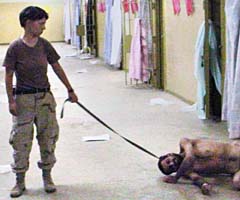
Sabrina Harman with leashed Iraqi prisoner
- May 9: Specialist Jeremy Sivits is the first US soldier to face a court-martial over the charges of abusing Iraqi prisoners at Abu Ghraib. The US military has resolved to schedule courts-martials quickly and publicly in order to defuse public criticism that it has not done enough to address the situation. The abuse scandal also looms over Bush's re-election efforts. Bush promises that "we will learn all the facts and determine the full extent of these abuses. Those involved will be identified. They will answer for their actions." Sivits is one of seven soldiers facing charges but appears to be a lesser figure in the case. Some of the others will likely face a general court martial, which can give more severe punishments than the "special" court martial that will try Sivits. His trial could produce evidence for prosecuting others believed more culpable. Sivits is believed to have taken some of the photos that triggered the scandal. His father, Daniel Sivits, said last month his son "was told to take a picture, and he did what he was told." He said his son trained as a mechanic but found himself performing military police work for which he was unqualified. Sivits has been charged with conspiracy to mistreat detainees, dereliction of duty for failing to protect prisoners and maltreatment of detainees. If convicted, Sivits could face one year in prison, reduction in rank to private, forfeiture of two-thirds of his pay for a year, a fine or a bad conduct discharge. Penalties could include only one, all or any combination of those punishments. Seven officers have already received career-ending reprimands. Sivits will be able to chose between trial before a single military judge or a three-member panel of senior officers. He has the right to a civilian attorney and will have access to military counsel. Officials hope the trial will convince Iraqis that the United States does not tolerate torture reminiscent of the darkest days of Saddam Hussein and will act swiftly to punish those responsible. Saddam's regime used the Abu Ghraib facility, located on the western edge of Baghdad, to torture and murder thousands of his critics. The trials could determine whether abuse at Abu Ghraib was an aberration, as the US command insists, or stemmed from pressure from military intelligence units to make detainees more compliant under questioning. Another soldier facing charges, Specialist Sabrina Harman, says she and others with the 372nd Military Police Company took direction from Army military intelligence officers, CIA operatives and civilian contractors who conducted interrogations.
- American officials have insisted the abuses at Abu Ghraib were carried out by a handful of soldiers who failed to follow procedures and were not part of a systematic program of brutality, though evidence is emerging almost daily that such is not the case. "Please don't paint with such a wide brush that it indicts the other 135,000 American soldiers and Marines out there doing the right thing," says Brigadier General Mark Kimmitt, failing to address the real charges of complicity and direction from the civilian leadership in the Bush administration. Kimmitt says investigators believe that only a "very small number of guards" were involved. The International Red Cross says differently. "We were dealing here with a broad pattern, not individual acts. There was a pattern and a system," says Pierre Kraehenbuel, the Red Cross operations director. US lawmakers have warned that the most repulsive photos have yet to be released and have insisted that the Army investigation should have repercussions for higher-ups, not just the military police accused of abusing detainees. "I think command responsibility has to be looked at just as seriously as the abusers," says Republican Senator Lindsey Graham. Harman says it was made clear to her that her mission was to break down the prisoners. "They would bring in one to several prisoners at a time already hooded and cuffed," Harman says. "The job of the MP was to keep them awake, make it hell so they would talk." She emphasizes that her duties were made clear to her by military intelligence agents and OGA (other governmental agency) officials. (AP/Charlotte Observer, Seymour Hersh)
- May 9: Four private military contractors have been named as suspects in the Iraqi prisoner abuse scandal, with the possibility that others will be named later. All four civilian contractors were assigned to the 205th Military Intelligence Brigade. Two of those civilians, Steven Stephanowicz and John Israel, were "either directly or indirectly responsible for the abuses" at Abu Ghraib, the Taguba report says. A third contractor, Adel Nakhla, is named as a translator and a suspect. A fourth, Torin Nelson, is said to be a witness. Both Nakhla and Nelson are listed as employees of Titan Corp., a security contractor based in San Diego. The report identifies Stephanowicz as an interrogator working for CACI; Israel, an interpreter, was also said to be working for CACI, although the company has denied that. Some news reports have identified Israel as an employee of Titan, which in turn has said he works for one of its subcontractors. The public has no way of knowing how many private contractors are working at Iraqi detention facilities, what their functions are, or who they are. (Defense Secretary Donald Rumsfeld told Congress on May 7 that "about 40" contractors are currently assigned at Abu Ghraib, but other sources give different figures.) There are no standard procedures for deploying private security workers under military contracts, which makes it far more difficult to gather information about who they are, what they're doing and for whom. They are not part of the military command; they are not covered by the code of military justice. At present, it is estimated that one out of 10 Americans in Iraq are private contractors and/or mercenaries employed by various "security companies" and private outfits. Months after Taguba issued his report to the Pentagon's central command, we still don't know what legal action, if any, the civilian contractors may face. CACI claims that it has not been contacted formally by the Army on this matter, and its employees are still working in Iraq. The Pentagon now says that it began an investigation of the Military Intelligence Brigade, civilian contractors and the Iraqi Survey Group, but not until April 24. It can be presumed that, being virtually immune from accountability and lacking any oversight except from their corporate superiors, these contractors are still working with, and possibly still abusing, Iraqi prisoners. (Washington Post)
- May 9: There are "many, many" criminal investigations going on of deaths in Afghanistan and Iraq, well beyond Baghdad's Abu Ghraib prison, says Republican senator Chuck Hagel. "This is deeper and wider than I think most in this administration understand," Hagel says. US officials have insisted the abuses at Abu Ghraib were carried out by a handful of soldiers and not part of a systematic program of brutality. Hagel says he cannot not discuss matters presented to him as a member of the Senate Intelligence Committee but they extend beyond the ongoing controversy over Iraqi prisoners of war at the prison. The panel was briefed by top intelligence and Army officials. "There are many, many investigations ongoing now as a result of deaths in Afghanistan and Iraq, deaths that came at the hands of United States officials," Hagel says. He says some of the probes have been referred to the US Justice Department. "It's probably in the range of 30, maybe more than that, of investigations, not all are homicide," he says. The Army acknowledges it is investigating possible abuse by US soldiers of 42 Iraqi civilians in addition to 35 investigations of abuse of prisoners. The Army said previously it was looking into the deaths of 25 prisoners held in Iraq or Afghanistan, determining there were two homicides by Americans against Iraqi prisoners, one case of justifiable homicide and 12 cases in which the cause of death was natural or undetermined. Ten other deaths and 10 cases of nonlethal assault remain under investigation. (Reuters/Free Republic)
- May 9: Although both Bush and Blair claim to be "shocked" by allegations and photos of tortured Iraqi prisoners, it is confirmed that both knew about the allegations as far back as two years ago, when similar allegations were made concerning Afghani detainees. Since April 2003, the International Red Cross has been submitting monthly reports of torture and abuse at Iraqi prisons, reports which were widely ignored by the Bush administration until the photos were made public in late April 2004. A senior Red Cross official says, "It doesn't matter which report it was, we had been telling the US and UK authorities in Baghdad for over a year about the scale of this [abuse and torture] problem. They had been given 10 or more reports. All detailed the same findings. They knew this had been going on for a year." Paul Bremer, the US governor heading the coalition's provisional authority in Iraq, was also handed a report by Amnesty International which described prisoner abuse and Geneva violations throughout US-run camps in Iraq last July. As a result, Bush called defense secretary Donald Rumsfeld to the White House for briefings on January 16. Rumsfeld is said to have told Bush the extent of the concern over abuse at Abu Ghraib prison. The meeting was attended by White House chief of staff Andrew Card. Yet just yesterday, Bush promised that he would "learn all the facts and determine the full extent of the abuses." Rumsfeld admitted to Congress yesterday that the Pentagon and a US general had tried to block CBS, the US TV network, from broadcasting abuse pictures taken inside Abu Ghraib. He also said "more photographs and videos exist," adding: "It's going to make matters worse if these are released to the public."
- The Sunday Herald's James Cusick writes, "The comments highlight the Bush administration's priority -- unconcerned with the humanitarian issues, but seeking to avert a public relations disaster." Teresa Richardson of Amnesty International says: "We have been delivering reports on these violations to the US authorities since the period between 9/11 and the beginning of the Iraq war. The abuse and torture, in Afghanistan, goes back two years." She says Amnesty reports on abuse by British soldiers in Iraq had also been handed to the Ministry of Defense in London in the months immediately after the war. "But we've received no response from the MoD," she says. "Our experience with the MoD, going back to Northern Ireland, is that investigation should not be carried out by the MoD, but by a civilian-led organization." Initially, Pentagon investigations of prison abuses in Iraq were more focused on limiting information and damage control than getting to the bottom of what happened in those prisons. While the investigations were going on, and reports from the Red Cross, Amnesty, and other organizations piled up, neither Bush nor Blair said a word in public about the abuses. When the abuses finally became public, the Bush administration attempted to pin the entire blame on six low-level US military police officers, but that strategy, too, proved futile, as Army investigations revealed that the directions to torture and abuse prisoners came from the highest levels of military command. Colin Powell at the State Department was said to be becoming increasingly uneasy over a situation his aides say he knew could get out of control. But Powell, increasingly isolated from the White House, could do little to influence either Bush or Rumsfeld. How far the scandal will spread, and who will eventually suffer for it, is yet to be determined. (Sunday Herald)
- May 9: Soldiers recently back from duty at Abu Ghraib prison add their own stories to the information coming out about the Iraq prison abuse scandal. One, Sergeant Michael Sindar, recalls seeing a 14-year old Iraqi boy with a broken arm being hurled to the ground and then mocked by US soldiers while he lay on the ground, weeping. The boy had not yet been processed and was still in the prisoner intake center. Sindar saw soldiers and officers boozing in violation of military rules and watched his commander quietly leave, accused of taking nude photos of female soldiers in the shower. He says that everyone knew about the photos, and competed to see who could obtain the most revealing and brutal shots. "It was like a commodity," he says. "Whatever pictures you had, whoever had the most foul picture out there, everyone wanted to see what it was." Top Army officers were rarely seen, and abusive soldiers faced little discipline. "The thing with the soldiers there, they think because we're Americans you can do whatever you want," says Specialist Ramon Leal. "They didn't have the nerve to discipline soldiers, so the bad soldiers had no reason not to." "There was a time I went to my superiors and said people are forgetting they're American soldiers," says Sergeant Joe Martin, a police sergeant in private life. "I saw people losing their temper quicker than was appropriate."
- "I didn't understand why we had to be so rude with these prisoners and beat the crap out of these guys," Sindar says. "When you have bombs going off around you all the time, it causes people to do crazy things," says Specialist Tim Noble. "some of the soldiers held off for a very long time before they had to engage the prisoners. Our company was really good at not using lethal force until they had to." Company medic Sergeant Kelly Strong, who treated both soldiers and Iraqi inmates for injuries, says he would watch soldiers for violent tendencies or other behavior that might call for combat stress teams or medication. "You can see these guys messed up, masturbating 12 times a day or running up and down the halls naked, or when they're not eating, losing weight," he says. "There were probably 30 people that went on medication while they were over there -- Prozac, Zoloft, those kind of drugs."
- Much of the strain came from the steady beat of mortars, rocket propelled grenades and small-arms fire from outside the prison, which grew more accurate over time. For a time, the prison was the most targeted US-run facility in Iraq. Alcohol was prevalent: cans of vodka or bottles sent from home. Soldiers would pay translators to buy beer or whiskey. Soldiers who complained said their gripes were dismissed. Several soldiers struggled with marital or business problems at home, adding to the strain of the endlessly bleak work in temperatures that reached 120 degrees and grew freezing on winter nights. By the time they reached the prison in October, their unit had been in the Middle East for five months running patrols in Najaf and Karbala and working in a Karbala jail. Its mission had been extended once and would be stretched out twice more. Strong says he found himself hitting Iraqi prisoners and saw how anger could turn to behavior that Defense Secretary Donald Rumsfeld described as "blatantly sadistic, cruel and inhuman."
- "You get a burning in your stomach, a rush, a feeling of hot lead running through your veins, and you get a sense of power," Strong recalls. "Imagine wearing point-blank body armor, an M-16 and all the power in the world, and the authority of God. That power is very addictive. That's what happened. They lost their sense of compassion, their sense that all these guys are not bad. Then they started degrading human beings." Several soldiers say they arrived to find little guidance for handling a fractious prison population. Indeed, soldiers had to decipher which inmates were hard cases and which were petty criminals. "It was figure it out as you go," says Specialist Jose Victor Leiva. "The leadership were more worried about our dress code, as opposed to the situation at Abu Ghraib, being mortared every night, having security issues. There was nothing set in place." Sindar, a nuclear, biological and chemical weapons specialist who was pressed into MP duty, says soldiers know the rules of engagement and were given a brief lesson in Iraqi culture before they left for the Middle East but nothing when it came to their jobs at the prison. "The training I got was -- common sense, use my head and have my morals about me." Nor were they briefed in prison operations, they say. Martin says he arrived around 1 am during a mortar attack and was told to start work the next day. "No orientation. No 'This is the [procedure].' It was get up and go to work," he says. The unit received "rudimentary" training in prisoner-of-war operations, Martin says. "In terms of, 'Let's talk about the Geneva Convention, let's talk about prisoner treatment, let's talk about the importance of why American troops should treat prisoners better than any other nation,' nothing."
- On the scandal itself, Martin muses, "I'm surprised heads didn't roll immediately. I'm surprised we weren't briefed and told people were going to go to prison immediately. We didn't see a written policy (on inmate treatment) for months." The soldiers say they saw little leadership. They said they rarely saw top-level prison officials like Brigadier General Janis Karpinski, commander of the Army Reserve's 800th Military Police Brigade tasked with overseeing prison operations. Karpinski would arrive from Baghdad perhaps once a month, then leave the same day, they said. Master Sergeant Greg Rayburn says most of the prison operations ran well in spite of the command. "It just didn't seem for this big prison that there was a lot of interest. There was a real lack of concern for what was supposedly the largest coalition prison in the country," he says. "It doesn't speak highly for the Army." (Contra Costa Times)
- May 9: The Bush administration's estimates of the 2005 cost of the Iraq war, of $50 billion, is tremendously underestimated. Congressional researchers and outside budget agencies estimate the cost of the war in 2005 to top $150 billion, over three times the lowballed estimate from Bush. As a measure of the Bush administration's priorities in the war on terrorism, it has spent about $3 in Iraq for every $1 committed to homeland security, experts say, and that divide is growing. The Pentagon says its monthly costs for Operation Iraqi Freedom shot up from $2.7 billion in November to nearly $7 billion in January, the last month for which it has provided figures. Since then, the number of troops has jumped by 20,000 to 135,000, and the insurgency has grown. Defense officials initially said the troop increases were temporary, but last week they changed course and said they planned to maintain the higher levels through 2005, along with increased numbers of tanks and other heavy military equipment. The tempo of military operations has increased sharply in response to a wave of lethal attacks, suggesting the costs still may be climbing. Both Democratic and Republican lawmakers have started to express deep concern over the costs and the way in which the Bush administration is choosing to cover them. They contend that the White House has been relying on budgeting stratagems to conceal the overall expense, at least until after the election in November. And lawmakers worry that Congress is going to be forced to do something the White House has said until now was not necessary: Chop away at other government programs to cover the costs of an occupation that has no end in sight. "DOD (Department of Defense) is being more than customarily opaque with us," says representative John Spratt, the senior Democrat on the House Budget Committee. "We're trying to pool our efforts and share information and piece something together, which is the only way to figure out what it is really going to cost us. But this is basic information. This is not unorthodox to get these numbers. It's not asking for somebody to rework the whole books. I think they are embarrassed by the level of the costs."
- By contrast, Operation Desert Storm, begun in 1991 after Saddam Hussein's armies invaded Kuwait, cost about $84 billion, adjusted for inflation, according to the Center for Strategic and Budgetary Assessments, a nonpartisan Washington think tank. But because the United States was part of a broad coalition of wealthy countries, including Britain, France, Germany, Japan and Saudi Arabia, about 90 percent of those costs were paid for by America's allies. Steven Kosiak, director of budget studies at the Center for Strategic and Budgetary Assessments, says war costs will reach $100 billion by the end of the current fiscal year on September 30 and could come to more than $150 billion by the end of fiscal 2005. Republican representative Curt Weldon, vice chairman of the House Armed Services Committee and a hawk on defense issues, says that his concern is that the administration has not been including the war's costs in the Defense Department's regular budget, but instead has been seeking special supplemental appropriations, which it has asked for as late as possible to delay the public release of financial information on the war. Worse, he says, by providing funding so late, the administration has placed further stress on the military itself, which is having to scramble and transfer money from other accounts to temporarily cover some war costs. "somehow, they have come to think that it's politically embarrassing that they need more money to pay for this war," Weldon says of President Bush and his aides. "If they're doing this for political purposes, I think it's stupid. It's shortsighted."
- Weldon says while he supports the occupation, the White House's approach of paying for the war by running budget deficits rather than slashing other programs -- including those to modernize the military by making it more mobile -- will have to end. "You can't do both at the same time," Weldon said. "The administration doesn't want to say that." Last week, the White House unexpectedly announced another supplemental request for $25 billion to cover war costs through the end of the current fiscal year. Kosiak says that without a doubt, the administration will need at least $50 billion to get through the next fiscal year. In this fiscal year, the Defense Department's regular budget totals about $401 billion, and the White House has requested $423 billion for fiscal 2005, which begins Oct. 1. All the costs of military operations in Iraq and Afghanistan are over and above those amounts. Also, neither the regular defense budgets nor the supplemental budgets include the costs of reconstruction. The United States has committed an additional $23 billion for rebuilding, which is likely to be paid out over a period of years. The Coalition Provisional Authority is another expense separate from the other budgets. It is costing nearly $900 million a year. What worries some in Congress is that part of these costs have been covered by shifting funds among accounts, rather than the White House directly explaining the entire financial need and asking Congress for appropriations. For instance, in his recent book, Plan of Attack, Bob Woodward writes that the Bush administration improperly diverted $700 million from a $40 billion emergency appropriation in the wake of the Sept. 11 attacks to pay for Iraq war preparations. Democrats have called for an investigation of this transfer. The White House has acknowledged using most of the funds for the war, but says it did so only after Congress passed resolutions supporting the invasion of Iraq. Many lawmakers now say the administration is going to have to bite the bullet and make hard decisions about what programs will have to be cut to finance the war. "What all this tells you is that you have questions that really haven't been asked much until now," Kosiak says. "If this really is about the war on terror, is this the best way to spend the money? Should more be spent on homeland security? There's no real right way to look at it. It's judgment calls."
- There are many mysteries about how the occupation is being managed and paid for, experts say. For instance, a recent report by the Congressional Research Service said it was not even clear who was responsible for the Coalition Provisional Authority. "No explicit, unambiguous and authoritative statement has been provided that declares how the authority was established, under what authority, and by whom," the report concluded. In addition, the supplemental budgets that have paid for the war have given the Bush administration unusual flexibility in how it uses and accounts for the funds. In late 2002, months before the Iraq war started, the Bush administration rebuked its own chief economic adviser, Lawrence Lindsey, for publicly estimating that a war in Iraq might cost $100 billion to $200 billion. In December 2002, Mitch Daniels, then the director of the Office of Management and Budget, said the cost more likely would be $50 billion to $60 billion -- which now looks like a fraction of the actual expenses. The Pentagon says the war in Iraq cost $63 billion from its beginning in March 2003 through January 2004. That involves money actually spent, rather than costs incurred and payments to which it is committed, experts say. Kosiak says it also does not include ancillary costs, such as the buildup of bases in Kuwait and other areas in the region. The Congressional Budget Office produced an analysis last year that estimated a continuing occupation of Iraq would cost somewhere between $85 billion and $200 billion over the next nine years, depending on how large an American force is needed and how long it remains. The numbers shoot even higher if, as some have proposed, the military has to create new divisions to bolster its overstretched forces. "In the near term, the absolute overriding concern has to be to bring this war and our efforts to fruition," says Spratt. "But at some point, we're going to have to look at the operating costs and think about taking money from elsewhere to pay for this. It's a lot of money." (San Francisco Chronicle)
- May 9: Horrific stories of organized slaughters performed by the Sudanese army and Arab militias against black tribes are largely going unnoticed by the Bush administration, the international community, and the American media. "The government wants to kill all African people," says one witness to the massacres. Over 100,000 refugees have fled into neighboring Chad, and over 1 million Sudanese are homeless due to the organizing pillaging and burning of villages. The UN has responded -- by electing Sudan to another term on the UN Commission on Human Rights. (Chicago Sun-Times)
- May 9: Vice President Dick Cheney comes to the defense of beleagured Defense Secretary Donald Rumsfeld, saying that people should "get off his case" and let Rumsfeld do his job. "Don Rumsfeld is the best secretary of defense the United States has ever had," Cheney says. Cheney's statement signals a White House push to rally Republicans behind the embattled Rumsfeld. "People ought to get off his case and let him do his job," Cheney says. National security adviser Condoleezza Rice says that Rumsfeld will continue to have the president's support. "He has the strongest possible support here in the White House," she says. Cheney spokesman Kevin Kellems, a former aide to Rumsfeld, says the American public supports the defense secretary. Rumsfeld's feisty demeanor in Pentagon press briefings since the Sept. 11, 2001, attacks has gained him a high public profile. "Americans want to keep Rumsfeld on the job. Why? Because the guy in the glasses they see on TV is the guy who is protecting them by going after the terrorists. That's who he is to the average American. That's the place he's earned since 9/11," Kellems says. Some analysts have said Rumsfeld's future could hang on the impact of the additional photographs of prisoner abuse, which Rumsfeld told Congress on Friday could further damage the United States. The new photos and videos, which are said to depict shocking "live-action" abuse, have not been released by the Pentagon. Pentagon officials are reluctant to let the public see them, and instead are offering to let selected members of Congress view them in private. (Reuters/My Way)
- May 9: In the wake of turmoil in Iraq and unrest at home, the Bush administration has decided to promote regime change in Cuba. The administration releases its plan for Bush and senior officials to fly to Miami to share with an audience of ultraconservative Cuban-Americans a series of new measures designed to "hasten" the demise of the Fidel Castro regime. Among them are increasing anti-Castro propaganda, giving greater support to "dissidents" on the island and, most incredibly, initiating clandestine operations to keep money from relatives from falling into the government's hands. The Bush administration, says Democratic senator Max Baucus after the new measures were revealed, has an "absurd and increasingly bizarre obsession with Cuba." Even though Bush says that "this strategy...promote[s] human rights," increasing the level of hardship for the Cuban people and forbidding Cuban-Americans from visiting family and their country of birth seems an ineffective way to promote their human rights. Visits by Cuban-Americans to relatives in Cuba have been cut from once every year to once every three years and, in what amounts to a redefinition of the concept of family, only visits to parents, spouses, children and siblings qualify. Close relatives such as aunts and cousins cannot be visited, and helping them became a crime. Visitors can spend only $50 a day on food and lodging instead of $164 as previously. Treating family in Cuba to a nice meal or a new pair of shoes has also become a crime. Representative Bob Menendez, a Democrat who is considered a hardliner on Cuba, accuses Bush of "playing election-year politics with the lives of the Cuban people." On the face of it, Bush's new plan seems designed to provoke a confrontation with Cuba. One of them is the decision to use US military planes to try to defeat Cuban jamming of the US government broadcasts. They would fly, supposedly, outside Cuba's territorial waters, though that seems doubtful at best, and likely to provoke outrage among Cuban governmental officials who don't wish their terroritial airspace violated by US military aircraft. "Most of the plan seems to me like more of the same failed 40-year-old policy -- tightening the embargo, etc.," says Democratic representative Jose Serrano. "But using war planes is different." He adds, "What would happen if they begin to fly -- as it could happen, knowing this administration -- over the island? This could be a way of provoking a response from Havana in order to have an excuse to attack Cuba." Patently the plans are designed to win the support of Cuban-American voters in Florida, but the positive effect of the plans are arguable, considering the hardship they will inflict on ordinary Cubans and their family members in Florida. (New York Daily News)
- May 9: Hundreds of Indian citizens have been duped by a jobs agent who hired them to work in US work camps in Iraq where they say they were forced to work as virtual slaves. US officials have promised to investigate the claims. The Indian workers were contracted to work for KBR, a subsidiary of Halliburton. The jobs agent who handled the workers has fled and is being hunted for by the Indian government. Fasil Aliyarukunju and Abdul Azeez Shajahan, two day-wage Muslim butchers from Velichikkala village in the coconut and cashew groves of the southern state of Kerala, say they were tricked into going to Iraq. They were then kept for nine months working 18 hours a day in U.S. camp kitchens, threatened with beatings and verbally abused by soldiers before their contractor employer let them go home. "They did not abuse us physically," Fasil says, referring to US soldiers, but "[t]he psychological abuse was worse." American soldiers made vague threats the contract kitchen staff would "face the consequences" if they stopped work, sometimes patting their guns as they spoke, the pair says. The two, like hundreds of others, were promised jobs in Kuwait, and instead found themselves working in terrible conditions in Iraq. (Reuters/Truthout)
- May 9: Many find Bush's moral pronouncements on Iraq and the prisoner abuse scandals "either duplicitous or fatuous," in the words of writer Joe Klein. "Liberate Iraq? Rubbish," says a prominent Jordanian businessman. "You occupy Iraq for the strategic and economic benefits. You are building the largest embassy in the world in Baghdad. Halliburton and Bechtel are running everything, at enormous profits. And then I watch Bush on Al-Arabiya and all I see is his sense of moral superiority. He brings democracy and freedom to the barbarians. But who are the barbarians? Even before the Abu Ghraib pictures, we saw male soldiers searching Iraqi women and humiliating Iraqi men by forcing their heads to the ground."
- Klein writes, "...Bush's moral certainty almost seemed delusional last week in the vertiginous realities of Iraq. A distressing, uninflected righteousness has defined this administration from the start, and it hasn't been limited to the President. Bush's overheated sense of good vs. evil has been reinforced by the intellectual fantasies of neoconservatives like I. Lewis Libby and Paul Wolfowitz, who serve Bush's two most powerful advisers, Dick Cheney and Donald Rumsfeld. It was neoconservatives who provided the philosophical rationale for the President's gut response to the evildoers of Sept. 11: a grand crusade -- yes, a crusade -- to establish democracy in Iraq and then, via a benign tumbling of local dominoes, throughout the Middle East. Those who opposed the crusade opposed democracy. Those who opposed the President coddled terrorists (according to recent GOP TV ads). They were not morally serious. But democracy doesn't easily lend itself to evangelism; it requires more than faith. It requires a solid, educated middle class and a sophisticated understanding of law, transparency and minority rights. It certainly can't be imposed by outsiders, not in a fractious region where outsiders are considered infidels. This is not rocket science. It is conventional wisdom among democracy and human-rights activists -- and yet the Administration allowed itself to be blinded by righteousness. Why? Because moral pomposity is almost always a camouflage for baser fears and desires. Bush, Cheney, Rumsfeld and the neoconservatives share a primal belief in the use of military power to intimidate enemies. If the US didn't strike back 'big time,' it would be perceived as weak. (Crushing the peripheral Taliban and staying focused on rooting out al-Qaeda cells wasn't 'big' enough.) The President may have had some personal motives -- doing to Saddam Hussein what his father didn't; filling out Karl Rove's prescription of a strong leader; making the world safe for his friends in the energy industry. The neoconservatives had ulterior motives too: almost all were fervent believers in the state of Israel and, as a prominent Turkish official told me last week, 'they didn't want Saddam's rockets falling on Tel Aviv.' At the very least, they were hoping to intimidate the Palestinians into accepting Ariel Sharon's vision of a 'state' without sovereignty. Abu Ghraib made a mockery of American idealism. It made all the baser motives -- oil, dad, Israel -- more believable. And it represents all the moral complexities this President has chosen to ignore -- all the perverse consequences of an occupation." (Time)
- May 9: Anthony Sampson writes an eloquent op-ed for the Guardian that makes the case for the use of torture spelling the end of any hope of a US-favorable settlement of Iraq. Sampson points out that the use of torture was considered within days of the 9/11 attacks on Muslim prisoners suspected of terrorist ties. The FBI asked to be allowed to abuse prisoners to get more information from detainees. The Israeli military, well-versed in torturing Palestinian suspects, encouraged the US and Britain to use harsh methods to extract information. An Israeli security official told the New York Times the West might have to use "other methods" if it was serious about the war against terrorism. After the Afghanistan offensive, the US decided to use torture methods against detainees hidden away in Guantanamo and Afghan prisons. Sampson writes, "It is now clear that the Iraq war marked a new stage in the acceptance of torture by the Pentagon -- even though it could be much less justified as a defense against terrorism. But it is also clear that the use of torture was brutalising individual soldiers, as had so often happened in history." Sampson gives a parallel between the Iraqi torture scandal and the French use of torture against Algerian insurgents in the 1954-62 war that "nearly tore France apart."
- He writes, "As the full details of the interrogation methods became known, French politicians and intellectuals were appalled by the brutalizing of both sides and people began to turn against the war. A 'safeguard committee' was formed in Paris to investigate the military excesses. 'The most serious problem is not the atrocities themselves', wrote one committee member, Robert Delavignette, 'but that as a result of them the state is engaged in a process of self-destruction.' Many commentators reckoned that torture had helped to win the Battle of Algiers, by revealing the whereabouts of the key terrorists. But it also helped to recruit more rebels, and eventually to lose the Algerian war, which continued for five years afterwards, ending in the French withdrawal. 'Torture has perhaps saved some at the expense of honour, by uncovering 30 bombs,' wrote Albert Camus. 'But at the same time it has created 50 new terrorists.' Sampson believes that the US and Britain are repeating the French mistakes: "Both Algerians and French are still paying the price for that prolonged and fearful war, and Algerians in France have played their part in the revival of terrorism today. Future generations in both America and Britain will find it hard to forgive their political leaders if they repeat the mistakes." (Guardian)
- May 10: After a briefing at the Pentagon, Bush appears in public with Dick Cheney, Donald Rumsfeld, and General Richard Myers. At the briefing, Rumsfeld offered to resign as Secretary of Defense. Bush refused the offer. To the press, Bush makes it clear that he is sticking with Rumsfeld. "You're doing a superb job," he tells Rumsfeld in front of the reporters. "You are a strong secretary of defense, and our nation owes you a debt of gratitude." Rumsfeld later reveals that he submitted his resignation twice, and both were summarily rejected. (Bob Woodward)
- May 10: Iraq's first human rights minister says that he repeatedly warned Paul Bremer, the US administrator of Iraq, in 2003 of tortures and abuses going on in US-run prisons in Iraq. Abdel Bassat Turki, who resigned in April, says he informed Bremer last November and again in December of the rampant abuse in US military prisons. "He listened very well. But that was all he did," says Turki. Turki also says he has received "information" of abuses committed against prisoners "just this week," but refuses to give details. Following allegations of abuse, he says, he had asked for permission to visit Abu Ghraib prison last November, the month the photos were taken of US guards abusing naked Iraqi inmates. But Bremer refused his request. In December, a month before the US military set up its own secret inquiry into Abu Ghraib, Turki telephoned Bremer to complain about the treatment of female detainees. "They had been denied medical treatment," he says. "They had no proper toilet. They had only been given one blanket, even though it was winter." Turki's claims suggest both the US administration and the Pentagon were aware of the widespread abuse much earlier than previously admitted. Dan Senor, Paul Bremer's spokesman, insists that Bremer only found out about the "humiliation" of prisoners in January 2004. Turki says that in March he and other US-appointed ministers had demanded an investigation after a US soldier raped a woman prisoner, documented by Major General Antonio Taguba in his report on Abu Ghraib. "We were told this matter would be dealt with in secret, and with only Americans attending," he says. (Guardian)
- May 10: Shi'ite militias loyal to cleric Moqtada al-Sadr have taken control of Sadr City, the huge, mostly Shi'ite-populated slum in Baghdad, seizing control of police forces, municipal administration and schools and blocking freedom of movement in an area just five miles east of US administration headquarters. Teenagers wielding rocket-propelled grenade launchers command entrances to the slum, home to about a third of Baghdad's 5 million residents. With the quick takeover, which was completed at dawn, Sadr City joins two southern towns, Najaf and Kufa, now under the control of Sadr's militia. The immediate trigger for the uprising in Sadr City was a US raid on March 8 on a former office of Sadr's organization and the detention of two of Sadr's lieutenants, Amr Husseini and Amjad Saedi. US officials say the men were responsible for Sadr's finances and operations in eastern Baghdad. Army Brigadier General Mark Kimmitt, the US military spokesman in Iraq, says the decision to raid the building was "based on intelligence suggesting that a large group of armed Moqtada militia were attempting to reestablish operations and reoccupy the building."
- "After the arrests and following the call of the leader...we decided to rise up with him and stop the Americans from coming into Sadr City again," says Sheikh Latif Moqtadai, commander of a small militia unit. His group mans an intersection on Orfali Street on the western edge of Sadr City, which was named for Sadr's father, Mohammed Sadiq Sadr, a revered grand ayatollah who was assassinated in 1999. Sadr has defied a US arrest warrant for involvement in the murder of a Shiite cleric, Abdel-Majid Khoei, who was killed last year. Sadr has taken refuge around Najaf, home to the shrine of Ali, a cousin of the prophet Muhammad and the first Shi'ite imam, a development that has complicated the US drive against him because commanders say they want to avoid storming the holy city. The commanders say they are chipping away at Sadr's forces by hitting them in several other southern cities, including Diwaniyah, Karbala, Kut and Kufa, just east of Najaf. US tanks roared deep into Kufa for the first time Sunday.
- In less than eight weeks, the US-dominated Coalition Provisional Authority is supposed to transfer at least nominal authority to a new Iraqi government. Sadr's rebellion against the American-led occupation, which started more than a month ago, has dimmed prospects for a smooth transfer. A rebellion also continues in central Iraq, spearheaded by Sunni Muslims. Shi'ite religious and political factions have grown nervous about a US decision to reach out to members of Hussein's former army and Baath Party to pacify the Sunni revolt in the western city of Fallujah. Hundreds of opponents of the Baathist revival demonstrated peacefully Sunday in downtown Baghdad. Sadr's Shi'ite rivals also fear they might have to deal with the radical cleric and risk intra-Shiite fighting. Sadr has rejected proposed political transition plans, which so far have excluded him. "This problem cannot be left to hang there unsolved," says Sabeeh Jasim, a former political prisoner who runs a relief charity in Baghdad. "The turmoil can only grow." Sadr City's warren of alleys had already proved to be volatile territory. The slum erupted in violence on April 4, a few days after the chief US administrator, Paul Bremer, closed Sadr's newspaper, al-Hawza, and a day after the arrest of one of Sadr's chief aides. The violence had subsided after a US counterattack, and until Sunday, Mahdi Army forces had withdrawn from the streets. Members of the Mahdi Army, which numbers in the thousands, have blocked streets with all manner of debris: fruit crates, stones, cinder block, automobile bumpers and iron grating. They set tires aflame and also burned the abundant street-side trash in the neighborhood. Heavy cranes and bulldozers were placed on main thoroughfares, available to block any American approach. (Washington Post)
- May 10: The International Red Cross was told that the practice of keeping Iraqi prisoners naked and hooded for days was "part of the process" used to elicit information, according to the ICRC's confidential report. One detainee in British custody, Baha Musa, died under the ministrations of his jailers. While his death is listed as caused by a heart attack, the report described him as one of nine men arrested in a Basra hotel and "made to kneel, face and hands against the ground, as if in a prayer position. The soldiers stamped on the back of the neck of those raising their head. ...An eyewitness description of the body given to the ICRC mentioned a broken nose, several broken ribs and skin lesions on the face consistent with beatings." (Reuters/CommonDreams)
- May 10: Concerns are growing that al-Qaeda or a related group could detonate a "dirty bomb" that would spew radioactive fallout across an American or European city, according to intelligence analysts, diplomats and independent nuclear experts. Although safeguards protecting nuclear weapons and their components have improved, experts said the radioactive materials that wrap around conventional explosives to create a contaminating bomb remained available worldwide -- and were often stored in non-secure locations. Detonating a dirty bomb would not cause the death and devastation wrought by a nuclear weapon, but officials and counter-terrorism experts predicted that it would result in some fatalities, radiation sickness, mass panic and enormous economic damage. Intelligence agencies have reported no reliable, specific threats involving dirty bombs or nuclear weapons, but senior US and European officials and outside experts say several factors had heightened fears in recent weeks. They say concerns were focused on three al-Qaeda operatives who led experiments involving dirty bombs and chemical weapons and on widely held suspicions that a special wing of the terrorist network was planning a spectacular attack. They also said that chatter justifying the use of nuclear weapons against the US has increased on radical Islamic websites as the occupation of Iraq stretches into its second year. (Los Angeles Times/Jihad Watch)
- May 10: A new study conducted by the University of Illinois at Urbana-Champaign shows that the Bush administration has used 27 different rationales for its invasion and occupation of Iraq, all floated between September 12, 2001 and October 11, 2002. The rationales identified in the study include everything from the five most familiar -- war on terror, prevention of the proliferation of weapons of mass destruction, lack of weapons inspections, removal of Saddam Hussein's regime, Saddam Hussein is evil, to the less well-known -- Senator Joe Lieberman's "because Saddam Hussein hates us," Colin Powell's "because it's a violation of international law," and Richard Perle's "because we can make Iraq an example and gain favor within the Middle East." With regard to the administration's shift from bin Laden to Hussein, the study finds that Iraq was "part of the plan for the war on terror early in the game." The study also finds that in many instances, the mainstream media not only supported virtually unquestioningly the administration's ever-changing rationales for war, but anticipated them, introducing new rationales for invasion that were eagerly adopted by the administration -- if indeed they were not planted in the media in the first place. The study, a senior thesis by law student Devon Largio, is available at UIUC's website. (University of Illinois at Urbana-Champaign)
- May 10: In his new book Misunderestimated: The President Battles Terrorism, John Kerry and the Bush Haters, journalist Bill Sammon, an enthusiastic Bush supporter, paints an interesting picture of George W. Bush. Sammon says that Bush is resolved not to repeat what he thinks were the two fundamental blunders of his father's one-term presidency: abandoning Iraq and failing to vanquish the Democrats. Bush tells Sammon that had "cut and run early" from Iraq in 1991. Bush also says that Senator John Kerry would "regret" disparaging the US-led coalition that liberated Iraq, and promises to use the Massachusetts Democrat's words against him in the election campaign. Bush acknowledges that "the rebuilding of Iraq is a difficult period," is optimistic about nurturing a democratic government there. "Freedom will prevail, so long as the United States and allies don't give the people of Iraq mixed signals, so long as we don't cower in the face of suiciders, or do what many Iraqis still suspect might happen, and that is cut and run early, like what happened in '91," Bush says. It is a blunt reference to the first President Bush's decision to stop short of toppling Iraqi dictator Saddam Hussein at the end of the Persian Gulf war, even when Hussein crushed postwar rebellions encouraged by the president. White House political strategist Karl Rove also details how the Bush campaign intends to paint Kerry as a condescending elitist who is pro-tax, weak on defense and on the wrong side in the culture wars. White House Chief of Staff Andrew Card describes Kerry as a John F. Kennedy "wannabe" who lacks the mettle to be president. Card, who also worked for the first President Bush, said when it comes to running for re-election, the son is much more engaged and far less complacent than the father. Bush bristles when reminded that Kerry called the nations that toppled Hussein, including Great Britain, Australia and Poland, "some trumped-up, so-called coalition of the bribed, the coerced, the bought and the extorted." "Yes, well, sometimes people say some things they regret," says Bush. "In the course of a campaign, there will be great scrutiny of people's words. ...I'm sure that is the kind of quote that will eventually be in the public arena. We'll let the American people decide whether or not it has any merit."
- Bush says of his re-election strategy, "I deserve a second term because, first, I've showed the American people I'm capable of handling tough times. The thing about the presidency is you never know what's going to be around the corner, and you'd better have a president who is capable of making decisions when times do get tough. And secondly, we're changing the world. Let me rephrase that: The world is changing, and we're helping to change it. And there's still a lot of unresolved issues regarding the security of the United States and peace of the world: North Korea, Iran." Bush says that a "big difference of opinion" separates him and Kerry on domestic issues. For example, Kerry "will raise taxes in order to feed the appetite of the federal government," says Bush. "I think we need to make the tax cuts I passed permanent." Bush says Kerry thinks "that the federal government will solve the medical issues facing small businesses and large businesses and the unemployed. I don't," he says. "I think that the federal government needs to pass policies that will enable private-sector solutions to emerge, such as medical-liability reform, associated health care plans, expansion of health-savings accounts."
- The strategy to beat Kerry is relatively straightforward, Rove says: You make it about big issues. The president is right on the war on terror; Kerry is fundamentally wrong. The president is right on what's necessary to keep the economy gaining strength and creating jobs; Kerry's wrong. The president's right on where the country is with regard to values; Kerry's fundamentally wrong." Rove says he expects to portray the candidates as "two men who have a fundamentally different attitude." This entails framing Bush as a rugged individualist and Kerry as a condescending elitist. "One guy who comes from Midland, Texas. You know: 'The sky's the limit. I trust you, not the government. I respect the individual.' And another guy who says: 'Hey, I'm better than you. I know better than you. The government knows better than you.'" Card says, "senator Kerry is someone who has aspired to be in politics and to run for president, I believe, ever since he was at St. Paul's in Concord, New Hampshire," referring to the elite prep school. Card ignores the fact that Bush, along with his brother Jeb, received similar elite educations and both Bush sons have been groomed for public office virtually since childhood. Card, who comes from Kerry's home state of Massachusetts, disparages Kerry's political accomplishments. "He's not as successful as some of the other politicians that I know from Massachusetts," says Card. "He didn't always have as much stick-to-itiveness in some of his missions as others did. He took advantage of political opportunities; I don't fault anyone for doing that. He was lieutenant governor and abandoned that to be able to run for the Senate. He's got a record that reflects very liberal-leaning Massachusetts tendencies. And I don't think that is what most people across the country want as the direction the country should be headed in."
- Bush's vow not to "cut and run early" from Iraq sums up an important difference in approaches between him and his father. After the Gulf war ended in 1991, the first President Bush urged Iraq's Kurds and Shi'ites to, in his words, "take matters into their own hands and force Saddam Hussein, the dictator, to step aside." The elder Bush then stayed on the sidelines when Saddam crushed their uprisings, fearful that further meddling might lead to a takeover by Islamic radicals. "I happen to think they were the right presidents for their times," Card observes of father and son. Card served as the first Bush's deputy chief of staff. "They came to office with the same moral character, but with different perspectives of America's problems. Forty-one [the first Bush] was an extremely important president for the time, managing without bravado or braggadocio -- even though there was great temptation. He was trained as a diplomat. He was there to help manage the extremely challenging change in the world, when the [Berlin] Wall came down and diplomacy had to be practiced in a different way than it has to be practiced today. But this president [George W.] came from West Texas. And West Texas was his home for a lot longer than it was for the former president. He was the governor of Texas. He wasn't the first envoy to China or the UN ambassador or the CIA director. His training was dealing with problems on the streets of Laredo or Dallas or Houston or Midland or Austin. This president came with a kind of street smarts and recognition of the importance of the resolve of America." How Card equates Bush's silver-spoon upbringing with "street smarts" remains unexplored.
- Colin Powell, Bush's secretary of state, says that Bush is a more formidable politician that he is generally given credit for. "I'd advise them to get smart," says Powell of Bush's detractors. "They keep grinding their teeth over his syntax or his not spending enough time on this or that. But he prevails. And they ought to look at his track record, as opposed to these secondary features and characteristics, which don't reflect the man." Bush's penchant for encouraging low expectations "shows how wise he is," says Powell. "Because if you have something that people consider a weakness, you can use that weakness to your advantage -- if it isn't really a weakness." Bush acknowledges that he encourages such misjudgments by detractors. "People tend to discount my ability to get things done, and that's exactly what I want," he says. "I want people to underestimate. I don't know why people do that. Maybe it's because of the philosophy I believe in, and maybe it's where I'm from. It doesn't bother me in this world that people would say that 'He can't get things done,' because I know I can." (Washington Times)
- May 10: Fox News political commentator Dick Morris tells his audience that every Muslim is a radical extremist, and no moderate voices will ever be heard from the Muslim world. During a discussion on the Hannity and Colmes talk show about the Iraqi prisoner abuse scandal and its implications for the war in Iraq, Morris says, "There really isn't any [a]nd there never will be" a "moderate Muslim voice to bring sanity and context" to the situation in Iraq. (Media Matters)
Decapitated body of Nicholas Berg discovered in Baghdad; video of his beheading airs on Internet, sparking worldwide outrage
- May 11: A shocking video showing American citizen Nicholas Berg being beheaded by masked Arabs airs on the Internet. Originally posted on a Web site connected with al-Qaeda, the video quickly makes its way around the world. CPA spokesman Dan Senor says the US is committed to finding out who was behind the execution and bringing those persons to justice. Senor says both the Defense Department and the FBI are involved in the investigation, and promises quick results. President Bush uses the horrific incident as a hook for his usual comments on violence in Iraq. "The actions of the terrorists who executed this man remind us of the nature of a few people who want to stop the advance of freedom in Iraq," he says. "Their intention is to shake our will. Their intention is to shake our confidence. Yet by their actions they remind us of how desperately parts of the world need free societies and peaceful societies."
- Other responses were more forceful, and more recognizant of the personal tragedy faced by the Berg family. Scott McClellan, the White House spokesman, says, "Our thoughts and prayers are with his family. It shows the true nature of the enemies of freedom. They have no regard for the lives of innocent men, women and children." A British Foreign Office spokesman says, "If this is genuine, then it is utterly repugnant and indefensible." Iraqi Human Rights Minister Bakhtiar Amin says Iraq will do everything within its power to bring Berg's killers to justice: "Those psychopaths who committed this immoral crime should be brought before justice very rapidly and get their deserved punishment." British Prime Minister Tony Blair describes the killing as "a truly barbaric act." The United Arab Emirates condemnes the beheading as a "heinous crime against the civilized world. ...We are ashamed because these terrorists carried out this revolting and inhumane act in the name of our religion and culture," says UAE Information Minister Sheikh Abdullah bin Zayed al-Nahayan. "This disgusting brutality can never be justified and has nothing to do with Islam or with our Arab values." Al-Nahayan also extends the UAE's condolences to Berg's family: "We pray for them to find the courage and strength to deal with their loss."
- In the video, Berg is shown sitting in an orange jumpsuit in front of five armed, hooded men. Berg, who appears lethargic and unaware of the fate that will soon befall him, says in a monotone, "My name is Nick Berg, my father's name is Michael, my mother's name is Suzanne. I have a brother and sister, David and Sarah. I live in Philadelphia." A hooded man then reads a long and somewhat incoherent statement berating the US for the Abu Ghraib prison abuses and accusing America of rejecting an offer to swap Berg for some of the detainees in Abu Ghraib. Berg sits virtually immobile throughout the harangue before being pushed to the floor. Though Berg hardly moves during the rough execution -- essentially his captors saw his head off -- blood-curdling screams are heard during the procedure. The captors chant "God is good" in Arabic during the murder. One of the captors then holds up his severed head. Though the Web site says the killing had been carried out by Abu Musab al-Zarqawi (the video is titled "Abu Musab al-Zarqawi slaughtering an American"), the leader of an Islamist terrorist group that has claimed responsibility for attacks on coalition forces in Iraq, CIA staffers say that the voice on the tape does not sound like al-Zarqawi. In fact, the men do not look like typical Arabs. All are heavyset, and at least two are wearing body armor, something quite unusual for Arab fighters. And, according to experts, the Arab being spoken in the video is certainly not spoken with an Iraqi accent, and is spoken badly, leading some to speculate that the killers might not even be Arabs. The killers promise to execute more Americans in the future.
- Berg, a private citizen who had gone to Iraq to build communications towers, had been missing since April 9. He had been detained by Iraqi police at a checkpoint in Mosul on March 24, under suspicion of possible involvement in illegal or terrorist activities, and was in American custody for an undisclosed period. He was released April 6, the day after his family family filed a lawsuit against Defense Secretary Donald Rumsfeld and the Defense Department saying the United States was holding its son without merit. Berg told his family he was arranging to come home before he disappeared. Senor says FBI officials met with Berg while he was in the custody of Iraqi police in Mosul, but denies that Berg was ever in US custody. Senor says that decisions about his detention and release were up to the Iraqi police. Senor says that the FBI "met with him on three occasions and made their own determination that he was not suspected of being involved in any criminal or terrorist activities. But he was at no time under the jurisdiction or within the detention of coalition forces." Such a statement is hard to believe considering Berg is an American and that American, not Iraqis, control almost all detentions within the country. The FBI claims that the CPA offered Berg "safe passage" out of Iraq, but he refused. "He also refused government offers to advise his family and friends of his status," the FBI statement says.
- Berg's family is outraged at the contradictory statements from American officials and says that they had received e-mails from Berg which state clearly he had been captured and detained by US forces. Berg's father, Michael, says, "I still hold [Rumsfeld] responsible because if they had let him go after a more reasonable amount of time or if they had given him access to lawyers we could have gotten him out of there before the hostilities escalated. That's really what cost my son his life was the fact that the US government saw fit to keep him in custody for 13 days without any of his due process or civil rights and released him when they were good and ready." He continues, "It goes further than Donald Rumsfeld. It's the whole Patriot Act, it's the whole feeling of this country that rights don't matter anymore because there are terrorists about. ...[I]n my opinion 'terrorist' is just another word like 'communist' or 'witch,' and it's a witch hunt, and this whole administration is just representing something that is not America, not the America I grew up in." (CNN, Daily Telegraph, Marc Perkel)
- May 11: Coalition military intelligence officials estimate that 70% to 90% of prisoners detained in Iraq since the war began last year "had been arrested by mistake," according to a confidential Red Cross report given to the Bush administration earlier this year. The report also described a wide range of prisoner mistreatment, including many new details of abusive techniques, that it said US officials had failed to halt, despite repeated complaints from the International Committee of the Red Cross. ICRC monitors saw some improvements by early this year, but the continued abuses "went beyond exceptional cases and might be considered as a practice tolerated" by coalition forces, the report concluded. The Swiss-based ICRC, which made 29 visits to coalition-run prisons and camps between late March and November last year, said it repeatedly presented its reports of mistreatment to prison commanders, US military officials in Iraq and members of the Bush administration in Washington. The ICRC summary report, which was written in February, also said Red Cross officials had complained to senior military officials that families of Iraqi suspects usually were told so little that most arrests resulted "in the de facto 'disappearance' of the arrestee for weeks or even months." The report also described previously undocumented forms of abuse of prisoners in US custody. In October, for example, an Iraqi prisoner was "hooded, handcuffed in the back, and made to lie face down" on what investigators believe was the engine hood of a vehicle while he was being transported. He was hospitalized for three months for extensive burns to his face, abdomen, foot and hand, the report added. More than 100 "high-value detainees," apparently including former senior officials in Saddam Hussein's regime and in some cases their family members, were held for five months at the Baghdad airport "in strict solitary confinement" in small cells for 23 hours a day, the report said. Such conditions "constituted a serious violation" of the Third and Fourth Geneva Conventions, which set minimum standards for treatment of prisoners of war and civilian internees, the report said. US intelligence agencies, including the CIA and the Defense Intelligence Agency, conducted interrogations at the site, but Army units were in charge of custody operations, officials say.
- The ICRC's full 24-page report cites more than 250 allegations of mistreatment at prisons and temporary detention facilities run by U.S. and other occupation forces across Iraq. The report also referred to, but provided no details of, "allegations of deaths as a result of harsh internment conditions, ill treatment, lack of medical attention, or the combination thereof." Among the abusive techniques detailed in the report was forcing detainees to wear hoods for up to four consecutive days. "Hooding was sometimes used in conjunction with beatings, thus increasing anxiety as to when blows would come," the report said. "The practice of hooding also allowed the interrogators to remain anonymous and thus to act with impunity." In some cases, plastic handcuffs allegedly were so tight for so long that they caused long-term nerve damage. Men were punched, kicked and beaten with rifles and pistols; faces were pressed "into the ground with boots." Prisoners were threatened with reprisals against family members, execution or transfer to the US lockup at Guantanamo Bay, Cuba. The report also provides new details about Abu Ghraib prison, the focus of the prisoner abuse scandal. During a visit to the "isolation section" of Abu Ghraib prison in October, ICRC delegates witnessed prisoners "completely naked in totally empty concrete cells and in total darkness, allegedly for several consecutive days." A military intelligence officer, who is not identified in the report, told the ICRC monitors that such treatment was "part of the process" in which prisoners were given clothing, bedding, lights and toiletries in exchange for cooperation. The ICRC report also describes torture and other brutal practices by Iraqi police working in Baghdad under the US-led occupation. It cites cases in which suspects held by Iraqi police allegedly were beaten with cables, kicked in the testicles, burned with cigarettes and forced to sign confessions. In June, a group of men arrested by Iraqi police "allegedly had water poured on their legs and had electrical shocks administered to them with stripped tips of electrical wires," the report notes. One man's mother was brought in, "and the policeman threatened to mistreat her." Another detainee "was threatened with having his wife brought in and raped." "Many persons deprived of their liberty drew parallels between police practices under the occupation with those of the former regime," the report noted. (Los Angeles Times/CommonDreams)
- May 11: Female prisoners in Iraq's prisons have even rougher experiences than their male counterparts. One prisoner has testified that she was repeatedly raped by US guards. Another says she was forced to strip naked in front of guards. A US Army report into the abuses at Abu Ghraib verifies the "sexual abuse" of one female prisoner by US guards, and recently released photos show instances of what the Pentagon terms "inappropriate behavior of a sexual nature." Islamic culture is unforgiving towards women who have been sexually molested or abused; as a result, many female prisoners face ostracism and even death upon their return to Iraqi society. "It is like being sentenced to death," says Sheik Mohammed Bashar Faydhi, a senior cleric based at Baghdad's largest Sunni mosque. Some Iraqi women said they were struggling to come to terms with the alleged abuses of female detainees at Abu Ghraib and other US-controlled lockups. Few female inmates will talk about it. "I hope [the allegations of rape and sexual abuse are] not true, because were it to be true, it is just too horrible to imagine," says Rajaa Habib Khuzaai, an obstetrician who is one of three women on the Iraqi Governing Council. Female lawyers who visited a detention center for female prisoners in March say their clients provided accounts of abuse and humiliation. Even seemingly minor actions by US soldiers, such as removing a woman's head scarf, represented a violation to these Muslim women. "We could not talk freely," says one lawyer, referring to US translators and guards present during the visit. "The women were devastated. They broke down crying."
- One prisoner was willing to speak more openly, and told the lawyers that she had been forced to disrobe in front of male guards, an action that an Iraqi translator found so disgraceful he turned his head away in embarrassment. Many women who had been detained are wives or relatives of senior Baath Party officials or of suspected insurgents. US Army officials have acknowledged detaining women in hopes of persuading male relatives to provide information. The lawyers said interrogators sometimes threatened to kill detainees. Once the women are freed, a new trauma begins, Iraqis say. Khuzaai, the Governing Council member, says most female detainees cannot talk about what they've been through. They and their families try to pretend nothing ever happened, she says. Another lawyer says her client fainted before providing further details of being raped and knifed by US soldiers. Five former detainees described to their lawyers having been beaten, but do not say they were raped. Whether they were sexually abused or not is unclear, because the women refuse to discuss much of what happened to them. "They are very ashamed," says a lawyer. "They say, 'We can't tell you. We have families. We cannot speak about what happened.'"
- In Iraq, silence may be their best protection. Faydhi says an Iraqi man cannot acknowledge having had a female relative in prison. The shame, he says, is bad enough if the woman was in an Iraqi jail. To have been taken by the Americans compounds the humiliation. Her life may be in danger especially if the woman is from a large, prominent tribe, he says, and her family believes she has been raped. Faydhi, an official with Iraq's Board of Islamic Clergy and a professor at the Islamic University, says a man will be discouraged from killing his female relative who has been released from prison if he seeks permission of an imam to restore the family's honor. But the cleric also said imams have limited ability to prevent this kind of murder. "I would remind him that she is a victim, and ask, how can we victimize her even more?" Faydhi says. "I would tell him to keep it secret, but that if word gets out, I would try to convince him that she should be seen as a patriotic symbol. But it is really difficult to convince an Iraqi to think in such a manner." Khuzaai says the stigma would be unbearable. "Like any woman who is raped, there is the mental, psychological breakdown and everything that is related to the self," she says. "But then there's the family and society. If a rape has happened, a family will never talk about it, not to the public, and maybe not even among themselves." (Los Angeles Times/Information Clearinghouse)
- May 11: CBS intends to broadcast a US soldier's video diary from Abu Ghraib. The diary, from a soldier whose name is being withheld, does not show scenes of abuse, but includes statements from the soldier that express her contempt and loathing for her prisoners and her duty post. The video was shot at Camp Bucca, in southern Iraq. "I hate it here," she says on the tape. "I want to come home. I want to be a civilian again. We actually shot two prisoners today. One got shot in the chest for swinging a pole against our people on the feed team. One got shot in the arm. We don't know if the one we shot in the chest is dead yet." She describes the hazards of Camp Bucca: "This is a sand viper," she says. "One bite will kill you in six hours. We've already had two prisoners die of it, but who cares? That's two less for me to worry about." She says that about three prisoners broke out of the camp every week, but they did not try to escape when she was on duty. "It's 'cause they are scared of me," she says. "I actually got in trouble the other day because I was throwing rocks at them." Tim Canjar, another soldier at Camp Bucca who has since been discharged from the military for abusing Iraqi prisoners, will also appear on the broadcast. He characterizes the situation at Camp Bucca as chaotic, with a dangerously low ratio of guards to prisoners. Canjar says that during one disturbance "at one point, it was me and another soldier guarding. I was watching 535 prisoners on my side.... The prisoners started hitting us." Fellow soldier Lisa Girman, who was discharged with Canjar, says commanders ignored the problems at Camp Bucca. She complains of "the ignorance of the chain of command not to listen to the person who was actually on the front line." Girman's and Canjar's families tried to draw attention to the problems at Camp Bucca last year. They called Rumsfeld's office repeatedly and talked to his staff, but got no response, CBS says. Their letters to the White House and two senators were also unanswered. Girman and Canjar, and a third soldier, Scott McKenzie, were discharged for punching and kicking Iraqi prisoners. They have vowed to appeal the decision and want the US Congress to investigate. (Reuters/My Way News)
- May 11: According to a former colonel from the Iraqi Army detained for three months at Abu Ghraib, forced sodomy was a specialty of certain US soldiers guarding the prisoners there. "The man in charge of my section raped several prisoners, both men and women," the former military commander tells the French daily Libération. The former prisoner, a Colonel Areth, explains that the US soldiers "were not the only ones" who committed such acts, as "there were also Iraqis who raped other Iraqis." The Abu Gharib prison command had organized a group of "capos" from the common criminals who were responsible for sowing terror amongst the detainees, the colonel says. "They are called the 'murakhabine.'" he says. "some 25 vigilantes were appointed to each area by the US soldiers and each one had three criminals working under their orders. One night, 35 of these criminals raped a 17-year-old kid," Areth says. He explains that the torture and mistreatment of detainees began after the second interrogation session if some of the replies did not coincide with those given during the first session 10 days previously. (EFE/Granma)
- May 11: In a surprise visit to Baghdad, Defense Secretary Rumsfeld says that the US military made no attempts to cover up the prison scandal at Abu Ghraib, and warns that new pictures and videos yet to come to light will make the situation worse before it can get better. He says lawyers for the administration are advising that no more pictures be released. After meeting with Major General Geoffrey Miller, the new commander in charge of prisons in Iraq, Rumsfeld visits some US guards in the Abu Ghraib mess hall and tells them, "We told ourselves that the right thing to do was to come out here and look you folks in the eye." He adds, apparently referring to the media questioning of the abuse, "It's generally a lot more fun here than it is back home." Rumsfeld is accompanied by General Richard Myers, the chairman of the Joint Chiefs of Staff. (MSNBC)
- May 11: Republican senator James Inhofe says he is far more outraged about the anger over the treatment of Iraqi prisoners than he is over the abuse itself. He expresses his puzzlement at "this outrage everybody seems to have about the treatment of these prisoners." Speaking for himself, but suggesting that he has hidden supporters on the committee, Inhofe continues, "I'm probably not the only one up at this table that is more outraged by the outrage than we are by the treatment." He accuses the media of fomenting discord and outrage over the scandal, and says that, while the perpetrators of the abuse should be punished, the abused prisoners must wake up every day thanking Allah that they no longer live under the reign of Saddam Hussein. "You know, they're not there for traffic violations," he says. "If they're in cell block 1A or 1B, these prisoners -- they're murderers, they're terrorists, they're insurgents. Many of them probably have American blood on their hands. And here we're so concerned about the treatment of those individuals." He continues, "I'm also outraged by the press and the politicians and the political agendas that are being served by this, and I say political agendas because that's actually what's happening." Inhofe delivers his remarks at a hearing with Army general Antonio Taguba, who investigated charges of abuse at Iraq's Abu Ghraib prison. David Wade, a Kerry campaign spokesman, accuses Inhofe of "trying to turn official Senate business into a political stunt to divert attention from the serious issues being discussed." Inhofe has had more to say about the prison abuses. Last week he told Chris Matthews on Hardball that he thought the brutality practiced by the French during the 1950s war to suppress Algerian independence was quite acceptable. Referring to current interrogation tactics, Inhofe said, "You've just got to be tough, and you've got to try to get the information out. If you don't get the information out, more Americans can be killed. And then you'd really hear squealing about it."
- During the Taguba hearing, Inhofe expresses his anger at the "many humanitarian do-gooders right now crawling all over these prisons, looking for human-rights violations, while our troops, our heroes, are fighting and dying." He says that adhering to Geneva Convention protocols isn't necessarily the best way to deal with Iraqi prisoners: "We're in a different kind of world than we've ever been in before," he tells a reporter. "And I believe that we need to be tougher than we have ever have been before...and it's imperative that we get intelligence." Counterpunch's Bruce Jackson writes, "Inhofe's remarks were full of pomp and smugness; they were devoid of ethical sensibility. Listening to him was like listening to someone on his way home from a lynching 50 years ago: 'They deserve what they get, whether or not they did what we said. They are what they are, aren't they? If they weren't, why would we have lynched them? G*ddam right!' If our enemies abroad were as interested in words as they are in photographs right now, Inhofe's words would serve them as well as the Army reservists' digital photographs from Abu Ghraib." (CBS, USA Today, Counterpunch)
- May 11: Bush signs a secret National Security Presidential Directive, NSPD-36, formally shifting responsibility for Iraq from the Pentagon onto the State Department after the termination of the Coalition Provisional Authority and the transfer of power from the CPA to an Iraqi government. "Under the guidance of the Secretary of State," the order reads, the US would be represented by a "Chief of Mission" -- US ambassador John Negroponte -- who would "be responsible for the direction, coordination and supervision of all United States government employees, policies and activities in country except those under the command of an area military commander." For the model to work, Negroponte and the new field commander, General George Casey, must work together. To build a relationship between the three, Bush throws a small dinner party for the two men and their wives at the White House. (Bob Woodward)
- May 11: Democratic representative Jan Schakowsky adds her voice to the calls for Defense Secretary Rumsfeld's regisnation, and calls Bush's support for Rumsfeld "a public display of the President's inept leadership." Schakowsky says, "It is disturbing that President Bush would continue to support Donald Rumsfeld, a Defense Secretary whose leadership is being questioned by those in the military, and a man who is a symbol of America's failed policy in Iraq. Donald Rumsfeld must go." She adds, "What does Donald Rumsfeld have to do in order to be fired by President Bush? He remains the Secretary of Defense even after he was wrong about how many troops we needed in Iraq. He is still at the Pentagon even though he sent our soldiers into battle without enough up-armored Humvees and body armor. And Donald Rumsfeld is in charge of our military even after trying to minimize the gravity of the abuse and torture of Iraqi prisoners. As Commander-in-Chief, it is President Bush's duty to dishonorably discharge Secretary of Defense Rumsfeld from his Cabinet. Unfortunately, by publicly supporting Donald Rumsfeld, President Bush is displaying his inept leadership to the American people and the rest of the world." Schakowsky also calls on Bush to suspend all contracts with private military firms involved in the supervision, security or interrogation of Iraqi prisoners and to provide Congress copies of such contracts. The Taguba report implicates some contractors in the abuse of Iraqi prisoners. "There are at least 20,000 highly-paid private military contractors operating in Iraq, and the recent events underscore the fact that contractors operate with little or no accountability to Congress or the American people," Schakowsky says. (Buzzflash)
- May 11: Bush continues to support beleagured Defense Secretary Rumsfeld amid growing demands for his resignation. Rumsfeld said last week that he would not quit "simply because people try to make a political issue out of it [the Iraqi prison scandal]." Appearing before a host of TV news cameras with Rumsfeld before Rumsfeld's flight to Baghdad, Bush says, "Thank you for your leadership. You are courageously leading our nation in the war against terror. You're doing a superb job. You're a strong secretary of defense and our nation owes you a debt of gratitude." (Reuters/New Zealand Herald)
- May 11: Former Marine colonel Oliver North echoes the GOP party line on the Abu Ghraib prison scandals, telling a Fox News talk show that the abuse is comparable to fraternity behavior on US college campuses. North says on Hannity and Colmes that the abuse was committed by "a group of obviously twisted young people with leashes and weird sex acts, the kind of thing that you might find on any college campus nowadays, being perpetrated by people in uniform." Two days earlier, in a May 9 commentary for the Washington Times, North wrote, "The media's 'compassion' for these imprisoned miscreants and suspected terrorists [the abused prisoners at Abu Ghraib prison] is a front for their journalistic jihad against the [George W. Bush] administration." North was a member of the National Security Council staff during the Reagan administration and is founder and honorary chairman of the conservative public policy organization Freedom Alliance. His felony conviction in connection with the Iran-contra scandal was overturned by an appeals court that said his appearance before Congress may have influenced his criminal trial. He is a nationally syndicated columnist and the host of the weekly Fox News Channel series War Stories with Oliver North. North is also the author of a book based on his tour in Iraq embedded with Marine and Army units during Operation Iraqi Freedom titled War Stories: Operation Iraqi Freedom, which includes a free DVD featuring an hour-long episode of his Fox show. Fox shares copyright on the book. (Media Matters)
- May 11: The Bush administration's push to replace comprehensive sex education with a strict focus on abstinence and religious faith is not only ignorant but counterproductive, warns writer George Monbiot. Monbiot's facts are hard to dispute, and are corroborated by a peer-reviewed study of abstinence programs cited by the Sexuality Information and Education Council of the US. According to the study, participants in the abstinence programs did postpone having sex for an average of 18 months, but were 30% less likely to use protection when they did have sex, a result SIEC director Adrienne Verrilli terms "backfire." The US and Britain, which is moving more and more towards a Bush-like stance on the subject, leads all Western developed nations in the instances of venereal disease and teenage pregnancies. In fact, many third-world nations have less teenage pregnancies per capita than the US, which trails countries like India, the Philippines, and Rwanda. Meanwhile, countries like Germany, Finland, Norway, Sweden, the Netherlands, and Denmark, whose frank and comprehensive sex education programs appall US and British conservatives, have the lowest rate of teenage pregnancies in the world. UNICEF explains that Sweden, for example, radically changed its sex education policies in 1975: "Recommendations of abstinence and sex only within marriage were dropped, contraceptive education was made explicit, and a nationwide network of youth clinics was established specifically to provide confidential contraceptive advice and free contraceptives. ...Over the next two decades, Sweden saw its teenage birth rate fall by 80 per cent."
- Sexually transmitted diseases, in contrast to the rising rates in the UK and the US, declined by 40% in the 1990s. "studies of the Dutch experience," UNICEF reports, "have concluded that the underlying reason for success has been the combination of a relatively inclusive society with more open attitudes towards sex and sex education, including contraception." Requests for contraceptives there "are not associated with shame or embarrassment," and "the media is willing to carry explicit messages" about them that are "designed for young people." As a result, the Netherlands has among the lowest abortion and teenage birth rates on earth. America and the UK, by contrast, are "less inclusive societies" where "contraceptive advice and services may be formally available, but in a 'closed' atmosphere of embarrassment and secrecy." The UK has a higher teenage pregnancy rate not because there is more sex or abortion, but because of "lower rates of contraceptive use." Monbiot writes, "The catastrophe afflicting so many teenagers in Britain and America, in other words, has been caused not by liberal teachers, liberated parents and Marie Stopes International, but by those who campaign against early sex education, discourage access to contraceptives and agitate against the social inclusion (income equality, the welfare state) that offers young women better prospects than getting knocked up." Abstinence programs favored by US and British conservatives result in, according to UNICEF, "an increase in the number of pregnancies among partners of young male participants." In other words, abstinence training increases the rate of teenage pregnancy.
- Monbiot writes, "If all this were widely known, the conservatives and evangelicals would never dare to make the claims they do. So they must ensure that we don't find out. In January, the Sunday Telegraph claimed that Europeans 'look on in envy' at the US record on teenage pregnancies. It supported this extraordinary statement by deliberately fudging the figures: running the teenage birth rate per 1,000 in the US against the total teenage birthrate in the UK, so leaving its readers with no means of comparison. Breathtaking as this deception is, it's not half as bad as what Bush has been up to. When his cherished abstinence programmes failed to reduce the rate of teenage births, he instructed the US Centers for Disease Control to stop gathering data. He also forced them to drop their project identifying the sex education programs that work, after they found that none of the successful ones were 'abstinence only.' Bush should also hope that we don't look too closely at his record as governor of Texas. He spent $10 million on abstinence campaigns there, with the result that Texas has the fourth-highest rate of HIV infection in the union, and the slowest decline of any state in the birth rate among 15- to 17-year-olds." (Guardian, Eric Alterman and Mark Green)
- May 11: In an excerpt from the Bush political biography Misunderestimated, by Bush supporter Bill Sammon, Sammon writes that the Bush campaign believes the Democrats have an "unhealthy fixation" on the Vietnam War that may dominate the 2004 campaign. Sammon's excerpt does not discuss the GOP's strong attempts to paint former president Clinton as a "draft dodger" because of his successful attempts to avoid being drafted for Vietnam service; neither does Sammon question Bush's own less-than-honorable military record. Sammon quotes White House political strategist Karl Rove as saying John Kerry is trying to use his service to negate the president's national-security credentials. "He's blatant about it," Rove says. "He says: 'Our Democratic Party has appeared weak on defense, and I can deal with that by demonstrating that I was a war hero in Vietnam.' Which he was. I mean, the guy served with honor." Rove goes on to distort Kerry's Senate record, again quoted unquestioningly by Sammon: "This is a guy who opposed every major weapons system we used to win the war on terror. This is a guy who, after we were struck in '93 at the World Trade Center bombing, said: 'Let's cut the intel budget.' This is a guy who says the war on terror is primarily a law-enforcement and intelligence matter. It ain't. It's a war." Sammon writes that the campaign, and the Bush administration as a whole, is unhappy with its perception that the media, in Sammon's words, "raced to brand that war -- first in Afghanistan and then in Iraq -- a Vietnam 'quagmire.'" Colin Powell told Sammon, "The press is fixated on Vietnam. ...Everybody says, 'Powell and all those generals still suffer from Vietnam Syndrome.' No, I don't." Powell told Sammon that the Vietnam comparison by the press is "an incorrect characterization of the thinking within the US military. ...I think the press is more sycophantic with respect to Vietnam than any general I've ever served with."
- Sammon's excerpt does not contain contrasting views from dozens of retired generals and senior military officers who insist that Iraq is becoming more and more like Vietnam every day. Instead, he turns to White House Chief of Staff Andrew Card: "I don't think the press learned as much by what happened in Vietnam as the government did. The people who are governing learned from what wasn't done well in Vietnam -- starting with political leadership making tactical decisions of war." Card adds, "The media, in my opinion, kind of wants to relive the Vietnam experience." Sammon quotes Condoleezza Rice as claiming that, while "most Americans" have "moved on" from Vietnam, the left seems stuck on the subject. "I come out of the university [she was provost of Stanford University in the early 1990s]. And look, for the intelligentsia, there's still an open wound about Vietnam. It's a huge deal, and it's like it's unresolved still. I see it in my colleagues at Stanford. I see it in the press. It's just unreconciled." Rice says that Vietnam symbolizes more than just an unsuccessful military venture: "For people of that generation it became the lodestar for the questioning of authority. And authority was never to be trusted again. And so whenever people say 'Vietnam,' what they mean is 'Authority is not to be trusted. Because the government had lied about the Gulf of Tonkin, they must be lying about weapons of mass destruction in Iraq' -- despite the fact that every reasonable person who knew anything about Iraq said there were weapons of mass destruction there."
- Sammon gives a very one-sided view of Kerry's statements about Vietnam and politics: while he notes that Kerry defended Clinton against charges of draft-dodging and deplored the use of Vietnam in the 1992 campaign, in 2004, Kerry has been much more vocal about his own service and has contrasted his record with Bush's. Sammon skims over the fact that Kerry refused for months to criticize Bush for his own AWOL status until the relentless attempts by the Bush campaign and its affiliates to paint Kerry as a "war criminal" and a "traitor," and their efforts to cast doubt on Kerry's receipt of three Purple Hearts, drove Kerry to counterattack. Sammon says that Bush is unconcerned with the entire Vietnam question, a view very different from the campaign's attempt to smear Kerry's service. He quotes Bush as saying the media's "fascination" with Vietnam is unimportant: "That's an inevitable part of this culture we're in, which is there's a lot of writers that remembered Vietnam and were legitimately concerned that the nation would get bogged down in another Vietnam. On the other hand, I've got a different perspective." Sammon also revisits the question of Bush's lack of interest in reading the daily news, quoting Bush as saying, "I get the newspapers -- the New York Times, the Washington Times, the Washington Post and USA Today -- those are the four papers delivered. I can scan a front page, and if there is a particular story of interest, I'll skim it." Bush claims he is very alert to "bias" in the news: "My antennae are finely attuned. I can figure out what so-called 'news' pieces are going to be full of opinion, as opposed to news. So I'm keenly aware of what's in the papers, kind of the issue du jour. But I'm also aware of the facts."
- Card says, indirectly, that Laura Bush does the bulk of the reading of the news and tells her husband what's important. "Indeed, the president often cites articles that Mrs. Bush flags for greater scrutiny, even when he has not personally slogged through those stories," Sammon writes. "Mrs. Bush routinely delves more deeply into the news pages than her husband, who prefers other sections. 'He does not dwell on the newspaper, but he reads the sports page every day,' Mr. Card said with a chuckle." Sammon says Bush isn't interested in reading what he considers the mass media's "liberal-leaning news coverage," believing that to do so "might cloud his thinking and even hinder his efforts to remain an optimistic leader. 'I like to have a clear outlook,'" Sammons quotes Bush as saying. Bush goes on, "It can be a frustrating experience to pay attention to somebody's false opinion or somebody's characterization, which simply isn't true." Bush relies on communications director Dan Bartlett and press secretary Scott McClellan to deal with the impact of news stories on his administration and his campaign. (Washington Times)
- May 11: Columnist William Pfaff notes that tortures and abuses such as those documented at Abu Ghraib are not an exception to the rule, as the Bush administration insists, but is much more of an example of the standard behavior and mindset of the administration. He says that Bush's policies have "contributed to a state of mind and morale in the American military that opened the way to the torture, abuse and, in some cases, apparent murder of prisoners in Iraq...." The Bush administration has routinely shown its contempt for international law and treaty obligations if it considered them obstacles to American interests...or corporate interests. During the Afghanistan fighting the US military routinely shipped prisoners outside of the country, mostly to Camp X-Ray/Camp Delta in Guantanamo Bay, without regard to the individual cases and in blatant disregard of Geneva procedures concerning POWs. It even created a new, extralegal designation, "enemy combatant," which has no legal status and essentially gives the US the leeway to do whatever it likes to such prisoners. "Ordinary American norms of justice, requiring timely presentation of charges, legal representation and impartial adjudication, were ignored then and continue to be ignored," Pfaff writes, and adds that the Democrats and the American press bear their own share of responsibility for allowing this to occur with little or no protest: "some Afghan and other 'war against terror' prisoners were transferred to third countries. Reporters were informed -- with a smile and a wink -- that this was because they could be tortured there. Again there was negligible reaction in US press and political circles. In Afghanistan, and subsequently in Iraq, an obvious reason for the involvement of civilian 'contract employees' in intelligence and interrogations has been that they are not subject to military discipline, and responsibility for them and what they do can be 'plausibly denied' by US officials."
- Pfaff gives a calmly chilling explanation: "All this is consistent with an attitude toward violence characteristic of the neoconservatives in the Bush administration, who have for years insisted that history is made through violence, and that in the national cause a governing elite has the right to mislead the public in order to achieve goals that the leaders alone are in a position to understand." Bush officials have no qualms in telling the biggest and most systematic of lies to justify their actions. They say without pause that America's opponents in Iraq and elsewhere have to be killed -- no negotiations or attempts at peaceful co-existence are even considered. "Dehumanizing language has deliberately been employed to describe all those who oppose the United States," Pfaff writes. "The cumulative effect of this has conveyed to American troops that international and national norms of lawful conduct have been suspended or crucially limited in the war against terror. It can be argued that the Bush administration created a state of expectation, mode of conduct, hostility to traditional norms of military behavior, and attitude toward Iraqi, Afghan and other Islamic 'terrorists,' that opened the way to atrocities." Civilians aren't deemed worthy of consideration -- killing hundreds of innocent bystanders as part of a military operation is standard procedure.
- Pfaff's most striking example is the "shock and awe" offensive that opened the attack on Baghdad. Hundreds upon hundreds of civilians died under the treads of American tanks or in the explosion of American missiles, to the point where the US military refused to even attempt to count civilian casualties any longer. As a result, American soldiers see Iraqi civilians as the enemy, as, in the worlds of a British officer, "untermenschen -- subhuman, a term applied by the Nazis to Jews and Gypsies." Pfaff writes, "Young military reservists from small American towns do not spontaneously torture, humiliate, sexually abuse and obscenely mock powerless prisoners unless people in authority over them have ordered or encouraged them to do so." And the result is predictable. Pfaff says an American friend of his in Saudi Arabia tells him "it's all over with those pro-American Arabs who until now have credited Washington with good intentions in Iraq. Photographs of American women soldiers sexually taunting and abusing naked and bound Arab men says to them that the United States is a totally depraved society." Pfaff asks: "But who debauched these young American men and women soldiers? I would argue that the moral debauchery came down the chain of command from Washington." (International Herald Tribune)
- May 11: Bard College professor Luc Baird calls the photos and videos from Abu Ghraib "trophy shots," and compares them to photos of lynchings of African-Americans from the first four decades of the 20th century: "[B]lack men are shown hanging from trees or light fixtures or maybe being burned alive, while below them white people are laughing and pointing for the benefit of the camera. There are some pictures of whites being lynched, too, but these tend not to feature the holiday crowd. Often the spectators at lynchings of African-Americans are so effusive in their mugging that they all seem to be vying for credit. Before seeing such pictures you might expect the faces in them to express some kind of collective rage; instead the mood is giddy, often verging on hysterical, with a distinct sexual undercurrent." Baird writes, "Like the lynching crowds, the Americans at Abu Ghraib felt free to parade their triumph and glee not because they were psychopaths but because the thought of censure probably never crossed their minds. In both cases a contagious collective frenzy perhaps overruled the scruples of some people otherwise known for their gentleness and sympathy -- but isn't the abandonment of such scruples possible only if the victims are considered less than human? ...The Americans in the photographs are not enacting hatred; hatred can coexist with respect, however strained. What they display, instead, is contempt: their victims are merely objects." He goes on to compare the photos to the "strings of human ears collected by some soldiers in Vietnam" or "the G.I. [in World War II] who blithely mailed his girlfriend in Brooklyn a Japanese skull as a Christmas present." He concludes, "That prison guards would pose captives -- primarily noncombatants, low-level riffraff -- in re-enactments of cable TV smut for the benefit of their friends back home emerges from the mode of thinking that has prevented an accounting of civilian deaths in Iraq since the beginning of the war. If civilian deaths are not recorded, let alone published, it must be because they do not matter, and if they do not matter it must be because the Iraqis are beneath notice. And that must mean that anything done to them is permissible, as long as it does not create publicity that would embarrass the Bush administration. The possible consequences of the Abu Ghraib archive are numerous, many of them horrifying. Perhaps, though, the digital camera will haunt the future career of George W. Bush the way the tape recorder sealed the fate of Richard Nixon." (New York Times)
- May 11: Ontario radio host John Derringer writes a thoughtful op-ed explaining why he no longer supports the Iraq occupation. "I was wrong. It's that simple," he writes. "When the Bush administration announced its plan to invade Iraq early last year, I supported them. I thought, like so many millions of others did, that the American forces would be in and out of there before you could say Grenada. I truly believed that Saddam would be toppled and a new government set up within a year, with minimal American casualties. I also thought that in such a quick conflict, Bush could finish the job that his old man couldn't, and that it would send a message about American resolve that needed to be sent. The backing of countries like France, Russia and China means nothing to me in any conflict, and the fact that they, and the United Nations, were not involved was a non-factor. ...Unfortunately for everyone involved, the American forces in Iraq have been mired in a hellish combat zone for well over a year, and by many accounts, the worst is yet to come.
- "The Bush administration has blindly stumbled through the minefield that is Iraq for the past 15 months, ignoring advice from the many experts on the subject, including their own military, intelligence agencies and diplomats. As I heard Senator Joe Biden say on Face the Nation on Sunday, Bush hasn't even listened to his own generals. With the creepy and shifty Donald Rumsfeld and the downright scary Paul Wolfowitz running the civilian command of the military, it's their way or the highway. It's become quite clear that Bush, both before and after the actual invasion, has tossed aside any advice that doesn't fully and completely support his own foregone conclusions. The arrogance that seeps from the Bush White House is mind-numbing, and although most American polls show running Bush neck and neck with Democratic challenger John Kerry for this November's presidential election, I think that has a lot more to do with the anemic state of Kerry's campaign than it does with support for the incumbent. One of the many areas in which Bush has really lost my respect is with this ludicrous notion that if you're not behind the War in Iraq, you're soft on terrorism. The Deliverance extras living in Tennessee trailer parks may go for that one, but few others will. The most recent controversy -- the alleged mistreatment of prisoners at the Abu Ghraib prison -- is a pivotal point for the American forces. It shows the frustration that many American soldiers face daily. These soldiers are seeing their friends and fellow servicemen killed or maimed in the most cowardly ways imaginable. Suicide bombings, car bombs, ambushes. There's no blow too low for this enemy. ...How on earth can American soldiers continue to battle with an enemy who doesn't play by any rules at all? The short answer is, they can't.
- "The frustration oozing from the Abu Ghraib prison won't disappear. It will get worse. And it's no fault of the soldiers. Damn those who blame this on kids from America's heartland who go halfway across the world to fight an enemy who knows no Geneva Convention, no Marquis of Queensbury rules, no rules of engagement that even approach reason or fair play. The Iraqi insurgents, like terrorists world-wide, know that the American military has to play by the rules, and it's their goal to turn the American media, and the American people, against their own military. With the Abu Ghraib prison abuse story hitting North American headlines, and the sickening sanctimony of the North American media, the insurgents have, to use a perfectly American analogy, 'hit a home run.' The irony here, of course, is that the atrocities committed at the prison by Americans on Iraqis don't hold a candle to the abuses that Iraqis heaped upon each other, at the very same facility, under Saddam. Although I've changed my mind on my support for this war, and those politicians who started it, my support for the soldiers who are over there fighting for their lives in the world's most unfair theatre of combat, has not changed a bit. I just hope they make it home alive. And I'm sure that's the goal that many have set for themselves: Just survive. Because this war is no longer about freedom or terror, it's about one man's political agenda, and dead American soldiers are obviously not about to get in his way. I thought it was about more than that. I was wrong." (Toronto Star)
- May 11: Laura Ingraham's new book, Shut Up and Sing: How Elites from Hollywood, Politics, and the UN Are Subverting America, is, according to reviewer Frank Wallis, a hysterically ignorant characterization of liberals using the crudest of stereotypes and the most inaccurate information this side of an Ann Coulter broadside. Ingraham, a lawyer who worked in the Reagan administration and now hosts her own conservative talk show, tries to define American liberals as limousine-ferried elitists who, by her own description, are cynical, arrogant, un-American, in the minority, anti-democracy, hateful of Middle America, self-cultist, infallible-feeling, godless, affirmative-action loving, French-loving, UN-loving, flag-burning, subversive, anti-Israel, traitorous, socialist, communist, fascist, aloof, pretentious, turgid, condescending, snobbish, vicious, sex-obsessed, atheist, anti-semitic, genocidal, world government loving, anti-religious, free immigrationist, globalist (seeking to undermine American values and sovereignty), disloyal, and march with "fellow travelers." And all this from the first 27 pages!
- She says that liberals perpetuate a "false myth of oppressed minorities." They hate individualism because individuals can think for themselves. They threaten the American empire with transnational government under the UN. They live in big cities. Their anti-Iraq War stance proves they are anti-American. Ingraham writes that the liberal elite drive around in limousines with black windows, "live in palaces invisible from the road outside, and fly in private jets, while their managers and assistants tell them only what they want to hear." She writes that "True Americans" believe in God, own guns, and want limited government. True Americans want to place God in public schools and in public life. True Americans are white, southern, Christian, and Republican. Some people who call themselves Republican are actually traitors, such as Sen. Olympia Snowe, she asserts, and goes on to say that the 1925 Scopes Monkey Trial was an insult to the South. Wallis goes on to analyze her stance on religion and state, the Iraq War, the economy, communism in our colleges, the United Nations, and Europe in detail that I will not go into here, but she does assert that, contrary to Biblical interpretation, rich people (except, presumably, her limousine liberals) have a much better chance of going to heaven than their poor counterparts, and states that to be a real American, one must be a born-again Christian fundamentalist. She claims that almost all Americans supported the war in Iraq until "Hollywood elitists" poisoned their minds against it. She says that US colleges are rife with Communists who deliberately attempt to subvert their country, and makes the usual claims that the NEA supports homosexuality being taught in public school classrooms and opposes teaching about "real" American history. She claims that the United Nations is bent on "taking over" America through its efforts to regulate gun ownership in this country, and believes that all Europeans are joined with the UN in its efforts to topple the US. All in all, her book is a fine compendium of the standard conservative drivel permeating this country's political and social discussions. (PowerSkeptic)
- May 12: Charges that US soldiers stripped, beat, and photographed an Afghan police officer at a US base in Kabul are being investigated by the US military. The former police colonel, Sayed Nabi Siddiqui, says that, in a series of different prisons, he was kicked, beaten, sexually taunted and also repeatedly photographed while naked, although that might have been part of the identification process. "To the best of our knowledge this is the first time anyone in the military chain of command or the United States Embassy has heard of this alleged mistreatment," US Ambassador Zalmay Khalilzad says. "We are not aware of the existence of any photos of the alleged incident." Allegations of prisoner abuse in Afghanistan are not new. "I have in the past spoken to people who have claimed to have had family members who were arbitrarily arrested and taken away and kept for months," says reporter Lara Logan, also in Kabul. "Because there's no judicial process involved, these detainees do not go to trial, they do not have lawyers, they're not represented in any way, by anyone other than the International Committee of the Red Cross, and they do not make their findings public."
- Lieutenant General David Barno, the top US official in Afghanistan, claims that the military has made "very significant changes" to the way it handles prisoners in Afghanistan after alleged abuse, including the deaths of three prisoners. Barno says the military had investigated "challenges and problems" at outlying bases and that it decided to transfer suspects to the main holding facility at Bagram, north of the capital, more quickly. He has denied an Afghan human rights group's demand for access to the prisoners at US jails in the country to make sure they're not suffering the same kind of abuses alleged in Iraq, saying monitoring by the International Committee of the Red Cross is sufficient. Siddiqui says he was wrongly detained on July 15 after he reported police corruption and that someone then accused him of being a member of the Taliban. He said he was held for about 40 days at three different US bases: at Gardez, Kandahar in southern Afghanistan, and Bagram. He describes being humiliated repeatedly during his detention in all three places. Siddiqui says that for the 12 days he was in Kandahar, detainees were packed into wire cages and forced to use a bucket as a toilet in front of other detainees. He also said soldiers threw stones and bottles at detainees. "It was like stoning monkeys at the zoo," he says. "They brought buckets of stones and they were laughing as they did it." The US has had an ongoing investigation into the deaths of two Afghans at Bagram's closely guarded jail in December 2002, but says it has had trouble gathering evidence and has yet to release results. Military autopsies found that both men died of blunt force injuries. A third Afghan died last June at a holding facility in eastern Kunar province. A US intelligence official said last week that the CIA inspector general is investigating that death because it involved an independent contractor working for the agency. The US military views Taliban and al-Qaeda prisoners as "unlawful combatants," and has held hundreds captured in the war that ousted the Taliban in late 2001 for more than two years without formal charge or access to lawyers. (AP/CBS)
- May 12: Defense Secretary Donald Rumsfeld defends the interrogation tactics used by US soldiers, intelligence agents, and private contractors/mercenaries at Abu Ghraib, and dismisses charges that the tactics violated the Geneva Conventions. Rumsfeld tells a Senate committee that Pentagon lawyers had approved methods such as sleep deprivation and dietary changes as well as rules permitting prisoners to be made to assume stress positions. General Richard Myers, chairman of the Joint Chiefs of Staff, also notes that the rules require prisoners to be treated humanely at all times. But Senator Richard Durbin, a Democrat, says some of the approved techniques "go far beyond the Geneva Convention," a reference to international rules governing the treatment of prisoners of war. Durbin notes that one American GI is missing in Iraq, his whereabouts unknown. Given the circumstances, he asks Rumsfeld, "wouldn't it help if there was clarity from you and from this administration that we would abide by the Geneva Convention when it comes to civilian and military detainees unequivocally?" Expanding his question to include detainees in Afghanistan and Guantanamo Bay, he asks whether such a declaration would "also serve to help American prisoners" held captive. Rumsfeld replies that the Geneva Convention applies to all prisoners held in Iraq, but not to those held in Guantanamo Bay, where detainees captured in the global war on terror are held. He says the distinction is that the international rules govern wars between countries but not those involving groups such as al-Qaeda. "Terrorists don't comply with the laws of war. They go around killing innocent civilians," Rumsfeld adds. (Guardian)
- May 12: General William Boykin, who recently outraged Muslims by saying his Christian god was superior to the god of Islam, has been linked to the Iraqi prison abuse scandal. The US Senate was told that Boykin briefed a top Pentagon civilian official last summer on recommendations on ways military interrogators could gain more intelligence from Iraqi prisoners. Many believe that Boykin's recommendations amounted to a senior-level go-ahead for the sexual and physical abuse of prisoners, possibly to "soften up" detainees before interrogation, a charge the Pentagon denies. Congressional aides and Arab-American and Muslim groups say any involvement by Boykin could spark new concern among Arabs and Muslims overseas the US war on terrorism is in fact a war on Islam. "This will be taken as proof that what happened at Abu Ghraib (prison) is evidence of a broader culture of dehumanizing Arabs and Muslims, based on the American understanding of the innate superiority of Christendom," says Chris Toensing, editor of Middle East Report. One Senate aide says any involvement by Boykin could be explosive: "Even if he knew about the abuse, that would be a big deal."
- Boykin touched off a firestorm last October after giving speeches while in uniform in which he referred to the war on terrorism as a battle with "satan" and said America had been targeted "because we're a Christian nation." He has denied being anti-Islam or against any other religion. The Pentagon has so far refused to discipline Boykin. Hussein Ibish, communications director for the Arab American Anti-Discrimination Committee, says his group and others has repeatedly called for Boykin to be reassigned to a less sensitive job until the Pentagon inspector general completes his investigation of Boykin's remarks. Senate Armed Services Committee Chairman John Warner and congressional Democrats have also urged Boykin to step aside, but the Pentagon has defended his right to free speech. Defense officials say the IG investigation, begun last fall, was nearly done and a report could be issued next month. "I'm not saying Boykin is directly responsible," says Ibish, "but there is a collective failure here. There is a tolerance in our society, in our government, in our media for hateful rhetoric when directed against Arabs and Muslims. It definitely contributes to a climate in which these young MPs apparently felt it was...OK to abuse Muslim and Arab men like this." Ibrahim Hooper, spokesman for the Council on American Islamic Relations, chides the Pentagon for not acting promptly to discipline Boykin and the delayed engagement of top military leaders on the prisoner abuse scandal. "It creates a climate in which...the perpetrators believe they're carrying out the policies of those above them, whether those policies are explicit or not," Hooper says. (Reuters/ABS-CBN)
- May 12: John Kerry says the war in Iraq is a failure and that a change in leadership is needed to end the Bush administration's mistakes and incompetence. In turn, Republicans charge Kerry with trying to make the war into a political issue, an interesting position given the Bush campaign's attempt to portray Bush as a successful wartime president. "Why should we reward more of the same?" Kerry asks. "Why should we reward miscalculations of what it would take to make the peace? I think that it's been one miscalculation after another, frankly. And arrogance that has lost America respect and influence in the world." Marc Racicot, Bush's general campaign chairman, accuses Kerry of dragging politics into the war on terror and warns that domestic criticism undermines military morale. "Political attacks come at a price for the military," Racicot says. "If there was ever a time to refrain from partisan politics, this is it. But all we see from the Kerry campaign and from John Kerry is political exploitation for political gain." Kerry rejects charges that he is politicizing the war. "They had no plan for winning the peace and now Americans are paying the price," he says. "A couple of hundred billion dollars a year, and that is disgraceful." Kerry says that, if elected, he will consider naming prominent Republicans to help in the fight against terror, including the possibility of asking Republican senator John McCain to serve as his defense secretary. Kerry also names Senator John Warner, chairman of the Senate Armed Services Committee, Senator Carl Levin, the panel's ranking Democrat, and William Perry, defense secretary under President Clinton, as possible heads of the Defense Department.
- "If America has reached a point where only one person has the ability in our great democracy to manage the Pentagon and to continue or to put in place a better policy even, we're in deeper trouble than you think," he says after being asked if his calls for Rumsfeld's resignation would be disruptive to the war effort. "I don't accept that. I just don't accept that. I think that's an excuse. The fact is that we need a change in policy." Kerry says the argument that the nation needs stability in the war on terror essentially means sticking with a policy no matter how flawed. "There are any number of people who are unbelievably capable," he says. "This notion that we have to continue with a policy that's wrong and taking us down the wrong track is absurd." Kerry sats responsibility for the abuse of prisoners in Iraq extends all the way to the Oval Office and that Bush must accept responsibility for setting a tone that allowed the abuse to take place. He also warns that a few low-ranking soldiers shouldn't be made scapegoats for a broader policy that led to the abuse. Racicot responds, "To blame the abuse on Bush and the armed forces is to blame all of America for the disgusting actions of a few. It's striking to see the ease with which John Kerry thrusts an important moment into the campaign's daily spin cycle, compared to the president's steady leadership and focus on doing what he believes is right." (Washington Post/Truthout)
"Free Republic" to blame for Berg's detention?
- May 12: It's possible that a political "outing" performed by the extreme right-wing organization calling itself the "Free Republic" may have contributed to the death of Nicholas Berg. On March 7, 2004, an "enemies list" composed of signatories to an anti-war petition was posted on the Free Republic website. The introductory and subsequent comments on that list suggest that the purpose of the posting was to encourage people to harrass the individuals on the list and to circulate their names to agencies and individuals that might take action against them. Nick Berg's father, Michael Berg was on that list; the list names Prometheus Methods Tower Service, Inc. as an affiliation. Nicholas Berg's company is Prometheus Methods Tower Service. It is conceivable that Berg was detained by US officials in response to the Free Republic's listing of Michael Berg and Prometheus Methods as targets for harassment. It's worth noting that, just after this information becomes public, the Free Republic edited and falsified its "enemies list" to remove any reference to Michael Berg or Prometheus Methods. (Center for American Politics)
- May 12: Diebold executive Wally O'Dell, whose company makes the leading brand of voting machines to be used in the November elections, says he made a "huge mistake" in sending out an August 2003 fund-raising letter that said in part, "I am committed to helping Ohio deliver its electoral votes to the president next year." He excused his comment by saying he didn't write the letter, and intended only to send party invitations. O'Dell, a staunch Republican who has made large contributions to the Bush campaign and other GOP candidates' campaigns, says he is no longer politically active, and that as long as Diebold makes voting machines, the company will not involve itself in political activities. California's Secretary of State Kevin Shelley has prohibited the use of Diebold machines in his state, and has called for an investigation into O'Dell's political ties with the Bush campaign. (New York Times
- May 12: The attack ads that the Bush and Kerry campaigns are employing are misleading the American voters about critical aspects of the candidates' policies, according to the New York Times' Adam Clymer. Conversely, voters don't know a great deal about the real stands of either candidate. According to polls taken in 18 "battleground states" where the ads have been heavily distributed show that 61% of voters believe that Bush "favors sending jobs overseas" and 56% believe Kerry "voted for higher taxes 350 times." Neither statement is accurate. A Kerry commercial contends that "George Bush says sending jobs overseas 'makes sense' for America," a statement Bush never made. The ad is based on a message Bush signed that accompanied the annual report of his Council of Economic Advisers, a report that asserted it made sense for the United States to buy goods and services from countries that produced them more cheaply than the United States could. Although the idea that Bush supports sending American jobs overseas can be easily inferred from the message, Bush never directly stated such a position.
- Bush commercials, and Bush himself, contend that Kerry "voted for higher taxes 350 times." This, too, is wrong: the list includes occasions when Kerry voted to keep taxes at existing levels, or supported lower tax cuts than Republicans sought. Now, he is calling for higher taxes only on people earning more than $200,000 a year while promising new cuts for middle-income families. Another Bush attack slogan, the idea that Kerry wants to slap a 50-cent tax on gasoline, is believed by almost half of the voters polled, but Kerry does not endorse such a tax. He gave vague support to a similar idea in 1994, but now rejects the idea. The 46% who believe that Kerry wants to raise gas taxes get the idea directly from Bush campaign ads. Kerry's campaign has been successful in persuading 72% of voters that America has lost 3 million jobs since Bush became president. The actual figures are closer to 2 million. Voters also don't know that Bush claims to support extending the ban on assault weapons, and he wants to cut the federal deficit in half (though few, if any, of his economic proposals would have such an effect). Voters don't know that Kerry wants to eliminate tax breaks for profits made overseas and use the money to encourage companies to invest their foreign earnings in the United States, neither do they know that Kerry wants to have the government help pay to get health insurance to all children and to help employers pay their workers' costs. (New York Times/Stanford University [cached Google copy])
- May 12: Conservative commentator Tucker Carlson, a co-host of CNN's Crossfire, reveals that he believes the war and subsequent occupation of Iraq is "a disaster." "I think it's a total nightmare and disaster, and I'm ashamed that I went against my own instincts in supporting it," he says. "It's something I'll never do again. Never. I got convinced by a friend of mine who's smarter than I am, and I shouldn't have done that. No. I want things to work out, but I'm enraged by it, actually." Carlson is increasingly trying to differentiate between his brand of conservatism, which may hawk back to the "paleoconservative" views of Pat Buchanan, Barry Goldwater, and Bob Dole, and the neoconservative views of many Bush administration officials and most conservative media commentators. Carlson is readying his own show for PBS, to be called "Tucker Carlson: Unfiltered." (New York Observer)
Missile defense shield proven unreliable
- May 13: A technical analysis performed by an independent scientists' group shows that the multibillion-dollar U.S. ballistic missile shield due to start operating by Sept. 30 appears incapable of shooting down any incoming warheads. The analysis found "no basis for believing the system will have any capability to defend against a real attack," the Union of Concerned Scientists said in a 76-page report. The Pentagon's Missile Defense Agency rejected the report. "It will provide a defense against incoming missiles for the first time in this country's history," says Richard Lehner, an agency spokesman. The Pentagon's initial deployment involves 10 interceptor missiles in silos in Alaska and California. It is designed to protect all 50 US states against a limited strike from North Korean missiles that could be tipped with nuclear, chemical or biological warheads. Boeing Co. is assembling the shield, which would use the interceptors to launch "kill vehicles" meant to pulverize targets in the mid-course of their flight paths, outside the Earth's atmosphere. Using infrared sensors, the vehicles would search the chill of space for the warheads. So far, the interceptors have scored hits five times in eight highly controlled tests designed to maximize the possibility of success.
- The Missile Defense Agency "appears to be picking numbers out of thin air," the report said of past Pentagon assertions of a high probability of shooting down targets. "There is no data to justify such an assumption," added the scientists' group, which is based in Cambridge, Massachusetts. Its findings dovetailed with an audit last month by Congress's General Accounting Office that said the system's effectiveness would be "largely unproven" when the initial capability goes on alert. Even unsophisticated countermeasures that could be mounted by countries such as North Korea remain an unsolved problem for midcourse defenses against long-range missiles, the scientists' report said. Balloon decoys could be given the same infrared signature as a warhead by painting their surfaces, it said. The project could also be confused by sealing the warhead in a large balloon so the kill vehicle could not determine its exact location or tethering several balloons to it. Overstating the defensive capabilities of the ground-based defense is dangerous, the group said. "If the president is told that the system could reliably defend against a North Korean ballistic missile attack, he might be willing to accept more risks when making policy and military decisions," the report said. "All indications are that it would not work," adds Lisbeth Gronlund, a physicist who is a co-author of the report and co-director of the group's global security program. "And the administration's statements that it will be highly effective are irresponsible nonsense," she says. Overall, the Pentagon estimates it will need $53 billion in the next five years to develop, field and upgrade a multilayered shield also involving systems based at sea, aboard modified Boeing 747 aircraft and in space. (Reuters/CommonDreams)
- May 13: Truthout's Marjorie Cohn proves that, contrary to the assertions of Donald Rumsfeld and other Bush officials, the abuses and tortures performed in Abu Ghraib were indeed violations of the Geneva Conventions as well as a variety of treaties authored and/or signed by the United States. "This conduct does amount to torture under the Convention Against Torture and Other Cruel, Inhuman or Degrading Treatment or Punishment, which occurs when a public official or one acting in an official capacity intentionally inflicts, instigates or consents to the infliction of severe pain or suffering on a person for the purpose of obtaining information or a confession. Torture is never permitted, even in times of war," she writes.
- "Torture is a crime under federal law. When a US national conspires, attempts, or commits torture outside of the United States, he can be sentenced to 20 years in prison. If his victim dies, the perpetrator can receive life in prison or the death penalty. Other acts chronicled in the Taguba report, such as forcing groups of male detainees to masturbate themselves while being filmed, and holding a naked detainee by a dog chain or strap around his neck, would, at a minimum, amount to inhuman treatment. ...Both torture and inhuman treatment are considered war crimes under the Geneva Convention, another treaty the United States has ratified. The War Crimes Act of 1996 provides that military or civilian US nationals could receive life in prison, or the death penalty if a victim dies. There is evidence that at least one Iraqi died while being interrogated at Abu Ghraib. These atrocities are not, as the Bush administration would like us to believe, confined to the Abu Ghraib prison or even to Iraq. ...A prisoner released from Guantanamo told Amnesty International that the interrogations there 'were like torture.' Australian lawyer Richard Bourke reported on ABC Radio that one of the Guantanamo detainees 'had described being taken out and tied to a post and having rubber bullets fired at them. They were being made to kneel cruciform in the sun until they collapsed.' Torture has also been used in Afghanistan. In December 2002, the documentary 'Massacre in Afghanistan' was broadcast on German television. An Afghan soldier recounted being ordered by an American commander to fire shots into the closed containers which transported prisoners. Some died from suffocation; others were dumped in the desert, shot and left to be eaten by dogs, as 30 to 40 American soldiers watched. A week after the documentary aired, the Washington Post reported that 'stress and duress' tactics were used on prisoners interrogated at the US-occupied Bagram air base in Afghanistan. The US military admitted that two prisoners were victims of homicide.
- "...When Rumsfeld decided the Third Geneva Convention didn't apply to the prisoners at Guantanamo or Afghanistan, after unilaterally declaring they weren't prisoners of war, he sent an implicit message to future American interrogators in Iraq that detainees need not be treated humanely. Rumsfeld presumably overlooked the Fourth Geneva Convention, which protects civilians in time of war. It prohibits the use of physical or moral coercion to obtain information from them. ...Only seven US soldiers have been charged with crimes at Abu Ghraib under the Uniform Code of Military Justice. None of the military or civilian (i.e., mercenary) personnel has yet been charged with war crimes under U.S. civilian law. The influential Army Times implicates both Gen. Richard Myers, chairman of the joint Chiefs, and Rumsfeld in the Iraqi prison scandal. It states that the responsibility 'extends all the way up the chain of command to the highest reaches of the military hierarchy and its civilian leadership.' In its report, the Red Cross described physical and psychological coercion by interrogators which 'appeared to be part of the standard operating procedures used by military intelligence personnel.' The myriad photographs confirm that the perpetrators felt they had nothing to hide from their superiors. ...Rumsfeld's involvement in setting policy for Guantanamo Bay is instructive here. Twenty of the most egregious interrogation techniques used at Guantanamo, which Human Rights Watch describes as 'cruel and inhumane,' were 'approved at the highest levels of the Pentagon and the Justice Department,' including Rumsfeld, according to the Washington Post. In the words of the Army Times, 'This was not just a failure of leadership at the local command level. This was a failure that ran straight to the top. Accountability here is essential -- even if it means relieving top leaders from duty in a time of war.'"
- Cohn concludes, "Policymakers must be held accountable. All those in the chain of command should be investigated, and war crimes prosecutions initiated of the responsible military and civilian personnel. Donald Rumsfeld should not only be relieved of his duties as Secretary of Defense. He must also be investigated for war crimes." (Truthout)
- May 13: Two of the seven soldiers charged with abusing Iraqi prisoners at Abu Ghraib prison in Baghdad will be court-martialed. Brigadier General Mark Kimmitt, chief US military spokesman in Iraq, announces that Staff Sergeant Ivan "Chip" Frederick and Sergeant Javal Davis will face a general court-martial. No trial date and venue have been set as yet. Another soldier, Specialist Jeremy Sivits, goes on trial May 19 in Baghdad before a special court-martial, facing a maximum of a year in jail, a fine and a bad conduct discharge. Davis and Frederick have been charged with conspiracy to maltreat detainees, dereliction of duty for failing to protect detainees from abuse and maltreatment of detainees. Davis also faces charges of assault and giving false official statements, and Frederick is charged with wrongfully committing an indecent act by watching detainees commit a sexual act.
- The charge sheet says that in one incident in which Frederick allegedly was involved, a prisoner was made to stand on a box, was attached to wires and was told he would be electrocuted if he fell off. The wires were not connected to a power source. Frederick is also alleged to have forced naked detainees into a pyramid position and photographing the scene. He is also accused of making detainees masturbate in front of others and forcing one man's face "directly in front of the genitals of another detainee" to simulate oral sex while photographing them. Davis allegedly forced detainees into a pile "and jumped on" them, the charge sheet says. He is also accused of stepping on prisoners' feet and striking a detainee "in anger." It says Davis lied when he said he did not intend to step on the detainees' feet and did not strike an inmate in anger. A report by Army investigators said Davis told of being "made to do various things that I would question morally." He also told investigators that military intelligence personnel appeared to approve of the abuse. "We were told they had different rules," he told investigators, according to the report. The Army report quotes a witness saying he saw Frederick hit prisoners stacked in a pile and hit a prisoner who posed no threat. The witness also reportedly testified he observed Frederick watching two inmates perform a sexual act. In Frederick's written accounts to his family about conditions at Abu Ghraib prison, he said his job was to prepare prisoners for interrogation and that he was told, "This is how military intelligence wants it done." He said military intelligence officers "encouraged us and told us, 'Great job.'" Frederick wrote that when he questioned the acting battalion commander about harsh inmate conditions, he was told "to do as he says." Attorney Paul Bergrin says: "Shawn [Davis] is a great American hero who risked his life and volunteered to go to Iraq knowing he might never return. He felt compelled to serve his country based upon 9-11, and the propaganda and political statements pertaining to the state of Iraq." "We are going to bring forth my son's innocence and expose the real people who are behind this," says Jonathan Davis, his father. "They know who they are. I think it goes all the way up to Rumsfeld and the joint chiefs of staff; I really do." (China Daily)
- May 13: The CIA continues to insist that Abu Musab al-Zarqawi was the masked man who beheaded American Nicholas Berg, despite evidence to the contrary. Al-Zarqawi is considered an ally of Osama bin Laden. The Jordanian-born Palestinian is a poisons expert. He is thought to be responsible for hundreds of deaths in Iraq. Last month, al-Zarqawi was sentenced to death in absentia in Jordan for masterminding the successful 2002 plot in the murder of Laurence Foley, a diplomat and administrator of US aid programs in Jordan. (AP/Miami Herald)
US lies about not having Berg in custody; Berg family blames US for holding Berg so long without charge
- May 13: According to e-mails provided by the family of Nicholas Berg, an American diplomat in Iraq told the family that Berg was held in US custody since early April. This directly contradicts claims from the US that Berg was never held by US forces. The State Department says that the diplomat was in error. The e-mails, from US consular officer Beth Payne, read in part, "I have confirmed that your son, Nick, is being detained by the US military in Mosul. He is safe. He was picked up approximately one week ago. We will try to obtain additional information regarding his detention and a contact person you can communicate with directly." That particular e-mail was sent to Berg's father Michael on April 1. Payne repeated that Berg was "being detained by the US military" in an e-mail the same day to Berg's mother, Suzanne. The next day, Payne wrote that she was still trying to find a local contact for the family, but added that "given the security situation in Iraq it is not easy." According to the e-mails, Berg was taken into custody on March 24 by Iraqi police and held in a jail that he described in the message as managed by Iraqis with oversight from United States Military Police forces. Berg wrote that US agents questioned his reasons for being in Iraq, whether he had ever built a pipe bomb or had been in Iran. "They can detain him and deny him his basic civil rights of a lawyer, a phone call or even a charge for 13 days, but they can't get him" on a plane, David Berg, brother of the slain American, says. "The Iraqi police is mentioned frequently, which is, of course, absurd, because there is no Iraqi government right now," he continues. "And if you think about it, to be detained by the Iraqi police without the US government's knowing would be tantamount to kidnapping."
- Berg's e-mails indicate that many of his fellow prisoners thought he was Israeli, and after some initial harassment from the prisoners, the American MPs moved him to his own cell. He wrote that many of the Iraqi prisoners he met had been jailed for months without being charged or interrogated, and said that the American and Iraqi guards treated them "like dogs." Berg was last seen by friends on April 9 in an Internet cafe near the Al Fanar Tower hotel in Baghdad, where he had been staying. State Department spokeswoman Kelly Shannon says Payne's information came from the Coalition Provisional Authority. The authority did not tell Payne until April 7 that Berg had been held by Iraqi police and not the US military. "As Mr. Berg had been released, the consular officer did not convey this information to the family because he was released, thankfully," says Shannon. "And we thought he was on his way." Berg's brother David calls on the government to come clean about its contacts with his brother before his death. The Berg family blames the US government for keeping their son in custody for too long while anti-American violence escalated in Iraq. "They're trying to deflect attention to a couple weeks down the road when no one's paying attention," says David Berg. "I think President Bush needs to be a man about this and tell the truth. I think most, if not all, Americans can figure out who's telling the truth and who's lying."
- Meanwhile, the family says Berg had been questioned by the FBI more than a year ago about a contact he had with a terrorism suspect in 1999, while he was a student at the University of Oklahoma in Norman. Some reports have said the suspect may have been Sept. 11 suspect Zacarias Moussaoui, but David Berg says that is not true. Nicholas Berg only went to school there in 1999; Moussaoui enrolled in a flight school in Norman in February 2001. Michael Berg says that the FBI cleared his son of any wrongdoing. He said Nicholas Berg met the suspect while riding the bus to classes, and had allowed the suspect to use his computer. (Moussaoui, or another terrorist suspect, may have had Berg's password and used it to access school computers, but investigators say Berg's password was used by dozens of students; his father says Berg often gave his password out, sometimes to virtual strangers.) The Bergs say they want to know if the government had received an offer to trade Iraqi prisoners for Nicholas Berg. On the videotape of his death, Berg's killers made a reference to a trade offer, but US officials have said they know of no such offer. Michael Berg says he wanted to hear President Bush address the issue: "I would like to ask him if it is true that al-Qaeda offered to trade my son's life for the life of another person. And if that is true, well, I need that information...and I think the people of the United States of America need to know what the fate of their sons and daughters might be in the hands of the Bush administration." (AP/Monterey Herald, New York Times)
- May 13: Freelance Chilean journalist Hugo Infante, who befriended Nicholas Berg in Iraq, says Berg told him he had been held by US forces for almost two weeks under suspicion of spying. "Nick told me, 'Iraqi police caught me one night, they saw my passport and my Jewish last name and my Israeli stamp,'" Infante relates. "'This guy thought I was a spy so they put me with American soldiers and American soldiers put me in a jail for two weeks.'" Infante says Berg told him that Iraqi police were suspicious of the electronics equipment he was carrying for his work on radio communications towers when he was arrested in Mosul. Infante's comments about Berg's whereabouts during that time period echo those made by Berg's family. US authorities continue to deny ever detaining Berg, insisting that Berg was held by Iraqi police. Coalition spokesman Dan Senor says Berg was visited three times by FBI agents while he was in custody of Iraqi police. He says the agents concluded Berg was not involved in terrorist or criminal acts and referred other questions relating to Berg's detention to Mosul police. The FBI confirms its agents met with Berg, and also said the CPA offered Berg safe passage out of Iraq upon his release. FBI agents "encouraged him to accept CPA's offer to facilitate his safe passage out of Iraq. Mr. Berg refused these offers," the FBI says. Infante says Berg told him he was held in a coalition facility where Syrians, Egyptians, Jordanians and Iranians suspected of entering Iraq illegally were also detained. "I still hold [Rumsfeld] responsible because if they had let him go after a more reasonable amount of time or if they had given him access to lawyers we could have gotten him out of there before the hostilities escalated," says Michael Berg, Nicholas's father. "That's really what cost my son his life was the fact that the US government saw fit to keep him in custody for 13 days without any of his due process or civil rights."
- Infante and another friend of Berg's, Colorado businessman Andy Duke, said they last saw Berg on the evening of April 9, at the Al Fanar Hotel three days after his release from Mosul. Infante says he thought Berg was intending to go to Baghdad Airport the following morning and take a flight back to the United States. The next he heard of Berg was when he heard news of his death. "I thought he was back in the States. And I thought, my God, this is the guy. A different guy. More skinny, more pallid," Infante says. Duke agrees. "I looked at the Internet and there was that truly disgusting video. I couldn't look but turned away. But I heard the sounds," he says. Duke, like Berg, is a self-employed businessman. He said there were many others like him who arrived in Baghdad looking for work and were successful. "Nick loved what he did. He was a risk-taker. He was a very robust young man, well-organized and well-prepared and this adventure was something he enjoyed and savored," he says. (CNN)
- May 13: Michael Berg, the father of slain American Nicholas Berg, blames the Bush administration for his son's death. "My son died for the sins of George Bush and Donald Rumsfeld," Berg says in an interview with a local radio station. "This administration did this." Berg says his son probably would have felt positive, even about his executioners, until the last minute. "I am sure that he only saw the good in his captors until the last second of his life," he says. "They did not know what they were doing. They killed their best friend." Berg slams the administration for its invasion of Iraq and its its sponsorship of the Patriot Act, which gives sweeping powers of surveillance to the federal government. He describs the Patriot Act as a "coup d'etat," and says, "It's not the same America I grew up in." Berg rejects government claims that his son had never been held by American authorities in Iraq. The Iraqi police chief in the city of Mosul has also contradicted statements by the US-led coalition concerning the younger Berg's detention. "I have a written statement from the State Department in Baghdad...saying that my son was being held by the military," Berg says. "I can also assure you that the FBI came to my house on March 31 and told me that the FBI had him in Mosul in an Iraqi prison." Dan Senor, spokesman for the Coalition Provisional Authority, said this week that Nick Berg was arrested in Mosul by Iraqi police on March 24 and released on April 6, but insists that Berg was in the custody of Iraqi police the entire time. (Reuters/CommonDreams)
- May 13: For the first time, Donald Rumsfeld says that the outcome of the US occupation of Iraq is uncertain. Rumsfeld says the prison abuse scandal has delivered a "body blow" to the nation-building effort in Iraq. "Will it happen right on time?" he says. "I think so. I hope so. Will it be perfect? No.... Is it possible it won't work? Yes." In the overall war on terror, Rumsfeld says the US is making progress in Afghanistan, but "I look at Iraq and all I can say is, I hope it comes out well, and I believe it will. And we're going to keep at it." Rumsfeld and Air Force General Richard Myers, the Joint Chiefs chairman, say they will go ahead with the June 30 transfer of limited authority in Iraq and review the situation in the fall to decide whether US troops could begin withdrawing. "That's the next time we would have a lens on what the requirement would be" and whether some of the 135,000 U.S. troops could be sent home, Myers says. Myers and Rumsfeld make their comments before a sometimes-unfriendly Senate Appropriations Committee hearing on the Pentagon's request for an additional $25 billion to fund the Iraq war, a figure Rumsfeld admits is only a partial payment on what the war will cost next year. During the hearing, Republicans join Democrats in questioning whether Rumsfeld had a viable plan to transfer authority to a viable Iraqi government. "We are only 42 days away from turning over this country to the Iraqi leadership, whatever that is," says Republican senator Pete Domenici. "I can envision that this situation will not work." (New York Daily News/Billings Gazette)
- May 13: Speaker of the House Dennis Hastert, normally the most loyal of Republicans, stuns observers with a speech harshly critical of the White House. Even more surprisingly, his audience, the House GOP caucus, applauds his remarks. Hastert "expressed outright dismay with the White House staff for the way the transportation bill had been handled," says one GOP member. "They did not give the priority necessary to the issue in resolving it as the Speaker had wanted. It's in absolute limbo." Another lawmaker says, "Hastert was frustrated and disappointed that he had not been dealt with openly and fairly and given accurate information. He was not so much speaking to the conference as he was speaking for the conference."
- The catalog of GOP complaints against the executive branch is lengthening. A senior Republican House member says his colleagues frequently disparqage the White House communications team, particularly on articulating its policy in Iraq. He says there is frustration about a lack of White House effort in pushing the FSC/ETI bill, designed to replace corporate subsidies with tax breaks. And in March, Hastert said that the White House was doing a poor job selling its economic policies. The are also widespread complaints among lawmakers that the administration's message machine is out of sync. When, for example, the House passed a bill in March raising penalties for violence against pregnant woman, the White House dimished the political impact by trumping it with the announcement that it would support a constitutional amendment banning gay marriage, even though key House leaders were not on board. Behind the scenes, the White House is making it clear that it is less concerned about grumbling among members of Congress than with winning hearts and minds beyond the Beltway. It believes that by this measure, the president's support is solid. It is the transportation bill, on which the White House remains determined to hold down costs, that appears to have brought Hastert's frustration to a boil. Earlier this month he ordered a White House legislative aide to leave his office. Efforts have been made in the past several days to mend fences. Senior White House officials met in Hastert's office this week, and on Tuesday Hastert and Senate Majority Leader Bill Frist had dinner at the White House with Bush and Vice President Dick Cheney. The GOP House leadership is also now publicly playing down its differences with the White House, while acknowledging that relations are not yet smooth. Finally, House leaders say, Iraq and the presidential election campaign loom over everything the House does. Majority Whip Roy Blunt says, "It is hard to get any message through. The political clutter demands a higher level of coordination between the White House and congressional Republicans. The campaign is overwhelming everything. The comments people are making would not be made if this were not an election year." (The Hill)
- May 13: Republican senator Charles Grassley says that when Democrats led Congress, they did a far better job of overseeing the federal bureaucracy than the current Republican leadership is doing. Grassley, speaking for several senior Republican and Democratic senators, says that congressional neglect extends far beyond the Iraq war spending and other "hot-button" issues into just about every aspect of the vast federal bureaucracy. "We Republicans have never quite reached the level of competent oversight that the Democrats developed over their 40 years that they controlled Congress," says Grassley, the Senate Finance Committee chairman and one of the few Republicans to pepper the administration regularly with inquiries. "We tried to emphasize legislating, and we've delegated so much authority to the executive branch of government, and we ought to devote more time to oversight than we do." When your party controls Congress and the White House, "You get less oversight," says House member Tom Davis, a Republican who chairs the House Government Reform and Oversight Committee. "That's the way it goes." Not necessarily, retorts Democratic senator Edward Kennedy: "When my brother was attorney general, Sam Ervin questioned him for two and a half days on the Civil Rights Act of 1964," he says, referring to the North Carolina Democrat's hearings with Attorney General Bobby Kennedy. "Two and a half days!" Kennedy says that back then, cabinet officials didn't try to shirk opportunities to testify, as they sometimes do now. "There wasn't a question of, 'Look, I've got an appointment downtown,'" he says. Powerful Democratic committee chairmen pursued a series of investigations into Clinton administration policies when they controlled Congress for the first two years of Clinton's term. There were tense hearings on Whitewater and on Clinton's controversial "Don't Ask, Don't Tell" policy on gays in the military. Clinton "got clobbered by his Democratic members," recalls a Democratic leadership aide. "Clinton couldn't even get a health bill up for a vote, for Christ's sake. It was his number-one priority."
- "The Republicans haven't tried oversight," says Democratic representative Barney Frank. "These people will not do oversight of their administration." Observers describe a much more tightly knit relationship between leading congressional Republicans and President Bush, who has racked up a series of legislative victories and has yet to issue a veto of any legislation. After the GOP gained control of the House and Senate in 1994, the Republicans followed up with investigations of the siege at Waco, Texas, and other matters. But Representative Henry Waxman. a Democrat, calls many of these investigations "excessive" and "politically motivated." As chairman of the Government Reform and Oversight Committee (it has been renamed simply Government Reform), Representative Dan Burton also looked into fundraising abuses in the Clinton-Gore campaigns and investigated the FBI's use in the 1960s of mobster informants. Burton signaled an interest in investigating the Bush administration on some issues, but he has since relinquished his chairmanship due to term limits. Waxman says that when Republicans ran Congress and Democrats had the White House, "There was no allegation too small for them to issue subpoenas." Now, he said, there is no scandal so big it won't get overlooked. Waxman, who serves on Government Reform and on Energy and Commerce, said that Democrats have sought hearings on federal contracting in Iraq, the outing of Valerie Plame Wilson's CIA identity, the California energy crisis, and the administration's energy task force -- and that in each case, the GOP majority refused, except for a Government Reform hearing on the government-contracting issue.
- Democrats on Government Reform recently sought an investigation of the role that private contractors played in the Iraqi prison abuse scandal. Davis says, "We're going to look at it. It'll be regular order." As of this writing, no investigation has been opened. Davis cites an earlier hearing dealing with other issues surrounding contractors such as Halliburton as evidence that the committee was willing to pursue even topics that might make the administration look bad. "There was some anxiety," he says, "but I wouldn't say there was pressure" not to go forward. At the same time, the House and Senate Appropriations Committees have given the administration vast leeway to distribute funds appropriated for the war -- although some members have criticized the administration for dedicating hundreds of millions of dollars to prepare for the war in Iraq while providing only a brief notification to Congress. "We've been so busy trying to get our bills passed through conference," says House Appropriations Committee Chairman Bill Young, a Republican. "It takes away from the time we should have been applying towards oversight." The ongoing hearings into the Iraqi abuse scandal may be the exception to the rule. In the last few years, the Senate generally has been more willing to pursue aggressive oversight than the House, with Grassley and Senate Commerce Committee Chairman John McCain often tasking the administration with unpopular inquiries. The House Energy and Commerce Committee also has played a role, but it often has focused on business issues like faulty Firestone tires and the controversial Super Bowl half-time show rather than government functions. Democrats on the Senate Health, Education, Labor and Pensions Committee wrote Chairman Judd Gregg in November seeking hearings on the new "No Child Left Behind" law. As yet, Gregg has ignored the request.
- The Senate Governmental Affairs Committee has conducted oversight of the new Homeland Security Department, but much of its work has been on consumer issues, such as an attention-grabbing hearing on "diploma mills." When oversight and hearings do occur, the results aren't always as enlightening as they could be. At the Senate Armed Services hearings, each of 25 members on the panel got a brief chance to query Rumsfeld. But it was hard for any of them to pursue a line of questioning. Staff weren't allowed to ask follow-up questions as they were allowed to do in the Watergate hearings. "This is a travesty that you get six minutes, and call that 'advise and consent,'" says Kennedy. "In too many instances, the Congress has yielded too many of its prerogatives to the executive." (The Hill)
- May 13: Bill Mitchell, the father of a soldier slain in Iraq, applauds the media's decision to print pictures of flag-draped coffins returning from Iraq. He believes his son, Michael, was in one of the coffins photographed. "It was showing the care and respect they give the coffins," Mitchell says. Since the Iraq war began, the Pentagon banned journalists from taking photographs at Dover Air Force Base in Delaware, the first stateside stop for fallen soldiers returning home. In April, the Air Force released more than 350 photographs, in response to a Freedom of Information request. The photos show airmen arranging flags on caskets inside a C-17 Globemaster and honoring them as they depart the aircraft. Both the Pentagon and the White House said the ban on photos of soldiers' coffins is in place to protect the privacy of soldiers' families, but Mitchell said he believes the motive is political: "They don't want people to see the true cost of war. "The $87 billion they are spending is not the true cost. It would not pay to bring my son back alive." A letter recently arrived from Defense Secretary Donald Rumsfeld, containing standard condolences, Mitchell says. But the letter from the Pentagon lacked feelings, he says. "It's just a form letter. It's in [a] computer, and you add someone else's name," says Mitchell. "I don't believe [Rumsfeld] signed it." (Stars and Stripes)
- May 13: Michael Moore's controversial film Fahrenheit 9/11 has been rescued by Miramax heads Bob and Harvey Weinstein. Disney, who originally oversaw the film, has refused to distribute it for political reasons, but has agreed to sell the film to the Weinsteins for third-party distribution. (MTV/Pabaah)
- May 13: Political activist Marc Perkel, and others, find the official explanation of the execution of Nicholas Berg by Arab terrorists hard to swallow. (Full disclosure: Perkel hosts this site.) They note some strange discrepancies in the video. One, Berg is wearing an orange jump suit, identical to those worn by US detainees in Abu Ghraib and other detention facilities. Of the hostages slain on camera before now by Arab terrorists, notably Daniel Pearl, none have worn such clothing. Secondly, the walls and baseboards of the room in the video are the same color as those in Abu Ghraib. Thirdly, it is evident that several of the men in the video are wearing body armor -- commonplace among American soldiers and mercenaries, but almost unheard of for Iraqi insurgents or Arab terrorists. The white plastic chair Berg sits in is identical to those used by guards in the Abu Ghraib photos, though the chair is of common manufacture and widely available. The Arabic spoken by the men on the videotape is poor, suggesting that Arabic is not their first language, and the accent is neither Iraqi nor Jordanian. Some insist that the men in the video are far too light-skinned to be Arabs. Additionally, the man initially identified as Jordanian terrorist Abu Musab al-Zarqawi is whole of body; al-Zarqawi is known to have lost a leg and uses a prosthetic. The man identified as al-Zarqawi also wore a mask to hide his identity, raising the question of why he would announce his identity on the one hand and wear a mask to conceal his features on the other. Most interestingly, Berg does not bleed properly as his neck is being sawn through; where one would expect jets of arterial blood spraying around the room, instead, Berg merely leaks blood in a pool, leading one to wonder if he may have already been dead when his head was sawn off. (The tape was obviously edited; it is possible that Berg's initial statement was taped earlier than his execution. Observers also note Berg's strange calm during his statement; it is possible that Berg knew nothing of his imminent execution, or perhaps he was drugged. Though the tape is filled with screams as Berg's head is being severed, Berg himself barely flinches, and does not attempt to struggle.)
- Perkel theorizes that Berg was not executed by Arabs at all, but by Americans, perhaps soldiers, perhaps mercenaries, at Abu Ghraib as an action designed to inflame American sentiment and distract from the outrage over the prison abuses in Iraq. This theory has, so far, been impossible to prove. Oddly, though the video was originally found on an Arabic web site by several Western news outlets, including Fox, CNN and the BBC, within an hour of its initial appearance, al-Jazeera journalists were unable to find the video a scant half-hour later.
- Note: the editor discussed this theory with a close friend who served for a year as an intelligence officer in Iraq, and the friend is not impressed. He says though it is likely Berg was indeed drugged and possibly already dead before being beheaded, the evidence of the military-style boots, the body armor, Berg's orange jump suit, and the ill-spoken Arabic means nothing, and is all quite commonplace among many Iraqis. (Marc Perkel, Al-Jazeera, my own sources)
- May 13: Atlantic Monthly editor Joshua Green compares the efforts of the 2004 Bush campaign to smear and distort John Kerry's candidacy to the extremely dirty, and extremely successful, tactics employed by the 2000 Bush campaign to smear and distort Al Gore's candidacy. Green uses a 2000 BBC documentary called "Digging the Dirt," which has never been aired in the US, for a major source. According to the documentary, the 2000 Bush smear campaign was headed by the chief of the Republican National Committee's research team, Barbara Comstock. Comstock is a lawyer who worked with Republican representative Dan Burton during Burton's intensive efforts to besmirch the Clinton administration with one falsified "scandal" after another -- Filegate, Travelgate, assorted campaign finance problems, and, of course, Whitewater. "The team we had from 2000," says Comstock, "were veteran investigators from the Clinton years. We had a core group of people, and that core was attorneys." Comstock and her team knew how to use opposition research in the service of a larger goal: not simply to embarrass Gore with hard-to-explain votes or awkward statements but to craft over the course of the campaign a negative "storyline" about him that would eventually take hold in the public mind. "A campaign is a lot like a trial," she says. "You want people aggressively arguing their case." Running a negative campaign can be a tricky business, since voters don't often respond well to what they perceive as negative politics and often punish the campaign carrying out the attacks rather than the intended target.
- The BBC documentary shows how Comstock and other political operatives have learned to use the media to get around this problem, by creating a journalistic black market for damaging stories. During the first debate between Gore and Bush, in October of 2000, the BBC crew stationed itself inside the RNC's war room, filming researchers as they operated with the manic intensity of day traders, combing through every one of Gore's statements for possible misstatements or exaggerations. The researchers discovered two (Gore erroneously claimed never to have questioned Bush's experience, and to have accompanied a federal official to the site of a Texas disaster on the particular date mentioned), and immediately tipped off the Associated Press. Soon the filmmakers would catch the team exulting as the AP took the story. The scenario happened again and again, on both sides of the campaign, but the Bush team was particularly expert at such indirect slanders. The team's sophisticated understanding of the media and their ability to manipulate the reporting of political news helps explain how Gore's public image shifted from that of stiff but competent technocrat at the outset of the campaign to that of serial exaggerator who would say anything to get elected. The steady stream of stories reinforcing this notion took its toll -- a fact neatly documented by the filmmakers' shot of the New York Post after the debate: Gore beneath the headline "LIAR! LIAR!" One researcher on Comstock's team, Tim Griffin, says, "We think of ourselves as the creators of the ammunition in a war. We make the bullets."
- The Gore campaign also deployed researchers, directed by Chris Lehane, who made his name spinning for the White House during the Clinton scandals and who by reputation is the most feared and loathed Democrat in the "oppo" world. Under Lehane the campaign portrayed Bush as an amiable dunce -- a charge supported by many of Bush's actions but one that backfired, by so diminishing expectations that Bush prospered in the debates that doomed Gore. Griffin has been once again retained by the RNC to lead the 2004 efforts to besmirch Kerry. The campaign against Gore illustrates how what Bill Clinton referred to as "the politics of personal destruction" has become institutionalized and grimly respectable. To avoid backlash, campaigns have become much more careful about attacking their opponents. Shrewd politicians can exploit this anger and still engage in hardball tactics -- as Bush did by pledging to be "a uniter, not a divider," even as his campaign savagely excoriated Gore.
- Unfortunately for Democrats, they have proven much more capable at slamming one another than going after their Republican opponents. Howard Dean is the most well-known victim of Democrat partisan politics; the Wesley Clark campaign, led by research team director Ben Holzer, compiled a binder full of damaging material against Dean, which they used quite effectively to blast the former front-runner. Dean's endorsement by Al Gore set off a barrage of attacks from the Clark campaign which effectively decimated Dean's status as a credible challenger to Bush, including charges that Dean had improperly identified constituents who are HIV positive, that property taxes in Vermont had skyrocketed under Dean's tenure as governor, that Dean had signed legislation providing tax breaks to Bermuda-based insurance companies (the story broke a day after Dean criticized companies that dodge taxes by incorporating in Bermuda), that Dean had signed legislation conceding more than $80 million in tax breaks to large corporations (again on the heels of Dean's criticism of Bush giving fat tax breaks to corporations), that Dean had allowed security at the Vermont Yankee nuclear plant to become lax, and that Dean was uninterested in appointing minorities to his cabinet during his time as governor, a charge initially leveled by fellow candidate Al Sharpton. Never mind that most of the stories were either untrue or misrepresented, the stories blew away Dean's aura of inevitability and instead created a sense among Democrats that Dean was unprepared for national office.
- "It was absolutely brutal," Jay Carson, a spokesman for Dean, says. "We were fielding four or five bad stories a day, and there were other stories percolating that we were frantically trying to kill or keep a lid on. When you're defending yourself on five or six fronts at once, every day, it's extremely difficult to talk about what you want to be talking about." Clark's campaign alone did not sink Dean's candidacy: Saddam Hussein's capture, Dean's frequent outbursts, and a flurry of negative TV ads by Richard Gephardt's campaign all contributed. But the Clark campaign could certainly be charged with aiding and abetting Dean's collapse. Polls in late November put Dean solidly in first place, with 32 percent of Iowans supporting him. The battered candidate finished a distant third in the January 19 caucuses, garnering just 18 percent of the vote. The damage to Dean may have inadvertently sabotaged the Clark campaign. Its purpose in attacking Dean had been to diminish his stature in New Hampshire, where Clark, who did not compete in Iowa, was running a strong second. But Dean's implosion gave Kerry an unexpected and resounding victory that vaulted him into the lead in New Hampshire. Clark finished a disappointing third and soon dropped out of the race.
- Attack politics is nothing new to America: Thomas Jefferson was painted by opponents as a godless Francophile bent on destroying the institution of marriage. Andrew Jackson's marriage to a woman he wrongly believed to be divorced, Grover Cleveland's illegitimate child, and Teddy Roosevelt's alleged drunkenness were all pushed by opponents during ugly presidential campaigns. Sometimes such indirection backfires. During the 1987 race for the Democratic nomination, the Dukakis campaign slipped a videotape to several media outlets that showed an opponent, Senator Joseph Biden, delivering a speech partially plagiarized from the British Labour Party leader Neil Kinnock. This prompted further scrutiny, and subsequent revelations of plagiarism and academic exaggeration drove Biden from the race. When it was learned that his campaign had supplied the damaging tape, Dukakis felt compelled to call a news conference and later fired his aides. Since then, standards have diminished. Campaigns routinely distribute videotapes and other damaging information to the media, but "trackers" with video cameras follow enemy candidates for the explicit purpose of capturing embarrassing moments.
- Other "hits" are now the stuff of legend. In 1984, Michael Bayer, the RNC research director, was digging into the vice-presidential candidate Geraldine Ferraro's past and obtained a list of properties owned by Ferraro and her husband. On a hunch Bayer, a former military intelligence officer, sent a photographer to take pictures of one warehouse loading area. He discovered that one tenant was a pornography distributor, a fact that soon made its way into the Washington Post and caused untold damage to Ferraro's credibility. In the 1992 Senate race in California, Bob Mulholland, a state Democratic Party official, learned that the Republicans' morality-and-values candidate, Bruce Herschensohn, frequented a Sunset Boulevard strip club. Four days before what looked to be a close election, Mulholland confronted Herschensohn at a campaign event waving a poster-size photo of the club and its marquee: LIVE NUDE -- GIRLS, GIRLS, GIRLS. Last July, Representative Darrell Issa, who launched the campaign to recall the California governor Gray Davis, was revealed in a front-page San Francisco Chronicle story to have been arrested twice in the early 1970s, for weapons charges and auto theft -- a story that was the handiwork of Davis researchers. And although no one has yet proved it to be so, an article of faith among Republicans (and some Democrats) is that the revelation on the eve of the 2000 election that George W. Bush was once arrested for drunk driving was a particularly devious plant by the Gore campaign. [It was not; the story was broken by a Maine television station.] "You can't Botox your record these days," Comstock says. "You can't hope anymore that no one will go in and look." The proliferation of cable television and talk radio, the advent of the twenty-four-hour-a-day news cycle, and the growth of the Internet have all increased the demand for political news and pushed the boundary of what is acceptable.
- Both parties now disseminate daily e-mails with headings such as "sen. John Kerry's Hypocrisy, Vol. 1, Issue 10" and "Bush White House: Home of the Whopper," which contain quotations, links, audio, and even video of damaging or compromising information. Contrary to the popular impression that campaigns traffic mainly in sleaze and rumor (though this occurs too), these e-mails are almost always scrupulously sourced from the public record. The goal is not to spread untruths but to have journalists repeat a selective, if often misleading, version of the truth. "We become a conduit," Comstock says. "We do the legwork for the reporter. Obviously, in doing it we tell a story from the Republican side." Campaigns have become highly sophisticated at using such material to maximum effect. "It's a lot like a trial," Comstock explains. "The candidate gives you what you have to work with. You're piecing things together that tell a larger story."
- Lehane agrees that the first step is choosing a negative storyline to push and laying the groundwork by talking it up to beat reporters and editors. "The second step," he says, "is to catalog a variety of stories you have that support this. You begin by planting some smaller stories so that you build a foundation or basis for the larger story you're going to want to have hitting in the fall." Especially in a presidential election "you have to plant a lot of the seeds in the spring and the summer so that you can capitalize on it," Lehane says. "If you have a big story that's going to hit in the middle of September, middle of October, what you really want to do is build several things that come off of the story so that it's not just a one-day hit. If the story runs on the front page of a major paper, you also want to set it up so that it hits some of the television morning shows, and from there you want to have surrogates [friendly talking heads] out the next day, so that you get a second hit. On the third day, ideally, you have some additional information you've been holding back that you can feed into it [to prompt] another round of stories. On the fourth or fifth day you try to hold your candidate back from saying anything, so that eventually, when he does say something about the issue, you get another round of stories. If you do it effectively, you can basically wipe out a guy's entire week -- he'll spend the entire week responding to a story that showed up on a Monday."
- In the heat of the campaign season each week is critical. Not only can a well-orchestrated hit knock an opponent off stride, it can solidify an impression that the many voters just tuning in to the election will carry into the voting booth. Implicit in this process is the news media's cooperation in carrying out the work of campaign operatives -- usually without disclosing that fact to readers and viewers. If gathering opposition research is a science, disseminating it is very much an art. "Usually you can find stories that match up with the dynamics of different media outlets," Lehane explains. "If you have videotape, you take it to a television outlet. If it's a complicated financial story, you take it to the Wall Street Journal. Something on special interests you take to the New York Times. It's all part of the process." "We believe in a twenty-four-seven news cycle," says Ken Mehlman, the Bush-Cheney campaign manager. "A typical presidential re-election campaign focuses on running good ads, turning out the vote, and the fact that the President is the President. We have a fourth tier: we need to earn media as well. We need to create events that convey a message to reinforce our paid message. That's a big part of what we're doing."
- One example from the 2000 campaign is especially revealing as a stage-managed controversy that caught some fire with the American media. Over the summer a retired machinist volunteering for the Gore campaign in Washington State saw the word "rats" flash across the screen in an ad attacking the Vice President's prescription-drug plan. Mark Fabiani, the Gore campaign's communications director, intrigued but not yet convinced of malfeasance, had colleagues in other television markets record and examine the ad. When they discovered that the "rats" frame appeared in all of them, the campaign offered an exclusive to the New York Times reporter Richard Berke. "We compiled all the legal documentation on subliminal advertising -- how the FCC has declared it deceptive," Lehane recalls. "We identified a couple of experts who would attest that the stuff was not appropriate. We packaged all this." His team brought Berke over to a studio to watch it. The Times was convinced, and prepared to publish the story on its front page. But the campaign thought the story's visual element could be exploited too. Lehane notified several television correspondents traveling with Gore that a major story was breaking, and assembled them in a hotel bar around midnight, just as the story from the next day's Times was posted on the Web. The correspondents determined in which order they would be allowed up to the room that was serving as a studio. "First we showed them the Times article, then we played the tape at three different speeds, then we gave them all the background information," Lehane says. "The TV networks went nuts." The taped evidence provided a compelling visual for television. Bush, appearing the next day on Good Morning America, was bombarded with questions about the ad, and fueled further stories by repeatedly mispronouncing "subliminal." Lehane continued, "The next day we had surrogates out calling for its removal, calling on [the RNC] to fire their ad guy. The third day we had some Democratic senators call for an FCC investigation" -- to clarify rules about subliminal advertising. "There was enough over the course of the week that they were knocked completely off message." It was a triumph of opposition research.
- In these days of increasing saturation of campaign ads and voter apathy, "real" news stories pay off like no paid advertisement can. "Presidential campaigns are not won or lost on paid TV," says Josh Lahey, a Democratic strategist and researcher. "They're all about free media, so there's even more of a priority." The payoff for a successfully placed item is the effect of the story itself in influencing media coverage. This accounts for the intricate methods of story-laundering by which campaigns avoid the taint of open negativity while gaining legitimacy from a seemingly impartial media outlet. The legendarily ruthless Republican political consultant Lee Atwater hewed to the adage that a campaign should frame its opponent before the opponent can frame himself. Democrats are limited in what they can do to President Bush, who has been publicly scrutinized for years and about whom most people already hold a firm opinion. (And they will be without Lehane, who initially worked for Kerry but had a bitter falling out and quit over the campaign's lack of aggressiveness toward Dean.) As much as anything, this campaign will be a battle to determine how John Kerry is framed in the public mind: polls show that 40 percent of Americans have not yet developed an opinion of him. Will he be a tough moderate who can restore fiscal discipline and frayed US foreign policy? Or will he be a soft-on-terrorism Massachusetts liberal in the mold of Ted Kennedy and Michael Dukakis? The research that will help settle that question -- what Tim Griffin might call "bullets" -- is already being conducted and passed around.
- "It's a science to know where to look, what to look for, and how to look for it," says David Bossie, the president of the conservative organization Citizens United and an independent researcher. Bossie is working diligently to find material to slam Kerry. Opposition research will be a key, and hidden, factor in the campaign. But it can burn campaigns that are too eager to deploy it. California's Gray Davis was such a hardened exponent, even against opponents in his own party, that when he desperately needed allies during the campaign to recall him, hardly any remained. Wesley Clark's campaign succeeded in its effort to hurt Dean, but its smear tactics hurt Clark as well, who found little favor with the press corps. And when the Republican case against Bill Clinton during his impeachment proved too heavy-handed for the public, it was not Clinton who paid the price, it was those who most recklessly pursued him. Whether Republicans fare better against Kerry will depend on how successful they are at influencing the media and public perceptions about him. Certainly there is more freedom to operate today than in 1988, when the Dukakis campaign released the Biden tape. The RNC recently broadcast a video on its Web site, not unlike that infamous tape, which sought to negatively juxtapose various issue statements by Kerry. Unlike the Biden tape, which was distributed surreptitiously, this one was accompanied by a boastful press release and narrated by the boxing promoter Don King.
- The official storyline on Kerry has already begun to unfold, though not the one the Bush campaign originally put forward. After Kerry won the Iowa caucuses, the image of him the Republicans hoped to instill was, as one of them told the Washington Post in January, "Liberal, liberal, liberal." But over the next month or so Kerry seemed to float above criticism and to enjoy almost universally good press. The trouble was that the Republicans' original version of the man didn't mesh with the facts: Kerry supported welfare reform, NAFTA, and deficit reduction; his service in Vietnam, his friendship with Senator John McCain, and his fondness for duck hunting were hardly the stuff of liberal caricature. So during the first week in March, Bush himself instructed campaign officials to stop referring to Kerry as simply a "Massachusetts liberal." The new line is that Kerry is a flip-flopper with a downright reflexive habit of taking the most politically advantageous position. His nineteen-year voting record in the Senate has become fodder for the research files and daily opposition e-mails slipped to reporters. The new mandate has a proven history. As the Boston Globe recently characterized this campaign, the idea is to portray Kerry as a "waffling Washington insider too aloof to connect with average Americans." If this has a familiar ring, perhaps that's because we've already heard it: the portrait Republican researchers are painting of John Kerry is the one they painted of Al Gore. (The Atlantic Monthly [cached Google copy], David Corn)
- May 13: Conservative columnist Thomas Friedman writes that it may be impossible to end the Iraqi occupation with any shred of honor unless the US undergoes its own regime change, a reference to the November presidential elections. He writes that while he believes the war and the subsequent occupation should be above politics, "[m]y mistake was thinking that the Bush team believed it, too."
- He continues, "I thought the administration would have to do the right things in Iraq -- from prewar planning and putting in enough troops to dismissing the secretary of defense for incompetence -- because surely this was the most important thing for the president and the country. But I was wrong. There is something even more important to the Bush crowd than getting Iraq right, and that's getting re-elected and staying loyal to the conservative base to do so. It has always been more important for the Bush folks to defeat liberals at home than Ba'athists abroad. That's why they spent more time studying US polls than Iraqi history. That is why, I'll bet, Karl Rove has had more sway over this war than Assistant Secretary of State for Near Eastern Affairs Bill Burns. Burns knew only what would play in the Middle East. Rove knew what would play in the Middle West. I admit, I'm a little slow. Because I tried to think about something as deadly serious as Iraq, and the post-9/11 world, in a nonpartisan fashion -- as Joe Biden, John McCain and Dick Lugar did -- I assumed the Bush officials were doing the same. I was wrong. They were always so slow to change course because confronting their mistakes didn't just involve confronting reality, but their own politics. Why, in the face of rampant looting in the war's aftermath, which dug us into such a deep and costly hole, wouldn't Rumsfeld put more troops into Iraq? Politics.
- "First of all, Rummy wanted to crush once and for all the Powell doctrine, which says you fight a war like this only with overwhelming force. I know this is hard to believe, but the Pentagon crew hated Colin Powell, and wanted to see him humiliated 10 times more than Saddam. Second, Rummy wanted to prove to all those US generals whose Army he was intent on downsizing that a small, mobile, high-tech force was all you needed today to take over a country. Third, the White House always knew this was a war of choice -- its choice -- so it made sure that average Americans never had to pay any price or bear any burden. Thus, it couldn't call up too many reservists, let alone have a draft. Yes, there was a contradiction between the Bush war on taxes and the Bush war on terrorism. But it was resolved: The Bush team decided to lower taxes rather than raise troop levels. Why, in the face of the Abu Ghraib travesty, wouldn't the administration make some uniquely American gesture? Because these folks have no clue how to export hope. They would never think of saying, 'Let's close this prison immediately and reopen it in a month as the Abu Ghraib Technical College for Computer Training -- with all the equipment donated by Dell, HP and Microsoft.' Why didn't the administration ever use 9/11 as a spur to launch a Manhattan project for energy independence and conservation, so we could break out of our addiction to crude oil, slowly disengage from this region and speak truth to fundamentalist regimes, such as Saudi Arabia? (Addicts never tell the truth to their pushers.) Because that might have required a gas tax or a confrontation with the administration's oil moneymen. Why did the administration always -- rightly -- bash Yasser Arafat, but never lift a finger or utter a word to stop Ariel Sharon's massive building of illegal settlements in the West Bank? Because while that might have earned America credibility in the Middle East, it might have cost the Bush campaign Jewish votes in Florida. And, of course, why did the president praise Rumsfeld rather than fire him? Because Karl Rove says to hold the conservative base, you must always appear to be strong, decisive and loyal. It is more important that the president appear to be true to his team than that America appear to be true to its principles. (Here's the new Rummy Defense: 'I am accountable. 'But the little guys were responsible. I was just giving orders.') Add it all up, and you see how we got so off-track in Iraq, why we are dancing alone in the world -- and why our president, who has a strong moral vision, has no moral influence." (New York Times/Falls Church News Press)
- May 13: Columnist John Nichols notes the extreme anger of many Wisconsin residents over the harsh tactics imposed on local communities to muzzle dissent and channel protest during Bush's recent visit to the state. "There's a pattern of harassment of free speech here that really concerns me," says Guy Wolf, the student services coordinator at the University of Wisconsin-La Crosse. "If they're going to call it a presidential visit, then it should be a presidential visit -- where we can hear from him and he can hear from us. But that's not what happened here, not at all." Along the route of the Bush bus trip from Dubuque to La Crosse, the Bush team created a "no-free-speech" zone that excluded any expressions of dissent. In Platteville, peace activist Frank Van Den Bosch was arrested for holding up a sign that was critical of the president. The sign's "dangerous" message, "FUGW," was incomprehensible to children and, no doubt, to many adults. Yet, it was still determined sufficiently unsettling to the Bush entourage that Van Den Bosch was slapped with a disorderly conduct ticket. In La Crosse, the clampdown on civil liberties was even more sweeping. Wolf and hundreds of other Wisconsinites and Minnesotans who sought to express dissents were videotaped by authorities, told they could not make noise, ordered not to display certain signs and forced to stand out of eyesight of Bush and his entourage. Again and again, they were told that if they expressed themselves in ways that were entirely protected by the First Amendment to the Constitution of the United States, they would be "subject to arrest." "Everyone understood the need for basic security for the president, but none of us could understand why we had to give up our free speech rights," says Wolf. La Crosse Mayor John Medinger shares that concern. The Bush-Cheney campaign leased a portion of a local park where the royal rally was held. Yet, Wisconsinites who wanted to protest Bush's visit were told they could not use a sound system in a completely different section of the park. "I want to find out why the whole park was used when only a portion was leased," Medinger says. "so when demonstrators were told they couldn't have [sound] systems, the question is why." The Bush-Cheney campaign paid a $100 fee to use one part of the park, but disrupted much of the city. Medinger is now assessing the full cost of the visit and hopes to deliver a bill to the campaign, which State Elections Board attorney George Dunst says the Bush campaign should pay. Other communities, including Prairie du Chien, are looking at following Medinger's lead. (Madison Capital Times/CommonDreams)
- May 14: In an attempt to staunch the flood of negative press and world outrage over the Iraqi prison abuse scandals, the British government says that photos of British troops torturing Iraqi prisoners are faked. Armed Forces Minister Adam Ingram tells the House of Commons that the pictures, originally printed in the Daily Mirror newspaper, show a style of truck that had never been used by British troops in Iraq. The Mirror stands by its story. The photos, whose authenticity has been questioned by the government since their publication May 1, are a central part of a prisoner abuse scandal that has unfolded in Britain in parallel to the one in the United States. The British government is also facing claims that its troops killed Iraqis unjustly in military operations and beat up Iraqi prisoners. Ingram says that the Royal Military Police, which conducted an investigation, and independent experts have concluded separately that the pictures were a hoax. He says he could not give more detail, because people involved in taking the pictures "may have committed criminal offenses under military law, which are the proper subject of ongoing investigations." It is "deeply disturbing that there are those prepared to casually vilify our armed forces without first establishing the facts," he says.
- The Mirror's editor, Piers Morgan, has repeatedly accused the British government of refusing to face up to issues of abuse by its soldiers. In a statement, the newspaper says that Ingram had not "satisfactorily answered the very serious charge of why he failed to act on information about this abuse presented to him last year. There is of course a much bigger issue here that we make no apology for highlighting -- which is that the pictures accurately illustrated the reality about the appalling conduct of some British troops." The newspaper has followed an antiwar editorial policy since the beginning of the Iraq conflict. The pictures show soldiers from the Queen's Lancashire Regiment kicking and urinating on an Iraqi prisoner. While the findings are good news for the army and the government, the damage has already been done in the Arab world. Allegations of abuse by British troops have been limited compared to those facing US troops, but they have still generated widespread revulsion in the Middle East. The British government also continues to face pressure at home on the issue. In the House of Commons, Ingram fields questions about whether he had misled lawmakers last week when he claimed he had not received reports of abuse from "external agencies"such as the International Committee of the Red Cross and Amnesty International. Opposition politicians jeered the minister with cries of "disgraceful" when he said he meant that he had received a letter from Amnesty International last year that he felt did not fit the description of a full report and was "hardly a dossier." Michael Ancram, foreign affairs spokesman for the opposition Conservative Party, later says, "Being a lawyer, I know semantic arguments when I hear them, and I thought that was the most extraordinary bit of semantics I have heard for a long time." Charles Kennedy, leader of the Liberal Democrat party, steps up pressure on Prime Minister Tony Blair by hardening the party's stance on Iraq. He says that no more British troops should be sent to Iraq to support President Bush's "failing strategy" and calls US military actions in the Iraqi city of Fallujah "unacceptable and counterproductive." (Washington Post)
- May 14: Private Jeremy Sivits, one of the soldiers charged with abusing Iraqi prisoners, has offered to plead guilty to charges and has given specific testimony about abuses committed by other soldiers. The offer has been accepted by the staff judge advocate overseeing his court-martial. Sivits has told investigators that other prison guards forced detainees to strip, masturbate and pile on top of one another. Staff Sergeant Ivan "Chip" Frederick forced two detainees to punch each other, Sivits says. In another instance, Specialist Charles Graner put a sandbag over a detainee's head and "punched the detainee with a closed fist so hard in the temple that the detainee was knocked unconscious." He continues, "I walked over to see if the detainee was still alive." The prisoner lay motionless with his eyes closed for about two minutes, Sivits says, before he moved "for the first time, like he was coming to." Sivits admits to photographing incidents of abuse and not reporting them. Military authorities acknowledge that Frederick and Sergeant Javal Davis would face general courts-martial, proceedings that can result in much more severe sentences than the special trial held for Sivits. The two will be arraigned next week.
- In his statement, Sivits implicates five of six other soldiers charged in the case. Lawyers representing the soldiers or their families have denied anything illegal was done. Most of Sivits's statement concerns the night of last Oct. 3. Frederick had asked him to come to holding cells in the Abu Ghraib prison where some new detainees had just arrived. Sivits says that after he and Frederick got there, some detainees were put in a pile on the floor. Sivits said Davis ran into the room and "lunged into the air and landed in the middle of where the detainees were." Davis then stomped "on either the fingers or toes of the detainees," he says, causing them to "scream loudly." Sivits said Frederick later hit a detainee in the chest "for no reason. The detainee took a deep breath and kind of squatted down," Sivits recalls. "The detainee said he could not [breathe]. They called for a medic to come down to try to get the detainee to [breathe] right." Frederick has maintained that "he has never lifted a finger against any prisoner in Iraq," according to family members. Sivits says that at one point, a detainee with gunshot wounds to his leg was handcuffed to a bed. Graner then apparently picked up an object and struck the man's wounds "with a half baseball swing." The detainee begged Graner to stop, saying, "'Mister, Mister please stop,' or words to that effect." Sivits says Graner responded by saying, "in a baby-type voice, 'Ah, does that hurt?'" Sivits says he thought Graner hit the captive because "he was still angry because this detainee had tried to kill one of our soldiers."
- Paul Bergrin, a lawyer representing Davis, says Sivits's statement is "fabricated" and "self-serving." "This is in order to cover up for his own misdeeds and mischievous behavior," he adds. Guy Womack, an attorney for Graner, says Sivits's statement "is of dubious value because he's trading information to try to help himself." He also says he is not convinced that the person identified in Sivits's statement is his client. Throughout the statement, Graner's name is spelled "Grainer" and his rank is given as corporal, not specialist. Sivits says he saw two other soldiers, Specialists Lynndie England and Sabrina Harman, posing for photos with naked detainees. Sivits told investigators that the abuse would not have happened had higher-ranking members been present. "Our command would have slammed us," he says. "They believe in doing the right thing. If they saw what was going on, there would be hell to pay." That statement echoes testimony given by one of the initial investigators on the case. During Specialist Megan Ambuhl's Article 32 hearing, a session similar to a grand jury proceeding, Tyler Pieron, an Army criminal investigator, said the abuses occurred "after the chain of command had changed shifts and gone home." Both Sivits and Pieron said that a sergeant first class at one point witnessed an incident and ordered the soldiers to stop. Pieron said he thought the sergeant saw Davis stepping on a detainee. "They were surprised at how angry he was when he told them to stop," Pieron said. Sivits says he did not report the abuse to his commanders because Graner told him not to, "and I try to be friends with everyone. I see now where trying to be friends with everyone can cost you." (Washington Post)
- May 14: Roy Hardy, a civilian lawyer for Private Lynndie England, says his client appeared in photos with naked and abused Iraqi prisoners because the photos were staged. England is among seven soldiers who are charged with putting naked Iraqis at the Abu Ghraib prison into sexually humiliating poses and photographing them. She faces a court-martial on charges that include conspiracy to maltreat prisoners and assault consummated by battery. If convicted, she would face punishment ranging from a reprimand to more than 15 years in prison. England and her attorneys contend soldiers were ordered to pose for the photos, which were to be used to elicit information from other prisoners. Hardy says those who issued the orders "have now melted away." He continues, "People keep asking the question, 'Why didn't she refuse the order?' We're told in basic training, you can refuse an illegal order. But if you're wrong, you could still be court-martialed." England lacked the experience and confidence to know whether she could challenge higher-ranking soldiers. "Her extensive Army career was one weekend a month," Hardy says. In one photo, England is seen holding a leash bound around the neck of a naked Iraqi prisoner. Guards in the photo wore gloves. England did not, Hardy says. "That's because she's not there to handle prisoners," he says. "she's not touching these people. She was just posed there. And she had reason to be there. Her friends were there. Her boyfriend was there. She just happened to be there." (AP/KATV)
GOP lawmakers resist letting more pictures be seen by public
- May 14: Fearful of a political backlash, GOP lawmakers are rallying to oppose the release of any more pictures of tortured prisoners from Abu Ghraib prison. Their ostensible reason is that the pictures might affect the prosecution of soldiers implicated in the abuse scandal. Lawmakers were able to view the pictures privately. "Take our word for it. They're disgusting," says Republican senator Mitch McConnell, the majority whip. McConnell, Senate Majority Leader Bill Frist, and Senator John Warner, chairman of the Senate Armed Services Committee, all say the pictures should be kept under wraps. "In my view, and it's solely my view, these pictures, at this time, by the executive branch, should not be released into the public domain," says Warner, citing the possibility that more images of abuse end up "inspiring the enemy." But other lawmakers say the images should be released, arguing withholding them would only prolong the controversy. Iraqi captors who recently beheaded American Nicholas Berg said the killing was in part a response to the abuse of Iraqi prisoners at Abu Ghraib. Some lawmakers have urged the Bush administration to allow the photographs to be released in order to prevent further shocking disclosures. "I think the only hope that we have, really, of redeeming ourselves here and winning back some of the support that this incident has cost us [is] if we act as an open society that will deal with problems openly, that will hold people accountable," says Democratic senator Carl Levin, the ranking Democrat on the Armed Services Committee. Senator Saxby Chambliss, a Republican, agrees. "Every time we have these photographs dribbled out or some expansion of that situation, it is not good for America," Chambliss says. "And we need to conclude it. And getting all of these photographs out at one time is the way to do it." Warner concedes that even if defense officials decide not to release the material, it will get out anyway. "No one knows how many copies have been made and the distribution, whether it's in the United States or worldwide," he says.
- As lawmakers emerged from the private viewings -- one was held for House members and another for senators -- they described what they saw. Democratic representative Jane Harman, a member of the House Intelligence Committee, calls the images "stomach churning." She says one image showed a handcuffed man beating his head against a wall. Asked if the pictures were worse than those already public, Republican senator John Cornyn says, "They're all bad." Lawmakers said they also saw several images of hooded men masturbating. "Twelve sick, sadistic kids could not have acted alone," Harman says, challenging statements from Pentagon leaders that the acts were limited to some lower-level military police. "The photos clearly demonstrate to me the level of prisoner abuse and mistreatment went far beyond what I expected, and certainly involved more than six or seven MPs," says GOP senator Lindsey Graham, a former military prosecutor. "It seems to have been planned." Probably the most memorable image to come out of the abuse scandal -- that of a hooded man standing naked on a box, arms outspread, with wires dangling from his fingers, toes and penis -- may do a lot to undercut the administration's case that this was the work of a few criminal MPs. The practice shown in that photo is an arcane torture method known only to veterans of the interrogation trade. "Was that something that [an MP] dreamed up by herself? Think again," says Darius Rejali, an expert on the use of torture by democracies. "That's a standard torture. It's called 'the Vietnam.' But it's not common knowledge. Ordinary American soldiers did this, but someone taught them."
- The Senate's 100 members were given three hours to come and see the material; the 435 House members were provided with a 45-minute slide show of over 180 still pictures and several videos that was repeated several times to allow as many lawmakers as possible to view it. Congressional aides estimate that more than half of the Senate saw the pictures. "It was a very subdued walk back to the House floor," says representative Jane Harman, the ranking Democrat on the House Intelligence Committee. "People were ashen." Senate Armed Services Committee chairman John Warner declares the pictures are the worst "military misconduct" he'd seen in 60 years, and plans more hearings. (Warner's outrage will quickly fade.) The crowd at the viewing in the House is described as standing room only, but some lawmakers expressed no interest in seeing the pictures, describing them as more of what has already been released. Among those who did not attend was House Speaker Dennis Hastert. A spokesman said he "already guessed the general gist of it, he understands it and he doesn't need to get into all that pornography." Senators were not allowed to make copies of the images during the session, and all pictures, which were contained on CDs displayed on a computer, will remain in Pentagon custody. Nor were congressional aides allowed in the room. "What we saw is appalling," Frist says. "It is consistent with the photos that you're seen in the press to date. They go beyond that in many ways, in terms of the various activities that are depicted." Some photographs depict Iraqi prisoners being sodomized with chemical lights known as "glow sticks," and a video shows two US soldiers having sex in the prison facility. (CNN, MSNBC)
- May 14: Nick Berg, the US hostage shown being beheaded by Islamic radicals, was held for two weeks in Iraq at the FBI's request for travelling without documents while his identity was checked, a US general has confirmed. "Berg was in Mosul," says Brigadier General Carter Ham, who heads the Olympia Task Force in that city. "He was travelling alone. The Iraqi police found him without any documentation. Iraqi police were suspicious and took him into custody. FBI asked (police) to keep him until they knew who he is," Ham confirms. Berg was eventually released "at the request of the State Department represented by the Coalition Provisional Authority," Ham says. Berg, a 26-year-old businessman from Pennsylvania, was held in Mosul from March 25 to April 8, according to Ham. Previously, coalition spokesman Dan Senor said he was arrested on March 24 and freed April 6, after being seen three times by FBI agents. "We know he was well treated by the police," says Ham. "He was strongly encouraged and offered opportunity to leave the country," Ham adds. "There was an offer to help him to leave. He was alone, an American travelling without security, without documentation." Berg's family says he was freed after his parents filed suit in federal court in Philadelphia, contending that he was being illegally held by the US military. (Agence France-Press/Johannesberg Sunday Times)
- May 14: George W. Bush says that he is convinced Nicholas Berg was killed by al-Qaeda supporter Abu Musab al-Zarqawi, and that the killing proves his assertions that "terrorist ties" between al-Qaeda and Saddam Hussein existed before the US invasion of Iraq. "We knew he [Saddam Hussein] had terrorist ties," Bush tells an audience at a fund-raiser. "The person responsible for the Berg death, Zarqawi, was in and out of Baghdad prior to our arrival, for example." Bush has previously admitted that the US has uncovered no ties between the Hussein regime and al-Qaeda or other Islamic extremist groups. (Reuters/Boston Globe)
- May 14: Moderate Sonia Gandhi posts an unexpected defeat of the right-wing incumbent Atal Bihari Vajpayee to become India's new Prime Minister. Gandhi's victory is credited mostly to poor Indian voters who felt that Vajpayee's economic reforms benefited the wealthy while leaving the middle-class and poor behind; religious riots left unchecked by the former government also added to the discontent for Vajpayee. Gandhi is working to form a coalition government, and promises to continue Vajpayee's attempts to build a peace with neighboring Pakistan. Sonia Gandhi's mother-in law Indira Gandhi and her husband Rajiv are former prime ministers of India; both were assassinated. The Gandhi family is not related to the famous peace activist Mohandas "Mahatma" Gandhi. (AP/USA Today)
- May 14: Much of the money funding the Bush campaign-related organization "swift Boat Veterans for Truth," which has mounted one of the ugliest attacks on a candidate (Kerry) on modern record, is coming from two senior officials of Gannon International, a corporation with deep Republican ties that does much of its business in the Communist country of Vietnam. Ties to Gannon can be traced via the Swift Boat Vets Web site. On April 14, the site was registered under the name of Lewis Waterman, Gannon's information technology manager, in St. Louis, Missouri, at the firm's headquarters address. Although Waterman refuses to discuss why he had set up the Web site, he doesn't deny that his boss, Gannon president and CEO William Franke, had asked him to do so. "The information about my client is confidential," says Waterman. He acknowledges knowing, however, that his boss Franke is a Navy veteran who served in Vietnam on swift boats.
- Gannon vice president Stephen Hayes, who oversees the company's office in Alexandria, Virginia, is likewise a swift boat veteran who first met Franke when they served together in the Mekong Delta. Franke is well known in Missouri as a longtime Republican Party activist and financier. In 1976, he managed John Danforth's victorious Senate campaign; two years later, he ran unsuccessfully for Congress. He also failed in an attempt to resuscitate the defunct St. Louis Globe-Democrat (which was, despite its name, a staunchly Republican newspaper) in 1986. Before the Globe-Democrat finally went under in 1987, Franke had obtained a commitment from the state industrial development authority -- all of whose members were appointed by then Gov. John Ashcroft -- to raise $9 million in tax-exempt revenue bonds to keep the paper afloat. Last June, Franke gave the maximum $2,000 to the Bush-Cheney campaign, and he has since donated an additional $2,000 to House Majority Leader Tom DeLay's political action committee, Americans for a Republican Majority, and $2,000 more to Keep Our Majority, the PAC operated by House Speaker Dennis Hastert. Hayes left a long career in government to join Franke's company in 1993. His resume is filled with public relations posts in Republican administrations dating back at least to 1984, when he worked as a transition spokesman for Treasury Secretary Donald Regan. He moved on to similar jobs at the Internal Revenue Service, the Federal Aviation Administration and the Agency for International Development. Following the departure of the first Bush administration, Hayes joined Gannon. He is a director of the International Center for Religion and Diplomacy, an organization that promotes "faith-based diplomacy" to resolve global conflicts.
- What is most intriguing about Franke, Hayes, and Gannon -- especially in light of their apparent role in the campaign against John Kerry -- are their strong commercial interests in Southeast Asia. While Gannon is a highly diversified holding company whose divisions range from real estate in Florida and Missouri to Internet technology and software, it maintains an unusual presence in Vietnam, with offices in both Hanoi and Ho Chi Minh City. Indeed, Gannon has operated in that country's tourism, real estate and import-export sectors for a decade. (The target market for its tours was fellow Vietnam veterans.)
- None of Gannon's profitable activities in the communist republic would be possible, of course, without the approval of the Hanoi government, which Franke has described as "strong" and "stable." Nor would Gannon be conducting business in Vietnam without the Clinton administration diplomacy, assisted by Senator Kerry, that established diplomatic and trade ties with the United States in 1994. Franke first began traveling to Vietnam on behalf of Operation Smile, an American charity that provides plastic surgery to children abroad. The relationships he established during those humanitarian missions provided a considerable advantage in doing business under government auspices. It was also during those early visits to Vietnam, as he told the St. Louis Post-Dispatch, that Franke reached a clearer understanding of the war he had once fought as a young Navy lieutenant. "As I looked back 20 years, I saw that it was a very imperial relationship we had with these people," said Franke in 1989. "We were young. We were there because we were told to be there and that they were the enemy. This time I saw them as human beings who had fears and hopes the same as we." Franke's revelation is interesting in light of the "swift Boat Veterans'" anger at Kerry for reaching the same conclusion about the Vietnamese people. (Salon)
- May 14: Chief Justice William Rehnquist will travel to Ohio to dedicate the state's new 15-story judicial center. He will travel on a jet provided by American Electric Power. "AEP will be reimbursed for the cost of that," says Ohio Supreme Court spokesman Chris Davey. "We are hoping to save a little money because AEP has agreed to do it at cost." Catherine Turcer, of government watchdog Ohio Citizen Action, says flying a US Supreme Court justice on a corporate jet at another court's request, even at cost, doesn't look good. "I have a friend in Washington that I'd love to fly out here, but I can't call up AEP and ask for the plane," she says. "Clearly, this is a favor. All businesses, including AEP, have things they need or want from the courts. I know Justice Rehnquist doesn't want to say more by the way he travels than with any speech he gives." She notes that AEP and other utilities are defendants in a federal lawsuit filed by the US Environmental Protection Agency and Department of Justice over alleged violations of the Clean Air Act by their Ohio power plants. The case could work its way up the US Supreme Court. "Who should Ohio citizens be more upset with, a for-profit company providing the plane or the Ohio Supreme Court for wiring the deal?" asks Jack Shaner, lobbyist for the Ohio Environmental Council. AEP spokesman Melissa McHenry said the company is "accommodating a request from the Ohio Supreme Court" and estimated the "incremental" cost to the court for the flight to be approximately $3,800. The "incremental" cost would not include the salaries of pilots or other fixed costs that would be paid regardless of whether the plane left the ground Saturday. US Supreme Court spokesman Kathy Arberg says the chief justice had nothing to do with the flight arrangements. "Arrangements for justices' travel and accommodations are made by the inviting organization," she says. "That's provided for in the Judicial Code of Conduct." (Toledo Blade)
- May 14: Fox Television Network has announced the development of a savagely homophobic "reality show" to air in June and to be called, "Seriously, Dude, I'm Gay." The premise is for two heterosexual men will try to convince various people that they are gay. In the news release, Fox described the notion of a straight man "turning gay overnight" as "a heterosexual male's worst nightmare." For one week, the two straight guys will "immerse themselves in 'the gay lifestyle,'" the release says. Each day, the two men will complete a challenge "to test their ability to pass for gay." After the two are done trying to "pass for gay," they will be put to, according to the release, a "jury of their queers." The jury, made up of gay men "from all walks of life," will declare which of the two they believe actually is gay. The winner will receive $50,000. Unsurprisingly, reaction to the announcement was quick. Fox subsequently apologizes for its "false attempt at humor," acknowledging some of the language in the press release is "ill-chosen and inappropriate," and issues a second release. The edited version lacks all references to a heterosexual male's worst nightmare and the "jury of their queers" remark The Gay and Lesbian Alliance Against Defamation is not amused. "The press release speaks to a very backward stereotype that raises red flags for GLAAD," says Steve Macias, the organization's entertainment media director. The show itself, he speculates, probably will be either "flattering" or "tiresome in its premise of yet another straight man pretending to be a gay man. This is an old premise -- look at 'Three's Company,' for example -- show after show of straight men pretending to be gay men so that they can find something for themselves." Macias says GLAAD has asked Fox to send a tape of the special; Fox will comply. On May 27, Fox will announce the cancellation of the broadcast after GLAAD terms the show "an exercise in systematic humiliation." (Washington Post, Reality TV World)
